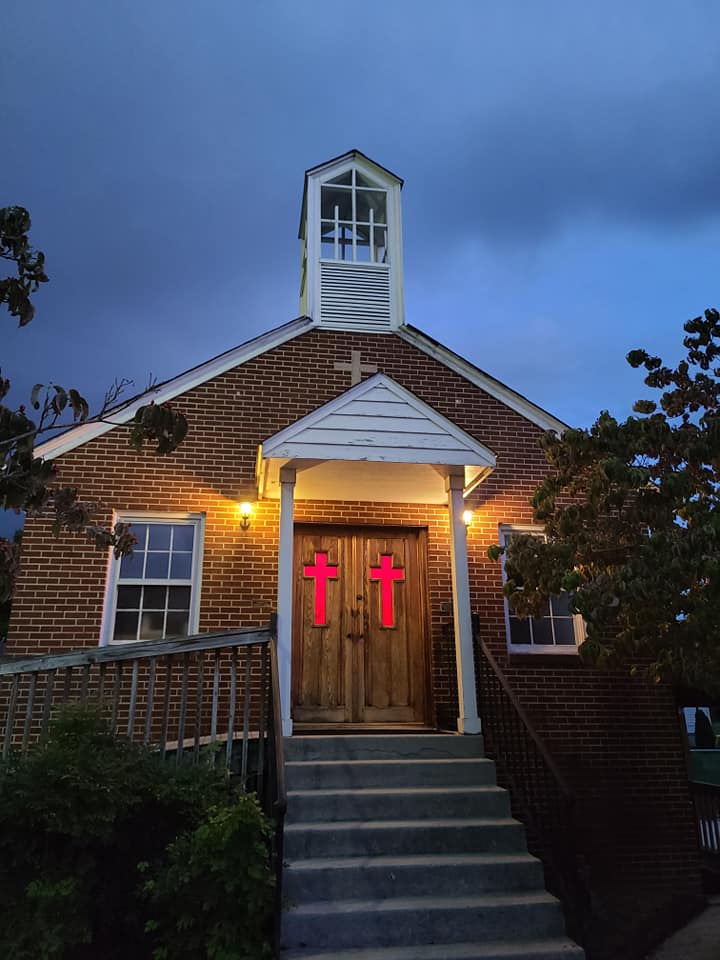
Light in the Darkness . . .
“The Scripture is a banner
before God’s host unfurled;
it is a shining beacon
above the darkling world.
It is the chart and compass
that o’er life’s surging tide,
mid mists and rocks and quicksands,
to you, O Christ, will guide.”
Easter 2026 – Fr Geromel
My own thoughts take me this morning to the story of an Orthodox bishop whose whole sermon was to stand up and say, “The Holy Trinity is a great mystery. We should be grateful for this mystery” and then he sat down again. After approximately fifteen separate services over the last week (as well as the usual number of pastoral visits and other extra conversations with folks), I am likewise tempted to simply get up here and say, “The Resurrection is a mystery for which we should be grateful” and sit down again. Of course, this won’t do. One is expected to get up every Sunday, but chiefly on Resurrection Sunday and say something comprehendible perhaps even brilliant – but I do not feel entirely keen and razor-witted after a full Holy Week. Nevertheless, let’s see what we shall see.
The whole notion of enduring ascetical struggle by going through tons of both elaborate and simple ceremonies throughout the whole of Holy Week does not entirely fit with how churches are supposed to act according to conventional expectations. As I just said, I am expected as a preacher to get up and say something edifying pretty much every Sunday and brilliant at least a fair number of Sundays throughout the year, but especially on high holy days such as today. Of course, one should and it is generally good for all if one does. Sadly one of the reason that one is expected to have a decent sermon is because of the assumption that the congregation must be growing or else it is dying. There seem to be only two possibilities, and, by the way, if your congregation is staying the same size, nope, sorry, since your people are naturally getting older, you lose, you are dying. The only possibility is up, up, up and grow, grow, grow. It reminds one of the quote from Hawthorne that families are either rising or falling in America. So with the families, so with the churches, I guess.
I think I had quite a few guesses right about how ministry was going to be when I entered into it coming up on twenty years ago this June. One thing I never expected was how many people on the streets, new acquaintances, would just up and ask me, after I told them where my church was, “is it growing?” They may have been genuinely curious, and it’s not as if they weren’t willing to give me the benefit of the doubt (all of those thing, I suppose could be behind such a question) but it just seemed like this is what you asked in polite society today about yet another church on the block. But to the early Christians this would have been a remarkably bizarre question. Even for hundreds of years after Christ’s Resurrection and Ascension, that question would seem bizarre to them, from what I gather. Rather, one might ask a Christian other questions like, is your congregation diligent in good works, are they holy, what fasting days do they keep, what do they fast from, even, when does your congregation celebrate Easter? How long was your Lent? I could be wrong, but my study of Church History leads me to speculate thus.
But unlike a tent revival, which for the American church has become like a super sales week in the retail world, the ascetical Holy Week is not there as a super big opportunity to grow your particular congregation – which I do not really think is the only reason for a tent revival, don’t get me wrong. I do believe in the power of God’s Word preached, especially to save; but too often (and I am guilty of this) preaching is about saving someone from one congregation, and about saving them for another congregation. On the other hand, although all church activities are libel to misuse and corruption, an ascetical Holy Week’s goal is to actually try to get into the struggles of Jesus, especially during his final pre-glorified days on earth. It is very much the way of the early Church, which certainly had brilliant sermons (and yet some other ones recorded that, like all preachers on their off days, we still can’t figure out what on earth they were trying to get at) and certainly the early church went up, up, up and grew, grew, grew, but really – really – what we remember them for most was not their brilliant sermons (although that is a definite second) or how awesomely the early church grew (and they did) but how they back then knew so well how to suffer as well.
And here I am obliged to say, as everyone says, Oh, yes, this congregation is growing. Lest you might think the sermon is all there to cover up some inadequacy. But please note that the way we so often to hastily add an addendum, “Oh, yes, this congregation is growing, don’t worry” is similar to the haste and tone we would use to assure people that a congregation was not guilty of some grave moral failing. There may be moral failings involved in failing to grow, there may not be. If there is, fix it; if not, relax. But, again, this was not how the early Church talked about such things. It would be more like, does your congregation have martyrs? Yes. That would be the question on the street, so much so that if you did not have relics of martyrs in your church you were considered maybe not legitimate, it was wondered almost if you were guilty of some moral failing.
And when it came down to it, early Christians gathered around the tombs, and literally celebrated the Holy Eucharist on the caskets of martyrs, literally right there, bread and wine right there on top of dead bodies, not because the fellow Christian was a great preacher and teacher (although that was very often true enough), nor because the fellow could grow a church like today, like wow, look at that, there was a cornfield there last week, now we’ve built a monstrosity in concrete and aluminum duct work with A, B, C, D parking lots, like the mall, so you have to take a pic with your phone so as to remember where you parked (but even here, true, God’s Word can be preached and not return void of what God intends). No, they didn’t gather around the tomb of the fellow Christian because of that, although the fellow in the casket could have built a pretty sizable congregation up, that wasn’t the reason.
The absolute number one reason why the early Christians gathered around the tomb of a fellow early Christian was because that person had suffered and died for the faith – not exactly like Jesus did – but like Jesus to some degree, like a ripple from a pebble dropped in a pond, in some way like the child walking feebly alongside the parent, in such a way the martyr had lived the life and death of Jesus and was now awaiting the same kind of resurrection that Jesus had been the first-fruits of on that first Easter Day. That is why they gathered around the graves of Christians and made the catacombs the place where they preached, taught, eulogized, and offered liturgy, did what we call worship today. We might even say that one of the reasons why the churchyard was for centuries and centuries the same thing as a graveyard and not a parking lot, was not because they hadn’t invented cars yet, but because of this really traditional, bedrock value and principle that where the departed saints slept, is where the living saints ate consecrated bread and wine “showing the Lord’s death till He came again” and where the departed saints slept awaiting the resurrection is where the early Christians very much wanted to worship the Lord of the Resurrection. I might be bold enough to say that in imitation of the women coming down to the tomb early Easter Sunday morning, the early Christians gathered through the night and into the dawn not at the Holy Sepulcher, but at the graves especially of martyrs.
All that said, I’d like to shift, ever so slightly, if I may, to early Christian extra-biblical texts (not that I don’t hold the Bible in the highest regard possible but because of where I am trying to get to this morning). There are some early Christian books, what are called “apocryphal” works, that do a bit what Dante did in his Inferno, his story of a trip he took to Hell, and these books were best sellers centuries before Dante advanced Italian literary history by coming up with all sorts of ways for people to be infernally tormented. One of the earlier ones, known as the Apocalypse of Peter appears to have come out in the middle of the second century, followed by the Apocalypse of Paul, middle of the fourth century. Both stories have Dante-like (long before Dante) trips to Hell to see the torments of the sufferers there. In the Apocalypse of Paul, St. Paul and St. Michael, kneel down and supplicate God for the cessation of torture for those in everlasting torment. So Jesus declares a respite, he says he shed his blood for all those folks in torments, wore a crown of thorns for them, but it availed nothing – yet for the sake of Michael and Paul and for the brethren, the children who keep the commandments, “I grant you in perpetuity . . . a rest of one night, and one day, on that day whereon I rose from the dead.”
In the later story, The Apocalypse of the Mother of God, written not earlier than the reign of the Emperor Justinian, or as it was later known The Pilgrimage of the Mother of God Among the Torments, we see the notion expand to a lengthier period of time – corresponding to the festive 40-ish days that follows the Lenten fast. For the Christians in Hell, a reprieve from torment is declared from Good Friday until Pentecost every year. Now, again, I do not think to give any more credence to all of this than I do to Dante’s eloquent and classic works, but in all of this woven fabrication there are threads of truth, I have no doubt. It is simply not what the tent preachers would call “Bible Truth,” and I am okay with making that distinction.
My point here is that for the early Christians the Resurrection was so important, so life-changing and afterlife-changing, that they could imagine that even Christians condemned to Hell had to celebrate it. Jesus is said to have said in the Pilgrimage of the Mother of God, and while not from the Bible I think these are worthy of meditating on this morning:
“And the Lord said: ‘Listen, all of you! I planted Paradise and created man in my own image and set him to be master in Paradise; and I gave the man and the woman life eternal. But they were disobedient and sinned by their own will, and were delivered up to death. But I did not wish to see the work of my hands tormented by the devil: I came down upon earth and took flesh of a virgin, and raised myself up on the cross to deliver them from slavery and from the primal curse; I asked for water and they gave me gall mixed with vinegar; it was my hands that created man, and they put me into the grave. Then I went down to Hell and trampled my enemy underfoot, I raised up my chosen ones, I blessed the Jordan to heal you of the primal curse, yet you took no thought to repent of your sins; you called yourself Christians, but in words only, for you did not keep my commandments; and for this you are now in inextinguishable fire, and I can do not more to show you mercy. But today, by the compassion of the Father . . . and the prayers of my mother, for she has wept greatly for you, and the entreaty of Michael, the captain of the hosts of Heaven, and the multitude of martyrs, for they have been greatly grieved for you, this is what I shall grant you, who are tormented day and night: from Holy Thursday until Pentecost, … you will have remission; and you shall give glory to the Father and to the Son and the Holy Ghost.’”
None of this may be true, it is not written in the Bible as true; yet all of it may be true, for none of it contradicts the Bible where it says that there is an eternal fire waiting for those who do not repent. None of that “Bible Truth” says that you can’t have a sabbath rest from the torments in Hell in honor of the Holy Resurrection. Nevertheless, I shall end, where I began, by saying that the Resurrection is a great mystery, life eternal is a great mystery, and despite the dreadful and tantalizing mystery of it all, we must be grateful for this mystery. And I shall end with how the text of the Pilgrimage of the Mother of God Among the Torments ends, “Glory be to the Father and to the Son and to the Holy Ghost, now and for ever, and unto ages of ages. Amen.”
Maundy Thursday 2026 – Fr. Geromel
“Then He came to the disciples and found them sleeping, and said to Peter, “What! Could you not watch with Me one hour?” (Matt. 26:40 NKJV)
In the middle of our Lord’s institution of His Supper, we find the disciples getting all excited about the upcoming Kingdom of God, which they likely saw as the restoration of the Kingdom of Israel, excited about good ole Israel, the golden age, being established again. They couldn’t wait. “And there was also a strife among them, which of them should be accounted greatest.” But when it came down to it, they could not even watch with Him one hour, let alone rule a kingdom with Him. Any soldier that cannot stand watch for just an hour is not worthy of the battle, let alone to be a general. And, in fact, the Apostles could not square their shoulders with those who came to arrest Jesus, rather they all fled. Standing watch is a prerequisite to standing and being able to suffer.
This very much reminds me of an earlier incident, when Naaman the Syrian had leprosy. He was a general of the Army of Aram. He could probably keep watch for an hour successfully, but he had the same flaw as we see the Apostles having tonight. He could not wrap his head around the small things that God expected of him for his healing. He was not what we would call a good man, necessarily. He was a man stealer, a kidnapper, like so many of those folks living around Israel. He also had leprosy. But a girl he captured and sent to work as a slave for his wife was an Israelite. She told him about Elisha and to Elisha Naaman went to be healed of leprosy. Elisha was happy to help. He simply asked for Naaman to go wash seven times in the Jordan River. Naaman is offended. It was so simple! Fortunately, his friends talked some sense into him. Those near him told Naaman that if Elisha had asked him to do some great thing, then Naaman would have done it. Elisha didn’t. Elisha only asked him to go and dip seven times in a river. So stop being a doofus and go wash!
The Apostles probably thought something similar. David’s mighty men had gone off and slain giants. They themselves had seen the power of God in healing the sick, casting out demons, Satan falling like lightning from heaven. But Jesus only asked them – that night – to do two things 1) participate in a meal with him 2) watch with him one hour. It was one of those great “hours” of “power” but instead they either argued about who would be on top, who would get a bigger statue in the new kingdom, or fell asleep.
There are many things wrong with the Church today and not just other people’s churches, everyone’s churches. The Lutheran theologian Herman Sasse wrote in 1971, “Every sermon, even those preached in small parishes, has more worth than the conferences in which great ecclesiastical resolutions . . . are discussed.” As he puts it concerning bishops (for him those are bishops of state churches in Europe) “Many things have become attached to the spiritual office through the modern over-organization of the Church, even down to the ecclesiastical-political tomfoolery with which modern bishops squander their own and other people’s time. These amount to no more than ecclesiastical show with no substance.” Such over-organization of the Church, such “tomfoolery” by modern bishops, comes down to the sin of Naaman and the sin of the Apostles on the first Maundy Thursday and our own sin too when we see the stars of prestige overshadowing the tiny candles on the altar. It is the sin of seeing the ways of God as the ways of grandeur, not the ways of littleness. The candles on the altar should always beckon us more than reaching for the stars and dancing with the stars. “The kings of the Gentiles exercise lordship over them; and they that exercise authority upon them are called benefactors. But ye shall not be so: but he that is greatest among you, let him be as the younger; and he that is chief, as he that doth serve.” “Seek ye first…” the little stars upon the altar, and, eventually, in some way, the big stars will be given unto you.
So much of what is wrong with the world, and especially the Church today, is too many people standing around at conferences sipping wine, trying to figure out how to save the world from this that and the other thing. Clergy do it too. It isn’t just politicians and rich widows, celebrities and investment bankers, inventors, etc. Sadly, we clergy can’t just be content mostly to stand watch at the little candles either, we have to seek stardom. But what we are reminded every Sunday – I hope – and especially on this night – instead of standing around, sipping wine, talking about the affairs of today (as if our tiny brains can even come close to fixing it all) – is to kneel down, strike your breast, cross yourself, sip some wine, and let God save the world, from ourselves.
“Then He came to the disciples and found them sleeping, and said to Peter, “What! Could you not watch with Me one hour?”
Palm Sunday 2026 – Fr. Geromel
In my “mercifully short sermon” for Palm Sunday, I’d like to reflect a moment on David versus Goliath. Much ink and children’s art has been spilled in retelling the old story, and so I assume you know it well enough. In today’s context, we might liken David to a young man, perhaps a teenager, who likes to sit out with the sheep, or cattle, or goats, whatever you’d like (we might even say he likes to feed the chickens). Perhaps he likes to spend time out there because the wild and the outdoors is music to his soul and helps him to compose music. Indeed, unlike his brothers, he is to be found out with the livestock and the quiet. We can imagine him as carrying with him perhaps a BB gun, or a .22 caliber rifle, not much more than that to fend off wild animals, but, spending time out there as boys do, he gets pretty good at this activity. But when he must be among others, he is useful. He earns extra money delivering door-dash (this is because he is said to have gone to the battlefield to deliver cheeses to his brothers). We might say he volunteers to play his guitar (he’s a bit of a poet and musician don’t you know, maybe a singing cowboy he practices out on the livestock). But, in fact, he volunteers as well as a music therapist, and is sought after by the king who has, well, anything from melancholy, to mental illness, to demonic oppression. Indeed, he is such a good music therapist that some find he almost has the skills of an exorcist to keep away evil spirits. Such was the boy, David.
What of is adversary, Goliath. With whom shall we liken that giant fellow today? Let us imagine, that a boy such as we have described in a single combat took out (with a BB Gun – which can be effective if the BB goes through an eye, or as with one boy I knew through his temple – or with a .22) fell Osama Bin Laden or the younger Ayatollah, or the leader of North Korea, or whichever bogeyman we find on the news today. Is it an apt analogy? It is, because we, in fact, find that these Canaanites, and Amalekites, and Philistines, were the terrorists of their day. Take for instance, in the time of Saul, “Then Nahash the Ammonite went up and besieged Jabesh-gilead; and all the men of Jabesh said to Nahash, “Make a treaty with us, and we will serve you” (1 Sam. 11:1 RSV). The answer? “On this condition I will make a treaty with you that I gouge out all your right eyes, and thus put disgrace upon all Israel.” In the time of Saul, “there was no smith to be found throughout all the land of Israel; for the Philistines said, “Lest the Hebrews make themselves swords or spears” (1 Sam. 13:19 RSV) so there was an arms race. And we are given good proof of the kind of terrorism when we read, of Samuel slaughtering Agag of the Amalekites saying, “As your sword has made women childless, so shall your mother be childless among women.”
We might ask why he chose five stones from a brook. I could not find that the church fathers delve into this. That the stone that David used to fell Goliath is likened to the Rock of our Salvation, Christ, is a well-known allegory from the church fathers. Augustine says, “Taking from the torrent’s bed five smooth round stones, he proved that, even amidst all the eddying currents of the world, his feelings were free both from roughness and from defilement.” Fair enough. But why five? Given what Augustine has said, we might be tempted to liken the five stones to some kind of virtues. Traditional Christian virtues come in Seven, four cardinal virtues from pagan philosophy adopted by Christianity, namely by Ambrose and Augustine: Temperance, Justice, Prudence, Fortitude” and three theological virtues that we find from St. Paul, “Faith, Hope, and Charity.” But these are seven (or four and three) not five. Although virtues do help overcome “roughness” and “defilement” as we can overcome Pride with Humility, Lust with Chastity, etc. We do find five from Confucian philosophy, or rather, eight, a combination of Three Fundamental Bonds and Five Constant Virtues. And since none are opposed to Christianity, and since our own four cardinal virtues were preached by pagan philosophers before they were preached by Christian priests, I might as well recount them here for your edification. The five most important virtues in Confucianism are benevolence, righteousness, propriety, wisdom, and trustworthiness. But I do not think the five stones represent five virtues.
I found on the internet several possible reasons for five stones. Some say “Faith and Preparation” that, while David trusted God, he also did not tempt God by presuming too much for a miraculous one shot win, or being prepared for future battles. What if the Philistines had rushed the field in anger at the defeat of their champion rather than turning and running? One symbolic possibility is that the number five can represent grace, strength and protection. The most interesting one was because Goliath had four brothers. In fact, David and his loyal retainers took out all four brothers eventually.[1]
We might be tempted to think of the five stones as the five minor sacraments. It is presumed that David was both circumcised and participated in the Passover, so he participated in the forerunners of the two dominical or major sacraments of Baptism and the Lord’s Supper. So what of the minor sacraments of confirmation, confession, healing unction, marriage, ordination? While the stone is usually said to be Christ, it does hold a sacramental significance because each Sacrament theoretically has a vow associated with it, and before fighting Goliath, David made an oath, “I will strike you down, and cut off your head; and I will give the dead bodies of the host of the Philistines this day to the birds of the air and to the wild beasts of the earth; that all the earth may know that there is a God in Israel.” And yet, No, the five stones do not likely represent these or any sacrament. Let us try this: Perhaps the five stones represent the five kinds of prayer. While the Catechism in the 1979 Book of the Episcopal Church names seven “principal kinds of prayer” “adoration, praise, thanksgiving, penitence, oblation, intercession, and petition”[2] the Catechism of the Catholic Church names five, Blessing and Adoration, Prayer of Petition, Prayer of Intercession, Prayer of Thanksgiving, Prayer of Praise.[3] Indeed, this matches nicely with what Augustine said, “Taking from the torrent’s bed five smooth round stones, he proved that, even amidst all the eddying currents of the world, his feelings were free both from roughness and from defilement.” It is very much through a life of prayer that from roughness and defilement our feelings become free – although through the Sacraments too, which are filled with grace, help of with this.
Now, I’ve gone through these possibilities in sort of the way a medieval theologian would and I hope it was interesting and instructive, even if a little pedantic. It is always good to be reminded of the virtues, and the sacraments, and the kinds of prayer. But I don’t want you to think that I would presume to say what God in His authorship of His own Blessed Word intended to symbolize with five smooth stones being picked out of gurgling creek bed. No, these things are helpful only to draw our minds to meditation but not to fix what God in his secret counsel means when He tells us that David had five stones in hand.
I want to turn in closing to the sword of Goliath, because it was not the stone that killed Goliath. The stone that sunk deep into his head only that only felled him, it did not kill him. It is true that through the life of prayer, and the life of grace, we can fell our spiritual adversary, the devil, represented in this story by Goliath (if you consider his armor, especially his helmet, it looks very serpentine, serpent like); we can turn to flight his minions, the spiritual evil angels, represented in this story by the host of Philistines, who were all, in fact, led on to attack the armies of the Living God through no doubt demonic influence. But we cannot really kill our spiritual adversary. It was through the sword of Goliath that Goliath was killed, and there are all sorts of biblical quotes that we can assemble about people falling into the trap they made for others, etc. It is really interesting that David would not wear Saul’s armor into battle. It wasn’t made for him. He would not trust in it. But he could take up the sword of a giant and chop off a giant’s head. That I find really interesting. And we seem to draw spiritual strength from this reality in a multi-faceted way that I will leave you to ruminate on throughout this Holy Week.
It is said that if the stone represents Christ, the sword represents the Cross. The Cross is what the Devil trusted in to kill Christ. It was the sword that Goliath trusted in to kill David. But it is the sword that was the decapitation of Goliath, and the Cross was the termination of the capital power of the Devil. All we have after the Triumph of the Cross is the twitching of the tail, the spastic death throes of the legs. This week we recount that glorious story, over and over again, in the Passion Readings of great David’s Greater Son, crushing the head of the serpent, Satan, and then cutting off Satan’s head, with a Cross.
[1] https://bibleask.org/why-did-david-need-five-stones-to-face-goliath/
[2] 856.
[3] 2626-2643.
Lent 5/Passion Sunday 2026 – Fr. Geromel
“ye are come unto mount Sion, and unto the city of the living God, the heavenly Jerusalem, and to an innumerable company of angels, To the general assembly and church of the firstborn, which are written in heaven, and to God the Judge of all, and to the spirits of just men made perfect, And to Jesus the mediator of the new covenant, and to the blood of sprinkling, that speaketh better things than that of Abel.” Hebrews 12
Perhaps it is the weather lately – feeling a bit more February than March of late – but for some reason, when reading the lessons for Passion Sunday this year, my mind was turned to Groundhog Day, the film with Bill Murray where a weatherman, arriving in Punxsutawny, Pennsylvania, for Groundhog Day, finds that the day keeps repeating itself, over and over, until the main character gets it right and gets the girl, romancing her the right way and getting a new attitude.
I suppose that my mind went to this film because of the fact that the sacrifices according to the Law of Moses were daily, or yearly. The priests offered sacrifices on a rotation, according to courses, and, so, the same priests didn’t need to do this year in and year out. There were times when they got to do it. I suppose it didn’t get old in that sense, but if you stayed in the Temple, it was a bit like groundhog day, the same thing happened everyday. Then once a year, big stuff happened like the high priest going into the holy of holies yearly. So in that sense, our Epistle lesson reminds me of Groundhog Day.
Likewise with our Gospel lesson. It too reminds me of Groundhog Day. There are two ways of looking at how the world turns – if you will allow the phrase. There is the Eastern or Asian worldview and then there is what we might call the Abrahamic one. The Asian worldview is a bit like Groundhog Day – one is reincarnated, yes. But also in Hinduism creation and the destruction of the world repeats itself, starting all over again and we, if I understand the paradigm correctly, will all be sitting here billions of years from now, you in your pew and I in my pulpit, listening to this exact same sermon. It’s all a bit like Groundhog Day.
We can say that the main character played by Bill Murray in Groundhog Day is resurrected each morning. In fact, at some point he starts trying to end his life, but he just wakes up again on the morning of February 2nd, in Punxsutawny, Pennsylvania, circa 1993 and lives the day all over again. That isn’t quite Resurrection. That’s more like Reincarnation. It isn’t until the end of the movie, when he wakes up and it’s February 3rd that he is really resurrected. He is resurrected to newness of life. He is now getting somewhere. He has now gotten off, as the Asian philosophies would say, the wheel of life. In our Christian worldview, Resurrection Day is sometimes called the 8th Day, and the world has leapt forward from a 7 Day week to a new rebirth.
We might say that the blood of bulls and of goats in the Old Testament just got us more sacrifices with bulls and goats. It took Jesus to get us somewhere. The Temple kept sacrificing as the sun rose and set and the Jewish people, in a sense, didn’t get anywhere. Of course, the Abrahamic worldview isn’t cyclical, it’s linear. For Jews, Christians and Muslims, the world is headed someplace definitive. It is headed towards the Resurrection of the Dead. For us it comes with the return of Christ, for Jews with the arrival of the Messiah, and for Muslims, well, they have their own view about how the end of the world all comes about. But for all three we are headed somewhere, we aren’t just chasing our cosmic tails off.
Yet it feels so often that we are, in fact, working our tails off, chasing our tails, in this cyclical Groundhog Day. The alarm goes off each morning. The coffee smell wafts into our nostrils. The aroma is followed by the warm feeling of it on our tongue and down our throats, the taste of the toothpaste, the feel of the toothbrush, and out the door we go – whether to work or to our school or to our retirement recreations and duties. The paycheck goes in. The paycheck slowly evaporates, or quickly evaporates. It just keeps going on and on, our lifeblood draining out as time marches on. Is it going anywhere? Except inside a box and down in the ground?
Christ’s words ring out to us today, God is the God of the Living not of the Dead. These are words of life, not a message of death, not a message of uselessness, of futility. It is true as St. James tells us that life is a vapor, or as Isaiah tells us that life is grass, the grass withers, the flower fades. But what does Isaiah tell us further? The Word of our God remains – it is a Word of Life, of Resurrection. The words should be an encouragement! But for many it is not. The Pharisees tried to throw stones at Christ in today’s Gospel lesson with a message of death, with murder (fired up with self-righteousness) in their hearts. Next week we are told that if the children of Israel did not shout for joy at the Messiah’s entrance into Jerusalem, the rocks would sing out for them. It is the message of Life that brings the deadness of stones to the point of singing out.
So if it is such a wonderful, wonderful, message, why did the Pharisees try to pick up stones and kill the Lord of Life? Supposedly for blasphemy, of course. But it is really because of exclusivity. “Who makest thou thyself?” “Who do you think you are?” Jesus made a claim of exclusivity. “Before Abraham was, I am.” He did so in the Temple. The Temple was the place of exclusivity for the Jews – that it was the place where God heard you, where God was present. It was place where atonement for sins was made, where the Resurrection to Life was procured, taken hold of. If Jesus could take that from them, then what did they have? If His message of Life was true, the Pharisees had to have Jesus not what they already had, the blood of bulls and of goats, the sprinkling of an heifer. When people think they have something, and find out they don’t quite have it – not in the way that they thought they did – they get kinda mad.
People today think self-righteously just as much as the Pharisees in the past. They either think that they have it all through having perfectionism, or they think they have it through being nice, being sincere. Perfect performance of the prescribed rituals won’t get you there. Just meaning well won’t get you there either. What gets you there? What gets you to life eternal? Jesus’ blood and righteousness. All the rest is sinking sand. On that you’d better make your stand. Of course, for many of us this is new nothing new. It’s all old hat to many of us. We’ve probably heard it, and the hymn, since we were kids. The answer at this point is, do we really believe it. It’s a great question. It’s a daunting question. It’s a question that leads to, well, fear and trembling, and at times, when we need a little shaking up, it leads to getting us to question it all and that can be helpful, but it can also undo our faith. Because, if it is all about how much we really believe it, then it’s all about us. It ceases to be about Jesus’ blood and righteousness. We fall into the sinking sand, the quagmire, of do we really believe it? We might just as well ask if we are truly perfect, or truly trying to be perfect. We might as well ask ourselves am I really, and truly, sincere. It becomes all about us.
You see, all three of these things are things we bring to the table – our feigned perfection, or our sincerity, or our sincere attempts at perfection, or our pathetic, insignificant, faith. If we really want it, there’s a sense in which we don’t bring to the table anything. To say we “take our stand” is a poetic phrase with a logistical error. It rhymes well with “sinking sand” but what the hymn really means is, not taking a stand, but taking a knee – “I fall to my knees with nothing in my hand” as in another hymn we know well, “nothing in my hand I bring, simply to thy cross I cling.” Even the idea that we can “cling” to anything is a bit anthropocentric, man centered. We don’t have any faith worth having. It is the faith that has us. We don’t have hands that can grasp and hold onto the cross. The hand of God holds us, even holds us, we might say, above the flames of hell.
And yet, all that said, our daily experience is that we do make a stand for Jesus, we do take a knee before Jesus, we do plead the blood of Jesus, we do cling to the cross. And in all of this we must rely on Grace, and rely on Grace, and rely on Grace, and rely on Grace. If I say to myself, do I really, really, believe this stuff? I’ve then taken my eyes off Grace, and put my eyes on myself. We have taken our eyes off of Jesus, and looked down at the swirling tempestuous water beneath our feet. It is Grace that holds us fast, we do not take hold on Grace, grace takes hold on us. But, again, having said that, do the things that are grace-filled actions.
One further point comes to my mind as we enter this Passiontide 2026. It’s from another hymn. “Were you there when they crucified my Lord?” It’s a great hymn. And it asks a rhetorical question and expects us to answer “yes!” But how could you be? How could be present at something that happened two-thousand years ago? Well then, how can I plead the blood of Christ at all? All the spilled blood of Christ seeped into the ground in Jerusalem, and especially on Golgotha two-thousand years ago? How can we plead it? It is through something almost magical that we describe with a Greek word, “Anamnesis”. It means commemorating, but more than that, it makes real and present what is remembered effectively. So that when we ask the question, “Were you there when they crucified” him, you can answer “Yes!” because you commemorate Him, especially in the Holy Eucharist. You remember His death, not like you remember that trip you took last year. It’s present and effective today. If the Eucharist today, with bread and wine, is commemorative of this crucifixion and this spilled blood, then the “blood of bulls and of goats” is what we might call pre-memorative, in the Old Testament. It pleaded the blood of Christ, and made present the crucifixion, in a sense, beforehand. So the Jews too who lived before Jesus could say from heaven, “Yes!” when asked if they were there when Christ was crucified. They were there in the pre-memorative sacrifices, just as you are today in the midst of a commemorative offering of bread and wine. It’s really fascinating.
And so, although it may have felt like Groundhog Day years ago, with this daily routine of morning and evening sacrifice in the Temple. It was getting the Jews somewhere. It may feel like Groundhog Day in our daily reasonable offering of ourselves to God and our neighbors in a service. But you aren’t not going anywhere. Indeed, you are already there.
“ye are come unto mount Sion, and unto the city of the living God, the heavenly Jerusalem, and to an innumerable company of angels, To the general assembly and church of the firstborn, which are written in heaven, and to God the Judge of all, and to the spirits of just men made perfect, And to Jesus the mediator of the new covenant, and to the blood of sprinkling, that speaketh better things than that of Abel.”
Lent 4 2026 – Fr. Geromel
This Sunday, known as mothering Sunday, is one of those refreshment Sundays, signified by rose colored vestments – a mid-Lent refreshment. We have the same in Advent, a rose Sunday, a refreshment Sunday. Our Gospel lesson today reflects this refreshment. Those who are on their pilgrimage, following Jesus, fasting in the wilderness, going up high on a desolate mountain. We are in our pilgrimage, following Jesus, fasting out in the wilderness, climbing up, pressing up the hill of holiness with noble emulation. Fasting puts things in perspective. It makes things seem relatively better. The food tastes better than it did before, if we don’t have food. Barley loaves are not something that we would normally look forward to, unless we are fasting. I’d rather have bacon and eggs than a bran muffin. I’d even prefer a blueberry muffin to a bran muffin – not that I positively hate bran muffins. But if I am hungry, a bran muffin tastes better than nothing at all. So, relatively speaking, the barley loaves feeding for five-thousand people out in the wilderness, on a mountain, was a refreshment.
What would be a refreshment to you now, in the midst of your Lenten discipline? Go ahead and go for it today. But don’t go crazy, maybe. Think barley loaf not filet mignon.
Another way that we can reflect on refreshment Sunday is the phrase, “Now there was much grass in the place.” What does that mean? Why is that noted in God’s Word written? It points us to Psalm 23, of course, that the Lord makes us to lie down in green pastures. But we are also reminded that there wasn’t grass everywhere. It was the wilderness, but it was also close to the feast of Passover, which means it was in the Spring. Even in the wilderness, there is grass in the springtime. I remember when I was in northern Texas how green the grass was in the spring. The grass was brown in summer, fall, and winter, but bright green for a short while in the spring. I remember a coworker from El Paso commenting on how beautiful it was. Well, relative to way down south in El Paso, Dallas is beautiful in the Spring. But to the rest of us, from elsewhere in the country, maybe not so much.
What kind of a place would be a refreshment to you today, in the midst of your Lenten discipline? Is there a nice park to go to? A pretty place to go for a walk?
Another way we see relative beauty today is in the miracle that Our Lord wrought today. There are miracles everywhere. We hardly ever see them. But there are also extraordinary miracles. St. Augustine said this, “…God has reserved to Himself acts, beside the established course and order of nature, to do at suitable times; in order that those who overlooked the daily course of nature, might be roused to wonder by the sight of what was different from, though not at all greater, than what they were used to. The government of the world,” he says, “is a greater miracle, than the hunger of five thousand with five loaves; and yet no one wonders at this: the former excited wonder, not from any real superiority in it, but because it was uncommon.”
We can see a consistency of thinking between Augustine here and Bishop Joseph Butler (1692-1752), and his classic acclaimed work against the Deists which came out in 1736, The Analogy of Religion. In his defense of Miracles he says, “[S]uppose a prince to govern his dominions in the wisest manner possible, by common known laws; and that upon some exigencies he should suspend these laws, and govern, in several instances in a different manner: if one of his subjects were not a competent judge beforehand, by what common rules the government should or would be carried on, it could not be expected that the same person would be a competent judge, in what exigencies, or in what manner, or to what degree, those laws commonly observed would be suspended or deviated from.”[1]In other words, we do not know enough about science to say that something is outside of the realm of possibility because our understanding of the rules of the Universe are so scanty, but all we can say is that something is uncommon. Or as Butler puts it, “If [such a subject i.e. us] were not a judge of the wisdom of the ordinary administration, there is no reason to think he would be a judge of the wisdom of the extraordinary.[2]
And then let us see the clear line from Augustine and Butler eventually following through to C.S. Lewis in his Miracles book (and this book we are probably far, far more familiar with than Bishop Butler, although Bishop Butler’s book, rarely given more than a passing nod to, was so influential in the two centuries before C.S. Lewis that it is remarkable we know so little about it.) Here is a quote from Lewis that follows naturally from the previous statements by Augustine and Butler, “Experiment finds out what regularly happens in Nature: the norm or rule to which she works. Those who believe in miracles are not denying that there is such a norm or rule: they are only saying that it can be suspended. A miracle is by definition an exception. How can the discovery of the rule tell you whether, granted a sufficient cause, the rule can be suspended?”[3]
So as we maybe go to a nice park, with some nice green grass, maybe we think about the miracle of creation, the miracle of green grass, pretty flowers, and think about how much more of a miracle this is, how easy this all is for God to do – and this should be a refreshment to us.
In this midst of such a reflection, we should also think about how easy it is for God to work on us, if we would let Him. How easy it is for God, who created Heaven and Earth to do a miraculous work on us, if we would let Him. What are our sins that we are trying to work on this Lent? How hard it is for us to uproot those sinful habits. How easy it is for us to feed those sinful habits. How easy it is for us to find a nice green grassy patch, a comfy place, to settle our sin and live in peace with our sinful habits – even at the expense of living at peace with our neighbors.
In our Epistle lesson today, we are reminded by St. Paul recounting the story of Abraham having to choose his lawful wife, Sarah, over his unlawful mistress, Hagar, “Cast out the bond-woman and her son; for the son of the bond-woman shall not be heir the son of the free-woman.” We are reminded in the story about the distance and the difference between Jerusalem’s Mount Zion, which is, symbolically, what we call “free”, and Mount Sinai, out in the wilderness, where God met His people, and bound, enslaved so to speak, the Hebrews to the Law of Moses, because of sin, because of their idolatrous hearts, because of the hardness of their hearts. Mt Sinai is far from Jerusalem. Even further can God, miraculously, set our sins from us and set us apart, starve out, and dehydrate our sinful habits. It is as easy as creating heaven and earth. He who created us can create in us a new heart.
So, being refreshment Sunday, I shall end there, with what Fr. Edmunds, one of the priests in our diocese, might call a “mercifully short sermon.” The saying is, “a change is as good as a rest.”
[1] Butler, The Analogy of Religion (New York: Mark H. Newman & Co., 1848), 164.
[2] Ibid.
[3] C.S. Lewis, Miracles (New York: Touchstone, 1996), 63.
Lent 3 2026 – Fr Geromel
There is a story of the Viking siege of English town of Chester in 907. The old Roman walls of Chester were very well-built and strong, and the Vikings started to dig underneath the walls. First the Anglo-Saxon inhabitants threw stones down, so the Vikings braced up the structures overhead while they kept digging under the walls. Then the Anglo-Saxons, under their Queen’s direction, boiled all the water and ale they could and put it down on the siege structures. That worked a bit, but then the Vikings just put hides on top of the roof of their siege structures, and this stopped the problem, and they kept digging. Finally, the Anglo-Saxons threw beehives on top of the siege structures, and this finally worked. It turns out this was an old warfare tactic used by the Romans years before. The Vikings went away. I am reminded of a scene from Indiana Jones and the Last Crusade, where Indiana Jones’ father, Dr. Henry Jones, played by Sean Connery takes out a German plane by scaring some pigeons into the plane and says, “I suddenly remembered my Charlemagne. Let my armies be the rocks and the trees and the birds in the sky…” The bees were humble, but effective.
We can learn from this that Courage is one thing. But that’s not enough. You have to bring the right equipment to the fight. The comparison between real life war and our Gospel lessons is probably clear to everyone, but let us make it clearer. N.P. Williams (1883-1943) the Lady Margaret Professor of Divinity at Oxford from 1927 until his death, stated in a sermon preached at St. Alban’s, Holborn, in 1924, “For the Christian who takes the Sermon on the Mount seriously, earthly war, considered absolutely and in itself, must always be an utterly bad and hateful thing, and even a just war can only possess that kind of relative and accidental goodness which may be attributed to a lesser evil when compared with a greater.” And again, “. . . earthly wars are broken flashes and reflections, partial manifestations in time, of the vast cosmic war between God and the rebellious spirit-world which will only end with the consummation of all things.”[1]
The third, fourth, and fifth Sundays in Lent, in the modern and ancient Western Church are Sundays when the “Scrutinies” are often administered. The scrutinies are examination and prayers of exorcism that lead up to adult baptism, or at least confirmation at Easter. What I hope we can do today is scrutinize ourselves a little bit. What I want us to focus on is 1) what sins have we yet to fully exterminate in our lives? 2) specifically, in what ways do we have only the moral high ground in our fight with evil instead of the spiritual high ground.
Jesus spoiled the Devil’s goods and divested the Devil of his armor in today’s Gospel lesson. We are talking here about superior weaponry and superior armor. Jesus speaks today about breaking into His own house and taking back that which was stolen from Him. In other words, it is really the sort of thievery that the police do when they go in and confiscate stolen property. To the thief, the police retrieving stolen property is a sort of thievery, but whose was the property to begin with? God’s, His Who created all things
There is no question that God gave us this world and our bodies. And that the Devil has come down (having been beaten in a war in heaven) knowing he has a short time to steal on earth. There is no question that what is ours is God’s and He has graciously, generously and abundantly lent it to us, our bodies/souls and this world. When the Devil holds us captive in our own world and in our own bodies, Jesus is more than happy to come with greater weapons and take away that in which the Devil trusted. Indeed, we can go further. We are enabled, it is our duty, to defend that which God has loaned to us, this world and our bodies and souls. Even if we are prisoners of war, it is our duty to escape our captor.
Taking this and applying it to ourselves, we must scrutinize ourselves a bit. Back to the war analogy: It is good to have superior arms and armor but also better to have the right on our side, so we can say, “God defend the right!” We often say this when we think we have the moral high ground. The difficulty is we are all so morally complicated, and we can’t claim the high ground unreservedly. So, I have no problem defending Just War Theory so far as it goes. But not unreservedly! No country is completely on the moral high ground, just like each of us individually. But we can, possibly, have the spiritual high ground and that’s better.
There’s a story from the Book of Acts. “Then certain of the vagabond Jews, exorcists, took upon them to call over them which had evil spirits the name of the Lord Jesus, saying, We adjure you by Jesus whom Paul preacheth. And there were seven sons of one Sceva, a Jew, and chief of the priests, which did so. And the evil spirit answered and said, Jesus I know, and Paul I know; but who are ye? And the man in whom the evil spirit was leaped on them, and overcame them, and prevailed against them, so that they fled out of that house naked and wounded” (Acts 19:13-16). By the very thing that happened, we can probably guess that these were some who were not with Jesus, so they were not gathering but scattering. Why? Because they spoke lightly of Jesus. Remember Jesus said, “there is no man which shall do a miracle in my name, that can lightly speak evil of me.” Somehow, they spoke lightly of Jesus “We adjure you by that Jesus guy whom Paul talks about”. Instead, perhaps they should have said: “We adjure you by Jesus, the Son of God.” That gathers, not scatters. They had, perhaps, the moral high ground in the fight, but not the spiritual high ground. They lost. We should be careful. Many might say, I have the spiritual high ground when they mean I have the moral high ground. The spiritual high ground, beloved, is the way of humility. Too often, when we get sins out of our lives, we become morally superior, feeling as if we have the high ground. This is inviting seven other spirits more wicked into our lives, the chief of which is spiritual pride, the opposite of spiritual humility.
To bring all this home, I’d like to give two examples. The first is the movie, The Untouchables, starring Kevin Costner, Sean Connery, Robert De Niro, Andy Garcia. In it, Malone, played by Sean Connery, the veteran Irish constable, who makes it clear to Eliot Ness, played by Kevin Costner, that if he is going to take on Al Capone, the great Chicago land gangster, he has to prepared to go all the way. There are no half measures in this fight. You have to complete the whole process. We do too. We have to commit to scrutinizing and exterminating.
We also have to have the spiritual high ground, not just the moral. I rewatched the movie after thinking of using it as a sermon illustration. There is no question that Malone has the moral high ground, feels morally superior, but he does not have the spiritual high ground – despite being a religious man. For example, he feels superior as an Irishman towards Italian Americans and calls them all sorts of names, and kills when he should not. This is his undoing. When an Italian mobster comes in his home with a knife, he pulls out his sawed-off shotgun and goes off contemptuously and racially, “Isn’t that just like a wop. Brings a knife to a gun fight.” It’s his undoing. The knife fighter draws Malone out of his door where his sawed-off shotgun, good for home use, is no use. A Tommy Gun takes him out from a distance in the doorway. But we see Malone, having been humbled, reaching for his St. Jude medal in his final moments and reaching for the spiritual high ground. How often does our spiritual adversary trick us, getting us to trust in the moral high ground not the spiritual high ground?
If you see the famous train station gunfight in The Untouchables, it is interesting. The gun fight plays out in a very different way because Eliot Ness, Kevin Costner, goes down the steps to help the mother up the stairs with her stroller and the toddler in it. If you watch carefully, it would have gone much differently if he had stood on the high ground and challenged the gangsters as they came into the train station with Al Capone’s bookkeeper. One should watch these scenes carefully. The details are not incidental. Humility won the day.
My second and final example: Fr. Arthur Tooth, SSC, (1839-1931) helped found the Guild of All Souls, died on March 5. An Anglo-Catholic in the Church of England, after becoming the vicar of Hatcham St. James in South London, within five years he had introduced things now common among us, but novel and hated then, the priest facing east at mass, lighted candles, water and wine (not just wine) in the chalice, vestments, wafer bread and incense. His preaching attracted large crowds. He started a choir school, and orphanage for boys, and the Sisters of the Holy Paraclete. In March, 1876, legal proceedings were leveled against him for his new practices, as well as genuflection, elevation of the Host at mass, and making the sign of the cross, and singing the Agnus Dei. In July of that year, he was found guilty, but Fr. Tooth did not defend himself, refusing to recognize the authority of the court. The Bishop sent his chaplain to conduct services, and was met not by anger. Instead, Fr. Tooth politely replied that he did not mean to give offence to a fellow priest, but he was the priest and would celebrate the service. Then, after Christmas Day, there were riots organized and paid for by the leaders of the Protestant Truth Society, to disrupt services. In response, Anglo-Catholics came from all over to support him. Fr. Tooth had to be conducted to the vicarage by a bodyguard of faithful men. The windows of the church were broken, the church doors broken down, and members of the congregation assaulted. And this disgraceful behavior by those who called themselves Christians, continued each Sunday for a month.
On 22 January, Fr Tooth was arrested and imprisoned for nearly a month. He then went abroad to recover his health. Returning to his parish in May, he found his church locked against him but in through a window he went and celebrated Mass. He continued on until 1931, helping to bring about the revival of the shrine of St. Thomas A Beckett at Canterbury, and speaking in 1920 at the first Anglo-Catholic Congress in Albert Hall. Of him, the great Fr. Stanton, said, “No one could have been in his company or heard him preach without realizing his deep spirituality. The heavenly things were always present; he was at once a mystic and yet of practical mind. He was a holy man who lived in the constant companionship of the Angels and the Saints. Every material beauty reminded him of the beauty, the glory, and the peace of God. He was a lover of the poor and the outcast, and someday the Church of this country will recognize him as a saint.” But I want us to note two things. 1) how he did not leave off the fight until the fight was won and 2) how he did not take the moral high ground but the spiritual high ground, that of peacefulness with all men and divinely enabled humility. May we all come to share in that same spirit of thoroughness, personal scrutiny, and humility this Lent. Both Malone, in The Untouchables, and Fr. Tooth in real life, had their homes invaded – Fr. Tooth his home church anyway. I am not saying don’t defend your home with a sawed-off shotgun. I am saying, if you do so, do it with humility, like Fr. Tooth. Take the spiritual high ground of humility. That’s your indestructible weapon. Don’t just trust to your sense of moral superiority.
[1] Eric Waldram Kemp, N.P. Williams, 101.
Lent 2 2026 – Fr Geromel
Therefore I will judge you, O house of Israel, every one according to his ways, saith the Lord God. Repent, and turn yourselves from all your transgressions; so iniquity shall not be your ruin. Ezekiel 18:30
When I was in middle school or early high school, I didn’t want to be a priest (actually I probably always wanted to be a priest). I was living a bit of a fantasy. I wanted to be a fur trapper. My father was kind enough at that time to ask a local furrier to let me come to his shop and play around with sewing fur together, doing little jobs for him. But the trapping part, and the skinning part, I had no experience with. One Michigan winter, there was a dead rabbit out in the snow outside my dad’s church. My Dad produced a knife and said if I wanted to be a fur trapper I should go try to skin the rabbit. So I am out there in the snow, no idea what I am doing. I don’t think the knife was sharp enough. I remember trying to get through the skin on the breastbone but slipping down it was just so easy to get through the skin around the belly. Oops. I punctured the bowels. I couldn’t get the image out of my mind for the days or the smell of all that mess for days either.
I had this quote last week from P.T. Forsyth, who said, “Both (Church and State) are divine agents for human perfection. But the one by way of conscience and redemption. The State does not exist to make men good, the Church does. The State to secure the conditions of goodness, the Church to create the thing itself . . .”[1] What I want to talk about a little bit this week – again – is our job in the Church, and in Lent, rather than that of the State.
[1] The English Church: A New Look, 14.
I had this quote last week from P.T. Forsyth, who said, “Both (Church and State) are divine agents for human perfection. But the one by way of conscience and redemption. The State does not exist to make men good, the Church does. The State to secure the conditions of goodness, the Church to create the thing itself . . .”[1] What I want to talk about a little bit this week – again – is our job in the Church, and in Lent, rather than that of the State.
When we see the government, with all its apparatus, it is like the furrier. They are sewing together skins to make a covering for man, to cover his nakedness, to keep him warm, keep him sheltered, like Adam and Eve after their transgression in the Garden of Eden. The work of the Church, however, is much harder. It is the work of cleaning out the dirtiness of the bowels, the stinky-ness of sin. Our Epistle today says, “that every one of you should know how to possess his vessel in sanctification and honour; not in the lust of concupiscence, even as the Gentiles which know not God.” Think of the “vessel” as like a fur coat. If you get putridness all on the inside lining of the fur coat, what good is it when you take it out for a night on the town? What good is it to keep you warm? It will do the task, but why would you want it to? Our Epistle lesson today says, “God hath not called us unto uncleanness, but unto holiness.”
There are parallels between our Gospel lesson today and an incident that happened to Peter in the early days of the ministry of the Apostles after Christ’s Ascension. It was when Peter was staying with Simon the Tanner. What is a tanner? Someone who makes leather. What is leather? Well, the definition of leather which is famous for having to be memorized by cadets over decades goes: “If the fresh skin of an animal, cleaned and divested of all hair, fat, and other extraneous matter, be immersed in a dilute solution of tannic acid, a chemical combination ensues; the gelatinous tissue of the skin is converted into a non-putrescible substance, impervious to and insoluble in water; this, sir, is leather.” That was fun. But the story of Peter goes: “Peter went up upon the housetop to pray about the sixth hour: And he became very hungry, and would have eaten: but while they made ready, he fell into a trance, And saw heaven opened, and a certain vessel descending unto him, as it had been a great sheet knit at the four corners, and let down to the earth: Wherein were all manner of four-footed beasts of the earth, and wild beasts, and creeping things, and fowls of the air. And there came a voice to him, Rise, Peter; kill, and eat. But Peter said, Not so, Lord; for I have never eaten any thing that is common or unclean. And the voice spake unto him again the second time, What God hath cleansed, that call not thou common. This was done thrice: and the vessel was received up again into heaven” (Acts 11: 9-16). Peter took this as an indication that the Gentiles, despite, as the Epistle lesson today says, possess their vessel in the lust of concupiscence – that is, the inclination to evil – they needed salvation through Jesus Christ. This should have been no surprise to Peter if he had been paying attention to Jesus healing the daughter of the Canaan, afflicted by the Devil. But it was a surprise.
This is because it had been culturally instilled in Peter that the Jews were superior to all other peoples on the earth. This kind of ethnocentrism is not uncommon. It isn’t something unique to any particular peoples. All nations can start to get this sense about themselves. It is part patriotism, part pride, superiority. We might even sum up the attitude of the Jews – Peter included – as that of President Trump at the State of the Union address this last Tuesday that “when God needs a nation to work his miracles, he knows exactly who to ask.” The difference is that Peter and the Pharisees believed it was them, the ancient nation of Israel, whom God used to work His miracles. Jesus’ rebuke to the Pharisees who trusted in the fact that they were sons of Abraham should, however, resound in our ears – that God can raise up children of Abraham from stones. The State of the Union, if I can make that pun, between Soul and Body while we are here on this earth is that all have sinned and come short of the glory of God and that a fur coat, a good government, a noble tradition, a beautiful constitution is wonderful – but we need to make sure to clean out the spiritual gunk or else it is all for nothing. The other nations of the earth are permitted, they are given opportunity through the Blood of Jesus, to become holier even than the Jews of the Old Testament. That is the lesson that Jesus taught in His Gospel lesson today, “Then Jesus answered and said unto her, O woman, great is thy faith”. Anyone, from any Nation, can be someone in whom God works His miracles.
For instance, after Peter finished seeing his vision at Simon the Tanner’s house, he was asked to come and see Cornelius the Centurion, a Roman, who had been seeking him. After hearing that Cornelius was seeking faith, Peter said to him, “Of a truth I perceive that God is no respecter of persons: But in every nation he that feareth him, and worketh righteousness, is accepted with him.” And then, a miracle happened, “While Peter yet spake these words, the Holy Ghost fell on all them which heard the word. And they of the circumcision which believed were astonished, as many as came with Peter, because that on the Gentiles also was poured out the gift of the Holy Ghost. For they heard them speak with tongues, and magnify God.” With all due respect to our President, God goes to his people in every Nation to work His miracles.
The Church, as the Body of Christ, is precisely the organ of government, so to speak, that is tasked with cleaning all that up all that sin that gets in the way of being a good Nation – without getting it all cleaned up, everywhere, we have some work to do. We cannot rely on being children of George Washington, or Thomas Jefferson, or whatever founding father we choose. That will not make us righteous. After getting cleaned up spiritually – usually beginning with Holy Baptism – we are blessed if we have a good furrier (that is a good government) to make us a beautiful coat, to keep us warm, to keep us sheltered, to keep us safe, for years and years to come – because a good fur coat should last a lifetime. But it profits a man nothing if having gained, not just a wholesome country, a good “State of the Union”, but the whole world and while at the same time losing his own soul. It matters nothing if we triumph gloriously over our enemies, in war, in economics, in even civic virtue, if we lose our own soul.
Therefore I will judge you, O house of Israel, every one according to his ways, saith the Lord God. Repent, and turn yourselves from all your transgressions; so iniquity shall not be your ruin. Ezekiel 18:30
Let us pray this prayer written by Bishop Jeremy Taylor.
Let us pray
O Lord, our Defender, have pity upon us; behold the armies of the flesh, the world, and the devil fight against our souls, and multiply against us every day temptations and disadvantages. We are not able of ourselves, as of ourselves, to think a good thought, much less to put to flight the armies of them that have set themselves against us round about. But Thou, O Lord, art our Defender, Thou art our Worship and the Lifter-up of our heads. Up, Lord, and help us; arm us with the shield of faith and sword of the spirit, and in all times of temptation and battle, cover our heads with the helmet of salvation, so shall we not be afraid of ten thousands of our enemies, for salvation belongeth unto Thee; through Jesus Christ our Lord. Amen.
[1] The English Church: A New Look, 14.
Lent 1 2026 – Fr. Geromel
We are perhaps aware that during the Passion of our Lord there were what are called “Seven Last Words of Christ,” (and which are now the subject of our Adult Sunday School class during Lent). If that is so, we might easily see the same sort of thing in our Gospel lesson today and speak of the “Three First Words of Christ,” which came at the beginning of His earthly ministry, right after His Baptism in the Jordan. During the time that He was tempted of Satan in the desert, He spoke 1. “Man shall not live by bread alone . . .” 2. “Thou shalt not tempt the Lord thy God . . .” 3. “Thou shalt worship the Lord thy God, and him only shalt thou serve.” Of course, if you add 3 to 7 one gets 10 and so our minds could easily be drawn to speak of 10 words of Christ. This is noteworthy because the Ten Commandments are also known as the Decalogue, or the Ten Words of Moses. Interesting, eh? Well, then, did you know that we often refer to the first three commandments as having to do with God and the last Seven to man? Some ways of dividing up the Ten Commandments would say the first 4 and the last 6, but there is an arguable division by which the first three have to do with God and the last Seven with man. It is all essentially the same material, it just has to do with how you divide it up. If you take the bit about “no graven images” and assume that that is a continuation of the commandment “Thou shalt have no other gods besides me,” then there are three. This is the numbering familiar to the Roman Catholics and the Lutherans, whereas those who derive their numbering from the Reformed tradition, including the Anglicans, there are 4 to do with God and 6 to do with neighbor, because there “Graven images” is its own command.
And you might notice that the first three words of Christ have to do with the first three commandments. “Him only shalt thou serve” corresponds nicely with the first Commandment. The Second “First Word,” “Thou shalt not tempt the Lord thy God . . .” is related to the Commandment about not taking God’s name in vain in a number of different ways, I suppose, but it should be sufficient to say we should take God seriously, not treat Him lightly, and with contempt, with less respect, shall we say, than we might pay to another human being just because He isn’t obviously standing right in front of us. I mean I don’t tempt another human being. I don’t go around flicking another human being’s ear, like a school kid might, or walk around saying his name over and over again. It might be called a form of bullying. We shouldn’t bully God, obviously. The first one, “Man shall not live by bread alone, but by every word that proceeds out of the mouth of God,” is even easier to relate to the commandment to “Keep Holy the Sabbath Day,” because we don’t live just by our work that we do Monday through Friday, by which we earn our daily bread, but we set one day a week aside to live by the word that proceeds out of the mouth of God, broken as bread of life for us, His Word both in reading and preaching, and through the Sacraments which are visible signs of God’s Word. So I think we can say that at the beginning of His Ministry, there were three words, and at the end of His Ministry, during His Passion, there were seven words – but I won’t try to match the Seven Last Words with the last seven commandments, not today at least.
At the beginning of Lent, we read about Christ’s Temptation and at the end of Lent, about Christ’s Passion. As I said, we can see three words at the beginning of Lent and seven words at the end. But also at the end of Lent lies the words of Christ, “My Kingdom is not of this not of this world.” This seems to resonate nicely with the beginning of Lent and Christ’s Temptation in the Wilderness. Each one of the temptations can correspond to things that kingdoms, governments, leaders of nations, promise in a sense, to their subjects, or constituency. Bread and Unity. Right? If Christ were to have had all the nations of the world handed to Him by the devil on a platter, there would be unity, a one-world order. If He could make bread out of stones (which of course He could, but chose not to) then He could feed the nations. And the jumping off high towers is interesting. If He could do that and not go *splat* on the ground, then He would be recognized as sort of like a superhero, who wouldn’t want to follow that guy. According to history, or legend, that is precisely what happened to a biblical character whom we meet in the Book of Acts, Simon Magus, the one who wanted to pay the Apostles to receive the Holy Ghost. He met his end by going *splat* according to the Catechetical Lectures of St. Cyril of Jerusalem and the apocryphal Acts of Peter. According to both accounts, Simon Magus met his end when he attempted to soar through the air, to prove that he was a god, but St. Peter, or both Peter and Paul, prayed and Simon Magus fell to his doom. You can see a similar rendition in the novel and movie starring Paul Newman, The Silver Chalice. Whether or not the story is true, you can see how, had Jesus landed without a thud after jumping off the pinnacle of the Temple, His task of proving Himself the Son of God would have been made quite easy. And leaders of nations so often want to prove their competence and leadership ability by the shortest route.
All that being said, it is almost as if the Devil was just as clueless about Jesus’ task on earth as the Apostles and Disciples so often were. That message, “My kingdom is not of this world” was not easy for anyone to grasp. But Jesus kept trying to get His point across – and still does! You see, it is not the external world that Christ’s kingdom is here to renew, to make new, but the internal, the spiritual realm, man’s heart, so to speak. A couple of quotes that, I think, help us understand this well: The first is from the 19th century Anglican visionary, F.D. Maurice. Speaking of national churches, like the Church of England, he said, “A national Church should mean a Church which exists to purify and elevate the mind of a nation, to give those who make and administer and obey its laws a sense of the grandness of law and of the source whence it proceeds, to tell the rulers of the nation and the members of the nation that all false ways are ruinous ways, that truth is the only stability of our time or of any time.” I think the quote is just as good to remind the many denominations that serve these United States that their task is not to make the United States government the Church, but the Church is there to elevate the people of the government and the governed to higher things. Perhaps a bit clearer comes from a theologian in the early 20th century of the Free Church of Scotland, P.T. Forsyth, who said, “Both (Church and State) are divine agents for human perfection. But the one by way of conscience and redemption. The State does not exist to make men good, the Church does. The State to secure the conditions of goodness, the Church to create the thing itself . . .”[1] Sadly, of course, we know that the Church and State are in a horrendous state, far from what either should be. What I quoted on Ash Wednesday from John Donne’s Litany that “In churches, when the infirmity of him that speaks diminishes the Word, When magistrates do mis-apply to us, as we judge, lay or ghostly sword.” That is, both ecclesiastical clergymen and the civil magistrate fail in their duties, are corrupt, and fall short of God’s Law.
To bring it back to someplace we can all relate to easier than these sophisticated quotes, a country song. I heard it this week and thought about my sermon. The second verse of the song goes: “I turn on Fox news and then CNN. But it’s the same dang thing all over again. The world’s in the toilet and the market’s in the tank. Well, I can’t fix that, no. But I can fix a drink.” Now the idea there is let’s have a drink. But I thought, “I can’t fix that, no, but I can write another sermon.” “I can’t fix that, no,” but forgive me if this sounds blasphemous, it isn’t meant to be at all, but I can fix a silver chalice of wine, and pour in some water. Mix it on up and get you back to righteous.” And this brings us nicely back to our Epistle lesson today, which tells us: “WE then, as workers together with him, beseech you also, that ye receive not the grace of God in vain . . . giving no offence in any thing, that the ministry be not blamed; but in all things approving ourselves as the ministers of God . . .” If we read through that list of things that the ministers of God are, according to Paul, to do, they are acts of suffering, of humility, not turning stones into bread, or jumping off of buildings like Spiderman or Batman, or looking at how many lands we can get to see our great leadership, and follow our lead. I really don’t know how to fix a lot of what is wrong with the world. And I, as a priest of God, and you as lay ministers of God, can get frustrated that we can’t figure it all out, how to bring interest rates down, or bring about nuclear disarmament, or feed all the hungry out there. But I can tell you, what I do know how to do, or am learning better how to do, is to walk humbly with my God, and to love my family and feed my family, to write another sermon, to put more bread and wine on the altar and pray that God would feed us all with the Bread of Heaven, with that manna which moss and rust cannot corrupt.
Today we remember three saints who were, we might say, so inspired by Jesus’ forty days in the wilderness that they walked away from it all and lived like Him for decades. Thalassius, Limnaeus, and Baradates, they were all hermits of Syria. This means that they were desert dwellers. (Quoting from OCA.org) “Saint Thalassius of Syria lived during the fifth century. At a young age he withdrew to a hill near the village of Targala and passed 38 years there in monastic deeds, having neither a roof over his head, nor any cell nor shelter. For his simple disposition, gentleness and humility he was granted by the Lord the gift of wonderworking and healing the sick. Many wanted to live under his guidance, and the saint did not refuse those coming to him.” A disciple of his, Limnaeus later joined with St. Maron, the great saint and monastic and father of the Maronite Catholics. “On a hill he built a small stone enclosure without a roof, and through a small aperture, he conversed with those who came to see him. His heart was full of compassion for people. Wanting to help all the destitute, he built a wanderers’ home on the hillside with the help of his admirers, a dwelling for the poor and the crippled, and he fed them with what pious people brought him.” And of Saint Baradates it is said, he “built a stone cell upon a hill, so cramped and low that the ascetic could stand in it only in a stooped position. It had neither window nor door, and the wind, rain and cold came in through the cracks, and in summer he was not protected from the heat. After many years Patriarch Theodoretos of Alexandria urged the monk to leave the cramped hut. Then the saint withdrew into a new seclusion: covered in leather from head to foot with a small opening for his nose and mouth, he prayed standing with hands upraised to heaven. The grace of God strengthened him in his works and purified his heart from passions. People began to flock to him for spiritual counsel, and Saint Baradates with deep humility guided them.”
These are the sorts of ministers of God that the Church should produce. These should be an inspiration to us as to follow the example of Christ’s time in the wilderness, and what St. Paul tells us to do today, whether we are in town or country. This is how the Kingdom of God is built up. And we pray that it is built up in each of us, as we draw closer to Christ this Lent.
[1] The English Church: A New Look, 14.
Quinquagesima 2026 – Fr Geromel
O HOW plentiful is thy goodness, which thou hast laid up for them that fear thee, / and that thou hast prepared for them that put their trust in thee, even before the sons of men!
This week we experienced something new in the history of the world, the history of the galaxy, of the universe. For the first time, someone accused someone else, falsely, of committing a crime from space. An astronaut’s former spouse accused her of bank fraud that she supposedly performed from the international space station. This false accuser is now the one being “booked” for committing a crime, for “lying to law enforcement,” or what we call in the Ten Commandments, “bearing false witness.” Inspired by this, so to speak, let us consider how our Epistle lesson, has to do with being true witness as opposed to bearing false witness.
Many churches today will likely delve into our Epistle lesson today by zoning in on the subject of “Charity” – i.e. being in “love and charity with our neighbor” as 1 Corinthians 13 is so well-known for, and, of course, bearing false witness is not charitable. But it goes beyond that. Consider these words: “Charity envieth not . . . thinketh no evil; rejoiceth not in iniquity, but rejoiceth in the truth; beareth all things, believeth all things.” Let us zone in on “thinketh no evil.” When we think evil, we bear false witness to ourselves, presenting to ourselves things that are untrue. When we bear false witness to ourselves, we rejoice in iniquity. When we rejoice in the truth, when we believe all things, then we bear true witness to ourselves in our minds.
Now, certainly, it would seem that the false accusation of someone accessing the bank account of someone else from outer space is so easily verified, or proved false, so ludicrous, and just so ridiculous that one wonders why the accusation was ever made at all unless there is some sort of mental illness involved. But let us be clear, envy or falsely witnessing to oneself, these to a sort of mental illness of their own, a delusional reality, and isn’t that a big part of mental illness? Having delusional realities? But that is not what the world thinks. They think that we, who believe God’s Word, must have a sort of mental illness, at least when they read the plain words of Scripture: “believeth all things”? That sounds like a sort of delusion, a mental illness. How is that we can do that unless we are fools? Yet “believeth all things” is not believing indiscriminately but rather holding all things in light of the truth. Truth is. Truth is not that which isn’t. It is fully everything that truly is.
Let me try to be clearer: Charity is about relationships and relationships have to be between what is, not what is not. There can be no Charity, no relationship, between oneself and nothingness. Let’s take into consideration Science. We generally think of a scientist as one that scrutinizes, who is skeptical. Fair enough. But Science cannot be completely skeptical. It must begin with believing something. The cogito of Descartes comes to mind, that is, his saying: “I think therefore I am.” We may recall that that whole thing that the 17th Century French Philosopher, Descartes, came up with “I think therefore I am” came from his mental descent into an imaginary realm of ultimate skepticism, a sort of hell. When he delved down into this mental contemplation the whole world became cloaked in darkness, we cannot trust anything, everything is a dream, an illusion, produced by a demon, an evil deceiver. Can anything really exist? He decided that the Self existed, based in the fact that he thought therefore he must be. A scientist does not actually start from this kind of radical skepticism, but a modest skepticism. A scientist starts with some kind of belief, some kind of truth. He or she begins somewhere.
I have gotten a bit heady, I know. Let me bring it down to earth or try. From Alfred Edward Taylor, sometime Professor of Moral Philosophy at U of Edinburgh: “We speak of a man’s “noble” confidence in . . . the fidelity of his wife, in the face of all appearances to the contrary; there would be nothing “noble” in being convinced of your wife’s fidelity, if you had locked her up in a high tower and carried the key away in your pocket. The moral nobility of trust is only possible when a man is trusting where he cannot demonstrate, or, at any rate, has not demonstrated and does not know that he ever will.” This is a better way of understanding “believeth all things”. He goes on, “It may even be worth while to remark that this attitude of trust and faith, where demonstration is impossible, is just as characteristic of science . . . as it is of religion. Outside of the sphere of mathematics how far can we say that any of the propositions which make up the “scientific view of the world” are strictly and rigidly proved? It is at least certain that most of them have never received and do not seem capable of receiving anything like demonstration. . . . Yet it is quite certain both that this fundamental principle cannot be demonstrated, since all reasoning in the sciences depends on assuming it, and it cannot be even definitely expressed by any formula which does not appear highly questionable.”[1] Perhaps I have been heady still, but the general idea, that we have probably heard before, is that Science requires a kind of faith. Basically, we cannot demonstrate everything completely but must start with trusting in something.
Let me speak plainly. The ultimate lack of Charity, the ultimate false witness to oneself, is that nothing is true, nothing is real. We are reminded, perhaps, that the opposite of Love is not Hate but Indifference. An ultimate false witness to oneself is that it’s all just BS, it all doesn’t matter, nothing is believable. False witness to oneself is the sin of the delusional, yes; the one who questions his or her spouse’s fidelity without any reason to, yes; False witness, I dare say, is the sin of the conspiracy theorist, when it becomes an obsession and not a modest skepticism. The irony is that an obsessive conspiracy theorist claims to be seeking the Truth, but in doing so, the radical skepticism that ensues is often the madness of a false witness; rather than “believeth all things” it is “believe nothing”; In the X-Files, Agent’s Skully’s poster of a UFO that says “I want to believe” hides an insidious “believe nothing” of the die-hard conspiracy theorist, who pretends to be a scientist but can’t start because there is nowhere to start. This is not the way of the Christian.
The way of the Christian is to bear true witness, to bear witness to the Truth, and to “believe all things” in that all that is, is, and can be related to, and since it can be related to, it can be loved. And the more particular it is, the more relatable it is – I can identify with it. And the more I can identify with it, the more I can love it. Let me share a quote from a friend of mine since high school, Fr. Ron Drummond, on Facebook: “The problem with wishing people cared more for humankind is that “humankind” is an abstraction, the care of which costs nothing but pays rich dividends of self-righteousness. Far more costly is to humbly and sacrificially love one’s neighbors, where “humankind” has actual names and faces and stories and needs. The gospel works in particulars, not generalities.”
You may have realized that so far we have covered a little bit about Charity and a little bit about Faith. In our delving into True as opposed to False Witness, let us speak about witnessing, about Hope. Taylor again, “The Christian is eminently a hopeful being; he has hopes for himself and for his kind which surprise the non-Christian society around him. Since, as his neighbours can readily satisfy themselves, he is not a mere lunatic, he presumably has good grounds for his hopefulness which he can make intelligible to others, and it is his duty to produce them when they are asked for.” Taylor had started with the Bible verse: “Being ready always to give answer to every man that asketh you a reason concerning the hope that is in you, yet with meekness and fear.” (1 Peter 3:15). So he goes on: “But he is to do so courteously and carefully.” We might say “Charitably”. “His faith is not to be a blind faith for which he can give no reason than that it makes him comfortable to hold it” – We might add, “Charity suffereth long, and is kind.” – “or that he has been ordered to hold it by some authority into whose trustworthiness it is forbidden to inquire.” That is an indication of a cult, when some authority makes you hold it without the possibility of questioning it. “Those who ask the reason for his hope are asking a fair question and are entitled to a candid and mannerly answer.” There, we have covered, perhaps in far too heady a manner and far too briefly than we should have, these three, Faith, Hope and Charity.
I’ll end briefly with our Gospel lesson: Note where Faith, Hope, and Charity are. In the blind man’s cry, “Jesus, thou Son of David, have mercy on me.” There is both Faith and hope. Belief that has some level of reason to believe, but reason to doubt as well. The Blind Man could hear with his ears, but could not see. And so are we in this world, we cannot demonstrate completely, beyond all doubt. His ears could have deceived him while his eyes could not see, yet he bore true witness, hopefully and faithfully, “Jesus, thou Son of David, have mercy on me” despite rebukes. And there, there is both Charity from Jesus in His healing of the man, but, as we have explained, where there is relationship, there can be Charity. There is a Blind Man, reaching out to a Man, the Son of Man, the Son of David, on the street, and there is relationship and there is Charity, love, in the crying out. So we love God when we cry out to Him. Thereby, His faith saved Him, and made up what was lacking in what was demonstratable. I am reminded of Shakespeare’s Much Ado About Nothing, where Claudio, before wedding the maiden Hero, believes false witness of her infidelity and accuses her of having taken a lover the night before the wedding. Then Hero’s friends conspire to pretend she has died of a broken heart, and Claudio is convinced to wed another, and then, in the end, Hero is presented to Claudio from behind a bridal veil; he receives his true virgin bride back again from the dead. What glorious biblical truth from the pen of Shakespeare! But better the Christian man, who believeth all things, who believes against the cries of his neighbors, “your wife is not faithful,” and not having locked her in a closet, cannot ultimately demonstrate her faithfulness, but believing to the end, receives back with certainty his wife’s faithfulness on the Last Day when, as the marriage service tells us, “when the secrets of all hearts shall be disclosed,” in the ultimate court of “the truth, the whole truth, and nothing but the truth.” There we, who we are blind shall ultimately see – then shall such a witness, such a charitable and hopeful believer in the Truth, be rewarded.
[1] Essays Catholic and Critical, 32.
Sexagesima 2026 – Fr. Geromel
“Wherefore hidest thou thy face . . . ?”
One of the more remarkable things in Tolkien’s The Hobbit and The Lord of the Rings is how Hobbits seem to be generally resistant to the power of The Ring, the evil ring of Sauron, the Ring that wishes to consume the whole of Middle Earth and bind it in darkness. It is a remarkable thing that such a little creature could avoid using a ring of invisibility for evil. That is the first indication that a Hobbit, or perhaps a specific family of hobbits, with a particularly chosen grace, a chosen DNA, the Baggins family, could be so resistant to the temptation of being able to do whatever you want, whenever you want, with no ramifications, because of invisibility.
The ethical thought experiment – a story, analogy, example by which we think about ethical issues – of an invisible ring appears first in its most well-known form under Plato, in his Gyges Ring scenario, where a fellow is given a ring of invisibility and can do what he wants with no ramifications. What would we do with such a ring? How would we act if we could avoid being seen? “Wherefore hidest thou thy face . . . ?” This question from Psalm 44:25 asks the question why God seems to be hidden. There are many reasons why God is hidden from our eyes. Nevertheless, with the eyes of Faith we perceive that A. “Neither is there any creature that is not manifest in his sight: but all things are naked and opened unto the eyes of him with whom we have to do.” As Hebrews tells us. And B. “The eyes of the LORD are upon the righteous, and his ears are open unto their cry.” As Psalms tells us. But we can see neither His eyes nor His ears, we cannot see Him seeing, nor hear Him hearing. He is invisible. As far as we know empirically, by our eyes, by our ears, by our touching, smelling, sensing, we have a ring of invisibility from His ability to view us.
Now, that’s not the case with other people, of course. Our parents, our teachers, our neighbors, the Law, the Governor, the President, they can all see, hear, feel, smell, sense . . .us. So, we do not have a ring of invisibility with them. Thus, the question has relevance, what would you do if you had a ring of invisibility from them? Would you do the right thing? Would you do the wrong thing? Would you do a little bit right and a little wrong, just enough right to feel righteous and just enough wrong to feel dangerous? And, of course, if we search our hearts, this is precisely what we generally do, I suppose, if we are honest. We act as if we have a ring of invisibility, doing just enough right to feel righteous and just enough wrong to exert our own self-will, our own sinful sense of freedom, of autonomy.
Why is this? Why do we have this tendency? It is a great question concerning humanity, perhaps the greatest question. E.J. Bicknell (1882-1934), sometime Vice-Principal of Cuddesdon Theological College, summarizes this mystery nicely: “When . . . we look into ourselves we discover the fact, so mysterious to all who believe in a good God, that we find there evil tendencies and desires, similar to those which result from indulgence in actual sin, but which are prior in time to, and independent of, any such actual sin. For these bad tendencies and impulses we do not recognize any personal responsibility. They are not the consequence of our own acts of choice. They seem to come to us ready made. Yet, quite as fully as those bad habits which are the result of actual sin, they incapacitate us from full fellowship with God. They hamper and thwart our better purposes. They are not simply imperfections: they are positively evil. They are loyalties that conflict with and weaken our loyalty to God. Nor do we show any signs of outgrowing them.”[1] End Quote. In case you are wondering, we tend to call this underlying, dormant, ready-to-erupt volcano of a sin nature “original sin” or an even bigger word, “concupiscence” – an inclination to evil that is as mysterious as it is dangerous.
Coming to our Epistle lesson today, we are struck by how very boastful St. Paul appears to be. He wants to lay out his resume of suffering for all to see. And yet, we can see that he ends his “going off” on others not with a note of triumph, of pride, but of humility: “Who is weak, and I am not weak? who is offended, and I burn not? If I must needs glory, I will glory of the things which concern mine infirmities.” This is a man who combines two important principles in the spiritual life: Confidence and Self-Distrust. Confidence and Self-Distrust. And that Confidence and Self-Distrust shows up in our Collect for today which prays, A. “O LORD God, who seest that we do not put our trust in any thing that we do.” And B. “Mercifully grant that by thy power we may be defended against all adversity.” We have confidence in the “power” by which “we may be defended against all adversity.” But beyond that Power that stands under, The Grace of the Lord Jesus Christ, we have very little confidence. Quite the opposite, we should have “Self-Distrust.” And one reason we have self-Distrust is because we do not really fathom the depths of our own evil tendency and capacity, just was we cannot comprehend the height and supremacy of the Power of the One who can help us with this infirmity.
So then we come to our Gospel lesson today, one well-known to us. Concerning this, I think it is fair to quote Bicknell again: “In the teaching of Christ Himself as recorded in the Gospels there is no formal theology of original sin. Indeed we should not expect such. What we do find is the full recognition of the facts of human nature and history which the theological doctrine was formulated to express. It is not too much to say that in His teaching and ministry He assumes that all men are in a condition of “fallenness.” They are sick and need a physician. They cannot cure themselves. They need not only enlightenment, but redemption. They are in bondage to a strong and cruel tyrant. They are no longer free and cannot deliver themselves. They are not only undeveloped, but misdeveloped, and therefore must undergo not simply growth and education, but new birth. The existing world order is largely under the domination of evil powers. It resembles a field in which an enemy has sown tares among the wheat. The wheat and tares are hopelessly intermixed both in the hearts of man and in all human life.”[2] End Quote.
The discussion of Original Sin cannot be had, or is almost never had, without a discussion of St. Augustine versus the British priest, Pelagius. Pelagius offered a strongly Celtic monastic spirituality, some would say an efforts-based spirituality by which we pull ourselves up by the bootstraps, that we have a radically free will, able to determine between right and wrong, like Adam in the very first instance in the Garden of Eden. In opposition to this, St. Augustine, rightly or wrongly, made a case for Original Sin that was strongly in need of Grace upon Grace, because the nature of man was quite corrupt, and was corrupt by a sort of biologically-inherited, what we might call today hopelessly flawed, perverted, and twisted DNA, coming down from Adam himself. The debate between them was an epic, hot mess controversy, as so many are in the history of the Church. That debate was given balanced decision, upon mature reflection, at the Synod of Orange in 529, which, while not an ecumenical council, was supported by a Pope, and is one of those helpful minor church councils. I will briefly summarize, if I may, in the words of Bicknell, the Synod “expressly condemned the idea of predestination to evil which was implied in the doctrine of irresistible grace. As regards the Fall it asserted that Adam’s sin affected not only himself but his descendants, and that it has impaired not only the body but the soul. Nothing however is said about entire corruption.” Today we would just say that the Synod of Orange was neither full-blown Pelagian nor what we would call today extreme Calvinism. It was balanced.
And I would add that, it is often observed that Anglicanism has a tendency to be quite Augustinian in the Prayer Book but quite Pelagian, or at least semi-Pelagian, in its preaching, that is, emphasizing our own efforts towards good works and cooperation with Grace when it comes time for the sermon. Whether or not that is a correct assessment and whether or not that is a good thing, my basic point is that Anglicanism has a tendency to also strike a balance between too much Pelagianism and too much Augustinianism or Calvinism.
So it is with our Gospel lesson today. We are mystified, as were the disciples, about what was going on with all of these seeds being sown. Some are falling one way, some another. Some of the seeds fall in such a place as might be interpreted as favoring a Calvinist, or extremely Augustinian, interpretation: “some fell by the way-side, and it was trodden down, and the fowls of the air devoured it. And some fell upon a rock, and as soon as it was sprung up, it withered away, because it lacked moisture.” Why would God allow it to fall on the way-side? Why would He allow it to fall on the rocks? It must be because He determined in His infinite Wisdom, that He predestinated, it to be so. Fair enough. So long as we don’t push it too far. That being said, some of the seeds fall in such a place as might be interpreted as favouring a Pelagian interpretation: “And some fell among thorns, and the thorns sprang up with it, and choked it. And other fell on good ground, and sprang up, and bare fruit an hundredfold.” Remember that the thorns represent those who “are choked with cares, and riches, and pleasures of this life” and they on the good ground “are they which in an honest and good heart, having heard the word, keep it, and bring forth fruit with patience.” All of that seems to favor an interpretation where we have a choice, where the will is free. And so it is, just as with the Synod of Orange, or with Anglicanism, which should balance Free Will and God’s Providence, that our Gospel lesson points us.
“Wherefore hidest thou thy face . . . ?” I saw a church sign this week that said, “God is okay with the real you. Are you okay with the real God?” The real God throws seeds on stony ground and good ground. We should learn to be okay with it* The real God expects us to try our best anyway and bring forth fruit anyway. * The real God expects us to act as if He is watching – because He is – even though it’s easy to forget. * The real God loves us, before we fail, while we fail, and after we fail. That kind of blind love, able to turn a blind, invisible eye, to sin, that, perhaps that, most of all, we should learn to be okay with it.
[1] Essays Catholic and Critical, “Sin and the Fall,” 206.
[2] Ibid, 210-11.
Septuagesima 2026 – Fr. Geromel
In our Book Study, we’ve been studying Bishop Hilarion’s The Mystery of Faith. Last week, we read in it that, Some “do not go to church at all because they are ‘too busy’. ‘He is engrossed in his work’; ‘work is everything to her’; ‘he is a busy man’. These are some of the best compliments that one can receive from friends and colleagues.” I find this to be a really insightful reality that we consider “busy” people to be just about the most laudable in our society but that that is something that can keep a man from church and lead him to jeopardize his immortal soul.
Imagine my surprise when I found a quote or two from that great preacher of the Christian Missionary Alliance, A.W. Tozer that got my thoughts a bit further:
In this world men are judged by their ability to do.
They are rated according to the distance they have come up the hill of achievement. At the bottom is utter failure; at the top complete success, and between these two extremes the majority of civilized men sweat and struggle from youth to old age.
A few give up, slide to the bottom and become inhabitants of Skid Row. There, with ambition gone and will broken, they subsist on handouts till nature forecloses on them and death takes them away.
At the top are the few who by a combination of talent, hard work and good fortune manage to reach the peak and all the luxury, fame, and power that are found there.
But in all of this there is no happiness. . . . (The Best of A.W. Tozer, Book One, 46)
These two quotes, as you can see, have a bit to do with one another. Our Epistle lesson appears to laud the busy, successful person. “So run, that ye may obtain.” But is it so?
Our Gospel lesson balances out any chance we might have of feeling as if St. Paul is lauding the busy, successful person, in an unqualified way. This is because one place of Scripture can not be expounded in such a way that it “that be repugnant to another” (Article XX). As if commenting on our Gospel lesson today, Tozer remarks:
When we come to Christ we enter a different world. The New Testament introduces us to a spiritual philosophy infinitely higher than and altogether contrary to that which motivates the world. According to the teaching of Christ the poor in spirit are blessed; the meek inherit the earth; the first are last and the last first; . . . (47)
In our Gospel lesson we see the “first are last and the last first” because it says, “[c]all the labourers, and give them their hire, beginning from the last unto the first.”
We, I am afraid, assume all too often that the ones standing idle in the marketplace not getting out in the hot sun and working must be the folks on “Skid Row”. It must be talking about the “lazy”, the unemployed; those who choose to sit home and watch riveting television like The Bold and the Beautiful and The View. These idle ones must be the ones keeping the Home Shopping Network in business rather than going out and fighting the daily commute, the daily grind, and paying according to the highest level tax bracket that can be attained because that’s what “busy” people do. We assume that the ones out there early must be the go-getters, the successful people. Both assumptions might well be right. But I wonder…
A.W. Tozer’s thoughts put me in mind of another possibility between these two extremes. He mentions “the majority of civilized men” who “sweat and struggle from youth to old age.” At some point we realize, the majority of us, I suppose, that we will neither be rich but we will darn well never be poor. And, in that in between place, we are darn sure we will be comfortable. It is, of course, possible that the fools standing idle in the marketplace until the eleventh hour are the folks on Skid Row, the ne’er-do-wells, the folks on the “dole”, the ones who make our taxes higher than we’d like.
But what if the folks idle in the marketplace are actually simply “the comfortable”? They don’t have a lot of money in the bank, but they’ve still got some money in the bank, and they’ve learned the hard way that trying to get really ahead doesn’t really get you ahead, but they also refuse to slide down all the way to poverty. Remember that the labour in the parable is spiritual labour, not physical labour; it is the good works of those who are striving for the crown of virtuous, active, servanthood to others, including doing “all such good works as [God has] prepared for us to walk in.” “All such good works” is a big “All” and isn’t really a comfortable big “All”.
Remember a similar parable where a man, because he is comfortable, failed to be rich towards his neighbor. He is described as having been rich, but whether upper or middle class, he was certainly comfortable. “The ground of a certain rich man yielded plentifully. And he thought within himself, saying, ‘What shall I do, since I have no room to store my crops?’ So he said, ‘I will do this: I will pull down my barns and build greater, and there I will store all my crops and my goods. And I will say to my soul, “Soul, you have many goods laid up for many years; take your ease; eat, drink, and be merry.” ’ But God said to him, ‘Fool! This night your soul will be required of you; then whose will those things be which you have provided?’ “So is he who lays up treasure for himself, and is not rich toward God” (Luke 12:16-21 NKJV). How many of us say or long to say “take your ease; eat, drink, and be merry.” It is a genuine pitfall we must be wary of!
So we return to the Epistle lesson. The two lessons balance each other out. Whether “rich” or “poor” we should not be too comfortable but should get out there after the “big All” of “good works” as if we are the only ones who could actually pull it all off. Another interesting quote I have from a reflection on the 1928 Book of Common Prayer by David Hein where he references Rose Macauley and an insight about Anglicanism that
By itself, the protestant emphasis on the situation of each believer seemed too narrow, too individualistic, to fit her life. Instead, she affirmed the need “to get the right balance,” between “Protestantism (the individual seeking after God) and Catholicism (the seeking through the Church), neglecting neither.” Perceiving the Body of Christ to be like a “tremendous symphony” . . .
That is a great insight! And we might say that the Epistle lesson emphasizes the Protestant “individual seeking after God” and the Gospel lesson “seeking through the Church” because the labour in the vineyard is the work of the whole Church. So when it comes down to it, even the comfortable have the chance get in on the work of the Church, even at the eleventh hour, and receive the same reward.
We don’t tend to like that everybody in Little League today gets a trophy. But, whether we like it or not, that’s something that the Gospel lesson proclaims, maybe not in Little League, but certainly in the Final League, the Final Judgment. Whether you struck out all the time, or you hit home runs all the time, you were part of the team and you all get the same trophy “beginning from the last unto the first.” It is both important to get in with the Team (the Church) and (“Do Your Best”) – run the race as if you are the only person on the Team, and the only one who could get a trophy.
Epiphany 2 2026b – Fr. Geromel
Times of transition are often described in relation to a river. We say, “I have to cross that river” or “I have to cross that bridge when I come to it.” Perhaps it is because a river is a natural division, a natural way that a border is marked. Many of the great defining moments in History have been decided in relation to a river. We have a term pretty well-known phrase, “Crossing the Rubicon” and this is important for the history of the Western Civilization, because it marked a time when in January 49 B.C. Julius Caesar crossed that river with his Army and into Italy, contrary to law and order, eventuating civil war and his becoming Dictator. It caused Rome to move from being a Republic, a free society not unlike our own in the United States, to being an Empire. The crossing actually took place on my birthday, a fact of little importance to anyone but me – and hardly of importance to me either. On the flip side, we might say that the Roman Empire began to end because of another episode, which happened on October 28, A.D. 312, at the Milvian Bridge, a bridge over the River Tiber in Rome, where Constantine became Emperor, and under him Christianity became legal, and eventually that which was Rome and an Empire, became Christian.
Other great moments in history happen at rivers. If we think of the English Channel as a river, of sorts – I know it’s a stretch – crossing it, William the Conqueror turned England from Anglo-Saxon to Norman-French. We think of the crossing of the Delaware River by Washington to take Trenton, New Jersey, one of the great turning points in the early days of the Revolutionary War, which happened on Christmas and St. Stephen’s Day, 1776, and helped to stop the diminishing morale and keep the war going. Little thought of today, however, by those in the United States was an incident at another great North American River, the St. Lawrence River on the border of Canada, and involved a British fleet and British forces against the French at Quebec. It culminated in the Battle at the Plains of Abraham, Major General James Wolfe against the Marquis de Montcalm, commander of the French forces in French Canada. Studiers of History know that while Great Britain gained all of Canada in that French and Indian War, the events of the 18th century, would lose Great Britain her previous colonies.
None of these great events of History, however, can come close to the importance for the History of the World of the various crossings of a little river in the Middle East, the Jordan River. It is through the various crossings of the Jordan that the Great Abrahamic Religions came to be. Abraham himself would likely have crossed the Jordan to enter into the land promised to him by the Creator of Heaven and Earth, after he stepped out in faith to leave behind him the idol worship of the land to the East. His servant would likely have crossed the Jordan to return East once again to seek a wife for Isaac, Abraham’s son. And Jacob crossed it to go to Haran and then returned again crossing it with two wives as Genesis 32 tells us. And we remember, of course, its importance in the Book of Joshua for Israel entering the Promised Land from Egypt, where they entered on dry land through the midst of the waters just as the Red Sea had parted for them a generation before. Similarly, Elijah and Elisha both passed through the waters of the Jordan on dry land. These acts are historical acts important for our salvation, since through these mighty acts, Christ came to us in history.
It is fitting, then, that Mark goes directly from talking about the “Beginning of the Gospel of Jesus Christ, the Son of God” to talking about Baptism, which is quite plainly the beginning and foundation of our spiritual lives. Here we see in plain sight, Jesus, the Father, the Holy Spirit, all enacting, or re-enacting, the great beginning in Genesis: “And the Spirit of God moved upon the face of the waters.” “And God said, Let there be a firmament in the midst of the waters, and let it divide the waters from the waters.” Thereby, we are pointed to the fact that the “beginning”, when Mark chooses that word, is undoubtedly precisely chosen to point us in the direction of more than just the beginning of a bunch of blessed marks made upon blessed papyrus, or vellum, or paper in the tangible record of Mark. The word “beginning” is to point us to a new beginning, a re-beginning, a re-Genesis, a re-generation, if you will allow that quick stream of words all packed with lots of juicy meaning for us. Baptism in this first chapter points us to the fact that, except for Jesus, who came up straight out of the water, because, as some of the church fathers point out, what you were doing while you were under the water was that you were confessing your sins in the privacy of the depths, but Jesus, having nothing to confess, came up straight out of the water, and the voice proclaimed that his testimony was true, He was sinless, He was the beloved son in Whom the Father was well-pleased. And Holy Baptism re-enacts Genesis, for there is in the midst of the waters a firmament – the Body of Jesus, the New Adam, the Head of the New Creation. This Baptism of Jesus then, is the great water-crossing or water-entering of history, for it commences the re-creation of the world. So an Eastern Hymn tells us at Epiphany, “Today is creation illumined, today do all things both heavenly and earthly rejoice. Angels and men are intermingled; for whithersoever the King cometh, there also cometh orderliness. Let us make hast then unto Jordan, and we shall all behold John, as he baptizeth the head not made with hands and sinless.”
From there, we recall, Jesus went into the wilderness, which by tradition is somewhere around Jericho. In the very same First Chapter, the campaign begins, the healing of the Land of Israel commences. In other words, immediately, “there cometh orderliness”. In verse 16 of the first chapter, Jesus has started recruiting his Apostles. He immediately starts to heal and to cleanse, to cast out evil. Mark, I think, begins with the Baptism in the Jordan so quickly because he wants to emphasize the conquest of the land. The land defiled with evil. When Jesus sent His disciples out two by two, to begin the cleansing of the polluted land, he gave us an example for the Church to come to follow. Please allow me to read a bit from my old mentor, Bishop Paul Hewett’s “PRINCIPLES OF MILITARY COMBAT: the Church as the Army of God
- Objective. clearly defined, decisive, attainable goal.
- Intelligence. accurate knowledge of the enemy. “A man’s mind should swim in the Holy Scriptures” (St. Seraphim of Sarov)
- Surprise. Our Lord used this on the Cross, where Satan was surprised and tricked out of his dominion, through Love and Sacrifice in the shedding of Jesus’ Precious Blood.
- Offensive. seize, retain, exploit the initiative.
- Mass. choose decisive time & place to obtain objective, concentrating (massing) your forces. Our Lord came in the fulness of time, and concentrated His efforts with the Twelve.
- Economy of force. Use only the force needed to achieve primary objectives.
- Unity of command. the diocese is gathered in unity around its bishop who represents Jesus, the Good Shepherd.
- Security. the life of the Church has an internal integrity of Her own. The world does not write the Church’s agenda.
- Supply. maintain a good quartermaster corps. War chest. Supply is achieved through the Word and Sacraments (the Church is the Sacrament of the Holy Spirit), and through prayer, fasting, almsgiving and tithing.
- Simplicity. the best strategies, tactics and orders are usually the simplest. The simplicity of the Gospel. The humblest peasant can grasp all the mysteries of the Faith in Creed and Scripture. Our life of prayer simplifies as it deepens.
This leads to our Epistle lesson, which teaches us in what way we can be part of the Church Militant, the great band of Christian soldiers. We have gifts differing according to the grace given to us. Some have the gift of prophecy, others of servanthood, or teaching, or exhorting, and giving. Each one of us has that gift, and, as our Catechism in the Prayer Book tells us, our bounden duty as members of the Church includes to “work and pray and give for the spread of his kingdom”. That is dependent on the grace given each of us, the personalities and gifts given to each of us.
One thing each of us can do, we can “love to tell the story” “of Jesus and His love”. When I go to see elderly folks, especially men, they are all usually watching Westerns. Someone said to me, how many times can my Dad watch the same episodes of Gunsmoke? Well, how many times can you see and here good overcome evil? How many times can you see and here good principles and law and order wrestle the wild west into submission? How many times can you watch another episode of Blue Bloods for the same reason, law and order keeping law and order in the wild east of New York City? The same is true if we like to watch Law and Order or CSI. I like to watch Brit Crime. You might think, how silly. First three minutes of every Brit Crime there’s a new dead body, just like the first three minutes of Gunsmoke or The Rifleman yet another black hat rides into town to try their luck at causing chaos in town. We love to hear the story. We are also to love to tell the story, that good principles will overcome bad principles. The story is there. The story can be told.
But the same story of law and order coming is told in the Gospels, very much so in the Gospel of Mark. We can tell the story, and how it is our own. What chaos and disorder has been expelled from us? What law and orderliness has entered in? We can share these things, even though our Christian perfection is not complete. After all, Mark’s Gospel doesn’t just go from the Baptism to the Crucifixion and Resurrection, and then say, oh, by the way, along the way this fellow was healed and that fellow was healed. He tells the little victories along with the great victory of the Life, Death and Resurrection of Christ. We should do the same. Let us Pray.
O God, Who through Thine Only-Begotten Son Jesus Christ our Lord hast endowed the regenerating waters with the Grace which halloweth unto eternal salvation; and didst thyself come upon Him by Thy Spirit, in the descent of the mysterious Dove on His head; grant, we beseech Thee, that there may come upon Thy whole Church a blessing which may keep us all continually safe, may unceasingly bless all classes of Thy servants, may direct the course of those who follow Thee, and open the door of the heavenly kingdom to all who are waiting to enter; through Jesus Christ our Lord. Amen.[1]
[1] Gothic. Bright’s Ancient Collects, 29-30.
Epiphany 1 2025 – Fr. Geromel
“How is it that ye sought me? Wist ye not that I must be about my Father’s business?”
It’s in the news recently that astronomers, using the Hubble Telescope, have discovered a “Cloud 9” or a space of dark matter where a galaxy might have developed 14,000 light years away but did not. There are many wonders out there about the Universe that we’ve yet to discover. But if we think that what the Epiphany Season is really about is a really nifty star that led Wise Men to Jesus in Bethlehem, we’ve got it all wrong. The Star, if you read up on it, was really something else and so were the wise men who were able to discern what the Star meant, but that’s not what it’s all about. St. John Henry Newman, in a sermon during this season in 1857, remarked “it seems almost an officious intrusion upon our holiday to engage in any exercise of the reason, even though it be in order to enliven the devotional feelings proper to the holy tide.” In other words, the season becomes a time of, as he put it, “religious rest and spiritual festivity” with a sort of aura of, “let’s set our brains aside and just wonder.” And we do, in awe and wonder, wonder about this Star that led the Wise Men, and in awe and wonder, behold with them the manger scene.
On the other hand, it is a season chock full of theological import and theology requires the brain to be engaged, not just the heart. So, in view of that, I think I would like to point out that we might say that Christmas is the Season for taking account of the Incarnation, the in-flesh-moment, of the Word assuming human form. But Epiphany is the Season where we discuss Christology proper, how exactly is Jesus both God and Man. The Gospel lessons in the Epiphany Season lead us to wonder at, discuss, and even, to a limited degree, carefully speculate about the interaction of the fully God-ness and fully Man-ness of our Saviour and Redeemer, and to ask the question over and over again, what did He know, and when did He know it?
Next week, we look at the Baptism of Jesus. How cognizant was John the Baptist and how cognizant was Jesus Himself as to Who He actually was at that Baptism? We ask similarly the week, when, following that event, and His time in the Wilderness, Jesus goes to a Wedding and seems to now say, “my time is not now” and a moment later the time is now, he’s begun that Ministry, that first Miracle of miracles. What did He know and when did He know it? Today, we see the same sort of thing, with a vision of what Jesus did during what are generally known as the “hidden years” of his early life, how He said He must be about His father’s business. Non-canonical texts from ancient times give us all sorts of stories about what Jesus might have done. For instance in the Infancy Narrative, “And Joseph used to go about through the whole city [of Nazareth], and take the Lord Jesus with him, when people sent for him in the way of his trade . . . . As often, therefore, as Joseph had to make anything a cubit or a span longer or shorter, wider or narrower, the Lord Jesus stretched His hand towards it; and as soon as He did so, it became such as Joseph wished.” Here we have a distinct difference, arguably, between the canonical Scriptures and these knock-offs. As much as there might be some truth in them, there is nothing distinctly revealed in these cheap-ish miracles. It is true, such magic tricks arguably reveal Him to be Creator of the Universe, but they also are so trite that they are hardly worthy of the Creator of the Universe. They seem to indicate that Jesus, in being a child and being God just played around with stuff, very similar to the Jack Jack in The Incredibles, a child superhero, not the Word Made Flesh, or like the Mickey Mouse in Magician’s Apprentice, a child with some magic skills, all very Disney-like, not at all revealing the kind of things about Christ that are meant to bring us to serious, solemn, repentance and salvation.
While I do not agree with everything that the Reformer John Calvin says on this matter, he has a point or two when he says, ‘Mark tell us that the signs which followed the preaching of the apostles were wrought in confirmation of it; so Luke also relates that the Lord “gave testimony to the word of his grace, and granted signs and wonders to be done” by the hands of the apostles. Very much to the same effect are those words of the apostle, that salvation by a preached gospel was confirmed, “The Lord bearing witness with signs and wonders, and with divers miracles”’. And Calvin also rightly points out that: “Magicians and enchanters have always been famous for miracles, and miracles of an astonishing description have given support to idolatry: these, however, do not make us converts to the superstitions either of magicians or idolaters.” And all this written in his preface to his Institutes of the Christian Religion. Now, while John tells us that, “. . . Jesus did many other signs in the presence of the disciples, which are not written in this book” and, furthermore, “. . . there are also many other things which Jesus did; were every one of them to be written, I suppose that the world itself could not contain the books that would be written.” These texts might indicate to us that the various questionable scriptures that tell us of Jesus performing miracles as a child must be true, but really this is little better than the argument that when Jesus says that there are other sheep that the disciples don’t know about, that that must mean that there are little green men living on other planets, rather than the obvious fact that the disciples were to seek the lost Sheep among the Gentiles, the Nations throughout the four corners of the world. We might ask, quite frankly, what doctrine is revealed, what teaching conveyed, when miracles are done as related by various extra-biblical texts? The disciples are students. They are learning something and the miracles convey learning material. Likewise, as John Calvin points out, miracles performed by Apostles point out to their students that the message, the teaching, is of God. What possible message does making a board longer or shorter for Joseph the Carpenter convey, but rather looks like the cheap trick of a magician at a Las Vegas casino.
As I look at my kids’ report cards, about how well my son can count to 100, or can match body parts with the five senses, I wonder, “What did the kindergarten kid Jesus know and when did He know it?” If he is the Creator of the Universe, does He have to learn to count to 100? If He did, did He just pretend not to know what He already knew and thus at least somewhat grow up a normal life before revealing Himself as Messiah? There is an old false view of the Incarnation, that Jesus just appeared to be human, that He was a deceiver, that He was in disguise. It is called Docetism, from the Greek, to appear. Well, friends, if Jesus only pretended to learn to count, when He already knew, wasn’t He a bit of a deceiver? An actor? You see, friends, these questions plummet the depth of how Jesus manifested forth His glory, revealing His divine image in His human image. It gets into the realm of Christology, the logic of the full God, full Man, dual nature of Christ.
But there is a balance, and while a bit closer to the historical Jesus side than I’d like, Evelyn Underhill paints a nice picture of hiddenness in the child Jesus, that counters the Mickey Mouse the Magician precociousness of the Gnostic texts: “The child Jesus grows as other children, the lad works as other lads. . . . I love to think” she says “that much in Christ’s own destiny was mysterious to him. It was part of his perfect manhood that he shared our human situation in this too.”[1] She is attempting to strike a balance and doing so admirably. Let’s speak more of this balance.
There are two extreme views, historically and today. One is to emphasize the human part to the exception of the divine part of Christ, and this was the error sometimes leaking out in the areas around ancient Antioch. The other extreme was to emphasize the divine part of Christ to the exception of the human part, and this tended to happen among those discussing theology in Alexandria, in ancient Egypt. It is also the tendency of Gnosticism. Gnosticism, secret knowledge about God, sort of like Alchemy for theological students, is always erring too much in one direction of another. Either God is just appearing to be human, or God is just a man who is being eventually divinized, becoming God-like. These are the two ways humans conceive wrongly about the topics of the Epiphany Season. Later on, in Church History these two things revealed themselves as Pietism or Fideism versus Scholasticism. Either we over-intellectualize God, dwelling too much in the mind, and forgetting the human heart i.e. Scholasticism. Or we make everything about the human emotions, and our approach to God is so about the humanity of it all that we naturally make Jesus too human and not enough God. While Scholasticism reigned supreme in the high middle ages, it made a comeback in the second generation of the Reformation, yet there were always movements seeking the humanity of it all, and man’s approach to God being very much about the heart.
Today we see the same thing in spiritualism, which, like Gnosticism of old seems to indicate that we are all godlike, just appearing in some yucky, fleshy, shell. So, if Jesus was God, He must have been this way too. And on the other hand we see the search for the historical Jesus, that Jesus was a real, human, historic, person, and so, what did He know and when did He know it? He knew it all just as much as you and I know it. He learned to count to 100, or what the parts of the body were and were for. Both are the opposite side of the same coin, seeking to explore too deeply, rather than delving into, but ultimately adoring the Mystery of it all.
How are we to understand it all? Or how much of it all should we try to understand or even dare to understand? “And be not conformed to this world: but be ye transformed by the renewing of your mind, that ye may prove what is that good, and acceptable, and perfect, will of God.” We might ask ourselves, what does this or that miracle reveal about the character and love of God and His will for us? How are we about our Father’s business, even when we do not know what that business is, ultimately? We keep renewing our minds in Him until our earthly task is revealed, and then we are fully revealed to ourselves as God has destined us to be – saints. The canonical miracles are food for thought on the way. Mary “pondered” many things in her heart. We are to do the same. Ponder them in the heart. Interesting. There we have the convergence of mind and heart, of intellect and flesh. She didn’t “ponder” them in her mind or emote about them in her “heart”. She “pondered” them in her “heart.” We have there a sort of Christology, and a remedy for the two extremes at the same time.
[1] Evelyn Underhill, “The Light of Christ”, Celebrating the Seasons: Daily Spiritual Readings for the Christian Year, 62.
2nd After Christmas – Fr. Geromel
“The Spirit of the Lord God is upon me”
We live among Christians who often speak about having an “anointing”. We hear, “So and so has a real anointing!” What do our fellow believers mean by this when they say “so and so has a real anointing”, and does it square with what and who we are to be as Christians? We might first notice that the text, in its first sense refers to Isaiah himself, then to all Prophets and such like them, then ultimately to Christ. “The Spirit of the Lord God is upon me [upon me, Isaiah, but ultimately Me, Christ]. And because of this ultimate sense of Christ’s Anointing, we can sing out, like St. Ephrem the Syrian, “Blessed be He Who in His love stooped to redeem mankind! Blessed be the King Who made Himself poor to enrich the needy! Blessed be He who came to fulfil the types and emblems of the prophets! Blessed be He Who made creation rejoice with the wealth and treasure of His Father!”[1]
And yet the text can be a prophesy about the future Christians, not just Christ, who under the Holy Spirit reign become the Assembly called The Church, can ultimately refer to all and every Christian, as the Geneva Bible comments, “of [Christ’s] abundant graces everyone receive[s] . . . as it please[s] [Christ] to distribute.”[2] Understanding that all Christians can say of themselves, “The Spirit of the Lord God is upon me” squares with another prophet, Joel, who said, “And it shall be in the last days, saith God, I will pour out my Spirit upon all flesh, and your sons, and your daughters shall prophesy, and your young men shall see visions, and your old men shall dream dreams.” St. Peter quoted Joel on the day of Pentecost, saying that these words of Joel, and also of Isaiah, I suppose, was being fulfilled on the Day of Pentecost and has been being fulfilled, every day since, since the Holy Spirit is continuously being poured out upon us in these “last days”, since that same Holy Day of Pentecost. In other words, St. Peter could have just as easily quoted Isaiah instead of Joel on the Day of Pentecost, “The Spirit of the Lord God is upon me” and upon you, and all Christians, every day hereafter.
So who are these special people that some Christians want to point out as having an “anointing”? It is a bit in the eye of the beholder. And, of course, just like false prophets, it can be faked. But let us be measured in our consideration of this matter! I rather like what was said by a certain Rev. Canon Tom Smail, a charismatic Anglican, in his article “Life in the Holy Spirit.” I think it is measured and biblical. “The first sign that the Holy Spirit has begun to work in a person is not some sudden transformation in that person’s character, the appearance of new God-given gifts – although both need to follow in due time. The first mark of the Spirit’s activity is when a believer makes two distinctively Christian confessions.” He then outlines two very biblical ones: 1) The Christian will say ‘Jesus is Lord.’ And 2) The Christian will also say, to God, ‘Abba, Father.’. Here I would add that these square with two important parts of the Christian Baptism. We are buried with Christ. We are raised with Christ. Christ has died. Christ is risen. Christ will Come again. He is Lord. And also, we are able to say the Lord’s Prayer, crying out as children of God, “Our Father.” Thus we have said, “Abba, Father.” Of course, any fool can say they believe, any infidel can repeat the Lord’s Prayer, any false believer can claim these doctrinal pieces of information. So how do we know? Well, that’s a bit like saying, “how do we know this or that fellow is truly ‘anointed’”. We don’t, on a certain level, certainly not in the first place.
But what ties it all together is what St. John said in his first Epistle: “Dearly beloved, believe not every spirit, but try the spirits whether they are of God: for many false prophets are gone out into the world. . . . Beloved, if God so loved us, we ought also to love one another. . . . Hereby know we, that we dwell in him, and he in us: because he hath given us of his spirit. . . . Whosoever confesseth that Jesus is the Son of God, in him dwelleth God, and he in God” (4: 1, 11, 13, 15 Geneva). You see, Love and Confession of Doctrine go together. The demons believe the Doctrines, but do not love. But there are some who claim to love, who deny the Doctrines. Thus Canon Smail again, “If anyone claims to be speaking in the power of the Spirit, we shall test that claim. And our yardstick will not be the person’s sincerity or conviction, but whether what they say is in agreement with the word of God in the Bible, and compatible with confession of Jesus as the unique Son of God and Saviour of humanity.” He then rightly give for example Mormons, Jehovah’s Witnesses, Moonies, “the promoters of spiritualism and transcendental meditation.”[3] Now, friends, I do believe that God is a just Judge and will Judge according to the love that non-believers have for one another and will recompense accordingly, but to say that they have the Spirit of God, this is not the case.
So, now, we shall know true Christians, truly anointed ones, generally, by their works, by their fruits. John again, “whosoever hath this world’s good, and seeth his brother have need, and shutteth up his compassion from him, how dwelleth the love of God in him?” (1 John 3:17). And so when someone says, “so and so has a real anointing” it doesn’t usually happen the afternoon after their Baptism or their Confession of Faith on Sunday morning. No. It comes after many days, months, years, even decades of faithful service to our Lord that people begin to discern that “so and so has an anointing” that so and so, basically, is “holy”, is “Christ like.”
In this Holy Season of Christmas and upcoming Epiphany, we celebrate “Jesus is Lord” of the manger, but while still in the manger a little baby, since He’s God, He was still manager of the whole universe. In this upcoming season of Epiphany, we see that Jesus had an “Abba, Father” who said “this is my beloved son in whom I am well-pleased” at His baptism, and by virtue of His, so we do by our Baptism.
Let me give you a couple of examples from this Holy Season. St. Nicholas, Bishop of Myra in nowadays Turkey, was given to secret acts of charity. He dropped golden coins down chimneys in order to provide for the poor. This leads to our tradition of stockings on Christmas Eve. But there is also the great tradition of the New Years and Epiphany Cake. “Each New Year, Orthodox Christians bake and share the Vasilopita, a special sweet bread or cake made in honor of St. Basil the Great, Archbishop of Caesarea in the 4th century. . . . [T]his beloved tradition comes from a story of humility, generosity, and a miracle. According to tradition, a cruel ruler once demanded an unjust tax from the people of Caesarea. To protect the poor, Saint Basil asked the faithful to bring what they could: coins, jewelry, anything of value. But when the tyrant saw their peaceful unity, he was moved and canceled the demand. Now faced with returning the treasures, Saint Basil was at a loss. How could he return each item to its rightful owner? So, he prayed and baked the coins and jewels into loaves of bread. When each family received one, they miraculously found exactly what they had offered.”[4] Also, a prize was baked into the Epiphany Cake or “King’s Cake” in honor of the wise men, which may have a similar origin.
But this leads on to our next part of the text from Isaiah: “Preach good tidings unto the meek” do we do that? The saints do. “Bind up the broken-hearted”. Do we do that? The saints do, both the saints of old and those of today. “Proclaim liberty to the captives.” “Opening the prison to them that are bound.” “Comfort all that mourn.” Do we let the Holy Spirit do those things? The saints of old and the saints of today do.
Briefly turning to our Gospel lesson: How do we know that St. Joseph had an “anointing”? He saw dreams and in those dreams he saw angels, just as Joel said would happen in the “Last Days.” We don’t know much about St. Joseph but what we do know indicates to us the presence of the Holy Spirit, that the “Spirit of the Lord God” was upon him. We should let the Holy Spirit do so with us as well. Despite this, St. Joseph had his moments when He was struggling, and faltering, and thought to put Mary away privately and to walk away from God’s great purpose and moment in St. Joseph’s life. Being tempted doesn’t negate the Holy Spirit, if we don’t give in. He was just like me and you. We will struggle. We will not feel that we are or can ever be saints. We will need a fresh “anointing” from time to time. Tom Smail, who started out a Scottish Presbyterian Minister and ended up an Anglican priest, and an honorary canon in Southwark Cathedral, dying in 2012, says as well, and I agree with him here: “To be filled with the Spirit is never a once-for-all experience, on the strength of which we can live for the rest of our lives. We become dry and weary, in our sin we grieve and quench the Spirit, so that we lose some of his power in our lives. We come on times of need and suffering that send us back to God for new resources. We come across promises in God’s word that we have not personally made our own . . . In all these situations we need to open ourselves to a new filling of the same Holy Spirit, a new sharing in the boundless life of Jesus himself.”[5] Let us pray.
“O Light of light, O Brightness indescribable, Christ our God, the Wisdom, Power, and Glory of the Father, Who didst appear visibly to all men as the Word made flesh, and having overcome the prince of darkness, didst return to Thy throne on high; grant us Thy suppliants, amid this dark world, the full outpouring of Thy splendour; appoint the Archangel Michael to be our defender, to guard our going out and coming in; and admit us to a place on Thy right hand, to receive the crown from thee.”[6] Through JC our Lord. Amen.
[1] The Prayer Manual, 37.
[2] Geneva Study Bible: “Thus appertaineth to all Prophets and minister of God, but chiefly to Christ, of whose abundant graces everyone receiveth according as it pleaseth him to distribute.”
[3] Nelson’s Introduction to the Christian Faith, 245.
[4] Greek Orthodox Archdiocese Facebook Page.
[5] Nelson’s Introduction to the Christian Faith, 256.
[6] Bright, Ancient Collects, 92. Mozarabic.
Holy Innocents 2025 – Fr. Geromel
“And she being with child cried, travailing in birth, and pained to be delivered. And . . . behold a great red dragon, having seven heads and ten horns, and seven crowns upon his heads. . . . and the dragon stood before the woman which was ready to be delivered, for to devour her child as soon as it was born.” Rev. 12
Quodvultdeus, the fifth century bishop of Carthage, a contemporary of St. Augustine and who was persecuted for the faith, who was exiled by the Arian Vandals when they invaded Carthage in 439, said this about the Holy Innocents’: “You [Herod] are not restrained by the love of weeping mothers or fathers mourning the deaths of their little ones, nor by the cries and sobs of the children. You destroy those who are tiny in body because fear is destroying your heart. You imagine that if you accomplished your desire you can prolong your own life, though you are seeking to kill Life itself.”[1]
When Herod struck out against the innocent boys of Bethlehem, in order to try to kill the Messiah, he was trying to prolong his reign. To read the history of Herod, as related to us by Josephus the great historian of the Jews, is to read the story of a man zealous to hold on to power against many enemies. Early on, we are told, “. . . Herod was an active man, and soon found proper materials for his active spirit to work upon. As therefore he found that Hezekias, the head of the robbers, ran over the neighboring parts of Syria with a great band of men, he caught him and slew him, and many more of the robbers with him; . . . insomuch that hymns were sung in Herod’s commendation, both in the villages and in the cities, as having procured their quietness, and having preserved what they possessed to them; . . . Accordingly, he procured the good-will of the inhabitants of Jerusalem, by his own management of the city affairs, and did not abuse his power in any disagreeable manner; . . .” but only a chapter later Josephus says, “Herod slew so many men . . . and this in contradiction to the law of the Jews” that he almost immediately became concerning to those around him. Later on, Herod’s enemy Antigonus besieged many of Herod’s own relatives at the great fortress at Masada, which today is the preeminent shrine of Zionism because of the siege a few decades later, when Zionist Jews held Masada against the Romans to the death. Anyways, Antigonus seems to have taken advantage of Herod being away in Italy, besieging Masada with Herod’s relatives trapped there, but Herod returned and “. . . took Joppa, and then made haste to Masada to free his relations. Now, as he was marching, many came in to him, induced by their friendship to his father, some by the reputation he had already gained himself, and some in order to repay the benefits they had received from them both; . . . he easily recovered his relations again that were in Masada, as well as the fortress Ressa, and then marched to Jerusalem, where the soldiers that were with Silo joined themselves to his own, as did many out of the city, from a dread of his power.” Many other insurrections and attempts to unseat him he dealt with. But at the end Josephus says, “Herod’s distemper became more and more severe to him, and this because these his disorders fell upon him in his old age, and when he was in a melancholy condition; for he was already seventy years of age, and had been brought by the calamities that happened to him about his children, whereby he had no pleasure in life, even when he was in health” and also “Herod . . . died, having reigned thirty-four years since he had caused Antigonus to be slain, and obtained his kingdom; but thirty-seven years since he had been made king by the Romans. Now as for his fortune, it was prosperous in all other respects, if ever any other man could be so, since, from a private man, he obtained the kingdom, and kept it so long, and left it to his own sons; but still in his domestic affairs he was a most unfortunate man.” I hope that this short excerpt of the many adventures and feats of Herod the Great is enough to understand that he was a man who had to defend his kingdom. This was a man who held on, to his own misery, and the death of those around him, a great legacy, like so many leaders among men.
But kingdoms are arguably held for good. Consistency of power, consistency of policy, consistency of strength, is, usually good for everybody. See how much in the beginning Herod was praised for the stability he brought to the area, how many robbers he put to death. See the great good he did by rebuilding parts of the Temple of the Living God. And yet, for the sake of the longevity of his kingdom, he slew the babes of Bethlehem, on one occasion he also tortured a number of maids and free women in the midst of a concern over some treachery, one of the maids exclaiming in her agony, “May that God that governs the earth and the heaven punish this author of all these our miseries”. Well, God did, it would seem, because Herod suffered “various symptoms; for there was a gentle fever upon him, and an intolerable itching over all the surface of his body, and continual pains in his colon, and dropsical turnouts about his feet, and an inflammation of the abdomen, and a putrefaction of his privy member, that produced worms. Besides which he had a difficulty of breathing upon him, and could not breathe but when he sat upright, and had a convulsion of all his member . . .”[2] He tried to kill himself in the midst of his suffering.
The innocent suffering in order to support continuity of rule, continuity of practice, of power and strength, this is what we saw then and that is what we sometimes see now. We are aware of the continued problem of abortion in this country, now through better medical science through abortion pills, but more things than that go on against the innocent, as we know. A First Things article, quoting mostly from a Wall Street Journal article or two, has outlined the practice of “birth tourism,” by which individuals, especially Chinese billionaires come to this country to do sperm donation, and use surrogates to produce children for themselves, which then provide them, when those children are twenty-one, the possibility of U.S. citizenship. One gaming guru, Xu Bo, is said to have fathered 300 children, but that figure appears overblown. It is only a mere 100 children. What is essentially baby selling, through scientific exploitation of surrogate mothers is exploding. These individuals are trying for longevity of power, like Herod did. I quote from the First Things article, “The motivations vary. Some view surrogacy as a way to secure heirs or build dynasties amid China’s collapsing birthrate. Others openly describe plans to marry daughters strategically, consolidate wealth, or raise large cohorts of children groomed for leadership in business and technology. In a striking reversal of the male preference that once defined China’s one-child policy, some intended parents now deliberately select for girls, citing industries they believe increasingly favor female leadership.”[3]
The possibility as well exists that these practices are for organ harvesting, to prolong the life of the father or mother at the expense of the children. But those who call this out are, at this point, decried as conspiracy theorists, but we are wiser than to believe that human evil will not do what is an obvious thing to do with such bought and sold children. Indeed, there are ideas being put out there but what we can only call “mad scientists”, that are being discussed ethically and seriously, about using brain-dead mothers – if they agreed to it before they were brain dead – as surrogate mothers through gestation surrogacy, that is, implanted egg and sperm, using the brain dead, artificially kept alive mother, as the host for this practice.
My point here is that, in human contrivance, things that appear to be for life – that appear in a twisted way to be “pro life” (producing more children) are, in fact, ethically, by choice, not by necessity, undermining life and exploiting the innocent. My point is this: Herod killing the Babes of Bethlehem could be seen as a way to save life, by diminishing the chance of sedition, privy conspiracy, and rebellion, and rebellion and war causes more death. So in order to keep sedition from happening, Herod kills a few babes, breaks a few eggs. Again, if you put down a sedition hard and fast, you arguably stop more sedition and stop more death from happening in the long run. That is the argument, from a utilitarian standpoint, that can be made. But we are not called to, Herod was not called to, scientists today are not called upon to contrive ways in their twisted minds to see into the future what is best for the world, at the expense of Holy Innocents. We are not psychics. We are not omniscient. We are to be moral based on the prima facie principles that stand directly in front of us; we are to avoid evil and do good, as St. Thomas Aquinas said; and as the Bible says not be overcome of evil (Oh, shoot, in order to achieve this good in the world, I had to break a few eggs, I guess I just had to do a little evil) No, we are to overcome evil with good, by doing the good that is right in front of us, one of which is to protect the innocent, and avoid the evil that is right in front of us, the exploitation and destruction of the innocent.
It is all well to mourn the Babes of Bethlehem, but if we are unwilling to learn from Herod’s mistakes, while I am neither a prophet nor the son of a prophet, I seriously fear we shall reap his reward, disease, plagues, infanticide and death. We will not build prosperous kingdoms, but sickly ones, twisted ones, draconian ones, and dragon-like ones, a multi-headed hydra, a culture of death that devours its own young. “And . . . behold a great red dragon, having seven heads and ten horns, and seven crowns upon his heads. . . . and the dragon stood before the woman which was ready to be delivered, for to devour her child as soon as it was born.” Rev. 12. Nevertheless, let us pray for the advance of medical science that good may come, rather than evil. Let us pray.
O God, whose Spirit filleth all the world, revealing the wonders of nature through each succeeding day: We thank thee for the continual advance in medical science, whereby the bodies of men are made apt for thy service; beseeching thee that those who minister to thee in nature may be consecrated to thee by grace; through Jesus Christ our Lord. Amen.
[1] Celebrating the Saints: Devotional Readings for Saints’ Days, 468.
[2] Josephus, The Wars of the Jews, Book 1, passim.
[3] https://firstthings.com/the-wealthy-chinese-buying-babies-and-american-citizenship/
Christmas 2025 – Fr. Geromel
I am pleased to see that this year, rather than the oft-quoted “Christ is the Reason for the Season” I am seeing signage around that says “Christ” in capitals or bold followed by “mas”. The idea is the same, I’m guessing, but it is a bit more subtle and a bit less cliché at this point.
We have been doing this for some time ourselves, in traditional Anglicanism, by writing out Christ, perhaps in caps, and then Mass, with two S’s showing off a word we are proud of, a word that means the same as the “mas” with just one S. We celebrate tonight the Christ Mass. It provides a nice rounding out of the season. As I think about it, there are, it seems to me, three major m-a-s holidays that have come down to us through Church History of the English sort, Michaelmas – St. Michael and All Angels, September 29 – and then Christmas, of course. And, finally, Candlemas, the Purification of the Blessed Virgin Mary and the Presentation of Christ in the Temple, February 2nd.
We might say there is a certain logic here. Let me try to recount it. There is a war in heaven, Michael and his angels fought against the Dragon and his angels and he prevailed not. The Dragon, the Serpent was cast out of heaven and woe to the inhabiters of the earth because of it, because the devil came down with great wrath knowing his time is short. His time to do what? Deceive man, get man to rebel with him, to continue with him in his rebellion against the Creator of Heaven and Earth. The first crisis on earth arises when the Devil appears to be successful, to deceive, Adam and Eve and get mankind to rebel with him.
So fast forward a period of time and as the Devil and His angels were cast from heaven to earth, then the Son of God, the second Person of the Trinity casts Himself down, through self-giving and self-sacrifice rather than through rebellion, taking on flesh. This is Christmas.
And what about the Purification of Mary? Like the feast of the Holy Circumcision, celebrated 8 days after Christmas, in is rarely important in Evangelical Protestant theology, and in more Catholic circles it can end up being relegated to the first of many Marian feasts, but its importance, we might agree, is this. The Devil and His Angels rebelled against heavenly law and were cast out of heaven. Adam and Eve rebelled against the law of the Garden of Eden – as Billy Cosby in one of his old standup comedies said, it was time for the God the Lifeguard to blow the whistle and tell everyone to get out of the pool. And Adam and Eve did. And like cold and shivering children at swimming practice, they needed a towel. So God made them clothes of skin, a figure of His own Incarnation to come. Well, back to the Purification of Mary, this act where Mary makes an offering in the Temple to “redeem” the son that is her first-born son with a gift according to the Law of Moses. Let Scripture do the talking: Galatians 4, “But when the fullness of time had come, God sent forth his Son, born of woman, born under the law, to redeem those who were under the law, so that we might receive adoption as sons.” You see, the Purification of Mary and the Presentation of our Lord was an initial submission of Christ, through the law-abiding good work of Mary, to the Law for man’s sake, for the sake of the flesh that He had freely taken on. I might add this as well. Circumcision was a feature of Abrahamic covenantal law, if I can say it that way, while the Purification/Presentation was the first instance of submission to Mosaic Law and it happened at the Temple, the place that unified Israel, rather than the Circumcision which happened, shall we say, in a sense, parochially, in a local village, home, or synagogue assembly – a family affair rather than the affair of the Nation of Israel and it was something happening at the Nation’s Capital.
There you have it – the three M-A-S holidays. There are others, even more antiquated, like Martinmas, the Feast of St. Martin, but these three are the major ones.
What are the two parts of Christmas? Christ and Mass. We have already thought a bit about Who Christ is, the anointed incarnate One. But what of this “Mass” word? Where does it come from? Some have identified and connected this curious word with the idea of Dismissal, which in itself has a connection with the word “Mission”. The idea then is, at the end of the mass, we might say, as in a military formation, “You are dismissed”. But you are not to dismissed to go back to barracks, or on leave, to see your girlfriend or significant other, to the bar, but you are dismissed to go on your mission, “to love and serve the Lord.” Many say that is the point of the “dismissal” at the end of mass, to dismiss for mission. Some have even said we should call the recessional hymn the “mission hymn.” This is a fair stab at getting at one reason why we might call the Holy Eucharist, the Lord’s Supper, etc. the “Mass”.
There is another stab at the derivation of the word that connects it not with “dismissal” and “mission” but with “the mess”. The way we get there is from the Latin for Table, “Mensa” to the Spanish “Mesa”. Here, again, we have different military metaphor – the Mess Hall, the place of the Chow Line. “Chow”, I hazard, is connected with “Chaw” and “Gnaw” and “Chew”. “Chaw” that old English word that in Appalachia we might connect with chewing tobacco, but actually is a word that appears in Archbishop Cranmer’s own theological on how Christ is really present in the Eucharist. Here we go in the direction of “Holy Meal” and “Holy Table” and, without meaning to be flippant, we have a “Holy Chow Line” on our way to Holy Communion this evening. But our word, “Mess”, means more to us in our day than just “table” – Ah, how language evolves! But God is good. He does not let language evolve in such a way that it ceases to teach His truth to His people!
Hopefully tonight’s Holy Mass is more than organized chaos and a “Holy Mess”. I’m sure, especially on at this solemn feast, we are doing our best to do it justice. If you want to see such organized chaos, I encourage you to all check out our family service at 6 pm. Imagine kids all excited for Christmas trying to sit through a liturgy. But the liturgy is able to provide order in such chaos, similar to the way the Word provided order in chaos when the world was created.
But while the orderliness of the Solemn Eucharist especially symbolizes to us two things, the orderliness of heaven (now that Satan and his minions have “departed in chaos”) wherein, as we read in Isaiah, and Ezekiel, and Revelation, the Angels in an orderly way worship the Triune God (that’s the first thing it symbolizes); but also what the orderliness of the Earth, the Cosmos, can once again be, once sin is expelled and we are unified and the universe is organized again under the Law of Love – but not yet.
Since it is “not yet” the Holy Mass is both missional – let’s get sin out, love in, and brotherly unity all around – but is also symbolic of, voicing, calling out, the Holy Mess that still abides, because a table, whether a family table at the Holidays or a carefully ordered Altar, will still, always, always, always, create a mess. As clean as things seem to you all in the pews, the altar servers and myself will need to clean up a mess afterward and the altar guild will need to clean up even more later. It cannot be otherwise at this present time. Angels are here in a wonderful order to serve us, but they do not clean up the mess at the altar, or at our homes, or they rarely do. There are other ways angels are to serve, but this is not a class in angelology.
There was mess on earth, when the Flood came. And Noah’s ark was the remedy. And still, there was a mess in the remedy. To quote again another early standup by Bill Cosby when he, narrating Noah, got annoyed at God about having to build an ark, the animals all safely in the ark, he says to God, “have you looked down in the bottom of that boat? Have you seen that mess? Who’s going to clean up that mess?” God didn’t. Angels didn’t. Noah and his sons cleaned the stable down in the berth of the Ark. And, oh yes, the manger seen is a seen of Noah’s Ark, the angels, shepherds, and stable animals worshipping. But there was a mess at the bottom of the stable. It could not and cannot be otherwise at this juncture. So we while receiving the saving remedies in the God’s Holy Church, receiving them especially in Word and Sacrament, we receive still in the state of a bit of a mess.
So let us remember, if things are a mess, the Incarnation is for you, the Church is for you, the Sacraments are for you. However, things are a mess, Christ is with you in the mess, his angels are with you in the mess, the saints who are gone before, in some mystical way, are also with you in the mess, and we who are Christians are to be present and with each other, and with the whole world, in the mess. And so we forward, with the Holy Mass, remembering and a bit more thoughtful about the meaning of “Christ Mass.”
Let us pray. O Lord, who by thy wondrous Birth hast put off from us the old nature of our manhood: grant, we beseech thee; that by this new Sacrament of thy Nativity we may ever be inwardly renewed in our souls. Through Jesus Christ. Amen.
Advent 3 2025 – Fr. Geromel
“But made himself of no reputation, and took upon him the form of a servant, and was made in the likeness of men”
We want to venture today into the realm of what is called Christ’s Humiliation, Christ’s Humiliation. Humiliation is a bit more than humility, as we commonly use the word today. It implies derision, being ill-treated, abuse, contempt. This is all true enough. I hate to grab from Wikipedia, but I did like what was said, so here it is: “Humiliation is the abasement of pride, which creates mortification or leads to a state of being humbled or reduced to lowlines or submission. It is an emotion felt by a person whose social status, either by force or willingly, has just decreased.” We can see how this applies to Christ.
It also applies to those who went before Christ and were humiliated, including John the Baptist, and those who come after, we who are Christians. All who follow Christ, those before Him and those after Him, are to be humbled, yes, but inevitably, on some level, humiliated. This is one of the mysteries of the Faith. Humility is a virtue, a power, a vehicle, by which God works in this world. Humiliation is the inevitable way God has of asking us, calling us, inclining us to follow His way, His way of the Cross. That is, we should think, a subject for Lent, while this is Advent. Well, as we have just seen, the steps towards the Cross begin with the Incarnation, His taking on Flesh. Our step towards our Holy Death, is the holy life-giving act of surrendering our lives to Him, chiefly through Holy Baptism.
I have said many times that the mysteries of faith, and the holy mysteries, the Sacraments, mirror one another. The Sacraments are vehicles, means, by which we take on and live out the mysteries of faith, including that of humiliation. They are not the only ones. Crushed grapes for wine, crushed grain for bread, crushed oil for holy oil, these are outward signs of the ways in which humility and humiliation takes place. We are crushed in the grind of this world, and become wheat for the bread of heaven. Jesus told St. Peter that Satan wished to grind him up like wheat, humiliate him by tempting St. Peter to deny Christ. Each Christian is to do just this very thing – not deny Christ – but to become nothing so that Christ Who is something can be seen to be everything. John the Baptist said that he had to decrease so Christ could increase. We are too. Again, in Holy Matrimony, we die to self, become stripped bare of our pride, and give our bodies to one another. St. Paul says that our bodies are not our own in Holy Matrimony, but this is not an excuse or invitation for one spouse to abuse the other, but it is an invitation for each spouse to be self-giving, one to another, to the abasement of pride, to the decrease of social status, so to speak, in become servants to one another, for the sake of humility. The road to humility is paved with humiliation.
But all of this is not contrasted with Glorification. Christ was glorified in His humanity the very minute He began the road to Calvary through His Incarnation, His taking on flesh. He never divested Himself of the Glory that was His Father’s Glory. Humiliation is opposed to Pride, not to Glorification. There is no room for pride in servanthood, but there is room for glory. Hear Bishop Jeremy Taylor on this matter: “Christ entered into the world with all the circumstances of poverty. He had a star to illustrate his birth; but a stable for His bed-chamber, and a manger for His cradle. The angels sang hymns when He was born; but He was cold and cried, uneasy and unprovided. He lived long in the trade of a carpenter; He, by whom God made the world . . . He did good wherever He went; and almost wherever He went was abused. He deserved heaven for His obedience, but found a cross in His way thither; and if ever any man had reason to expect fair usages from God, and to be dandled in the lap of ease, softness, and a prosperous fortune, He it was only that could deserve that, or any thing that can be good.”[1]
So here we see, I think, that when Christ said of John the Baptist, and of any prophet, “what went ye out for to see? A man clothed in soft raiment? Behold, they that wear soft clothing are in kings’ houses.” He is talking a bit about Himself. He, as the son of God, was used to, in some pre-incarnate way, used to a King’s House, the abode of the “Immortal, Invisible, God only wise.” He left that soft clothing, whatever that might be in the land beyond light inaccessible, and exchanged all that for the humility and the humiliation of diapers. Diapers may be soft, for a time, but they are not the soft clothing, the silk and satin, of kings’ houses. And in all of this, there is no lack of glorification. Indeed, in the lack of pride, Christ went on from glory to glory in every step, and in every way, and in every moment, and, while divested of the honor and privilege of His Father’s House, not exactly the Temple in Jerusalem, not only that, but the Temple above in the Jerusalem above, He continued to be glorified.
Now let us speak of martyrdom. Because this is the Gospel lesson where John the Baptist, facing the prospect of martyrdom, to go before with his cross, to be John the Baptist the forerunner in that way, before Jesus took up the ultimate Cross, sent two disciples from where he was in prison to find Jesus and to see if He is indeed the One Who was destined to bear the Ultimate Cross that would make John the Baptist’s cross worth anything. So let us speak of martyrdom.
One form of martyrdom we call red martyrdom. That is what John the Baptist was to face, to resist even to blood, to confess the truth even to blood. Here there is humility and humiliation both. There were many, many, who were martyrs before John the Baptist, who was himself a martyr before Christ. St. Paul speaks of them in Hebrews: “for the time would fail me to tell of” all the heroes of the Old Testament “who through faith subdued kingdoms, wrought righteousness, obtained promises, stopped the mouths of lions, quenched the violence of fire, escaped the edge of the sword” – These are confessors, white martyrs as they are called (because martyr means a witness, someone who bears testimony to a truth), those like Joseph and Daniel who went and witnessed to kings in far away places – but then St. Paul talks about the red martyrs of the Old Testament “others were tortured, not accepting deliverance; that they might obtain a better resurrection: and others had trial of cruel mockings and scourgings, yea, moreover of bonds and imprisonment: they were stoned, they were sawn asunder, were tempted, were slain with the sword: they wandered about in sheepskins and goatskins; being destitute, afflicted, tormented . . .” These last describes, to some extent, green martyrs, those who stayed in their own land, like John the Baptist. He stayed in the green hills of Israel in hair shirt and witnessed there to kings in his homeland, and finally received the crown of red martyrdom. All of this humiliation is opposed to pride, but not to glorification.
And so it is for us, beloved, we who bear the Name of Christ, we are to bear our Cross, be stripped bare of our pride, and accept humiliation, so that we might be faithful stewards of that mystery of God. How is it that God could deign to such a low estate? That is a great mystery. We are stewards of that mystery. But to be stewards of that mystery is to speak of, to witness to, that mystery. And martyr means witness. To be stewards and to be witnesses to that mystery of His humiliation, is to be a “messenger” before His face, which “prepares the way before” Him. We might do it by being sent far away from home, to face white martyrdom. We might do it by staying close to home and witnessing to our friends, neighbors, high school buddies. We might ultimately do it through suffering, shedding of blood, death. All of it is to be a steward of the mystery of His humiliation, and witness of the same, all of it is to be a messenger before His face to prepare the way for His grace to work salvation in others.
We are not to do these things grudgingly or of necessity, but cheerfully, because God loves a cheerful giver. This is something we are to rejoice about, our introit singing out today, “Rejoice in the Lord always: and again I say rejoice”. Hence part of the reason why this is a rose-colored Sunday, because we see all that suffering through a certain rose-colored pair of glasses, the one that St. Peter tells us about when he says that we should “greatly rejoice, though now for a season” that “whom having not seen” we love and “believing” we “rejoice with joy unspeakable and full of glory”. Therefore, he tells us, that we should “think it not strange concerning the fiery trial which is to try [us], as though some strange thing happened unto [us]: but rejoice, inasmuch as [we] are partakers of Christ’s sufferings; that, when his glory shall be revealed, [we] may be glad also with exceeding joy. If [we] be reproached for the name of Christ, happy are [we]; for the spirit of glory and of God resteth upon [us]; on their part he is evil spoken of, but on [our] part he is glorified.” Let us pray.
O God, who dost inspire us to confess thy holy Name by the witness of thy martyrs: Grant that thy Church, encouraged by their example, may be ready to suffer fearlessly for thy cause, and to strive for the reward of heavenly glory; through Jesus Christ our Lord. Amen.[2]
[1] Jeremy Taylor, Holy Living, A Year Book of Thoughts from the Works of Jeremy Taylor, 187.
[2] Black Letter Saints Days, 69.
Advent 2, 2025 – Fr. Geromel
“…that by patience, and comfort of thy holy Word, we may embrace, and ever hold fast the blessed hope of everlasting life…”
The other night, our daughter was rather fussy and sleepless. We were trying various things as parents do and one of the things we try is some ibuprofen for aches or teething, or whatnot. Unfortunately, children’s Ibuprofen rarely has the dosage written on the bottle for below the age of 2 and tells you to ask a doctor – which I am not going to do at 2 a.m. So I find that I am often looking up the dosage in the middle of the night, on the internet, while sleepy, amid screams of an upset child. Looking up the dosage and beginning to administer, the wife perked up and questioned the dosage. I showed her the website that I had checked, and she then agreed with me. I was happy for the double-check. As we all got to bed, I thought to myself, as you do in mid-sleep paranoia, what if AI or Russian hacker has gone in and changed a website, or made up a website? What if my baby’s in danger. And I found myself thinking again, as I have several times recently, how we might need to return to paper books, if there is going to be hacking and changing of things on the internet. It has been a long time since we have used those handy-dandy books for home care that my mother used to reference when we had health concerns that didn’t require doctor’s visits. And then I found myself thinking about the Bible, as God’s Word written, and then I started thinking about this sermon. I didn’t get much sleep that night.
We have to have some level of spiritual assurance, and the Scriptures provide us an assurance – a particular kind of assurance – in black and white, a definite record about what God did, Who God is, what God wants us to be, what God is doing. If we do not have anything but hearsay, hearsay is changeable, not so reliable. If we have only hearsay, remembrance, oral tradition, as to what the ibuprofen dosage is for an infant at 2 a.m. the mind is fallible and the stakes are too high. When it comes to matters pertaining to eternal life, the stakes are far higher, higher even than mortal danger – they are a matter of immortality itself. What is written on a medicine bottle can be misunderstood and misapplied, but at least it is written down. Similarly, the Bible can be misinterpreted, mistranslated, but it, too, is better than hearsay. The Bible doesn’t have all the answers, Jesus does. But the Bible is His book He gave us, sealed with His guarantee of reliability, knowing we needed it.
Now, God’s ultimate Word, His Logos, Jesus Christ, is deeply written into the fabric of the Universe, and He is the Wisdom by which all things have been created and hold together. Yet while we can see the beauty of Jesus deeply written into a sunset, it is the Bible that puts on record that Jesus the Logos made the sunset. In Tracts for the Times, Isaac Williams, one of priests of the Oxford Movement in the mid-19th century wrote, “Jesus Christ is now, and has been at all times, hiding Himself from us, but at the same time exceedingly desirous to communicate Himself, and … exactly in proportion [that] we show ourselves worthy He will disclose Himself to us . . .” This matches well with Romans, chapter 2, which says, God “will render to every man according to his deeds. To them who by patient continuance in well doing seek for glory and honour and immortality, eternal life . . . glory, honour, and peace, to every man that worketh good, to the Jew first, and also to the Gentile”. This “patient continuance” in Chapter 2, matches with our Epistle from Romans 15 today, which says, “WHATSOEVER things were written aforetime, were written for our learning; that we, through patience, and comfort of the Scriptures, might have hope. Now the God of patience and consolation grant you to be like-minded one towards another” and as E.B. Pusey, of that same Oxford Movement, said, “Scripture gives us but one rule, one test, one way of attaining the truth, i.e. whether we are keeping God’s commandments or no, whether we are conformed to this world, or whether we are, by the renewing of our mind, being transformed into His image.”[1]
So while the voice of nature only gets us so far, Scripture gets us farther. J. Gresham Machen commenting on Romans 2 tells us, “there is another way, still apart from the Bible, in which God has spoken to His creatures. He has spoken not only in the wonders of the world outside of us but also through His voice within. He has planted His laws in our hearts. . . . A law implies a lawgiver. Conscience testifies of God.”[2] And back to Romans 15, today’s Epistle, the gentiles too can praise God, glorify God. Yet we are to confess to the unbelievers that, if there is a lawgiver, then there must be a Law book; if there is a great healer, a physician of souls, there must be a medical book. Far better to have the Law book itself, than to discern from the natural world; Far better to have the medical book itself, than to rely on memory about what will heal and save souls.
I have spoken a bit about what God wants us to be, how He wants us conformed unto His image, via his Law and Commandments in the Bible. But what is His image? And this is to ask the question “who is God?” And Scripture has much to tell us about who God is. On December 6, we celebrated St. Nicholas, who, along with St. Athanasius, was one of the great defenders of the true doctrine of Who God is. The Nicene Creed, we just recited, was written as a testimony, a confession, a shield of faith, rightly detailing What God did and Who God is, according to Scripture. Pope Leo, in a recent statement upon the 1700th Anniversary of the Council of Nicaea this November describes how heavily the early Church relied upon Holy Writ. Concerning the turbulence of that time, when most of the Christian Church believed wrongly about Who God is, he writes: “God does not abandon his Church. He always raises up courageous men and women who bear witness to the faith, as well as shepherds who guide his people and show them the way of the Gospel. Bishop Alexander of Alexandria realized that Arius’ teachings were not at all consistent with Sacred Scripture.” Thus a few good men stood up, contra mundi, against the whole world, confessing Who God Is. Concerning Mark’s Gospel, Pope Leo astutely points out that the words, ‘“The beginning of the gospel of Jesus Christ, the Son of God” . . . summariz[es] [the Gospel’s] entire message in the affirmation of Jesus Christ’s divine sonship. Similarly, the Apostle Paul knows that he is called to proclaim God’s good news concerning his Son who died and rose again for us (cf. Rom 1:9). Indeed, Jesus is God’s definitive “yes” to the promises of the prophets (cf. 2 Cor 1:19-20). In Jesus Christ, the Word, who was God before time, through whom all things were made — as the prologue of Saint John’s Gospel says — “became flesh and dwelt among us” (Jn 1:14). In him, God became our neighbor, to the extent that whatever we do to any of our brothers and sisters, we do to him (cf. Mt 25:40).’ Leo says again, “The Council Fathers bore witness to their fidelity to Sacred Scripture and Apostolic Tradition, as professed at baptism in accordance with Jesus’ command: “Go therefore and make disciples of all nations, baptizing them in the name of the Father and of the Son and of the Holy Spirit” ( Mt 28:19).” Full of biblical references, this encyclical, In Unitate Fidei, shows us that the Church then and now speaks authoritatively from Scripture. His doing so while visiting with the Ecumenical Patriarch, I might add, is commendable and encouraging.
The Church, as the Body of Christ, are His circuit judges, moving about the world in testimony to His truth. The Apostles adjudicated God’s Law and Truth in New Testament times, as the Elders, Priests, and Prophets of Israel adjudicated God’s Law and Truth in the Old Testament times before them, and so the Church does today. Simultaneously, as the embodiment of Jesus, the Spiritual Physician of Souls, the Church heals, moving about the world like a country doctor does his country practice, checking regularly, daily, the written Medical Book, and applying Healing Power with prayer and with wisdom, according to Holy Tradition, or “best practice”. To couple Tradition with Scripture is to combine the Shield of Faith, with the Sword of God’s Word written. Here we defend with the shield arm when attacked by misunderstood or misapplied Scripture or truth, defending with what the oral tradition has always said that Scripture says; and then authoritatively we thrust back with the Sword of the Word of God having already caught the enemy’s attack with our Shield of Faith. In the times of Nicaea, for instance, Arius misused Scripture to say Jesus was not eternally God, and not the same substance or essence as God the Father. The Nicene Fathers caught that thrust in their Shield of Faith, the Apostolic Tradition, and then thrust back with the correct use of God’s Word contra Arius, contra mundi.
Finally, I want to talk a moment about what God is doing and where things are going. The Church is more than circuit judge and country doctor, She is the expectant, prophetic, people of God. She speaks from what God did, to what God is doing, and where God is going, all concretely drawn from the Bible. We can see this in the Gospel today, where some of the things that God will do in future is recorded. We are expectant of these things. We’re not surprised, caught off guard. We read the end from the beginning. Not completely comprehending all details, we believe, we expect. In closing, a great Bible verse that shows us how we can be expectant people of God, expecting Him to do what He says that He will do, because He is what He says He is, is written in Isaiah 46, “Remember the former things of old: for I am God, and there is none else; I am God, and there is none like me, Declaring the end from the beginning, and from ancient times the things that are not yet done, saying, My counsel shall stand, and I will do all my pleasure”. On what does His Counsel, His Word, stand? But on the Church, the ground and pillar of Truth. Whatsoever things He has done, He has done, and are written, authoritatively, in Holy Scripture. What He will do, it is His pleasure to do, and what we know authoritatively that He shall do, we know from the same. What He has done, Who He is, Who He wants us to be, and What He is doing and will do – not everything is written in the Bible – but what we can know authoritatively to be true about those things can be discerned while reading the Bible. Finally, from our Collect today: What He has done – this especially we can learn from the Holy Scriptures. Who He is – this is especially a comfort to us. What He wants us to be and what He is doing in us and in the world – this especially requires patience of us, because it doesn’t usually happen overnight. And What He will do – this is a Blessed Hope to us.
[1] Chadwick, The Mind of the Oxford Movement, 68.
[2] Machen, The Christian Faith in the Modern World, 23-24.
Advent 1/St. Andrew 2025 – Fr. Geromel
“Blessed is he that cometh in the Name of the Lord”
Our Gospel lesson from last week mentioned St. Andrew, whom we partly celebrate today. In fact, both possible Gospel lessons for last week, ours (the historic one) and the Canadian prayer book’s Gospel lesson, both mention St. Andrew – as if a sneak peak to St. Andrew’s day, which follows invariably quite close to the Sunday Next before Advent. Our Gospel lesson for last week mentions St. Andrew thus: “One of his disciples, Andrew, Simon Peter’s brother, saith unto him, there is a lad here, which hath five barley loaves, and two small fishes; but what are they among so many?” The Gospel lesson given in the Canadian Prayer Book is a better introduction to St. Andrew, coming at the early part of St. John’s Gospel, and as such is a better introduction to Advent. “JOHN the Baptist stood, with two of his disciples; and looking upon Jesus as he walked, he saith, Behold the Lamb of God! And the two disciples heard him speak, and they followed Jesus. Then Jesus turned, and saw them following, and saith unto them, What seek ye? They said unto him, Rabbi (which is, being interpreted, Master), where dwellest thou? He saith unto them, Come and see. They came and saw where he dwelt, and abode with him that day, for it was about the tenth hour. One of the two which heard John speak, and followed him, was Andrew, Simon Peter’s brother. He first findeth his own brother, Simon, and saith unto him, We have found the Messiah (which is, being interpreted, the Christ). And he brought him to Jesus.” Jesus said, “Come and see.” What is that we are to come and see? The coming of the Messiah. “Behold the Lamb of God!” And we might well respond with a verse from today’s Gospel lesson, “Blessed is he that cometh in the Name of the Lord; Hosanna in the highest.” The ability for St. Andrew to introduce things, introduce Simon Peter to Jesus, and then introduce a boy to Jesus who happened to have the makings of one very large feast, five barley loaves and two small fishes, is fitting, since it is the Feast of St. Andrew that introduces us to the beginning of the liturgical year, the celebration of the Advent, the Coming of the Messiah.
One of the things that the coming of the Messiah is to us is a great comfort. We might recall the words of Isaiah so apt for the Holiday season, “Comfort ye, comfort ye my people, saith your God. Speak ye comfortably to Jerusalem, and cry unto her, that her warfare is accomplished, that her iniquity is pardoned: for she hath received of the Lord’s hand double for all her sins. The voice of him that crieth in the wilderness, Prepare ye the way of the Lord, make straight in the desert a highway for our God.” Words said by Isaiah, but literally accomplished by John the Baptist in his own proclamation of “Come and See” “Behold the Lamb of God” “Behold him that taketh away the sin of the world.”
Now these two words “Come” and “Comfort” appear to be similar, although they are derived from different words in different languages. The Old English and Germanic “Cumen” as in “to move with the purpose of reaching, or so as to reach, some point; to arrive by movement or progression;” is not the same as the “Cum” that means “With” of Latin and that combines with the “fortis” to become, “comfort” – as in “consoling” or “strengthening” words. So we should not get this confused. But we should also be assured that the Coming of the Messiah, is a welcome sight, and is a comfort, a consolation and a strengthening to us. So, when Andrew heard Christ say, “Come and See” it was a comfort to him. When Andrew said to Simon Peter, “we have found the Messiah” and, essentially, said “come and see” it was a comfort to Simon Peter. When Jesus found Philip and said to him, “Follow me,” it was a comfort to him. When Philip found Nathaniel, that is Bartholomew, and said to him, “Eureka, we’ve found the Messiah” it was a comfort to him. This was at the beginning of Christ’s Ministry. At the end of Christ’s Ministry we have before us what is today’s Gospel lesson, a story about a multitude in Jerusalem coming and seeing that which is a comfort to them.
Here we have a part of the meaning of the Advent Season, the coming to and seeing of that which is a comfort to us. How shall we respond? With gladness in our hearts and accepting Him as He is, full of Grace and Mercy. And we do respond most appropriately when we come into His Temple and to the Holy Table to receive Christ in His holy Sacraments, his means of Grace. Those who are Baptized, and are numbered among the faithful, come to the Holy Table and receive first the Absolution and Remission of their post-Baptismal sins, which is a means of Grace. Then they receive the Sacrament of His Body and Blood, which too is a means of Grace, indeed, a comforting and strengthening by Bread and Wine, which both nourishes the Body and feeds the Soul.
We know of course that St. Andrew is the Patron Saint of Scotland (of course this is why we are celebrating as we are today, with a Piper and with our Plaids on). Well, in the Scottish Episcopal Church they had a curious way long forgotten of welcoming that Holy Gift of Absolution and Remission of Sins when the Comfortable Words were spoken to them. As is the case with much of Scottish Episcopal liturgy, which was not as uniform as we might be used to today, there was a lot of variety from one place to another. In a book written on the subject from 1910, the author says that in his own living memory he knew that in one church, Lochlee in the highlands of Forfarshire, the faithful would respond to the comfortable words thus: “Come unto me all ye that travail and are heavy laden and I will refresh you.” “Refresh, O Lord, thy servant wearied with the burden of sin.” “God so loved the world, etc.” “Lord, I believe in thy Son Jesus Christ – O let this faith purify me from all iniquity.” “This is a true saying, etc.” “I embrace with thankfulness that salvation, which Jesus Christ has brought into this world.” “If any man sin, etc.” “Intercede for me, O blessed Jesus, that my sins may be pardoned, through the powerful merits of thy propitiating death.”[1] While the author of this work knows of it from living memory, its earliest account is from an edition of the Scottish Liturgy printed in Edinburgh in 1781. And a rubric is given in an edition from 1813 that says, “When these portions of scripture are read, that follow the absolution, and are designed to beget in us a lively faith, and trust in God’s mercy, we may use some short ejaculations after them, in the following manner.”[2] There are some English devotional works from the same era that also encourage this praying in response to the Comfortable words, and, in fact, there is one American work from the early 19th century by John Henry Hobart (1775-1830), the great Bishop of New York, her third bishop, after whom Hobart College is named, that has similar responses to the Comfortable Words for devotional purposes. Thus, I might say, in this custom of the Scottish Church, the Comfortable Words themselves are met with Welcoming Words.
Another peculiar and curious way that the Scottish Episcopal Church in her traditions welcomes the comfort Who is Christ our King is somewhat similar to our Gospel lesson today when it says, “And a very great multitude spread their garments in the way; others cut down branches from the trees, and strawed them in the way.” It was the practice of the faithful Scottish communicants to do as we do, and follow the instructions of St. Cyril of Jerusalem, taking the right hand and placing on top of the left palm and thus to make a throne for the King of kings when the Blessed Sacrament is given to us to receive, that is, when the Blessed Sacrament, which is a comfort to us, comes to us. But, even more so, and I quote, “Women used to bring a clean handkerchief and spread it over the left hand, placing the right hand extended upon it when receiving. . . . At Old Meldrum, Ellon and Turriff forty years ago, old women used to bring a clean white handkerchief for Communion, with a scrap of southernwood or costmary to smell instead of snuff. This use of a piece of scented herb was at one time common all over Scotland and was also practiced by Presbyterians.”[3] What is even more fascinating is that “In Shetland in the 18th century and later” our authority writes “it was a common custom for Presbyterian communicants to take away in a clean handkerchief a portion of the Sacrament to sick members of their families. The writer has been told that it is still done in places.”[4] So there was a further use for these handkerchiefs in some places. Thus we might imagine that the handkerchief is like the garments laid down in the way of our Lord in His Coming to Jerusalem, and liken it to Christ coming to us in our City and Temple of the Holy Spirit, meaning our bodies and souls, in the Blessed Sacrament. I might even push further and say that the herbs laid down in the handkerchief might be likened to the Palms strawed in the way of our Lord. It is a stretch, but you can see my point. Thus the Comfort that is our Lord in His Most Blessed Sacrament is met with a welcome.
I will add that I find it amazing how these traditions find similarity with other traditions elsewhere in the Church Catholic. For example, how in the Coptic Orthodox tradition of Egypt pieces of cloth like handkerchiefs are given to the faithful, and they place them over their mouths as they chew the Holy Communion, so that no particle might fall out of the mouth while chewing. I have observed this myself. Also in the Assyrian Catholic tradition of Iraq, where they, like us, place the hands in the ancient way taught by St. Cyril of Jerusalem in the 4th century, and when it is time to come forward to receive, the thurible or censer is placed in such a way that the faithful may and do place their hands over top of the still smoking incense, so as to make their hands fragrant with the incense before receiving Christ the King on those same hands. This, too, I have personally observed. Let us think on these things in preparation for our receiving the Comfortable Words at today’s liturgy. And let us think on them when receiving Our Lord today in the Holy Communion. “Blessed is he that cometh in the Name of the Lord”
[1] F.C. Eeles, Traditional Ceremonial and Customs Connected with the Scottish Liturgy, 68.
[2] Ibid, 69.
[3] Ibid, 73.
[4] Ibid, 95.
Sunday Next – 2025 – Fr. Geromel
Jeremiah, from whose writings we draw our Epistle lesson today, wrote during the end of the reigns of the Kings of Judah. The Kings of Israel had already been led into captivity by the Assyrians. It was a divided kingdom and had been for three hundred years. Hence looking forward to the time of Christ he says, “In his days, Judah shall be saved, and Israel shall dwell safely . . .” It is interesting to note that Jeremiah began his prophetic ministry in the 13th year of King Josiah’s reign and King Josiah’s reign was 5 kings from the end of Judah’s Monarchy. After him came four more kings, all of them his sons and one grandson. Josiah was good. All four that came after him were not good kings. And then it all ends. Today we begin Advent, in a sense, in the Green, in the good season of Josiah. And then the following four Sundays before Christmas are penitential, in the purple, and here we might imagine that we are in the season of the four bad kings of Judah. I am not sure anyone else has made this analysis, exactly. But what I will point out is that there is in some places a season of the Church Year called “Kingdomtide”. It is that latter part of Ordinary tide, or what we call Trinity season and falls during autumn. So in some liturgical Protestant churches and part of the Anglican church, between All Saints Day and Advent is “observed as a time of celebration and reflection on the reign of Christ in earth and heaven.” In the Church of Wales, since 2004, the final four Sundays which follow All Saints Day are officially named the First, Second, Third and Fourth Sundays of the Kingdom, with the “Fourth Sunday of the Kingdom” being named “Christ the King.” Remember that in newer calendars of the Church, today is celebrated as Christ the King Sunday, rather than the Sunday before or nearest All Saints Day as well celebrate it. Either way, across the different Western traditions, today likely has some kind of reflection as Christ the King. Either you are celebrating it as Christ the King Sunday today, or if you are celebrating it as the Sunday Next before Advent, with today’s Epistle lesson from Jeremiah and his focus on kingship.
After the last King of Judah, there was the 70-year Babylonian Captivity and it is often pointed out that the days from Septuagesima Sunday (the first Sunday that we don the purple of penitence, three Sundays before Lent) are seventy days before Easter. And that those seventy days before Easter recall to our minds the seventy years of captivity in Babylon, before the Temple was rebuilt. The Temple being rebuilt is like the Resurrection of Christ, it is like Easter Sunday, because Christ said His Temple, His Body, would be rebuilt, resurrected, after three days. Similarly, it is pointed out by some that the four Sundays of Advent are like the four hundred years of Silence between the Prophecies of Malachi and the coming of Christ.[1]
Our Gospel lesson also recalls to us the Kingship of Christ, because it is as a result of the multitudes following Christ that His enemies decided He must be a King, and must be stopped. It is also in giving them bread that He is shown to be a King. A King provides bread to His people. One possible meaning of the word “Lord” in Anglo-Saxon is “Loaf Ward” someone who guards and distributes the Bread. Under Joseph, in the storehouses of Egypt during seven years of famine (maybe the Sundays from Septuagesima to Easter can be likened to the seven years of famine in Egypt under Joseph) the Pharoah distributed grain from the grain storehouses that Joseph built.
Back to Advent: It is said that one thing that distinguishes Advent from Lent is that, in the Greek church, the days before Christmas were penitent like Lent. And in Rome, the four Sundays before Christmas had a more joyous quality to them. And so they do today. Our Advent is a time of reflection, of penitence, to a certain extent, but also joyful. We gather with friends from Thanksgiving until Christmas. Our Sundays have a note of sobriety but of joyous anticipation. We might say that while Lent is a season of Prayer, Fasting, and Penance, Advent in our popular culture is a bit as it should be. It is a season Almsgiving. We give thanks by giving to others. It is a season of offering charity, both by filling out our pledge cards for church, by getting in the final charitable donations before the end of the year and before the taxman cometh, and by, of course, being generous to friends and neighbors through gifts, and to the less fortunate through gifts as well. It is a season of Prayer, Fasting and Almsgiving. And it is more apt that we should take something more on during Advent than to give something up – and we do. We take on extra duties in baking, in Christmas performances, in shopping, in wrapping, all of which we do with an overall tone of joyful service. We should offer these to the Lord.
But let’s get back to this tone, this note of expectation that Jeremiah sounds like a trumpet in our ears today. What is it that Israel and Judah hoped for and expected? A good King. A King is something that has an impact on your life that you, the People, don’t have a great deal of control over. But you expect it anyway. You talk about it anyway. You dread it anyway. There are a few ways you could be made king, again, nothing that the common people have much control over. It could be through luck in battle. It could be through line of succession, son or so-and-so, or whatnot. It could be, as it was in Scandinavian countries, through vote by the nobility, or through act of English Parliament, as in the case of Dutch William of Orange after the time of James II of England (at the end of the 17th century), or as in the case of German George I, after the death of good Queen Anne (at the beginning of 18th) whose succession was helped along by decisions by Parliament.
We Americans don’t get all of this very much. We are so used to electing all “rulers and governors” by popular election. But we can get a sense of what that is like – and we did get a sense of what that was like – that sense of expectation in the last few weeks as folks in this area and throughout Virginia as we waited anxiously to find out who the next coach for Hokie football was. That was a decision by others that we don’t elect but a decision that impacts everyone, everyone who likes football anyway. There is a real sense in which, more than other sports, the football coach leads Virginia Tech into battle, and wins battles. He leads the charge. He organizes that which assembles the multitudes in a stadium, fills a stadium, a stadium that can shake the earth, literally. This, and military generals that we, the commoners, have no control over, comes closest to what it is like for commoners in other countries who do not get to pick their king or rulers and governors.
We do not get to pick our King of kings. There is no election of angels or men that determines this. He leads us into battle, and we can either be in His army or the losing army. That’s the reality of the situation. In all the battles from the beginning of time, when it was said of old about our Captain and Anointed One, “And the LORD God said unto the serpent, Because thou hast done this, thou art cursed above all cattle . . . And I will put enmity between thee and the woman, and between thy seed and her seed; it shall bruise thy head, and thou shalt bruise his heel.” Until the last battle, the battle of all battles, when Christ will show up, at the end of time, we simply do not get a choice as to Who it is that leads us. In fact, from the beginning of our lives until the end of our lives, it is not our choice who feeds us. Rather it is our ultimate “Loaf Ward”, the God of Heaven and Earth, who supplies our every need. We did not popularly elect the God of Heaven and Earth. Noblemen, parliament, angels, the banking industry, armies with or without nuclear capabilities, the Chinese Communists, George Soros, the Pope in Rome, the Illuminati, nobody picked the God of Heaven and Earth behind the scenes to be the One to supply our every need here on earth between our birth and our death, and for all eternity in heaven. We either acknowledge this with gratitude, and joyful obedience to His will on earth, or wallow in our own self-pity. We don’t get to pick our King of kings. We are commoners, whether we make much money or little money. We are peasants, beholden to the God of heaven and earth for our daily bread, whether we are in debt, or have money in the bank. We only have the choice as to our attitude about it, but little else. You can hate who got picked as coach for Tech, but you can go pound sand for all they care. Same for Christ. And if we allow that fact to lead us to self-pity rather than joyful obedience, then we have already picked the losing army, because the fallen angels were there before us, bemoaning and bewailing and plotting sedition, privy conspiracy and rebellion with false doctrine, heresy, and schism, through hardness of heart and contempt of God’s Word and Commandment. Besides, He loves you and wants you to enjoy Him forever. So love Him back.
This is, as I think about it, aptly called Kingdomtide. It is like the day that the Lord hath made, we should rejoice and be glad in it. We get into the season that we are in. Next week begins Advent. It too the Lord hath made, and the Church has marked out in its calendar, we should rejoice and be glad in it, joyfully serving the Lord. Many will say that Advent is a man-made season, and that Christmas is a man-made holiday. I would disagree. It is not made by human hands, but by through the wisdom of the Church. I would say with Wilhelm Loehe, “The Church Year is a whole, but not something invented or fabricated; it is no timid human system.”[2] But I will grant that God’s Word written gives us only times and seasons, days and years, and the days of the Week all revolving around the Sabbath. Granting all that, I would say – and all Christians would agree – we are commoners in this as well. We could not vote on Winter coming, on Spring blooming, on Summer scorching, or Autumn falling. I wish we, the commoners, could vote on daylight savings time, but an Oligarchy does seem to be orchestrating that nonsense. Yet we are given a choice to get on the right side of Nature’s God, the King of kings, and expect Him joyfully at His second coming, or not. Let us pray. We beseech Thee, O Lord, be gracious to Thy people, that we, leaving day by day the things which displease Thee, may be more and more filled with the love of Thy commandments, and being supported by Thy comfort in this present life, may advance to the full enjoyment of life immortal; through JC our Lord. Amen.[3]
[1] Loehe, The Pastor.
[2] Loehe, The Pastor.
[3] Leonine Sacramentary
Trinity 22 2025 – Fr. Geromel
“Until seventy times seven”
I was reading Simeon the Cat in the Hat recently, or rather he was reading it to me. At some point, Simeon said to me, “why doesn’t he just go away?” That’s a natural response to this book. It has a way of carrying one into a world somewhat like Alice in Wonderland, a crazy world of destruction called fun. Every time you read the story you feel completely overtaken with the sense that the Cat in the Hat is going to do it, again, and there isn’t a darn thing you can to stop it, except stop reading the book. There is a point at which any relationship, whether with school friends, or roommates, or spouses, or with children, that one wants to say, “why doesn’t he or she just go away?” Should they go away before or after they ruin our lives? Before or after everything is all over the floor? Shall I get a divorce before or after “thing one” and “thing two” are introduced into a bad marriage? Will it ever get cleaned up? Or will I be stuck in this mess until Mom, I mean, Christ, comes back home.
Yet into these feelings, these feelings of frustration, of anger, of murder even, feelings that arise in the midst of relationships – every relationship at some point – we must be reminded of the words of Christ, in response to the ever-on-point Peter, “Lord, how oft shall my brother sin against me, and I forgive him? till seven times?” “I say not unto thee, Until seven times; but, Until seventy times seven.” And moreover, a frighteningly alarming, “And his lord was wroth, and delivered him to the tormentors, till he should pay all that was due unto him. So likewise shall my heavenly Father do also unto you, if ye from your hearts forgive not every one his brother their trespasses.” Failure to forgive has eternal consequences.
In our polite society, it is considered good manners to respond to an apology, “Apology accepted.” I cannot say for certain but whether or not this qualifies for what our Lord is telling us to do today is questionable. This is the reason. “Apology accepted” is, in a sense, passive. “I forgive you,” is active. I am actively doing something, and this is what I am doing: What I am actually doing is, as a Christian, I am wielding the Keys of the Kingdom of Heaven. It is something sacramentally done by a priest and yet offered and administered from one to another as a priestly people, as Christians. While this is a feature of Christianity often emphasized by the more Protestant traditions, it is nonetheless cemented into Holy Tradition. Thus on Cheesefare Sunday, or Sunday of Forgiveness, the last Sunday before Great Lent starts, (and corresponding to our Quinquagesima Sunday), on Saturday night before, called Forgiveness Vespers, the faithful approach the priest and say, “Forgive me, a sinner.” The priest replies, “God forgives. Forgive me.” And the faithful reply, “God forgives.” The same is done from Christian to Christian that same evening. It is fascinating to me that many of the kids in our neighborhood growing up who prayed with us at family prayers, and observed us as a family confessing our sins aloud, have often continued to be Christians or have returned, even from quite sinful lives, to consider again Christ and his Holy Church for themselves. Thanks be to God. It is very much of the essence of the Gospel and at the very center of the Christian’s life.
To do this “confessing sin one to another” is to get to the essence of Holy Confession, which was done in the early church publicly before the face of the whole Congregation, deacons, priests and the Bishop, but eventually just to the Bishop, or rather delegated to the priest, as the church grew and became bigger. Thus priests, as representatives of the whole Body of Christ, absolve and perform the Ministry of the Keys, by the authority of Christ committed to the whole Church. So the wording goes in the absolution in our own Anglican tradition, “Our Lord Jesus Christ, who hath left power to his Church to absolve all sinners who truly repent and believe in him, of his great mercy forgive thee thine offences: And by his authority committed to me, I absolve thee from all thy sins . . .” thus the priest says.
But, while I said there was an active and passive sense in which we do this, the passive sense is proclaimed to us in our Epistle today, where St. Paul says, “Always in every prayer of mine for you all making request with joy, for your fellowship in the Gospel from the first day until now; being confident of this very thing, that he which hath begun a good work in you will perform it until the day of Jesus Christ.” “And this I pray, that your love may abound yet more and more in knowledge and in all judgement; that ye may approve things that are excellent; that ye may be sincere and without offence till the day of Christ; being filled with the fruits of righteousness, which are by Jesus Christ, unto the glory and praise of God.” As St. Paul tells us in 1 Corinthians 13: “Charity suffereth long, and is kind . . . Beareth all things, believeth all things, hopeth all things, endureth all things.” We do not forgive seventy-times seven simply to endure the agony of disappointment, although the agony of disappointment may occur, the person may not actually ever change. But we actively forgive, passively hope for the best, because this is what Charity does, it hopes for the best. “Apology accepted” is a bit like saying, “de rien”, it is nothing, forget it, no worries, let’s get passed this. As a way of reconciling, it has its time and place.
And in hoping for the best, we do not just “hope” in this blah sort of way, but we place our hope in the Grace and Mercy of God to change ourselves, and to change other people. In doing so, we hope that they will have the benefit of the same remedy that we ourselves hope for. It is like having cancer and hoping that the chemo will not only save you but others too. This is what the Grace of God is for us, a remedy and remission of sin, the way chemo is a remedy and remission of cancer. This requires a certain meekness, a meekness that is necessary if we are to survive in the spiritual fight. It isn’t just a matter of saving face, looking good, doing well – it isn’t a boxing match. Fight will sin and death is a fight to the spiritual life or a the spiritual death. It isn’t the ultimate fighting championship, in the ring with EMTs waiting to save your life. It is a battle for life out in the jungle of sin. There is not any time for winners and losers, only winners. St. Paul says, “only one can get the prize”, he says, “I don’t just beat the air” as a boxer does, it’s time for the real fight, to make real contact, for real blood to flow. Lack of meekness keeps us from forgiving from the heart, and lack of forgiving from the heart means that voice from the old video game, “Street Fighter” – you lose. And the loss is the loss of your soul.
Lack of meekness will eat us up, kill us spiritually. A.W. Tozer tells us, “Let us examine our burden. It is altogether an interior one. It attacks the heart and the mind and reaches the body only from within. First, there is the burden of pride. The labor of self-love is a heavy one indeed. Think for yourself whether much of your sorrow has not arisen from someone speaking slightingly of you. As long as you set yourself up as a little god to which you must be loyal there will be those who will delight to offer affront to your idol. How then can you hope to have inward peace? . . . . Continue this fight through the years and the burden will become intolerable. Yet the sons of earth are carrying this burden continually, challenging every word spoken against them, cringing under every criticism, smarting under ever fancied slight, tossing sleepless if another is preferred before them.”[1]
St. Tikhon Bellavin, Bishop of Alaska and the Aleutian Islands, preached in 1901, “it is said to be extremely difficult to forgive discourtesy and to forget disrespect. Perhaps our selfish nature finds it truly difficult to forgive disrespect, even though in the words of the Holy Fathers it is easier to forgive than to seek revenge. . . . Yet everything in us that is good is not accomplished easily, but with difficulty, compulsion and effort. “The Kingdom of Heaven suffereth violence, and the violent take it by force.” (Matt. 11. 12) For this reason we should not be discouraged at the difficulty of this pious act, but should rather seek the means to its fulfillment. The Holy Church offers many means towards this end . . . “Imagine,” says a great pastor, who knows the heart of man, Father John of Kronstadt, “picture the multitude of your sins and imagine how tolerant of them is the Master of your life, while you are unwilling to forgive your neighbor even the smallest offense. Moan and bewail your foolishness, and that obstruction within you will vanish like smoke, you will think more clearly, your heart will grow calm, and through this you will learn goodness, as if not you yourself had heard the reproaches and indignities, but some other person entirely, or a shadow of yourself.” (Lessons on a Life of Grace, p. 149) He who admits his sinfulness, who through experience knows the weakness of human nature and its inclination toward evil, will forgive his neighbor the more swiftly, dismissing transgressions and refraining from a haughty judgment of others’ sins.”[2] End quote.
Seek the means, beloved, through the Holy Church, towards this end. Faith, hope, and charity. We have to believe that God can forgive sins, and the first fact of all facts, that we are chief among sinners. We have to hope that others can be better through the Grace of God, as we hope that we can be, we have to offer charity, that is not be weary with well doing, that is be worn out with forgiving others’ their offences, as we hope to be forgiven ourselves, and not be overcome of evil, ourselves and others, but overcome evil with good, that is by forgiving “until seventy-times seven.”
Let us pray. We beseech Thee, O Lord, be gracious to Thy people, that we, leaving day by day the things which displease Thee, may be more and more filled with the love of Thy commandments, and being supported by Thy comfort in this present life, may advance to the full enjoyment of life immortal; through JC our Lord. Amen.[3]
[1] The Best of A.W. Tozer, 30.
[2] https://www.holy-trinity.org/spirituality/sttikhon-cheesefare.html
[3] Leonine Sacramentary
Trinity 21 2025 – Fr. Geromel
“And when the ark of the covenant of the LORD came into the camp, all Israel shouted with a great shout, so that the earth rang again.”
Let us look at three ways in which we can understand the Armor of God. 1) as Holy Communion, indeed as all seven sacraments. 2) as the spiritual covering that protects us by angelic and spiritual care. 3) as the Mystery of the Gospel, which clothes us like a garment. Let us pray. Illumine our hearts, O Master who lovest mankind, with the pure light of thy divine knowledge, and open the eyes of our mind to the understanding of thy gospel teachings; implant in us also the fear of thy blessed commandment, that trampling down all carnal desires, we may enter upon a spiritual manner of living, both thinking and doing such things as are well-pleasing unto thee: for thou art the illumination of our souls and bodies, through Christ our Lord. Amen.
First, likening to the Sacraments: Story about St. Michael’s Conference using “A Mighty Fortress is our God” as a hymn on the day that we celebrate Corpus Christi. Complaints about it because it is considered a “Protestant” hymn and, as if all Protestants are against the doctrine of the Body and Blood of Christ in Holy Communion. But why? 1) Luther was very much a defender of the True Body and Blood of Christ being present in the Sacrament of the Altar. 2) St. Thomas Aquinas’ own prayer after receiving communion says: “Let it be to me an armor of faith and a shield of good purpose”. Sacraments are outward signs of inward grace, yes, but also doctrines. And as Arthur Miller wrote in The Crucible, “Theology is a fortress.” Doctrines, I would say, are fortifications.
Likening the Sacraments, especially Holy Communion, to the Armor of God is nothing new. In fact, the Priest when he vests prepares as if he is putting on armor. I love to read various versions of these prayers across the different traditions. Hear the vesting prayers of the Armenian Apostolic Church. Just consider the putting on of the headgear of an Armenian priest and I quote from a website on the matter: “This bulbous, kingly headgear resembles the crown of a fairy tale king. Indeed it echoes the royalty of Christ the King as well as symbolizing the victorious liberation of the soul from bondage to evil. Traditionally, twelve arched pieces are joined to form a peak which is topped by a cross. This made its appearance after the thirteenth century and may have been inspired by Persian helmets.” “Lord, put the helmet of salvation on my head to fight against the powers of the enemy.” Concerning the Sanctuary slippers, which are like the shoes of peace: “You will tread upon the lion and the cobra; you will trample the great lion and the serpent.” So when the priest goes forth to minister the Sacraments, he dresses himself as if for battle.
Second, likening to Angelic Protection: Bishop Johnson being protected in a motorcycle accident this week. In his collar, leather combat veterans motorcycle vest, and chaps. Someone said he was protected by the armor of God. And this is usually how we think of the armor of God, like angelic protection.
Each one of us, whether clergy or not, have the armor of God. We are knights of God. Reminds one of the scene from Indiana Jones and the Last Crusade, when Jones was expected to fight the old knight protecting the holy grail. The knight looked at his leather jacket, Stetson and bull whip and said, strange garb they have knights wearing these days. Soldiers today do where helmets, bullet proof vests, tactical boots, etc. Story of police officer at the hospital excited to get her bullet proof vest.
If the Armor of God represents to us the Seven Sacraments, we might add an eighth component and that is the voice of the knight and warrior of God. The voice. “And when the ark of the covenant of the LORD came into the camp, all Israel shouted with a great shout, so that the earth rang again.” This is the preaching of God’s Word and this, to some extent, every Christian is allowed to do and expected to do. This is not exactly the same as the Sword of the Spirit, but this is the Shout of the Army of God. And here we have Word and Sacraments. The Seven Sacraments in the armor pieces and the word in the thunderous voice of the soldier of Christ.
The Sword of the Spirit, this we know to be the written Word of God. William Gurnell in his “Christian in Complete Armor” says, “That the written word , or if you will, the Scripture, is the sword by which the Spirit of God enables his saints to overcome all their enemies. . . . The word is the sword, and the Spirit of Christ the arm which wields it in and for the saints. All the great conquests which Christ and his saints achieve in the world are got with this sword.”[1] It is the right and privilege of every Christian to carry devoutly his Bible just as it is the right and privilege for every citizen in our country to “keep and bear arms”. We generally think of this as guns, and it is. But in the first instance of the colonies the notion of “arms” was a sword, or pike, or halberd. Conquistadors. But especially the sword, which was the right and privilege of the aristocracy, the gentlemen, first and foremost. Until the early 1800s when gentlemen stopped walking around with swords and starting carrying walking sticks, often with swords inside them, the sword was the distinguished sign of a nobleman. But it is dangerous to carry. Martin Luther as a young travelling student was hiking with a sword to protect himself from bandits and somehow cut himself and it laid him up and nearly killed him. It is a privilege and duty to use the Bible correctly because, like a sword it is two-edged and can hurt the one who is carrying it (if interpreted poorly) as well as protect him.
Third, likening the Armor to the Mystery of the Gospel: This leads us to our Gospel lesson today. Jesus said, “Except ye see signs and wonders, ye will not believe.” And how does the sign and wonder in today’s lesson occur? By the word of God, “Jesus saith unto him, Go thy way; thy son liveth. And the [nobleman] believed the word that Jesus had spoken unto him, and he went his way.” A.W. Tozer the great preacher of the Christian Missionary Alliance said this, “The Word of God is quick and powerful. In the beginning He spoke to nothing, and it became something. Chaos heard it and became order, darkness heard it and became light.”
In the hymn earlier under investigation, Martin Luther’s “A Mighty Fortress is our God” the hymn says, “The prince of darkness grim, We tremble not for him; His rage we can endure, for lo! His doom is sure, One little word shall fell him. That word above all earthly powers, No thanks to them, abideth; The Spirit and the gifts are ours Through him who with us sideth.” Now, certainly, one gift is the Bible. But that is not the word spoken of here in this hymn, this little word by which chaos is brought into order and light into darkness and by which Satan falls from heaven like lightening. A.W. Tozer says, “And this word of God which brought all worlds into being cannot be understood to mean the Bible, for it is not a written or printed word at all, but the expression of the will of God spoken into the structure of all things.” “The Bible is the written word of God, and because it is written it is confined and limited by the necessities of ink and paper and leather. The Voice of God, however, is alive and free as the sovereign God is free . . . God’s word in the Bible can have power only because it corresponds to God’s word in the universe.”[2] That is when the Bible as the sword of the spirit can cut us instead of our enemies, when we interpret and use the Bible not as it intended, according the “Spirit of Christ” as a mirror and reflection of God’s Voice in the universe, but contrary to the spirit and will of God’s intent in the Bible. But when we speak from the Bible, accurately, we wield that sword with care and finesse and then we shout as a battle cry against our enemies. But we can also whisper it, when it is the power of God.
What is the effect? Life out of Death, as in today’s Gospel lesson. This is why St. Paul ends his explanation of the Armor of God with the voice of God that he is to use, once he is fully in his armor. He asks for prayers, “that utterance may be given unto me, that I may open my mouth boldly, to make known the mystery of the gospel, for which I am an ambassador in bonds: that therein I may speak boldly, as I ought to speak.” This connects us with our Gospel lesson today, where the nobleman “believed” God’s word spoken to him which we now read about in God’s word written. William Gurnell in his commentary on this “mystery of the gospel” says that it is a mystery, 1) “because it is best known only by divine revelation” 2) “Because the Gospel when revealed, its truths exceed the grasp of human understanding.” 3) “Secrets are whispered into the ears of a few, and not exposed to all.” 4) “It is a mystery in regard of the sort of men to whom it is chiefly imparted” 5) saints have a) “knowledge of it in part and imperfectly” and b) “It is mysterious and dark”. 6) “The eyes of some it opens, others it blinds” 7) “The gospel is a mystery in regard of those rare and strange effects it hath upon the godly . . . As the gospel is a “mystery of faith,” so it enables them to believe strange mysteries – to believe that which they understand not, and hope for that which they can not see.”[3] This was the chief way in which the Gospel was a mystery for the nobleman in today’s Gospel lesson. So William Gurnell tells us:
“The professors of the gospel, why are they so hated and maligned, but because they partake of the mysterious nature of the gospel, and therefore their worth is not known? They are high-born, but in a mystery; you cannot see their birth by their outward breeding. . . No, their outside is mean, while their inside is glorious . . . They pass, as a prince in a disguise of some poor man’s clothes, through the world . . . Had Christ put on his robes of glory and majesty when he came into the world, surely he had not gone out of it with so shameful and cruel a death; the world would have trembled at his footstool . . . . [if] saints walk[ed] on earth in those robes which they shall wear in heaven, then they would be feared and admired by those who now scorn and despise them.”[4] These royal robes, beloved, that we put on, which is the mystery of the Gospel, is the Armor of God. We should wear the mystery of the Gospel proudly, like a uniform. Let us pray this prayer inspired by the robing of an Armenian priest. Let us pray. O Jesus Christ our Lord, clothed with light as with a garment, who appeared upon earth, make us also worthy that we may be divested of all ungodliness, which is a vile garment, and may be adorned with thy light. In thy mercy, Lord, clothe us with that radiant garment and fortify us against the influence of the evil one, so that we may sing: My soul will rejoice in the Lord, for he has clothed me with a raiment of salvation and with a robe of gladness. He has put upon me a crown as upon a bridegroom and has adorned me like a bride with jewels. And so that we may shout, with a great shout, proclaiming the mystery of thy gospel, so that the earth may ring again. Amen.
“And when the ark of the covenant of the LORD came into the camp, all Israel shouted with a great shout, so that the earth rang again.”
[1] Gurnell, Christian in Complete Armor, 220.
[2] The Best of A.W. Tozer, 20-21.
[3] 556-59.
[4] 561.
Christ the King 2025 – Fr. Geromel
Today is the Feast of Christ the King and that feast raises the question for us about whom we put on a pedestal? Who among the sons of men do we exalt higher than we should? We might even ask whom do we worship? We are to worship Christ the King, but man is no good at this. The Old Adam, we might point out, tempts the New Adam, the rejuvenated man in Christ, to exalt any person who will represent and promote his own vanity and idolatry of himself. The result of such idolatry is, eventually, nothing short of slavery, at best, or even worse, death, even worse, and worst of all, spiritual death. More on this later.
While our Feast today was established to, in some respects, counteract the impact of Secularism under, especially, Mussolini in Italy in 1925. But there is an intentional correspondence to Reformation Sunday as celebrated by many Protestant churches on this, or next Sunday, a feast which remembers and celebrates a certain kind of freedom, freedom that comes through the Gospel. While it is rumored that originally the feast fell on Reformation Sunday on purpose, a kind of “in your face” to the Protestants, both the Feast of Christ the King and Reformation Sunday are good messages. Through the Gospel we have freedom in Christ, freedom in and through the Truth, freedom from dead works that enslave us. A lot of slavery comes from thinking that our labor will free us. Our labor is then capitalized on by certain enslaving leaders. We are promised, by such enslaving leaders, freedom through work, but all we get is more work. True freedom comes from Christ and His free gift of Grace.
This is indeed what happened over the last five or six hundred years. Having unshackled herself from certain enslaving factors happening within the confines of the late Medieval Church, Christendom in Europe, following the Reformation, fell again into another kind of slavery. This was not through the accomplices of the Papacy, the money-changers in the Temple, so to speak, under the Bishop of Rome, during the late middle ages, greedy for the fat of the land and exploiting that fat by selling freedom from sin and penance to the poor and rich alike through indulgences, but instead through secular leaders and political philosophies which rose up like weeds in the fertile soil of the freedom of thought allowed by the Reformation and followed by the Enlightenment. So by the mid to late 19th century, and especially into the 20th, Christendom was falling headlong into another form of slavery in the guise of Fascism and Communism and, like a sly sibling happy to run between one and the other brother, sometimes agreeing here and sometimes agreeing there, their mutual default setting called Socialism.
Then in 1925 Pope Pius XI wrote Quas Primas, meaning “in the first”, thus hoping to return the Church again to first principles, just as the early Reformers, too, had attempted to turn the Church back to “first principles,” namely the principle of Free Grace through the Justifying atonement won by Christ on the Cross. Indeed, Quas Primas shared with Calvinism an important principle, what is called the Sovereignty of God and the Mediatorial Kingship of Christ, and also shared with Lutheranism the idea that freedom could enjoy peace and prosperity under republic and monarchy alike. This is because of the Lutheran emphasis on two swords, or two kingdoms, which is fairly like what we call in America separation of church and state.
Ironically, by proclaiming the Kingship of Christ in his encyclical, Pope Pius XI necessarily softens his own claims of authority. What I mean by this is that Pope Pius XI, in my estimation, models a proper kind of missionar-oriented and consensus-building Papacy when he says, in Quas Primas, “we deem it in keeping with our Apostolic office to accede to the desire of many of the Cardinals, Bishops, and faithful, made known to Us both individually and collectively, by closing this Holy Year with the insertion into the Sacred Liturgy of a special feast of the Kingship of Our Lord Jesus Christ.” He has received feedback and made a decision here. He has not advocated tyranny. Would that the Bishop of Rome had, earlier on, during the Reformation, acceded to the advice and counsel of other faithful earlier on in elevating immediately, when crisis arose, the preeminent place of Free Grace over and against the power and privileges of the Roman Church. And we pray, indeed, as we begin a new pontificate in Rome that Pope Leo will build consensus and missionary zeal as a leader in Christendom (a leader among many), rather than enslave the faithful under his care to his own power and authority. To my point about slavery, let me quote Pope Pius XI:
“When once men recognize, both in private and in public life, that Christ is King, society will at last receive the great blessings of real liberty, well-ordered discipline, peace and harmony. Our Lord’s regal office invests the human authority of princes and rulers with a religious significance; it ennobles the citizen’s duty of obedience. . . . . If princes and magistrates duly elected are filled with the persuasion that they rule, not by their own right, but by the mandate and in the place of the Divine King, they will exercise their authority piously and wisely, and they will make laws and administer them, having in view the common good and also the human dignity of their subjects. The result will be a stable peace and tranquillity, for there will be no longer any cause of discontent. Men will see in their king or in their rulers men like themselves, perhaps unworthy or open to criticism, but they will not on that account refuse obedience if they see reflected in them the authority of Christ God and Man.”
Thus this Pope offered not secular anarchy in the name of freedom, but the correct principles of free republics and pious monarchies, all under the sovereignty of Christ the King, as the way forward for peace upon earth. In keeping, therefore, with this Holy Feast, it behooves us to ask ourselves, how have we put trust in man where it should have been placed in God? This can be very subtle. It begins with fear and ends in slavery. A cult leader is able to present a fear, and provide an answer, a solution, and between the whip of the one, the fear, and the carrot of the other, the solution, such a cult leader is able to broker power. It can be done wittingly or unwittingly. Often a leader will become caught up with the spirit of the age and the necessity of his or her own actions. The crown will be taken for good, and end up for ill. If the populace are able to recognize this before it is too late, it is very good for their own salvation, but early recognition of what is starting to happen can help the salvation of the leader too. It can protect the one who would be swallowed up with populace’s need for his or her leadership and who can become a slave to what appears to be the necessities and unfortunate consequences of the times. The history of the world is littered with the skulls of good intentions that became necessary necessities in the minds of leaders and those who advised them.
But this does not just happen with leaders in politics. This happens with leaders in religion, obviously. Which religious leaders do we put on a pedestal that might compete with Christ the King, whether that religious leader wishes it or not? The obvious answer for the Reformation was the Pope. But then, ironically, other leaders arrived on the scene to become little popes themselves, because man can’t help but deem little champions and saviours where only a Big Saviour, a Champion of God’s own choosing will do. We are all allowed the honor, of course, of “standing in the gap” on this matter or that. There is a time and place for many heroes in Christendom. We all have been given a task to speak the truth and stand up for the truth in our own age, but very quickly man becomes attracted to such courage, becomes attracted to such charisma, such eloquence, such precision and clarity of thought. Before we know it, a little pope has arisen who, while holding doctrines of the truth, becomes as a King of the Truth. The fallible has become infallible. The ability to unite becomes more important than collegiality and wise counsel. Man is addicted to placing man on a throne, where Christ should only be. We may think that we are above such things in the Land of the Bible, in the Bible Belt, but the TV Evangelist, the Tent Revivalist, the mega church guru of church growth, even the mitered bishop, can hold the sway of any Pope on TV, or in Tent, or in little or big church. The author of Christian books becomes an authority as great as any encyclical-writing Pope easily. The inheritors of the Reformation can become slaves just like pre-Reformation people very quickly, very subtly, and in a way deadly to their spiritual lives if they are not careful. The inheritors of we shall read and interpret the Bible for ourselves become the slaves of someone else’s interpretation quite easily.
Why is it deadly? Because it is wrong. There is nothing wrong with a spiritual leader and authority in terms of a spiritual guide. There is much wrong with a spiritual leader whose word is put on a pedestal, branded, franchised, and peddled from town to town and bookstore to bookstore so that it comes to be the word by which the Word of God is interpreted. Now, when that leadership is advocating consensus, the council and wisdom of the ages and of that age itself, and promoting the good of all Christianity, then it is good leadership. Such is the best kind of Papacy, in my opinion, such is the best kind of preacher and author of books. Even then, man is just so addicted to the ease of “appeal to authority”, the Pope says this, my favorite preacher proclaims this, the book I was just reading says this, that he is addicted to becoming a slave. And that is what today’s Feast of Christ the King, and, by the way, Reformation Sunday, is, in many respects, all about. Let Christ be King, let His Word be read by all in the Bible, let man be obedient to man so far as the Law of God according to His holy word allows, and let man be free, let man be free, let man be free. Let us pray a prayer for Reformation Sunday. Let us pray. O Lord God, Heavenly Father, pour out, we beseech Thee, Thy Holy Spirit upon Thy faithful people, keep them steadfast in Thy grace and truth, protect and comfort them in all temptation, defend them against all enemies of Thy Word, and bestow upon Christ’s Church militant Thy saving peace; through the same Jesus Christ, Thy Son, our Lord, Who liveth and reigneth with Thee and the Holy Ghost, ever One God, world without end. Amen.[1]
[1] Common Service Book, 184.
Trinity 18, 2025 – Fr. Geromel
“What? Shall we receive good at the hand of God, and shall we not receive evil?”
My topic for this sermon is: “What kept St. Paul awake at night?” We’ve been reading from the Book of Job at Evening Prayer and I chose this text “What? Shall we receive good at the hand of God, and shall we not receive evil?” because I cannot help but feel that perhaps St. Paul felt this way as an Apostle, as a Bishop. This because the Church at Corinth had some difficulties, and they were always pushing St. Paul’s patience. Good stuff and Bad stuff was always happening in the Church of Corinth, at the same time, it seemed.
Despite how difficult the Church of Corinth could be St. Paul starts off his epistle by being grateful. “I thank my God always on your behalf, for the grace of God which is given you by Jesus Christ; that in every thing ye are enriched by him”. So the former Anglican, Orthodox scholar, Fr. Farley, in his commentary on 1 Corinthians says, “. . . for all the current difficulties [the Church of Corinth] present, nonetheless [they are] a source of joy to him.” The previous verse to where we begin our lesson today, (1 Cor. 1:3) is, “Grace be unto you, and peace, from God our Father, and from the Lord Jesus Christ.” Grace and Peace are two things which St. Thomas Aquinas notes in his commentary and he says that Grace refers to the 7 Sacraments and Peace leads to eternal happiness. Neither of these facts are much different from Fr. Farley’s own commentary, that “By grace . . ., St Paul here means the spiritual-gifts of the Spirit . . . with which they have been enriched. The apostolic witness and preaching about Christ was confirmed among them.” And these are two things which a bishop brings with him when he visits a church. St. Paul brings the Sacraments to the local congregation, in this case Corinth, and he brings Peace and the Bishop’s greeting is generally the same as Christ said when he met his Apostles, his future bishops, when he rose from the dead. “Peace be unto you” is what Christ said, recorded in John 20:19. Remember, the Sacraments are not only tangible means of Grace; they are tangible tokens of the mysteries of the faith, the facts of our faith, which the Apostles and their successors, and we ourselves, are stewards of. For example, Baptism is a tangible token of the mystery of our faith in the Death and Resurrection of Christ, and the forgiveness of sins. The Lord’s Supper, likewise, betokens His true Body and Blood shed on Calvary, His Passion, and, likewise, the forgiveness of sins – these are mysteries of our Faith which the Church acts as stewards of, the bishops taking the lead.
Because it relates to my sermon topic which is what kept Paul, or us, awake at night in terms of the state of the Church, whether it is Corinth or today, I will mention this latest document from the New Anglican Communion, titling itself, it would seem, the Global Anglican Communion – the Latest document severing from Canterbury and claiming to be, it would seem, the true Anglican Communion. The document put out by the Primate of Rwanda begins with an allusion to our text under investigation, “Grace and Peace to you in the name of our risen Lord Jesus Christ, on the Commemoration of the martyrdom of Hugh Latimer and Nicholas Ridley.” He begins Article 1 of this document, “The Anglican Communion will be reordered with only one foundation of communion, namely the “Holy Bible.”. Fortunately, it quotes the Jerusalem Declaration of 2008, The Holy Bible “translated, read, preached and taught and obeyed in its plain and canonical sense, respectful of the church’s historic and consensual reading.” Here at least we have a passing reference to Holy Tradition and thank God for that. But what we find rather lacking is what Aquinas said this “Grace” in “Grace and Peace” meant, the Holy Sacraments. No implied or explicit reference can I see to the Sacraments in this document. And I might add that one helpful thing to Holy Tradition is the Hymns of the Church. They help us, imperfectly, of course, to interpret Scripture rightly. It seems that the Good Archbishop of Rwanda has forgotten, “The Church’s one foundation is Jesus Christ her Lord, She is his new creation by water and the word.” And there we have Baptism, Water, and the Word, Word and sacrament, not just the holy Bible, extending out from Jesus Christ’s Incarnation to the end of time, these two should be stated as the foundation of any Christian communion. Yet, while we are Anglican Catholics and not Global Anglicans, we can find much good in the document that came out this week, and we must receive the not-so-good with the Good with anything that happens in the Church.
“I thank my God always on your behalf” St. Paul continues, “for the grace of God which is given you by Jesus Christ; that in every thing ye are enriched by him, in all utterance, and in all knowledge…. So that ye come behind in no gift.” You see here how St. Paul is not mocking what God has already given to Corinth. He isn’t saying it’s no good, that they are no good. He acts the way that an Old Testament prophet is supposed to act. “A bruised reed shall he not break, and the smoking flax he will not quench: he shall bring forth judgment unto truth.” as in Isaiah 42. Paul says what God has already given Corinth is grace and is worthy of thanksgiving. He prays and prays for them, that she may come behind in nothing, that she may not be left in the dust behind other great churches.
Such a work of prayer and patience as St. Paul here manifests is indeed a mighty work before God. As Paul wrote to Timothy, “If a man desire the office of a bishop, he desireth a good work.” It takes long hours, constant prayer, constant patience, and self-denial; all of this to bring forth a mighty crop, albeit small, of God’s elect that they may stand blameless before the judgment seat of Christ. What is this fiery burning inside a man of God, which prompts him to so many sleepless hours and constant worries? It is love. That manly love is simply a sliver of the love that God bears for a man who has set himself upon the office and work of a bishop. The love of God surpasses all understanding and, indeed, the work of a bishop surpasses the understanding of common man.
Let’s transition to the Gospel lesson. Not so long ago, in a world not so very different from our own, a man stood up and asked Jesus, “Which is the great commandment in the law?” Now the law is great, filled with law upon law – line upon line, precept upon precept – the law is surpassing understanding; at least, one might spend one’s whole life studying it and still not comprehend all of it. But what Jesus had to say in response to that man who stood up and asked a question two-thousand years ago still surpasses understanding. Somebody once said that “Brevity is the soul of wit” (it was Polonius in Shakespeare’s Hamlet.) Well, Brevity also is the soul of salvation. If we cannot understand the basic law, the Summary of the Law, we will never understand all of the Law, because we have not Love.
How often do people ask us essentially this same question that the lawyer in today’s Gospel asks and we grasp and gasp and stammer for the answer? They say, “I don’t think you have to belong to a certain church or believe in a certain God, you just have to be a good person.” It is essentially the same question because what they are really saying is: there are too many things which God asks of us, what is the greatest of them? And their own response to their own question is, “I guess I will just try to be a good person.” And we shake our heads up and down in understanding and back and forth because we know that their intuition isn’t quite right and, perhaps, we shake our heads because we don’t know what answer to give. And yet, the answer is right there if we have the courage to read it and to give Christ’s words as our own. “Good, you say, Good? Only one is good.” There you have it. Those are Christ’s own words. “And he said unto him, why callest thou me good? There is none good but one, that is, God: but if thou wilt enter into life, keep the commandments” (Matthew 19:17). And there you have in fact begun the Shema, the “Hear, O Israel, the Lord our God is One Lord.” You see? You have said it. Only one is Good, because the Lord your God is One Lord. And what follows after in Deuteronomy 6? “And Thou shalt love the Lord thy God with all thy heart, and with all thy soul, and with all thy mind.” “Thou shalt love thy neighbour as thyself.” If you say that to the person who asks you to put a stamp of approval on their cheaply bought salvation, they will not dare ask you any more questions.
The world is not so much different – in fact it is no different at all, essentially, from the world in which the Old Testament prophets stood up with the Spirit of God and spoke out with the Word of God and proclaimed many things which were not easy to hear. It is no different from the world in which Christ stood up and said those things which surpassed all understanding and yet made so very much sense that man has been reading them ever since. It is no different from the world in which Paul wrote letters, in which he slaved and cried out and was shipwrecked and treading water in the sea, washed up on shore and bitten by snakes and whipped, so that some guy in Corinth could hear something vitally important and sometimes not easy to hear.
The Commandment is the same. The message is the same. The hearers are the same. The world is the same. And our job is to proclaim a Commandment of Love which is not so easy to follow, which cannot be accomplished by going to soccer practice, or yoga class, or by disappearing into a world of Instagram and Tiktok and video games like “Minecraft” or even stamp collecting, but can only be accomplished by coming to the church and hearing things which are not easy to hear. And thereby receiving Grace through preaching and Holy Communion so that we can hopefully fulfill the Commandment of Love. As a churchman, an Anglican, I am bound to say that it is not accomplished simply by sitting and reading your Bible – it is accomplished first and foremost by being in the Church. In the Church, unlike sitting reading your Bible by the cozy fireplace, both good and ill happen. I might spill coffee by the fireplace, but far worse things happen in Church
Today, being the Feast of St. Frideswide, we are reminded to receive good and, what appears to us to be evil, at the hands of God – He who is all good – in the life of the Church. St. Frideswide who lived in the 8th century, had to receive good things and difficult things in her life as a Christian, escaping a marriage she did not feel called to, and becoming, as a princess of Mercia, the abbess of a monastery near Oxford. Her abbey was destroyed two hundred years later during a vicious genocidal act, in which some Danes, including the sister of the King of Denmark, living in the vicinity of Oxford, were killed during St. Brice’s Massacre, and this by the Anglo-Saxon king, Aethelred, one of the worst of the kings of that part of English history. He rebuilt the Abbey, which became Christ Church, Oxford, two years later, even daring to say it was with God’s aid that he did so.
She was named the Patron Saint of Oxford in 1440, only to have her own shrine vandalized during the Reformation, just a hundred years later. Ultimately and regrettably, her remains were mingled together, in Elizabeth’s time, with the remains of the wife of the Italian Reformer (who wrote a bit still in our Prayer Book), Peter Martyr Vermigli – his wife being, ironically, a former nun. Today, of course, we continue to receive, as St. Paul did, both Good and what appears to us to be evil, from the Hand of God, in the life of the Church. We, who are Anglicans, have just watched the usurpation of the Chair of Canterbury, and the Chair of St. David of Wales, by two ladies claiming to be Bishops who cannot possibly be bishops. We now watch as the Global Anglican Church moves to try to right itself in an unsteady boat. But we must say, nonetheless, with Holy Job, “Shall we receive good at the hand of God, and . . . not receive evil?” and all the while continuing to receive Grace and Peace in the Church. Grace and Peace are received in the Church until the end of time.
Trinity 17, 2025 – Fr. Geromel
“I therefore . . . beseech you that ye walk worthy of the vocation wherewith ye are called . . .”
As was said last week, St. Paul is, while writing the Epistle to the Ephesians, under a kind of house arrest. But here, in this part of Ephesians, he says that he is “the prisoner of the Lord”. This notion we find elsewhere in St. Paul. For example in 1 Corinthians 9 where he says, “For though I am free from all men, I have made myself a servant to all, that I might win the more; 20 and to the Jews I became as a Jew, that I might win Jews; to those who are under the law, as under the law, that I might win those who are under the law; 21 to those who are without law, as without law . . . that I might win those who are without law; 22 to the weak I became as weak, that I might win the weak. I have become all things to all men, that I might by all means save some.” Here he has restricted himself, placed himself under a certain house arrest, even when he is not under house arrest, in order to win others for Christ.
On the other hand, in our Gospel lesson today, we find Jesus breaking free of the Law, in a certain sense, not being a prisoner, in a certain sense, in order to heal another. He heals on the Sabbath day, does a “good work” on the Sabbath day, in violation of the rabbis’ own view of the restrictions of the Sabbath day. The Catechism of the Catholic Church rightly tells us: “In presenting with divine authority the definitive interpretation of the Law, Jesus found himself confronted by certain teachers of the Law who did not accept his interpretation . . . guaranteed though it was by the divine signs that accompanied it. This was the case especially with the sabbath laws, for he recalls often with rabbinical arguments, that the sabbath rest is not violated by serving God and neighbor.”[1] In this way, St. Paul is following the example of Jesus. He is a prisoner to doing right by serving God and neighbor, whether those under the Law (the Rabbinic Jews) or those outside of the Law, whether to those who are weak, as to those who are strong, that he “might by all means save some.”
This is what we are to do. But, alas, it is so often not what we do. Joost de Blank, Bishop of Stepney, in his work The Parish in Action, published in the bygone era of 1954, still remains piercingly relevant for those of us who wish to have a parish that is action-oriented. He writes, “. . . the local church is not just a hobby that draws together a small, like-minded section of the population, for it is the parish church, and as such it is responsible under God for all the people living in its area.” He states, “. . . an inward-looking church is really no church at all. Unless it is looking outward upon the world with all its needs and sorrows, the church is bound to fail because it is no longer fulfilling the divine purpose of its existence.”[2] Now, here I, the preacher, am moralizing. And I must be careful not to moralize, because we come to the church to be fed, to be strengthened, to be enlightened, not so much to be scolded. But I hope that you are enlightened – we might say that Paul became a lover of rock music, in order that he might win some that loved rock music. We might say that Paul became a lover of tattoos, in order that he might win some who had tattoos. We might even get a little wild, and say that Paul became a lover of body piercings, that he might win some that had body piercings – and that he was captive, a prisoner, to the need to do such things. And that he was captive, a prisoner, to tell others that they too should be lovers of these things, on some level, on some level, because that was to “walk worthy of the vocation” that they had, to do so “with all lowliness and meekness, with long-suffering, forbearing one another in love . . .” And yet, enlightening though I have been, perhaps, I still feel as if I am moralizing.
So let me inspire you with a few more words from Bishop de Blank: “the parish church, by its very nature, exists to offer to Almighty God the worship of the locality for which it is responsible.” Let me strengthen with this notion from Bishop de Blank: “Day by day it brings to Him the joys and sorrows, the sins and problems, the failures and successes of its people. It lifts up to Him in prayer and sacrifice their individual lives and the expressions of their corporate life in work and leisure. It is the praying heart of the neighbourhood.” Let me feed you with these words: “This is its unending mission, and it can never rest until the whole parish is freely and deliberately uniting in the worship of God. Meanwhile the streams of sanctifying grace flow from God not only to fructify the lives of the faithful, but, as they overflow these lives, to irrigate the parched ground around.”[3] Having felt our hearts warmed by these inspiring words, let’s immediately get back to the “parched ground around”, the not so fun part of our Christian walk and duty – at least until we get our Mary Poppins on and figure out how to make a distasteful duty something fun.
For the Pharisees in today’s Gospel lesson, the Sabbath had become an excuse not to do healings, but they had no problem rescuing their prized cow from getting harmed or drowning. They would let a human being drown in whatever their problem was on the Sabbath, but not their own livestock. Such was the evil of their notion of the Sabbath. And yet, here I go moralizing again – we so often do the same thing. What do we do to keep God’s purpose far from our lives? What do we do to alienate ourselves from our neighbors in need and alienate our neighbors in need from ourselves. What are our little sabbaths that hold us back from God and neighbor? Where in our hearts is that hypocrisy that makes sure our pets are fed, but can’t feed others – with nourishment spiritual, physical, and emotional – as we could, or should, or would if we felt we had more time?
Let’s get another dose of Bishop De Blank: “Church activities must not be permitted to drag people away from the ordinary life of the neighbourhood, thus turning them into an intimate party out of touch with the rest of the folk in the local environment. . . . Church activities must not bring people into an unnatural world remote from their contemporaries but must produce real people living their lives with, and among, the rest of the parishioners, sharing their jobs and interests, yet living all the time as real Christians who seek to obey Christ not only in matters of religious duty but in home life and working day and leisure hours.”[4] For, “[t]here are in all parishes faithful men and women who are in need of all kinds of help, and it is the congregation’s privilege to meet these needs to the best of its ability” and “[t]he congregation is called to serve the whole parish [that is the geographic area around us] and, if tackling its duty properly, it will create an atmosphere of goodwill as strongly among those who do not go to church as among those who do. This involves being interested in the drainage, the housing, the kind of pictures shown at the local cinema, the ambulance and hospital facilities available, and everything that constitutes the life of the community.”[5]
I would submit this requires a certain shackling to one sort of thing, an imprisonment to one thing, and an unshackling from another sort of thing, being freed from it. The demands of life are too heavy for anyone to do it right, like the Law of Moses that constrains us if we were to allow it to do so, constrains us from loving our neighbor, rather than freeing us to love our neighbor. How many times must I brush my teeth a day? We are well-catechized from youth. “Twice a day, and floss once” isn’t it? How often are we to wash our hands? “All employees must wash their hands before returning to work.” Repeat after me, “We should exercise . . . daily”. What are the four food groups? You know them well. How many meals should you eat a Day? Three, anyone who hasn’t been living under a rock, or anyone who isn’t a hobbit, answer. How many hours of sleep should you get a night? 8 hours, isn’t it. “Cover your . . . Cough.” We know all these things. They are drilled into us. And yet, if we were to follow all the things that the law of modern America tells us to, we would never get around to loving our neighbor, or bringing him the good news of salvation, let alone leading him towards the attainment of holiness. I am not saying we must all be anarchists and refuse to wash our hands. Paul is saying that we should live under a reasonable amount of cultural expectations, just as Jesus, at least to a certain degree, to witness to those in that culture. So cover your cough in America, and belch after meals in the Middle East, but remember to love your neighbor either way. But do we know the Ten Commandments as well as we know about food groups? Do we know the seven deadly sins as well as we know about flossing daily? Have we memorized the Creed and learned to explain in words that all can understand?
Again I quote Bishop De Blank: “. . . immediately we are brought face to face not only with the need for instructed Christians but also with the problem of time. There are but a certain number of hours each week which any busy man or woman can devote to interests and activities of any kind, particularly if the person concerned has a home and a family with their own special responsibilities. Inevitably, too, there are many demands made upon the members of church congregations.” “There is only one solution. The parish must have courage enough to prune, and to prune drastically if need be, all the demands that its own domestic affairs make upon the time of its people, so that some at least of its real leaders may be released for tasks outside in which they have expert knowledge and for which they are well fitted.”[6] And that expert knowledge, my friends, is used for a very specific purpose, by and large, to produce saints. And “saints are not mass-produced. . . . no two saints are alike, and each individual Christian must make his own response to the love of God.”[7]I keep having to try to remember that despite all the things I have to do, and don’t have time to do, there is one thing that in many ways trumps it all – does it lead me and those around me to Salvation?
Today we pray, “that [His] grace may always prevent [go before] and follow [after] us, and make us continually to be given to all good works.” It can be prayed. It can be lived. The answer is often multitasking. That is to say, “It is an essential part of the Gospel of the Incarnation that we worship God not only when we sit in church but in every activity if it is done in obedience to Him, praying His blessing and seeking to do it according to His will . . .” When we “mend the shoes, or bake the bread, or work at a desk, or stand behind the factory bench, or whatever may be our daily calling.” “As has been so well said, we are not asking our people to do a lot of religious work but to do all their work religiously.”[8] Let us pray. Stir up, we beseech Thee, O Lord, the wills of Thy faithful people; that they, plenteously bringing forth the fruit of good works, may of Thee be plenteously rewarded; Indeed, Stir up Thy power, O Lord, and come, and mercifully fulfil Thy promise to Thy Church unto the end of the world; through Jesus Christ our Lord. Amen.
[1] CC582
[2][2] De Blank, 16.
[3] Ibid, 17.
[4] Ibid, 29.
[5] Ibid, 30.
[6] Ibid, 35.
[7] Ibid, 48.
[8] Ibid, 37.
Trinity 16, 2025 – Fr. Geromel
The fictional Elder Zosima in Dostoevsky’s, Brothers Karamazov, delivered this fictional address to other monks in which he says, “Fathers and teachers, what is hell? I think it is the suffering of one who can no longer love.” He basically says that we were born, created to love, “And what happens? The privileged creature rejects that priceless gift, fails to appreciate it, does not even like it, sneers at it, and remains unmoved. When such a creature leaves the earth . . . when he is already in sight of heaven and is allowed into the presence of the Lord, he is filled with suffering at the thought that he will appear before the Lord never having loved and will be brought into the presence of those who have loved him but whose love he has scorned.” This is, of course, a far cry from the physical sort of Hell that we often imagine. About this, the Elder Zosima, says, “Men speak of hell fire as a physical fire. . . . I believe that if the fire was physical, sinners would be glad, for if they were subjected to a physical ordeal, they would forget for a brief moment the infinitely more fearful spiritual torment. But it is impossible for them to escape that spiritual torment because it is within, not outside, them.” This notion is not unusual among the Orthodox of that era. Kallistos Ware in his work, The Orthodox Church writes, “Hell is not so much a place where God imprisons humans, as a place where humans, by misusing their free will, choose to imprison themselves. And even in hell the wicked are not deprived of the love of God, but by their own choice they experience as suffering what the saints experience as joy.” Then quoting Lossky, another authority, ‘The love of God will be an intolerable torment for those who have not acquired it within themselves.’”[1] I am not saying we, as Anglicans, must agree with this, but it is very C.S. Lewis sounding, isn’t it.
Certainly, we will surmise, rather quickly, that when St. Paul says to us today, by way of his letter to the Ephesians, “I desire that ye faint not at my tribulations for you, which is your glory” he is not talking about some kind of torture that he is presently undergoing, as if he was being whipped, which on more than one occasion he was, in real time while writing. No, his “tribulations” were psychological, proceeding out of love. He is in prison, it is true, when writing these words. And yet, that imprisonment is described in Acts 28, thus: “Paul was permitted to dwell by himself with the soldier who guarded him”. It’s a sort of house arrest, a “minimum security prison”; so his tribulation was psychological, and spiritual. And if we are to understand that even Hell is not Hell, but a spiritual anguish, a suffering soul, separated from God while being close to God, we can kind of say that Paul in his “Tribulations” is in this sort of Hell while he is in a sort of prison.
And what does he tell us he does in response to this sort of hell? “For this cause I bow my knees to the Father of Our Lord Jesus Christ . . .” Is this an inward bowing of the heart and mind and soul – definitely that. Is it more? Can we not discern in these words that what his heart, mind, soul and strength are doing his body is doing as well? Is not this evident also, when the Old Testament is filled with examples of holy men bowing holy knees before a holy God? 2 Chronicles 6:13, when Solomon dedicated the Temple; Ezra 9:5, when Ezra prayed after fasting; Daniel 6:10, when he prayed three times per day on his knees “as he had done previously” – so we are to assume that Daniel prayed regularly three times a day on his knees. Could we not imagine that St. Paul, under house arrest, would not do as Daniel had done, and pray on his knees, physically, as well as spiritually, three times at least per day? And so we do even today, this being one of the several “postures” of prayer. Indeed, we are enjoined to do this by tradition, by the directions in the prayer book, by the canons of 1604, from the reign of James I, which says, “all manner of persons present in the time of divine service shall reverently kneel upon their knees when the general confession, litany, and other prayers are read . . .” The custom is ancient. And so we cite the early church father, St. Basil the Great who said, “We bend the knee, and this representeth our fall by sin; we afterwards rise again, and this is a type of the divine mercy that raises us again, and gives us assurance to look up to heaven.”[2] Marius Victorinus, from the early church, tells us, in commenting on our Epistle today, “By kneeling we demonstrate the full form of prayer and petition. So we bend our knees. We ought not merely to incline our minds to prayer but also our bodies.”[3]
This seems reasonable enough. However, I wish to press for yet another posture or way of praying, and this is the use of the sign of the Cross. Last week, in the Epistle Lesson, from Galatians, St. Paul tells us “From henceforth let no man trouble me: for I bear in my body the marks of the Lord Jesus.” This was all that whipping and other suffering. These were, indeed, the tribulations that he suffered for Christ, for evangelism, for love of God and love of neighbor. He prays today, “that ye [Ephesians], being rooted and grounded in love may be able to comprehend with all saints what is the breadth, and length, and depth, and height; and to know the love of Christ, which passeth knowledge.” Here we have a little Creed. We have the Father, the Holy Ghost, the Son, all mentioned, each according to their divine personalities: The Father of the family, the Creator God, strengthening us by his Spirit, “that Christ may dwell in your hearts by faith.” And in the Sign of the Cross, we have a form of our Creed as well. We are told by many different writers how the Sign of the Cross tells us of the Son coming down from the Father, to earth in his Holy Incarnation, and that He went from Hades, the left side, to the Ascension, and the right hand of the Father; or that He shall come from East to West in His second coming, so we move our hand thus; or that, according to other authorities, He comes to rest in our hearts, or bosoms, by the Holy Spirit, as God did on Pentecost. By making the sign of the cross, we can imagine that our bodies, being Temples of the Holy Spirit, on them we are measuring that Temple, as sometimes prophets were told to do, the “height”, “depth”, “breadth” and “length” of that Temple which is our Body; and that we are measuring in the shape of the Cross. St. Gregory of Nyssa telling us, “The divine mind of the apostle did not imagine this fourfold figure of the cross to no purpose.”[4] So that breadth, length, depth and height, are the sign of the Cross, it’s cruciform, as, I might add, is the New Jerusalem as it is described in the Book of the Revelation. And we, being Temples of the Living God, trace the shape of the New Jerusalem on ourselves, thus blessing ourselves, reminding ourselves of the suffering of the past, in holy living, and the suffering to come, in holy dying, and the eternity awaiting us in the New Jerusalem. So Holy Ambrose tells us, being himself an early Christian, “We make the sign of the cross upon our forehead, that we may always be bold to confess: upon our breast, that we may remember to love: upon our arm, that we may be ready at all times to work.”[5]
All that said, in the last part of the Epistle reading for today, we are reminded that none of these things, in themselves, work some kind of magic salvation, neither kneeling in prayer, nor crossing and blessing ourselves. For St. Paul ends, “Now unto him that is able to do exceeding abundantly above:” which puts us in mind of when St. Jude says, in his Epistle, “Now unto him that is able to keep you from falling, and to present you faultless before the presence of his glory with exceeding joy . . .” reminding us that it is God who works all in all, not us who work the work of salvation on ourselves, by ourselves, lest we fall.
I do want to briefly touch on our Gospel lesson today. The Venerable Bede points out that this “only son of his mother” represents each one of us, each of us who are all very unique, very special, and are all sons of our Mother the Catholic and Apostolic Church by Baptism. And he reminds us that this “gate of the city” is like our senses, through which we sin, and come to death. Remember how it happened for Eve: She heard the serpent’s beguilement, she spoke back, she touched the apple with her hand, having seen with her eye that it was a delight, and tasted with her mouth. All these are gates by which death entered into her, and it was then repeated with Adam. And so, if it is through the body that we come to death and are damned, why do we not come to life in our bodies as well, and come to be saved through holy actions? What if Eve, instead of hearing, speaking, looking, touching, tasting, in a spiritual deadly dance with a slithering deadly serpent, had fallen to her knees and made the sign of the Cross over the body that God had gifted to be fragrant not filthy? Why was it that they were taking this boy out to bury him? Because bodies corrupt, they stink. We take them outside the city and bury them down deep. With the saints, it is different. We are, by Christ’s merits and grace, a “sweet smelling savor”. And this is the reason why we use incense at burials, as one authority says, “To signify that the deceased, according to his Christian vocation, had been “a good odor of Christ” (2 Cor. 2:15) . . .”[6] This is by grace, not by works, lest any man should boast. Yet penance, works worthy of repentance, is the normal course.
When the Elder Zosima died, in Brothers Karamazov, he began to stink, and everyone was a little embarrassed because they assumed he was a saint, and there is a belief that the bodies of saints do not corrupt, and sometimes might even smell a little like incense, miraculously. But, of course, this did not mean that the Elder was not a saint; it just meant that this particular miracle didn’t happen to happen. Whether the body corrupts or not, just as easily as Christ raised that young man from the dead in Nain, he is able to raise us up, because, He, a great prophet, has risen up among us, “able to do exceeding abundantly above all that we ask or think” even the revivifying of our dead flesh “according to the power that worketh in us” and we should sing out “unto him be glory in the church” which is the assembly of the saints, probably soon-to-be-stinky, but always fragrant before the Lord, “by Christ Jesus throughout all ages, world without end. Amen.”
[1] 262.
[2] Staley, English Ceremonial, 189-90.
[3] Ancient Christian Commentary, NT Vol. VIII, 152.
[4] Ibid, 155.
[5] Staley, 200.
[6] Goffine’s Devout Instructions, 313.
Trinity 15 2025 – Fr. Geromel
“Stand fast therefore in the liberty wherewith Christ hath made us free, and be not entangled again with the yoke of bondage.” Gal. 5:1
Last week, in our collect from Trinity 14, we were reminded of the three theological virtues of Faith, Hope, and Charity. This week I want to reflect on the distinction between God and Mammon in light of these concepts, taking as my springboard the Preamble of the Declaration of Independence, where it says that we believe that we have been created with the “right to life, liberty, and the Pursuit of Happiness.” I also want to show that the notion of “new creature” as expressed to us in our Epistle lesson today corresponds to the idea of freedom, indeed, that blessed “liberty wherewith Christ hath made us free.”
Back during the 2016 election, I observed a way to describe the polarization in our nation today. I saw that one side in the U.S. tended to emphasize “quantity of life” and another side “quality of life.” The two contrasts can be seen, I think, in those who emphasize “right to life” and they correspond to “quantity of life” and then those who emphasize the “right to pursuit of happiness” and this corresponds to those who emphasize “quality of life.” Now, I don’t want to unduly throw anyone into any camp exclusively, to overgeneralize in any way. These are general trends only and please feel free to express yourself as holding to both as much as you’d like. In fact, I think that that is exactly what most people do. Are they 100% for “right to life” or 100% for “right to pursuit of happiness” to the absolute exclusion of the other side? Certainly not. But we do tend to emphasize things and that might end up meaning we are 60/40 or 70/30, emphasizing one more than the other.
It might be nice if I could make things very easy on myself and say that those who are for the “right to life” are on the side of “God” and those who emphasize “quality of life” are clearly in the “pursuit of happiness” camp, and they are clearly for materialism, comfort, the good life, and that they are really just on the side of “Mammon” and, having made that point, be done with my sermon. But that is hardly going to suffice, because it is not that simple, and, certainly, we hold these truths to be self-evident, presumably, and therefore hold that, in some way, “Life, liberty, and the pursuit of happiness” are all, not just lovely sentiments, but equal, on par with each other, all inalienable truths of who we are by God the Creator’s most supreme will. So I am not going to do that. I do think, however, that those who emphasize the “pursuit of happiness” bit have not quite gotten the notion exactly in focus, because there are some nuances here in the phrase “pursuit of happiness” that the modern reader doesn’t usually get. That is to say, “pursuit of happiness” does not just mean that you have a right to pursue materialism, comfort, the good life; it means much more than that. To hold that it just means pursuit of good stuff, might be to mix up these three in the Declaration with what John Locke said, that political philosopher who was an intellectual giant just at the time the Revolution and who was no small influence on those who fashioned our country. He said that we have a right to “life, liberty, and property” and so, if pursuit of happiness is the pursuit of property then, indeed, pursuit of materialism, comfort, the good life, which usually has something to do with “mine, mine, mine” i.e. property, is very much on the table.
Oddly enough the word “property” ala John Locke was discarded by Thomas Jefferson and the Continental Congress and “pursuit of happiness” was put in instead. Why? Because they didn’t think that property was quite it. There are two ways, then, that this can be interpreted. The first is that pursuit of happiness is to be understood teleologically. That is, your function in society, your purpose as a human being, your “telos” in the Greek, is changeable. If you are a Blacksmith’s son, you could become a butcher, a baker, a candlestick maker and you need not be a Blacksmith yourself. Yet this is a limited notion of “telos” because “telos” means so much more, that you have a purpose, function, or end, not only in society, as a cog in the machinery of civilization, but a God given personhood and purpose and something to be pursued, matured, developed, brought to fruition. This is Scriptural, not just Philosophical. For many of those who wrote our founding documents, the words of the Westminster Catechism, written by the Puritan divines, would have been very much on their minds. “What is the chief end of man?” That word “end” a translation of the Greek “telos”. What is the chief “telos” of man, what is his teleology?” “To Glorify God and enjoy Him forever.” Another important way they would have understood this “pursuit of happiness” bit would have been in Cicero’s “On Duty” or “De Officium”. He was an ancient Roman orator, full of wisdom, who stood on the precipice between the virtuous Roman Republic and the Rome of dictators and emperors. His words, for those who were moving things forward from a monarchy in England to a republic in America, would have been important. In his work, he says that happiness lies in the pursuit of virtue. So when we are designed by God to be free to pursue happiness, we are really to be free to pursue virtue, whereby we might Glorify God and enjoy Him forever.
Sadly, this is a far cry from how people understand the phrase today, and as the phrase is understood today, the phrase does appear a little votive offering at the altar of Mammon, the god of this world, the god of property and of materialism. Subtle is the mold that corrupts the precious metals of years gone by, subtle is the cancer that eats away at the Wisdom from ages past. But I want to try a little something. Let us see if we can match up “life, liberty, and the pursuit of happiness” with “faith, hope, and charity.” How should we do this? Perhaps life is faith, because we live in the Covenant faithfully, and hope is liberty – freedom is something we ultimately hope for in heaven – and pursuit of happiness is charity. The best way to happiness is not materialism, but love of neighbor. So then, if that is so, the pursuit of virtue, the pursuit of happiness, is charity and this is the greatest of these three. But maybe you have a different way of matching it all up.
Anyways, back to this quantity of life versus this quality-of-life stuff. There are two extremes of this. We can immediately, I think, consider that those who emphasize the “quality of life” part in the most radical and extreme way, are those who wish to annihilate our “carbon footprint” to nothing, indeed, to make us extinct as humanity. That is one extreme of emphasizing “quality of life”. But there is another extreme – and I’m not talking about Roman moral theology and their non-use of birth control – but, honestly, in some radical cul-de-sacs of Christianity there are communities where everyone, absolutely everyone, must have absolutely as many children as possible. And, yet, your average American is probably, as I said, somewhere in the realm of let’s have some reasonable quantity of life with some reasonable quality of life. Of course, our standards are never exactly as they should be – we are disordered in our affections, our wants and desires after all – but the attempt at some kind of reasonable balance is usually made by reasonably-minded people – or we should hope so.
So by coming to balance, we come to our Epistle lesson today. “For in Christ Jesus neither circumcision availeth any thing, nor uncircumcision, but a new creature.” In between the two extremes in this country, between those who emphasize “quantity of life” to the exception of quality and those who emphasize “quality of life” to the exception of quantity; between those who rally around “right to life”, in a distorted way, and those who rally around “pursuit of happiness” in all of its diversity, in a distorted way, there are mostly just good people who are trying to balance between the extremes, blessing the world with increase and happiness. What matters, in the spiritual realm, is a new creature in Christ, someone who has that blessed liberty of the saints in light, and who hears the Spirit of God whereby he is a son of God. You see, St. Paul was contesting with some who uncompromising individuals, contesting, striving with each other, glorying in those they could win to their point of view. He was dealing with radicals on two sides of an issue, polarized, those who could no longer talk to each other anymore, hear each other anymore. And he says, get over yourselves, be new creatures.
Let’s bring in our Gospel lesson further on. There was a time in our history as Americans where people got as much property as they could and then had as many children as they could, not just because they wanted some help working the farms, but, as the Psalm says, “. . . men of the world, which have their portion in this life, and whose belly thou fillest with thy hid treasure: they are full of children, and leave the rest of their substance to their babes.” Or again, “Their inward thought is, that their houses shall continue for ever, and their dwelling places to all generations; they call their lands after their own names.” This is what causes problems like the Hatfields and McCoys, a land grab, followed by two clans populating the land as quickly as possible and then warring with each other. These “good Christians” emphasized “quantity of life” but for a disordered and distorted purpose, in order to keep the land and keep the wealth. This is the opposite and equal problem to those who don’t have children at all in order to grab at wealth, prosperity, and comfort in life. It amounts to the same thing. But the person who has true liberty, who balances between life and pursuit of happiness, the pursuit, indeed, of wisdom and virtue, in order to glorify God and enjoy Him forever, is one who “Consider[s] the lilies of the field, how they grow; they toil not, neither do they spin: yet I say unto you, that even Solomon in all his glory was not arrayed like one of these. But if God doth so clothe the grass of the field, which today is, and tomorrow is cast into the oven, shall he not much more clothe you, O ye of little faith?” So trust God, have some children, pursue some virtue. Don’t grab for security out of fear. God will provide.
That language in Matthew is matched wonderfully in the words of James in his Epistle. Note the common themes: “For the sun is no sooner risen with a burning heat, but it withereth the grass, and the flower thereof falleth, and the grace of the fashion of it perisheth: so also shall the rich man fade away in his ways.” “But whoso looketh into the perfect law of liberty, and continueth therein, he being not a forgetful hearer, but a doer of the work, this man shall be blessed in his deed.” “From whence come wars and fightings among you? come they not hence, even of your lusts that war in your members?” Those filled with liberty, are those who can trust God to provide, and need not trust to quantity of life or quality of life exclusively for security.
St. Matthew 2025 – Fr. Geromel
Today we celebrate St. Matthew, one of the twelve Apostles, of whom we know a little but not a lot. He was also known as Levi, a son of Alpheus, and was the brother of another apostle, St. James the Less. He is most noteably a tax-collector and, as such, ranks along with Mary Magdalene as one the ones called by God to be a companion in his ministry who was considered by the culture around them to be an abomination. The tax collector had prostituted himself for the sake of the Roman government and Mary Magdalene was a prostitute. The rest were, in general, good Jewish boys, often from Galilee, who had some association with the Zealots, bearing names that point to what we would Zionist political leanings today – Simon Peter and Judas or Judah, for instance, were names of Maccabees, the freedom fighters from the era prior to Christ’s incarnation. These names, perhaps, tell us that their parents wanted these boys to be like the Maccabees, freedom fighters against the Romans in the same way as the Maccabees had fought against the hellenized or Greek-influenced Syrians. So, even the receiving of Matthew among the Twelve, someone who was a collaborator with the Romans, would have been edgy, a questionable act, to the simple Galileans who plied their honest fisherman trade and waited for the day when Israel might rise again against the new foreign invaders.
After our Lord’s Resurrection and Ascension, St. Matthew preached in many places and this includes, according to the Orthodox Synaxaria, “Macedonia, Syria, Persia, Parthia and Media, establishing Churches there and in other places…He travelled all about Ethiopia, which had fallen to him by lot, and enlightened it with the light of the knowledge of the Gospel. Finally, guided by the Holy Spirit, he arrived in the land of the cannibals, who were a dark-skinned and savage people. There he entered a city known as Mirmena and, having converted several souls to Christ, he appointed Platon, his fellow traveller, to be their bishop, and built a little church…The wife and son of Fulvian, the prince of that city, were possessed by demons…The apostle rebuked the unclean spirits and expelled them; and those who were healed fell down before the apostle and meekly followed after him…” It is here, in Ethiopia, according to Western sources, that it is said that he was martyred, for refusing to help a certain King Hirtacus to marry Princess, later Saint, Iphigenia, whom the Apostle had already helped take vows of perpetual chastity. It is noteworthy that in both East and West, St. Iphigenia and St. Matthew are celebrated the same day. Our own Anglican Breviary describes the martyrdom thus, “that he raised to life the king’s daughter, Iphigenia, whereby the royal family was converted to Christ; that after the king died Hirtacus his successor demanded Iphigenia to wife; and that she (who through Matthew’s teaching had vowed herself to God) rejected Hirtacus in pursuance of her vow; for which reason Matthew was by royal order put to death whilst celebrating the holy Mysteries, whereby he fulfilled his apostleship in martyrdom.”
But above all, we remember St. Matthew because his was, by the majority of opinions and the earliest of opinions, the first Gospel written down and passed down for our Salvation. A certain Papias, a second-century Christian author, saying that he wrote his account in Hebrew or Aramaic and that it was copied by others into their own languages. The early Christian historian, Eusebius, tells us, “Of all the disciples of the Lord, only Matthew and John have left us written memorials, and they, tradition says, were led to write only under the pressure of necessity. For Matthew, who had at first preached to the Hebrews, when he was about to go to other peoples, committed his Gospel to writing in his native tongue, and thus compensated those whom he was obliged to leave for the loss of his presence.” In St. Matthew’s Gospel, we have a Good News written for the Jews to show them that Jesus is the Messiah, to show them that the Law was being kept by Jesus and the Prophecies fulfilled in Him. It is fascinating to me that it was Judas Iscariot, who would later betray Jesus, who carried the bags of money, kept the accounts so to speak, for the brotherhood that surrounded Jesus and not Matthew. I wonder why this was, since Matthew was the one that we know knew something about how to keep accounts and keep track of money, being, as he was, a tax-collector, an IRS agent we would say today. We might think, well, maybe money was a temptation to Matthew. But then, it was for Judas Iscariot whom some accounts say was a thief. In John 12:6, John calls Judas out for being a thief when Judas caused a fuss about Mary anointing Jesus’ feet with costly ointment. “This he said, not that he cared for the poor but because he was a thief, and as he had the money box he used to take what was put into it.” Here we are to learn, beloved, here our Lord can teach us, that just because a person has a moral failing in an area does not mean that they are untrustworthy later. Matthew was given much trust, but not, perhaps, in an area of temptation. Yet, that being said, the one who comes among us appearing to be a good Christian may yet turn out to be a “Judas” and to not be an earnest Christian. We must discern the Spirits. Not all who appear to be good turn out to be good, and not all who were once bad will turn bad again when we hand them some trust.
Matthew also shows to us not only Jesus as He relates to the Law and Prophets but how Jesus relates to the Church. So the Oxford Annotated Bible tells us, “The Gospel according to Matthew is a manual of Christian teaching in which Jesus Christ, Lord of the new-yet-old community, the church, is described particularly as the fulfiller and fulfilment of God’s will disclosed in the Old Testament.”[1] Well said. And to this point, Dr. William Barclay points out, “Matthew is especially interested in the Church. It is in fact the only one of the Synoptic Gospels which uses the word Church at all. Only Matthew introduces the passage about the Church after Peter’s confession at Caesarea Philippi . . . Only Matthew says that disputes are to be settled by the Church . . . By the time Matthew came to be written the Church had become a great organization and institution; and indeed the dominant factor in the life of the Christian.”[2] This is significant, beloved, because Matthew’s gospel being the earliest it is possible it was written between 50 and 70 AD. Some scholars see in the Gospel some indication that the Temple, destroyed in 70 AD, still existed when this Gospel was written,[3] placing it earlier. But many others place it later, after the destruction of Jerusalem and her Temple there.[4]
Matthew, however, shines through in his accounting sort of impulse, his ordering of things, that we might imagine came with being a tax-collector, in how he organizes his teaching material. As the Oxford Annotated Bible points out, in Matthew’s Gospel, “the accounts of Jesus’ deeds and words, drawn from Christian sources both oral and written, are arranged in a generally biographical order . . . . Within this natural framework the accounts of what Jesus said or did are grouped by common subject matter.”[5] Or as Dr. Barclay puts it, “Matthew was the great systematizer. It was his habit to gather together in one place all that he knew about the teaching of Jesus on any given subject. . . . Matthew does more than collect and systematize. It must be remembered that Matthew was writing in an age when printing had not been invented, when books were few and far between . . . . Matthew therefore always arranges things in a way that is easy for the reader to memorize. He arranges things in threes and sevens. There are three messages to Joseph; three denials of Peter; three questions of Pilate; seven parables of the Kingdom in chapter 13; seven woes to the Scribes and Pharisees in chapter 23.”
And the next thing that Dr. Barclay points out is really cool. Listen to this: “The genealogy of Jesus with which the gospel begins is a good example of this.” And there isn’t much more tedious and exasperating reading in all of the Gospels as in the very beginning of the very first Gospel, I might point out, in the genealogy. “The genealogy is to prove that Jesus is the Son of David. In Hebrew there are no figures; when figures are necessary the letters of the alphabet stand for the figures. In Hebrew there are no written vowels. The Hebrew letters for David are DWD; if these letters be taken as figures and not as letters, they add up to 14; and the genealogy consists of three groups of names, and in each group there are 14 names. Matthew does everything possible to arrange the teaching of Jesus in such a way that people will be able to assimilate and remember it.” I think that is pretty cool and I kind of imagine Matthew turning his accounting skills to teaching skills, using number theories of this sort and organizing skills of this sort to be an able teacher of the Kingdom of God. In this way, God turned an obstacle to Matthew’s salvation into first an opportunity for his salvation, and finally an instrument of the salvation of others. That’s one of the great ways that God works in our lives.
To sum up, however, we might end where we should have began by asking “What is a Gospel?” Thereby, we might understand better what Matthew is best known for providing to us. Martin Luther explains to us what a Gospel is in his preface to the New Testament and we should think on this: “The notion must be given up that there are four gospels and only four evangelists” He then explains that Gospel means Good News, “For example,” he says, “when David overcame the great Goliath, there came among the Jewish people the good report and encouraging news that their terrible enemy had been struck down and that they had been rescued and given joy and peace; and they sang and danced and were glad for it. . . . Thus this gospel of God or New Testament is a good story and report, sounded forth into all the world by the apostles, telling of a true David who strove with sin, death, and the devil, and overcame them, and thereby rescued all those who were captive in sin, afflicted with death, and overpowered by the devil. Without any merit of their own he made them righteous, gave them life, and saved them, so that they were given peace and brought back to God. For this they sing, and thank and praise God, and are glad forever, if only they believe firmly and remain steadfast in faith.”
[1] 1171.
[2] William Barclay, The Gospel of Matthew, 7.
[3] Didache Bible, 1259.
[4] Orthodox Study Bible, 1265.
[5] 1171.
Trinity 13/Exaltation Holy Cross – Fr. Geromel
“For at that time I will change the speech of the peoples to a pure speech, that all of them may call upon the name of the Lord and serve him with one accord.”
I was struck by these words from the prophet Zephaniah this past week in our daily readings and I want to explore these words during our discourse today. The idea here is that the regenerated ones will speak in a pure speech, a pure language, a new language, if and when they all worship the same God. What we are observing in these latter days is the result of not worshipping, not calling upon the name of the Lord with one accord.
The words of the great New England theologian Jonathan Edwards come back to me, this morning, as I observe what we are seeing in these latter days, that which is trending, that which is devolving. He preached in his farewell and resignation sermon from the pulpit of Northampton, Massachusetts in 1750, “A contentious people will be a miserable people.” He expressed that “since I first became your pastor,” “The contentions which have been among you . . . have been one of the greatest burdens I have laboured under in the course of my ministry – not only the contentions you have had with me, but those which you have had one with another, about your lands, and other concerns – because I knew that contention, heat of spirit, evil speaking, and things of the like nature, were directly contrary to the spirit of Christianity, and did, in a peculiar manner, tend to drive away God’s Spirit from a people and to render all means of grace ineffectual, as well as to destroy a people’s outward comfort and welfare.” I cannot say that I have had contention with you, my flock, nor have you, my flock, had contention with me. But I am weary. I came among you during Covid, masks or no masks, to have church or to have it not, followed by the vaccine debates, followed by another heated election. I have observed, with you, as we have watched and rejoiced as abortion has been overturned nationwide, but watching the states draw lines, yet again, between abortion states and pro-life states, as in another era of our nation’s history. And I am weary. “A contentious people will be a miserable people.” And we are miserable and in misery, pitiable even. I have watched political personalities flee from the UK to here in order to hide under the shadow of our President’s wings rather than bear the wrath of the UK’s tyrrany towards it’s historically Judeo-Christian citizenry, in favor of newer religions on her shores and newer idealogies unknown and unheard of in the days of their and our founding fathers. And I have friends who are in the UK and refuse to come home because they fear that the shadows of cruelty and bloodshed are about to descend upon us here in the US to an unprecedented level. Take your chances. Stay where you think it safest. It’s anybody’s guess.
This is what happens when we all follow gods of our own choosing, truths of our own choosing, and languages of our own choosing. And when I say languages, I do not mean of this ethnicity or that, of this set of immigrants or that set of immigrants; I mean our philosophical languages, what we mean when we say what we say. This is what Zephaniah meant too. He did not mean that we would all speak the same language in a concrete way; he did not prophesy that. He prophesied that we would hold fast to the same truth, despite our many languages. He prophesied what St. Irenaeus spoke of in the early church, and the words that I repeated of his just a few weeks ago, saying, “the Church, having received this preaching and this faith, although scattered throughout the whole world, yet, as if occupying but one house, carefully preserves it. She also believes these points [of doctrine] just as if she had but one soul, and one and the same heart, and she proclaims and teaches them, and hands them down, with perfect harmony, as if she possessed only one mouth. For, although the languages of the world are dissimilar, yet the import of the tradition is one and the same. . . .” That is what Zephaniah was prophesying, that despite many different languages our God and our Truth would be the same and that, in such a thing, dreamily and sublimely called “Christendom” we would live in peace and harmony and a house divided against itself would not be our lot, would not be our undoing. None of that is easy to build and it is all easily destroyed, and we have seen it crumble in these latter days.
Today, we recall the Exaltation of the Holy Cross, the setting up of a standing stone and pillar and banner and touchstone, whatever you might call it, which would be, and should be, and could be a rallying point of truth, of equity, of justice, of one-ness, we might even say of an a-woken-ness to the power and awesomeness of God, Who is trinity in unity and unity in trinity and who models for us our oneness despite diversity. But without that Cross set up on high, both on buildings high in the sky and in our hearts, in the deep, deep crevices of our wicked wicked heart, subduing all that should not be there, we are goners, our civilization “gone with the wind”, already blowing like tumbleweeds to a place beyond the reach of the tall riding and heroic American spirit. We can’t catch it if it gains speed on us, not if it is truly gone with the wind. It’s too bad, so sad, and all of that. Yet there is so much hope for the future. I do not wish or mean to dampen anyone’s spirit, only to recall the tragedy of any wasted time, time that could have been spent in peace, and concord, and oneness and a-woken-ness to the power and majesty of our God.
Let us move backwards a moment and see Jerusalem through the eyes of the Prophet Zephaniah in those latter days. He says, “Woe to her who is rebellious and defiled, the oppressing city! She listens to no voice; she accepts no correction. She does not trust in the Lord; she does not draw near to her God. Her officials within her are roaring lions; her judges are evening wolves that leave nothing till the morning. Her prophets are fickle, treacherous men; her priests profane what is holy; they do violence to the Law.” As it stands, we are not far from the city of Jerusalem in those bygone days. We are close to receiving the following sentence of destruction from the Lord, who says, “I have cut off nations; their battlements are in ruins; I have laid waste their streets so that no one walks in them.” Shall we go, you and I, down the streets of San Francisco, and see the waste laid in their streets? Shall we traipse down the roads of Portland and see what beauty there is to see? This excrement is the result of multiple philosophical languages, diversity of truths, lack of concord in belief, many gods and not one God.
And what have we done? To add to our own condemnation as a nation, we have shot at our own children, we have attempted to slay our leaders, we have slain our prophets. These are the acts of a barbarous nation, the result of lions roaring after their prey in the so-many well-planned, righteously envisioned, cities that were once set on a hill to be a beacon of justice and liberty for all, the result of evening wolves leaving nothing until the morning, gobbling up their ill-gotten gains, the hardly-earned revenues due to bribery. This excrement is the result of multiple philosophical languages, diversity of truths, lack of concord in belief, many gods and not one God.
I want to read to you on this Feast of the Exaltation of the Holy Cross these words by Bishop Fulton Sheen in days following the assassination of JFK. Hear them. “A young woman leaning over the blood-stained body of her spouse is the picture of the world’s greatest tragedy. It recalls that moment when the crimsoned body of Christ was taken from a Cross and laid in Mary’s lap.”
“In all the heart-breaking dramas of the world, a woman is summoned to have her heart pierced mystically, as a man’s heart is riven with steel. A Jacqueline leaning over a John is a compassionate beating of a heart in rhythm with a Mary leaning over a crucified Jesus. Grant the infinite distance between a God-man dying for the sins of the world, and a man dying because of a man’s inhumanity to man; grant that unbridgeable span between voluntarily laying down one’s life and having it violently taken away – the latter still derives its value from the former, as the coin from the die.”
If it is fitting on this Sunday to recall the memory of JFK because we are Americans, it is equally fitting on this day that we recall the martyrdom of King Charles the First of England since we are Anglicans; and it is always fitting to recall on the Feast of the Exaltation of the Holy Cross each and every martyr, old and new, each and every innocent cut down in tragic circumstances, and every passion-bearer who takes the inevitable mortality of man not a thing to cower from, but a thing to look straight into the eyes of, to not avert one’s eyes from the grim reaper standing before one, knowing that beyond that grim one is an all-merciful One, ready to welcome us into His loving arms.
So I wish also, if I may, to quote yet another great Roman Catholic, with whom I do not in every aspect see eye-to-eye, but in the broader brush strokes I see the same Faith and same Zeal that I hold dear as an Anglican Catholic, and this would be the late great Fr. Ronald Knox. And he said this,
“In the martyrdom of Charles, as in the Passion of Jesus on Calvary, it is to some extent true to say that it was in ignorance his murderers did it, as did also their rulers.” Who shall we blame, indeed, beloved, for these multiple latest barbaric incidences by young murderers who have been, we must acknowledge, twisted up with the words, and philosophical truths, and diverse languages, and strange gods, gods that their forefathers knew not of, and who have chosen to shed blood for their faulty understanding of truth. But in hopefulness for a brighter tomorrow, even a brighter Christendom, and we might say a brighter America, Fr. Knox also said, “It is ours, then, if we would take advantage of this holy feast to increase our devotion and advance our salvation, to labour, with the Holy Spirit for our Guide and the prayers of Charles for our succour, in restoring the old faith of the English people, and in helping forward that great day of the Lord . . .” This we may say to ourselves today about the old faith of the American people. This we may say to ourselves on this holy feast of the Exaltation of the Holy Cross. And likewise with Fr. Knox we may say to ourselves on this day, “It is no easy battle, for the world is always ready to grow weary of us, or to be frightened of us, to curse us for traitors and despise us for fools.”
Trinity 11 Labor Day 2025 – Fr. Geromel
“How dreadful is this place! this is none other but the house of God, and this is the gate of heaven.” Genesis 28:7
Our Epistle and Gospel lessons today, beloved, speak to us of belief and humility, or as our catechism tells us, Faith and Repentance, which are, as I am sure you know or should know, prerequisites to receiving rightly the two chief sacraments, that of Holy Baptism and also the Sacrament of Christ’s Body and Blood. Thus, concerning Baptism, “What is required of a person to be baptized? Repentance, whereby they forsake sin; and Faith, whereby they stedfastly believe the promises of God to them in that Sacrament” and concerning Holy Communion, “What is required . . .? It is required of those who come to the Lord’s Supper to examine themselves, whether they repent them truly of their former sins, with stedfast purpose to lead a new life; to have a lively faith in God’s mercy through Christ . . .” So, there you have it, in both primary sacraments generally necessary to Eternal Salvation, belief and humility, faith and repentance.
How are these proclaimed to us in our Epistle and Gospel? First in our Epistle lesson, taken from 1 Corinthians 15: 1, St. Paul begins with a number of points that are, in fact, an early form of the Creed, and this he calls “the gospel which I preached unto you.” So we are to understand the gospel as a sort of Creed, a set of beliefs, which are all beliefs that are “good news” which is what the word “Gospel”, in fact, means. It is also, incidentally, Holy Tradition – in other words, “the teaching of the Apostles” – because this notion “For I delivered unto you first of all that which I also received” is the tradition of the Apostles, not the “traditions of men” or, rather, the rabbis and pharisees, but the tradition received from Christ by the Holy Apostles and passed down from the Apostles to us. So this Epistle in the Latin says, “Tradidi enim vobis in primis” i.e. I passed down, we might say “traded down” to you all first of all “quod et accepi” that which I had accepted or received. This idea of the “tradition of the Church, of the Holy Apostles” is not an evil thing, but a concept that St. Paul himself uses, “tradition,” which is the Gospel or Creed of the Church. St. Paul then, in this part of the Holy Epistle, this holy apostolic letter that he sent to assembly of the saints, the church, at Corinth, outlines the death and resurrection of Christ, which we know to be a part of the Creed which we just recited. But the conclusion of this segment of the Epistle that we read today ends with an admission of humility, “For I am the least of the apostles, that am not meet to be called an apostle . . .” and yet by God’s grace “I am what I am” and by God’s grace none of it was in vain, for “I labored more abundantly than they all; yet not I, but the grace of God which was with me.” There, belief and humility, faith and repentance. In our Gospel lesson, one, the pharisee, held, in fact, to the traditions of men, “I fast twice in the week, I give tithes of all that I possess.” Fasting isn’t bad. Tithing isn’t bad. Neither are bad traditions, but the bad tradition is self-righteousness. The other, a publican, held fast to the tradition of the Living God, he smote his breast saying “God be merciful unto me a sinner.” He believed that God could forgive his sin, in the midst of his humility, his repentance.
Today, in the Church’s calendar, we remember Holy Aidan of Lindisfarne and not just him, but his whole missionary team and their effort in the north of England long, long ago. Here I want to recount to you what belief and humility can do for missionary work and, on the other hand, how it can frustrate things when humility isn’t there, even if belief is there. When the Roman mission to England arrived in the late 6th century, Pope Gregory sending Augustine, later known as Augustine of Canterbury, to the south shores of Angle-land, it bumped into and knocked heads with the Celtic mission that was already there and had been there for some time, since before the Roman legionnaires left the shores of Britain, now called Angle-land. Bishop Grafton relates the experience of the two “bumping” heads after Augustine had some initial success baptizing the King of Kent, “. . . Augustine found himself confronted with the fact that there was a Church with Bishops already existing in Britain. He sought . . . a conference with them, with a view to union in their missionary work. . . . The conference took place at what came to be called “Augustine’s Oak,” at the junction of the two present dioceses of Worcester and Hereford. . . . Augustine began by brotherly admonition to preserve Catholic unity and unite in the blessed work of preaching the Gospel. . . . . The British Bishops . . . postponed their decision to a future conference. . . . . The Britons, before coming to it, are said to have consulted with a certain holy and discreet hermit, who said . . . . contrive . . . that he may arrive first with his company at the place where the Synod is to be held, and if at your approach, he shall rise up to meet you, hear him submissively, being assured that he is the servant of God. But if he shall despise you and not rise up when you approach, let him also be despised of you.” Augustine stayed seated “like a sovereign receiving a humble deputation from his subjects.”[1] The result was a general lack of cooperative missionary work for some time to come.
Fast forward to the time of Aidan of Lindisfarne and before him Paulinus of York. Paulinus of York, like Augustine of Canterbury, who was able to accompany a Christian princess, Bertha, when she wedded a pagan king of Kent, found his entre with King Edwin of Northumbria when Ethelburga, daughter of Bertha, repeated what her mother had done, and went even further north to marry her own pagan king, taking, this time, a certain Paulinus and James his deacon, with her. It worked the first time. Would it work a second time? Well, it did. The Venerable Bede tells us, “King Edwin, with all the nobility of his nation, and most of the people, came to the font, in the eleventh year of his reign, the 627th year of the Lord’s incarnation, and about 180 years from the coming of the English. He was baptized at Easter, the twelfth of April.” But, beloved, as I was relating to you last week, this missionary success came from three things: 1) teaching 2) service and 3) signs and wonders following suffering. The night after Easter 626, one liturgical year before King Edwin would be baptized, Queen Ethelburga was in labor with their first child. On that night, a messenger, claiming to be from the King of Wessex, came bearing a poisoned sword. Edwin’s attendant, realizing his king was in danger, jumped in front of the blade as the assassin began to thrust. The sword, however, went all the way through this loyal servant and pierced King Edwin somewhat. When the child was delivered later that night, King Edwin gave thanks to his pagan gods but Bishop Paulinus had the guts to say, “‘It was I who obtained of Christ by my prayers that your Lady the Queen should have her child without difficult labour.’ The King was pleased at this and promised, ‘I will renounce the idols and serve Christ if he will give me my life, and victory in the fight with that King who sent the murderer and wounded me, in pledge of which I give my little daughter to be consecrated to Christ by you.’” King Edwin did not die from the wound, despite it being a poisoned blade, and spent the next year receiving “instruction from Paulinus on the grounds of the Faith”. Alas, it was all not to last. Six years later, during which time, Paulinus was catechizing and baptizing the people around him, Edwin was slain by the pagan King of Mercia, and a Christian King of Wales. Paulinus, Ethelburga, and child went into exile.
But continued evangelism for Northumbria was already in progress. When Edwin was raised to the throne, the son of his rival, named Oswald, had been similarly exiled. Oswald, exiled to Iona, the Scottish monastery founded by St. Columba of Ireland, became a Christian. Edwin slain, Oswald took back the throne of his father, by defeating the Christian King of Wales. Enter Scottish missionaries. The first missionary, unfortunately, was too proud, but the second one, Aidan, planted himself, and blossomed. And there is a lesson here. Paulinus, planted, Aidan, watered, but God gave the increase. There, in Northumbria, both Roman and Celtic missionaries worked, consecutively, and God gave the increase, and in His own time.
Backing up, during that year of instruction, King Edwin received a letter from Pope Boniface of Rome, which must have taken a long time to arrive, because the good Pope had died a year before it arrived. But it arrived when it was supposed to and I quote: “God is beyond words to describe him, beyond what thought can conceive. Yet he has given man some knowledge of himself, even this gospel which our Saviour commanded us to preach to all nations. God is creator of heaven and earth and sea, and of all that is in them. Man, made of dust, but in God’s image, he has set over all creation, and made capable of receiving eternal life. God, Father, Son, and Holy Spirit, is thus confessed from east to west. And in his mercy he has begun to warm the cold hearts of nations at the world’s end, as in Kent, which you know through your Queen. Reject idols, their worship, temples, and soothsayers, for God the Father almighty, Jesus Christ his Son, the Holy Spirit, and life everlasting. For idols are helpless, perishable, man-made. Destroy them, and accept instead the cross, sign of man’s redemption. Accept the words of the preachers, believe, and be baptized, that you may live with God in eternal glory.”[2] Thus came from the Apostolic city, an apostolic letter, not unlike the Epistle we read from today.
In the Temple of the Living God stood two men, one a publican, the other a pharisee. For one, it was none other than the House of God and the Gate of Heaven; God heard him there, for he rejected self, and thus rejected idolatry. The other, the Pharisee, he had become, not a Temple of the Holy Spirit, but a temple of a false and prideful spirit, and an idol unto himself, and for him, it was the house of self, and Gate of Hell, and God did not hear his prayer. So it is for every man. “Remember, O Christian Soul, That thou hast this day, and every day of thy life, God to glorify, Jesus to imitate. A soul to save. A body to mortify. Sins to repent of. Virtues to acquire. Hell to avoid. Heaven to gain. Eternity to prepare for. Time to profit by. Neighbors to edify. The world to despise. Devils to combat. Passions to subdue. Death, perhaps, to suffer. Judgment to undergo.”[3]
“How dreadful is this place! this is none other but the house of God, and this is the gate of heaven.” Genesis 28:7
[1] Grafton, The Lineage of the American Catholic Church, 99-102 passim.
[2] From John Foster, The Converted our Ancestors, “Chapter V: The Conversion of Northumbria.”
[3] From the front pages of the St. Augustine’s Prayer Book.
St. Bartholomew 2025 – Fr. Geromel
The great historian of ancient times, Herodotus, tells a story about Darius of Persia and his encounter with the Callatians, a tribe in India, who customarily ate the bodies of their dead fathers. He noted another culture in the opposite direction, Greece, where they cremated their dead. Being a man of sophistication and taste, being a broad-minded king, he got the two cultures together. He summoned the Greeks and asked them what they would think about eating the bodies of their dead fathers. As you can imagine, they were horrified. But what you might be surprised about was what happened when Darius summoned the Callatians and suggested that they burn the bodies of their dead fathers. They considered this a very dreadful thing indeed.
Of course, Darius was himself a Zoroastrian, an ancient religion of Iran, and was, therefore, opposed to burning the dead, since Fire was sacred, and dead bodies were unclean and you don’t mix what is sacred with what is unclean. So what do the Zoroastrians do? They expose bodies so that the birds of the air can pick the flesh clean and then the bones can be collected up and put into an ossuary. For us, in our culture, we would no doubt be horrified by either excarnation, that is exposure of dead bodies to the elements, as well as, no doubt, cannibalism. But we are not horrified by cremation as the Callatians were and Zoroastrians were.
In the Book of Tobit, Tobit keeps burying the dead, dead Jews who were thrown out behind the wall of the city, exposed to the elements. The king of Assyria, in whose lands Tobit lived, was angry at him for constantly burying the dead. On the Feast of Pentecost, he found out about another such unfortunate and went out and buried said unfortunate (risking his life to do so) and, because he was unclean after this, Tobit slept in the courtyard and a bird defecated onto his face, and into his eyes, causing an infection and subsequent blindness. It is my opinion that this symbolically has something to do with Zoroastrianism versus Judaism. The birds were being deprived of their feast on dead flesh as was the culture, because Tobit kept the birds from the carcasses by burying them and they were mad at him. I am not saying the story isn’t true but there does seem to be something here symbolically. Yet Tobit was following the Word of the Lord which says, “Dust thou art and unto dust thou shalt return” thus one should be decently buried. The Word of the Lord was in conflict here with Zoroastrianism which believed that the sacred element of earth, as well as the sacred element of fire, shouldn’t be contaminated by dead flesh. This put Tobit at odds with the King of Assyria for continuing to bury the dead. Is should add, that, while it was a widespread religion, there is no definite information that I am aware of that says that this area, at this time, where Tobit lived, was Zoroastrian, but it was a widespread religion and exposure of bodies is even the practice of Tibetan Buddhists, so it is widespread throughout that general area.
The Word of the Lord being in conflict with different cultures is what Jews in diaspora experienced, that is those Jews who were in exile, like Tobit, at various times and for various reasons. We know the stories of Daniel in the Lion’s Den and the three children in the fiery furnace. Well, Tobit went through his fiery trial as well, as he experienced blindness as a result, one way or another, of doing the right thing by burying the dead, and doing the right thing by considering himself ritually impure and staying in a courtyard all night. This same kind of danger was what the Apostles faced as they went out to preach the Gospel to all Nations. St. Bartholomew was one of the Apostles who went east, instead of those who went west and into the Mediterranean and Hellenic world of the Roman Empire. One of the possible places where St. Bartholomew was martyred was in Armenia or Azerbaijan, the same general area and on the other side of Armenia, closer to the Caspian Sea. These areas too were heavily Zoroastrian at the time of the Apostles, incidentally. All missionaries face the difficulty of varieties of cultural mores, taboos, moralities, ethical systems, religions, things that conflict with Christianity just as they conflicted with Judaism, and still conflict with Judaism today.
There is a popular way to make sense of all these different cultures today and we know it as “cultural relativism,” that there is no objective standard by which one can judge one society or culture as superior or more moral than another. Now, this is easy enough to do. It will do the trick. Just slapping all cultures as just as right as any other culture will make it so you can go about your day feeling morally sophisticated, even superior. But what it will not do is make sense of the whole problem. You see, “cultural relativism” is not in itself objective, it is a subjective position that is no more right than any others. That is to say, if it is all relative than relativity itself cannot be held to because, actually, that too is relative. Americans living in the 21st century judge others by the views of cultural relativism constantly and thereby are judging other cultures. The Callatians did not think their view of eating their fathers was just as right as any other perspective, they believed that they were right. The Greeks in not eating their fathers and cremating them instead also did not think that their position happened to be no better than any other position on the subject. So neither one of them would have accepted the judgments of “cultural relativism” on their actions. Rather they’d be perturbed at the insinuation. They were right, and everyone else was wrong, and they would have been horrified if somebody told them otherwise. Thus you see how other cultures would have viewed cultural relativism as arrogant and, indeed, that is how they view cultural relativism. Tell a Muslim that his views are only just as right, and no more right, than any other religious system and he will not be pleased with you. Not at all.
So we are left wondering, how was it that the Apostles convinced others of the rightness of Christianity, of the superiority, even unto death, of the life, death and resurrection of Jesus the Messiah? We can read through the Book of Acts and get a sense that there were reasons given – what we call apologetics – yes, the intellect was involved. Paul disputed with Jews and Gentiles on an intellectual level, reasoning with them that Jesus was the Messiah and was God. We can only imagine that those who went East instead of West, Apostles like St. Bartholomew and St. Thomas, did the same. But we also notice our Epistle lesson today, which is from Acts, references “Signs and wonders”. We are, perhaps, a little embarrassed about all that. I mean, a good debate, we get that; we like that on social media, but signs and wonders, miracles? How is that to fit into our worldview today? And yet, we are told, that in Solomon’s Porch, that is in the teaching area of the Temple, where Jesus sat as a twelve year-old boy and taught and where Jesus taught again just before His crucifixion was a place not only of intellectual teaching but also of signs and wonders and healings. Again, we are little embarrassed by all of that. Fortunately, it wasn’t signs and wonders without teaching, without reasoning, without the use of the mind – it was both. Teachings and then wonders, wonders and then Teaching.
We are given another hint in our Gospel lesson today as to how people realized that Christianity was the true religion among all of those different cultures with all of those different ways of seeing the world. “. . . he that is greatest among you, let him be as the younger; and he that is chief, as he that doth serve.” There is being a servant, being lowly, being humble. These three things are really important. We can see these three as like the Trinity. God the Father teaches. He teaches as a Father, through His Word, and He teaches through His World that He created. God the Son serves, He serves mankind, ultimately by dying on the Cross for our Salvation. And God the Holy Spirit does signs and wonders and healings. Of course, we know that Jesus did all three, but let’s stick with this Trinitarian theme here for a moment.
There is, in fact, a cultural relativism – or shall I say it, a deconstructionism – when witnessing to others, in a sense. Let me give you an example. Why did the Callatians eat their dead? Oddly enough, out of respect for the dead. Why did the Greeks burn their dead? That’s a bit simpler, out of respect for their dead. We’ve deconstructed why they did it, what it meant to them. So respect for the dead is a mutually held value for both cultures. Do Zoroastrians respect the dead? Do any not? Maybe there are some, but generally this is a strongly held belief throughout all cultures. If you follow the Book of Tobit, these three steps of teaching the Faith were utilized. 1) Tobit taught, although implicitly, the Word of God – “Dust thou art and unto Dust thou shalt return” so we bury the dead. 2) He served others, even to the point of persecution and suffering, by burying the dead. 3) In the midst of his suffering, signs and wonders followed. The story, if you continue to read it, includes the Archangel Raphael accompanying his son Tobias to seek a bride. It involves a miraculous conflict with a fish, and a demon, and ultimately to the healing of Tobit’s blindness. That the whole book is an apologetic for the Faith in front of other cultures is clearly shown in a final chapter, “Give thanks to Him before the nations, O children of Israel, For He scattered us among them. Make known His greatness there; Exalt Him in the presence of all the living, for His is our Lord and God” That is what we are to do. Tobit in that same chapter then talks about the Holy City Jerusalem and talks about the Gentiles who “will come from afar To the name of the Lord God, Bearing gifts in their hands And offerings to the King of Heaven.” This is what we do, beloved, we who like the Jews, like Tobit, like the Apostles, including St. Bartholomew, have been scattered among the Nations – we draw people to the Holy City Jerusalem, not the one down below, nope, but the one above, and we do it through the Church, the New Jerusalem on earth, which corresponds to the New Jerusalem above. Tobit foretells, just as St. John does, the Jerusalem above, not the Jerusalem below, for he says, “For Jerusalem will be built with sapphire and emerald, And her walls with precious stones, And her towers and battlements with pure gold. The streets of Jerusalem will be paved with beryl, onyx, and stones from Ophir. All her streets will proclaim, ‘Alleluia!’ And will give praise, saying, ‘Blessed is God, who exalted you unto all ages.’”
There, the Apostles, including St. Bartholomew, will be seated on twelve thrones, judging the twelve tribes of Israel. There all nations will be gathered, having been taught, having been served and having served, and having seen the signs and wonders associated with the Power of the Holy Spirit, which is the Power of the Age to Come.
Trinity 9, 2025 – Fr. Geromel
“But God is faithful, who will not suffer you to be tempted above that ye are able”
A colleague of mine, commenting on the Gospel lesson today said, “That boy runs away every year.” That is, we read about it once a year on Trinity 9 (unless some other prayer book holy day falls on that day). If Jesus preached this today, he might say that the younger son went to Las Vegas and there squandered his living on casinos, and parties, and tipping cocktail waitresses and gentlemen’s clubs and other things that we won’t mention from the pulpit since “What happens in Vegas stays in Vegas.” There we might imagine him becoming a bus boy in some shabby Mexican restaurant, taking out the garbage to the dumpster and thinking, jeez, I’m really tempted to dumpster dive for some of them beans and rice I just threw in there and then deciding he might as well return to his father’s house. Actually, since it is a far country we might imagine Monte Carlo or even Dubai in the United Arab Emirates, which I am told is a good place for riotous living, or, Bangkok in Thailand. We can see in the Gospel lesson a reversal, of sorts, of what happens in Genesis with Joseph and Jacob. Joseph, the younger son, is given a “coat of many colors”. The younger son in today’s story has the best robe put on him at the end. In the Joseph and Jacob story, Joseph’s older brothers sell him into slavery; in today’ story the younger son sells himself into slavery through riotous living. So were are themes familiar to the New Testament listener from the Old Testament scriptures and Jesus knew and preached accordingly.
Yesterday, a missing hen from our chicken coop came back. She’d been gone a week or so. We let the chickens out to roam last week and I was dealing with some pastoral matters that kept me pretty busy a couple of days and my wife was trying to get the kids ready for school that started this week. The result? One of the chickens was not there when we finally got around to putting them back in. (Normally, if we leave the run open, they put themselves to bed in the coop and then come back out and roam the lawn the next morning.) Anyways, as the song goes, or doesn’t go, “The hen came back . . . not quite the very next day. We thought she was a goner but . . . well, she came back.” I got her back in the coop yesterday and, immediately, the other hens didn’t accept her, they started being combative, didn’t want her to have the food or water. So we had to separate her out for a bit, and we’ll reintegrate. But that begged the question to me, what was going on before? This hen that disappeared had been being “broody” for weeks. Why did she break from the other hens and go roaming off on her own for almost a whole week before returning.
I find myself wondering, like the Joseph and his brothers story, why did the younger son want to go off with his inheritance early? We are tempted to think that the problems between the two brothers somehow began when the younger one returned and was welcomed by his father and the older brother got jealous – but if we think about it for just a few seconds longer, none of us really believe this. There were very likely problems before between the brothers, problems on the family farm, and the younger son said, to heck with it, I am tired of working with Bubba, with big brother, and off I am to find my place in the world elsewhere. These things happen. They really do, just as the story of Jacob loving Joseph more and pining for Joseph after he was thought dead and ignoring his other sons, we know this happens. I once ministered to a woman on hospice back in Pennsylvania. Her son had been killed in Vietnam and, even though she had another son still alive, all she ever did when I visited her was go on and on about the son who was killed – and that’s a big deal – but ignoring and taking for granted the son who was there with her, taking care of her at the end, while on hospice. It was very sad, but very real and we see the truth of the Old Testament stories as real stories because, unlike so much mythology, the Old Testament heroes have problems like us and we know them well. But all of this that I’ve been saying is to focus a bit in the wrong direction, or perhaps a less fruitful direction.
I am reminded of something said by Theodore Wedel, in his work from 1957, The Pulpit rediscovers Theology. (Theodore Otto Wedel was from Kansas, born 1892, B.A. from Oberlin, M.A. from Harvard, Ph.D. Yale. He was eventually ordained and began his ordained ministry in the 1930s as secretary for college work at the National Council of the Episcopal Church and eventually Canon Chancellor for Washington Cathedral and warden of the College of Preachers.) He stated concerning the Parable of the Sower: “The temptation to moralize . . . and thus to transform a parable of a sower into a parable of soils, was apparently irresistable even for the writers of the Gospels . . . . For this parable, in Jesus’ earliest intent, was, clearly, a parable on the doctrine of grace, not a moral exhortation.”[1] You see, this all got me thinking. We call what we read today the Parable of the Prodigal Son and thus it gets preached as a moral exhortation not unlike that country song, “she left the suds in the bucket and her clothes hanging out on the line”, you know the song about the farm girl running off to Vegas to marry her childhood sweetheart with the line, “Now, don’t you wonder what the preacher’s gonna preach about Sunday mornin’?” You see, for many this lesson is an opportunity for moralizing; moral exhoration time, not grace time. Good boys and girls, don’t be like the Prodigal Son – which is so ridiculous since each and every one of us is a Prodigal Son already. So let’s talk about grace. Let’s talk about how this is, more properly, the Parable of the Forgiving Father.
Let me veer off course here and take us to look at some flowers over yonder a minute: There’s a theological issue that has come up of late in our daily readings at Morning and Evening Prayer, namely in 1 Samuel. When Saul was caught not doing as God told him in the Battle against the Amelikites the Word of the Lord came to Samuel and in the King James it says, “It repenteth me that I have set up Saul to be king: for he is turned back from following me, and hath not performed my commandments. And it grieved Samuel; and he cried unto the Lord all night.” Later in the same chapter it says, “And also the Strength of Israel” that is God “will not lie nor repent: for he is not a man, that he should repent.” Now, right there in Chapter 15, it appears we have a problem. In the same chapter it says that God both “repented” and doesn’t “repent.” Some have made it a simple matter of the King James translating the Hebrew wrong. This is because unpointed Hebrew – that is Hebrew without any vowels – will give us the same three consanants “n-h-m”. Depending on context and tradition, the vowels that can go there might be different. So the King James puts “repent” for both verses, whereas the New King James gives us “I deeply regret I set up Saul to reign as king . . .” for the first verse and then “For He is not like a man that He should repent.” And so go most of the modern translations. But it wasn’t just a problem after the King James came out. The Church Fathers wrestled with this as well. Quoting from the Orthodox Study Bible: “Melito of Sardis calls the repentance of the Lord a “change of His procedure” with man. Tertullian views God’s regret as a judgment against the character of Saul rather than as a self-incriminating repentance of wrongdoing.” And, indeed, there are two different verb-words used in the Septuagint, that is the Greek Old Testament, a different verb for the first verse and then the classic verb Metanoia, repent, for the second verse. God is not a man that He should Metanoia, repent. What does it say in the Greek Old Testament for “repent” in the first verse “I deeply regret I set up Saul”? The verb construct says, para- Kéklæmai – which is the verb Kéklæmai (a verb tense of “to call”) with the Preposition “para” which can mean “beside” – as we would use the preposition in English – but also has the sense of “going by, leaving on one side, going beyond,” even “contrary to”. So if we get the sense of how this “para” is used with the Kéklæmai in this context we get the idea of “I’m so over it, I am so over calling Saul to be King – I’ve moved on”. That is not quite “repent”. So far has my own meager abilities in Greek gotten me in solving this riddle.
Now, there are other verses that the King James translates as repent, but we won’t tarry and plod through each of them this morning. Let’s take what we have accomplished in study and meditation so far, by God’s grace, and apply it to two different scenarios and individuals, Saul and David. I quote again from the Orthodox Study Bible: “Saul seems to repent,” in 1 Samuel 15 “yet God does not accept his confession as He did that of David after David’s sin. St. Augustine notes that mere outward confession of sin is not what God desires, but an inward change of heart. One only has to look at the lives of Saul and David to see that one truly repented and the other did not.” And here’s how it relates to today’s Gospel lesson. If the Father in the Parable is God the Father, God the Father neither “repented” nor did he “move beyond” – give up on the younger son. In His Providence and Sovereignty, He knew the younger son would return with “inward change of heart” with Metanoia – as the Greek verb is. He was not “over him”, not at all. He didn’t move beyond him, not at all, just as He didn’t give up on David. But if I can turn it back to moral exhortation, 1 Samuel 16 tells us about the result of Saul’s feigned contriteness, “But the Spirit of the Lord departed from Saul, and an evil spirit from the Lord tormented him.” Incomplete repentance, repentance that is only outward, only pleasing to the eyes of man, is not enough for our Forgiving Father. When it came to Saul’s replacement, David, the Lord said to Samuel, “Have no regard for his outward appearance, nor for the maturity of his stature, because I have refused him” that is God refused David’s older brothers the same way, in a sense, God eventually refused Saul, who was tall of stature. “For man does not see as God sees; for man looks at the outward appearance, but the Lord sees into the heart.” Let us pray a prayer by the eminent theologian and Oxford Father, E.B. Pusey. Let us pray.
O God, Who art faithful, and sufferest us not to be tempted above that we are able, but with the temptation also makest a way of escape, that we may be able to bear it: we humbly entreat Thy Majesty that Thou wouldest graciously strengthen with Thy heavenly aid Thy servants who rely on Thy mercy; and keep them with Thy continual protection, that they may everymore wait on Thee, and never by any temptation be drawn away from Thee; through Jesus Christ our Lord. Amen.
[1] Wedel, The Pulpit rediscovers Theology, 96.
Trinity 8, 2025 – Fr. Geromel
Last week, I talked about how the feeding of the multitudes was a sign of Christ’s Prophetic office, that He was able to call the things that are the things that are not, and the things that are not the things that are. That is, a few loaves and fishes became many baskets of food. This week we talk about False Prophets. It is striking that we move directly from a great miracle of God’s Prophetic office to a place where we are warned to test and discern the spirits whether they be of God or not. The Apostles too were prophets, as were the Old Testament prophets. Both the Old Testament prophets and the Apostles did miracles, but many false prophets could do miracles too. This was especially true of the great charletan of the early Church, Simon Magus, who appears in Luke’s account of him in the Acts of the Apostles as trying to buy Holy Confirmation, from which we derive our modern word “Simony”, from the Holy Apostles, he was told by St. Peter, “Thy money perish with thee, because thou hast thought that the gift of God can be purchased with money” and then St. Irenaeus, in writing about many false prophets in his work “Against Heresies,” tells us, Simon Magus “then, not putting faith in God a whit the more, set himself eagerly to contend against the apostles, in order that he himself might seem to be a wonderful being, and applied himself with still greater zeal to the study of the whole magic art, that he might the better bewilder and overpower multitudes of men.”
Here we have a sign of what false prophets are: they wish to compete with the Church, first with the Holy Apostles, and then with their successors, the truly appointed, Bishops, Priests, and Deacons of the true Church. Like Satan, they do it for envy. Some even elevate themselves to the highest levels of infamy by becoming anti-Christs, that is, new messiahs. This goes on still today. Charles W. Ferguson, in a provocative work, The New Books of Revelation, written in the 1920s, observed: “It should be obvious to any man who is not one himself, that the land is overrun with messiahs. I refer not to those political quacks, who promise in one election to rid the land of evil, but rather, to those inspired fakirs who promise to reduce the diaphragm, or orient the soul through the machinery of cult religion. Each of these has made himself the center of a new theophany, has surround himself with a band of zealous apostles, has hired a hall for a shrine and then set about busily to rescue truth from the scaffold, and put it on the throne.”[1] But this was promised to us from the beginning. Deuteronomy 13 says, “If there arise among you a prophet, or a dreamer of dreams, and giveth thee a sign or a wonder, And the sign or the wonder come to pass, whereof he spake unto thee, saying, Let us go after other gods, which thou hast not known, and let us serve them; Thou shalt not hearken unto the words of that prophet, or that dreamer of dreams: for the Lord your God proveth you, to know whether ye love the Lord your God with all your heart and with all your soul.” So, guess what, if the sign or wonder comes to pass, that doesn’t mean it is a true prophet, not if the next thing that prophet says is, let’s go follow after other gods. But it also clearly says in God’s Word that signs and wonders will follow the prophets, yet those signs and wonders should lead to a deeper worship of the one true God, the living God, and should be consistent with the faith of the Church as She has always taught it, in the terms and definitions in which She has always taught it.
These false prophets may well be moral people. Dr. Walter Martin pointed out about today’s Gospel lesson, “Christ . . . taught that the fruits of the false prophets would . . . be apparent, and that the Church would be able to detect them readily. Let us never forget that “fruits” from a corrupt tree can also be doctrinal, as well as ethical and moral, and a person may be ethically and morally “good” by human standards, but if he sets his face against Jesus Christ as Lord and Saviour, and rejects Him, his fruit is corrupt and he is to be rejected as counterfeit.”[2]
When we think about cults, we may think of the Jehovah’s Witnesses, or of the Mormons. But we sadly find the cult leaders now too in the once Christian universities, the once Christian seminaries; there we find the false prophets. Commenting on the esteemed theologian of the 20th century, Paul Tillich, Dr. Bernard Ramm pointed out, “. . . Such Biblical notions of sin, guilt, damnation, justification, regeneration, etc., all come out retranslated into a language that is foreign to the meaning of these concepts in the Scriptures themselves.”[3] When this happens, what is frightening, is that the techniques, the magic, the language games, of the cults themselves have been used to dazzle, bait and switch, us out of true theology and into something new, even by those who are claiming to be Christian teachers. We must insist that others define their terms, declare their principles, make it clear that Scripture and the teachings of the Church are the basis of what they propose. This is one of the truest ways to understand what men mean when they open their mouths. To this point, many cults claim they have a Holy Trinity but it is just another set of gods, not the true and Living God, and here I quote M. Thomas Starkes, “Jehovah’s witnesses assert, for example, that the Holy Spirit is not a God, not a member of a trinity, not co-equal with Jehovah and not a person. . . . For Christian Scientists, life, truth and love constitute the triune person called God, who is father-mother. Christ is said to be the spiritual idea of sonship, divine science or the holy comforter.”[4] JW’s also render John 1:1, “In the beginning was the Word and the Word was with God and the Word was a god” separating out the Father from the Son and making the Second Person of the Trinity into a second god. Again from Starkes, among Mormons, “The Christian view of the Trinity is recast and expanded into an extended royal family with Jesus and the Holy Spirit as the Father’s spirit children and counselors.”[5] By doing this, by changing the Holy Trinity, these cults expect us to follow new gods. How little things have changed. Writing in the early ages of the Church, Irenaeus wrote something that can still be true of these false teachers today: “it is manifest that they now generate another [god], who was never previously sought after.”
Thankfully, there is a really interesting way that we can protect ourselves against the heresies of the cults. Dr. Martin, in his acclaimed work The Kingdom of the Cults, points out the way the American Banking Association trains bank clerks, tellers, how to tell counterfeit money from real. In the entire two week course, the trainies never handle counterfeit money. It is by handling the true money that the teller gets to know the fraudulent. So it is with us. We know the truth by handling the truth, the truth as it is in Scripture, and the truth as it is in Jesus Christ. St. Irenaeus, writing in the early ages of the Church stated:
“The Church, though dispersed throughout the whole world, even to the ends of the earth, has received from the apostles and their disciples this faith: [She believes] in one God, the Father Almighty, Maker of heaven, and earth, and the sea, and all things that are in them; and in one Christ Jesus, the Son of God, who became incarnate for our salvation; and in the Holy Spirit, who proclaimed through the prophets the dispensations of God, and the advents, and the birth from a virgin, and the passion, and the resurrection from the dead, and the ascension into heaven in the flesh of the beloved Christ Jesus, our Lord, and His [future] manifestation from heaven in the glory of the Father “to gather all things in one,” and to raise up anew all flesh of the whole human race, in order that to Christ Jesus, our Lord, and God, and Saviour, and King, according the will of the invisible Father, “every knee should bow, of things in heaven, and things in earth, and things under the earth, and that every tongue should confess” to Him, and that He should exectue just judgment towards all; that He may send “spiritual wickednesses,” and the angels who transgressed and became apostates, together with the ungodly, and unrighteous, and wicked, and profane among men, into everlasting fire; but may, in the exercise of His grace, confer immortality on the righteous, and holy, and those who have kept His commandments, and have persevered in His love, some from the beginning [of their Christian course], and others from [the date of] their repentance, and may surround them with everlasting glory.”
This is the Faith of the Church. He writes, as you see, different words concerning the Creed of the Church, but the words amount to the same Creed, the same belief and faith. Concerning the Prophets of the Church of God, he writes:
“As I have already observed, the Church, having received this preaching and this faith, although scattered throughout the whole world, yet, as if occupying but one house, carefully preserves it. She also believes these points [of doctrine] just as if she had but one soul, and one and the same heart, and she proclaims and teaches them, and hands them down, with perfect harmony, as if she possessed only one mouth. For, although the languages of the world are dissimilar, yet the import of the tradition is one and the same. . . . Nor will any one of the rulers in the Churches, however highly gifted he may be in point of eloquence, teach doctrines different from these . . . For the faith being ever one and the same, neither does one who is able at length to discourse regarding it, make any addition to it, nor does one, who can say but little diminish it.”
[1] Quoted in Martin, The Kingdom of Cults, 16.
[2] Ibid, 15.
[3] Ibid, 18.
[4] M. Thomas Starkes, Confronting Cults Old & New, 2.
[5] Ibid, 13.
Trinity 7, 2025 – Fr. Geromel
“But now being made free from sin, and become servants to God, ye have your fruit unto holiness . . .”
Let us speak of Christ’s three offices of Prophet, Priest and King as they relate to today’s Gospel lesson and then how those three offices speak to us. In Christ’s actions in the Gospel lesson today, He is prophetic. That is, He is miraculous. The Prophets in the Old Testament worked miracles time and again. Perhaps the first Prophet, Samuel, he was able to tell Saul where missing donkeys were, or, rather, that they were already found. Elijah and Elisha, of course, worked great wonders, both of them raising boys from the dead. So, in the gospels, they keep saying of Christ that a “great prophet” has risen up in the land of Israel. Here they are referring to the miracles that He did that reminded them so much of the Prophets of old. So when He is able, more than once, to feed the multitudes with little, as we hear today, this miraculous act relates to His prophetic office.
Christ has an office that is Priestly and is shown in today’s Gospel lesson when he “gave thanks, and brake”. This kind of action of giving thanks and breaking is filled with sacrificial imagery, in that giving of thanks and breaking apart a sacrifice is all part of the sacrificial acts that were going on in the Temple and, of course, other places where priestly acts were performed. Whether breaking apart bread, are cutting apart animal sacrifices, or ripping fish apart, the idea is the same, make it smaller so that one is able to hand it out to those who would consume the sacrifice. In the Temple, the consumers of the sacrifice would often be the offerers of the sacrifice and the priests who offered the sacrifice. So when Seven loaves and a few small fishes are handed over to Jesus the High Priest by those who had something to give, to offer, then Jesus breaks it all apart and hands it back to the disciples, to hand back to the offerers, thus Temple action is taking place here.
Christ also exhibits the Office of a King in today’s Gospel lesson. When Jesus gave thanks, He likely used the traditional blessing, still used today among Jews. “Blessed art thou, O God, King of the Universe.” When He gave out, miraculously, He acted as King of the Universe, dispensing what was not from what was, thus what had not been was suddenly present. This miracle was a creative act. You cannot feed four thousand from Seven loaves and a few small fishes without Creative and Kingly energies. But we also see this in how the Multitudes followed Jesus. Multitudes follow a King. And the fact that Multitudes were following Jesus was one of the reasons why the powers that were saw this as a danger sign, a sign that He would make Himself King, that He was, as Pontius Pilate seemed to see, that He was, King of the Jews.
But let’s take it a step further. Since we are the Church, the Body of Christ, there is a sense in which we, as the Church, are supposed to be Prophetic, Priestly, and Kingly people. Let’s flesh this out. Bishop Charles Gore, the great High Church bishop from a hundred years ago in England, said, “The church is prophetic: that is to say, it is to speak for God by definite commission and inspiration: it is to be the divine teacher of its own members and of the nations.”[1] How can we make this happen? We are so often, in the Life of the Church, faced with this ever present reality, “From whence can a man satisfy these men with bread here in the wilderness?” (Just this week . . . Lots happening, most not good.) Now we might want to go in the direction of, how can we feed all the poor? And this is certainly part of our task, and an impossible task, especially since we are told in God’s Word that the poor shall be always with us. We are to feed the poor, and clothe the naked, anyway. We are to do an impossible, thus a miraculous task. We are also to break the bread of life, and give that bread of life, God’s Word and Sacraments, to a spiritually hungering people out there. Seems daunting, impossible. We might even say, we are to bring the dead back to life. Why not? The Prophets did. Jesus did. The Apostles did. So, no, we are to bring the dead back to life, both really and figuratively, not necessarily every day, but sometimes. An impossible task! But it is a prophetic task handed to the Church until Christ comes again.
Speaking of breaking the bread of life, this leads us naturally into the Priestly work of God’s People. Charles Gore again, “The church is the priestly body, because it both lives in the full enjoyment of His reconciliation and is the instrument through which the whole world is to be reconciled to God ‘in one body’.”[2] And again, “. . . in the eucharistic liturgies the sacrifice is constantly spoken of as the sacrifice of the whole church – ‘we offer,’ ‘we present’ – and not of the ministering priest on their behalf.”[3] And again, “. . . the whole Christian society stands, before the world as exercising on behalf of all humanity its priestly function. It stands ‘lifting up holy hands’ on behalf of all men. [according to 1 Timothy 2] It thus offers itself to all men as the example and the instrument of reconciliation with God.”[4] So we stand with Jesus, He breaks the bread of life, He breaks the fishes apart. Having Given thanks with Him, we offer to the world food, real food, alms and charity, and both Word and Sacrament, that reconciles man to God, that reconciles the multitudes to God. This impossible task just became a little bit more comprehensible and doable. We offer the Eucharist and the other Sacraments and God works through the Eucharist and the other Sacraments to bring man back to God.
From Gore again, “. . . the Church is kingly; it is a royal priesthood, like the people of the old covenant, but in a far deeper sense, because it partakes of the regal character of Christ.”[5] And we will get to this in a moment. But here we come to the flip-side, the dark-side, of it all that St. Paul tells us of in his Epistle to the Romans, chapter 6, that which we have been delivered from, when we yielded, that is surrendered, gave up, the members, the parts of our bodies, to uncleanness and iniquity unto iniquity. There is, in the spiritual realm, an anti-Church that serves, in some general sense of the term, an “Anti-Christ.” We have been reading about this in our daily evening prayer readings from Daniel. The kings of Babylon acted, when they did not submit to the Living God, as anti-Christs, other-anointed-ones who expected loyalty. The Pharaohs of Egypt did the same and so did the Caesars at the time of Christ. These anointed, other-Christs, expected allegiance, to their laws and their gods, and to their personages as nothing less than divine emperors, and thereby showing themselves to be representing, frighteningly, the unseen dark powers that wish to possess and destroy humanity. That is what pagan kings were of old and why it was so, so very important for the Church to preach prophetically, offer themselves sacrificially, and wield the power of the unseen Living God, the King of the Universe; to insist that these foes and usurpers, of Christ’s realm, no matter how well meaning they were, submit to the Rule of Christ.
On the positive side, we see the saints act like true prophets, priests and kings. In the Old Testament, Shadrach, Meshach, and Abdenego, in pushing back against the pagan king of Babylon, and refusing to offer false worship, were prophetic, in that they proclaimed their trust that their God would save them; they were priestly, in that they were willing to the self-sacrifice of their lives for truth; they were kingly, in that not only did one like a Son of the gods stand with them when they were thrown into the fiery furnace, but their clothes were left not at all singed, not even the smell of smoke was upon them. Like regally clothed dignitaries, they came out of the fiery furnace like princes, and the Babylonian Emperor proclaimed, in response to this stand for the truth, that no one should dare to speak ill of their God, the Living God, the King of the Universe.
Among the New Testament saints, we see the same. Just today, on August 3rd, we are reminded of the prophetic life of the Venerable Isaac the Ascetic of the Dalmatian Monastery at Constantinople, who lived in the 4th Century. It is said of him: “When Saint Isaac heard about how the Emperor Valens had fallen into the Arian heresy and was persecuting the Orthodox Christians, he left his monastery and traveled to Constantinople to confront the emperor. . . . Saint Isaac tried to change the emperor’s mind several times, but was unable to convince him. He prophesied that Valens would die in flames because of his actions. The emperor ordered that Saint Isaac be thrown into prison, and promised to deal with him when he returned from his expedition. On August 9, 378 Valens was defeated at Adrianople and died in a fire after hiding in a barn, just as the saint had predicted.”[6] Today we remember, a couple of Georgian saints. (Georgia lies on the southern part of Russia between the Caspian and Black Sea, and above Armenia. Both Georgia and Armenia are Christian countries that converted from Zoroastrianism, the official religion of the Persian empire at that time.) St. Razhden was descended from a noble Persian family, in the 5th century, but became Christian, and in Georgia served the Christian king there as a military adviser and commander. The Persian king invaded Georgia and captured St. Razhden but the saint “fearlessly asserted that Christianity is the only true faith and that Christ is the only true Savior of mankind. King Peroz tried to conceal his anger and cunningly lure Razhden to his side, but his attempt was in vain. Convinced that his efforts were futile, Peroz finally ordered that the saint be beaten without mercy. The expert executioners trampled Saint Razhden, battered him, knocked out his teeth, dragged him across jagged cliffs, then chained him in heavy irons and cast him into prison.”[7] He was released upon appeal from certain of the Georgian nobility. But he was required to return. So after he went home, bid farewell to his family, and returned to the Persian King who again tried to persuade him to become Zoroastrian again. This not working, St. Razhden was crucified. A thousand years later, Persia being no longer Zoroastrian, but Muslim, they again invaded Georgia in the 1600s. On the Feast of the Annunciation, 1625, the Georgians annihilated the Persian army in the Battle of Martqopi. But the enraged Shah Abbas returned with fifty-thousand, which came up against the Georgian Christian army of 20,000. The army, having received Holy Communion, fought at Marabda, where 9,000 were killed, along with two bishops, and nine banner bearers. This defeat is still commemorated by Georgian Orthodoxy as martyrdom. (11 Martyrs of the SCW.) In these three instances we see that the Church, still lives out her prophetic, priestly, and kingly vocation, against the anti-Church, whether it be heretical Christianity and heretical kings, or false religions and heathen kings. May God give us grace to follow in their good examples, following Christ, the Living God.
[1] Gore, Orders and Unity, 60-61.
[2] Ibid., 64.
[3] Ibid., 65.
[4] Ibid., 66.
[5] Ibid., 66.
[6] https://www.oca.org/saints/all-lives/0579/08/03
[7] Ibid.
Trinity 6 – 2025 – Fr. Geromel
“ . . . leave there thy gift before the altar, and go thy way; first be reconciled to thy brother, and then come and offer thy gift.”
In Genesis 4, we read about Cain’s sacrifice to God being rejected and Abel’s being accepted. There is some level of speculation as to why Cain’s sacrifice wasn’t accepted before God and why Abel’s was. It is tempting to see that Abel’s sacrifice was accepted because it was flesh and blood, and that Cain’s was not because it was crops. It is even more tempting to assume that the sheep were acceptable in some say looking forward to the sacrifices that were accepted at the Passover feast and, ultimately, Jesus Christ, the Lamb of God slain for us sinners. But this is to overlook the grain offerings in the Law of Moses, in Leviticus 2. The grain offerings had to be finely ground and have oil and salt in it, and no yeast or leaven, or honey in it. It is still the case in the Old Testament law that blood had to be shed for the remission of sins, i.e. for a sin offering. So grain offering could not be offered for a sin offering. So, again, it is tempting to speculate that what Cain should have done was traded some crop for a sheep and then offered a sheep. I am not saying that this isn’t precisely what was wrong with Cain’s sacrifice, that there was no blood in it. Obviously, the Eucharist has no blood in it, it is a bloodless sacrifice, representing to us and communicating to us the life-giving Blood that was shed on Cavalry. So, it isn’t as if grain offerings are the worst ever, and so many authorities veer away from interpreting the matter of the sacrifice as what was deficient.
So then many authorities inevitably move in a direction of saying that the intention of the heart, and/or the faith of Cain had something wrong with it. And this squares with so much commentary by the Prophets in the Old Testament who talk about the sacrifice itself not being, in itself, propitiatory. It wasn’t a matter of the matter, the substance, of the sacrifice, but a matter of the heart. That is, not being able to do anything before God, but that the heart is what matters when the Old Testament folks offered sacrifice. This is indeed true. This is one thing that the Old Testament prophets emphasized in their preaching. You get your heart right with God and then you offer sacrifice. Of course, you still offer the appointed sacrifice. No Old Testament prophet would have endorsed offering a frog or a squirrel in place of a turtle-dove or two small pigeons, for instance, at the Purification of a first-time mother of a male child. That would have been blasphemy and sacrilege. Had the Old Testament priest offered such a thing as a frog or a squirrel, it likely would have required the altar to be reconsecrated as we see at the cleansing of the Temple in the Book of Maccabees if such a thing were to have happened. And this is where some Protestants’ overemphasis on faith and matters of the heart too much, thinking that coke and crackers is a possible substitute for bread and wine in the Eucharist because it is faith and the heart that matters. This is going too far, just as far in one direction, as the opposite evil. It is the extreme opposite of those who offer sacrifice with no faith. Neither extreme position is correct.
But we are left with a third possibility, and it isn’t so much different from our second possibility. That third possibility is presented to us today, where Christ, very much like the prophets before Him, warns of offering sacrifice without the right heart, and this time in a very specific instance. If you have ought against your brother, don’t offer sacrifice. Leave it there. Be reconciled to your brother. Return. Offer the appointed sacrifice – no frogs or squirrels, if you please! And this example by Christ, speaking not just of blood brothers, but brother Jews, and, today, what we call brothers in Christ, gives us a possible hint as to what was wrong with Cain’s sacrifice. He had something against Abel. So then, when Cain and Abel are walking together, and Cain rises up and kills Abel, we do not need to make the assumption that Cain suddenly became jealous of Abel for his sacrifice being accepted and not Cain’s. We could speculate, differently, that it was a discussion of whatever was wrong in the relationship before Cain’s sacrifice was offered that precipitated the murder of Abel and the fall of Cain.
Similarly then, we can reach back further to the difficulty between Adam and Eve. Was the sin of Adam and Eve that they both reached for the apple, Eve first and then Adam? Or was the reaching for the Apple that undid us all an event that had history to it, we might say had a dysfunctional marital relationship to it. Indeed, was there something wrong with the relationship before the reach and the fall occurred. If you find the discussion of Cain’s sacrifice intriguing, you will find the discussion as to where Adam was when Eve reached for the Apple even more intriguing. Some indications are that he was there, right beside her. Some indications are there that he forgot to tell her about the problem with the Tree, because the instruction about the Tree was given before Eve was created from Adam’s rib. Some say that he was right there beside her when it all happened because it says in 1 Timoth 2:14 that “Adam was not deceived, but the woman being deceived, fell into transgression.” But, all that being said, you can see, despite all the uncertainties concerning the very much true information that we receive from the biblical text, as to what exactly was going on, where exactly Adam was, how much Adam was involved in the conversation with the serpent or failed to be, that something was still just not right before Eve reached for the Apple, just as we might easily speculate something was not quite right before Cain’s sacrifice was rejected and before Cain argued and slew his brother, Abel.
All of this, beloved, points us to the separations that occur in human relationships that mimic or parallel our separation from our heavenly Father. Do we become estranged first from God and then from our neighbor, or do we become estranged first from our neighbor and then from God? The complexity of our unity with God and with neighbor is such that to tease it all out would take longer than we have today and more blank pages than are empty and ready to be written on in most books. Did Cain become estranged from God first and then kill his brother, or was he estranged first from his brother and then estranged from God second by his sacrifice being rejected? Was Adam separated from God first, or from his only other human neighbor, Eve, first? Was she estranged from her husband first, and then tempted of the serpent? Or was she estranged from God first by being tempted, Adam standing by and allowing her to be deceived? If we tease out the human psychology of it all, the strands are too many and to subjective to be followed up.
But the effect, the fruit, the impact, we know full well. Estrangement from God and neighbor is something that we both experience as a condition, known as original sin or, at least, an inclination to evil, and as something to which we contribute to by actual sin, and, to our shame, we amplify and allow to continue in the world of our existence through our estrangement from God and from fellow men. We are left with a question of what to do about it all. And, thankfully, we know it was all done for us, by the God-Man Jesus Christ, in his atoning sacrifice. And yet, we are called to do something to live out our faith in a living, and holy, and reasonable sacrifice to God and to our fellow men. We are called, as Christian men and women, to be baptized and to participate, in the Eucharist, the Lord’s Supper, the sacrifice of praise and thanksgiving which is bloodless and made of crops. We might call it the sacrifice of Cain, for we are all, in our hearts, our brothers’ murderers. I doubt a single one of us here has not felt the alluring and intoxicating burning in our hearts, which is not the presence of the Holy Spirit felt by those who hear the voice of the Savior and Creator, but a sickenly sweet burning in the heart, which is the presence of the spirit of the devil, who is a murderer – he murdered our first parents through deception, after all. Yes, we might say that it is meet and right that we offer the crop offering of bread and wine in the Holy Eucharist, because it is the offering of a sinner.
But, brothers and sisters, fellow sons of Adam and daughters of Eve, we are still requred to have righteousness that exceeds the righteousness of the Scribes and Pharisees. Otherwise, we cannot enter into the Garden of Eden, into Paradise, again. We have a holy work to do. There is a clarion call in today’s Gospel lesson to cease from estranging ourselves from our neighbor. Of course, in reality, we must ask forgiveness. We must offer the appointed sacrifice, the only atoning sacrifice of Christ on the Cross, and put our trust in the Lord. But, despite that, we are handed a mandate not to increase the evil on the earth, not to amplify, the sin of Adam and Eve, and of Cain, on the earth. We are not to be overcome of evil, but overcome evil with good, and one of the greatest goods that we can accomplish on this earth is reconciliation. The longer the separation occurs between brothers occurs, the more it is solidified. The time is growing shorter to accomplish such reconciliation, which is why Christ gives us an imperative to get the reconciliation done at once and cease from such unholy works of darkness. It didn’t go well for Cain and it won’t go well for us either if we let estrangement from a brother continue.
I have provided for you some of the head work, teasing out the implications of Scripture for you. But you are left (I would not say abandoned but left) to a categorical imperative, to the heart work that requires of you true reconciliation with brothers. It is to be done before walking into church, ideally, but, if left to such a point that it has not been finished beforehand, it should be done even while the Liturgy is in progress. It is so serious a matter that it cannot wait. We agree with our adversary quickly while we are in the way with him. There is, of course, grace and mercy for such a heart work. And there is joy when that reconciliation is accomplished. If there is joy in heaven, over one sinner that repenteth. Can you imagine the weeping of the angels over one who presents himself for Holy Communion having still in his heart the sin of Cain? It is true that all sin, all inclination to evil, does not magically disappear from the heart upon becoming a Christian, or asking forgiveness of God, but there is still a concrete outward sign that you intend what you say that you intend, and so Christ says to us, “go and be reconciled.”
Trinity 5 2025 – Fr. Geromel
We can call our watchword concerning our lessons today, “Imitation of Christ” so that others can Imitate Christ. It has become fashionable in the last few decades for churches to write “mission statements,” and the most popular of them perhaps is “To know Christ and to make Him known.” This is a bit of that. There is nothing wrong with a mission statement such as I have just said. But what is often missing in all of this, the salt that seasons the meat, so to speak, is suffering. To sit around a comfortable Vestry meeting and come up with mission statements like “To know Christ and to make Him known” is a very comfortable thing to do in a very comfortable surrounding and is often lived out in a very cushy church. Suffering simply isn’t on the menu for most churches in America. Good coffee and good fellowship is, but not suffering.
1st Peter is filled with points about suffering. We see verses in 1st Peter all the time that speak about suffering. The Epistle begins dwelling on suffering: “IN this you rejoice, though now for a little while you may have to suffer various trials, so that the genuineness of your faith, or precious than gold which though perishable is tested by fire, may redound to praise and glory and honor at the revelation of Jesus Christ.” Another one comes in the next chapter after our Epistle lesson today, “Since therefore Christ suffered in the flesh, arm yourselves with the same thought, for whoever has suffered in the flesh has ceased from sin, so as to live for the rest of the time in the flesh no longer by human passions but by the will of God.” And in the same chapter, the 4th chapter, comes one of the best known ones: “Beloved, do not be surprised at the fiery ordeal which comes upon you to prove you, as though something strange were happening to you. But rejoice in so far as you share Christ’s sufferings, that you may also rejoice and be glad when his glory is revealed. . . if one suffers as a Christian, let him not be ashamed, but under that name let him glorify God.”
Even our Epistle lesson today speaks about it, “But even if you do suffer for righteousness’ sake, you will be blessed.” The Psalm that St. Peter quotes in his Blessed First Epistle is from Psalm 34: “The eyes of the Lord are upon the righteous, and his ears are open unto their cry. The face of the Lord is against them that do evil, to cut off the remembrance of them from the earth.” Bishop George Horne, John Wesley’s bishop in the 18th century, in his renowned commentary on the Psalms says this: “The righteous may be afflicted, like David, and like a greater than David; and their oppressors may, for a time, be triumphant; but, in the ned, the former will be delivered and exalted; the latter will either cease to be remembered, or, they will be remembered with infamy. . . . “The righteous cry, and the Lord heareth, and delivereth them out of all their troubles.” This great and comforting truth is attested by the history of the deliverance of Israelk from Egypt, Babylon, etc. of Jonah from the whale, of the three children in the flame,s etc. wrought at the supplications of the respective parties in distress: but, above all, by the salvation of the world, through the intercession of Jesus Christ. The death of martyrs is their deliverance; and the greatest of all deliverances.” So far Bishop Horne.
Our minor propers today match the language and sentiments of St. Peter’s quoting of Psalm 34. From Psalm 27: “HEARKEN unto my voice, O Lord, when I cry unto thee: thou hast been my succour, leave me not, neither forsake me, O God of my salvation. The Lord is my light, and my salvation: whom then shall I fear?” From Psalm 84: “Behold, O God, our defender: and look upon thy servants. O Lord God of Hosts, hear the prayer of thy servants. The king shall rejoice in thy strength, O Lord: exceeding glad shall he be of thy salvation.” And from Psalm 16: “I will thank the Lord for giving me warning: I have set God always before me: for he is on my right hand, therefore I shall not fall.” These are verses and cries of suffering servants, of holy martyrs, not of comfortable committee members and delicate sippers of coffee and tea at fellowship. Indeed, today we remember St. Margaret of Antioch, sometimes called St. Marina the Great Martyr, reputed to be the daughter of a pagan priest, who suffered, like so many of those virgin martyrs, for refusing to marry when she had decided to be married, in a sense, to Christ, to be celibate. She is likely the one described in our hymn, “I sing a song of the saints of God” as the “Shepherdess on the Green”, for she became just that after becoming a Christian. Upon dying, she said is reputed to have said words similar to those in our Introit today: “Hearken to my prayer, O God, and grant to every man who shall write my life and relate my works or shall hear or shall read them that his name be written in the book of eternal life; and whosoever shall build a church in my name, do not bring him to thy remembrance to punish him for his wrongdoings.” A strange prayer, if it was actually prayed, to be said before she was martyred. As the text Black Letter Saints Days tells us of her, “But trustworthy biography there is none. The character and name represent a type rather than any historical individual. But the Church always joyfully and thankfully celebrates women who in face of difficulty, danger, and death have preserved by divine grace their virginity an their Christian faith; and of them St. Margaret is the token.” Again, I wonder what she would make of our sitting around committees coming up with “Mission Statements” and our love for coffee fellowship, not that there weren’t agape or love feasts in the early church.
Goffine’s Devout Instructions, a French Catholic text, instructs us on today’s lessons, Concerning our Epistle Lesson: “How may and ought we to sanctify the Lord Jesus in our hearts? By faithfully imitating Him; for thereby we become His true and faithful disciples, honor Him, sanctify ourselves and edify others, who by our good example are led to admire Christianity, and Christ its founder, and to become His followers.” Concerning our Gospel lesson, “We learn that nothing has any value before God which is done from mere natural inclination and human respect, that our labors are without merit if not undertaken in the name of God, but that He does not permit the least work to be in vain when undertaken without hesitation, relying on His assistance and for His sake. That the disciples obeyed so quickly, teaches us to obey God at once, to spare no sacrifice, to leave all quickly, and not to put off till to-morrow what is to be done to-day. Finally, we may learn not to be proud of the success of our labor, but, like Peter, to give glory to God, Who does such great things, by cheerfully leaving all earthly things to follow Him.” Although working on committee for the Lord does not usually tax us a great deal, nor does putting together a bit of dainties and some coffee on Sunday morning (although depending on the week and what we are up against, well, some weeks are easier than others and some weeks are much much harder than others, I get it!), we might find the idea that we have to die a martyr’s death as St. Peter and St. Margaret did a bit daunting, a bit more than we ever thought that a mission statement like “To Know Christ and to Make Him Known” ever expected of us. How are we to find the strength for such a possibility, to have the faith for such a possibility.
While the tasty dainties and yummy coffee at fellowship does not have within itself the strength to fortify us to be the stuff that martyrs are made of (they hardly keep us filled till it is time to get to brunch, as scrumptious as they are) but there is a feast that will fortify us to die the death of martyrs and to endure all sorts of afflictions, we know not what, until we meet again, God willing, next week – a possibility that was not so very likely in the times of persecution when “God be with us till we meet again”, had it been sung in the early church, would have been sung with tears because it was not a forgone conclusion we would meet again. Psalm 34, in fact, which was quoted by St. Peter in our lesson today,
In the Orthodox church, Psalm 34 is, according to the Orthodox Study Bible, “a prophecy teaching how Holy Communion is to be received in the Church:” Verse 9, says, “Oh taste and see that the Lord is good” which points us in the direction of Holy Communion. “(1) with a gentle spirit” as verse 3 says, “My soul shall be praised in the Lord; Let the gentle hear, and be glad.” (2) as a sojourner in the world” as verse 5 says, “I sought the Lord, and He heard me; And He delivered me from all my sojourning.” “(3) with a poor, broken, and humble spirit” as verse 7 says, “This poor man cried, and the Lord heard him, And saved him from all his afflictions” and verse 19 says, “The Lord is near those who are brokenhearted, And He will save the humble in spirit.” “(4) with the fear of God” and here we can see this in verse 8, “The Angel of the Lord shall encamp around those who fear Him, And He will deliver them.” And verse 10, “Fear the Lord, you His saints, For there is no want for those who fear Him.” And 12, “Come, you children, listen to me; I will teach you to fear the Lord.” “(5) with hope in the world to come” as we see in verse 9, already quoted, and verse 23, “The Lord will redeem the souls of His servants, And all who hope in Him shall not go wrong.” “(6) with clean lips and a peaceful heart” which points us right back to the themes in today’s Epistle.
It’s hard to be clean and pure, like St. Peter tells us we should be. It isn’t easy to go out and become fishers of men, as Christ promised to St. Peter. But we are able, by God’s grace, especially as received in His Holy Sacraments, to be faithful disciples who can do just that. It is not only possible, it is expected, and expected without delay. Let us pray a pray written by Bishop Nicholas Ridley, who with Archbishop Cranmer and Hugh Latimer died a martyr’s death in the Reformation of England.
O Heavenly Father, the Father of all wisdom, understanding, and true strength, we beseech Thee look mercifully upon Thy servants, and send Thy Holy Spirit into their hearts, that when they must join the fight in the field for the glory of Thy Holy Name, then they, being strengthened with the defence of Thy right hand, may manfully stand in the confession of Thy faith and of Thy truth, and continue in the same unto the end of their lives; through Jesus Christ our Lord. Amen.
Trinity 1 2025 – Fr. Geromel
Last week, we heard the startling words ring from the Athanasian Creed, “Whosoever will be saved, before all things it is necessary that he hold the Catholic Faith.” The Creed also ends with the words, “This is the Catholic Faith, which except a man believes faithfully, he cannot be saved.” The first sentence what we should hold to if we want to be saved, the second sentence, which is essentially the same, adds this idea “believes faithfully”. That will become an important point towards the end of this sermon. As is normal, we find ourselves in the midst of the Octave of Corpus Christi on the First Sunday after Trinity. It is always so, at least, for those who observe the Octave of Corpus Christi (and not all calendars in all jurisdictions do).
“Corpus Christi” means the Body of Christ, of course. And, while it primarily has to do with the Sacrament of Christ’s Body and Blood, the term really means “The Church” the “Body” the “Bride” of Christ. While each individual, personally, receives the Body and Blood of Christ, in receiving holy communion, we also receive together as the Body of Christ. This is so important, this togetherness, so much so that some sects have made it the major thing about communion, this togetherness of eating and drinking together, rather than that it is really the Body and Blood of Christ. Yet, they are right in so far as they go: Holy Communion is a meal for a brotherhood, together in body, as well as a meal for the feeding of the soul. It could not be otherwise.
To be excluded from such a brotherhood is to be excluded from the Communion and from receiving, eating and drinking, Holy Communion. The two ideas, that of the brotherhood and that of the holy bread and holy wine, are inextricably linked. The belief – what we believe – is also the brotherhood; we are bound together in a communion of likeminded-ness, common beliefs. So to believe, is to partake of communion; to partake is to confess to believe what all the other believers believe. It could not be otherwise.
Bishop Charles Gore (an Irish born high church Anglican bishop of Worcester, then Birmingham, then Oxford who lived from 1853-1932) wrote these words on this very subject, and on the subject of the notion in the Athanasian Creed that “Whosoever will be saved, before all things it is necessary that he hold the Catholic Faith.” He said, “Extra ecclesiam nulla salus: outside the church there is no salvation’ is an unpalatable” that is an unsavory “maxim. It is, I cannot but believe, an untrue maxim if it is interpreted to mean that no one attains the end of man’s being, or shares the ultimate or heavenly salvation – the membership in the kingdom of God which is to come – who is not a member of the church on earth.” Here the very catholic-minded Bishop Gore is sounding a bit more Protestant than might be thought usual for him.
He goes on to say, “The church by its unfaithfulness and corruptions” that is the church on earth “has alienated many who are the friends of Christ; and by its limitations and its lack of zeal has failed to reach and win multitudes who have been or are ready to welcome Christ. All this inadequacy in the representation of Christ by the church we believe will be rectified. ‘Many shall come from the east and the west, and sit down with Abraham and Isaac and Jacob in the kingdom of heaven,’ while ‘the sons of the kingdom shall be cast forth into the outer darkness”. Here Bishop Gore quotes Scripture to ground his notion of what might be called the invisible church, that there is an invisible church made up of those who are truly part of the flock of Christ, while, possibly, rejecting the visible Church on earth “in real time.”
Nevertheless, he adds, and I agree with him, “But none the less, Christ did come to establish a new covenant of salvation: a sphere of human life where God’s salvation is known and accepted and realized here and now in the world: and this sphere of covenant is the visible society or church, into which men are admitted by the one baptism, and in which they profess in common the one name, and break the one bread, and submit to one rule of living, and know themselves to be members one of another.”
He speaks good words, and words that we need to hear. Just as there is a localized reality in which Christ is sacramentally present with His people, a place on that altar, where bread and wine possess the fulness of His grace, mercy, peace, and reconciliation with those who partake, there must too be a localized reality known as the Church, where Christ works the same. It does not mean that there aren’t some who receive the benefits of Christ’s Body and Blood outside of having ever received communion by hand and tongue. It means that there still must be a place where we know that He is, in His Church, and at His Communion. Outside of the Church there is salvation, that is possible, but not, beloved, if there is never a Church. You see the subtlety there! Often those who wish for us to speak of the possibility of “salvation outside the Church” what they really mean is salvation without a Church at all, salvation without a Creed at all, Salvation without a Communion at all. That can never be, because it is the same as wishing salvation without a Christ at all. And, yes, this is very much wished for by many who cry out for the possibility of salvation apart from Jesus Christ. It may be possible for some to be saved without ever hearing the name of Christ, but never, ever, ever, could that be the case if there was never a Christ to save us. For He is our Salvation, whether man has heard of Him or not.
That is a bit of what is going on today in our Gospel lesson. We have a rich man, who is, we can only imagine, an upstanding member of his local synagogue. Why can we make that assumption? Because, historically, Jews do not regularly do business with other Jews who are not of the synagogue, who are not in communion with the Old Testament church. They shunned such persons, and tried to do business with each other. They literally would wash their hands ritually after transacting any kind of business, trading any kind of money, with any one who wasn’t a Jew. It is kind of hard to make a lot of money when the other businessmen in town won’t do business with you. Tax collector, he might have been, but then the Our Lord might well have just said that. But Christ said, “rich man” and that implies a well-connected man of business.
Lazarus, however, as the name implies, is someone with Leprosy, an outcast, excommunicated, for very practical reasons, from the synagogue and society in general. But, of course, as the story goes, he is ultimately saved, despite not being “in communion” with the Old Testament church of the synagogue. The rich man, likely an outstanding member of the synagogue, is not saved. He is in outer darkness. He is in torments. But how can it be so? Did not our Athanasian Creed say, “This is the Catholic Faith, which except a man believes faithfully, he cannot be saved.” Is it not a set of beliefs that make one live forever in the land of delights? It is certainly not apart from a true set of beliefs that one is saved. But there is more. If you read further back from that statement in the Athanasian Creed “This is the Catholic Faith, which except a man believes faithfully, he cannot be saved.” Yes just one verse before it says, “They that have done good shall go into life everlasting; and they that have done evil into everlasting fire.”
This is a warning that right belief implies, and requires, results in, right action. Right action proceeds inevitably from right belief. So the Thirty Nine Articles rightly tells us, “Albeit that Good Works, which are the fruits of Faith, and follow after Justification, cannot put away our sins, and endure the severity of God’s judgment; yet are they pleasing and acceptable to God in Christ, and do spring out necessarily of a true and lively Faith insomuch that by them a lively Faith may be as evidently known as a tree discerned by the fruit” (Article XII). “do spring out necessarily of a true and lively Faith.” As the Russian Catechism of St. Philaret tells us, “Is not faith alone enough for a Christian, without love and good works? No; for faith without love and good works is inactive and dead, and so cannot lead to eternal life.” And on the other side, “May not a man on the other hand be saved by love and good works, without faith? It is impossible that a man who has not faith in God should really love Him: besides, man, being ruined by sin, cannot do really good works, unless he receive through faith in Jesus Christ spiritual strength, or grace from God.” So if you really believe the Creed, you really act out the Creed and you do good works. And having believed the Creed, and through prayer to God, one receives grace to really and truly do good works, inwardly, from the heart, as well as outwardly with the hand. In other words, the Rich Man didn’t believe and you can tell he didn’t believe because he didn’t take care for Lazarus at his door. It’s that simple. And it’s just that frightening.
Let us pray.
O God, Who hast delivered us from the power of darkness, and admitted us into the fellowship of Thy saints; grant, we beseech Thee, that as by baptism we are made members of the one Body of Christ, so be we high or low, prosperous or depressed, wheresoever, whatsoever we be, make us and ever more keep us well-pleasing in Thy sight; O God, Who art the Father of all mankind, we beseech Thee to give us a fuller realization of our brotherhood, man with man, in Thee; and raise up among us a deeper sense of truth and equity in . . . dealings one with another. Give grace, O Lord, to those who serve, that they may do their work heartily as unto Thee and not unto men; to masters, that they may do what is just and equal as having themselves a Master in heaven: and to all alike, that they may be united in the common service of the Lord Christ, and receive of Thee the reward of their inheritance; through the same Jesus Christ our Lord. Amen. (Various sources)
Trinity Sunday 2025 – Fr. Geromel
“There was a man of the Pharisees, named Nicodemus, a ruler of the Jews: and the same came to Jesus by night”.
Today we celebrate the revelation of God as Trinity. We were not given this gift simply for contemplation. We were not given the Trinity so that we could consider the symbolism of the number “3” and the number “1”. We were not informed of this indelible character of God because it sounds pretty when we say, “Glory be to the Father, and the Son, and the Holy Ghost”. But that we should duly use it.
It is like thinking that we were given sexual organs simply for the beauty of the body when Michelangelo sculpts it. We were not given sexual organs simply so that we might contemplate maleness and femaleness, but that we should duly use them. We are to use them for either self-denial in abstinent chaste celibacy or in Holy Matrimony for the procreation of children and other purposes outlined in the Prayer Book.
Yes, we were given the name of the Holy Trinity so that we might duly use it. I have realized that it is not so simple as to say, this is how God chose to reveal himself because last week he thought “Yahweh” would be nice, two weeks ago it was “El Shaddai”, and now, this week, it is three persons in one divine essence. No, we were given the Trinity because this is who God is. And to this God who IS we are to fall down in awe and wonder, repentance and adoration, beseeching His mercies for a life filled with unbelief.
In the movie, The Deerhunter, Robert DeNiro plays “Michael” the Green Beret who leaves his small town in Pennsylvania to defend his country in Vietnam. Before leaving he goes one last time with his buddies to hunt deer. Confronted with a friend who does not take hunting seriously enough, he holds up a bullet and says, “You see this. This is this. It is not something else. This is this”. His buddy cannot understand why he is saying this, why he takes things so seriously. Robert DeNiro’s role in the movie represents St. Michael who defends the city against Satan, just as Michael defends the small forging town from the communists in Vietnam. It is St. Michael who earned his name casting Satan out of God’s presence crying, “Who is Like Unto God”.
When we hold up a Bible our response should be, this is the Bible, the Word of God, it is not something else. It is thus, as it was in the beginning is now and ever shall be. In the movie, “The Outlaw Josey Whales” Clint Eastwood as Josey goes before a Comanche war chief to make peace. He says that he has come in person with his six-shooter because by it the war chief will know that his word of death is true. But that by the same token, since his word of death is true, that is, that he as a man will kill and be killed if necessary, therefore, his word of life is true. By word of life is true, he meant that his offer of peace was good and would not be broken.
When we hold up the Word of God, it is a Word of Death to those who do not believe it. And it is likewise, by the same divine essence working through the inspired words, a Word of Life to those who do believe it.
It is the job of a confessor, one who proclaims the truth, to say, “This is this. This is not something else. This is this.” You see, God is not a God of today. He is the God of yesterday, today, and tomorrow. If the Trinity is simply what God wants us to understand of himself today, then He could change it tomorrow, thus ending what we know today. God does not work that way. He proclaims from the beginning what he is and proclaims tomorrow what he proclaimed yesterday. The Trinity is our pledge of un-change. That is the maleness of God. He does not change his name. It is the name that he will carry for all time.
Peter Mogila, in his Orthodox Confession of the 17th Century, presents the Holy Trinity thus:
“No comparison can be made, which would fully explain this mystery; so as that we should clearly comprehend, how Go, who is in essence but one, should be three in persons. No likeness, nor example, can sufficiently express him; as God, whose name is Jehovah, does himself testify; saying (Isa. xlvi.5), “To whom will ye liken me, and make me equal, and compare me, that we may be alike?” For the mind of man, or angel, is unable to conceive, or to express this wondrous truth: wherefore we should widely say, with the apostle (2 Cor. 10.5), “Casting down imaginations, and every high thing that exalteth itself against the knowledge of God; and bring into captivity every thought to the obedience of Christ.” We believe, with a firm faith, that God the Father, self-existing from eternity to eternity, depending on none, begot the Son, and produced the Holy Spirit, as St Athanasius, in his creed, does more fully, and at large, declare. And being contented with this simplicity of faith, let us search no farther. For the inquisitive searcher into the hidden things of God is forbidden in Holy Scripture (Sirach 3.21), “Seek not out the things that are too hard for thee; neither search the things that are above thy strength; but what is commanded thee, think thereupon with reverence; for it is not needful for thee to see with thine eyes the things that are in secret.” . . . .”
Here in this place we experience the who-ness of God. I may speak of the what-ness of God from the pulpit but the who-ness we all have access to today in the Liturgy. It may be that when we enter the church our hearts fall to the floor because there are not as many folks in the pews as we should like to see. Our hearts may fall, our heads may be dizzy, and our legs faint and weary. But that is a good sign of good things to come. Have you ever sat in a church alone, alone with the presence of God? Have you ever entered a church when it is a totally dark except for the presence lamps? It is scary, because the place where God is is not comfortable but frightening.
God wishes to hear us speak to him. But if we come to him in darkness, as Nicodemus did, we must leave the crowds. We do not get to be where everybody else is, but what a small price to pay to be with Jesus. Crowds are sometimes a good thing. Light is sometimes a good thing. But to leave the crowds and to go out into the desert is to find God where He is – peaceful, comfortable with Himself, not agitated, meditative, deliberate, sure of Himself, self-contained, complete, self-sufficient, and very, very, very, alone. And by being alone, God draws near to Himself all things, Angels, Archangels, Living Creatures, Seraphim, Cherubim, Elders, all manner of beings.
He wishes us to be alone, so that we can contemplate how and why he has created us. Why he has given us the name he has given to us. He wishes us to be all that he intended us to be. And then strangely enough we shall start to draw people to ourselves. To be with other people is to risk not being with God. To be with God and away from other people will eventually, perhaps not in this life, but eventually, bring us closer to billions and billions of people.
God is here waiting for you to be with Him, night and day, hour upon hour. He is not lonely, He is just alone. He is alone, because he desires to be accessible to you. Nicodemus may have had a number of reasons for going to Christ at night. Some may say he desired to hide his interest in Jesus from the crowds. But I prefer to think he went to see Jesus then because he was sure to catch the infamous celebrity alone. None of us dares to walk up to a busy and important person and bother him with our problems until he is no longer busy. But God is always busy, and yet never busy. He is always ready to answer our questions but perhaps he shall answer with a riddle, another question, or with silence.
God is what he is because He is God and not somebody else. He is alone because He is God and not somebody else. He is triune because He is what He is. But although we may be given some hints or some side reasons as to why He is who He says He is, we shall never know ultimately. And any way, how rude it is to ask! Try asking the person next to you in the pew why they are who they say they are. They will probably answer, Why? I am who I am because I am.
Pentecost 2025 – Fr. Geromel
I want to take a look at Isaiah 35 as it relates to today, to Pentecost. But first I want to share with you the following from a liturgical text about the Ukrainian Catholic tradition and its description of Pentecost. “The Church of the Old Testament had a custom on the feast of Pentecost of covering the floor of their homes and synagogues with fresh grass and adorning their homes and synagogues with the branches of trees and with flowers as a sign that, when the Law of God was given at Mount Sinai, all nature was in bloom. Presumably, the Apostles also observed this custom and decorated the upper room with greenery and flowers. This custom was also take over by the Church of the New Testament. From this custom, Pentecost received another name namely, “Green Sunday”. Flowers and greens are a sign of life and therefore became a symbol of the life-giving Spirit. Just as nature in springtime is renewed with greens and flowers, so too, holy Church and her faithful are renewed by the power of the Holy Spirit.”[1] This is true in Roman Catholic Poland as well. This is confirmed by a rubric in the Orthodox Service Book of the Antiochian Orthodox Church which says, “It is customary to decorate churches and houses at this Feast with freshly cut trees and flowers, and to stand at the Divine Liturgy holding flowers. This custom is founded upon that of the Old Testament Church (Lev. xxiii.10-17; Num. xxviii. 16). The trees and flowers, the tokens of the renewal of Nature in the Spring, typify also the renewal of mankind by the indwelling of the Holy Spirit.”[2] It is possible that what is true of the Jewish synagogue, and Eastern Church, was true of the Church of England as well, although I cannot find any indication. Greenery in church in Winter, at Christmas, this we know well. But that greening up the church was also the case at other times may well be since George Herbert in his Country Parson, his rule of life and ideals for a rural pastor, says a duty of the Parson is, “that the Church be swept, and kept clean without dust, or Cobwebs, and at great festivals strawed, and stuck with boughs, and perfumed with incense.”[3]
It is no wonder then that, when one of the readings in the Daily Lectionary leading up to Isaiah 35 was read by me earlier this week that it put me in mind of Pentecost itself. Indeed, this is one of the readings for the Feast of the Epiphany in the Eastern Church. Not Pentecost, but still, Epiphany is a great Festival. The chapter can be described as a chapter on “The Restoration of Zion.” It is a short chapter, only ten verses, and begins:
The wilderness and the wasteland shall be glad for them, And the desert shall rejoice and blossom as the rose; It shall blossom abundantly and rejoice, Even with joy and singing. The glory of Lebanon shall be given to it, The excellence of Carmel and Sharon. They shall see the glory of the Lord, The excellency of our God.
The Venerable Bede, an early Medieval scholar of old England, tells us that “God turned the Judean desert into a place of honor: the Church.” (All these quotes from the Ancient Christian Commentary on Scripture). The quite Calvinist Geneva Bible of 1599 definitely agrees with this assessment telling us that in this chapter: “[Isaiah] prophesieth of the full restoration of the Church both of the Jews and Gentiles under Christ, which shall be accomplished at the last day: albeit as yet it is compared to a desert and wilderness.” And, “[Isaiah] showeth that the presence of God is the cause that the Church doth bring forth fruit and flourish.” You see, in my mind, this chapter is about the Church now; and the Church is a foretaste of the New Heaven and the New Earth to come, in the life of the age hereafter. In other words, in the Church we get to see some of the things that will be later. On Pentecost, the Spirit fills the whole world, especially the Church, making this foretaste possible. The text goes on:
Strengthen the weak hands, And make firm the feeble knees. Say to those who are fearful-hearted, “Be strong, do not fear! Behold, your God will come with vengeance, With the recompense of God; He will come and save you.” Then the eyes of the blind shall be opened, And the ears of the deaf shall be unstopped. Then the lame shall leap like a deer, And the tongue of the dumb sing. For waters shall burst forth in the wilderness, And streams in the desert.
All of this, of course, is a prophecy about John the Baptist and then Christ coming. But it comes about also through the life of the Church, so Chromatius of Aquileia of old tells us, “If we look closely, we can also recognize the sacraments prefigured mystically in him [that is Christ], for the lame man received healing while looking toward Peter and John when he was at the Beautiful Gate of the temple.” This healing at the Beautiful Gate was after Pentecost, in the Book of Acts, during the time that spiritual power had especially come to the Church. “We too were lame prior to coming to the knowledge of Christ, in the sense that we were limping along the way of righteousness. Our halting strides were not those of the body, however, but those of the interior life.” We see this especially in Baptism and in Confirmation, when the Bishop lays hands on the Confirmands and strengthens them, clarifying their vision, opening their ears to the Holy Spirit, helping their hearts to gush forth with good works. The text of Isaiah 35 goes on:
The parched ground shall become a pool, And the thirsty land springs of water; In the habitation of jackals, where each lay, There shall be grass with reeds and rushes. A highway shall be there, and a road, And it shall be called the Highway of Holiness. The unclean shall not pass over it, But it shall be for others. Whoever walks the road, although a fool, Shall not go astray.
Christianity and the Church was early on called the “Way”, and it is truly a Highway of Holiness. Justin Martyr, or Justin the Philosopher as he is sometimes called, an early apologist for the Church says, “The fountain of living water that gushed forth from God upon a land devoid of the knowledge of God (that is, the land of the Gentiles) was our Christ, who made his appearance on earth in the midst of your people and healed those who from birth were blind and deaf and lame.” And Gregory the Great, the early Bishop of Rome, tells us, “The Lord makes a promise about holy church through . . . saying, “The reed and the rushes will become green and lucious.” Let us finish up with our text from Isaiah 35.
No lion shall be there, Nor shall any ravenous beast go up on it; It shall not be found there. But the redeemed shall walk there, And the ransomed of the Lord shall return, And come to Zion with singing, With everlasting joy on their heads. They shall obtain joy and gladness, And sorrow and sighing shall flee away.
A good city is one with strong walls that keep out ravenous beasts. The Church is such a strong walled city. We may recall the bad omen that occurred in Shakespeare’s Julius Caesar: Casca saying to Cicero before the assassination of Julius Caesar, “Against the Capitol I met a lion, Who glaz’d upon me and went surly by, Without annoying me.” Casca took it as a bad omen concerning the future. Cicero brushed it off. As it happened, The Republic of Rome was about to come to an end with the death of Julius Caesar and the Empire of Rome, was about to be ushered in. It was after this murder happened – a few years later and a little bit of civil war later – that Augustus Caesar, under whose rule Christ was born, arose as ruler of the Empire. But we are promised that in the New Jerusalem, there will be no civil strife, no lions or other ravenous beasts roaming the streets, as Revelation tells us: “Outside” of that strong walled city, New Jerusalem, “are the dogs and sorcerers and fornicators and murderers and idolaters, and every one who loves and practices falsehood.” There are no lions or other ravenous beasts within; it is a “safe space.” And within the true Church, as she is spiritually none is there either. She too is “safe space” and this is promised to us in the life of the Church now, and also in the life of the age to come, wherein all tears shall be wiped away.
Today is the day that the fulness of the Holy Trinity is shed down upon the Church so that the Eastern Church today sings, “Come, O ye people, let us worship the Godhead in three Persons, the Son in the Father with the Holy Spirit.” Today the full revelation of God the Holy Trinity is given to the Church. In the 1662 Prayer Book today is one of the days that at Morning Prayer you recite the Athanasian Creed. Next week is Trinity Sunday when we celebrate this full revelation that Pentecost brings us today.
The Nineteenth century Anglican Bishop J.C. Ryle (and leader of the Evangelical party within the Church of England) said concerning the One, Holy, Catholic and Apostolic Church: “The true church of Christ is tenderly cared for by all the three Persons of the Blessed Trinity. In the plan of salvation revealed in the Bible, beyond doubt, God the Father chooses, God the Son redeems, and God the Holy Ghost sanctifies every member of Christ’s mystical body. . . . three Persons and one God, cooperate for the salvation of every saved soul.” (I do not agree with J.C. Ryle on everything, but on this statement I emphatically agree.) More especially concerning this Holy Ghost, Bishop Ryle says, “The mighty agent by whom the Lord Jesus Christ carries out this work in the members of His church is, without doubt, the Holy Ghost. He it is who applies Christ and His benefits to the soul. He it is who is ever renewing, awakening, convincing, leading to the cross, transforming, taking out of the world stone after stone, and adding it to the mystical building.”[4]
This is the idea of being built into a spiritual house made of living, that is Holy Spirit filled, stones. In the Shepherd of Hermes, an early Christian allegory, a sort of fantasy novel (like Pilgrim’s Progress) that was very popular, was seen in the Third Vision, the building of this Church in poetic imagery, “myriads of men were carrying stones to it, some dragging them from the depths, others removing them from the land, and they handed them to these six young men. They were taking them and building; and those of the stones that were dragged out of the depths, they placed in the building just as they were: for they were polished and fitted exactly into the other stones, and became so united one with another that the lines of juncture could not be perceived.” We are fitted together in unity as the Church by the Power of the Holy Spirit, so that “The lines of Juncture [cannot] be perceived” – a strong tower, a strong city, with no fault or crack in it. Today, we have opportunity especially to give thanks in this Festal Holy Eucharist for Christ’s work through the Holy Spirit in the Life of the Church. Let us pray.
“O God, Who didst graciously send to Thy disciples the Holy Ghost, the Comforter, in the likeness of fiery flame: grant to Thy people that they may be united in fervent faith, and that abiding ever in Thy love, they may be found steadfast in faith and active in serving Thee; “O [Lord] God, Who by the mystery of this day’s festival dost sanctify Thy universal Church in every race and nation, shed abroad throughout the whole world the gift of the Holy Sprit; that the work wrought by Divine goodness at the first preaching of the Gospel may now also be extended among believing hearts; through Jesus Christ our Lord. Amen.” (Gelasian Sacramentary)
[1] A Byzantine Liturgical Year, 174-75.
[2] 245.
[3] 74.
[4] Ryle, Holiness, 260.
Sun after Ascension – 2025 – Fr. Geromel
“He ascended into heaven, he sitteth on the right hand of the Father, God Almighty; from whence he shall come to judge the quick and the dead.”
So we are told in the Athanasian Creed, which is appointed to be recited several times a year at Morning Prayer, and ends with these solemn words, “This is the Catholic Faith, which except a man believes faithfully, he cannot be saved.” (And this phrase requires some explanation but we will not delve into this now, but is generally true.)
We have been having a mice problem in our attic again. We’ve consulted someone about it, but the last few nights, when watching TV, I have a “hickory dickory gee-whiz, gimmeney, the mouse ran up the chim-e-ney”. Then back down again, then back up again. Several months ago, during similar activity, one of our cats, a Maine Coon, a pretty smart one, was playing with a mouse, had it pretty well trapped, then let it go. The mouse scurried up the chimney, and into the crack in the ceiling that is the door to its home. The cat stared up at the place where the chimney and ceiling met, fully expecting the mouse to come down and play again. I felt as if I had to be that angel who told the Apostles, “Ye men of Galilee, why stand ye gazing up into heaven? this same Jesus, which is taken up from you into heaven, shall so come in like manner as ye have seen him go into heaven.”
Let me quote from a liturgical source, “In the fourth century the feast of the Lord’s Ascension became a universal feast, celebrated everywhere. . . . The feast of the Ascension was highly extolled in the sermons of St. John Chrysostom, St. Gregory of Nyssa, St. Epiphany of Cyprus, Leo the Great and others.” End Quote. Today, the Sunday after Ascension is known as “Dominica Expectationis” that is “Waiting Sunday” a day of preparation for the Feast of Pentecost next week. Indeed, it appears that for the first three centuries, celebration of the Ascension of our Lord was simply combined with the celebration of the Descent of the Holy Spirit at Pentecost. St. John Chrysostom in a homily for Ascension Day preaches, “Today the human race is completely reconciled with God. The ancient battle and enmity have disappeared. We, who were unworthy to live even on earth – are lifted up to heaven. Today we become heirs to the kingdom of heaven, we, who do not even deserve earth, we ascend to heaven and inherit the throne of the King and Lord.”[1]
While Ascension Day, on Thursday, is a joyful feast, we seem to be back to something of a sorrowful theme today. Today we are back to the words in the Gospel of John which Jesus spoke to his beloved disciples just before His crucifixion. Three weeks ago, we heard, “ye shall be sorrowful.” Two weeks ago we heard, “sorrow hath filled your heart.” Today we hear, “They shall put you out of the synagogues: yea, the time cometh, that whosoever killeth you will think that he doeth God service.” With all this sorrow, you would think we were in Lent, not in Easter. All three of these quotes come from words Jesus spoke, as I have said, come from John 15 and 16, in those dialogues with His beloved Church, we might as well call it that for that is what it was, a gathering of His Church, just before His crucifixion and death.
It was not the Church fully marked and endued with power from on High at Pentecost, yet it was the Church nonetheless. And, of the Church, we say that She has four marks, that She is One, Holy, Catholic and Apostolic. We furthermore say – and these are marks generally added after the Reformation – that she is where the Gospel is truly preached, where the Sacraments are administered according to the Institution of Christ, and where Godly discipline is appropriately used. We see all of these three, of course, in Jesus’ narratives and actions at the Last Supper, related so exhaustively to us by St. John. We see the Gospel truly preached: “If you keep my commandments, you will abide in my love, just as I have kept my Father’s commandments and abide in his love. . . . This is my commandment, that you love one another as I have loved you.” Jesus, of course, administers His own Last Supper according to His own institution. And Godly discipline is exercised, He saying to Judas Iscariot, “What you are going to do, do quickly.” And still, there is, shall we say, an eighth mark of the true Church, and this we see Jesus over and over again telling us about especially in these many words recorded by John. The true Church, beloved, bears the Cross.
Martin Luther had some memorable things to say on this subject. It’s something he thought a lot about. In his sermon on the Feast of the Invention of the Holy Cross, he preached, “Today is the day of the discovery of the [relic of the ] Cross. . . . we want to see, how the cross may be found. Actually, the cross means suffering that is bound together with shame and disgrace . . . . For this reason, the actual suffering of the Christian is called the cross. For the Christian suffers differently than a Jew or heathen, So the martyrs still had to suffer all kinds of shame, indeed even if they were not guilty at all.” And in a sermon on Cross and suffering he preached, “For God appointed that we should not only believe in the crucified Christ, but also be crucified with him . . . It is as if he were saying: His whole Christendom is not fully completed; we too must follow after, in order that none of the suffering of Christ may be lacking or lost, but all brought together into one. Therefore every Christian must be aware that suffering will not fail to come.”[2]
Christendom, it is probably impolitic nor very politically correct to mention, has three great adversaries. From them we very likely get dealt blows and kicks, whips, and a cross laid upon our backs. We pray for all three of them on Good Friday especially in the Solemn Collects. They are 1. “them that are in heresy and schism”, 2. “likewise for the Jews”, and 3. “likewise for the heathen”. So impolitic is it to mention these three that, for instance, the Bidding Prayers in the Lutheran Hymnal of 1941 (following an earlier Hymnal of 1919) omits these three – heresy, Judaism, and heathenism – and says, instead, “Let us pray for our enemies, that God would remember them in mercy and graciously vouchsafe unto them such things as are both needful for them and profitable unto their salvation.” (Such an omission, even prior to the Holocaust should, in all fairness, minimize any accusations of anti-Semitism among American Lutherans, at least in official worship books.) Sadly, when checking the internet, there are many who wish to strap the label of anti-Semitism on Martin Luther and Lutheranism as often as possible. With the Jews, of course, we must be as charitable as possible, being themselves so often the target of persecution and worse, martyrdom. However, we may note, it is the Jews who are mentioned so distinctly today, “They will put you out of the synagogues; indeed, the hour is coming when whoever kills you will think he is offering service to God.”
Nevertheless, while setting aside the possibility of anti-Semitism, which has to do with hating an ethnicity, and should have nothing to do with disagreeing with Jewish theology, which in all intellectual fairness we have every right to do, we can say that the first adversary, “heresy and schism” has a wrong notion, usually, of who God is. The second, Judaism, has an issue with “unbelief” and so we pray in the Solemn Collects on Good Friday, “that the Lord our God may remove from their hearts the veil of unbelief” and, finally, the “heathen” who are filled with idolatry. So we can say that “heresy and schism” is wrong belief, Judaism isn’t enough belief, and heathenism is too much belief, (if one can say it that way) that is to say that they see everything as God, and God in everything. God is in the trees, the birds, the water, you and me, in the heavens, below the heavens. That’s heathenism. A very brief example of unbelief among the Jews is whether or not God can raise of children of Abraham, among the Gentiles, without the benefit of circumcision, and only through baptism. That seems so trite to us today, but it wasn’t a small matter in the early Church in their interactions with Judaism. Indeed, Aphrahat (280-345), an ancient Syrian Christian teacher spoke of Persecution coming from these very sources. In one of his homilies, he preached, “The unclean (the heathen) say, that this people [the Church], which is gathered together out of all nations, has no God. And thus say the impious: – “If they have a God, why does He not avenge His people.” And darkness more exceedingly has thickened upon me, because the Jews also reproach us, and magnify themselves over the children of our people.”[3]
Of course, none of us expects to get kicked out of a synagogue anytime soon. That time has probably passed. Yet the words, spoken as they were by Christ to the whole Church, until the end of time, must apply somehow to us. What shall we get kicked out of? The early Christians may not have been kicked out of Jewish synagogues, but they could get kicked out of Pagan temples, and later, as Christianity became established, plenty got kicked out of heretical churches – and still do today. All of these are forms of bearing the Cross and signs of being of the True Church. It isn’t the only sign, it isn’t the only mark. So we can remember with Aphrahat, as he said to ancient monks, so he can say to us today, “Let us be partakers in His sufferings, that so we may also rise up in His resurrection. Let us bear His sign upon our bodies, that we may be delivered from the wrath to come. For fearful is the day in which He will come, and who is able to endure it?… Let us think upon the things which are above, on the heavenly things, and meditate on them, where Christ has been lifted up and exalted. But let us forsake the world which is not ours, that we may arrive at the place to which we have been invited. Let us raise up our eyes on high, that we may see the splendour which shall be revealed.”[4] Let us pray. “Grant us, Lord, we beseech Thee, not to mind earthly things, but to seek things heavenly; so that though we are set among scenes that pass away, our heart and affection may steadfastly cleave to the things that endure forever; through JC.” (Leonine Rite)
[1] Ibid, 170.
[2] Quoted by Matthew Phillips in “Luther, Persecution, the Cross, and Martyrdom” in Historia et Memoria published online June 6, 2013.
[3] Aphrahat, “Select Demonstrations”, Nicene and Post-Nicene Fathers, Vol. 13, 392
[4] Ibid, 363
Easter 5 Rogation 2025 – Fr. Geromel
“Labour not for the meat which perisheth, but for that meat which endureth unto everlasting life, which the Son of man shall give unto you: for him hath God the Father sealed.” John 6:27
Coming to today, Rogation Sunday, we turn our minds to the two great principles of our endeavors as Christians – Work and Prayer. These are the two great principles of the Benedictine monks. There is a spirituality to work. And it is not an easy spirituality. On the one hand, we need money, as earthly beings. St. Paul saying, “if any would not work, neither should he eat.” On the other hand, we are not to worry about money, since, like angels, we are something of spiritual beings. Christ saying to us, “Consider the lilies of the field . . .” they don’t work, but they still eat. This is a frustrating paradox and if we think about it, it can absorb our every waking hour with perplexity. Perplexity over money, and frustration that we cannot be spiritual enough, and just not care about money. When we think it over, when we consider the contradiction of it all, we are left a bit annoyed with God for putting such a paradox around our necks. But, if it is a paradox that He has hung around our necks as Christians – that we must work to live, and live as if we do not need to work – it is a paradox that He, as the first Christian, hung around His own neck by taking on our earthly nature, being Himself a spiritual Divine Person. He bore the image of the earthly, so that we could bear the image of the heavenly. He took on work and labor, so that we could live as if we need not work nor labor, in the midst of work and labor.
The first principle of living with this natural contradiction is to pray about it. All the perplexities, complexities and contradictions in life are to be prayed over. Prayer, too, has within itself a certain perplexity, complexity and contradiction. It is both effort and effortless. Richard Baxter, the great Puritan Anglican, captures this complexity in a little thing he wrote up on prayer. He says on the one hand, “When thou settest to the work, look up toward Heaven. Let thine eye lead thee as near as it can. Remember that there is thine Everlasting Rest. Study its excellency, study its reality, till thy un-belief be silenced and thy faith prevail.” Here the idea is contemplation, which appears to be effortless, but really, actually, takes some effort.
The conversation of prayer is in heaven, which is our true citizenship. When we ask the saints to pray with us and for us, beloved, we are asking for their companionship, their fellowship, because we are fellow citizens with them in heaven, and our conversation is both of heavenly things and it is, in some really profound sense, actually in heaven. Remember, St. Paul tells us in Philippians that our “conversation is in heaven” and he tells us in Ephesians that “we are seated with Christ in heavenly places”. If we think that we have special pull with God because of the prayers of the Saints, we do an injustice to the nature of such saintly prayer. The Bible does not tell us that we have special pull with God because the Saints pray for us, rather that we have an advocate and mediator, Jesus Christ. Rather the Bible tells us that the prayer of a righteous man, of a saint, availeth much and that we are compassed about with a great cloud of witnesses, so that we might be encouraged. We pray with the Saints and ask for the prayers of the Saints in order that as the very well-composed Scottish collect goes, “encouraged by their example, strengthened by their fellowship, and aided by their prayers, we may attain unto everlasting life” but this says nothing about special pull with God. Any merits they have, were Christ’s merits first and by His grace. They can offer nothing more than what was Christ’s to begin with, the Grace that was Christ’s first, just like us. And yet, as the Russian Orthodox Catechism of St. Philaret says, “The faithful who belong to the Church militant upon earth, in offering their prayers to God, call at the same time to their aid the saints who belong to the Church in heaven; and these, standing on the highest steps of approach to God, by their prayers and intercessions purify, strengthen, and offer before God the prayers of the faithful living upon earth . . .” We can say that quantifiably, there is more time for the saints to pray in heaven, and say that in quality, they are better prayers – but that is not the same as saying that they have special weight or pull with God. Why? Because we pray as one Body, Church Militant here on earth, and Church Expectant, in heaven, until we become together the Church Triumphant. They aid, but do not make our prayers somehow acceptable. Christ makes both prayers, the earthly and the heavenly, acceptable to God the Father, through His perfect and complete sacrifice.
This is to acknowledge that even in heaven, there is effort of a certain sort, but of the effortless kind, of the kind that angels perform. Not effort of sweat and toil, but of joy and delight, as at a feast. So it is no wonder that if there is effortless effort in heaven, when prayer is prayed by the saints, that there should be effort made in praying here on earth, with the goal of making it effortless effort just like it is in heaven. Richard Baxter, though he would never agree with us on the matter of prayers through Saints in heaven, will say to us concerning prayer on earth, “If thy heart draw back, force it to the work; if it loiter, spur it on; if it step aside, command it in again; if it would slip away and leave the work, use thine authority. Keep it close to the business till thou have obtained thine end.” Likewise, Charles Simeon, an 18th century preacher in Cambridge, and an heir of the Puritan Anglican tradition says about prayer, “It is not the death of Christ as our sacrifice, nor the intercession of Christ as our great High-priest, that will save us, if we do not pray for ourselves. Though he is on a throne, and that throne is a “throne of grace,” we shall receive no benefit from his power or grace, if we do not sue for it [ask for it] in earnest and believing prayer. His offices are not intended to supersede our endeavours, but to encourage them, and to assure us of success in the use of the appointed means.” Neither of these quotes encompass perfectly this effortless effort that we must make when praying, but they help us and encourage us to pursue this great work with restful vigor and timeless timeliness. We should get to it, and then rest in it.
These considerations of prayer are fruitful in our consideration of work, because when we pray we are about the work of heaven, which then informs us and teaches us how to go about our work on earth. This is why we get to prayer as soon as possible, as early as possible, before we get on with our day. Richard Baxter talks about an hour and a half of prayer each day. Now, we think, the boss wants me to do this and that, the dentist wants me to brush and floss twice a day, the doctor tells me I should walk at least a mile a day, I am to sleep at least eight hours a day, and now I am to fit in an hour and a half of prayer? What mortal creature can do this thing? Who can do it all? But, it is likely that things are possible with God that are not possible with men, and so we offer up the time and see what He does with our time for us.
Let me get back to earthly work and labor. George Herbert, not a Puritan Anglican, but a high church one talks, in the Country Parson, that a bunch of essays about being a rural pastor, about how the rural pastor should admonish his flock when visiting them in the midst of their workaday lives, “of two things; first, that they dive not too deep into worldly affairs, plunging themselves over head and ears into carking” “carking” is to be “full of anxious thoughts, burdened with care” “but that they so labor, as neither to labor anxiously, nor distrustfully, nor profanely.” How many of us labor anxiously, or distrustfully or profanely? He says, “. . . they labor anxiously, when they overdo it, to the loss of their quiet, and health”. Americans are awesome at working anxiously “to the loss of their quiet, and health” the E.R. and cemetery are full of such quote-unquote “hardworking Americans”. It is very important that we not pour over the affairs of state and the state of affairs much at all when working. Too often, the news is on and the live-feed is trending, and Wall Street is trading, and we think, what’s the point? The government will tax it all away from me anyway. We don’t work for the government, and we don’t work to get ahead of the taxes either. We work for God. Let him worry about the government and the taxes. George Herberts says, they labor “distrustfully, when they doubt God’s providence, thinking that their own labor is the cause of their thriving, as if it were their own hands to thrive, or not to thrive. Then they labor profanely, when they set themselves to work like brute beasts, never raising their thoughts to God, nor sanctifying their labor with daily prayer; when on the Lord’s day they do unnecessary servile work, or in time of divine service on other holy days, except in the cases of extreme poverty, and in the seasons of Seed0time and harvest.” So, if we aren’t working, trusting in God’s providence, above all, if we aren’t praying while working, then we are laboring improperly. Many “hardworking Americans” are really good at this too; they are working very, very hard and working very, very wrongly.
George Herbert adds this note, “Secondly, he adviseth them so to labor for wealth and maintenance, as that they make not that the end of their labor, but that they may have wherewithal to serve God the better, and to do good deeds.” In other words, you’ve got to pay bills, but oddly enough you are not to work in order to pay your bills, but so that you can serve God the better and do good deeds. The thing about bills is that they are never ending. So if we make the focus of our labor on bill paying, we will only end up paying bills all the time. But if we focus on how we can get work done so that we can have time to “serve God the better and do good deeds” we have a tendency to refocus. We are to work in order to rest, not rest in order to work. Let me repeat that. We are to work in order to rest, not rest in order to work. And rest is not an end in itself, either. Rest is the time when we serve God, by worshipping him in a more focused way and serve our neighbor in a more focused way, spending time and enjoying our family and friends, having joy of them in the Lord.
We have got to get off the treadmill, the hamster wheel. The Buddhists talk about a wheel of life, and it’s a real thing. We can’t work in order to eat and eat in order to work. We have to got to work in order to pray, and pray in order to work. And let God supply the eats, let God pay the bills, let God cover those things that, by our own effort, we just can’t pull off. So let us “Labour not for the meat which perisheth, but for that meat which endureth unto everlasting life, which the Son of man shall give unto you: for him hath God the Father sealed.”
Easter 4 2025 – Fr. Geromel
“Howbeit when he, the Spirit of truth, is come, he will guide you into all truth”
How is it that we are to take these words, beloved? What is the “Spirit of truth”? What is “all truth”? We know that the Holy Spirit is this Spirit of truth and “all truth” is, well, something extremely concrete but mystical; it is as hard to grab hold of as it is obviously right before our faces. Indeed, it is much like the wind. And Jesus likens the Spirit proceeding of His Father, the Holy Spirit, to that wind saying, “The wind bloweth where it listeth, and thou hearest the sound thereof, but canst not tell whence it cometh, and whither it goeth: so is every one that is born of the Spirit” (John 3:8). St. James uses this word, “listeth” in the context of the helmsman of a ship saying, “Behold also the ships, which though they be so great, and are driven of fierce winds, yet are they turned about with a very small helm, whithersoever the governor listeth” (3:4).
We have here the image then of the Wind blowing where it “listeth” or wants to and the governor of a ship using that Wind to guide the ship where he wants to. Or, rather, in the direction that he has orders, directives, and commands, as the Captain of the Ship to pilot it. So then, we might think that a Ship, known as the Church, would be guided by the Wind, the Holy Spirit, and by the Governor of the Ship, Christ Jesus, by Orders from the Father, into all truth, into journeys and adventures unknown, into facts and information and insights so beautiful, like the majestic mountains of some desert island hidden by fog, inhabited by animals and fruits never before imagined.
As I have just described it, we have, very possibly and a bit disturbingly, an analogy that lends itself towards a progressive view of truth. It is not what I intend the analogy to be used for it, but it could be. The progressive view of truth might be summed up like this: Truth is yet to be discovered and we fumble in the dark for it. We blind men grasp around for pieces of the puzzle, as the old saying among the Jains (a very ancient religion in India) tells us that many blind men, reaching around an elephant, one grabbing the trunk, another the tail, all thought that they had the truth. One grabbed and said, “The Trunk of the Elephant is the Truth” another grabbed and said, “The hoof of the Elephant is the Truth” but none could guess the magnitude of the truth. So we could take this progressive spirit of truth as some sort of safari guide, guiding us poor blind men around the different parts of the Elephant. This progressive view of truth is one extreme view and, I dare say, it is a dangerous one, if we let it guide us to the exception of other guides.
There is another view, another dangerous one if we allow it to have full sway in our lives. This is the Fundamentalist view of Truth. I use Fundamentalism reverently, for I respect many aspects of it, as I, actually, respect certain very specific aspects of Progressivism. But the Fundamentalist view of Scripture permits us to use the Spirit only as a way to delve into Holy Scripture and from that “Biblical” view of the world to view the rest of Creation through that lens. So the Spirit then guides not the Ship, the Church, but the individual believer’s understanding of the Scriptures. Then different individual believers, when they have found similar truth by the Spirit’s power and in that Holy Book, join together to form a congregation. This is a dangerous view in that it is, again, man-based, just as Progressivism is. It requires preachers the same way Progressivism requires professors – expositors of truth, channels of the Spirit, interpreters of information. But of the priesthood, the passers-on of Holy Tradition and distributors of true signs of love, the Sacraments, they know nothing.
To navigate the waters between these two extremes is to chart a course between Scylla and Charybdis. This allusion is from the mythological travels of Odysseus. During his years of wandering the Greek Sea trying to get home, Odysseus saw many wonderful and frightening things and on one occasion had to navigate his ship between a multi-headed dragon on the one hand and a whirlpool on the other. This is a vision of balance, of the Via Media – the middle way – of the lack of one-sidedness as some have described the Orthodox Faith. The Odyssey of Odysseus is, in many ways, another way of telling the story of the Israelite’s wilderness wanderings, of the King’s Highway that the Israelites had to walk on, erring and straying neither to the right hand nor to the left.
Progressivism is that whirlpool on the one hand. It is the elevation of Reason, Humanism, the elevation of Science, the inevitable navel-gazing which claims to have such an all-encompassing thesis concerning the world such that it becomes self-absorbed in its own self-delusion and spins in a downward spiral towards the abyss. Fundamentalism is that multi-headed dragon on the other hand. It claims to have prophetic insight into Holy Scripture and, through its Scripture-colored glasses, claims to have insight into the rest of Creation, how the world should really work, how to have heaven on earth. But since it rests on the individual’s interpretation of Holy Scripture, every new prophet and preacher has a different interpretation of the signs of the times.
Progressivism allows the Spirit of the Times to guide it into all truth and into a downward spiral towards death. The Hydra, the vicious talking-headed monster on the other side, observes this ridiculous spectacle, this whirlpool. In its Fundamentalism this hydra fights within itself and lashes out at the world with distressing vigor. Death by way of the whirlpool is much gentler. One simply gets lulled into the way things are going, the way of the times, and suffocates slowly. But Fundamentalism eats you alive, eventually, slowly, masticating you anger, bitterness and cultic destruction by the sharp teeth of gossipers and self-righteous Pharisees.
The way of the Anglican Catholic, on the other hand, should be the way of the King’s Highway, the way between the two extremes, treating both dangers as equally perilous. We live not in an Anglican Catholic land but in a Puritan one and both of these extremes, Progressivism and Fundamentalism, are forms of Puritanism. They both lash out at smoking and drinking – and we thank them for their concerns about both. They both fight over Evolution versus Creationism, both of which are interpretations of the Book of Genesis that have no place in the thinking of the Church Fathers. Progressivism looks at the Bible through the lens of Science. Fundamentalism looks at Science through the lens of the Bible. They both judge others and put people on public exhibition – in stocks, if you will – for stepping out of line and use fear to dominate and constantly stifle freedom and liberty. They both dislike the arts. Post-modern art – which is hardly art at all – is the development of Progressivism. Hardly any art at all is the stark and boring contrast of Fundamentalism.
In both of these extremes are things that I love and to deny one fully I would have to push myself so far in one direction that I would inevitably end up in the arms of the other. I love the Creed of the Fundamentalist, for it is the Creed of the Christian Church – Christ’s Incarnation, atoning death, bodily Resurrection and glorious Ascension. Every Fundamentalist I call “brother” according to their general Creed. I love the compassion and charity of the Progressivist, even though his prejudices inevitably deal out harsher judgment than the Progressivist claims the Fundamentalist to have done. Every Progressivist I can love for his charity and compassion and can remind him when he strays from that same charity and compassion because he is trying to be charitable and compassionate. But both pure Charity and true Creed is the goal of the Catholic.
The chief sin of the Puritan, as deftly observed by the Cavaliers – the Anglican Catholics during the English Civil War – is spiritual pride. (And anyone who gives sway to Spiritual Pride will eventually be as dangerous to himself and his neighbor as the Progressive and the Fundamentalist.) Yet the ship of the Orthodox Catholic Faith will keep on sailing, as it has always sailed, past these two extremes. Both promise a perfection here on earth that cannot be attained, and certainly cannot be attained by turning the futility of man’s mind in academic pursuit of either the Bible or Science. Both promise a perfection that tempts that ship, the Church, to stop its journeying westward towards the undying sun. Both promise a vision which claims perfection, but is not God himself. Both have value, but not on their own. Science has its value and so does the Bible. But our Faith is not solely in the Bible nor to the exception of it. We trust Scripture’s words because of Who spoke them and Who guarantees them. But our Faith cannot be in our understanding of them, because it is our understanding and, therefore, faulty. We love Science because of Who created creation and Who holds it all together, but our understanding of Science is still our understanding and is still faulty.
Scripture, Tradition and Reason are the inevitable guideposts for our journey, but they are still only guideposts and Christ must be the Light. We must have Faith that He guide us home, as He guided Odysseus home eventually and the People of Israel home eventually. We must have Faith that He will lead us into all truth and will lead us past many interesting facts and wonderful visions on our way. But we must not let any particular facts or wonderful visions distract us from keeping our eyes fixed on Jesus. If we become fixated on anything besides Him, we are in danger of falling out of the boat. Let us pray that among the sundry and manifold changes of the world, our hearts may surely there be fixed, where true joys are to be found; through Jesus Christ our Lord. Amen.
Easter 3 2025 – Fr. Geromel
“A little while, and ye shall not see me: and again, a little while, and ye shall see me, because I go to the Father.”
Jesus speaks to us today of a very common thing, “sorrow”. It is sad in itself that the Christian life is presented to far too many as a happy life. It is not a happy life. It is a blessed life. The two things do not have much to do with one another. Many who are not blessed, who are not righteous, are happy. Happiness does not last. It is a vapor. The ones who have riches in this life may have happiness for a bit longer, but their happiness still comes to an end. We have not been promised a bed of roses, but a crown of thorns, to be exchanged some day for a crown of gold that will last forever.
We are told in Psalm 73, “Truly God is loving unto Israel: even unto such as are of a clean heart.” This should comfort us. But even the writer of the Psalm is not comforted, not completely. So he writes, “Nevertheless, my feet were almost gone, my treadings had well-nigh slipt.” The man is desperately clinging to his faith, and why? “I was grieved at the wicked” he says, “I do also see the ungodly in such prosperity. For they are in no peril of death; but are lusty and strong. They come in no misfortune like other folk; neither are they plagued like other men.”
St. Paul today presents to us the life of a Pilgrim, of strangers and sojourners. And so we are. We live among Gentiles, unbelievers, who have either not yet learned that life is a life of sorrow, or they have not learned the ultimate consolation in suffering and in all sorrows, our Lord Jesus Christ. But worse yet, we live among Christians who have yet to learn that the spiritual life in Christ is a life of sorrow. To be among Christians who think that life is a life of happiness is to live among individuals who are like potential traitors in our midst, we cannot trust them. They are not steel forged in the same fire of adversity as true Christians are. They might well bend under pressure, or their mettle shatter in adversity. They are not veterans in the strife.
If we are truer Christians who have already learnt this, that the spiritual life is a suffering life, then we can learn it more deeply and we will learn it more deeply because we are not promised that happiness will increase, but, in a sense, we have been made to expect that sorrows will increase. In the midst of sorrows increasing, blessedness increases (if we take those sufferings patiently) If we accept the sorrows that come, and turn them to our advantage, then our blessedness is sure to increase. Blessedness can increase in the midst of happiness as well. But, like the Apostles, our blessedness is not increasing optimally when we have Jesus in our midst, when we can see Him before us, and while our hearts are rejoicing to be in His presence. Jesus says, “Can the wedding guests fast while the bridegroom is with them? As long as they have the bridegroom with them, they cannot fast. The days will come when the bridegroom is taken away from them, and then they will fast in that day” (Mark 2:19-20 ESV). Like the Apostles, our blessedness increases exponentially when we can’t see Jesus, when a fog and a cloud has hidden Him from us.
The Apostles increased in holiness and in blessedness when they were in a storm and Jesus was not in the boat with them, or when he was asleep and hidden from them by sleep. The Apostles increased in holiness and in blessedness when Christ was hidden in darkness dying on the cross. The Apostles increased in holiness and in blessedness when Jesus was parted from them on the Day of His Ascension into heaven. The world rejoiced. But the world is not – the Gentiles are not – holy nor blessed. The Apostles were sad when Jesus was parted from them, and they are blessed and holy.
I would like to read to you a bit from a letter by Bishop Charles Grafton, this second bishop of Fond du Lac, Wisconsin, which he wrote to “One in Great Sorrow” on April 9th, 1900. He wrote,
“Our parents and friends and relatives pass from us into His merciful care. While we grieve, those on the other side [those in heaven] welcome them with joy. We say, she is gone; they say, she is come. We say she is dead; they say, another child is born. As about our cradles love prepares a welcome, so when thither we appear, our needs, are they not provided for by the welcome of those we love?”
Let me say this: Here there is a paradox. Our grief on earth, means their joy in heaven. Our loss, is their gain. He says, “By our conformity to His will we send a flash of Joy to their hearts. For do they not rejoice in Him at every submission we make and at every act of our faith?” Here Bishop Grafton is speaking of the joy of the saintly ones in heaven – either saints, or saintly relatives – over our turning our hearts in submission to the Divine will. He goes on, “And can we not make this known to Him by means of the Blessed Sacrament?” Here Bishop Grafton is speaking of Holy Communion. We so often think of Holy Communion as communion with our Divine Lord, and with our brothers and sisters who kneel with us at the altar rail, but the Blessed Sacramet is not only that. He reminds this grieving person and Bishop Grafton reminds us, “For Him whom we receive is the Living Bond between us and them. So every act of loving submission and acceptance of His dear will, and bright, brave, loving acts of union with us, pass through Him to them, and His heart is the medium of communication. So we flash to them, by our faith and love, the signal that all is well with us and they rejoice in our acceptance of the Blessed will; we gladden them by our loving resignation, and He, making it known to them, wipes all tears from their eyes. May our dear Lord be thus to you a comfort as He becomes your message Bearer to those you love. So will death rather unite than separate us from those within the veil.”
On the other hand, and frightening (or it should be to us) in its presentation, the writer of Psalm 73, says to himself and to us, about those unrighteous ones who are happy but not blessed, “Lo, these are the ungodly, these prosper in the world, and these have riches in possession: And I said, Then have I cleansed my heart in vain, and washed my hands in innocency. All the day long have I been punished, and chastened every morning.” This is a suffering, faithful, person, who is trying to do the right thing, and is in sorrow because of it. He says to us and to himself, “Then thought I to understand this; but it was too hard for me. Until I went into the sanctuary of God: then understood I the end of these men. Namely, how thou dost set them in slippery places, and castest them down, and destroyest them.”
The writer of this Psalm is not talking about the earthly sanctuary, he is talking about the eternal sanctuary, God’s habitation. He is talking about the final judgment. “O how suddenly do they consume, perish, and come to a fearful end! Yea, even like as a dream when one awaketh; so shalt though make their image to vanish out of the city.” This is not the earthly city, but the heavenly one.
It is better, beloved, that we be “chastened every morning” and “punished” “all the day long” here on earth, then to be one that forsakes God and, as Psalm 73 says, who “shall perish”. The psalm says, “thou hast destroyed all them that are unfaithful unto thee. But it is good for me to hold me fast by God, to put my trust in the Lord God, and to speak of all thy works in the gates of the daughter of Sion.” So there is a step further that we should take. Not only should we suffer patiently here on earth, that we may rejoice in heaven, but we should proclaim God’s works, proclaim how good He is and how blessed we are.
Let us take a moment to pray on this subject, today using a prayer written by Benjamin Jenks, (who lived 1646-1724), Rector of Harley, and Chaplain to the Earl of Bradford. Let us pray.
Lord, be with our spirit, and dwell in our hearts by faith. Oh! Make us such as we should be towards Thee, and such as Thou mayest take pleasure in us. Be with us everywhere, and at all times, in all events and circumstances of our life, to sanctify and sweeten to us whatever befalls us; and never leave nor forsake us in our present pilgrimage here, till Thou hast brought us safe through all trials and dangers to be ever with Thee, there to live in Thy sight and love, world without end. Amen.
“A little while, and ye shall not see me: and again, a little while, and ye shall see me, because I go to the Father.”
Easter 2 2025 – Fr. Geromel
The “Woolsack” is a ceremonial seat for the Lord Speaker of the House of Lords in Parliament. In the 14th century, under Edward III, it was decided that the wool trade was so important to the economy of England in the Middle Ages that it shouldn’t be forgotten during deliberations concerning policy and procedures. We might ask ourselves in the United States, what would we place underneath the Speaker of the House or the Vice President in his deliberations? Perhaps a barrel of petroleum. That sounds like a hazardous thing, however. I shouldn’t try it if I were either one!
George Whitfield, the great Methodist preacher, related Sheep to God’s People on August 30th, 1769, just before heading out to sea to go to the American colonies, when tobacco, and other such things were important products of America, and when Petroleum was not at all important and sheep were still important to England’s economy: “Sheep are little creatures,” he said, “and Christ’s people may be called sheep, because they are little in the eyes of the world, and they are yet less in their own eyes. O, some people think, if the great men were on our side, if we had king, lords, and commons on our side, I mean if they were all true believers, O if we had all the kings upon the earth on our side! Suppose you had: alas! alas! do you think the church would go on the better?” We think these thoughts today. It would not go on the better, it never has. The Church wins the world over through little acts, for the most part, not big acts of Parliament or Congress, with little tithes and offerings of little folks, not with the money from wool or tobacco or petroleum.
Sheep, like many such animals, provide a great deal of important things. Whitfield wrote, “. . . Sheep are the most useful creatures in the world; they manure the land, and thereby prepare it for the seed; they clothe our bodies with wool, and there is not the least part of a sheep but is useful to man: O my brethren, God grant that you and I may, in this respect, answer the character of sheep.” So we might well ask ourselves, if the great men and leaders of nations are there, ideally, to protect our economic interests, to make sure that we are protected and thrive as a nation, what is the little man to do? It is said that the Battle of Crécy during August of 1346 was fought in France by the English to protect the trade routes getting English Wool to European Markets. It is said that many wars are being fought over similar trade and natural resources today. Of course, it is the “little man” who often fights the wars, but we who are Christians are the little saintly ones that, on a spiritual level, fight the spiritual battles that have to do with the greatest things on earth, not economics but, what we might call, the Divine economy, purchased with sweat, with water and blood, not the blood of bulls and goats but with human blood. Our Kingdom is not of this world. Our fight is not of this world.
So do we clothe the naked? We probably feel as if we do. That is, we do some work with non-profits or drop our old coats off at the thrift store. But let us go a step further. Do we allow others to fleece us? What does it mean to be “fleeced”? In time past that simply meant to be sheared like a sheep. Now it means to be dishonestly taken advantage of. Isaiah prophesied, “like a sheep that before its shearers is silent, so [Jesus] opened not his mouth.” Jesus said, “if anyone would sue you and take your tunic, let him have your cloak as well.” In other words, let yourself be fleeced – in some sense of the word. He goes on, “And if anyone forces you to go one mile, go with him two miles.” This has to do with being unjustly set upon by those who have the rule over you, as in the days of the Romans, when the Roman soldiers could make you carry their burdens for one Roman mile. This is a principle that we hardly live by as god-fearing conservative Christians today. It is distinctly un-American. But St. Paul says, “For though I am free from all, I have made myself a servant to all, that I might win more of them.” So it isn’t a purposeless sort of allowing yourself to be fleeced and there are limits placed on it by other places of Scripture such as, 2 Thessalonians 3:10 “For even when we were with you, we would give you this command: If anyone is not willing to work, let him not eat.” We love to think on this passage, to bemoan how are taken advantage by the poor and by the taxes. I do it myself. Yet St. John Chrysostom comments on this passage, “Let me say something burdensome and grievous. I know that you will grow angry. Nevertheless, I will say it . . . . We criticize them for their laziness, something which is worthy of forgiveness for the most part. However, we too often do things which are even more grievous than any laziness . . .”[1] So we don’t just hand out and hand out, but when Christians start to insist on “my rights”, “my property” too much, it’s easy to lose sight of what it is to be “silent” before our “shearers” just like Christ. It is okay to be taken advantage of by the poor or the powerful a little bit. It’s going to happen sometimes and getting upset about it all the time is a problem. We can’t lose sight of our major spiritual battle for the sake of the little justice wars. We have to keep things in perspective. Ultimate justice is coming, after all.
I remember at a Maronite Catholic youth retreat I went to in college, there was this Lebanese priest from South Africa there and he told a story in which some family gave him a nice leather jacket and some teenage boy, later on, commented on what a nice jacket it was. This priest just took it right off and gave it to him. He was fleeced, in a good way. He took this principle seriously and we should too.
In a similar way, do we feed the poor? Sheep feed us. They also provide milk, which produces yogurt, cheese, etc. You can even make fermented drinks out of milk as the Mongolian tribes do, out of Mare’s milk, and so that’s fun. Alcohol, Scripture says, at least wine, makes glad the heart of man. Do we make people warm, fed, and glad? Again, that is not the only thing Christians have to offer. We offer eternal Salvation through Christ Jesus, that’s the main thing; but we do some basic things as well for people’s basic needs. Now what about Lanolin? It is oil from wool, and it is a form of ointment. The word, Lanolin, comes from the combination of the Latin word for Wool and the Latin word for oil. Wool-oil. It is good for our health. Do we work on healing others? Hoof glue is made from boiling hooves, including sheep hooves. Are we glue to those around us? Do we bind people together, do we help solidify relationships, make strong communities through interactions with each other?
Sheep manure is also a great way to fertilize the land. How do we fertilize the land? We fertilize our land by confessing our sins. When we confess our sins, and get rid of the spiritual waste, it becomes a spiritual fertilizer for our communities, and it makes our prayers rise up like flourishing plants in our communities. That is probably one of the best things that we can do as sheep. We eat of the grass of the field which are spiritual foods of our faith, the Sacraments, and we confess our sins, which is like producing manure, and fertilize everything around us. And like Jesus, who was the Lamb of God, for Salvation, we are lambs of God and are reasonable offerings for others, that they can come to know Jesus.
The Good Shepherd, not only lays down his life for His Sheep, not only seeks after the Sheep that have gone missing, but leads them into good pastures and away from bad pastures. One of the things that comes with being an under-shepherd, a bishop, or priest, or deacon, is that we have the training to know – or we’re supposed to – where the good pastures are. Some things that sheep can eat are noticeably bad right away. Things like Mountain Laurel, St. John’s Wort, Elderberry, Milkweed, Buttercup, can kill sheep. But other things need to be given out more carefully. For instance, while Alfalfa is good for pregnant or nursing ewes, for lambs, or sheep recovering from illness, ongoing feeding with Alfalfa can cause obesity, urinary blockage, kidney stones. These things are things that the professional shepherd should know or he is a bad shepherd, not a good shepherd.
In a similar way, a professional and good under-shepherd should know something about not only what is dangerous and poisonous right away to the sheep, such as the toxic and insidious heresies, and false teachings, but should also know what kind of spiritual information is right and proper at the right time. St. Paul talks about spiritual milk and spiritual meat. Does the pastor, the under-shepherd, give to the spiritual sheep spiritual milk now? When should spiritual meat be given? When is it time for the nursing ewe, or the lamb, or the healing sheep to stop eating Alfalfa? This is something that we must trust a good under-shepherd with. As they say, one should never self-medicate. We should have check-ins with our spiritual pastors about our spiritual health.
The good under-shepherd is ordered, in a sense, to sit upon a Woolsack, and he’s ordered to do so by the King of kings and Lord of lords. Our sheep are our great asset in the Church. Christ died for them. He didn’t die for the church furniture and flowers, or the bank investments, the church coffee, or the church landscape. Did you know that the Pallium, a white scarf-like garb of a Bishop, in the Western Church, is made by Trappist monks, who have woven the wool of lambs, into a white band of cloth marked with black crosses that symbolizes that the Bishop is carrying a lamb on his shoulders. The spiritual leadership do, indeed, sit on a woolsack, or rather carry the image of a sheep on their shoulders. Let’s end with this prayer by John Knox, the Reformer of Scotland, for the Flock of Christ (From Chain of Prayer Across the Ages, 174). Let us pray.
O God of all power, Who hath called from death the great Pastor of the sheep, our Lord Jesus, comfort and defend the flock which He hath redeemed by the blood of the eternal testament; increase the number of true preachers; mitigate and lighten the hearts of the ignorant; relieve the pains of such as be afflicted, but especially of those that suffer for the testimony of the Truth, by the power of our Lord Jesus Christ. Amen.
[1] Ancient Christian Commentaries, “On Repentance and Almsgiving,” 124.
Easter 1 2025 – Fr. Geromel
“And when he had said this, he breathed on them, and saith unto them, Receive ye the Holy Ghost. Whosesoever sins ye remit, they are remitted unto them; and whosesoever sins ye retain, they are retained.”
Are you witnesses to the Resurrection? The answer, of course, is yes. We don’t often think about Christianity in this way. We talk about “Witnessing” but that often has to do with presenting the atoning sacrifice of the Cross for man’s salvation to others hoping they will agree and be saved. That is what we usually mean by “witnessing”, although none of that precludes presenting the Resurrection of Christ to our fellow man.
In our Epistle today, we have a lot of talk about “witnesses”. There are three that bear witness, water, blood and spirit. What on earth does that all mean? We kind of get the Father, Son, and Holy Spirit witnessing to the Resurrection, but we don’t quite get this water, blood and spirit business as easily. Many might think, it is more of St. Paul being hard to understand in his Epistles . . . again. But there is a logic and a logic that matches our Gospel lesson today. It has to do with forgiveness of sins. More on that in a bit.
Bishop Pearson, in his acclaimed work from the 1800s on the Apostles’ Creed, says “Those pious women which thought with spices to anoint him dead, found him alive, held him by the feet and worshipped him, and as the first preachers of his resurrection, with fear and great joy ran to bring his disciples word.”[1] This truth in modern times, alas, has been twisted into evidence for the ordination of women, or, as the sentiment runs, that the holy women were “apostles to the Apostles.” But before we get too far with that thought, implying something it doesn’t, we should reach back further to that great Preacher, John the Golden-tongued, John Chrysostom, a bishop centuries earlier than Bishop Pearson, who tells us, “to women He giveth good tidings of joy, because that sex was in sorrow, and had received this as the first curse.” It is not an evidence of women’s ordination that the holy Women saw evidence our Lord’s Resurrection first, and spoke to the Apostles first, but as a sign and symbol that the curse was being reversed. For first Eve ate, and then she gave to her husband, Adam, and he ate. So to the women first Jesus brought joy, and then they, like good and noble and replenished daughters of Eve, (replenished with the first fruit of them who have slept the sleep of death, rather than killed by the forbidden fruit) brought word of the blessed First Fruit to the sons of Adam.
But let us look further. Who were the first witnesses of the Resurrection. The Angels guarding his body, possibly. But who of earthbound creatures? The soldiers guarding the body. The enemies of Christ. So Bishop Pearson tells us, “because the testimony of an adversary is in such cases thought of greatest validity, we have not only his disciples but even his enemies to confirm it. Those soldiers that watched at the sepulchre, and pretended to keep his body from the hands of his apostles; they which felt the earth trembling under them . . . they who upon that sight did shake and became as dead men”[2] (thus far Pearson) guess what, they became preachers of truth, despite being enemies of the Cross of Christ, and preached the truth to the chief priests. If this is so, that preachers of truth should all be ordained, should we then ordain the enemies of Christ? Surely not. So we should not ordain women, simply because they told a vital truth to the Apostles themselves. If someone uses this as an argument for the Ordination of Women, let us be clear, this is a poor argument.
Not all witnesses to the Resurrection should be ordained. Those who are ordained are male in sex, and are three-fold, Bishop, Priest, and Deacon. They, primarily, minister the forgiveness of sins, the fruit of the Resurrection. In short, the Bishop through the words, Peace be unto you; the Priest administering Holy Baptism and the Gift of Absolution; the Deacon by reading the words of the Holy Gospel and administering the Blood of Christ, the Cup of Salvation, that precious chalice that holds within itself the Remission of Sins.
But as for us, whether male or female, we are all commissioned and ordained to be witnesses to the Resurrection. In holy Baptism, when traditionally performed, we are anointed with the holy Chrism, the anointing of kings and priests, to be of the royal priestly people of God. In other words, beloved, we have been endued with power from on high by “just” (if I can say “just”) about Baptism, simply by Holy Baptism, to be witnesses of the very thing. We who are water, blood, and spirit witness to the Resurrection while we are yet living, we who have the witness in ourselves. And we can all witness to the Resurrection with eight simple arguments, that I will present to you now. I am going to be very brief in presenting each one.
- An Analogy of Nature on the Macro or cosmic level.
- An Analogy of Nature on the Micro or personal level.
- A Law of Negative Justice or Retribution.
- A Law of Positive Justice or Retribution.
- According to the Law.
- According to the Prophets.
- According to Christ.
- According the Holy Ghost in the Church.
Practically all religions out there see that the human spirit or soul lives on forever. The harder evidence to procure is for some kind of personal bodily resurrection, to which only three religions ascribe: Judaism, Christianity, Islam. Some other religions claim a reincarnation, but into a different kind of flesh, not one’s own.
That there is an analogy of nature on a macro or cosmic level is indicated by Bishop Pearson in the sun dying and rising again in 24 hours, the rotation as well of the seasons, especially winter to summer. There is, I would add, an analogy of nature on a personal or micro level in that we are constantly shedding cells, and shedding atoms as a result. Thus in a few years we are completely made over already, so it is nothing for God to raise us up on the last day with different atoms, according to the same pattern, not just as man generally, but as us personally.
There is good reason for Bodily Resurrection according to Justice. The Athanasian Creed states a belief in a Jesus who is coming again and “At whose coming all men shall rise again with their bodies; and shall give account of their own works. And they that have done good shall go into life everlasting and they that have done evil into everlasting fire.” It is incomplete justice that a man suffer for his sins without his body that engaged in evil behavior, and it is incomplete justice that man be rewarded in soul only and not his body. So Thomas Aquinas tells us, “since we believe that through this [resurrection of the flesh] we will receive eternal goods in the resurrection for what we do here and now, we will strive to lead a good life.” “Just as the hope of a reward entices [us] to live well, so fear of pain that we believe is reserved for the wicked, draws us away from evil.”
Both the Law and the Prophets in the Bible bear witness to the Resurrection of the Dead in multiple places in Scripture. And this is summed up in Christ. From Bishop Pearson, “Christ, who called himself the resurrection and the life, refuted the Sadducees, and confirmed the doctrine of the Pharisees as to that opinion. He produced a place out of the law of Moses, and made it an argument to prove as much, As touching the resurrection of the dead, have ye not read that which was spoken unto you by God, saying, I am the God of Abraham, and the God of Isaac, and the God of Jacob? God is not the God of the dead but of the living. With the force of which argument the multitude was astonished and the Sadducees silenced.”[3]
Thus I have covered, ever so briefly, evidence from the Law, the Prophets, and Christ Himself. But let me conclude with the evidence of the Holy Ghost in the Church. Martin Luther gives this in his exposition in his Large Catechism on the Church. “We believe that in this Christian Church we have forgiveness of sin, which is wrought through the holy Sacraments and Absolution, moreover, through all manner of consolatory promises of the entire Gospel. . . . For although the grace of God is secured through Christ, and sanctification is wrought by the Holy Ghost through the Word of God in the unity of the Christian Church, yet on account of our flesh which we bear about with us we are never without sin.” You see, we continue on needing to be forgiven in this life because we are forever imperfect. He goes on “Meanwhile, however, while sanctification has begun and is growing daily, we expect that our flesh will be destroyed and buried in all its uncleanness, and will come forth gloriously, and arise to entire and perfect holiness in a new eternal life. For now we are only half pure and holy, so that the Holy Ghost has ever [some need] to continue His work in us through the Word, and daily dispense forgiveness, until we attain to that life where there will be no more forgiveness, but only perfectly pure and holy people . . . . in our dissolution He will accomplish it altogether in an instant, and will forever preserve us . . .”
So we get why this part in our Gospel lesson today is linked to our Epistle. Our witness to, our evidence of, the Resurrection, is linked directly to the forgiveness of sins; we bear it in ourselves, we are forgiven and redeemed people. Luther said concerning our Epistle, “The water cannot be proclaimed without the blood. Nor is the blood of Christ given without the water of Baptism. Besides, the blood and water do not come to us except at the instance of the Holy Spirit, who is in the Word. . . . For these three constantly accompany one another, and through the Word a daily immersion and a perpetual Baptism takes place, a perpetual shedding of the blood of Christ and of the Holy Spirit, a continual cleansing from sins”[4] “Then said Jesus to them again, Peace be unto you: As my Father hath sent me, even so send I you. And when he had said this, he breathed on them, and saith unto them, Receive ye the Holy Ghost. Whosesoever sins ye remit, they are remitted unto them; and whosesoever sins ye retain, they are retained.”
[1] Pearson, On the Creed, 389.
[2] Ibid, 389.
[3] Pearson, On the Creed, 573.
[4] Lutheran Study Bible, 2180.
Easter 2025 – Fr. Geromel
After 60 years and 27 movies later, James Bond is dead. He’s been killed off in the last of the Daniel Craig James Bond movies. Now we are in the midst of a discussion as to whether he will come back again, and if he will come back, who will play him. In the third James Bond novel, Ian Fleming writes about the world’s most famous spy that “He had a small but comfortable flat off the King’s Road, an elderly Scottish housekeeper . . . and a 1930 4 ½- litre Bently coupé, super-charged, which he kept expertly tuned so that he could do a hundred when he wanted to.“On these things he spent all his money and it was his ambition to have as little as possible in his banking account when he was killed, as, when he was depressed, he knew he would be, before the statutory age of forty-five. “Eight years to go before he was automatically taken of the Double Zero list and given a staff job at Headquarters. At least eight tough assignments. Probably sixteen. Perhaps twenty four. Too many.”
I completely joke when I say that, Moonraker having been written in 1955, and, according to Ian Fleming, James Bond being in that year 37, and given that he died in a movie in 2021, James Bond died at the ripe old age of 103. Not only did he outlive his own expectations, but he might well have gotten on Elon Musk’s radar. Was he really still alive and should he still be receiving Social Security?
But in these words penned or, more likely, typed out by Ian Fleming, we catch the flip side of the god of stealth and scandalous sex that James Bond was and would continue to become as the legend grew. The flip side – which includes the Big D word, Depression. We aren’t supposed to hear that coming from 007, but we all know it to be true. Deep down, we all know, he must be a sad, sad man, if only because he is forever young, and forever reappearing in film after film. Immortality of this sort, must be, on a certain level, exhausting.
Such Immortality as James Bond has is nothing new. It appears throughout history, throughout Mythology. It is always tinged with a bit of sadness, even depression. One of the earliest tales to grapple with the question of Immortality was the Epic of Gilgamesh, where Gilgamesh watches the star and stud of the tale, his buddy Enkidu, die. He was a mighty man. He dies because of the capriciousness of the gods, because the gods are angry with Enkidu. In twelve short days he withers away. Gilgamesh seeks a remedy, seeks eternal life, and fails to procure a medicine of immortality, and finally settles on the idea that the city that he rules gives him a sort of immortality, or that writing, by transmitting his story down through the centuries, gives him a sort of immortality. How profound and yet how sad.
The same superficial immortality is given to us in Homer’s hero, Achilles, who is given the wonderful choice of either being killed in battle while still young and be remembered forever, or living to a ripe old age and being forgotten. He chooses immortality, and that immortality is through his story being told down through the centuries, the same sort of immortality that Gilgamesh has received.
Even the idea of a city being named after one, the monuments that stand as a testament to your life, this is vapid and unfulfilling. Later on down the line of rulers in Mesopotamia, modern day Iraq and Syria, a ruler years after Gilgamesh named Nebuchadnezzar, so we are told in the Bible, was driven mad by claiming that it was he who had built such a wonderful, wonderful city, over which he ruled. He ended up insane, on all fours, thinking and acting like a beast, until he acknowledged the God of Heaven once again. But, my friends, I would submit to you that madness is the only logical and reasonable response to such a ridiculous basis for your self-worth, even of your immortality. You are crazy to believe a city that you build gives you anything worth a darn.
One reason why is as the Book of Ecclesiastes tells us, “Yea, I hated all my labour which I had taken under the sun: because I should leave it unto the man that shall be after me. And who knoweth whether he shall be a wise man or a fool? yet shall he have rule over all my labour wherein I have laboured, and wherein I have shewed myself wise under the sun. This is also vanity” (2:18-19). Perhaps it was partly this realization that drove Nebuchadnezzar mad, mad with the Wisdom, the insight, that God had given to him – that what he had produced through brilliance, and architectural genius, and darn hard work, would all be left ultimately to someone who might well be a fool. The Tower of Babel too pushes back against the kind of immortality that seeks God-status by building buildings. We don’t even know where the Tower of Babel is, and the only thing we remember about it is that man was divided into a myriad number of languages as a result of trying to attain immortality or ascend to heavenly heights through brick and mortar.
Centuries ago, in England, a preacher penned these words and preached these words, to folks just like us: “Beloved people, I ask you that as often as you go by the sepulchers of rich people you look at them and consider where their wealth has ended up together with their goods and their retinues and their worldly pride and their vanity. Why do you need all this that passes and slips away like a moon’s shadow with its worldly glory once so rich and now faded and dwindled and useless and defiled? But look then on those sepulchers and say to yourself, “Listen, a person once lived joyously in the world whom I once knew.” Then the shattered bones would teach us and the dead dust would speak to us from the sepulcher about this – if they could speak: “Why, you wretched one, do you labor in greed in this world? Or why do you raise yourself up in pride, in vainglory, and in vice and follow the sun too much? Look at me, and abhor your evil thoughts and know yourself. I once was as you now are, and you will yet become what I am now. Look at my bones and my dust, and forsake your evil desires.”[1]
But today, on Easter, we recall and commemorate a new and living way to immortality. The Book of Hebrews tells us, “Having therefore, brethren, boldness to enter into the holiest by the blood of Jesus,” or as the New Living Translation renders it, “we can boldly enter heaven’s Most Holy Place because of the blood of Jesus.” The text goes on: “By a new and living way, which he hath consecrated for us, through the veil, that is to say, his flesh” (Hebrews 10: 19-20). It takes boldness to try a new way, even when the old and faulty ways have been tried and tried over and over and have been found wanting again and again. Still it takes boldness to try a new and living way. A different way than through a nice apartment, a remodeled kitchen, or a nice car, or a James Bond lifestyle, or through having something someone else has, or even through earthly friendship, like Gilgamesh and Enkidu had. Neither a bromance or a besty friendy, not even selfies will last forever. Certainly we can’t count on building great monuments, or great legacies. All these can fall apart. Earthquakes and floods are all too common. That’s why we have insurance.
We are called to a bold new way to enter into immortality today. It is through the resurrected flesh of Christ. He is the one who has boldly gone where no man has gone before, to Hades and back. He is the one so esteemed by His Father that life was given back to Him in a new and glorious way. It isn’t easy, perhaps, to have faith that that is what actually happened on Easter Morning – that is – until we realize that it is a “new and living way” not the old worn out ways that we have seen over and over again. Will we try it? Do we have the courage to live like Jesus is the Way, the Truth, and the Life. That is, do we have the courage to live like He is the true Way, the ultimate truth, and the eternal Life?
He says, No Man comes to the Father, but by Me. It’s a pretty bold statement. But He sealed it with death, and showed it to us by a sign, the sign of His Glorious and Life-giving Resurrection. And by this, we are given a new and living Testament, or Covenant, a new agreement with God, sealed in His blood and raised in His flesh. When the same old same old starts to feel the same, when the old is getting old, or maybe when we start to just plain wear out, we might try something new, something that we haven’t tried before, Life in Jesus. How do we try life in Jesus? We live our lives in the Church, in the fellowship and communion of the saints, awaiting the Resurrection and the Life Everlasting, as we have said we believe in the Creeds. There are very many fine preachers today, who speak about the importance of Life in Jesus, and this is very important. But fine preachers though they are, they forget to preach how we do this, and we do this in the Life of Church until Jesus comes again. Wisdom is timeless, and that sermon I quoted before did not forget the Church when preaching all those years ago. It ended, as I am going to end, with these words:
“Let us now turn to what is better and turn to our Lord and eagerly obey him and keep his commandments. And let us visit our churches in purity and there listen to the holy teaching . . . The King’s glory is visible there, and the fair host of angels is there, together with the song of the apostles and God’s praise and worship of the highest King. There the faithful people shine as the sun and reign as angels in the heavenly kingdom. We are bidden and invited to this holy home and to the kingly sanctuary where the almighty Lord lives and reigns with all his saints forever and ever. Amen.”[2]
[1] Bodley 343, “The Transience of Earthly Delights”, Anglo-Saxon Spirituality, 162.
[2] Ibid, 167.
Palm Sunday 2025 – Fr. Geromel
Today, as well as being Palm Sunday, is known in the Eastern Church as Lazarus Sunday, the day that we remember the Resurrection of Lazarus, which occurred just before the Triumphal Entry of Christ into Jerusalem. This story is the Seventh Sign that Jesus is the Messiah told to us in the Gospel according to John. It was at this time that it was decided that Jesus must die. It says in John 11:53, “Then from that day forth they took counsel together for to put him to death.” It was also determined that Lazarus must die too. For it says in John 12:10 & 11: “But the chief priests consulted that they might put Lazarus to death also. Because that by reason of him many of the Jews went away, and believed on Jesus.” Lazarus who was also dead and resurrected must be killed just as Jesus, the One who was to be executed and was to become Resurrected, must also be put to death. It is shortly after this, in John 12:12 that we read, “On the next day much people that were come to the feast, when they heard that Jesus was coming to Jerusalem, Took branches of palm trees, and went forth to meet him . . .”
In John’s Revelation, there are likewise Seven Seals, which have become the obsession of many. What are these Seven Seals? What do they signify? Just as the Seventh Sign is the last act before Jesus enters into Jerusalem, so the Seventh Seal are Four Trumpets blown by Four Angels, in the first instance, radiating notes that bring destruction. But, alas, there are three more yet to sound. “And I beheld, and heard an angel flying through the midst of heaven, saying with a loud voice, Woe, woe, woe, to the inhabiters of the earth by reason of the other voices of the trumpet of the three angels, which are yet to sound!”
But this narration, concerning the Seven Trumpets, is followed by a reflection on and investigation of the Temple in the New Jerusalem, “And there was given me a reed like unto a rod: and the angel stood, saying, Rise, and measure the temple of God, and the altar, and them that worship therein.” After the Seven Sign, the Raising of Lazarus, Jesus enters into Jerusalem and into the Temple, for his final inspection of it, before His crucifixion. Of course, what calls the People of God to the Temple and to Jerusalem but the Trumpets, the Shophar, the Jewish Rams horn. Just as the Book of Revelation describes four different Angels in the Seventh Seal, with four distinct blasts, the Shophar has four different tones, four different ways it can be played. And I quote.
“Tekiah
Pronounced tuh-KEE-ah, the tekiah blast is one long note that acts as a kind of summons. Others have suggested that it is the sound of a king’s coronation. On Rosh Hashanah, we are traditionally called to reaffirm God’s sovereignty.
Shevarim
Pronounced shih-vah-REEM, this word literally means “breaks” or “fractures.” The shevarim blast is three medium-length notes that have been compared to the sound of weeping.
T’ruah
Pronounced tih-ROO-ahh, the t’ruah blast is a series of very short, staccato sounds that have been compared to an urgent alarm, calling us to rouse from our spiritual slumber.
The three blasts are sounded in various combinations during the shofar service on Rosh Hashanah. They are traditionally concluded with one long tekiah gedolah (or “great tekiah”) which is similar to, but much longer than, the standard tekiah.[1]”
Of course, we can compare these Four Angels with Four Trumpets to the Four Gospels. An Angel can be compared to an Evangelist, or a Gospel writer easily enough. But in the light of what I am talking about, the Shofar, we can reflect that Jesus crying with a Loud Blast, “Lazarus, come out” was the Trumpet Blast that initiated the final showdown between Jesus and the Sanhedrin. Indeed, we know that Gabriel, with the sound of the Trumpet, will on the last day resurrected everyone for the final judgment, just as Jesus called forth Lazarus from the Tomb.
Just as there are three, becoming four, shrill, trumpet calls on the Shofar, so there were three, and then a fourth, raising of the Dead by Jesus in the Gospel. There was the Widow’s Son of Nain, Jairus’s Daughter, and then Lazarus. The Great Tekiah, we might add is Jesus Himself raising Himself from the Dead.
“the tekiah blast is one long note that acts as a kind of summons.” “Young man, I say unto thee, Arise. And he that was dead sat up, and began to speak.” “Others have suggested that it is the sound of a king’s coronation.” “And there came a fear on all: and they glorified God, saying, That a great prophet is risen up among us. And this rumour of him went forth throughout all Judaea, and throughout all the region round about.”
“Pronounced shih-vah-REEM, this word literally means “breaks” or “fractures.” The shevarim blast is three medium-length notes that have been compared to the sound of weeping.” “And all wept, and bewailed her: but he said, Weep not; she is not dead, but sleepeth. And they laughed him to scorn knowing that she was dead. And he put them all out, and took her by the hand, and called, saying, Maid, arise. And her spirit came again, and she arose straightway . . .”
“Pronounced tih-ROO-ahh, the t’ruah blast is a series of very short, staccato sounds that have been compared to an urgent alarm, calling us to rouse from our spiritual slumber.” “And . . . he cried with a loud voice, Lazarus, come forth. And he that was dead came forth, bound hand and foot with graveclothes: and his face was bound about with a napkin.”
This last, Lazarus, was a type of Christ, bound with the same style of graveclothes, stuck in a tomb three days, just like Jesus. So the Eastern Church sings on this day, “Thou didst raise Lazarus from the dead, O Christ-God, making certain the universal resurrection, before thy Passion. For which cause we also, like unto the children, bearing the emblems of victory, cry aloud unto thee, the Conqueror of Death: Hosanna in the highest! Blessed is he that cometh in the Name of the Lord.”
Of course, we too, wish to hear that glorious Trumpet call on the Last Day, that shrill voice of the Shofar, calling us to a better Resurrection. And so we too, pray with the Eastern Church on this day, “Having been buried with thee in baptism, O Christ our God, we have been vouchsafed life immortal through thy Resurrection, and singing praises unto thee, we cry: Hosanna in the highest! Blessed is he that cometh in the Name of the Lord.”[2] Amen, and Amen.
[1] https://www.myjewishlearning.com/article/the-shofar-blasts/
[2] Service Book of the Holy Orthodox-Catholic Apostolic Church, 204.
Lent 5 Passion Sunday – Fr. Geromel
“Are ye able to drink of the cup that I shall drink of, and to be baptized with the baptism that I am baptized with?”
We know the phrase well from Star Trek, “Space, the final frontier.” But, of course, it isn’t. There are still unexplored areas of our own planet, not just in the deepest depths of the ocean or in all of the pinnacles of the Himalayas, but, in the extreme north, in the extreme south, and on deserted islands. We are still finding large fish we thought extinct. We still wonder about Big Foot, Sasquatch, the abominable snowman. Wycliffe Bible Translators are quick to point out that there are only 756 languages in which the Full Bible has been translated and 3,756 languages which have at least some Scripture in their hands. But, my friends, there are 7,396 languages out there. Meaning there is some ways to go in the mission field on our own planet before we seek converts on another.
Recently, I was reading about the American-Ukrainian who is in trouble for landing on the North Sentinel Island and leaving a cocunut and a diet coke as a peace offering to these natives. The Island has been off limits for some time. The people are very hostile to outsiders and, furthermore, there is a desire not to allow these, what used to be referred to as “noble savages” to be disturbed, even contaminated, by other cultures. More to the point, in 2018, John Chau, an American Evangelical Missionary, a Graduate of Oral Roberts University, illegally went on the island and was killed while attempting to evangelize. I quote from Wikipedia: “On November 15, Chau attempted his first visit in a fishing boat, which took him about 500–700 meters (1,600–2,300 ft) from shore. The fishermen warned Chau not to go farther, but he canoed toward shore with a waterproof Bible. As he approached, he attempted to communicate with the islanders and to offer gifts, but he retreated after facing hostile responses. “On another visit, Chau recorded that the islanders reacted to him with a mixture of amusement, bewilderment, and hostility. He attempted to sing worship songs to them, and spoke to them in Xhosa, after which they often fell silent. Other attempts to communicate such as echoing the tribesmen’s words ended with them bursting into laughter, making Chau theorize that they had been cursing at him. Chau stated they communicated with “lots of high-pitched sounds” and gestures. Eventually, according to Chau’s last letter, when he tried to hand over fish and gifts, a boy shot a metal-headed arrow that pierced the Bible he was holding in front of his chest, after which he retreated again. “On his final visit, on November 17, Chau instructed the fishermen to abandon him. The fishermen later saw the islanders dragging Chau’s body and the next day they saw his body being buried on the shore.”
Our Epistle today, for Passion Sunday, recalls the Blood of Christ shed and sprinkled for the salvation of mankind. “Are ye able to drink of the cup that I shall drink of, and to be baptized with the baptism that I am baptized with?” used in the Canadian church on this Passion Sunday asks an important question of each of us this Lent. The connection between today’s Epistle and Holy Baptism is laid out quite nicely and ably by a certain John Hacket (1592-1670), bishop of Coventry and Lichfield, in his work, “Christian Consolations” and he says, “We may gather out of our Church-office for Baptism, that the everlasting benediction of heavenly washing affords two comforts. It signifies the Blood of Christ to cleanse us . . . as the price that was paid to ransom us from death; and the sanctifying of the Holy Spirit to cleanse us . . . by His inbeing and celestial infusion . . . There is no remission of sin without blood, says the Apostle, meaning the invaluable Blood of the Lamb of God.” End quote.
It follows then, or it would seem to, that if there is no remission of sin without blood and if blood is represented with water – Bishop Hackett says “the heavenly thing is represented by the visible element of water” – then there is no remission of sin without Holy Baptism, and that, therefore, there can be no salvation for those who have not received water baptism. This is not a happy thought to us, I should think, but, lo, we come to the Catechism of the Catholic Church and we find some relief in these words, “Baptism is necessary for salvation for those to whom the Gospel has been proclaimed and who have had the possibility of asking for this sacrament.” Which is relieving to us in our modern concern that the Love of God and the Mercy of God shines preeminent in our spiritual thoughts and sentiments. Then it is said, “The Church does not know of any means other than Baptism that assures entry into eternal beatitude; this is why she takes care not to neglect the mission she has received from the Lord to see that all who can be baptized are “reborn of water and the Spirit.” God has bound salvation to the sacrament of Baptism, but he himself is not bound by his sacraments” (CC1257). And this article seems to jump back and forth, perhaps halting between two opinions. And no wonder then that there is a contrary opinion, don’t you know, that the Vatican II Church of Rome has erred in this regard. These might quote the Council of Florence of 1442 which says that everyone “outside the catholic church, not only pagans but also Jews or heretics and schismatics, cannot share in eternal life and will go into the everlasting fire which was prepared for the devil and his angels, unless they are joined to the catholic church before the end of their lives.” They say that the Catholic Faith has to agree with itself and so if Vatican II disagrees with the Council of Florence, Vatican II is wrong.
Fortunately for us, who are Anglicans, the issue of whether Salvation is impossible without Baptism, especially when it comes to unbaptized babies, has long since been addressed. Bishop Joseph Hall (1574-1656) says similar sentiments as the modern Catholic Catechism when he states, “That the contempt of Baptism damneth is past all doubt; but, that the constrained absence thereof should send infants to hell, is a cruel rashness. It is not their sin to die early: death is a punishment, not an offence, an effect of sin, not a cause of torment.” He points out, as does the eminent John Bramhall of the same time period, Archbishop of Armagh in the Anglican Church of Ireland, that 1) the early church usually only baptized at Easter, so plenty of people might die before having been baptized, including infants, and 2) the Jews require circumcision on the 8th day, and concerning this precursor to Holy Baptism, plenty of babies die before the 8th day and Bramhall points out that David himself said, when it came to his uncircumcised child born of Bathsheba, “I shall go to him, but he shall he not return to me.” So whatever blessed place we can be certain David, a man after God’s own heart, ended up, his child was waiting there for him.
Now, either of these opinions might be true. If the rigorous opinion is true, that those who are not baptized are damned, then we have a very important reason to get out there and get busy. If, however, those who are not baptized might still be saved (for whom there has always been some exception, for instance those who were preparing for Holy Baptism, especially if they were martyred, these would be deemed as saved even though not washed by the waters of Baptism), we are left with a possible response from some, why then try so hard? If it is possible to get baptized and be saved or not get baptized and still be saved, why do we move mountains with faith in order to accomplish the salvation of man? Why should missionaries go out and shed their own blood in order to try to wash others with with the Blood of Jesus? It is a great question. I shall give but a few short answers that I hope might be helpful.
First, in Matthew 28, the Apostles are commanded to go out, teaching all nations, and baptizing them. They are not told to go out and save them, not precisely. Saving is God’s work alone. They are told to “Go therefore and make disciples of all nations, baptizing them in the name of, etc, and teaching them to observe all that I have commanded you.” Remember, earlier, they were told to go out two by two not to “save” people but rather, in Mark 6 it is said, “And he called to him the Twelve, and began to send them out two by two, and gave them authority over the unclean spirits. . . . So they went out and preached that men should repent. And they cast out many demons, and anointed with oil many that were sick and healed them.” Corresponding to this in Matthew 10 they are told, “preach as you go, saying, ‘The kingdom of heaven is at hand.’ Heal the sick, raise the dead, cleanse the lepers, caste out demons.” I should add that there is a threat of future liability for those who will not listen, “And if any one will not receive you or listen to your words, shake off the dust from your feet as you leave that house or town. Truly, I say to you, it shall be more tolerable on that day of judgment for the land of Sodom and Gomorrah than for that town.” There is here, as when Jesus Himself preaches that the Kingdom of Heaven is at hand, and what the Kingdom of Heaven is, some kind of end-times, death and judgment, doom hanging over the subject. But it is also utterly clear that “the last shall be first and the first last”, that there are many mysteries concerning this final judgment and execution of the wrath of God on whoever. Nevertheless, the command to preach looms over all of this, the command to baptize is coupled with this preaching. We are not to ignore so weighty a matter as preaching the Kingdom of Heaven and Baptizing into the Name of the Holy Trinity. We would do so to our own spiritual peril.
Second, and perhaps lastly, because I could go on about this for quite a bit more. We are told in Scripture from Jesus’ own mouth things like “The truth shall set you free” and the really unfortunate reality that sin is bondage, it’s slavery. It is, theoretically, possible that a man who has never heard of Christ can be saved everlastingly even if he never hears the Gospel call, or whether or not he is taught the Catholic Faith, which is another way of saying “teaching them to observe all that I have commanded you.” But sin is so weighty a thing, so tormenting a thing, that to be freed from it, to know the Truth, is reason enough to move mountains by faith, and shed blood “in the fight to set men free.” Who of us would not, finding a wolf’s foot caught in a trap, seek or feel an urge to loose it, even if it bit us in the process? Being bitten by the wolf that we are seeking to set free is that baptism wherewith Christ bids us be, like Him, baptized.
It may be supposed that we have all eternity to live free, one way or the other, as long as we die in good conscience even while never having known our Savior in this life. Yes, this is a likely enough possibility. So someone might ask, trying to justify themselves, why should we try so hard to evangelize, especially when we will very likely get bitten in the process? For such an inquisitive soul as this, for such a worthy adversary, I shall add a third reason, which I will jokingly call the “ponzy scheme” reason, or the “law of compound interest” reason. Here it goes: Each one of us is called by our baptism, as priestly people, as apostolic people, to be of an apostolate which has a zeal for souls. And our own catechism bears witness to this saying, that we, each and every one of us, are “to work and pray and give for the spread of his kingdom.” When we preach or press another soul into the Kingdom, dip that body into the water, enter that name in the Lamb’s Book of Life, such persons rise up out of that water, in a very strong sense, apostles, (not one of the twelve, not bishops) but still, witnesses to the Resurrection and sent on a mission. Apostle means “one who is sent”. Remember, we have been buried with Christ in Baptism, and resurrected with Him as well. When we add another person to that glorious Kingdom by Holy Baptism, they too become witnesses to His Resurrection, and apostles to others so that the whole thing can happen all over again, more people can be set free from sin, set free by the Truth. It becomes, at the risk of making it all sound a bit trite, a rinse-repeat scenario. Rinse in Holy Baptism, Repeat in Evangelism.
And I shall add a fourth reason, and I promise then I’m done. We do it for the Glory of God. As the Venerable Bede has told us, “the greater the torment, the richer the reward; and the fiercer the battle, the brighter the glory of the fighters whose triumph in martydom was in this wise adorned with more suffering.” Here Bede does not say, the brighter the glory to the fighters, but of the fighters, because the glory is God’s alone. “Our mother the Catholic Church” he says, “which is spread far and wide throughout all this planet, hath learnt, from Christ Jesus her Head, to fear neither shame nor cross nor death, but to increase in strength by enduring suffering rather than by resisting it.” “Are ye able to drink of the cup that I shall drink of, and to be baptized with the baptism that I am baptized with?”
Lent 4 – 2025
In our Epistle Lesson today, we want to see two mountains. The first is that of Sinai, the second that of Jerusalem, the third is whatever holy mount Jesus wishes to ascend. Today, we read about a mountain on the other side of the sea of Galilee which Jesus ascended. Other times he ascends a hill or mountain to proclaim the Beatitudes, for instance. Wherever He speaks is monumental. In all these cases, we see Him ascend out of an overflowing love, an overflowing love that urges Him to clothe Himself with flesh for our Salvation. Let us then liken these three mountains to our Lenten discipline: Prayer, Fasting and Penance, or almsgiving. These three correspond to Faith, Hope, and Charity. Faith, as I think I have said in the past, corresponds to Prayer. Fasting to Hope, because we have to have Hope that we will eat again after a bit or else we would not put aside eating for just one little bit. What is Penance, and why is it connected with Almsgiving? Penance in our time is “bringing forth fruits worthy of repentance” as John the Baptist said. We do so by good deeds, offered from our time and talents, or money, which is the product of our honest labor.
Penance and Almsgiving correspond, of course, to Charity. The greatest. Why is Penance and Almsgiving the greatest? Why not Prayer, why not Fasting? Well, Penance and Almsgiving have within themselves Prayer and Fasting. We Pray while being penitential, we Pray about what we should give in Almsgiving. Lord, how much should I give this homeless person? How much can I afford to give to charities? This is prayer over what we should give. We Fast, or do not consume what we could, when we do Penance and when we give Alms. So Penance and Almsgiving have within them the other two acts of Prayer and Fasting. Charity, likewise, has within itself Faith and Hope, because we have to have Faith in order to Love rightly, and Hope in order to Love correctly. James says, “Religion that is pure and undefiled before God and the Father is this: to visit orphans and widows in their affliction, and to keep oneself unstained fromtheh world.” One commentary on this, from the Didache Bible says, “The true practice of faith must include love and care for the poor and needy. Families should first take care of their own members who are poor, sick, elderly, or disabled, but this care becomes the responsibility of the Christian community when such help is not available.” The Geneva Bible commentary on this text says, “the true service of God standeth in charity toward our neighbors (especially such as need others’ help, as the fatherless and widows), and purity of life.” The next verse from James 1:27 is 2:1 which says, “My brethren, have not the faith of our glorious Lord Jesus Christ in respect of persons.” Or in a more modern translation, “My brethren, show no partiality as you hold the faith of our Lord Jesus Christ, the Lord of glory.” The commentary from the Geneva Bible of 1599 says, “Charity which proceedeth from a true faith, cannot stand with the accepting of persons: which he proveth plainly by seting forth their example, who with the reproach or disdain of the poor, honor the rich.” A person who shows partiality because of someone’s outward appearance, giving them a better place in the pews, is not showing Faith, nor Hope. We often think if we bring the right people into church, the church will continue on financially. This is to sin against Hope.
So again, we have three mountains. The mountain of Sinai, where the Law was given. This corresponds to Faith. The Covenant was given by God and proclaimed by Moses; the People of God, therefore, must be semper fidelis, always faithful, to this Covenant. But, some time later, Jerusalem was taken by the Israelites and made a capital. In this place, both in the palace and in the Temple, there was hope, hope that the Messiah would come from the Dynasty of David, would be a Son of David, and would occupy the throne of David his forefather or ancester. There was much Hope in Jerusalem, despite its destruction twice and rebuilding twice. And the Israelites were not disappointed. Jesus, the Son of David, came to Jerusalem, many times, ultimately dying just outside her gates, sealing the deal in His Resurrection, that He would continue for ever the Son of David, great David’s greater Son, in a Kingdom without End. The Hope was not without foundation or fruition.
In the Book of Malachi, the last book in your Bible before the New Testament, “Malachi considers the temple, the priesthood, and true worship as the spiritual foundation not only for the people of his day, but also for the messianic kingdom to come.” He preached against the corruption of the Levitical priesthood in the age after the reconstruction of the Temple after the Babylonian captivity. The Covenant is mentioned twice, once in 2:8 where he says the Priesthood has “weakened many in the law and corrupted the covenant of Levi” (NKJV) and in 2:14 where he accuses the Priesthood of forsaking, “the wife of your covenant.” The Levitical Priesthood was to marry very specifically and very purely, and remember that before the downfall of the place of worship at Shiloh, the High Priest Eli’s sons were doing the same sort of thing with infidelity and fornication. So this is a dire warning. Lastly, I will point out that Malachi is strong on Almsgiving, or keeping the Tithe correctly. “You have kept back your tithes and offerings” concerning the storehouses. In 3:5 there is mention of oppression of widows and orphans. The storehouses were there to collect the tithe for purposes of almsgiving and charity. So in Malachi, the future hope of Israel, we might say, depends on three covenantal things: the purity of the Priesthood and worship, the purity of marriage and family, the purity of deeds of almsgiving. Prayer = right worship, Fasting = self-control, which is one of the nine fruit of the spirit, a virtue required also for fidelity in marriage, and Almsgiving= not oppressing the widows and orphans, and not stealing from the widows and orphans fund, but rather funding it, according to Malachi. In a minute we will see these themes in the Epistles.
But this third Mountain, wherever it was, whether it was place of the Sermon on the Mount, or Jerusalem when Jesus was there, or the mountain in today’s Gospel lesson, or, finally, Golgotha, the place where Christ was crucified, this third mountain was the mountain of Charity, paying the Penance for the sin of the whole world, and shedding out an precious almsgiving of water and blood from Christ’s side, an almsgiving that could wash away the sin of the world. We are to imitate Christ in charity, in penance, in holy Almsgiving during Lent, as well as praying and fasting. Today, we see Jesus charitably giving out to many, many, the bread of earth that will perish. On Maundy Thursday, we see Him begin to give out that bread of heaven in the Eucharist which will sustain us unto eternal life. Both are acts of super-charity, super-almsgiving, flowing.
There is a second book of Homilies in Anglicanism, and one on Alms, “Amongst the manifold duties that Almighty God requireth of his faithful servants the true Christians, by the which he would that both his Name should be glorified, and the certainty of their vocation declared, there is none that is either more acceptable unto him or more profitable for them, than are the works of mercy and pity shewed upon the poor which be afflicted with any kind of misery. . . . It is therefore a very necessary thing, that God’s people should awake their sleepy minds, and consider their duty on this behalf.” It says we should learn about this subject “By the which both the godly charitable persons may be encouraged to go forwards and continue in their merciful deeds of giving alms to the poor, and also such as hitherto have either neglected or contemned it may yet now at the length, when they shall hear how much it appertaineth to them, advisedly consider it, and virtuously apply themselves thereunto.” I find the progression of the Homilies in the Second Book of Homilies published to be read from the Pulpits of England, Ireland and Wales, fascinating in its progression and very Lenten in its approach. First, “An Homily of Good Works: And first Fasting”, In two parts. Then “An Homily Against Gluttony and Drunkenness” then “An Homily Against Excess of Apparel”. Then “An Homily or Sermon Concerning Prayer”, in two parts. Followed by, “An Homily of the Place and Time of Prayer,” in two parts, then, “An Homily wherein is declared that Common Prayer and Sacraments ought to be ministered in a tongue that is understanded of the hearers.” And then we get on to two Homilies on the subject of Almsgiving.
A progression, and the Lenten approach, is seen in this. We learn about Fasting, then about the sins of Gluttony and Drunkenness, that is overindulgence in the stomach by which our “God becomes our Belly”. Then about the problems of Excess of Apparel, clothes and other fine things that soothe us outwardly, as food and drink soothe us inwardly. These things teach us to cut down, simplify. Then we learn about prayer, then about Almsgiving. Because in order to give rightly, we must pray rightly. So instead of “Prayer, Fasting, and Almsgiving” we might say that the Second Book of Homilies, as a book of instruction, teaches rather, “Fasting, then Prayer, and then Almsgiving” in that order.
Let’s see Malachi’s teaching continued in the Epistles again. St. Paul says to Timothy, “I desire then that in every place the men should pray, lifting holy hands without anger or quarreling; also that women should adorn themselves modestly and sensibly in seemly apparel, not with braided hair or gold or pearls or costly attire but by good deeds, as befits women who profess religion” (1 Tim. 2:8-9 RSV). We so often start to get angry and quarrel about this passage and others like it and make it about the Battle of the Sexes and St. Paul’s supposed male chauvinism. But we miss things because we haven’t prayed about the text, but have rather gotten angry quickly and quarreled about it instead. See here the Prayer, the Fasting, the Almsgiving. The Prayer, “Lifting up holy hands”. The fasting, “adorn themselves modestly and sensibly in seemly apparel” and the Almsgiving, “adorn themselves . . . by good deeds . . .” Similarly, hear St. Peter, “Likewise you wives, be submissive to your husbands, so that some, though they do not obey the word, may be won without a word by the behavior of their wives, when they see you reverent and chaste behavior. Let not yours be the outward adorning with braiding of hair, decoration of gold, and wearing of robes, but let it be the hidden person of the heart with the imperishable jewel of a gentle and quiet spirit, which in God’s sight is very precious. So once the holy women who hoped in God used to adorn themselves, and were submissive to their husbands . . .” Uh oh. Battle of the Sexes time again! But let’s look for “Faith, Hope and Charity” in this text. “Likewise you wives, be submissive to your husbands . . .”, keep good faith with your husbands, “so that some, though they do not obey the word, may be won without a word”, that is we can hope that they will be better husbands and be patient about that. And then charity, “let it be the hidden person of the heart with the imperishable jewel of a gentle and quiet spirit . . .” What a beautiful phrase that we don’t see because we start to get angry and quarrel about whether or not it [God’s holy word] treats women fairly. But St. Peter speaks to the husbands, “Likewise you husbands, live considerately with your wives” [keep good faith with them] “bestowing honor on the women as the weaker sex, since you are joint heirs of the grace of life, in order that your prayers may not be hindered.” Which takes us right back to our text from St. Paul, “I desire then that in every place the men should pray, lifting holy hands . . .” As if the two of them, St. Peter and St. Paul, were preaching in tandem, because they were. “St. Peter continues, “Finally, all of you, have unity of spirit, sympathy, love of the brethren, a tend heart and a humble mind.”
We ask this Lent, what hinders our prayer, fasting, and almsgiving? Our faith, hope and charity? Why are the rich flattered? Why are the poor neglected? It often comes back to the household, the individual together with the family. If the husband had true fidelity in his wife and trusted her, as he ought; if the wife had true faith in her husband; if both hoped for the best in each other, slimming down as needed on both sides of each other’s budgetary concerns, in other words “fasting”, then their prayers would not be hindered by anger and quarreling, and the time, energy, and money, would be there far more often for good deeds, like taking care of the poor, both monetarily, and with our time and talents. As the Homily on Almsdeeds says, “the learned and godly doctor Chrysostom giveth this admonition: “Let merciful alms be always with us as a garment;” that is, as mindful as we will be to put our garments upon us, to cover our nakedness, to defend us from the cold, and to shew ourselves comely, so mindful let us be at all times and seasons, that we give alms to the poor, and shew ourselves merciful to them.” Of course, if we have failed or do fail at this, “If we confess our sins, he is faithful and just to forgive us our sins, and to cleanse us from all unrighteousness.”
Lent 3 – 2025
“Every kingdom divided against itself is brought to desolation; and a house divided against a house falleth.”
Today, I want to take for my theme, or my major metaphor or analogy, the notion of “Totems and Taboos”. This is best known as a book by Dr. Freud from 1913 on sociology, anthropology, religion and, of course, psychology. I am not going to delve too deeply into what he discusses but the basic concept is quite straightforward. Totem comes from an Ojibwe word meaning sort of like mascot or an animal that is something of a spirit guide or lodge symbol. We, of course, know what a Totem pole is amoung the Pacific Northwest tribes. Taboo as a term was brought to us by Captain Cook as he traveled around the Polynesian world exploring the Pacific Ocean. Totem unites. Taboo is something that, if engaged in, divides or severs the community, or separates an individual from it. These are basic topics in Anthropology or Sociology 101 or World Religions 101.
A Totem that readily comes to mind in our community is the Hokie bird. Another is the Flag of Virginia, Lady Virginia. Then there are aspects of this. The school colors of Virginia Tech, and the Design that says Tech. Virginia is for Lovers would be another. These unite us. In our own community of St. Peter’s our sign outside has some Totems, so to speak. It is, in a sense, a Totem Pole. Although the things on it are not readily recognizable to those in our secular community around us as we might hope, certainly not as recognizable as a Hokie Bird, etc. in our community, they are meaningful to us internally and unite us. One is the Anglican Catholic shield, derived from the Episcopal Shield, with its Cross of St. George, symbolizing to us our heritage from England and the blue field evocative of the blue field in the United States Flag, and the white image in that blue field, likewise evocative of the Stars for the States in the U.S. Flag. Our blue field has a white Cross and a white Crozier crossed to form an X. Other groups that we are in communion with have other things. The Anglican Church in America has just a white cross. The Anglican Province of America has a white Chi-Rho (symbolic Greek letters for Ch-R for Christ) with the Alpha and Omega, Greek letters for the beginning and the end, in the Blue field. These heraldric symbols are totems. Also on our sign it says, “1928 Book of Common Prayer”. This too is something of a Totem, or thing that unites us. Similarly, of course, the Crucifix above our altar has become iconic, no pun intended, since it is an icon Crucifix, of who we are as St. Peter’s.
In our Epistle lesson today, we begin with something that should unite us, a “totem”. “BE ye therefore followers of God, as dear children; and walk in love, as Christ also hath loved us, and hath given himself for us, an offering and a sacrifice to God for a sweet-smelling savour.” The second or so verses of our Epistle outlines some Taboos, or what should be Taboos in our Christian society. “But fornication, and all uncleanness, or covetousness, let it not be once named among you, as becometh saints; neither filthiness, nor foolish talking, nor jesting, which are not convenient; but rather giving of thanks: for this ye know, that no whoremonger, nor unclean person, nor covetous man, who is an idolater, hath any inheritance in the kingdom of Christ, and of God. Let no man deceive you with vain words: for because of these things cometh the wrath of God upon the children of disobedience.” The fact that it is a “taboo” is outlined in the next sentences: “Be not ye therefore partakers with them: for ye were sometimes darkness, but now are ye light in the Lord: walk as children of light; (for the fruit of the Spirit is in all goodness, and righteousness, and truth;) proving what is acceptable unto the Lord. And have no fellowship with the unfruitful works of darkness, but rather reprove them; for it is a shame even to speak of those things which are done of them in secret.”
Coming to our Gospel lesson, it is a bit harder to discern where Totem and Taboo are here. The Pharisees want to say, as usual, that Jesus has done something Taboo. He has cast out the Devil through the Power of the Devil, essentially. But Jesus turns their logic on them. If He is casting out the Devil through the Devil’s own power, how can a kingdom like that stand for long? How can a house divided against itself not fall? Heraldric symbols are symbols, of course, of houses. One of the great stories of a house divided against itself, is the fictional story told by Robert Louis Stevenson, “The Master of Ballantrae”. In that story, when Bonnie Prince Charlie raises the banner of the Stuarts in 1745, to march south and reclaim the throne of England, the Laird of Durrisdere, his eldest son “the Master of Ballantrae” and the younger son decide that one will fight for the Jacobite and be loyal to the House of Stuart and one will be loyal to the House of Hanover. Well, it’s a disaster in the making, of course. The result is an old story, an old trope, about a brother presumed dead, his younger brother assuming his lifestyle, even wedding his betrothed. It really is the fall of the House of Durrisdere. The story is so old, or the basic concept is, that in Jesus’ day, and down through history, we know perfectly well that “a house divided against itself falleth”. You can play that game for a while, but eventually it all turns on itself and falls apart. So loyalty to a uniting principle is actually quite important and we, if we hold to one unifying principle or totem while also holding on to or acting upon certain taboos that are naturally inconsistent with that totem, we will be a house divided against itself. We will turn on ourselves and we will fall apart.
So Jesus continues on with his own sermon. “When a strong man armed keepeth his palace, his goods are in peace; but when a stronger than he shall come upon him, and overcome him, he taketh from him all his armour wherein he trusted, and divideth his spoils.” When a house is divided against itself, it is weak, it’s defenses are no good. A stronger man can come and spoil that house. Jesus is not saying that Satan and his minions are a house divided against itself. Not at all. He is saying that that group of evil angels is strong, very strong and united, very united. St. Bruno of Cologne, the 11th Century founder of the Carthusian order, said this about our Gospel lesson today, “With a very clear illustration He confutes those who said that He was casting out devils by Beelzebub. For if it is as they say, then Beelzebub has wholly lost his power, his leadership, and his kingdom. For if the spirits of evil were waging war against each other, they would have had little or no power against man.
“Rather what is worse than this holds; for there are scarcely to be found any number of men imbued with such unity of purpose in doing good, as the devils possess in doing evil. For though they are endless, innumerable, yet in this they are one, that they seek to do nothing but what is evil. If then they had not this concord in wickedness, and desired to be converted to penance, and could do so, then indeed would the kingdom of Beelzebub be brought to desolation; for this is what we see take places in other kingdoms. It is not therefore as these others say; and Satan does not cast out Satan; rather do all in his kingdom give aid to each other in all that they do.” In other words, they are united in their Totem, which is to do always that which is evil. And they are united in their Taboos, which is to avoid and spurn and exile from themselves all that is good.
It is Christ, however, who is the “Stronger than he”. Despite their unity of purpose, Jesus, being fully good, part of the Holy Trinity, which is wholly good and at unity in itself, and this Jesus, the second Person of the Holy Trinity, being fully resolved to banish, avoid, spurn, exile, all that is evil, is the “Stronger than he”. Jesus can go in and spoil the Devil’s house and the Devil’s goods, not because that house is divided, but because apples to apples, He is stronger because goodness is stronger than evil. Goodness is stronger than evil.
No, beloved, the notion of a House Divided against itself is not there to describe Satan and His Minions. It is there to describe us. We are the House Divided against itself. We are House with one Laird and two sons. Which of the two sons will be Master of Ballantrae? Will the one who is loyal to the true King, be master? Or will the one who is loyal to the false king, be master? It is a great question. And so Jesus follows with the next bit of His sermon. “He that is not with me is against me: and he that gathereth not with me scattereth. When the unclean spirit is gone out of a man, he walketh through dry places, seeking rest; and finding none, he saith, I will return unto my house whence I came out. And when he cometh, he findeth it swept and garnished. Then goeth he, and taketh to him seven other spirits more wicked than himself; and they enter in, and dwell there; and the last state of that man is worse than the first.” You see. Jesus is stronger. He can come in and clean out the House. That’s not a problem. The problem is, what will we do once He has cleaned out the house? Will we choose to master ourselves, by His good Grace, setting up the banner, the Totem of the true King in our Home? Will we continue to be inconsistent or will we be consistent? That is, will we, having set up the right Totem, avoid the right Taboos? Or will we go back to being a House divided against itself? Because, if we go right back to being a house divided against itself, we are easily overcome, invaded, made prisoner again in our own home by evil forces that corrupt and destroy us. Indeed, who, having been expelled once from a castle or fortification, doesn’t go back with more buddies, more reinforcements, to hope to hold onto that castle again? It only makes sense that evil ones return with more nasty, ghouly, stinking, vile, cowardly, demons, to hold what they lost before.
Sadly, this is the case with many people who come to Christ. They say, I’ve got this problem. I recognize I am not at unity in myself, I’m not at peace with my neighbors, I am embarrassed about my money problems, my personal problems, my bad habits, my smoking, I drink more than I should. They ask Jesus to come in and take care of that problem, but then they don’t really take the gift that Jesus gave them by cleaning their house for them and run with it, start, with His Grace, to clean their home on their own. It is true that a home can get so bad, so overrun; a money problem, a personal problem, all of these things can get so bad that we have to get some help. But having gotten the help, we are expected to make good on the help, by doing what we need to do going forward. Where have we failed in this since last Lent? How can we rectify it going forward?
Lent 2 – 2025 – Fr. Geromel “For God hath not called us unto uncleanness, but unto holiness.”
We often think of Jesus going “beyond borders” in today’s Gospel lesson, that is, going outside of Israel. He has, after all, gone, we ar told, to the coasts of Tyre and Sidon and he is there pursued by a Syro-Phoenician woman, a Caananitess. In this sense, we can look upon Jesus as beginning His mission to the Gentiles early. There is, in fact, it occurs to me, a similarity between today’s Gospel lesson and the first part of John, at the Wedding in Cana of Galilee. Mary His Mother says, “They have no wine.” Jesus says, “Woman” (or we would rather say, Ma’am, My Lady, for that is a better translation of the idea here) “My hour is not yet come.” But what does He do? He does it anyway. He goes ahead of time and starts the time of miracles early. In today’s Gospel lesson, the rebuke, rebuttal, or, let us say, response by Jesus to the Syro-Phoenician Woman is similar, Woman, or Madam, or Dear Lady, “I am not sent but unto the lost sheep of the house of Israel.” But He goes ahead and heals anyway, for “great is” her “faith”. He goes ahead of time to do good things, even though it is not yet time to extend the mission of the Kingdom of God so far north beyond the border of Galilee.
But on the other hand, we should remember that, although at the time of Jesus, the borders of Israel, was Galilee, and Galilee lay a bit to the southwest of Tyre and Sidon. Nevertheless, that was the border at the time of Jesus and yet the original decree of God was that “When ye come into the land of Canaan, this is the land that shall fall unto your inheritance: that is, the land of Canaan with all the coasts thereof. . . . And this shall be your North quarter, ye mark out your border from the great sea unto mount Hor” (Num. 34: 1, 7 GEN). Now Mount Hor is a ways north of Tyre and Sidon, so Jesus is actually going into Canaanite lands, what they called Phoenicia and what we call Lebanon, that was land originally promised by God to His people. He has not gone beyond borders. Not in God’s eyes. Though it is true that Jesus has gone ahead of time to heal the daughter of a Gentile, before the mission to the Gentiles, especially under Paul, has commenced.
Paganism was in the midst of the Land in the time of Jesus, even within borders of what was Palestine at that time. We know this. Even years after, three hundreds years after, according to the Life of St. Hilarion (who lived between 291-371) and which was written by church historian, St. Jerome, there was much work to be done in Israel, not just among the Jews and Samaritans, but among the pagans. So that at Elusa, which is a city in the southern part of Israel, between Gaza and Petra, we hear, “In [a certain] journey, [St. Hilarion] was accompanied by a great number of his disciples into the city of Elusa, on the confines of the Saracens, on a festival day, when the people were all assembled in the temple of Venus, who was there worshipped by the Saracens on account of the star that bears her name. No sooner had they heard that Hilarion, of whose sanctity and miracles they had been previously informed by several of their nation whom he had delivered from evil spirits, was passing by, but all the men, women, and children ran out in crowds to meet him and to beg his blessing. The Saint received them all with the utmost tenderness and humility, and begged that they would henceforth worship the living God, rather than stocks and stones: shedding at the same time many tears, and looking up towards heaven, he promised, if they would believe in Christ, that he would frequently come to see them. So wonderful was the grace that accompanied the words and prayers of the man of God, that they would not suffer him to quit their city, till he had first marked out a plot of ground for the building of a church; nay, their very [pagan] priest had received the sign of the cross of Christ, in order to his baptism.” And again, concerning the area around Gaza, A “disconsolate mother, hearing of the sanctity of Hilarion, whose wilderness was not far distant from Gaza, went in haste to visit him, accompanied by some of her servants, and thus addressed herself to him: “I beg of thee for God’s sake: for the sake of Jesus our most merciful God; through His cross and His blood; that thou wouldst vouchsafe to come and restore health to my three sons, that the name of the Lord our Savior may be glorified in that pagan city: that when His servant comes into Gaza, Marnas (the idol which they there worship) may fall to the ground.” And finally, let me tell you about this diabolical attempt by a young man to procure the affection through a love spells for a dedicated virgin, in other words an early nun, “there was . . . in the . . . town of Maiuma [“the haven of Gaza”], a virgin dedicated to God, with whom a young man in the neighborhood was vehemently in love. After having employed, without success, flattering speeches, idle jokes, and other freedoms, which too often pave the way to greater crimes, he went to Memphis in Egypt, to seek a remedy for his wound from the priests of Esculapius. They furnished him with certain magical spells and monstrous figures, graven upon a plate of copper, which he buried under the threshold of the house where the maid dwelt, when behold immediately (in punishment of her having laid herself too open to the enemy, by not flying, as she ought, or not resisting former freedoms) the maid ran mad with love, tearing off her head clothes, whirling about her hair, gnashing with her teeth, and calling upon the name of the young man. Her parents, therefore, took her to St. Hilarion . . .”
Gaza is but a little south of Tyre and Sidon along the Coast of the Mediterranean. And here we are describing 300 years after Jesus, great evangelism done by the monk and hermit St. Hilarion. St. Hilarion had to battle the same sorts of things that Jesus did three hundred years before. Near Tyre and Sidon, there was a certain god, Eshmun, worshiped, who was, supposedly a healing god. He appeared with a snake wrapped around a stick, which we all recognize even today as the sign of medicine of healing. It is here amidst the cult of Eshmun, perhaps, a false god who healed according to false powers, Jesus works this wonder and healing for a syro-phoenician’s daughter. We do not know the reason for the daughter’s devilish affliction, it is not recorded, but we can guess. We still face the same struggles and evil manifestations today and the story is ample reason to encourage anyone to seek after Christian Baptism, to be placed under that sign and seal and effectual means of grace, in other words, to be grafted into the Covenant of the One True God through the life of His Church.
But for those of us who are already Christians, already baptized, what is a takeaway for us, especially in this time of Lent? The Reformer of Zurich, Heinrich Bullinger, wrote this in 1534, that it “is our duty to adhere firmly by faith to the one God, inasmuch as he is the one and only author of all good things, and to walk in innocence of life for his pleasure. For anyone who has neglected these things and has sought false gods, who has lived shamefully or impiously, and who has worshipped God more with ceremonies or external things than with true holiness of life, will be excluded, disinherited, and rejected from the Covenant.” I don’t agree with everything Bullinger always says, but I think we should take this as a good warning against false living and encouragement to cling to true religion.
Do we do so completely? Back to the borders and boundaries of Israel. Israel is God’s land, but we who are baptized are God’s earth too. We are made of dust, earth, carbon, after all. We are a land, symbolically, that Christ has washed with His own precious and pure blood to wash it clean from the sinful blood pollution that comes with sin and worshipping falsehood and wrong. The Israelites were vexed for years by those areas where they went ahead and left Canaanites alone and didn’t destroy them, so much so that even 300 years after Christ the land was still polluted by blood through false worship and false sacrifice, through diabolical devices and desires of man’s heart. The mistake was in leaving a single inch left to the enemy, the mistake was to leave a single hole in the land of Israel that was still worshiping a false God instead of the true and living God. For a single inch left to the enemy, a single hole left vacant of the Holy Spirit, can become a Hell, potentially filled with a vast volume of devils. Where during this Lent have we left a place where falsehood is worshiped and where the true God is not worshipped? Think of it: Every faculty, every member, every organ, every sense, every cell, every atom is to be brought under His dominion and kingdom, in order to utterly and completely worship the one true God. And Who is He? He is the Name that we have been baptized into, Father, Son, and Holy Spirit, one God. And “God hath not called us unto uncleanness, but unto holiness.” Let us pray.
“We beseech Thee, O Lord, be gracious to Thy people, that they, abhorring day by day the things which displease Thee, may be more and more filled with the love of Thy commandents, and being supported by Thy comfort in this mortal life, may advenace to the full enjoyment of life immortal” Indeed, “Pour out, O Lord, we beseech Thee, the Spirit of grace upon Thy family, and cast out from them whatever evil they have incurred by the fraud of the devil or by earthly corruption; that being cleansed wihtin and without, they may ever render unto Thee a pure worship, and may the more readily obtain what they fitly and reasonably ask”[1] In the Name of the Father…
[1] Both from the Leonine Rite. Bright, Ancient Collects, 85.
Sexagesima 2025 – Fr. Peter Geromel
God be in my head, and in my understanding; God be in my eyes, and in my looking; God be in my mouth, and in my speaking; God be in my heart, and in my thinking; God be at my end, and at my departing.” In the Name of the Father . . .
First of all, concerning our Epistle lesson today: It may appear that St. Paul is boasting of all his sufferings. Actually, he is telling us ways that he is blessed. “If I must needs glory, I will glory of the things which concern mine infirmities. The God and Father of our Lord Jesus Christ, which is blessed for evermore, knoweth that I lie not.” Paul is blessed in fellow-suffering with the One Who is blessed forevermore. We can easily see two of the Beatitudes in the Epistle Lesson today. 1. Blessed are the Poor in Spirit. The Russian Catechism of St. Philaret answers what is “Poor in Spirit” with “it is to have a spiritual conviction that we have nothing of our own, nothing but what God bestows upon us, and that we can do nothing good without God’s help and grace, thus counting ourselves as nothing, and in all throwing ourselves upon the mercy of God . . .” Chrysostom points out that “spiritual poverty is humility.” The other beatitude that St. Paul participates in is the third one, to be meek. The Charismatic Episcopal Catechism says of this, “To be meek is to have a heart and soul that has by faith received God’s grace to live a life disciplined and controlled by His love.”
Some of us may be tempted to call what St. Paul describes here as “sufferings”; others would choose call them “adventures.” What they really are – are blessings. It is a half-empty versus half-full cup attitude issue. Having this attitude is something I, for one, struggle with. Fortunately, during a lot of these “adventures”, St. Paul didn’t go out alone. One or two went with him, following the examples of Our Lord who told the faithful to go out two-by-two. This was our New Testament for Septuagesima Monday morning: “And he called unto him the twelve, and began to send them forth by two and two; and gave them power over unclean spirits” (Mark 6:7). On Septuagesima Monday, as well, we begin to read daily from Genesis and this lection gets us eventually up to the Passover narrative when we get close to Easter. The custom and practice of starting with Genesis at Septuagesima in the daily readings of the Church is an ancient one. Mark 6 matched this nicely on Monday because it is Christ sending out his students and messengers two-by-two to preach the Kingdom, to begin to make all things New, as He will make all things New at His Crucifixion, Death, and Resurrection, and ultimately New in His Second Coming. Genesis is the beginning; Christ’s life in the Gospel Story is the New Beginning. I would like to reflect on an interconnectedness between Genesis and Mark from Monday’s daily Morning Prayer readings, ultimately bringing us to reflect on our Gospel lesson today. May God “open our hearts that we may receive [His] Word to us all. Bless [me and these] people, for Christ’s sake. Amen.”[1]
So, in Genesis 1 we have the famous “Let there be light” command. What is the result of this command? “And God made two great lights; the greater light to rule the day, and the lesser light to rule the night: he made the stars also. And God set them in the firmament of the heaven to give light upon the earth, And to rule over the day and over the night, and to divide the light from the darkness.” We can say that the Greater and Lesser light and the Stars symbolize a family, Mommy, Daddy, and Kids. Indeed, at the end of the Creation narrative, what does God make? Man, in two sexes, male and female, a Daddy and a Mommy. And He says, be fruitful and multiply. Later in Genesis, Abraham is told that his descendants will be like the stars in the sky. In this way we can see one symbolism of the stars in the Creation Story to be human offspring, children.
But we can also see the Sun and the Moon as two prophets. There are often two. Elijah and Elisha, John the Baptist and Jesus. 12 Apostles sent out 6 different ways, two by two, evoking what God promised by the mouth of Moses saying in Deuteronomy 28:7 “The LORD will cause your enemies who rise against you to be defeated before your face; they shall come out against you one way and flee before you seven ways.” Jesus and 6 sets of Apostles take on Satan who had just come after Jesus “one way” in the Desert, in Mark 1:12 and 13. And then Satan flees seven ways, before the face of the Apostles. “And they went out,” Mark says, “and preached that men should repent. And they cast out many devils, and anointed with oil many that were sick, and healed them.” This was the beginning of sorrows for the evil one. This was the beginning of his downfall, and the beginning of the New Beginning. In a similar incident in Luke 10, when Christ sends out the 70 disciples two by two, in 35 directions, He responds: “I saw Satan, like lightning, fall down from heaven” (GB). Elisha was given a double portion of Elijah’s grace; Elisha was the sun to Elijah the Moon. As John the Baptist, the Moon, who was the Last Prophet, created for the age when Satan held sway, diminished, as he decreased, Jesus the Son of Righteousness, increased, and rose with healing in His Wings, as the Prophet Malachi predicted. And as a result, the spiritual sons and daughters of Abraham became as stars of the heaven, too many to count. The Kingdom is Coming. And that should bring us joy and excite us.
Believe it or not, such themes can be connected up with today’s Gospel lesson. We often think of a sower as a lonely guy out there like Johnny Appleseed throwing seeds around. I usually did. It’s easy to imagine that. More likely though, a team of Oxen was involved. In that area, Oxen would be yoked and a plow, different from our European plow, would be used. The plows there – even recently – do not turn the soil over, they simply scratch the surface and, unlike how we farmed in Europe and when we settled this land, you don’t remove the rocks. The rocks just stay there. You don’t want to turn the soil and you don’t want to remove the rocks because both actions will let what little moisture there is in the soil escape. This way I guess it is quite easy to cast seeds upon rocks. It is quite easy for birds to snatch up the seeds sown along the wayside.
These yoked Oxen are likened to husband and wife in Scripture. One is not to be unevenly yoked, we know this. We have already connected the Sun and the Moon with husband and wife. Interestingly, what does Elisha do when he wants to follow Elijah. In 1 Kings 19:19-21, Elijah “found Elisha the son of Shaphat, who was plowing with twelve yoke of oxen before him, and he was with the twelfth. Then Elijah passed by him and threw his mantle on him. And he left the oxen and ran after Elijah, and said, “Please let me kiss my father and my mother, and then I will follow you.” And he said to him, “Go back again, for what have I done to you?” So Elisha turned back from him, and took a yoke of oxen and slaughtered them and boiled their flesh, using the oxen’s equipment, and gave it to the people, and they ate. Then he arose and followed Elijah, and became his servant” (NKJV). And then the two of them, like two Oxen when out and were plowing the field with the Word of God for the Lord God of Israel. Interesting, huh!
So it is today, when two or more go out to allow Christ the Sower to sow His seed in hearts. A husband and wife go out to proclaim the Kingdom of God through their Christian marriage. This task isn’t just for missionary couples in foreign lands. It’s for every husband and wife to go out and help sow the Good Seed of God’s Kingdom. A bishop goes out with his priest, or deacon, or a monk. A priest goes out with his wife, or another priest, a deacon. We hope that all are equally yoked. It is important. A fun fact: A well-trained team of oxen can pull loads three times their body weight. That is to say, if one Oxen can pull 5,000 lbs, a well-trained team of Oxen can pull up to 15,000 lbs. As the Bible teaches us, two are better than one.
We pray today, “O Lord God, who seest that we put not our trust in any thing that we do; Mercifully grant that by thy power we may be defended against all adversity . . .” Hesychius of Jerusalem from the 5th century said, “The human spirit is not in a position to resist the temptations of demons by its own power. It should never even attempt to do this.” Russian theologian Nicolas Arseniev adds, “There is a dilemma here: We are called to be soldiers of God, we are called to virility, courage and activity, to effort and spiritual combat, and yet we are feeble, powerless, and ought not even to dare to enter into the fray on our own resources. . . . This is, of course, St. Paul’s experience.” It was also St. Paul’s experience, as we have said, that his experiences of sufferings, was a blessing to make him bless-ed. That’s one takeaway for today. Your sufferings are blessings.
Now, of course, we want to be the good soil that receives the good seed which is the good Word of God. This brings us back to what we need to be good soil. A couple of things we need to be: We need to be poor in spirit and we need to be meek. We need to have spiritual humility. Humility comes from the word humus, not that fancy yummy dip you buy at Kroger, but what the Latin word means, “earth.” We need to be down near the earth, near the roots of our mortality, near the muck and decay of the reality of our sinfulness. (I’d rather be in the treetops feeling the breeze.) We did that a bit today by chanting the Litany at the beginning of Mass. We need to be good dirt. Arseniev observed, “This humility is not a ‘virtue’ that is added, it is the fundamental quality of the holy soul who sees himself in the presence of God, who sees his own littleness and feebleness, and God’s greatness.” He goes on to tell us about the abbot Dorotheus, living in the sixth-seventh century, who describes how fruit trees when hanging down become lush with fruit, but when the branches stand up straight there is no fruit. Arseniev explains, “The same thing happens with souls: when they humble themselves they become rich with fruit, and the richer they become the more they humble themselves. This is why the nearer the saints approach to God the more they see themselves as sinners.”[2] Let us pray. “Almighty God, Thy word is cast like seed into the ground; Now let the dews of heaven descend, and righteous growth abound.”[3] In the Name…
[1] H. Harbaugh, The Heidelberg Catechism with Proof Text and Explanation as used in the Palatinate with Forms of Devotion (Reading, PA: Daniel Miller Publisher), 254.
[2] Arseniev, Russian Piety, 34-35.
[3] H. Harbaugh, The Heidelberg Catechism, 255.
Epiphany 5, 2025 – Fr. Peter Geromel
Our Gospel lesson today gives to us some of the most vivid imagery of all of our Lord’s Parables. It is a call both for us to ask for Grace and it is a call to action. It is a call to the weak to be strong and for the strong to be humble. It is a call for the Bishops, Priests, and Deacons to be diligent and not to be asleep. “But while men slept, his enemy came and sowed tares among the wheat, and went his way.” Or as a similar thought is given to us in the Old Testament, in the Book of Proverbs (24:30-34): “I went by the field of the slothful, and by the vineyard of the man void of understanding; And, lo, it was all grown over with thorns, and nettles had covered the face thereof, and the stone wall thereof was broken down. Then I saw, and considered it well: I looked upon it, and received instruction. Yet a little sleep, a little slumber, a little folding of the hands to sleep: So shall thy poverty come as one that travelleth; and thy want as an armed man.” So, as the hymn tells us, this is a call for both ordained clergy and consecrated and Holy-Ghost-filled laity to “Come, Labor on.” It is not always the time for Harvest, when the callouses are happily lived with because the reward is coming soon. It is sometimes the time for planting seeds. Sometimes it is not even the time for planting seeds. It is the time for repairing walls, mending fences. Sometimes it is the time for fertilizing. In other words, sometimes the callouses on hands and the faintness in our hearts does not see the reward coming anytime soon. Whatever stage we are in, “Come, Labor on” is the watchword of those who are diligent servants, whose lamps are burning, who wait for their master to return so that He can give to them the fantastic reward that true servants so diligently desire, so that they can hear the word, “Well done, Good and Faithful Servant.” Let us pray.
ALMIGHTY God, our heavenly Father, who declarest thy glory and showest forth thy handiwork in the heavens and in the earth; Deliver us, we beseech thee, in our several callings, from the service of mammon, that we may do the work which thou givest us to do, in truth, in beauty, and in righteousness, with singleness of heart as thy servants, and to the benefit of our fellow men; for the sake of him who came among us as one that serveth, thy Son Jesus Christ our Lord. Amen.
There is much work to be done, and we have to grow in holiness too, that is, if we are truly wheat and not tares. Not only are we those servants who serve the Lord in tending what is planted, we are the plants. As the hymn ascribed to the ancient poet of Syria, St. Ephrem, says, so we pray, “Strengthen for service, Lord, the hands that holy things have taken . . . . the bodies by thy Body fed with thy new life replenish.” You see there in that prayer that we are both the servants tending to the garden, but, definitely, we have been planted as good seed and need nourishment to grow. So, what is it that feeds the plant that is planted, the wheat that hopes to produce good grain? Holy Communion is a key one. Our Catechism asks us the following question about Holy Communion: “What are the benefits whereof we are partakers thereby? Answer. The strengthening and refreshing of our souls by the Body and Blood of Christ, as our bodies are by the Bread and Wine.”
We tend all too often to focus on the bad seed in sermons on such a Sunday with such a lesson. So often preachers who consider themselves good preachers of God’s Word, give to their flock fears and anxieties, not comfort and cheer. Let’s not do that today. Let’s not scare you into thinking, am I really a Christian? If you are baptized, if you accept the Creeds as your own, as C.S. Lewis says, you may be a bad Christian, but a Christian you are. By Grace ye are saved and redeemed. Are we wheat? I hope so. Are we tares, are we weeds? I hope not. To the fearful part of us it can all sound like we are dealing with some fatalistic, capricious, God, throwing some seed up to heavenly bless, and casting some seed down to the fires and torments of hell. We might be tempted to say, “Oh well, I guess I just ain’t one of the one’s God has chosen.” That is not the meaning of the text. It isn’t all that fatalistic. We do not have a capricious God. Jesus tells us it is the Devil who sewed the bad seed, the tares, the weeds, after all. Jesus tells us in a parallel Gospel, Luke, about the Good Seed on Good Ground: “But that on the good ground are they, which in an honest and good heart, having heard the word, keep it, and bring forth fruit with patience.” That text throws it back a little bit more into our laps, not a capricious God. The warning of today’s Gospel lesson is not to sleep, rather to be vigilant, lest the Devil throw falsehood and trouble in the mix, into the Church and into our souls. The call of Luke’s Gospel parable about the “good ground” is a call not to be slothful in tending our own garden, not to sit back on our laurels, to come labor on in weeding and tending our own souls. And yet, whether trying to be vigilant or diligent, we are ever so weak. We need help.
In the Liturgy of St. Mari and Addai, once used by the ancient church of Mesopotamia, and used today by the Assyrian and Chaldean in modern-day Iraq and east Syria, and the Syro-Malabar church of South India, after singing the Sanctus, the “Holy, Holy, Holy” man is described thus: “And with these heavenly hosts we give thanks to thee, O my Lord, even we thy servants weak and frail and miserable, for that thou hast given us [through] great grace past recompense in that thou didst put on our manhood that thou mightest quicken it by thy godhead, and hast exalted our low estate and restored our fall and raised our mortality and forgiven our trespasses and justified our sinfulness and enlightened our knowledge and, O our Lord and our God, hast condemned our enemies and granted victory to the weakness of our frail nature in the overflowing mercies of thy grace.” After this prayer the faithful receive Holy Communion having reflected on why they need to be strengthened. We too must be strengthened. Our Catechism speaks to us of the strengthening of Holy Communion, and it is consistent with what the ancient church taught.
Hear this. In the very early Liturgy of St. James (used by the Church of modern-day Israel, Turkey, Syria, Lebanon) the bishop or priest prays that Holy Communion might “be to all that partake of them for remission of sins, and for life everlasting, for the sanctification of souls and of bodies, for bearing the fruit of good works . . .” In the Liturgy of St. Mark, used by the ancient church of Egypt, the bishop or priest prays that by Holy Communion “. . . we may have faith that is not ashamed, love that is unfeigned, fulness of holiness, power to eschew evil and keep Thy commandments . . .” We too must be strengthened just as Christians in time past prayed for and were strengthened by Holy Communion.
Again, I ask you, do you believe that your have been sewn on good ground? If you are sitting here today, if you have been baptized, if you recited the Creed, if you are on the rolls of the Church, you are very likely cast on good ground. You are very likely wheat and not weeds. You have all you need in the Church to prosper and grow in holiness. Our Epistle lesson today calls us “the elect of God.” The elect of God are not cast on horrible ground; they are not tares and weeds. They are cast on good ground, the Church. And we, the elect of God, being “holy and beloved” are called to action, to good works: “mercy and compassion, kindness, humbleness of mind, meekness, long-suffering; forbearing one another, and forgiving one another.” In all of these things we fail, as the Sarum mass of old England says, “. Are we then tares and weeds, or are we wheat? No. It is a reminder that we need strengthening.
Failure in “mercy and compassion, kindness, humbleness of mind, meakness, long-suffering”, even weakness and inconsistency in “forbearing one another, and forgiving one another” are not “sins of malice”, not necessarily. In other words, they are not those sins which cut us off from receiving for a time the benefits of Holy Communion. If we allow hatred to reign in our hearts, if we are open and notorious ever livers, then are we to be excluded from the benefits of Holy Communion for a time by God’s priest, in consultation with the Bishop, but only, hopefully, for a short time until we turn to better minds and actions. Richard Sibbes, the Puritan Anglican of the early 1600s in his remarkable short work, The Bruised Reed, reminds us: 1. Weaknesses do not break covenant with God. 2. Weaknesses do not debar us from mercy. 3. If Christ should not be merciful to our weaknesses, he should not have people to serve him. Sibbes then outlines an important aspect of Anglican moral theology, called “sins of infirmity,” reminding us, the wheat on good ground, the elect of God, how even sins of infirmity are signs that we are still able to be strengthened by God’s grace. “Wherever sins of infirmity are in a person,” he says, “there must be the life of grace begun. There can be no weakness where there is no life.” Anglican and Roman moral theology match up here because a Roman Catholic “Mortal Sin” or Anglican “sins of malice” kill the life of grace in the soul, but, thankfully, in spite of sins of infirmity or venial sins (which all of us here today suffer from), the life of grace continues on and can be used by God. So Richard Sibbes tells us, “A Christian’s behaviour towards Christ may in many ways be very offensive, and cause some strangeness; yet he will own Christ, and Christ him; he will not resolve upon any way wherein he knows he must break with Christ. . . . we must know this,” he says “. . . in infirmities [Christ] perfects his strength. There are some almost invincible infirmities” he says “for the most part tainted with sin. Of these, if the life of Christ be in us, we are weary, and would fain shake them off, as a sick man his fever . . .”
Do you do so? Do you attempt to shake off your sinful infirmities as a sick man his fever? Then, I would say, you can be sure, God will not shake you off. He bids you even today to His Supper, to His table, His altar, to find strength to help in time of need, to find rest and healing for your souls. And it is not only, we should remember, at the time that precious bread hits tongue or that blessed chalice touches your lips, that you are strengthened. The whole of the Liturgy which we have already begun is a precious gift to you, a wholesome feast for your souls. Thus I’ll end with Richard Sibbes again, and you can reflect with thanksgiving on what Christ has given to your souls in the Divine Liturgy and, even, in our daily walk with Christ outside of Sunday church: “If we would make a comfortable use of this, we must consider all those means whereby Christ preserves grace begun: such as, first holy communion, [I think he means here, “holy fellowship” although it is the feasting on Christ’s Body and Blood is implied] by which one Christian warms another. ‘Two are better than one’ (Eccles. 4:9). ‘Did not our heart burn within us?’ said the disciples (Luke 24:320. Secondly much more communion with God in holy duties, such as meditation and prayer, which not only kindles but adds a lustre to the soul. Thirdly, we feel by experience the breath of the Spirit to go along with the breath of his ministers. For this reason the apostle knits these two together: ‘Quench not the Spirit. Despise not prophesyings’ (1 Thess. 5: 19, 20).” So, I would say, both in fellowship with others in church on Sunday and other days of the week, in private prayer on Sunday and other days of the week, and in hearing God’s word preached as well, the weak are made strong. Lastly, he says, “grace is strengthened by the exercise of it: ‘Arise therefore, and be doing, and the Lord be with thee’ (1 Chron. 22:16), said David to his son Solomon. Stir up the grace that is in you,” Sibbes says, “for in this way holy motions turn to resolutions, resolutions to practice, and practice to a prepared readiness to every good work.” In short, we pray, “strengthen Lord the hands that holy things have taken” and we stand up and “go Labor on.” In the Name of . . .
Sunday in the Oct of All Saints 2024
Concerning the All Saints’ Triduum
- We have “Fear of the Dark,” Followed by “Church Exalted,” Followed by “Church at Rest.” “Fear of the Dark,” the potential for real struggle in the midst of an actually scary world is related to us in Halloween. G.K. Chesterton understood, that “limitless terrors ha[ve] a limit, that these shapeless enemies have enemies in the knights of God, that there is something in the universe more mystical than darkness, and stronger than strong fear.” Rising above it by Grace and conquering by Grace, we become saints, this is All Saints Day. The Church at Rest is All Souls Day. There is an emphasis, that perhaps is ill-advised, on Purgatory. But we hear throughout the Requiem Mass, which itself means “Rest” the idea of perfect Rest in Christ.
- This matches up – reasonably well – with the idea of, of course, the Church Militant, Halloween, the Church Expectant, All Souls, and the Church Triumphant, All Saints’ Day.
- It also matches up nicely with the classic spiritual progression of the soul: Purgative Way, Halloween, the Illuminative Way, All Saints’ Day, and the Unitive Way, All Souls’ Day.
- When we pray for the Whole State of Christ’s Church (and this was pointed out to me by Fr. Joe Falzone whom I used to help in his parish, may he rest in peace) there is a curious little nuance to the word “Whole”. We could have prayed as the old Gregorian Mass does in the similar position, “For those who hold the Catholic Faith in Due Estimation”, in other words we might have said, “Let us pray for the Holy Catholic Church.” But instead we pray for the “Whole State”, and Catholic means “According to the whole”. In this way, we do pray for all those who “hold the Catholic Faith in Due Estimation.” We pray for all others of various branches of Christ’s Church. But we also pray for the “Whole” as in, the whole thing, the Church in it’s Purgative, Illuminative, and Unitive State after Death, wherever souls happen to land on that, presumably, mirror image shore, where we ascend higher and higher in estimation of Our Lord and of His Presence. In this way, we pray for the Church Militant, the Church Expectant, and the Church Triumphant. And in all of this, we pray for healing, for “wholeness”. We pray for the whole thing to be healed of its rifts and schisms here on earth, and the rift and schism that exists as a result of sin, separating us from our loved ones who have gone before us. Our words, “The Whole State of Christ’s Church” in the American Prayer Book is a resurrection of the fair more “wholesome” theology in the original 1549 Prayer Book as continued by the Scottish and American Church and later by other churches who can see this. The 1552 Prayer Book tries to tighten all of the “wholesomeness” away by saying, “Let us pray for the whole state of Christes Church militant here in earth.” In this, we are still, fortunately, praying that the Catholic Church may be one, but we have lost that thorough prayer for total healing that is incumbent upon us as Christians to pray for.
Now for the Gospel lesson. Fortunately, because we cover the All Saints lessons on Sunday, we at least get to hear the Beatitudes once on a Sunday. Otherwise, practically, we would not hear them at all so minimal is the attendance on All Saints’ Day itself.
The idea of Mitzvah versus Mitzvot. Mitzvah is commandment. Mitzvot is the plural, and good deeds associated with a commandment. Lately it has become a thing to sort of make every little kindness a mitzvah. And this makes a bit of sense, but it doesn’t tighten things down quite well.
- Like priests in the confessional now giving you the “penance” of just going and doing something nice for someone else. Well, that’s good. But it isn’t quite all that great. The Penance is specifically supposed to be a bit tough, to correspond to your besetting sin, to get you in a new habit.
- Anyway, Rabbi Ari Lev has this to say:
“Mitzvah comes from the Hebrew root צוי, which mean to join or connect. Joining points to a deeper understanding of what the Rabbis understood all along—that through mitzvot they were devising a system of spiritual technologies (blessings, prayers, fasting, acts of kindness, caring for the sick…) which places agency on the person doing the action. And, if engaged in, connect a person to holiness, to others, and to themselves in deep and essential ways.
“The root of the word Mitzvah is at the heart . . . Twice the Holy One addresses Moses directly, וְאַתָּה תְּצַוֶּה – v’atah tetzaveh…You do this… Here The Holy One tells Moses to tell the Israelites how to light the lamps of the menorah. Moses is not exactly commanding them to do so. But neither is he suggesting that it would be a good deed for them to do it. Here the word tetzaveh is commonly translated as, “Moses instructs the Israelites…” Which brings us to an important secondary meaning of the root צוי – to order or arrange.
“. . . we arrive at the truest meaning of mitzvah. A mitzvah is a spiritual instruction. It is a teaching intended to bring order and connection into our lives. Depending on our disposition this might carry with it the accountability of an obligation, something we must do. For others of us, we might do better seeing it as an invitation, an opportunity or even a spiritual practice, something we return to again and again with effort and discipline.
Maimonides gave us this 613 Mitzvot.
“It is said that there are 613 mitzvot, though they never appear in an ordered list in the Torah as such. In one telling there are 248 positive commandments and 365 negative commandments said to correspond to the 248 bones and 365 tendons of the human body. For some of us numbers and checklists are extremely helpful. For others confining. Invite them in or let them go. Either way, know that we are each called to love with all our heart, with all our soul, with our whole beings and even our bodies.”
In the Beatitudes, we have a spiritual sense of positive commandments, versus the negative commandments in the Ten Commandments.
The Catechism of the Charismatic Episcopal Church asks:
“In addition to living a life of faith and prayers, how must we live to show we are Christ’s own and so have confidence in our life with Christ in His Kingdom?
Answer: “We should always seek to do the will of our Lord by trying to fashion our lives after His perfect life, in order to experience the blessedness of His Kingdom now as well as in heaven.”
“What Biblical teaching guides us in fashioning our lives after that of the Lord Jesus Christ?
Answer: “The teaching of our Lord jesus Christ in the Beatitudes (or sentences on blessedness) guide us to live a Christlike life.”
They are all about “True Religion.” The Latin root for “Religion” is to connect things together as well. They are connection points between people and things, how to live out the commandments of the Lord, and spiritual instruction.
No one, I am afraid, became a saint by doing a “penance” as wishy-washy as “just go do something nice for someone else.” Please. Be a good boy scout. Do a good turn daily. But it just goes much deeper than that. It requires you to be go an an adventure that is purgative, illuminative, and unitive. It requires you to be a good soldier, “giving and not counting the cost, fighting and not heeding the wounds.” It requires you to be exalted in God’s Grace, to be united in Him not only through joys but through sorrows. It requires you to be a wholesome part of your community, but also wholly other, wholly different, while being wholly united with Christ and His community in heaven.
Christ the King 2024
In Holy Baptism we have been translated from the Kingdom of Darkness to the Kingdom of Christ, to Christendom, Christ’s Dominion in the Church. But how do we know that we have done so adequately?
Note St. Paul’s statement, in 1 Corinthians 6:9-11: “Know ye not that the unrighteous shall not inherit the kingdom of God? Be not deceived: neither fornicators, nor idolaters, nor adulterers, nor effeminate, nor abusers of themselves with mankind, Nor thieves, nor covetous, nor drunkards, nor revilers, nor extortioners, shall inherit the kingdom of God. And such were some of you: but ye are washed, but ye are sanctified, but ye are justified in the name of the Lord Jesus, and by the Spirit of our God.”
“Being washed, ye are sanctified, ye are justified in the name of the Lord Jesus, and by the Spirit of our God” is, of course, a reference to Holy Baptism.
Some may say, but there still dwells in my members the spirit of fornication, the spirit of idolatry, or adultery. Some may say that I have some aspect of confusion about my gender, about my sexual attractions to whatever. Some may worry thinking, I wish to steal, I covet others’ things. Some may consider, I drink a bit more than I should, can I inherit the Kingdom of God?
Today, on Christ the King Sunday, we consider this, I hope, quite thoroughly and soberly. Can I inherit the Kingdom of God? Am I a part of that Kingdom at all, even now?
A remarkable insight comes back to us from Johann Arndt in his monumental work, True Christianity. Who is Johann Arndt? He is a forerunner of Lutheran Pietism, living in that era right after the Reformation. He was deprived, at one point, of his parish by the Calvinists in the part of Germany where he was pastoring. Why? He refused to give up offering the prayer of Baptismal Exorcism when he administered Holy Baptism. And I don’t wonder at it, because the Exorcism is that part that specifically prays that we be translated, or “transferred” in modern English, from this Kingdom of Darkness to the Kingdom of Light and of Christ. His works are so highly prized by the wider Church that he was placed on the Episcopal Church’s calendar. He says this:
He says, 8. As long, therefore, as this conflict is felt in man, sin cannot be said to rule in him; for he who is continually fighting against sin, resists its struggles for dominion; and sin cannot destroy the man who opposes the attempts which it makes upon the soul.
I would add this: James says in 4:8, “Draw near to God and He will draw near to you. Cleanse your hands, you sinners; and purify your hearts, you double-minded.” It does not first say, “cleanse your hands, you sinners; and purify your hearts, you double-minded” and then say, “Draw near to God and He will draw near you.” It first declares that by Faith we are to draw near to God and then He will draw near to us, and then we are given strength in the battle to cleanse our hands and purify our hearts. We are not expected to clean up our act on our own before God has drawn near to us, but once He draws near to us to fight sin on our behalf, to fight alongside us as a Champion of champions, as the Athlete of all athletes in the spiritual contest, then the matter will be well in hand.
- It is the experience of all the saints, that they alike have sin, according to the word of St. John: “If we say that we have no sin, we deceive ourselves.” 1 John 1:8. It is not, however, the indwellingsin that condemns a man, but the reigningsin. The sin with which we contend, and to the commission of which we do not consent, is not imputed to us; as St. Paul says: “There is therefore now no condemnation to them which are in Christ Jesus, who walk not after the flesh, but after the Spirit” (Rom. 8:1); that is, who do not permit the flesh to rule. But as for those who are altogether strangers to this spiritual strife, this combat of the flesh and Spirit, they are not born again, but are under the reigning influence of sin; they remain the servants of sin and Satan, and are, consequently, damned; for “the law of the Spirit of life” hath not made them “free from the law of sin and death” (Rom. 8:2), so long as they thus suffer sin to rule over them, and to “reign in their mortal body.”
I would say: Those who are condemned are unrighteous according to St. Paul in 1 Cor 6 are called “unrighteous” because they do not fight sin, but allow it to reign. We often say, “Hate the sin and love the sinner” and this is true to an extent. But God did not love Jacob because he was without sin, but because he fought against sin that warred in his very members. It is said that God hated Esau. Why? Because Esau did not fight sin, but pursued marriage with Canaanite women with fervor, and by not fighting it, he became what he was by habit.
- All this is illustrated in Josh. 16:10. The remnant of the Canaanites were permitted to dwell amongst the children of Israel, but not to have dominion over them; and thus the Israel of God feel their remaining imperfections, but do not allow them to gain the pre-eminence. To preserve this pre-eminence is the duty of the new man in Christ, whose name is Israel (that is, a prince of God) (Gen. 32:28); and who, as a prince, hath power with God, and shall at last prevail.
- This daily strife with the old man, is an encouraging evidence of the existence of the new man; for it plainly indicates that there are two contending principles in him who is the subject of it. The strength of the spirit and the victory succeeding it, demonstrate the true Israelite; and the warfare of the spirit indicates the real Christian. The land of Canaan cannot indeed be gained without war: but when the flesh, like the Canaanite of old, invades the territories of the spirit, it then becomes the part of the spiritual and true Israel not to submit to such a master; but, after true repentance and remission of sin, to collect new strength in Christ, and by the grace of God to rise again from his fall, and earnestly implore Jesus, our true Joshua, to vanquish for him and in him, the spiritual Canaanite, the enemy of his soul. When this is accomplished, the sinner is not only forgiven and restored to favor, but he is likewise refreshed and strengthened in Christ, his great Captain in this spiritual combat. With regard, therefore, to such as continue to feel many infirmities in the flesh, and who cannot do the things which they would, I exhort them to cleave to Jesus as sincere penitents, and to cover their blemishes with his perfect obedience. It is in this order, and in this order alone, that the imputation of Christ’s merits becomes salutary and effectual; that is, when a man forsakes his sin, and by daily repentance strives against it; repairs his former losses, and guards against future temptations. But while the sinner remains a stranger to brokenness of heart on account of transgression; while he continues to gratify the unholy propensities of the flesh, nothing can be more absurd than for him to suppose that the merits of Christ are imputed to him; for how can the blood of Christ benefit him who treads it under foot? Heb. 10:29.[1]
I say this: Of course, there is a difference. The Book of Joshua is mostly a physical battle for the land of Israel with spiritual aspects. Ours is a spiritual battle for the soul, the soul of one who is an Israel, that is a “Prince”, of God, with physical aspects. We do, indeed, fight in a physical manner against the world, the flesh, and the devil. It isn’t all a battle of the mind. We must flee temptations with our bodies and with our minds. We must kneel and pray with our bodies and with our minds. We must receive the Sacraments, with our bodies as well as our souls. Christ’s kingdom is not of this world, but some aspects of the kingdom are fought for with the body as well as the soul. Because of the Resurrection of the Body, which will partake of the glorification or damnation of the soul, we are in a battle that is body as well as the soul. Would we not defend ourselves greatly if our bodies were in danger? Why do we not defend our souls, strengthen our souls, exert our spirits in spiritual weapons and exercises, in the same way and to the extent, actually more, than we would if we were defending our physical bodies. Do we not get licenses for concealed weapons, and train our bodies, and train our hands to stay steady as we shoot with the handgun? Why do we not spend just as much time concealing the temptations to sin, and restraining licentiousness? Why do we not spend just as much time training our souls in prayer, and training our spirits to remain steady and stable to shoot out prayers that go straight to God, without wavering, for James says, “But let him ask in faith, nothing wavering. For he that wavereth is like a wave of the sea driven with the wind and tossed. For let not that man think that he shall receive any thing of the Lord. A double minded man is unstable in all his ways” (1:6-8). So in the spiritual battle, let us ask in faith, nothing wavering, drawing near to God so that He can draw near to us, and so that we can win, with Him and His servants everywhere, the eternal victory.
[1] From Johann Arndt’s True Christianity, Ch XVI
Trinity 21 2024
Parts of the Armor. Ephesians 6 is often compared to Roman armor, but some have compared it to the vestments of the Aaronic priesthood, or of the Christian priesthood. But let us glean what we can today from the Roman armor.
Belt of Truth – Cingulum ‘the mark of the soldier’ – worn at all times even when off duty. It could only be worn by a soldier, by law. So this like a badge for a police officer. On it might have been the various campaigns, etc. that the soldier had been on.
Take away – the Belt of Truth is a mark of the Christian Soldier. We wear Truth at all times even when “off duty”. Our “accomplishments” are true accomplishments. We don’t boast, or glory, save in the Cross of the Lord Jesus. We give truth, glory to God, when we consider what spiritual battles we have fought.
Breastplate of Righteousness – Breastplates protect vital organs, reinforcing the rib cage and other natural defenses. Here then we have the two aspects of man, the natural man made in the Image of God and the supernatural man remade according to the Divine Nature. The natural man is made in the Image of God and has a rib cage to protect his physical organs. The supernatural man, the man who has become partaker of the Divine Nature by spiritual regeneration, needs to have his spiritual organs, such as his heart or soul protected with the righteousness that comes of Christ.
Shoes of Peace – these harp back to the Prophets who published Peace in the Villages of Israel and the Disciples who did the same among the Villages of Israel when Jesus was personally present and the Apostles who went beyond the borders of Israel to proclaim peace to the villages and cities of the Gentiles. There is a correspondence here with Roman shoes, or sandals. Where Roman Soldiers went, there went the Roman Law and the Peace known as the Pax Romanum followed them along the Roman Roads. The Apostles used the same Roman Roads to bring Christ’s Law and the Peace that surpasses the peace of all the Nations.
Why the Shield of Faith? Well, you will notice that Roman Soldiers had painted on their shields often depictions of Roman gods and goddesses and the Roman myths, the stories of the heroes and gods. Well, our Faith consists in the Divine Oracles of the Holy Scriptures, the genuine mythos, or story of God and the heroes of the Faith. Notice also how this corresponds later with the Chi Rho being placed on the shields of those legionairres loyal to Constantine, the first Emperor to give protective status to Christianity. The Chi Rho, the sign of the Christ, becomes the image of the Shielf of Faith to replace the false myths that were inspiring and, in some sense, protecting the pagan Roman soldiers. The darts that are thrown at us by our spiritual adversary are deflected by the true story of the Bible and what has been taught by the Church in accordance with Holy Scripture.
Helmet of Salvation – We can talk about the meaning of Salvation in the Greek. But the Latin word for Salvation is related not only to being saved from hell and saved for heaven, but the notion of being safe and being well. The helmet protects our brain, the seat of reason, and the senses such as hearing, seeing, smelling, tasting, and our ability to speak, all of which feed information to our brain, the seat of reason. All of these things need to be kept safe in physical battle and in spiritual battle or we cannot fight at all. If our sight is damaged, we cannot see to swing the sword and throw the javelin. If our hearing is damaged, we cannot keep our equilibrium and stand upright or hear the adversary or the commands of the trumpet. If our smell or taste is damaged, there are problems as well – a basic confusion in our brain and distraction. Spiritually, we must protect the passages to the brain as well, so that we can be safe and well. We protect our vision and what we look at, our hearing and what we listen to, what we smell, what we taste, and what we say. Part of the helmet is a neck guard so that we are not decapitated or the blood flow to our brain and other sensory organs are not damaged.
Sword of the Spirit. The Gladus is related to the Celtic Sword and was incorporated into the Roman Legions as such. It is a two-edged sword, unlike the weapon of the peasants, who wield single edged weapons. Here we have in the Old Testament the notion of turning pruning hooks into swords. This is longstandingly what those who are non-professional citizen soldiers do to protect themselves. This is true in Japan, with the Kama. This was true in the 1860s when Peasants rebelled in Poland and yielded Scythes. It is noteworthy that the Sicarrii, the assassins among the Jews that led to the Siege and destruction of Jerusalem and the Temple, used daggers, sometimes in such a way that indicates “sickles”. These were citizen guerilla soldiers, zealots, and freedom fighters, not professional soldiers. It is something that is used for the Harvest that is turned into a weapon. Early Romans, in the early days of the Republic were citizen-soldiers, and later professionals. But the two-edged sword is not useful as a tool. Why? I discovered this recently with a pair of clippers that had, on the back side some teeth for sawing into branches and stuff. If I try to use something with two-edges for gardening, this becomes unwieldy and dangerous. But a single-edged weapon I can use for the Harvest, but also, in times of war, makes a pretty wonderful weapon.
What does this tell me? The Gladus, the two-edged sword is the weapon of the professional full time soldier. We should think that a weapon such as Scythe would be the more obvious choice since we are to be citizen soldiers, bringing in the Harvest of souls, bringing in the Sheeves. But St. Paul wants, perhaps, for us to think of the professional full-time study of the Bible. We are all supposed to wear armor, even if we aren’t professional clergy, but the study of the Bible is not a part time activity. The Word of God, which is a sharper than a two-edged sword, is delivered to us, my and large, by a professional study and exposition of the Bible. If we are not full-time clergy, we still make us of Scripture according to that careful cutting and dividing and laying out for examination of the Word. It speaks to us of the careful cutting apart of the sacrificial animal by the Temple Priesthood as outlined in the Law of Moses.
Reflection for 11th Sunday after Trinity by Fr. Geromel
Presently, my cats are experiencing mockingjays. All day long the cats sit outside, or walk around, while the mockingjays caw and strafe them. These birds go and tap the cats on the rear end. Of course, the cats can’t turn around and swat at the birds fast enough before the birds are up in the trees again. The cats don’t even try.
This is a bit like the spiritual life. We have spiritual adversaries who don’t always fully confront us. They just annoy our weak and vulnerable side. Especially, those of us who are in Christ, it is hard for the spiritual adversary to fully confront us. But “picking” at us will often do the trick, will often drive us mad.
In today’s Gospel lesson, the assault is perceived in two different ways. In the Pharisee, he is strafed by a mockingjay who is mocking someone else, poor wretched sinners, of whom the Pharisee is convinced he simply isn’t one of those. The other, the Publican, is strafed by the same mocks but they stick to him; he “owns” his guilt. The spiritual adversaries’ point in the first sort of assault may well have been to get the Pharisee to “go up higher” into the precinct of the Temple feeling justified, when he wasn’t. The point of the second assault was to keep the Publican in such dejection that he wouldn’t go up into the Temple at all. He almost doesn’t. He stays right in the back. He doesn’t lift up his eyes.
The Publican uses, whether he realizes or not, these mocks to be brought to humility and to grace. St. Paul asks if we should sin so that grace may abound. He says, “God forbid!” But sin happens, and the Law, as St. Paul tells us, is there to bring us to knowledge of sin. The mockingjay is useful after all. He reminds the cats that they have limitations; they can’t fly. And it is humbling for them if they use it to increase humility.
Trinity 10, 2024 – Fr. Geromel
There is a Lutheran (at some place and some time) custom to read Josephus’ destruction of Jerusalem liturgically in church. I am not going to simply read it but intersperse it with the Gospel and Epistle lessons today for our joint edification.
Jesus prophecies: “For the days shall come upon thee, that thine enemies shall cast a trench about thee, and compass thee round, and keep thee in on every side.”
Josephus reports concerning the Destruction of Jerusalem: “And now the Romans, although they were greatly distressed in getting together their materials, raised their banks in one and twenty days, after they had cut down all the trees that were in the country that adjoined to the city, and that for ninety furlongs round about, as I have already related. And truly the very view itself of the country was a melancholy thing; for those places which were before adorned with trees and pleasant gardens were now become a desolate country every way, and its trees were all cut down: nor could any foreigner that had formerly seen Judea and the most beautiful suburbs of the city, and now saw it as a desert, but lament and mourn sadly at so great a change: for the war had laid all the signs of beauty quite waste: nor if any one that had known the place before, had come on a sudden to it now, would he have known it again; but though he were at the city itself, yet would he have inquired for it notwithstanding.”
Jesus prophecies: “and shall lay thee even with the ground, and thy children within thee; and they shall not leave in thee one stone upon another;”
Josephus reports: “WHILE the holy house was on fire, every thing was plundered that came to hand, and ten thousand of those that were caught were slain; nor was there a commiseration of any age, or any reverence of gravity, but children, and old men, and profane persons, and priests were all slain in the same manner; so that this war went round all sorts of men, and brought them to destruction, and as well those that made supplication for their lives, as those that defended themselves by fighting. The flame was also carried a long way, and made an echo, together with the groans of those that were slain; and because this hill was high, and the works at the temple were very great, one would have thought the whole city had been on fire. Nor can one imagine any thing either greater or more terrible than this noise; for there was at once a shout of the Roman legions, who were marching all together, and a sad clamor of the seditious, who were now surrounded with fire and sword.”
Let us take the finest military in perhaps the history of the whole world and compare it with the words of St. Paul as to how we can accomplish and complete our holy warfare.
St. Paul instructs: “Now there are diversities of gifts, but the same Spirit. And there are differences of administrations, but the same Lord. And there are diversities of operations, but it is the same God which worketh all in all.”
Josephus reports concerning the Roman Army: “Now two days afterward twelve of those men that were on the forefront, and kept watch upon the banks, got together, and called to them the standard-bearer of the fifth legion, and two others of a troop of horsemen, and one trumpeter; these went without noise, about the ninth hour of the night, through the ruins, to the tower of Antonia; and when they had cut the throats of the first guards of the place, as they were asleep, they got possession of the wall, and ordered the trumpeter to sound his trumpet. Upon which the rest of the guard got up on the sudden, and ran away, before any body could see how many they were that were gotten up; for, partly from the fear they were in, and partly from the sound of the trumpet which they heard, they imagined a great number of the enemy were gotten up. But as soon as Caesar heard the signal, he ordered the army to put on their armor immediately, and came thither with his commanders, and first of all ascended, as did the chosen men that were with him.” This is what happens when a well-trained and well-disciplined army first by stealth and then then by assembling in an orderly way is able to conquer a less-well disciplined rabble of Jewish, as Jospehus calls them, rebels.
So often, we focus when we talk about this text in 1 Corinthians on how we can receive “the gift” – as individuals. How foolish this is. This message that St. Paul tells us about gifts is for an army of God, to engage in a unified way in spiritual combat. Thus the spiritual enemy can fall into the trap that he set for us.
So Josephus tells us: “And as the Jews were flying away to the temple, they fell into that mine which John [the leader of the Jews] had dug under the Roman banks.”
Well did Isaiah say of battle, “For every battle of the warrior is with confused noise, and garments rolled in blood.”
Josephus tells us that then: “So a terrible battle was fought at the entrance of the temple, while the Romans were forcing their way, in order to get possession of that temple, and the Jews were driving them back to the tower of Antonia; in which battle the arrows were on both sides useless, as well as the spears, and both sides drew their swords, and fought it out hand to hand. Now during this struggle the positions of the men were undistinguished on both sides, and they fought at random, the men being intermixed one with another, and confounded, by reason of the narrowness of the place; while the noise that was made fell on the ear after an indistinct manner, because it was so very loud. Great slaughter was now made on both sides, and the combatants trod upon the bodies and the armor of those that were dead, and dashed them to pieces. Accordingly, to which side soever the battle inclined, those that had the advantage exhorted one another to go on, as did those that were beaten make great lamentation. But still there was no room for flight, nor for pursuit, but disorderly revolutions and retreats, while the armies were intermixed one with another”
St. Paul tells us later in 1 Corinthians that speaking in tongues is not a personal gift but one that is to edify the whole body, “Though I speak with the tongues of men and of angels, and have not charity, I am become as sounding brass, or a tinkling cymbal. . . . For we know in part, and we prophesy in part. . . . Follow after charity, and desire spiritual gifts, but rather that ye may prophesy.
2 For he that speaketh in an unknown tongue speaketh not unto men, but unto God: for no man understandeth him; howbeit in the spirit he speaketh mysteries.
3 But he that prophesieth speaketh unto men to edification, and exhortation, and comfort.
. . . For if the trumpet give an uncertain sound, who shall prepare himself to the battle?”
Our Epistle today continues: “But the manifestation of the Spirit is given to every man to profit withal. For to one is given by the Spirit the word of wisdom; to another the word of knowledge by the same Spirit; to another faith by the same Spirit; to another the gifts of healing by the same Spirit, to another the working of miracles; to another prophecy; to another discerning of spirits; to another divers kinds of tongues; to another the interpretation of tongues: but all these worketh that one and the selfsame Spirit, dividing to every man severally as he will.”
Josephus ends his chapter on the Destruction of Jerusalem: “AND thus was Jerusalem taken, in the second year of the reign of Vespasian, on the eighth day of the month Gorpeius [Elul]. It had been taken five times before, though this was the second time of its desolation; for Shishak, the king of Egypt, and after him Antiochus, and after him Pompey, and after them Sosius and Herod, took the city, but still preserved it; but before all these, the king of Babylon conquered it, and made it desolate, one thousand four hundred and sixty-eight years and six months after it was built. But he who first built it was a potent man among the Canaanites, and is in our own tongue called [Melchisedek], the Righteous King, for such he really was; on which account he was [there] the first priest of God, and first built a temple [there], and called the city Jerusalem, which was formerly called Salem. However, David, the king of the Jews, ejected the Canaanites, and settled his own people therein. It was demolished entirely by the Babylonians, four hundred and seventy-seven years and six months after him. And from king David, who was the first of the Jews who reigned therein, to this destruction under Titus, were one thousand one hundred and seventy-nine years; but from its first building, till this last destruction, were two thousand one hundred and seventy-seven years; yet hath not its great antiquity, nor its vast riches, nor the diffusion of its nation over all the habitable earth, nor the greatness of the veneration paid to it on a religious account, been sufficient to preserve it from being destroyed. And thus ended the siege of Jerusalem.”
Beloved, Jerusalem under the supposed Tyrrany of a certain John and his company out of sedition according to Josephus and because of a lack of forgiving their enemies and lack of charity according to our Lord were destroyed by the finest army in the world, after excellent army after excellent army had conquered or destroyed Jerusalem before that. This was prophesied by Daniel. Daniel prophesied concerning the Romans, “And whereas thou sawest iron mixed with miry clay, they shall mingle themselves with the seed of men: but they shall not cleave one to another, even as iron is not mixed with clay.” The Romans are the Iron, the very pinnacle of the Iron Age of weapons which began with the Hittites, which mixed with the clay of many nations. Daniel continues his prophesy: “And in the days of these kings shall the God of heaven set up a kingdom, which shall never be destroyed: and the kingdom shall not be left to other people, but it shall break in pieces and consume all these kingdoms, and it shall stand for ever.” Rome, beloved, was the pinnacle of the Iron age, but the Age of the Church is an age of spiritual weapons not made with hands.
We are taught in our Gospel lesson today of the destruction of the capital of the Kingdom of the Jews, and in 1 Corinthians we are taught the modes and operations of the Army of the Kingdom that shall never be overthrown, the Church Militant, which is intended to be a finer army, albeit a spiritual one, than the Roman Army. And such it has proven to be these last two thousand years. Always, however, it must be renewed by recommitment to the principles that make it a great Army. Diversities, but one operation. Many gifts but one Giver of those Gifts. Not about the individual, although individual heroism (or sainthood) is always welcome. But it is about the edification of the Body of Christ and the working together that is indicative of excellence in any military.
Reflection for the 10th Sunday after Trinity by Fr. Geromel
In today’s lessons, Epistle and Gospel, we bring together themes that are favorites in other traditions. The Epistle lesson speaks to us of spiritual gifts, a favorite topic of the Pentecostal, Holiness (Wesleyan) and Charismatic tradition(s). The Gospel lesson speaks to us of fearing aright “God’s visitation”, this being a theme very popular among those who are, to use a loaded, phrase “darkly Calvinistic.” This is the Reformed and Presbyterian tradition(s).
It is popular these days to speak of Anglicanism as being “Three Streams”. (It is not popular in our Continuing Anglican circles so much, but it is a popular slogan amongst much of biblical Anglicanism today.) The three Streams are “Catholic, Evangelical, and Charismatic.” Of course, this is always true to an extent. All Christian traditions should be, in some sense, all three.
We, as Anglicans, have always been Evangelical Catholics who are Charismatic by virtue of our Baptism and, more especially, our Confirmation – on which day the Bishop did pray that we might receive the Sevenfold Gift of the Spirit. We are Evangelicals who hold the Catholic Creeds and Councils of the Church. We are Evangelicals because we preach the Gospel if we are ordained and proclaim the Gospel whether we are ordained or not, or should. We are Evangelicals who, while preaching the Gospel, hopefully unapologetically, have united our ministry with that of a Bishop properly consecrated in a line of succession reaching back to the Apostles.
In each of our individual sacramental lives (which are lived out corporately in the life of the wider Church – another way in which we are Catholics), the sacraments offer to us both spiritual gifts and God’s visitation. They should be rejoiced over, used properly, and feared, especially if we are tempted to presume to use them unworthily or improperly. God weeps over those who do not respect or acknowledge His gifts and His visitation. We weep for one another when these are used improperly as well, or should. And then we turn around, hopefully, to “strengthen [our] brethren” (Luke 22:32) by the comfortable words of the Gospel.
But the Charismatic part, that is the part that often gives traditional Anglicans the willies. What do we mean? Are we to lift our hands at the hymns? Will that make us charismatic? No. But it will make you part of a charismatic “tribe” if you find yourself in their midst (and when you are in their midst you have freedom in Christ to “lift [your] hands on high” or not.) What really makes you charismatic is what charisma is translated for, “gifts”. It doesn’t stand for a certain style of worship or a certain emotionalism (or “enthusiasm” as it was called in the Methodist movement back in the 18th Century). It certainly doesn’t mean speaking in tongues. What makes you a “charismatic” is receiving and living out the gifts of the Spirit, which God deigns to give to you and wants you to embrace and, on a certain level, weeps if you reject.
9th Sunday after Trinity Reflection by Fr. Geromel
Our well-known Gospel lesson speaks of the unconditional love of the heavenly Father for us His children, certainly. But it also speaks backwards, indirectly, to various Old Testament stories where two brothers are involved. Cain kills Abel, the younger brother. After that, the line of kingly/messianic dignity (leading to Christ) goes through Seth, the next youngest brother. The older brother is, often, in the case Abraham’s sons, Ismael and Isaac, the problematic figure, Ismael “mocking” Isaac and being kicked out of the camp because of it. Similarly, Isaac’s sons, Esau and Jacob, Jacob is not perfect but it is Esau who seeks Jacob’s life after a perceived theft of a birthright. Joseph, a younger brother to his step-brothers, supplants his step-brothers as prophesied by a dream, and they seek his life. In the case of Moses and Aaron, again, Aaron is supplanted by his younger brother, Moses, and when he is rebellious, as with the golden calf or when he and Moses’ older sister Miriam try to buck Moses, it does not go well for either of them in Numbers 12.
We often think of Jesus as coming from a pretty standard family, father, mother, son. Yet despite depictions of the “Holy Family” as such, it was a bit more like a “modern family” – complicated (as were the Old Testament families). Joseph is an adoptive step-father. Mary is pregnant “out of wedlock”. And more to the point, Jesus has step-siblings, very likely, from Joseph’s previous marriage. In this way, he is a lot like Joseph and Moses, younger sons, deliverers of Israel, about whom there is some prophetic foresight.
So with that in mind, while seeing the younger son in today’s Gospel lesson as the “bad guy”, really, by the end of the story the older son is the “bad guy.” This is consistent with Old Testament tradition. That is to say, the one who receives the ultimate inheritance as we perceive things today Christians in the New Testament (restoration of dignity after falling into sin) is the younger son and not the older son. (After all, the line that leads to Christ is a line – not exclusively having to do with younger sons, right up to King David, even King Solomon.) The heritage that leads to Christ does not always follow the younger son, but significant moments in the story involve the line of inheritance making a noteworthy shift to the younger son.
All have fallen short of the glory of God. But the true inheritance is the state of forgiveness, reconciliation, and restoration of dignity through Christ and in the sight of the heavenly Father. Here the issue is not of birth order but of reconciliation. Unlike the culture of the times, all are equal before the Cross.
8th after Trinity Reflection by Fr. Geromel
Our Gospel lesson dwells on the concept of “False Prophets” which was a term resonating throughout the Old Testament. They aren’t just pagan priests, as in the case of Moses contending with Pharaoh’s “wise men, the sorcerors, and the charmers of Egypt” (Ex. 7:11 NKJV), for instance, in the case of which snake would swallow which snakes, etc; Daniel outdoing the “magicians, astrologers, Chaldeans, and soothsayers” in interpreting the message on the wall before the King, Nebuchadnezzar’s son (Daniel 5), or the case of Elijah’s contestation with Baal Prophets on Mount Carmel (1 Kings 18). There were false prophets among the Israelites who did a whole lot of damage. For instance, Micaiah the Prophet was called upon to advise the kings of Israel and Judah (the two kingdoms of the Hebrews) about whether to fight with Syria. Four hundred of “prophets” were prophesying, “Go up, for the Lord will surely deliver it into the hands of the king.” Only Micaiah, the son of Imlah, prophesied the opposite (1 Kings 22). The fact that there were four-hundred Baal priests in the case of Elijah and four-hundred “prophets” in that instance is probably there to draw our attention to the similarities.
In the New Testament, “false prophets” can be described as “false messiahs” or “false Christs and false prophets” (of which there were many who popped up at the time of Christ, as Josephus the Historian tells us) and Jesus warns, “Therefore, if they say to you, ‘Look, He is in the desert! Do not go out: or ‘Look, He is in the inner rooms!’ do not believe it” (Matt. 24:26 NKJV). But also these can be referred to as anti-Christs, as this implies the idea of “another Christ” and a “false prophet” so that John tells us in his First Epistle: “He is antichrist who denies the Father and the Son” (2:22) and “Beloved, do not believe every spirit, but test the spirits, whether they are of God: because many false prophets have gone out into the world. . . . and every spirit that does not confess that Jesus Christ has come in the flesh is not of God. And this is the spirit of the Antichrist . . .” (4:1, 3). St. Paul warns us as well saying, “But even if we, or an angel from heaven, preach any other gospel to you than what we have preached to you, let him be accursed” (1:8) The fact that St. Paul begins chapter 3 of Galatians with, “O foolish Galatians! Who has bewitched you . . . ?” is a sobering realization as to what false prophecy is really about.
In the early era of the Church, St. Irenaeus of Lyon (130-202 A.D.) in modern day France wrote his most well-known work as a virtual expose of the practices of magicians who peddled a conterfeit Christianity in the Early Church. His Against the [Gnostic or secret knowledge] Heresies reveals how many of these magicians “did their tricks” and harps back spiritually to how Moses’ snake consumed the snakes of the Egyptian sorcerors. Today, we are no less harried by false peddlers of conterfeit Christianity, but it is hard to tell where they hide most, whether in New Age cults, or in false religions, or in our own community and denomination, our own backyard, so to speak. This reality is not there to frighten us, but to remind us of the ever present spirit of every age that attempts to pervert the doctrines of the Church through falsely interpreting the Bible or traditional theology and to do so often with signs and wonders attached (what might they be today?), just as subtle means of drawing us into a web of deceit.
Sunday after Ascension – 2024 – Fr. Geromel
So much of our time seems to be taken up with understanding the history of our calendar and this is not, as much, the case when I look at the sermons in front of me preached in other countries. Our culture has been inundated so much with Sabbatarianism that we hardly remember and easily forget the calendar of the Church. It is a Baptist culture and before that it was a Scotch Presbyterian culture or an English culture so saturated with Puritanism. All in all, it is a Sabbatarian culture. Thus we easily forget the calendar of the Church.
On the one hand, we have holy days of obligation. So we have such in Anglicanism? This In the Roman Church are nine days, some of which fall on Sundays. Since Sundays are always holy days of obligation, where one is required to attend mass (or it is mortal sin), they are already holy days of obligation. Nine days of obligation in total, three are on Sundays, and six are not on Sundays. The other six are:
- The Solemnity of Mary
- The Ascension of Jesus
- The Assumption of the Blessed Virgin Mary
- The Solemnity of All Saints
- The Immaculate Conception of the BVM
- Christmas
In 1642, Pope Urban reduced the number from 36. What had they been reduced from? At the time of the Reformation, there were between 40 and 60 days of obligation, requiring cessation from work and attendance at mass, often with communal celebrations. This included seven feasts of the BVM, twelve days for each Apostle, and fourteen “auxiliary saints” or “holy Helpers”. There were then more local feasts. So one recalls that at the Battle of Agincourt it was said in Shakespeare’s Henry V that the soldiers then, if they had been in England, would have still been in bed, because it was Ss. Crispin and Crispinian. It was believed by the English Church that the two had been martyred in England rather than in France, as it happened. In 1917, the holy days of obligation were reduced again to 10. In the American Roman Catholic church, they are as you see them today. Many are simply celebrated on Sunday or transferred to Sunday.
At the time of the Reformation, there were three positions finally settled on concerning Holy Days: 1. Was the Lutheran and Anglican position which reduced the number towards the Apostles and the Days important to the Life of the Christ. (You can see this as still being worked out in the original prayer book where some others such as St. Mary Magdalen are in there that aren’t in the second prayer book, because of the influence of Martin Bucer who encouraged the reduction even further.) 2. Is to only have the days important for the Life of Christ or of the Gospels, the “Evangelical Feast days”. This is the position of the German and Dutch Reformed Churches. 3. The Sabbatarian position, no feast days whatsoever, which is the position of the Scottish Presbyterian and the English Puritans.
The position of the Lutheran, Anglican and Continental Reformed churches is that there should be Divine Services and a certain amount of preaching and catechizing on these days. There are obligations as well, within the Anglican and Lutheran churches, for receiving communion at certain times a year. This includes among the Anglicans, Christmas, Easter, and Pentecost. In our prayer book you can see added days during those seasons, thus giving the opportunity for folks to receive close to, if not on, those days. It should be added that this is more than was required by the 4th Lateran Council in 1215, which enjoined only yearly confession and communion.
Again, the emphasis is on teaching. In the Roman Church, there is an obligation to hear mass. The Orthodox have no similar idea as Holy Days of Obligation, but there are 12 major feast days, and there is an obligation in many ways to fast, and for the Orthodox Church the ascetical emphasis is such that one of the major ways you learn is through fasting.
But for the Reformers the emphasis is on teaching and what God can do in that teaching for us through those days, and there is an emphasis on worship. So that Luther says in his Larger Catechism about the points of the Creed including the Ascension that, “the proper place to explain all these different points is not the brief children’s sermons, but rather the longer sermons throughout the year, especially at the times appointed for dealing at length with such articles as the birth, passion, resurrection, and ascension of Christ.” The Second Prayer Books says, “The curate of every Parish . . . shall diligently upon Sundays, and holy days half an hour before Evenson, openly in the Church instruct and examine so many children of his parish sent unto him . . .” Cranmer, in his instructions on Keeping the Sabbath day holy, includes the holy days saying, “we observe the Sundays and certain other days, as the magistrates do judge convenient, whom in this thing we ought to obey.” His emphasis is not on what we must do for God but what God does for us on these days: “These be the chief holy days works by the which God rather serveth and worketh for us than we for him. For when he by his ministers causeth his word to be preached unto us, when he distributeth to us ineffable gifts of his sacraments, when he heareth our prayers, he is rather beneficial unto us then we be to him.”
So it is the responsibility of the Priest to provide services on the holy days and such our Canons in the ACC require. This is to give God the opportunity to bless us, not to make more of a burden for God’s people. But an opportunity missed is an opportunity missed. It is interesting that often when the early Anglo-Catholics got in trouble in parishes, it wasn’t because they were trying to have daily mass, or force people to observe Holy Days of Obligation as if they were Roman Catholics. They were simply doing as the rubrics required and providing Morning and Evening Prayer publicly in the church building on those Holy Days. Holy Days by that point, despite what Cranmer and the Prayer Book said, had been so disregarded for so long and so much of the spirit of the Puritans had entered into the culture of England that it was almost heresy to offer prayers on the Holy Days in the Prayer Book.
And this all brings us back to fact of the Ascension. Christ ascended into Heaven. He did not stick around to direct, personally, every aspect of the Church. The Father was to send the Holy Spirit to be active in teaching the Church how to teach, in what ways to teach. It is all well and good for us to say on the one hand all these Holy Days of Obligation of the Roman Catholic Church was tyranny and trampling on the Blessed Liberty given to us in Christ, or to say that the Puritans reduced the number of required days to just Sunday and got rid of even Christmas. These are the two extremes. Yet all of these attempts, imperfect though they were, were the teachers of religion attempting to figure out how to best edify the Church through what they were hearing from the Holy Spirit. It is changeable. Because the days themselves are not fixed doctrine. The doctrine is the doctrine. When the doctrine is taught is not the doctrine.
To make the point, the Apostles themselves, by the Power of the Holy Spirit, changed the Sabbath from Saturday to Sunday. Then the holy days were changed from Jewish Feast Days to Christian Feast Days. As Bishop Giertz said, “They began to celebrate the Lord’s Day on Sunday instead of the Sabbath. And they came up with all the other things that came with Christ, faith’s way to God. And we can be certain that He was sent to lead His church to all that we need to know when it comes to that which is the greatest and most important, salvation in Jesus Christ.” Then the Feast Days grew and grew until they were too many. Then, eventually, even the Roman Church (as almost Johnny Come Lately) have reduced the number of Holy Days of Obligation from 60 to 36 to 10 and even then transferring as many as possible to Sundays because people just can hardly get off of work on Sundays let alone weekdays. A great example of this is the Malankara Church in South India. They changed their day of celebrating Christmas from the Orthodox day of January 7th “Greek Christmas” as it has been called to December 25th and they did so in the 19th century. Why? Because given that the English were now in India, people got December 25th off not January 7th. The doctrine is the doctrine. The days on which we teach the Doctrines of the Church have some ability for us to adjust and we have to adjust them on our own as the Church for the edifying of the Church, the Holy Spirit directing us, because Christ has ascended up to heaven.
Bishop Giertz again, “To reform as it has happened many times in the church happens through such changes that have been carried out because they brought us closer to God. They are not at all attempts to get with thee times and not in the least an attempt for consistency with a zeitgeist that makes sense for a time but will later be long forgotten. . . . The real reformation is ongoing; the apostolic church continues to return to her foundational doctrines. And it is this we need at this time. It is the Spirit of truth that does it.”
He expects us to figure some things out and adjust things over time for the edifying of the Church, so that God can bless us through the Church in the midst of the Church, through the liberty which has made us free. Again and one final time Bishop Giertz, “It is for this reason that Christendom finds it particularly important to read God’s word, to listen to God’s word, to hear it laid out while gathered with others in order to pray and listen to the word and to learn. It is then that one wanders with Him and begins to see it in a way that one could never simply conceive with the mind. So it is in this way that the Holy Spirit looks after our education with the Bible, with communion, in the prayers and hymns.” But, emphatically, I must add, and the others I have quoted today would agree, we are not to change Truth which is unto Salvation.
Easter 5 Rogation Sunday 2024 -Fr Geromel
Today, being Rogation Sunday, we want to talk about vocation and prayer. First, about vocation: For our purposes today, I want to talk about how we earn our daily bread, but also where we fit into the bigger picture, of society, the church, our family, the universe. It is our place in this world.
Now, one thing we get wrapped up in is who’s working hard, who’s working harder, and who’s working hardest. Americans love to work hard. Even when many feel that the present generation has lost that good old fashioned work ethic, hard work is still all around us. We see it every day and, being a cultural norm and a tradition as old as baseball and apple pie – older still, try George Washington and Daniel Boone – we are shocked when we don’t see it everywhere or as much as we used to. We fear that something is slipping away that is very precious to us, and something that is pretty important too.
Of course, hard work being culturally precious to us, there’s all sorts of other things that go with it. The work we consider hard work in America is, by and large, practical work. It might involve an axe, or it might involve a computer, but hard it is because it is practical hard work. We have less tolerance for intellectual work unless it is intellectual work that leads to something practical, something medical, something scientific, something we can get our hands on in some sense or another. But if it is just intellectual and leads to nothing but more intellectual stuff, theoretical stuff, we Americans tend to look at it a bit suspiciously, exclaiming: “You say you are working hard, but are you really working hard? I’m not so sure.”
An older sense, and we might call it the Medieval sense, or Christendom sense, of hard work was a bit different and it involved the intellectual, the theoretical, as part of the big picture of society. And it was intellectual stuff and theoretical stuff that might just lead to more intellectual and theoretical stuff. But because that stuff was more important back then, there was no “just” about it. It led to more stuff that was important, valued, in its own right. We do have folks who are sort of important in this sense today, such as psychologists, and therapists, counselors. But they still show, hopefully, a finished product that we all admire, a healthy well-balanced you, a healthy well-balanced home and family, a healthy and well-balanced work-life balance, stuff like that. Like the theoretical knowledge of the dietitian, you can see practical results when the pounds fall off and the numbers on your lab work start to look better.
Yet in the Medieval mind, we might even say, the Christian mind, before something happened (good, bad and indifferent) that we don’t have time to catch up all the strands of today, and to peruse all the rabbit trails of today, yes, something in the Medieval mind, the Christian mind, before the Enlightenment, certainly before the Reformation, said that there was a practical thing in the unpractical thing, this was intellectual knowledge of metaphysical and supernatural powers and energies, the invisible world, beyond the visible world. It was even theoretical and had value just as theory. During that age, the rocket scientists were not building rockets to visit the space beyond the atmosphere, they were building maps of the unseen heavens, the world of angels and saints, as obviously present to them as the maps of galaxies are to us today. Their vocation, their place in the universe, was practically necessary despite being practically unnecessary, and as practically unnecessary then as now. Something has changed, because economies, industries, agriculture, metallurgy, all of these practical arts that we cherish today, were important then too, and, despite this, all the guilds, all the industries, bowed prostrate before the art of arts that was and is, well, theology and prayer.
I do not say theology and prayer as two separate things, but as one thing. Yes, they are the same thing, or at least two aspects of the art of the same artisan. The fourth century monk Evagrius told us this thing, “The one who prays is a theologian and a theologian is one who prays.” So even back then, I suppose, there must have been this false dichotomy running around in people’s heads that one was theoretical and the other practical, one was intellectual head games and the other was fervent activity.
Back to the vocation topic again: We human beings, like the impetuous children that we are, have an uncanny ability to judge constantly, even when we are pretending not to judge. And one of our favorite things to judge is who is working harder than others. The haves don’t work hard, but the have nots do. Or the have nots don’t work hard enough and that’s why they have not, say those who have. And the truth is on both sides of the debate to a reasonable degree, depending on perspective, if we have the time to follow up all those strands, and to frolic along every rabbit trail. But time is against us. Needless to say, this tendency was present with the Medievals as well. There was a ruling class, and did they work? Yes. In their own way. And there were the serfs, and did they work? Yes. In their own way. It was apples and oranges, as it is today, between those who work studying hard, and sitting long hours in front of books until their muscles ache and their brain hurts. This is hard work, although those who have never done it, will rarely know it. It is also inspirational work. Of course, roofing is also hard work, back breaking, muscle aching, brain aching work, but also inspirational work. Rarely, on the whole, do people do both in one lifetime – but some do. The difference is still apples and oranges, however.
This arguing about apples and oranges, this pointing of fingers back and forth causes all sorts of divisions in society, rather than unity. It is a division in society which has been exploited by peasants’ revolts over and over again, culminating in the almost worldwide empire of Communism, something that still threatens the world today. That breaks down society. This pointing of fingers back and forth causes strife between married couples, because, while housework and career work is definitely apples and oranges, even if both couples work, there is still an apple and orange factor. Men and women are different, their careers are often different, with different stresses, differing responses to stresses, and then differing responses to the tasks on the home front. Indeed, each individual has his own vocation, response to that vocation, slightly different measures of success and failure, different responses to stress, and different times in life when the challenge and struggle is more “real” than others. So, in the midst of all of this, how are we really to measure who is working hard, harder, hardest? There are plenty of indicators that breakdown in the final analysis of comparison. And remember, not recognizing that apples and oranges are there, and pointing fingers instead, causes breakdown in family, and therefore society.
Back to the prayer topic again: The monks in the Middle Ages could relate to both the intellectual side and the manual labor side. This is because they both studied and worked in the field, in many of the orders that were prevalent at least in the high Middle Ages. But what linked the two modes of work together, the two modes of body and spirit, of physical self and intellectual self, was prayer, seven times a day. Seven times a day these monks took breaks from field, the back aching, and from the scriptorium, where your back ached from copying out manuscripts, and all united in prayer. This activity had a very healthy effect all around in society, when done from the Abbeys or from the parish churches. You see, in the parish churches, the priests were in constant contact, ideally, with both the intellectuals, as well as the managers of the estates, and the serfs who worked the field. The connecting point was prayer.
Now prayer, too, is intellectual and physical hard work. Really? Yes. Here we are not talking about a five minute quiet time or meditation during your coffee break or lunch break to center yourself. We are not talking about a calm Morning Prayer service in a Virginia parish in the tradition of Virginia parishes going back to George Washington. All of that meditation, for a few minutes, or the calm and well-ordered Morning Prayer liturgy, all of that is right and beautiful in life. But when we start talking about vigils, and watchings; when we start talking about Coptic Orthodox prayer services six hours long in the cool cavern-like churches, hidden from the baking sun, or hour long Pentecostal revivals in the humid, sweat-drenching, revival tents of the deep south, even the Puritan of New England, happily sitting through an hour and half long sermon on Sunday morning and doing it all over again on Sunday evening, when it comes to that sort of effort at prayer and theology, we are no longer in the realm of pointing the finger at monks and Puritan preachers who make long sermons and saying, “and what do you do with your time, sir”? And this, in turn, leads to some mitigating observations, such as the fact that preaching for 40 minutes is the equivalent in terms of what it does to you body, as 8 hours of work. But this is hardly the point, and is still the preacher or monk trying to dodge apples and oranges as they are launched at his head in vindictiveness and contempt, that “and what do you do that is really useful in society, sir?”.
The answer as to what is done with the time is simple. There is here in that sacred time a seeking after what is properly called “The Vision of God.” This Theoria as it is called in the Greek, this contemplatio, contemplation, as it is called in the Latin, is not the product of doing something practical like farming, or doing something intellectual like reading – although both parties have access to it as well – and this the monk and priest is willing to teach the average lay associate of a monastery or average parishioner. A practical example will suffice. The priest, being mortal, having bills to pay, and having real burdens of time and finances and of relationship, just like everyone else, sets forth to say mass. He has fasted. He has said prayers of preparation. He has ascended the altar. He feels a bit grumpy, a bit unwell, a bit “I didn’t sleep as well as I should have liked last night. Maybe I am coming down with something”. He struggles through mass. But when the final words have been spoken and he genuflects and descends from that altar, he descends from that struggle, descends from in a very theoretical and mystical way, having become one with the sacrifice on the Cross – not by atonement of sin, but by imitation and representation. And he descends not as he was, but he descends in some ways a different man, because he has ascended and beheld the Vision of God, and done it, this time, a little bit more clearly, we should hope, than the last time he ascended up on high. This too the person in the pews may do, if they wish, in the very act of preparing, fasting, pushing through the various obstacles to get there, and in being there, entering in fully, not as observers of the sacred rite, or hearers of the sacred sermon, but as participants, not as “hearers only,” but doers of the word and of the work.
Of course, the scoffers and the finger-waggers, will still exclaim, “but what practical good was that Vision of God? You can’t eat it. You can’t cash it at the bank.” No. You can’t. They will exclaim, “you monks, you priests, you theologians and pray-ers, you are nothing but scam artists and charlatans.” But there were scoffers and finger-waggers at that first mass as well, that first Last Supper and that first Crucifixion, before any other Christians could bear their crosses and come after Him. There is no Vision of God without struggle and hard work. And all real hard work should find its consummation in The Vision of God, or it’s all just earning our daily bread rather than living on the brink of eternity, as all mortal men must. We will find, in seeking after the Vision of God as individuals, unique and special, and within congregations made up, hopefully, of managers, and employees, and intellectuals and not-so-much, that there are no apples and oranges, just righteous and savory fruit in praying together, and working together, for the glory of God. Let us pray.
O Lord our heavenly Father, by whose providence the duties of men are variously ordered; Grant to us all the spirit to labour heartily to do our work in our several stations, in serving one Master and looking for one reward. Teach us to put to good account whatever talents thou hast lent to us, and enable us to redeem our time by patience and zeal; through Jesus Christ our Lord. Amen.
Easter 4 2024 – Fr. Geromel
“Howbeit, when the Spirit of Truth is come, he will guide you into all truth . . .”
This is a curious statement. What is it that is meant by Our Lord, when he says, “into all truth”? Shall we learn, by the Holy Spirit, all things to do with the great and wondrous world that Our Lord has given us to live in? Shall we learn everything there is to know academically, scientifically? Shall we learn all the depths of quantum physics, of psychology, of philosophy, of astronomy, microbiology? Archbishop William Laud said concerning this text of Scripture, that “into all truth is a limited all: – into all truth absolutely necessary to salvation . . .” He said this in opposition to the Roman Catholic notion of absolute infallibility, and continued progress, concerning matters of Faith and Doctrine. This we will get back to in a moment. But I want to stress this quote for it will guide today’s discourse.
There are two strikingly different outlooks concerning the future of this planet, one optimistic and the other pessimistic. The optimistic outlook sees man “pressing up the hill of science with noble emulation” (to quote the inscription on the Parapet at the Virginia Military Institute) to such an extent and without any hindrance in that the mind of man is an ever expanding, ever truth-grasping, power, without limitation. This is secular man, secular man especially from the beginning of the Enlightenment through the turn of the century, dashed to pieces by two world wars and the death of the notion of man-unconquered-and-unconquerable, known as ubermensch. On the other hand is the pessimistic outlook, and this is, sadly, the outlook of many Christians, and of those secularists who believe that the world will end “not with a bang, but with a whimper” (to quote T.S. Eliot). The fundamentalists who see the Rapture around every corner, and filling up every biblical prophecy, and every numerology, they fall sadly into the camp of someone optimistically pessimistic. I am optimistic that Jesus will come soon and so I am pessimistic concerning the future of the world.
The good aspect of those who are in furry to save the world for Jesus because the world is about to end is that they are eager to evangelize and to conform the world to the moral teachings of the Messiah. The downside to all of that is, why should we advance in science if the world is going to end soon? Why should we build beautiful buildings to the Glory of God? Why should we compose beautiful music to the Glory of God? Why should we reflect the beauty of heaven on earth, through the Kingdom of God on earth and the Church’s glorious worship? I submit that there is plenty of impetus to save the world and evangelize simply because every man in the world, every human being, is mortal; he could fall prey to death in an instant and be presented before his maker to give a moral account of his deeds. This is impetus enough to rush around proclaiming Jesus Christ Crucified, but if we should hearken to the Second-Advent-of-Christ-mongers and their thin and strained biblical evidence that the world is to end imminently not with a bang, nor a whimper, but with the resounding shout of the trumpet of Gabriel very, very soon, then there is no reason to beget children, to raise them in the faith, or to advance in methods of prayer and meditation, to grow in holiness and spirituality, let alone science. St. Paul answers this question as to whether or not we should live like the world is going to end tomorrow or whether we should live as if it is going to be here for another thousand years when he says that we should go ahead and get married and raise children to the Glory of God. Indeed, I wonder why anyone who believes the Rapture is coming quickly bothers to send their children to college or even teach them their math figures. Just sit on a hill and wait for him to come, and learning be darned. But will Jesus wait for us to understand every subatomic particle, every movement of every wave of energy, every galaxy, before he comes again? I doubt that as well, but he might. It is up to our heavenly Father.
Story of trying to get my lawnmower to work and Allen’s past role in most things related to fixing stuff.
Allen is a bit like Jesus for the making of this sermon! My evangelism professor at seminary made the point that there is no reason for Jesus to go around changing St. Peter’s diaper all the time, if Jesus can train St. Peter to use the potty. And this is precisely the point here of Jesus going away so that the Spirit of Truth, the Comforter, can come and lead us into all truth. It is all truth for the establishing of Salvation in the World, it is not all truth about every aspect of every thing in it.
Now many want to go back to the Primitive Church, to the Church of the Bible, in order to figure out what we should be doing now. And this is a good method to a point. But it misses the point that, in fact, the tools and methods for doing the work of bringing Salvation to humanity is a bit of a progressive thing. It is a moving thing, because we are trying to save a world that is spinning hundreds of miles per hour round and round on its axis and round and round the sun. It is a moving target that we are trying to save. Remember our guiding quote from Archbishop Laud for this discourse, “into all truth absolutely necessary to salvation . . .” Now, did the Apostles have it in the beginning? Absolutely, they had all truth as absolutely necessary to salvation. They had the divinity of Christ, the humanity of Christ, the atonement possible through Christ, in short, his life, death and resurrection to preach. But the truth, pertaining to this precise purpose and function of the Church, is, like science, a bit ever expanding – in terms of tools. If Allen had been there, I would not have purchased something with which to charge my battery. It would likely have been supplied. If Allen had been there, I would not have figured out if a bicycle pump and then fix a flat would blow up my tire. My tools and my skills expanded to meet the environment and the challenges pertaining to my purpose, to mow my lawn. Indeed, at the time Jesus said these words and ascended up into heaven, there was no Bible, except the Old Testament. It would need to be written. And yet, while it was being written, men were being saved, for already the Truth necessary to do the task adequately and essentially were there. But not “all Truth,” meaning tools, to do it more and most effectively and efficiently. Indeed, it would take another three-hundred years before the Bible, as we have it today, was authorized as a single book in any sense of the word. Can we imagine evangelizing today without it? The sacraments, as we understand them today, were all there at the outset, but as tools, in the hands of the Church, carefully outlined, formulated, and ready to be used with efficiency, that “truth” required the Holy Spirit active in the Church in order to activate those sacraments as effective tools.
Even doctrine, and on this point I have to be careful, is expanded, it is led into all truth by the activity of the Holy Spirit in the Church. As to what I mean by “expanded”, it does not “progress”. Thinking that doctrine, the Teaching of the Church, progresses makes you a progressive. Nor do we need to know every aspect of theology to the fullest extent possible – this is the Roman Catholic project, when it gets itself in a muddle. The Church is not infallible concerning every point of doctrine that seems nice and useful to define, only that which has been believed everywhere, at all times, by all. She is infallible on matters necessary to salvation, for the Church is not a think tank, or theological laboratory, nor a grant-seeking research center. So William Laud says inspirationally assuring us, “the Church in general can never err from the faith necessary to salvation; no persecution, no temptation, no gates of Hell, whatsoever is meant by them, can ever so prevail against it. For all the members of the militant Church cannot err, either in the whole faith, or in any article of it; it is impossible. For if all might so err, there could be no union between them as members and Christ the Head; and no union between head and members, no body; and so no Church: which cannot be.”
Indeed, I would say, every doctrine, every Teaching, that we teach in the Church Catholic today, was present on the day of Christ’s Ascension, certainly by the time of Pentecost. But it expands, it advances, not by progress, not exactly. I would rather use the word “clarification”. The teachings of the Church advance not like a scientific method, by theory and hypothesis, nor by some kind of process of synthesizing. The teachings of the Church advance by clarification, as one does when one debates philosophically, with an adversary. This clarification came as a result of heresies and it is doing so today as a result of heresies, through debate with false teachings and false teachers – some of them very subtle, and some of them not even hostile to Christ and his Church. In this way, the Church has honed the tools known as the deposit of faith, the doctrine of the Church.
This is a reason why we are told that “every good gift and every perfect gift is from above.” The gifts are not all rain and sunshine, nor gifts like the Bible or the Sacraments of the Church. The “gifts” include the adversity arrayed against the Church Militant, even that sense of futility (although it is never futile), that comes with trials and tribulations and the lack of time that we have left on this planet. Those things make us learn to pray for the Holy Spirit to assist us in honing our skills, and tools, and character, leading us into “all truth” in the sense of leading us into those things necessary to and for our salvation, and that of our neighbors.
Easter 2 – 2024 – Fr Geromel
These thoughts by Fr. Stavros N. Akrotirianakis is the Proistamenos of St. John Greek Orthodox Church in Tampa, FL, reflecting on the good shepherd lesson read at the celebration of the Feast of St. John Chrysostom.
“The Gospel lesson of the “Good Shepherd” is read on many feastdays of hierarchs, including St. Nektarios and St. Spyridon among others. The reason for this is to remind our hierarchs (our bishops) that they need to be loving the way Christ was loving towards His flock. And this is also a reminder for us to follow our Shepherd (Christ) by being obedient to His earthly shepherds, our church leaders. As was mentioned above, there is supposed to be a synergy between clergy and laity, with the clergy leading in a loving and sacrificial way and the laity following in an obedient and joyful way. When love, sacrifice, obedience and joy are missing, the flock of Christ is imperiled. When these four ingredients are present, the flock is safe.”
This too is the lesson for ordaining a priest in the Book of Common Prayer. There is something very helpful in attending an ordination, as there is something very helpful in attending a wedding. It is to remind oneself of one’s vows. On the day of, one is so nervous, one hardly remembers a thing. But later, attending someone else’s, one has time to think on what happened to you and the vows you took.
Of course, we could say that when “love, sacrifice, obedience and joy” are missing, there is something wrong with any relationship. That is, if we take “obedience” and shift it into whatever those laws or rules of common human behavior are, or what we call today “proper boundaries” in relationship. If those are “obeyed” then, yes, we can apply these four things to any kind of relationship and instead of talking about “safe” we can talk about them being “safe” or “healthy” relationships.
Nazareth House Apostolate, that Anglican community in Kentucky, known more simply as “The Skete” under Fr. Seraphim has this insight about Good Shepherd Sunday’s lesson. “At first Glance, we see sheep (Christians), Shepherd (Jesus) and a sheepfold (Rosary). But… then we see Jesus as the gate.” Now, again, with another person’s quote I want to push back a little bit. It is more than a little over the top to adjust the Gospel lesson today, allegorically, and turn it into us, Jesus, and the Rosary. But, if we take a step back again, we will see that it is not all that bad of a teaching device, for that is the best sense use of allegory, when it is used appropriately.
Here, of course, in the image of the Rosary, we can see the four ingredients, or what we might call the “four walls” of the sheepfold: “love, sacrifice, obedience, and joy.” That is, if we change the idea of “obedience” into the “sheepfold, as in, following the order and “rules” or ritual of the Rosary, following along that well-worn path laid out by the Tradition of the Church in the ritual of the rosary, following along the beads. In this way, the Rosary does look a bit like a fence that keeps us safe.
But back to the idea of the Gate. The entrance of the Rosary, the dangly part, has the Cross or Crucifix at the bottom. Jesus is the Gate. But there are more steps than just the Crucifix. But the Crucifix begins with the Creed, the Lord’s Prayer, and three petitions for Faith, Hope and Charity. These several things become the gate by which we enter into the Sheepfold, Jesus both being Shepherd and gate. The Creed, the Lord’s Prayer (or just prayer), Faith, Hope and Charity, by these things we enter into the Sheepfold that is the Church. Really, we know that we enter into the Sheepfold of the Church by Holy Baptisms, and are made thereby sheep under one Shepherd, Jesus Christ.
I want to read to you from a form of administering Holy Baptism from a conservative Dutch Reformed denomination, the United Reformed Church of North America
Dear congregation of our Lord Jesus Christ:
What the Lord has revealed to us in His Word about holy baptism can be summarized in this way:
First, baptism teaches that we and our children are conceived and born in sin. This means that we are by nature children of wrath and for that reason cannot be members of Christ’s kingdom unless we are born again. Baptism, whether by immersion or sprinkling, teaches that sin has made us so impure that we must undergo a cleansing which only God can accomplish. By this we are admonished to detest ourselves, humble ourselves before God, and turn to Him for our cleansing and salvation.
Second, baptism signifies and seals to us the washing away of our sins through Jesus Christ. For this reason, we are baptized into the name of the Father, the Son, and the Holy Spirit.
When we are baptized into the name of the Father, God the Father testifies and seals to us that He makes an eternal covenant of grace with us and adopts us as His children and heirs. Therefore, He promises to provide us with everything good and protect us from all evil or turn it to our profit.
When we are baptized into the name of the Son, God the Son seals to us that He washes us in His blood from all our sins. Christ unites us to Himself, so that we share in His death and resurrection. Through this union with Christ, we are freed from our sins and accounted righteous before God.
When we are baptized into the name of the Holy Spirit, God the Holy Spirit assures us by this holy sacrament that He will make His home within us and will sanctify us as members of Christ. He will impart to us what we have in Christ, namely, the washing away of our sins and the daily renewing of our lives. As a result of His work within us, we shall finally be presented without the stain of sin among the assembly of the elect in life eternal.
Third, the covenant of grace contains both promises and obligations. Having considered the promises, we now consider the obligations. Through baptism, God calls us and places us under obligation to live in new obedience to Him. This means that we must cling to this one God, Father, Son, and Holy Spirit. We must trust in Him and love Him with all our heart, soul, mind, and strength. We must renounce the sinful way of life. We must put to death our old nature and show by our lives that we belong to God. If we through weakness should fall into sin, we must not despair of God’s mercy, nor use our weakness as an excuse to keep sinning. Baptism is a seal and totally reliable witness that we have an eternal covenant with God.
The explanation of Baptism goes on to explain why we baptize infants. I have my own thoughts.
Recently, I have been thinking about arranged marriages. For much of the world and much of history, this was the norm. It is not the norm for us and we find it displeasing as a culture, almost an automatic reason that it be a failed marriage before it has begun – which is simply not the experience of most of the world. Infant baptism is a bit like an arranged marriage. Arranged marriage being the norm in ancient Rome, it is not so strange that when a Roman father, the Paterfamilias, became Christian that the whole household, including slaves, were baptized too.
In America, Baptist is the default religion because it matches up nicely with a sense of autonomy, of rugged individualism. The individual chooses God and chooses to become Baptized. Of course, Church History shows us plenty of Roman children who defied their pagan fathers and chose Baptism, and often in so doing also chose to reject an arranged marriage. So both the rugged individual choosing God and God being chosen for the individual when a whole household became Christian (and this we see when the Godparents and Parents choose baptism for their children) are seen in the early Church. The thing both have in common is that Christ became the One Shepherd for both sets of individuals. That’s what is important. We get all wrapped up in choosing God or God choosing us. But God has chosen us, whether we appear to choose Him or it appears that others chose Him for us. The real choice, as in the case of an arranged marriage (or a chosen marriage after the newlywed stage has worn off), is whether we have “love, sacrifice, obedience and joy” in the midst of it all.
Easter 1 – 2024 – Fr. Geromel
“For as in Adam all die, even so in Christ shall all be made alive.” 1 Cor. 15:20
In our Christian conversation, we often talk about the Atonement, man’s Salvation through the once for all sacrifice of Christ upon the Tree. We often talk about the life of the Holy Spirit, sanctifying man after his justification before God through that same sacrifice. But let us talk about the reconciliation, or restoration, of relationship. Adam was the head of Creation, the head of the whole human race. There was a falling out, a brokenness, that occurred between himself as father of the human race and his heavenly Father. It effected the rest of the human race, that brokenness, that lack of being linked up, connected properly. A fishing line to heaven was broken, or at least seriously tangled up. That fishing line extended downward from Adam through history right up until the time of Christ.
Then a wonderful thing happened. Jesus, the anointed One, was connected back to the heavenly Father through perfect obedience. He was always perfectly connected with the Father as the Son of God, but now, through the flesh, He became the second Adam. “For as in Adam all die, even so in Christ shall all be made alive.” The evening of that first Easter, the first Day of the Week, the first Day of a new kind of week, of a new kind of year, of a new kind of age, the life of the age to come, “came Jesus and stood in the midst, and saith unto them, Peace be unto you.” He walked right through a locked door. It was a new kind of Jesus, I suppose. Although He had done many other wonders before His death and resurrection. But whether this was all that new or not – I think we might sometimes get a bit hung up on that – we know He said it once, and He said it twice, “Peace be unto you: as my Father hath sent me, even so send I you.”
Do you see that clear link? I am linked to the Father and you are linked to me. What is they are supposed to do? What they have been doing. They were going out to do the work of disciples before. They had been sent out two by two as disciples in the beginning of that ministry, to bring Peace and to declare that the Kingdom of God had arrived. Notice, friends, that it is not just the disciples, but the disciples and the Apostles. That likely means 70 + 12. That’s ninety two persons. That’s a church. I’d love to get 92 persons in here on Sunday. If they were 92 leaders, I’d clearly have the making of a Diocese. I’m sure Debbie would love to get 92 persons to attend Synod. They are likely in the upper room where they had been for the Last Supper and where they would be at the beginning of Pentecost. Mark has it that “Afterward he appeared to the eleven themselves as they were reclining at table . . .” This hints at the Upper Room where the Last Supper had been celebrated. Acts tells us that after they saw the Ascension, “Then they returned to Jerusalem . . . And when they had entered, they went up to the upper room, where they were staying.” I.E. that rented space that they had taken on for the Last Supper was someplace where they were gathering for fears of the Jews, and “reclining at table”. What does that mean? It certainly hints that they were back at the upper room, if not that they were engaged in continuing the Lord’s Supper right from the beginning, engaged in the Liturgy, right from the beginning. Of course, those of less imagination would think, they were simply taking common food together. And so it may be. But it at least very strongly hints this is the Upper Room.
But this commission is given, as it had been at the beginning of the Public Ministry of our Lord. They were to go out with Peace and Reconciliation, for restoration and reconciliation of relationships and primarily the relationship with the Father. As He and the Father are one, we should be one with Him and with His Father. It is connected in the beginning of the Public Ministry and it is connected at the end, after the Resurrection and before the Ascension with Baptism again.
So let’s get to that Epistle lesson from 1 John. The Spirit and the Water and the Blood. Here we have three things that mean Life. Spirit is the Life of the Body. Water is the Life of the Body. We are mostly water. Blood is the Life. Life is Resurrection. Jesus walked after the Resurrection with Spirit, Water, Blood. Spirit is a great mystery. We do not know where it comes from or where it goes. Where does the breath of life come from? How does it get into the body at birth. Sure, we know the first breath is drawn. We know how the baby in the womb respirates. Ok. Fine. If that is no mystery to you biologists then tell me this. How did the first breath get in there to start the whole process. How did the breath of life get into the first human being, the first mammals? That is a mystery. Where does the breath or the Spirit go when we die? Sure, biologically it just goes back into the atmosphere. It’s just air. But metaphysically, it is a bit of a mystery where we go when we die. Blood is mysteriously profound in how it operates in the Body. And Water. A simple molecule that does so much for us and covers 70% of the earth and in its depths below the surface of water is three dimensional rather than two dimensional. So that mapping the great deep is a lot like mapping outer space. You don’t map it two dimensionally, you map it three dimensionally. Water is a great Mystery. So is our Lord’s resurrection. How did it all get back in there again, the Spirit, the Water, the Blood? They all three witness to His being Resurrected.
These three, though, of course, are signs of the Holy Trinity. We can go round and round about which one, Spirit, Water, Blood, represents which Person of the Trinity. We could have a great discussion about it. But there are three there. But when it comes to human relationships, in terms of reconciliation and restoration of relationship with the Father, there are ways in which they represent to us. The Holy Family, Father, Mother, Child. That is one kind of trinity that often needs reconciliation and restoration of relationship within itself and with the Father. We were to go to all nations. What are nations? Tribes, kindreds, languages, peoples. When Peter and the others went fishing after our Lord’s resurrection and Christ said, throw your net over on the right side and they did, they brought in a certain number of fish, which was the number of nations that was believed to exist at the time. This comes from Jerome’s commentary in which he used the fishing authority at that time Oppian Halieutica, who listed 153 types of fish. So Jerome makes a leap in symbolism and says that since there were 153 types of fish in his contemporary fishing manual, that the fish represent all the different nations at the time. Right now, we have a list of 195 countries in the world. So that is interesting. The numbers are approximately similar.
The Water, we can say is the father’s contribution, the mother the Blood – she supplies the flesh for the child. The Spirit is the child that runs back and forth between mother and father, binding the two together in love and commitment, just as the spirit, the chemistry, that existed between them when the fell in love and which led to their commitment to each other. In the Church, we form a holy family. The father of the community, the priest and preacher, inseminates the congregation with the seed, the preaching of the Word. The folks in the pews are the blood, the lifeblood of the Church. Then they go out in the power of the Spirit and make more children in Christ, more disciples. By this we have resurrection, continued life in the Church. We don’t need to always be evangelizing disciples and young people in order to have lifeblood in the church. That is taking the analogy a bit too far, making it a bit too earth-bound. You could have new blood who show up in their 80s and the Church would still, in many spiritual and essential senses, still be resurrected and still have a future. The important thing is to make disciples of all nations, baptizing them in the Name of . . . etc.
So when Jesus became the New Adam, He didn’t just come to save individuals. That’s important too. But He came to connect back all the Nations that flow from Adam, not just the Hebrews, and connect them back to the Father, because they all fell away from the Father as a result flowing from the broken relationship initiated by the First Adam. Jesus as the Second Adam calls us to go forth to tie the knot once again, connecting them by Holy Baptism, back to the Father, to loose sins, to say Peace be with you. Priests are pretty tired after Holy Week but I’m sure it was nothing like that first Holy Week and the Apostles and Disciples were pretty tired. But Jesus came among them and commissioned them, revived them, resurrected them, once again saying, get up and get to it.
Easter 2024 – Fr. Geromel
“The first day of the week cometh Mary Magdalene early, when it was yet dark, unto the sepulchre . . .”
When precisely does the great Festival of Easter begin? While this text from John tells us it was yet dark, Mark tells us “very early in the morning, the sun being now risen.” There appears to be some conflict here. But as Augustine points out in his Harmony of the Gospels, both refer to aurora, or daybreak. There is some darkness, there is some light. Jerome agrees: “Very early, therefore, he says, where another Evangelist says, very early in the morning; the time between the darkness of the night and brightness of the day. In which time the salvation of the human race appeared as the sun.”[1] So there is some rationale, one might assume, for the practice all around us by churches who truly believe Jesus to be the Son of God, to have saved us from our sins on the Cross, and to have verily risen from the Dead, to hold sunrise services.
Why then does our own church, and that of many others, hold that Easter begins the night before, at the Easter Vigil? We begin with a New Fire. They with the Sunrise. For many in the mainline sort of Protestant churches, as in our own, we might think that Easter begins with the flowering of the Cross, or with the first note issued from the organ of “Hail thee, festival day!” It seems a strange sort of thing to start with a new fire. There is, in our initial consideration, no indication of this in Holy Scripture and our neighboring churches might well think that we worship fire. But then, the uninformed observer might think that the Baptist worships the sun, or the Methodist worships the springtime flowers stuck into a Cross.
The reality is that we do not know from whence that practice of a new fire has come, not definitively, except where it is hinted at in Scripture. There we read what is thought to be Paul quoting an early Christian hymn, or quoting Christ himself. “Wherefore he saith, Awake thou that sleepest, and arise from the dead, and Christ shall give thee light.”[2]And Jerome, moving on, seems to hint at this exact thing in correlation to our text today, saying, “His blessed nearness must be announced (in the Church), which as it it rises, sends before it a roseate aurora, that, the eye prepared by the grace of this shining glow may see, when the hour of the Lord’s resurrection has shone out; that the whole Church, after the example of the holy women, might then sing the praises of Christ, when by the proof of his Resurrection He has awakened mankind from sleep, when He has given them life, and poured into them the light of belief.” Here, as the quote by Paul hints at, Jerome is hinting even more implicitly at the rite of Holy Baptism, which is historically performed on Easter, in the middle of the night. The holy women today, as well, seem to mirror the wise virgins who went out with their lamps trimmed and burning to behold the bridegroom coming. So the theological John, makes the point it is still dark, as in “light shineth in darkness, and the darkness has not been overcome” while Mark, is perhaps a bit more scientific and matter-of-fact, definitively “the end of the Sabbath”. It was sunrise.
We begin in the Western Church with a bonfire and this seems to be connected with overcoming pagan practices, both Celtic and Germanic and Slavic, of springtime bonfires. So we have St. Patrick either apocryphally, as it was written two hundred years after he died, or really, in the fifth century, lighting a bonfire on Easter in opposition to pagan Celtic practice when Beltane corresponded on one propitious year with the Christian festival of Easter. We have indications in Northern Germany of these same bonfires. And, interestingly enough, it is the practice still among the South Slave, Serbs, Croats, Bulgarians, to jump over the flames of Easter and this is very interesting since it is also the Celtic practice to leap over the flames on Beltane.
There is also the practice of the Patriarch of Jerusalem entering the Church of the Holy Sepulchre on Easter night and emerging, miraculously, every year, with a light. But it seems that Eastern practice beginning late on Holy Saturday with the church being darkened and the first light appearing from the inner sanctuary and lighting everyone else’s hand candle to be evoking something else, Christ entering into Hell and preaching to the souls there. A bonfire can symbolize the same. The Coptic church darkens all the lights except the one behind white curtain or temple veil in the inner sanctuary and a dialogue is chanted between two deacons on the outside, and the priest or bishop inside, and the explanation of the liturgy is this: “The enactment of the Resurrection represents a “scene” that takes place in front of Paradise [after Christ has descended to Hades and risen]: two angels stand at the gate of Paradise and call to the angel who is guarding it announcing the resurrection of the Lord. The angels then command that the gates of Paradise be lifted that the King of glory may enter.”[3]
So there are many reasons why it is as it is. And whether it be dialogues in Coptic churches, or lighted candles in Byzantine churches, or New Fires and flowering Crosses, or sunrise services across our town, the point is the same, “Christ is Risen. Indeed, He is.” But this leads me to my second text for today, “Know ye not that a little leaven leaveneth the whole lump? Purge out therefore the old leaven, that ye may be a new lump . . .” Here we begin to talk about Yeast. Here there seems to be good Yeast and bad Yeast. And much of that has to do with what Yeast comes in contact with. Yeast in bread. Good! Yeast in beer. Very good! Yeast on the body? We call that a Yeast infection, or it is, in fact, what they, very likely, used to call leprosy. We know what Paul is referring to. He used to be infected with it, having been a pharisee among the pharisees, a super pharisee. Jesus said, “Beware the leaven of the Pharisees and the Sadducees” in Matthew 16:6 and “Beware of the leaven of the Pharisees and the leaven of Herod” in Mark 8:15 and “Beware the leaven of the Pharisees, which is hypocrisy” in Luke 12:1. The Church has to do not with “Malice and Wickedness” and hypocrisy but the “unleavened bread of sincerity and truth.” The Orthodox Study Bible states: “The Israelites were to remove the leaven from their houses in preparation for Passover, the remembrance of their freedom from Pharaoh’s bondage. Christ, crucified and risen, is our Paschal lamb, our Passover. United to Him in baptism, our life becomes an unending deliverance from evil. Since our life in Christ includes keeping the feast, Passover fulfilled in Eucharist, the old leaven of malice and wickedness must be continually removed from us personally and corporately.”
So there is another reason why we begin Easter in the dark, more than in the light. It is because of the Passover. For it says in Exodus 12:41 & 42: “. . . the entire army of the Lord went out from the land of Egypt by night. It is a night of vigil to the Lord from bringing them out of the land of Egypt. This is that night of vigil to the Lord for all the children of Israel throughout their generations.” And in which direction did they move? From the Nile towards the Red Sea, East, towards the rising sun. But they began their journey not with the light of the sun, but, presumably, with the light from their hearths, wherein they had cooked the Paschal Lamb, and cooked the unleavened bread. So we move speedily away from Malice and Wickedness, and Hypocrisy, of evil teachers, the Pharisees, and evil Priests, the Sadducees, and away from evil rulers, like Herod, with unleavened bread of sincerity and truth just as the Hebrews moved away under cover of darkness away from evil Egyptian sorcerors and priests and a Pharaoh. So Gregory Nazianzen says in an Easter Homily, “Yesterday the Lamb was slain and the doorposts sprinkled with His Blood; while Egypt mourned for her firstborn. But the Destroying Angel and his sacrificial knife, fearful and terrifying, passed over us: for we were protected by the Precious Blood. This day we have wholly departed from Egypt, and from Pharaoh its cruel tyrant, and his oppressive overseers; we are freed from labouring with bricks and straw, and no one forbids us celebrate the festival of our passing over, our Pasch, and to celebrate, not with the leaven of malice, and wickedness, but with the unleavened bread of sincerity and truth, and carrying with us nothing of the ancient and evil leaven of Egypt.”[4]
The Israelites in those days, under Moses and Aaron, I would say, were not doing anything new. Abraham had fled Ur of the Chaldees. His brother Lot had fled Sodom and Gomorrah, in great haste, with the hands of angels to guide him. Jacob had fled the wrath of Esau his brother, and wrestled with an angel in the night. His son Joseph had fled the bed of Potiphar’s wife, to land in a dark prison, and to flee a prison for Pharaoh’s palace. Our status as Baptized believers requires us to partake of the Passover sacrifice of the Eucharist, and we do so with candles lit as if we were under cover of night preparing to leave the country of slavery. So in the words of St. Proclus, sometime Patriarch of Constantinople, “Let us then feast; but not with the old leaven, nor with the leaven of malice and wickedness; but with the unleavened bread of sincerity and truth, so that after our departure from this life, we may together with the angels give praise to the Lord of glory, singing with them: The Lord hath reigned: he is clothed with beauty. To Him be Glory and Honour and Adoration for ever.”[5]
Let us pray.
O Christ, Thou art the life of the dying, the health of the sick, the only hope of those in misery, and the resurrection of all that are dead. O Jesus Christ our Lord, who on the third day didst break the bonds of death and rise free and glorious from the grave, do Thou grant to [us], though [we be] unworthy, a portion in the first resurrection by remitting our sins, and in the second resurrection a place for ever with Thy saints. In the Name[6]
[1] Both quoted from Catena Aurea. The Sunday Sermons of the Great Fathers, Vol. 2, 214.
[2] Ephesians 5:14
[3] Johnbelovedhabib.wordpress quoting the official liturgical text for the Coptic Diocese of the Southern U.S.
[4] The Sunday Sermons of the Great Fathers, Vol. 2, 220.
[5] Ibid., 235
[6] Ancestral Prayers, 52.
Palm Sunday 2024 – Fr. Geromel
“And so it was, when God helped the Levites who bore the ark of the covenant of the Lord, they offered seven bulls and seven rams.” 1 Chron. 15: 26
The Liturgy which we beheld today is what we find in the Anglican Missal, and this really derives from a 10th century manuscript, Pontificale Romano-Germanicum, the Pontifical of the Roman Church found in Germany, I suppose is the basic idea. It became a standard in the Western church. It also has elements of a very similar liturgy designed for Salisbury Cathedral in England, which became a liturgical standard for England, Scotland and Ireland throughout the Middle Ages. One of the unique features of this liturgy, as far as we can tell, is a major procession and a minor procession. The major procession of folks going forward bearing palm branches, represents the people of Jerusalem going out to meet our Lord. The minor procession is the Lord himself, wherein the Blessed Sacrament is lifted up and carried and called the “relic” but appears to be a bit like the Ark of the Covenant, as you read about it.
This puts us in mind then not only of this day, Palm Sunday, but of two events in the lives of King David or more correctly in the reign of King Solomon. Remember that David brought the Ark of the Covenant after he had captured it back from the Philistines. Remember that in the beginning of the 1 Book of Samuel, the Ark is taken out in battle against the Philistines and is captured. This was in the youth of Samuel. Samuel anoints David as king. Many things transpire, including David taking Jerusalem. And then David “gathered all the young men of Israel, about seventy thousand, and David arose and went, he and all the people with him, even with the rulers of Judah, on an expedition to bring back from there the ark of God, on which they called upon the Name of the Lord of Hosts who dwells between the cherubim.” So David captures it. And he brings the Ark not to Jerusalem, but to the City of David. He can’t take it back to Shiloh, where the Lord had been worshipped in the days of the High Priest Eli. It’s destroyed. The tabernacle, that special tent, was at the priestly city of Nob, but that isn’t an apt place because Saul killed priest’s in that town and killed their families for having helped David. So, after the incident of Uzzah touching the Ark and dying, David places it with a family for three months and seeing that the Lord has blessed that family, “So David went and brought up the ark of God from the house of Obed-Edom to the City of David with gladness.” He built a special place there, offered sacrifice, and the Ark of the Covenant remained there until the Temple of Solomon was ready to receive it and then David’s Son, Solomon, brings it into the City of Jerusalem.
We can then see some parallels with Palm Sunday. Jesus, born in Bethlehem, the City of David, begins his earthly journey to finally enter into Jerusalem in a special, triumphant way, the way that the Ark was brought in at the time of Solomon. David’s Son brings in the Ark. Today, we cry Hosanna to the Son of David, Great David’s greater Son, greater than Solomon, because He is the Son of God.
There is a difference in the Liturgy of the Palms as it was in the Middle Ages and today. The practice is older than the Sarum Rite of Salisbury Cathedral, because we find St. Aelfric, the Anglo-Saxon preacher from before the Sarum Rite was established, writing about it in his sermon for Palm Sunday.
The custom exists in God’s church, by its doctors established, that everywhere in God’s congregation the priest should bless palm-twigs on this day, and distribute them so blessed to the people; and God’s servants should then sing the hymn which the Jewish people sang before Christ, when he was approaching to his passion. We imitate the faithful of that people with this deed, for they bare palm-twigs with hymn before Jesus. Now we should hold our palm until the singer begins the offering-song, and then offer to God the palm for its betokening. Palm betokens victory. Victorious was Christ when he overcame the great devil and rescued us: and we should also be victorious through God’s might, so that we overcome our evil practices, and all sins, and the devil, and adorn ourselves with good works, and at the end of our life deliver the palm to God, that is, our victory, and thank him fervently, that we, through his succour, have overcome the devil, so that he could not deceive us.
So, while you will take your palms home with you today, and bring them back on Ash Wednesday next year, (and I have said prayers that ask that they be a blessing to you in your home) the folks earlier would present their palms back to the Lord. This shows us that, while God gives us mighty weapons in the spiritual realm, and the Holy Bible, and the Sacraments, yet the victory is the Lord’s, for they were His weapons. Those weapons that we have wielded and yet do wield against our adversary is not a glory to us, but to the One who gave the weapons – and thus no weapon forged against you shall prosper. May it be so.
St. Aelfric’s sermon indicates another thing of note. It is said at the end, to explain why there are not more sermons compiled between Palm Sunday and Easter, “Church customs forbid any sermon to be said on the three still days.” Those imply, I am guessing, the days just before Easter. I will preach something on the Blessed Sacrament on Maundy Thursday, this being the established custom now. But I will, myself, not preach much at all until Easter. The venerable and ancient liturgies of the Church will do most of the teaching. I have often said that this is our Revival week. And many churches around us have yearly, I suppose, or regular Revival weeks. But can you imagine one of those Revivals without sermons? No. They are mostly Sermons. It is not so during our Holy Week, our Revival week. The Word is read. The Liturgies do the majority of teaching.
But I want to make one more point. Notice that St. Aelfric, or the editors of this compilation of sermons, calls those days, the “three still days.” Why is that? I happened to pick up Streams in the Desert, that daily devotional written by Mrs Charles Cowman, a missionary from a sort of Methodist or we might call it today Wesleyan or Holiness sort of tradition. She writes on our Lord’s Passion, quoting A.B. Simpson, the founder of the Christian & Missionary Alliance.
There is no spectacle in all the Bible so sublime as the silent Savior answering not a word to the men who were maligning Him, and whom He could have laid prostrate at His feet by one look of Divine power, or one word of fiery rebuke. But He let them say and do their worst, and He stood in THE POWER OF STILLNESS – God’s holy silent Lamb.
In our reading from Adult Sunday school, we saw a similar theme of stillness in Fr. John Breck’s essay on Holy Saturday, where he quotes a fifth century mystic Diodochos of Photiki, saying “Spiritual knowledge comes through prayer, deep stillness, and complete detachment” (repeat).[1] Fr. John Breck says, “At the close of Holy Week, as we journey with our Lord toward His resurrection, we hear once again in the words of the Great Saturday Hymn of Entrance” that is a hymn our hymnal from the Liturgy of St. James which says, “Let all mortal flesh keep silence, and with fear and trembling stand” we hear in those words “an invitation to enter into that silence: silence which is essential if we are to assume with real faithfulness the ascetic struggle that characterizes our entire ‘life in Christ.’”
A.B. Simpson, to take up from Streams in the Desert again, seems to agree: “There is a stillness that lets God work for us, and holds our peace; the stillness that ceases from its contriving and its self-vindication, and its expedients of wisdom and forethought, and lets God provide and answer the cruel blow, in His own unfailing, faithful love.”
Here we can discern the same theme, that the victory is Jesus’. His victory in our lives. Hear this from the same devotion:
The day when Jesus stood alone
And felt the hearts of men like stone,
And knew He came but to atone
That day “He held His peace.”
They witnessed falsely to His word,
They bound Him with a cruel cord,
And mockingly proclaimed Him Lord;
“But Jesus held His peace.”
They spat upon Him in the face,
They dragged Him on from place to place,
They heaped upon Him all disgrace;
“But Jesus held His peace.”
My friend, have you for far much less,
With rage, which you called righteousness,
Resented slights with great distress?
Your Saviour “held His peace.”
The devotion even goes on from there to quote W.H. Griffith-Thomas, the low church Anglican from the Welsh borderlands, who himself quotes the Anglo-Catholic Bishop Whipple of Minnesota, known as “The Apostle to the Indians.”[2] I just love it when we can go from St. Aelfric, to Diodochos of Photiki, to Mrs. Cowman and A.B. Simpson, to Fr. John Breck, and to W.H. Griffith-Thomas, to Bishop Whipple. What a great cloud of witnesses to the same great truth!
But let us return to David. There was a holy silence while David left the Ark at the home of Obed-Edom the Gittite for the span of three months, a three months that betokens to us these three still days, the days within the Tomb before the Resurrection. In that holy stillness, something happened. David was angry at God for killing Uzzah at the beginning of the three months. But why was the Ark steadied? Because it was riding on a cart, rather than being borne by the Levites as it had always been when it was moved about in the wilderness. God too can do something in the holy stillness in your spiritual life this week, if you would let him. He doesn’t just teach in the reading of the Word, and in the hymns and prayers and actions of the liturgies, He teaches in the holy silence, especially during the Watch on Maundy Thursday and during the day on Good Friday, and in the morning of Holy Saturday. He can teach us to lay our palms at His feet, by surrendering something to Him that we hadn’t thought of that needs to be surrendered. Or perhaps we have been trying to use an oxen cart, upsetting the apple cart in our lives, rather than letting Christ bear our burdens with us and for us, as we lift them up with the proper tools designed for such.
“And so it was, when God helped the Levites who bore the ark of the covenant of the Lord, they offered seven bulls and seven rams.” 1 Chron. 15: 26
[1] John Breck, God with Us, “Holy Saturday: ‘With Fear and Trembling’”
[2] Streams in the Desert, Devotion for March 18
Lent 5 2024 – Fr. Geromel
“And almost all things are by the law purged with blood; and without shedding of blood is no remission.” Hebrews 9:22
Dom Gueranger in The Liturgical Year says, “This Sunday is called Passion Sunday, because the Church begins, on this day, to make the sufferings of our Redeemer her chief thought.” It is not called Passion Sunday because this is the first time we read the Passion Narrative. No. That is next Sunday, and for the days following during Holy Week. But today we veil the Crosses, we remove the Gloria Patri from the Psalms, we utilize the Preface of the Holy Cross. Indeed, in the medieval church of England, the veils over the crosses were not purple, but Ox blood, Crimson color. Indeed, so were the vestments and altar frontals. It might be well to revive this custom as it turns us to the thought that “without shedding of blood is no remission.”
I quote Nancy Guthrie from her Provision of Sacrifice in the Old Testament: “Now, today when we say that something was “a real sacrifice,” rarely do we mean that blood was shed. For us, sacrifice means giving something up or taking something on that costs us a little money or comfort or convenience. Sacrifice in the Bible, however, is the bloody reality of a bellowing animal being butchered on an altar. Imagine the sensory overload of this experience—the violent resistance of the animal, the spurting of blood, the feel of pulling the animal apart, the smell of its burning flesh and bones. Imagine the emotional and spiritual impact of offering this sacrifice, knowing that it was your sin that made this death necessary. And imagine the frustration in knowing that you’ll be back tomorrow or next week because you will sin again.”
In the early days of Paganism, there seems to be hints, mythic echoes, that much of religion had to do with human sacrifice and, if this could not be had, animal sacrifice. The fact that Abraham heard God say that Isaac was to be sacrificed is an indication, or a hint, that such was the common practice among the peoples around him. And we know that the sacrifice of the firstborn was the practice of the Canaanite people around Abraham. Did he hear God say it? I personally would not doubt it. But it is also possible that Abraham heard the only thing he could hear, what he feared, what was the cultural norm, that God wanted the blood of his only son. In the end, an angel stayed Abraham’s hand and a substitutionary animal was offered instead. If myth it is, and I do not think it only a myth, it is a story that implies a transition, possibly, from human sacrifice to substitutionary animal sacrifice.
A hint is there, indeed, in the story of Cronus and Zeus. Cronus the Titan, a primordial sort of God, was in the habit of eating his offspring, until Zeus was not fed to Cronus but a rock instead. And that Rock saved the future King of the gods from being eaten by his father. This hints, again, at an end to human sacrifice among civilized pagans, such as the Greeks. The same thing was occurring in enlightened India, where the end of the old Vedic sacrifices of blood were being pushed back upon by upstart reformed religions such as Jainism, with its mantra “Do no Harm” and its scrupulous practice of her practitioners sweeping the ground in front of them so as not to squash bugs. These were followed later by other reforms, such as the Buddhists, who followed the Jains in many things, including a tendency to stay away from animal sacrifice. The same sort of reform was occurring Persia, under the Prophet Zarathustra, who turned away from the old gods and embraced the new, brighter ones, choosing to worship the stars as gods, and fire, as well, not even allowing bodies to be burned, so that fire would not be contaminated by the stench of dead bodies. This too hints, for the evidence is scanty, of a push against the older forms of human and animal sacrifice and its use of fire to consume such fleshly sacrifices. But these reformed religions anticipated too much too soon.
On the other hand, there were religions and practices that seemed to buckle down on human and animal sacrifice. The Celts and, later Vikings, were so gory in their practices of human and animal sacrifice that I will not recount them today. So that even in the early, great city of Rome, where human sacrifice was only just outlawed 97 years before the birth of Christ, and where the arena was still the place of a form of human sacrifice in gladiatorial contests years later, Virgil’s Aeneid has gory descriptions of the human sacrifices of early Rome. Indeed, the very word for human sacrifice according to Cicero, hostia humana, holds within it one of the very words for enemy in Latin, hostis, thus implying that an enemy was also a sacrifice waiting to happen. Incidentally, our very word for the bread at the Eucharist is “host”, and, of course, we do not call the bread our enemy, for it is not our enemy, but rather “sacrifice” for that bread is a sacrifice of praise and thanksgiving, becoming for us the Sacrifice of Christ on the Cross by the words of institution and the mighty work of Christ through the descent of the Holy Ghost.
It was the Law of Moses, however, that held the middle ground, offering not human sacrifice for sin, but the blood of bulls and of goats and the sprinkling of an heifer. It held the middle ground between backing off of the very real reality that blood must expunge sin, and buckling down and doing it too much, with fervor and delight. As Nancy Guthrie states, “In Leviticus chapters 1–7 we find detailed instructions for offering sacrifices—five regular offerings that will invade all of the Israelites’ senses, informing their minds and engaging their hearts in regard to the seriousness of sin as well as the possibility and provision of a substitute.” Even the Prophets were going to be so audacious (and correct) as to say that God did not even want the blood of bulls and of goats, but rather a circumcised, that is a clean heart. In other words, there is no mechanical means to God, and the sacrifices had better be made by those who intend to change, to amend their ways, to stay their hearts on God, rather than just as a way to expiate the wrath of God.
All of this made way for the bloodless sacrifice of the Holy Eucharist. Once the Sacrifice of Jesus was complete, then it was time for the magi, the Zoroastrians, to stop their star gazing, and for the Romans to stop their gladiatorial fights, and the Jains, if they would, to stop trying to keep from sin by squashing bugs, because they will inevitably squash a bug. It was even time for the Greeks to stop their own sacrifices, and they did, eventually, turn to the bloodless sacrifice of the mass. If you will forgive the pun, everything before the Holy Eucharist was a bit of a mess.
But now we have returned, sadly, to sacrifice without blood, without the blood of Jesus. It is all well and good to have a cause, to have a crusade, whether it be the environment, or restorative justice, or, dare I say it, the 2nd Amendment. But none of this does anything without the Blood of Jesus alongside it. I was behind a car recently that had bumper stickers talking about saving Gray Owls. And if you want to go save Gray Owls, if you’ve prayed on it, and that is your good work in this world, good for you, go for it, but on the day of Judgment, you’d better be covered with the Blood of Jesus, because without it, there is no remission of sins.
If one do a hundred thousand good works, and give billions of dollars to charity, without this blood that is beyond price, it does you no good. And you can be a miserable sinner until the end of your life, and, like the thief on the cross, you can be saved by the tiniest drop of this blood. But neither is the goal, for death can come like a thief in the night. And so we are exhorted to offer both the sacrifice of praise and thanksgiving, of good works and the Holy Eucharist, and to call on the Name of the Lord and be saved by his precious blood saying, O Savior of the World who by thy Cross and precious blood hast redeemed us, save us and help us we humbly beseech thee.
Let us pray. O Christ our God, we behold the Cross, the light of our souls, and we venerate it with gladness. O Master, Lover of mankind, grant that we may pass through the remaining time of the Fast in repentance, that we may behold your life-giving Passion, through which you have redeemed us. Amen.
Lent 4 – 2024 – Fr Geromel
Lord Byron said, “Adversity is the first path to truth.”
This helps us, I think, to understand the spiritual mystery of what fasting and self-denial bring us to. They bring us to the truth, often the truth about ourselves.
In our Gospel lesson today, we see people fasting. They didn’t mean to. They just were following Jesus and got hungry but they were fasting nonetheless. In order to follow Jesus, we often have to forgo a few things, sometimes a great deal of things, sometimes our lives.
“Adversity is the first path to truth.”
It works in Philosophy, and many Religions. It works in Christianity.
But I want to point to a greater truth. I was once told by Fr. John Heidt, sometime (and now deceased) Canon Theologian of the Diocese of Fort Worth that the unique doctrine in Christianity is the Last shall be first and the First last.
This is a great mystery. What is meant by this?
In the spiritual realm, it is not the rich that are first but the poor. Christ says it isn’t easy for folks with money to get into the Kingdom of Heaven. It isn’t impossible. Jesus says concerning this that with God all things are possible. But getting a camel through the eye of a needle isn’t easy. It’s impossible. Even that, for God, is possible. I’m not sure how that works on the molecular level, getting a camel through the eye of a needle. But God could figure out a way. But it is even harder for a rich man to get into heaven.
“Blessed are the poor in spirit: for theirs is the kingdom of heaven.”
This is a great mystery that Mother Theresa could see right into when she saw Christ in the face of an untouchable in India. For the system of reincarnations and castes, those who are in the higher castes are closer to getting out of the wheel of life, for embracing heaven in the Hindu understanding of things. If you are from a richer caste, you are closer to getting to heaven.
Now, leisure means you can work on your spiritual life, and some money can help with leisure, but the last shall be first and the first last means that the person working loads of jobs, no money and the end of the month, more month at the end of their money, such a person is closer to making it to heaven.
Really? By virtue of what? Simply by being poor? A false notion of the Brahmans, the Hindu gurus, the false notion indeed of the Pharisees, is that there is an intellectual consideration. Leisure makes it possible for you to think more and thinking more leads you to truth and truth leads you to spiritual enlightenment and spiritual enlightenment to heaven. But…
“Adversity is the first path to truth.”
Leisure, however, can provide a way to not just think but experience the truth through exercises in piety. But we do not need leisure in order to exercise piety.
We can, in general, fight for righteousness and conquer sin, through “Self-Discipline, self-denial, Self-sacrifice, Detachment,” and “Recollection of God’s Presence.”
All of these require adversity, but not leisure.
In our Epistle lesson today, we are told that the Jerusalem which is above is free. As Americans, Freedom means a lot to us. We might well, reading the epistle lesson not so carefully, imagine that the New Jerusalem has a lovely American flag planted on top of it. That isn’t in Scripture, of course, so, no, that’s not the case. But we have so often said the word “Freedom” and thought of an American flag that the two ideas might well be linked by habit of thought.
But the idea in the Epistle lesson is that the Jerusalem above, the New Jerusalem, Heaven as we so often call it, is free of sin. That’s how St. Paul talked and that’s how Scripture teaches. We are truly free when we are free of sin, not when we become American citizens – although, of course, the two notions are talking about different ideas of freedom, I’ll grant you.
Leisure we think of as freedom from work. And this is a fair way to talk about it. Leisure does, however, have a notion of freedom in general attached. We are all have the potential for leisure, because we all have the capability to be free from sin by God’s grace. It isn’t leisure that gives us freedom from sin, by intellectually thinking about righteousness or better ways of overcoming sin, but freedom from sin that gives us leisure in the spiritual realm.
I’m getting a bit heady here, but this is how someone poor in spirit can be rich in Christ.
Whether working or at leisure we can be fighting sin and conquering sin by the Grace of God. We always have that freedom, no matter how much money or how little we have.
Lent 3, 2024 – Fr Geromel
The Story we have before us in the Gospel lesson tell of a man who got rid of one ill spirit and, not having done anything further, was then plague by seven ill spirits. There are many different sets of seven things that different theologians have given to us as to what these might be and, really, as long as we reflect on our own miserable sinfulness in this Lenten season we will reap for our efforts spiritual health.
The Anglo-Saxon preacher, Wulfstan, outlined the sevenfold gift of the Spirit, as declared to us by Isaiah the Prophet: “The sevenfold gifts are named thus: sapientia in Latin, that is wisdom in English; intellectus in Latin, that is understanding in English; consilium in Latin, that is counsel in English; fortitudo in Latin, strength of spirit in English; scientia in Latin, good sense in English; pietas in Latin, piety in English; timor Domini in Latin, the fear of God in English. These sevenfold gifts truly were in our Lord in perfection, and the Holy Spirit still daily distributes them to Christians, each according to his desire and his spirit’s eagerness, just as bishops in confirmation eagerly long for God himself.” This is a reference to the sevenfold gift of the Spirit being given in Holy Confirmation, when the Bishop lays hands.
We might ask, what was the man referred to in the Gospel lesson guilty of first getting rid of? It doesn’t really matter. But whatever we get rid of, that will become a plague for us again, if we do not put something back in, or rather beseech God to replace.
Wulfstan outlines his thoughts on the subject, a list of seven ill spirits that are certainly not often heard of today: “Now the evil spirit and the invisible enemy has contrariwise sevenfold ungifts that are the ruin of many people, and these are in every way opposed to all of these good gifts of God that we spoke about earlier. And he distributes them daily to the people . . .” That is, just as God is very willing to dispense gifts to those who ask, the Devil is very ready to dispense ungifts to those “who unhappily obey him and neither care for God’s gifts nor have the fear of God nor keep God’s law but follow their desire and idle will. I won’t go through all the Latin again but Wulfstan names these seven ungifts “Unwisdom, folly, recklessness, weakness, ignorance, impiety or wickedness, and insolence.”
What often happens is that people work very hard to get rid of a thing that is embarassing to them, or causing problems in the workplace, or holding up their ambition or promotion, or even things that will ruin their marriage or family life if they do not change. But having done so, they are lulled into thinking that they have done all that needs to be done. When this happens, spiritual pride, especially, creeps in and with it all sorts of problems. But for one who gets rid of unwisdom, the other seven, including spiritual pride, might follow back in. For one who gets rid of folly, recklessness might bring with him weakness, ignorance, wickedness, insolence, etc. And so it goes.
Christ warns about the pharisees doing just this, that they become whitewashed sepulchres. And we have modern day pharisees in the church. They have said, I am clean! I am washed by the blood of the Lamb! They have been justified. But then this turns to folly and spiritual unhealth, filled with ungifts, such as spiritual pride, and with that judgmentalism, and hardheartedness, being stiffnecked, and unwavering, and dominating others who dwell in the Church. He says of the Pharisees that they compass the world to make one convert and make that convert much worse a son of the Devil than they are; this is precisely what happens in the spirit of saying, I am washed, clean, justified, but having nothing more to do with the spiritual life than remembering the day that one has been so washed. This is not really washing in the Blood of the Lamb, as it turns out. This is dry cleaning and it leads to brainwashing.
On Ash Wednesday, at the Noon mass, I used a format from the 1929 Scottish Book of Common Prayer where the Decalogue, or the reciting of the Ten Commandments, was followed by the reading of the Beatitudes. This is to indicate how it is that we are to be filled with the fullness of God, through suffering, I might add. We get rid of those things that violate the Ten Commandments, and then we follow the Lamb of God in His suffering, be made perfect in suffering, and blessed in suffering. But in the midst of that we are being filled with all the fulness of God and all of these things that make the spiritual home not only swept and garnished but filled with the right furniture. The Epistle says to us today, “Be followers of God . . . . as Christ also loved us . . . [who is] an offering and a sacrifice to God . . .” Following God is a way of sacrifice and suffering.
If getting out the stuff that violates the Ten Commandments is getting out the old furniture, we need to get in the right stuff to order our spiritual homes correctly, that is our bodies and souls correctly. Now, the Holy Spirit, the furniture delivery man is standing at your front door with all new, free furniture. But you have to get the old stuff out first. Do you have to do it personally? No, the furniture delivery man is strong enough to get the new stuff in, so he is certainly strong enough to get the old stuff out. So you ask the furniture delivery man to help you. So the Holy Spirit helps us to get the old stuff out and put the all new stuff in. But what if he’s standing at the door and you say, hey, I like the old stuff better. That’s not good. And if you get the old stuff out by your own power, or by the Power of God, and then leave it empty, what happens? Spiderwebs. Rodents. Bugs. They move in. That’s not good either.
Here again, folks want to get the things that they want in a home. I want a nice couch. But what about a nice kitchen sink to wash your dishes in. I want a nice bed. But what about a nice shower to clean your body in. You see, a home needs both things for comfort and things for cleanliness. We cannot choose a bit here and a bit there.
Some folks want to be Christians and want a certain kind of gift. I want to be able to speak in tongues or I want to be good and spiritually counseling people. That’s all well and good, I suppose. But we need to have all the right furniture for a functional spiritual life, and we need the whole counsel of God’s Word to do so. Now, a bachelor pad, a man cave, may not have a very good kitchen scrub brush. A widow cat lady may not have a very good toolbox anymore, or now how to use it. So we each have our own set of things, that we prefer, that we would like to use more often than other things. But a functional home has all of these things. I suppose in the Body of Christ we can borrow from another member in a sense, but really the goal is that in our own spiritual homes, our spiritual lives, we have all the bits and bobs necessary for the a full life in Christ, not just the doohickybobs that we prefer.
To push the analogy further, we need, for a functional home, not just all the things we can see lying about in the living room but things stuck back in pantries and cabinets and garages. The Holy Spirit is willing to help us cart all that old stuff off to the rummage sale, or MCEAP, or to the curb, but we have to find it. The Epistle says to us today, “But all things that are reproved are made manifest by the light. . .” So we go looking with a flashlight into our spiritual lives further back in the closet to find the junky tools and accouterments that aren’t working anymore.
This is a difference between the Old Testament Law, especially the Ten Commandments, and the Spiritual Law of Christ. The Ten Commandments is all the visible furniture. An Exhortation for Lent and Advent in the Proposed 1928 BCP of the Church of England is designed a lot like the Commination we use on Ash Wednesday. Here not only are the Ten Commandments recited, but the Spiritual Law of Christ. Saying, “Furthermore, we put you in mind that those outward offences and violences which are forbidden by the Law are by our Saviour Christ more effectually forbidden. . . For those things, which Moses spake of the outward man, Christ speaketh of the inward, saying, A good tree cannot bring forth evil fruit, neither can a corrupt tree bring forth good fruit: and again: Out of the heart proceed evil thoughts, murders, adulteries, fornications . . .” etc. Again it says, “But I say unto you, that whosoever is angry with his brother without a cause shall be in danger of the judgment” “Ye have heard that it was said to them of old time, Thou shalt not commit adultery: but I say unto you, that whosoever looketh on a woman to lust after her hath committed adultery with her already in his heart.” Etc. and to all these things, as with the Ten Commandments, in this liturgy, the people and priest are to answer: “Amen. Lord have mercy upon us.” Doing this will make sure all those cabinets are nice and clean so that no mice, or rats, or bugs can nest there. But let us get back to talking about putting the good stuff back in.
Here we can think about doing the dishes. Some say, I am washed, I am clean, I am justified! But they have just washed the dirty dishes from the junk food that was on them and then they’ve stuck the dishes in the cupboard and cabinets and china cabinet, if they were eating of off the best china, and then they don’t pull the dishes out again. God’s Word, and the Gifts and Virtues and healthy fruit of the Spirit that God offers to us is like a big smorgasbord. It’s a buffet that we can fill up on as much as we wish. Jesus says to us today, “He that is not with me is against me: and he that gathereth not with me scattereth.” Here we are to gather together the good things, as much as we like. Now it may be that we have to take one helping at a time, and be patient, as we gather up from the Word of from the teachings of the Church and of the Saints those lovely, healthy, fruitful things that we can feed off of and put on our plates.
But there is something else that we must do. When we go out and do good in the world, and try to fill up on healthy stuff, and build Christian character, and consume nutritious foods – the Holy Spirit is our chef – our plates will get dirty again. We should leave them that way. We should clean our dishes again. The Blood of Christ is the Detergent. It isn’t used just once to wash away sins and then to leave the plates sparkling clean, to sit in the cabinet, to collect dust and mice droppings. No. The Blood of Christ can be used over and over again to wash our plates after each helping, after each attempt to go out and live a Christian life. And we return again to the Christ, each night and morning in our prayer closet, each Sunday in the church building and in the midst of the Liturgy. In those times we clean our plates, by confessing our sins, so that the dishes can be nice and clean for another helping, saving our dessert fork for last, because, of course, by Christian Hope we believe that the Best is Yet to Come.
Lent 2 2024 Fr. Geromel
Dear Friends, we sit here on the Second Sunday in Lent in an age of, perhaps, unparalleled licentiousness, that is, lawlessness. We are taught again and again that Jesus is a loving God. So what can these verses from the Epistle Lesson mean to us? “For ye know what commandments we gave you by the Lord Jesus. For this is the will of God, even your sanctification, that ye should abstain from fornication: that every one of you should know how to possess his vessel in sanctification and honour; not in the lust of concupiscence, even as the Gentiles which know not God: that no man go beyond and defraud his brother in any matter . . . For God hath not called us unto uncleanness, but unto holiness.” Should not all of this be simply passed over as the regulations of a bygone age? Some, even in St. Paul’s day, said the same thing. All those tough things that the Old Testament required of us, pertaining to the Moral Law, the Ten Commandments, were to be done away with according to some in Jesus’ day who believed in a Loving God. St. Paul says, not so, we have told you “by the Lord Jesus” the Moral Law, the Ten Commandments, are still in effect. Well, wasn’t Paul just a little bit strict? Okay. But let’s take some other instances, among the Laws of the Anglo-Saxons, just a few hundred years later. Hear the Laws of Alfred the Great, for a Christian Kingdom of the West Saxons:
Concerning Ye shall abstain from fornication:
“If anyone lies with the wife of a man whose wergeld is 1200 shillings, he shall pay 120 shillings compensation to the husband; to a husband whose wergeld is 600 shillings, he shall pay 100 shillings compensation; to a commoner he shall pay 40 shillings compensation.”
That’s on the male side of crime of fornication. On the female side of that transgression:
“If a young woman who is betrothed commits fornication, she shall pay compensation to the amount of 60 shillings to the surety [of the marriage], if she is a commoner. This sum shall be [paid] in livestock, cattle being the property tendered, and no slave shall be given in such a payment.
- 2. If her wergeld is 600 shillings, she shall pay 100 shillings to the surety [of the marriage].
- 3. If her wergeld is 1200 shillings, she shall pay 120 shillings to the surety [of the marriage].”
We would not consider these laws perfect. But are ours today? No but they show that fornication is no acceptable sin and is a crime. Concerning “no man go beyond and defraud his brother in any matter” in the Laws of King Athelstan:
“And if a moneyer is found guilty [of issuing base or light coins] the hand shall be cut off with which he committed the crime, and fastened up on the mint. But if he is accused and he wishes to clear himself, then shall he go to the hot iron [ordeal] and redeem the hand with which he is accused of having committed the crime. And if he is proved guilty the same punishment shall be inflicted as we have already declared.”
What is an ordeal? Concerning an ordeal:
“If anyone engages to undergo an ordeal, he shall come three days before to the mass-priest who is to consecrate it, and he shall feed himself on bread and water and salt and herbs before he proceeds further, and he shall attend mass on each of the three days. And on the day he has to go to the ordeal, he shall make an offering and attend communion; and then before he goes to the ordeal, he shall swear an oath that according to the public law he is innocent of the accusation.
- 1. And if the ordeal is by water he shall sink to a depth of one and a half ells (unit of measurement) on the rope. If the ordeal is by [hot] iron three days shall elapse before the hand is unwrapped.
- 2. And every man shall precede his accusation with an oath, as we have already declared, and everyone who is present in both parties shall fast according to the command of God and the archbishop. . .”
Concerning an oath:
“And if anyone swears a false oath and it becomes manifest he has done so, he shall never again have the right to swear an oath; and he shall not be buried in any consecrated burial ground when he dies, unless he has the testimony of the bishop, in whose diocese he is, that he has made such amends as his confessor has prescribed to him.
- 1. And his confessor shall make known to the bishop within thirty days whether he has been willing to make amends. If he [the confessor] does not do so, he shall pay such compensation as the bishop is willing to allow him [to pay].”
So here there is some continuity. The same things are still wrong, although there is a difference in culture. We would not consider trial by water, or fire, or trial by combat. We would consider trial by lawyers far more civilized.
Next we fast-forward about 6 to 8 hundred years, but still in the Land of England. The Canons of 1604 of the Church of England.
“IF any offend their Brethren either by Adultery, Whoredom, Incest, or Drunkenness, or by Swearing, Ribaldry, Usury, and any other Uncleanness and Wickedness of Life, the Church-Wardens, or Quest-Men and Side-Men in their next Presentments to their Ordinaries [that is the Local Bishop], shall faithfully present all and every of the said Offenders, to the intent that they and every of them may be punished by the severity of the Laws, according to their Deserts: and such notorious Offenders shall not be admitted to the holy Communion, till they be reformed.”
But there is an allowance made similar to the previous Laws of King Athelstan, referring to Holy Confession. A following Canon says that a Minister, and not just a Churchwarden, may present for the above offences: “Provided always, That if any Man confess his secret and hidden Sins to the Minister for the unburdening of his Conscience, and to receive spiritual Consolation and Ease of Mind from him: We do not any way bind the said Minister by this our Constitution, but do straitly charge and admonish him, that he do not at any time reveal and make known to any Person whatsoever, any Crime or Offence so committed to his Trust and Secrecy . . .” So the Seal of the Confessional makes it impossible for the Priest to present for public crimes, when they have been revealed to him in Holy Confession.
How very different are the times we live in, beloved. A man may commit adultery, whoredom (as long as he or she accepts no pay for it), incest (so long as it is not with a minor), Swear Falsely unless it be by perjury, and engage in Usury legally by engaging in selling Credit Cards and being a Loan Shark, and nothing can be done to him in the State, let alone the Church. Indeed, we are to admit all to the Holy Communion by virtue of his or her having presented themselves for holy communion, or else be considered by the culture around us as unloving and unworthy of the Name of Christ.
But, beloved, in all of these things there is the allowance as there has been of old to confess secret faults lest they become public faults.
In today’s Gospel Lesson, we see the Canaanite woman and we wonder, what is the significance here? St. John Chyrostom tells us: “For when thou hearest of a Canaanitish woman, thou shouldest call to mind those wicked nations, who overset from their foundations the very laws of nature.” What on earth does he mean by this? Hear the Wisdom of Solomon chapter 12. “For it was thy will to destroy by the hands of our fathers both those old inhabitants of thy holy land, Whom thou hatedst for doing most odious works of witchcrafts, and wicked sacrifices; And also those merciless murderers of children, and devourers of man’s flesh, and the feasts of blood, With their priests out of the midst of their idolatrous crew, and the parents, that killed with their own hands souls destitute of help:” It was not for nothing that they were cast out of the land of Israel, but for canibalism and infanticide. And today, we have a woman who declares publicly her need for forgiveness and seeking healing for it, because that her daughter is “vexed with a devil” and this means either oppression, or possession. It isn’t a good thing. But she declares herself to be sinful, asking for forgiveness for herself. And this indicates that perhaps it is in some way her fault, either by generational sin, even by simply being by heredity from a perverse and pagan peoples, or because she has taught her daughter witchcraft, or has used her for fortune telling, or sold her in prostitution. All of these are possibilities, and whatever the reason it is good that she confesses her sin.
This is a great example to us today, in a time when so many apples fall far from the tree. Or do they? Should we presume that they have? Should we presume that the faults of our children have so little to do with us? Or should we fall before the Lord in self-examination, conscientious fault-finding, and look for something that we might ask the Lord to have mercy upon us for? Isn’t it interesting that in asking for mercy for herself, she found healing for her daughter. Isn’t it interesting in claiming the over-flowing mercies of Christ “Truth, Lord: yet the dogs eat of the crumbs which fall from their masters’ table”, yes, the over-flowing and undeserved mercies of Christ, that she found healing for her daughter. How many professed Christians would come to the pastor and say, “Hey Pastor, pray for my daughter. I raised her right, I took her to church, I taught her the Bible, but she has turned away from the Truth, she has defied my teaching, she has turned her back on Christ.” Yes, it goes on all the time. People come to pastors with prayer requests like that all the time. But is this the example we receive today from this woman of a cursed peoples, the daughter of those who in time past had been kicked out of God’s Land for canibalism and infanticide, who even at that time were vexed by unclean spirits, still being perverse and godless? No. Asking the Pastor to pray for your daughter in spite of all you did right is not the example that leads our Lord to say, “O woman, great is thy faith: be it unto thee even as thou wilt.” It is her confession of her needing mercy, of what she has done wrong in raising her daughter. It is a request on behalf of her daughter it is true – but she does not say, “have mercy on my daughter” as so many would say now, but “Have mercy on me, O Lord, thou son of David.” And this should give us pause when we come before the altar and before the votive stand and ask God to heal our children.
We do not know the thing that this mother was asking mercy for. The seal of that Confession is kept safe by the Bible. Our Lord no doubt knew what it was and it was a secret between her and her heavenly Father Confessor. Isn’t it interesting that she first cried after the Apostles as well. “Send her away; for she crieth after us,” said they. Incidentally, he says to them, “I am not sent but unto the lost sheep of the house of Israel.” What does he mean by this? It is revealed later in his ministry, when he tells the Apostles that they are to start in Jerusalem and, then, to the Nations with them. He is foretelling of their mission, their mission to hear the Confessions of all the Nations, baptizing them, teaching those nations to observe everything the Divine Master had told the Apostles.
The same principle of Apostolic Authority holds true when we hear St. Paul say, “We” the Apostles and their ministers “beseech you . . . and exhort you by the Lord Jesus”. The same principle holds true when the Laws of King Athelstan say “he shall not be buried in any consecrated burial ground when he dies, unless he has the testimony of the bishop . . . that he has made such amends as his confessor has prescribed to him” and the same principle holds true when I declare unto you in the words of the 1552 Book of Common Prayer, as I did last week, “And because it is requisite that no man should come to the holy Communion but with a full trust in God’s mercy, and with a quiet conscience . . . let him come to me, or to some other discreet and learned minister of God’s word, and open his grief, that he may receive such ghostly counsel, advise, and comfort, as his conscience may be relieved; and that by the ministry of God’s word he may receive comfort and the benefit of absolution . . .” We are given admonishment from God’s Epistle by the hand of his Holy Apostle St. Paul, and from Church History today, that the Moral Law is not to be transgressed without grave consequences and we are given example today in the Holy Gospel that if we have in any way contributed to another person falling into grievous wilful sin and becoming afflicted by the evil one, we are to confess that, also remembering, as we should, that there is a General Confession and Absolution included in the Liturgy before the receiving of Holy Communion today, which also absolves and cleanses from sin. As the 1549 Prayerbook says, I am required to charge you that for those who are satisfied with Private Confession should not to be offended by those who use General Confession, and those who use General Confession are not to be offended by those who use Private Confession. “But in all things to follow and keep the rule of charity, and every man to be satisfied with his own conscience, not judging other men’s minds or consciences; where as he hath no warrant of God’s word to [do so]”
Lent 1 – 2024 – Fr. Geromel
Looking at Faith in terms of our Lessons today.
The Orthodox Confession of Peter Moghila – last week we looked at this in terms of faith, hope and charity, but especially charity.
What is faith?
“Faith (according to the blessed Paul, Heb. 11.1) is the substance of things hoped for, the evidence of things not seen; for by it the elders have obtained a good report”; or, the orthodox catholic and apostolic faith is to believe with the heart and confess with the mouth, one God in three persons. As the same apostle teaches us (Rom. 10.10), “With the heart is believed unto righteousness, and with the mouth confession is made unto salvation.”
Faith according to the Heidelberg Catechism is defined:
True faith is not only a certain knowledge, whereby I hold for truth all that God has revealed to us in his word, but also an assured confidence, which the Holy Ghost works by the gospel in my heart; that not only others, but to me also, remission of sin, everlasting righteousness, and salvation, are freely given by God, merely of grace, only for the sake of Christ’s merits.
The Creeds are the way that we express our faith in the Christian church. Sometimes they can be divided up into 12 articles, in the Nicene Creed (as Peter Moghila divides them up), or 12 articles in the Apostles Creed (as the Heidelberg Catechism divides them up) – a very helpful way to remember since there are 12 Apostles. In fact, there is a tradition, with almost no evidence attached, that each article was written by one of the Apostles.
Nowell’s Catechism, an Anglican Catechism, tells us
Tell me as plainly as thou canst, What that same lively, true, and Christian faith is?
Sch. Faith is an assured knowledge of the Fatherly good will of God toward us through Christ, and an affiance in the same goodness, as it is witnessed in the Gospel : which Faith hath coupled with it an endeavour of Godly life, that is, to obey the will of God the Father.
Nowell’s Catechism divides the Apostles Creed up into Four parts, not 12. Father, Son, Holy Ghost, and the Church. Fair enough.
Now, in our Gospel today, we see Christ experience three temptations. Each part has to do with one of these 4 parts of the Creed. The first Temptation we might refer to the Belief or Article of the Creed concerning the Holy Ghost. How so? It has to do with how we live. We live not by the flesh, by bread, but by the Spirit, God’s Holy Spirit. “Man shall not live by bread alone, but by every word that proceedeth out of the mouth of God.” God speaks breath, or spirit. He is spirit, He is life.
The second temptation of Christ is an affront to the Jesus the Son of God. We see a way to God’s glorification that doesn’t pass through the preaching, the suffering, the death and resurrection.
The third temptation seeing all the Kingdoms of the World and Christ being given them if he would but fall down and worship Satan is an affront to the belief in God the Father Almighty, who created everything, Whose all it is.
This is also an affront to our belief in the Church, which is God’s spiritual Kingdom on earth, that is to extent to all the nations of the world, starting in Jerusalem.
We can see the Church in the Gospel lesson as well, in both the beginning and the end of the Gospel lesson. Where? The first part is Christ fasting and praying. That is part of the work of the Church, to which we are especially invited today this first Sunday in Lent. When Christ is asked why his Apostles and Disciples did not fast, he said that he the bridegroom was present with them, but when he went away they would fast. So now we do, being His disciples, fast. But at the end, when the Angels ministered unto him, this is also the work of the Church, to be angels to others, to minister to others.
We all go through temptations, but the temptations will deal, first and foremost, with our beliefs. They will mess with our beliefs and our Creed, which is our belief in the Holy Trinity.
Hebrews we are taught not to fall in the wilderness, having lost our faith. We need to follow the shekinah glory, pillar of fire by night, cloud by day. This is our wilderness wandering, leading to heaven, when the Angels will minister to us and take us to heaven. In our Epistle we are told about all the things we go through as the Church here on earth, during which we are not to lose our faith.
Quinquagesima 2024 – Fr. Geromel
In the Orthodox Confession of Peter Moghila, written in the early 17th Century in the Eastern Church we receive a lengthy catechism not unlike the sort written in the West at the same time. It is very different from the Western Protestant catechisms, however, in its emphasis on good works.
- What does it behoove a catholic and orthodox Christian to believe and do, that he may have eternal life?
Right faith and good works; for whoever holds these two, the same is a good Christian, and has certain hope of eternal salvation, as the Scripture says (James 2.24): “You see then how that by good works a man is justified, and not by faith only”; and a little after (v. 6), “For as the body without the Spirit is dead; so faith without works is dead also.” Saint Paul affirms the same (1 Tim. 1.19): “Holding faith and a good conscience, which some having put away concerning faith, have made shipwreck.” And again (1 Tim. 3.9): “Holding the mystery of the faith in a pure conscience.”
- Why does it behoove a Christian first to believe, and then to do good works?
Because without faith none can please God, as St Paul says (Heb. 11.6): “Without faith it is impossible to please him: For he that cometh to God, must believe that he is; and that he is a rewarder of them who diligently seek him.” That a Christian therefore be acceptable to God, and his works pleasing before him, it is necessary that, first, he have faith in God; and secondly, that he guide his life by that faith.
- In what do these two consist?
In these three theological virtues, faith, hope and charity; into which three parts it is our intent to divide this confession; namely, in the first part we shall treat concerning faith; in the second, of hope and the Lord’s Prayer, and the evangelical Beatitudes; and, lastly, in the third part of the divine law, in which the love of God and of our neighbour is contained.
So Faith he connects with the Creeds of the Church, chiefly the Nicene Creed. Hope Peter Moghila connects with the Lord’s Prayer and the Beatitudes. The Lord’s Prayer talks about Hope, indeed. “On earth as it is in heaven,” promises for the future. “Blessed are the peacemakers”. When did Peacemakers get peace on this earth? “Blessed are the Poor”. When did the Poor ever get blessed during their lifetime? Not much. “Blessed are the merciful”. Do they get mercy in this life? No, they get it at the judgments seat, in the life of the age to come. You see, the Beatitudes have to do with Hope, more so, arguably, than Faith and Charity.
Fascinatingly enough, Peter Moghila connects the virtue of Charity with the Seven Deadly Sins and the Ten Commandments. When we hear the words, “The greatest of these is charity” we might well think, oh, what a relief, God is love, Love is gentle, Love is patient, Love is kind. All of that. Just be nice to everybody and I am fulfilling the law of Charity. But to connect up the “greatest of these is Charity” with something of the Law, The Seven Deadly Sins and the Ten Commandments, that’s a bit more frightening. It shouldn’t be. It only makes sense. We may recoil at this notion that we should engage in “good works” because St. Paul has so many harsh things to say about “works righteousness”. But, really, it is not hard to do good works. It does not take any effort, at least in this sense: Good works is allowing the Holy Spirit to work in our lives as we pray today, “Send thy Holy Ghost, and pour into our hearts that most excellent gift of charity.” Good works is, in a sense, simply the absense of Bad Works. St. John Henry Newman said this, “I shall do His work; I shall be an angel of peace, a preacher of truth in my own place, while not intending it, if I do but keep His commandments and serve Him in my calling.” The Whole Duty of Man is to “walk humbly with our God” after all, having done justice and mercy.
There are many, many, more ways of not loving our neighbors as ourselves than just failing to be kind. Kindness helps. But lack of kindness is, really, easily forgiven. Hey, I didn’t get enough sleep last night. I wasn’t kind. It doesn’t cease to be a sin, but it is easily forgiven when explained. I didn’t get enough sleep and I spilled hot coffee on my lap and I wasn’t kind. Again, I should have been kind, but, when explained, it is easily forgiven. Anger, not so much, but then, Anger’s one of the Seven Deadlies. The distinction between lack of Kindness and Anger is slim, I’ll grant you, but Kindness is not the sum of all Charity, it is simply an aspect of Charity. Holiness is the sum of all Charity. And Kindness and Holiness are simply not equivalent.
The things that really hurt our neighbors, despite what Progressive Christianity tries to pass off as “loving neighbor” is not lack of kindness, lack of “charity” in its watered down, secular sense. What really hurts our neighbors isn’t failing to give a dollar to this or that charity when prompted when we pay for a candy bar at the gas station, or supermarket, or failing to walk to work because we want to reduce pollution – who does that anyways? What really hurts our neighbors is lying, adultery, murder. Try explaining those away. Yes, I’m sorry I lied to you, I didn’t get enough sleep last night. Sorry, I slept with your spouse behind your back, I was annoyed because you accidentally spilled coffee on my lap. You see, the usual, sorry I wasn’t kind explanations do not work when trying to apologize for the Big Seven or the Big Ten. Even idolatry does far more damage to our neighbor than just a little bickering or an unkind word here and there. Idolizing a job ambition, for instance, will bring jealousy, and anger, and lying, and all sorts of other disgusting behavior within your reach, you might even ruin someone else’s career in order to obtain it. Again, the Christian shouldn’t be unkind and shouldn’t idoloze either. But to think that kindness is Christianity or “My Religion is Kindness” as I believe a popular bumper sticker says, while charmingly and congenially applaudable and laudable, is also laughable and ridiculous. It just doesn’t cut it. It’s a bit like a friend of mine who is now a Maronite Catholic priest said to me in high school when I told him I gave up soda for Lent. He laughed and said, come on, Peter, you can do better than that. We Christians can do a bit better than simple kindness. Duty. As Robert E. Lee said, we can never do more and we should never do less. The Whole Duty of Man is more than simple kindness, as impossible to attain as even that is.
Hitler was actually pretty charming. Stalin was pretty kind. They murdered millions of people. If your religion is kindness, then you’ve got a saint in Hitler and Stalin. If you believe in the Ten Commandments or the Seven Deadlies, then you’ve got a lot to condemn Hitler and Stalin for – and even that – condemning Hitler and Stalin, a socially permitted evil (one is always allowed to say, “I hate Hitler” – why? God still loves Hitler, or do you, O Secularite, not believe in a God of Love… Condemning Hitler and Stalin is still evil. God is judge. God is the avenger of such. It is not… our place… to judge. Although we can judge that murder is always evil.
Now for our Gospel lesson. Consider Faith, Hope and Charity.
Can we see examples of Faith, Hope and Charity in the Gospel today? Sure we can. Jesus says he’s going to Die on the Cross and asks the Disciples to have Faith concerning this. Dying on a cross to save mankind, that seems a bit more of a “love your neighbor” deal than just being kind. They also had to have Hope in God doing something in the midst of something they couldn’t understand. As St. Aefric an Anglo-Saxon preacher of ancient England said concerning this Gospel, “Their mind was terrified by Christ’s saying, but he again cheered them by the words which he spake, “I will arise from death on the third day.” He would then strengthen and confirm their faith with miracles. And they came then to the place where the blind man sat by the way, and Christ healed him before the sight of all the multitude, to the end that, with that miracle, he might bring them to belief.” The fellow by the way-side begging, he has hope. He has faith too, and Jesus gives him Charity by healing him.
Ultimately, whether disciples, called to be leaders in the community, – enlightened by the spiritual enlightenment – or those who are disabled and blinded by sin, we are called to follow Jesus along the way that leads from our starting place, our home, past the place of curses, that is Jericho (for Jericho was a cursed place), to the Heavenly Jerusalem, our true home. On our spiritual journey we will pass through many curses, many sufferings, many places with bad memories, even if just in our minds. St. Aelfric says this, “The way which leads to the kingdom of heaven is narrow and steep, in order that we should with difficulty gain our country. If we desire to obtain it, we should love mercy, and chastity, and truth, and righteousness, and humility, and have true love to God and to men, and give alms according to our means, and be moderate in our food, and observe all other holy things. These things we cannot do without difficulties; but if we do them, then may we with those labours, through God’s support, ascend the steep way which leads us to eternal life.” And again, “Foolish is the wayfaring man who takes the smooth way that misleads him, and forsakes the steep which brings him to the city. So also shall we be truly inconsiderate, if we love brief voluptuousness and transitory pleasures so greatly that they bring us to eternal torments. But let us take the more difficult way, that we may here for some time labour, in order to be eternally without labour. Easily might Christ, had he been willing, have continued in this life without hardships, and gone to his everlasting kingdom without suffering, and without death; but he would not.”
Charity, love of neighbor, requires that we continue on our journey. We will be unkind, at times. We will lose patience, at times. We will, nevertheless, bear all things, believe all things [written in God’s holy Word and taught by the Church], we will endure all things.
Epiphany 3, 2023 – Fr. Geromel
“This beginning of miracles did Jesus in Cana of Galilee, and manifested forth his glory; and his disciples believed on him.”
In this third Sunday after Epiphany, I want to look at the manifestation (or epiphany) of God’s Word and Wisdom in the Natural World and in the Special Revelation of God revealed in the Bible, using as a template Proverbs 8. Then I wish to makes some comments on our Gospel lesson today. Here, in this Gospel lesson, we see the first miracle that Jesus did as John says, “This beginning of miracles did Jesus in Cana of Galilee, and manifested forth his glory . . .” Here in the Natural World, the Word made Flesh, Jesus the Christ, manifested a special revelation of Himself and this has been recorded in the Bible. In this first miracle we see natural revelation and special revelation coming together.
In Proverbs 8:22-35, we are told of three stages of Wisdom having worked its purpose out and still working its purpose out. The first stage is in the past before time, the second stage is in the past at the beginning of time, the third stage is in our contemporary lives today, as we roll generation by generation up to the pearly gates of heaven by way of the Judgment Seat of Christ. In the Wisdom literature, Wisdom and the Word are one and the same. While in the Greek Sophia is the Wisdom [of God], and the other in the Greek is Logos, the Reason or Word [of God], yet both refer to the same Son of God, the second Person of the Holy Trinity, Whom we now know personally as our Living God-in-the-flesh Jesus Christ. St. Paul has told us in 1 Cor. 1:24 that Jesus is the Wisdom of God and St. John has told us in John 1 that Jesus is the Word of God.
Proverbs 8 begins, “The Lord possessed me in the beginning of his way, before his works of old. I was set up from everlasting, from the beginning, or ever the earth was. When there were no depths, I was brought forth; when there were no fountains abounding with water. Before the mountains were settled, before the hills was I brought forth: While as yet he [God the Father] had not made the earth, nor the fields, nor the highest part of the dust of the world.” This is the first stage, in time past before time, as St. John has told us, “In the beginning was the Word, and the Word was with God and the Word was God” and as Psalms (90:2), “Before the mountains were brought forth, or ever thou hadst formed the earth and the world, Even from everlasting to everlasting, thou art God.” And John again, “The same was in the beginning with God, all things were made by him, and without him was not anything made that was made.” As the Church has taught us according to the teachings of Holy Scripture, Jesus Christ was the “eternally begotten Son of God.” He was there in the time past before time.
He was also there at the time past once time was made. Time was made after God had said, “Let there be light” and as Genesis has told us there were made two lights, the Sun and Moon, the greater light to rule the day and the lesser light to rule the night, so that these could be for “times and for seasons, and for days and for years.” This is a description of the beginning of time. In John 1:1, the Gospel writer talks about the Beginning of time. In the John 2:1, He talks about marriage. Similarly, the Book of Genesis says there is one light and then we are told of two lights, Sun and Moon. Then Genesis tells us that God made man in God’s “own image”, and then tells us of the making of man after two sexes, male and female. Thus we see how God reveals to us that according to Wisdom and according to His Word, light should be made of two types, the greater light to rule the day and the lesser light to rule the night, and thus we see that God, according to Wisdom and according to His Word, makes man in two types, male and female. Then Proverbs 8 goes on to tell us of this Word and Wisdom, Jesus Christ the only-begotten Son of God, working alongside of God the Father, the Almighty, Creator of Heaven and Earth. “When he [God the Father] prepared the heavens, I [the Son of God] was there: when he set a compass upon the face of the depth: When he established the clouds above: when he strengthened the fountains of the deep: When he gave to the sea his decree, that the waters should not pass his commandment: when he appointed the foundations of the earth: Then I was by him, as one brought up with him: and I was daily his delight, rejoicing before him; Rejoicing in the habitable part of the earth; and my delights were with the sons of men.” John’s Gospel, following the pattern of older books of the Bible, after talking about the beginning of Creation, describes Jesus almost immediately going to delight with man, at a wedding feast. This is similar to how Jesus walked in the Garden with Adam and Eve, delighting to dwell with them as soon as the “habitable part of the earth”, the Garden of Eden, was formed. Thus marriage was “instituted of God in Paradise, in the time of man’s innocency” as our excellent Prayer Book has described it and into the atmosphere of this honorable estate God was pleased, it seems, to “walk in the cool of the day”.
Then this exhortation from Proverbs 8 finishes up, “Now therefore hearken unto me, O ye children: for blessed are they that keep my ways. Hear instruction, and be wise, and refuse it not. Blessed is the man that heareth me, watching daily at my gates, waiting at the posts of my doors. For whoso findeth me findeth life, and shall obtain favour of the Lord.” This is the present impact of the Wisdom of God and the Word of God on our lives. There are two types of Revelation. The first is natural revelation, the world around us, created with the influence and by the art and design of the Word and Wisdom of God. The second is special revelation, the revelation found in the Word of God, the Bible. Both are provided to us like parents. Why? Our parents were there both before we were conceived, at our conception and, definitely, our mother was there at our birth. For all of us living now, the Bible was written before we were born; this is true. But the Bible as the Word of God, the self-revealing reason of God, was actually there before the written words of the Bible and thus predate all human beings. So it is that both are to be respected because they communicate to us the divine law and, in a sense, both are to be respected according to the commandment which says, “Honor thy father and thy mother, that thy days may be long in the land that the Lord thy God giveth thee.”
Hear this from the judicious Richard Hooker, that Anglican divine of the Elizabethan era in his First Book of the Laws of Ecclesiastical Polity: “The being of God is a kind of law to his working for that perfection which God is, giveth perfection to that he doth.” That is, the perfect thing that God is gives perfection to what He does. Going on: “Those natural, necessary, and internal operations of God, the Generation of the Son, the Proceeding of the Spirit . . . wherewith God hath eternally decreed when and how they should be. Which eternal decree is that we term an eternal law.” This is to say, for our purposes today, that God the Father, having God the Son present and active in and alongside the creation of the world is according to the consistent way that God has voluntarily chosen to operate within Himself, choosing to act as He is, the Holy Trinity, according to an eternal law, or as Hooker has said, “the imposition of this law upon himself is his own free and voluntary act.” He has freely chosen from all eternity to be God in three eternal and divine Persons.
Now the natural world is an interesting one because it has become corrupted by man’s fall. It is not perfect anymore. And yet it is perfectly adequate to teach us virtue and wisdom the same way that an imperfect parent, corrupted by sin, is able to teach virtue and wisdom. God does not say, “Do not honor your father and mother because they are sinful human beings.” He says “honor them anyway that your days may be long in the land that you have been given dwell in.” That land is Israel for the Jews, in the Old Testament, but it is also wherever God’s people have been placed to live. And the written word of God, the Bible, is an interesting one, because this special revelation is perfect and infallible; it does not err – in this sense at least: It goes forth to do exactly what God has intended for it to do and it will not return void and, yet, at present, it must be expounded upon and preached by fallible man, it must read by fallible man, it must be understood imperfectly. So when coming to understand the Bible, man can err. Nevertheless, we are taught to read, and ground ourselves, and revel in this special revelation. It too can be misapplied but it is still apt enough, it is still sufficient enough, to lead us to virtuous living, so that we are to honor it like a father and mother. It rightly is said to “contain all things necessary to salvation” and honoring it will lead us to live forever in the land that the Lord God has given us to dwell in eternally, that is, heaven.
And so we come to the Gospel lesson, which shows three things converging, miraculously occurring before a crowd of fallible, imperfect and mortal humans at a wedding. A wedding is that which is intended to bless the continuation of life on the earth – to sanctify life. It is to renew the very act of Adam looking upon Eve, in all of her fleshly beauty and glory, and declaring that she is bone of his bone and flesh of his flesh, and making her, a sister in Christ, to be one flesh through consummation, and thereby she takes on his name and is properly called his wife. In Genesis, God creates the world so that we might have life. In the Gospels, God in Christ Jesus is remaking the world so that we might have it more abundantly, and this is symbolized by the water made wine.
The three things that converge in this Gospel story are: 1. Jesus, the Word and Wisdom of God, 2. the natural order which might be summed up according to three subsets. A. Sun and Moon looking out over the blessing of this marriage (Jewish Old Testament weddings begin at night, under the moon, and continue in the sunlight), B. the man and the woman who were being blessed that they might be fruitful and multiply and fill the now-corrupted earth and subdue it [subdue it to what? to the will and law, the eternal purpose of God], and C. the water and the wine that was to do the very blessing. 3. The Word of God, his voice, which then became recorded in the written word of God, the Gospel story written in the Bible. There are in this Gospel story three words or statements of Jesus. Let us take them briefly one by one.
- “Woman, what have I to do with thee? Mine hour is not yet come.” Here we see the commandment fulfilled, “Honor thy Father and thy Mother.” Jesus honors His heavenly Father by saying, “Mine hour is not yet come.” Jesus honors his earthly mother by doing as she bids, and procuring more wine.
- “Fill the water-pots with water.” This symbolizes and echoes the creation of the world, God the Father separating the waters from the waters; the dry land appearing is symbolized in the “waterpots of stone.”
- “Draw out now, and bear unto the governor of the feast.” Here we see that the powers of heaven are presented to the powers of earth, the Governor of the Feast symbolizing the powers of the earth. This symbolizes the act of God saying to man in Genesis, “have dominion over the fish of the sea, and over the fowl of the air, and over every living thing that moveth upon the earth. And God said, Behold, I have given you” plural, to both Adam and Eve “every herb bearing seed, which is upon the face of all the earth, and every tree, in the which is the fruit of a tree yielding seed; to you” both Adam and Eve “it shall be for meat.” So the Governor of the Feast received the wine to do whatever with, and yet, the Governor duly used it according to the law of the marriage rite – he set it before the wedding guests and said to the Bridegroom, “Every man at the beginning doth set forth good wine; and when men have well drunk, then that which is worse: but thou hast kept the good wine until now.”
And what are we to learn from this? “This beginning of miracles did Jesus in Cana of Galilee, and manifested forth his glory; and his disciples believed on him.”
- We are to believe on him, thus honoring Him, that our days may be long in the land in which God gives us to dwell in now and gives us to dwell in when the life of the age to come has been brought to consummation and fruition. This happens in the fulness of time.
- We are to expect that He will through faith manifest forth his glory in our lives. We will become holy if we believe on Him, respecting and honoring His Word and Wisdom, hearing it read and preached on, and if we drink metaphorically of His water made wine. This water made wine prefigures the Sacraments. So by both Word and Sacrament we shall be wise unto salvation.
- We are to expect the miraculous in our lives if we believe on him. What is the miraculous? As we discussed last week, it is not necessarily anything ecstatic or dramatic. It is first and foremost this very thing, this very important thing, sinful man miraculously, contrary to his corrupt nature, grows in wisdom and stature, in favor with God and man, being made virtuous and holy. This is miraculous enough. But the second sense in which the miraculous will be worked in us is through the mighty power of God, whereby He shall on the last day, by His mighty voice, raise us from the Dead, and we hope and pray that we shall be raised to a better resurrection than that prepared for the devil and his angels, and all of reprobate man, those unfortunates who neither honored nor obeyed His Word and Wisdom in this life; who did not conform to His divine and unchangeable law, nor His natural and special revelation, in the time, according to cycles and rotations of the Sun and the Moon, that was allotted to them.
Epiphany 2, 2023 – Fr. Geromel “. . . but he shall baptize you with the Holy Ghost.”
I would like to look at what relationship the Holy Ghost has to Baptism. We are given all sorts of information in the culture around us about a so-called “Baptism of the Holy Spirit”, things like that. But what relationship does our own Office for Baptism have to the Holy Spirit? Where is the Holy Spirit manifested in our own rite of Holy Baptism?
It is fascinating to see that St. Mark’s Gospel says, “The beginning of the gospel of Jesus Christ” and then launches right into the subject of John’s Baptism and Jesus’ Baptism. St. John’s Gospel does the same sort of thing and spends a good bit of the beginning chapters talking about Water, water here, water there, water everywhere and “spiritual regeneration” that is “born not of blood, nor of the will of the flesh, nor of the will of man, but of God.” That is as clear cut a definition of “spiritual regeneration”, “spiritual rebirth” as you can get. Both John and Mark begin with this idea of “Beginning”, “In the beginning was the Word” and “The beginning of the gospel”. The Greek for this we know well as the idea we find in the first book of the Bible, “Genesis.” Beginning and birth. We could, in fact, say, “In the birth was the Word” or the “birth of the Gospel” or “In the birth God created the Heavens and the Earth.” Of course, we do not do this because the Greek for John 1:1 and Mark 1:1 and the Greek version of Genesis is not the word, Genesis or a derivative of that but the Greek word, arche. This word, arche, is like saying the “foundation of”, because in arch-itecture the foundation of a building is very often in some kind of arch. But conceptually you can see why whether arche or genesis the idea encapsulates the notion of beginning. In that idea of “beginning” both arche and genesis are, we might say, synonymns, and beginning and birth are synonymns as well.
When it comes to “regeneration” this is precisely and easily grasped, it means rebirth and when we talk about rebirth we are talking about, quite clearly, a new beginning. All of this to say that Mark and John both begin talking about “the beginning” and move right on to talking about birth, and baptism, and water. Isn’t that interesting.
In the patristic era, in the early church, there was a strong understanding, as there is in the Gospels, that the Holy Spirit is intertwined in the act and rite of Baptism. He brooded over the creation, the birth, of the world, over an abyss. He broods over the act of rebirth as it happens at the Holy Font during Holy Baptism. Yet something happened in both the Eastern Church and the Western Church that started to break down the clear connection between the Holy Spirit and Baptism. This was, ironically, due to church growth! In the early church, it was generally the case that all baptisms happened in the presence of the Bishop. But as the church grew and the priests, or elders, or presbyters, whatever you call them, moved out to what we would call nowadays in the megachurches “small groups” or what they back then called parochia and we call parishes, the Bishop couldn’t be present for all baptisms. In the East, the Bishops gave the Holy Oil, called the Chrism, to the priests, the oil, which conveyed that sign and seal of the Holy Spirit. In the West, the Bishops carried the Chrism with them and when they visited every few years confirmed those whom they found that had been baptized since their last visit.
But in the Early Church this connection between water and Spirit was very strong and did not require Holy Oil. So an early manual of church discipline called the Apostolic Constitutions says, “But if there be neither oil nor chrism, the water is sufficient both for the anointing, and for the seal, and for the confession of him that is dead, or indeed is dying together with Christ.”[1] And this is how the framers of the Book of Common Prayer understood things, having carefully, very carefully, read the Church Fathers. When they read and studied, they moved beyond some of the things that the Medieval Church had not gotten totally wrong, but had garbled along the way. The Medieval Western Church had put the emphasis on the wrong syllable by emphasizing the washing away of original sin rather than on new birth by Water and the Holy Spirit, but this really very natural because of the emphasis that was going to be placed on the Confirmation by the Bishop, when the Holy Spirit would be quite plainly given and talked about. The teaching naturally emphasized the Holy Spirit at Confirmation and dropped it a bit at the Baptism when normally the Priest alone was officiating.
So where do we find the Holy Spirit in the Baptismal Office? He had better be there because John the Baptist said, “he shall baptize you with the Holy Ghost.” Well, He is primarily mentioned in three places. Let’s look. On page 273, “Dearly beloved, forasmuch as our Saviour Christ saith, None can enter into the kingdom of God, except he be regenerate and born anew by Water and of the Holy Ghost . . .” There is one instance. This is a clear reference to the story of Nicodemus and Jesus in John chapter 3, “Verily, verily, I say unto thee, Except a man be born again” be regenerated “he cannot see the kingdom of God.” And then Jesus says again, “Verily, verily, I say unto thee, Except a man be born of water and of the Spirit” the Holy Spirit, of course “he cannot enter into the kingdom of God.”
The second place, page 279, where we clearly see “Baptism by the Holy Ghost” in the Prayer Book office of Holy Baptism. This is in the part where the water is blessed. The Sursum Corda, the Lift up your hearts, that is there prior to the Blessing of the Water indicates this a bit. The Prayer is Trinitarian “we should give thanks unto thee, O Lord, Holy Father . . . for that thy dearly beloved Son Jesus Christ, for the forgiveness of our sins, did shed out of his most precious side both water and blood” Where is the Holy Spirit? “sanctify this Water to the mystical washing away of sin; and grant that this Child, now to be baptized therein, may receive the fulness of thy grace, and ever remain in the number” the elect “of thy faithful children”. “Sanctify” is an invocation of the Holy Spirit and “receive the fulness of thy grace, and ever remain in the number of thy faithful children” is the work of the Holy Spirit. The work of Jesus, except as intercessor in heaven, is done. He has “shed out of his most precious side both water and blood”. That is past tense. Now He, Jesus, prays the Father send the Holy Spirit to continue the ongoing work of making us holy and keeping us ever in the flock of Christ.
The third and fourth places, page 280, are “Seeing now, dearly beloved brethren, that this Child is regenerate, and grafted into the body of Christ’s Church . . .” and after the Lord’s Prayer is said by the congregation “We yield thee hearty thanks, most merciful Father, that it hath pleased thee to regenerate this Child with thy Holy Spirit, to receive him for thine own Child, and to incorporate him into thy holy Church.” This is all work of the Holy Spirit, who makes us to sit in heavenly places as the Epistle to the Ephesians tells us, who brings us to Mount Zion and the Celestial City of the Living God, the New Jerusalem, as the Epistle to the Hebrews tells us. And we give thanks for this.
So if the Holy Spirit is given at Baptism, what happens at Confirmation? Why get Confirmed? The Bishop, if he were sitting in the pews today, or any bishop, might be waving at me right now saying, “what about me? What about me?” In this church, I even anoint with the Holy Chrism, though I need not, according to ancient statements in the Apostolic Constitutions. The Holy Spirit is present anyway. To answer the question a bit, I would quote from that Scottish Episcopal bishop, Alexander Jolly, whom I more and more love to cite:
“Q. How does the Holy Spirit operate in that sacred Institution, by which we are made Christians? A. He sanctifies the waters of Baptism to the mystical washing away of sin, and thereby prepares for Himself a temple to dwell in. Q. And by what means does He enter more fully into this His temple? A. By prayer, and the Laying on of Hands in Confirmation, which, being used by our Lord’s Apostles, has been wisely continued by the Church. Q. For what end is the Holy Spirit thus given to Christians? A. To be a principle of spiritual life within them, the sacred bond, which unites them as members to Christ their head.”[2] And there, my friends, we get a glimpse as to why our Epistle is chosen for us today, wherein we hear: “Having then gifts differing according to grace that is given to us, etc. etc., . . . Be of the same mind one toward another.”
Let’s not go there in detail. You can reread the Epistle on your own and see how it talks about uniting us together in fellowship, giving us different works and things to do, all of it connected to Christ our glorious head, the Captain of our Salvation. But we want to get back to a bit of a misunderstanding where the thrown around phrase “Baptism by the Holy Spirit” is concerned. Richard Hooker the great Anglican Divine said this about Confirmation,
Only bishops, as successors to the Apostles, have had this power of laying-on-of-hands. Nowhere has it appeared that anyone else has had these miraculous gifts and graces that God was pleased to offer His Church. (V,66)
It was never the intention of the Church to say that it was absolutely impossible to receive the Holy Ghost in the sacrament of Baptism without the later addition of the laying on of hands in Confirmation by a bishop. Rather, because the integrity of the Church depended on the dignity of her superiors, it seemed reasonable and fit to honor bishops by giving them certain powers not given to others. Without such pre-eminence in bishops, there would be as many schisms as there were priests. (V,66)[3]
Let’s focus on this idea of “miraculous gifts” given in Confirmation. Does that mean that everyone who is Baptized or certainly those who are Confirmed should be showing miraculous gifts, perhaps even speaking in tongues? No, not at all.
In closing I just want to quote Bishop Jolly again, briefly, in his commenting on Baptism and Confirmation as it is recorded in the Book of Acts, “Q. And did such Christians receive the Holy Ghost in a miraculous manner? A. Not always in a miraculous manner, but in an ordinary way, for all the purposes of Sanctification.”[4] And Archbishop Cranmer said in his Catechism, or Sermons on Baptim, “the work of baptism” is “to quieten the conscience and to make us glad and merry.”[5] Ordinary Sanctification, if we can call any Sanctification “ordinary”, is miraculous enough. Think of today’s Gospel lesson, how we are told that the Holy Spirit descended like a dove. There is little agitation in a dove, except when it flies. But we, beloved, are born to agitation. We are agitated when we are born and we are agitated as we die, and in between we are in a state of constant agitation. Why would the “Baptism of the Holy Spirit” be, as some of the tent revivalists insist, some of the megachurch microphones insist, a spirit of agitation rather than a calm, peaceable spirit? Is not as Cranmer said, “to quiet the conscience and to make us glad and merry” miraculous enough? Does a father lay his hands on a child and say, “be agitated, be loud, be boysterous, speak gobbledygook?” No my friends, much as I respect those who in a goodly spirit and displaying innocency and holiness of life, claim to speak in prayer languages or in interpretable tongues when it is edifying in the Church, I cannot think that a bishop, a reverend father in God, would do convey to us anything but what his and our Heavenly Father wishes for us, the miraculous and sanctifying laying on of hands, for a courageous heart, and a virtuous life, and a calm and confident spirit in the Lord Jesus Christ. That is miraculous enough for me, but if God wishes He will do what He will.
[1] Book 7, Ch 22, 3.
[2] Anonymous, A Harmony of Anglican Doctrine of the Catholic and Apostolic Church . . .,190.
[3] Philip B. Secor and Lee W. Gibbs, The Wisdom of Richard Hooker: Selections from Hooker’s Writings with Topical Index (Bloomington, IN: authorhouse, 2005), 43-44.
[4] Anonymous, 190.
[5] Quoted in G. W. Bromiley, Baptism and the Anglican Reformers, 180.
Epiphany 1, 2024 – Fr. Geromel
“Unto me, who am less than the least of all saints, is this grace given, that I should preach among the Gentiles the unsearchable riches of Christ; and to make all men see what is the fellowship of the mystery . . .”
In the Epiphany Gospel lesson, a story well known to us, we see the wise men coming to the child Jesus, “they presented unto him gifts; gold, and frankincense, and myrrh.” In today’s Gospel lesson, that appointed for the First Sunday after Epiphany, we see that Mary and Joseph go up to the Temple at the time of the Passover, as they do every year. When you go into the Temple you bring gifts, gifts to sacrifice. So in both lessons we see people, mere mortals, bringing gifts to God, sacrifices to God. So it is even today. We are made for sacrifice. We have a sacrificial gene, perhaps a hereditary tendency, left over from our first ancestors to offer to the Divine, to the heavenly, some things of the earth. St. Paul says to us today, “I beseech you therefore, brethren, by the mercies of God, that ye present your bodies a living sacrifice, holy, acceptable unto God, which is your reasonable service.” Thus St. Paul tells us that the best we can offer, not bulls, or lambs, or two turtle doves, is our own selves, souls, and bodies. We are made for sacrifice.
So was God in Christ Jesus. Thus, we note that myrrh is presented to baby Jesus to foreshow his death on the Cross, His sacrifice, the sacrifice of God for us mere mortals. He gave us His all. We can do no less than offer our “bodies a living sacrifice, holy, acceptable to God”. It is a “reasonable service,” a reasonable exchange, for God having given all to us. It is a reasonable exchange, but not equal, for what offer to Him sinful and imperfect. Fortunately, God does not leave us to give just ourselves, mere mortals and, if we are honest about ourselves “the least of all saints”. He does not leave us to give just ourselves to Himself and to our neighbors. He outfits us, by his grace and mercy, with gems and jewels, as befits sons and daughters of a King of kings, gems and jewels to bear forth to our neighbors. Therefore, St. Paul says that we are to present to the Gentiles, to the Nations, the “unsearchable riches of Christ; and to make all men see what is the fellowship of the mystery” that is, at least partly, the Church “which from the beginning of the world hath been hid in God, who created all things by Jesus Christ”.
This activity requires action, movement, pilgrimage, coming from one place and going to another. We cannot sit still, stare at the home fires, and somehow accomplish letting people know the unsearchable riches of Christ. We must get up and shake a leg. Shake a leg and do what? Be of reasonable service, outfitted with gems and jewels and spiritual advantages and privileges as King’s daughters and sons, to be shared with other people because “the Gentiles should be fellow heirs, and of the same body, and partakers of his promise in Christ by the gospel.”
Nevertheless, missionary activity to those who should be a part of the Church aside, let’s speak about our privileges and advantages as being part of the Body of Christ ourselves. In this too, there is action, movement, pilgrimage, coming from one place and going to another. Any apostle, prophet by the spirit, that is any ministers of Christ’s Church by succession from the Apostles is “made a minister according to the gift of the grace of God given unto” them “by the effectual working of his power.” This power is given by the laying on of hands, the traditional and effectual method going back to the Apostles and, before that, to the Prophets and Priests of the Old Testament.
One of the privileges and advantages within the Christian Church, where she is one, holy, catholic and apostolic is the bringing of gifts from the Altar to the faithful. Remember that in old times we brought gifts to the Temple, the Magi brought gifts to Baby Jesus, now, in the New Testament but more and more is revealed and manifested the power and condescension of God, that He would extend gifts out to us, gifts of His grace. (Sure, we still bring gifts, ourselves, our tithes and offerings, maybe a dainty or two, some donuts, for the coffee fellowship, our time and talents serving at the altar, singing in the choir, or teaching in Sunday school.) But more and is revealed the power and condescension of God, that He would extend gifts, gifts of His grace, to us men and for our salvation.
One of the earliest church advantages we read about in the writings of Justin Martyr, Justin the Philosopher as he is sometimes called, an early Church writer. Here “Justin Martyr mentions as customary in the middle of the second century, ‘and to those who are not present [the Holy Communion] is sent by the hands of the deacons.” One writer says, “The inference seems clear. Communion is a pledge of the unity of the Christian assembly, and no member of it should absolve himself from the participation in the Sacrament of unity; if he cannot be present at the holy assembly, the Sacrament of that assembly may be conveyed to him through the deacons at another time.”[1] Sometimes we are shocked that those who did not receive communion for three weeks out of the month in the early were not permitted, by the ancient canons, to receive a Christian burial, but, if the communion was conveyed (especially in times of persecution) stealthily by the hands of the deacons, this church law would not be so shocking, that someone refusing this privilege and gift of Holy Communion brought to them at great peril and danger to lives to the deacons and to very the comfort of their own home, refusing that should they would be essentially absenting and excommunicating themselves from the Christian assembly.
This ancient practice of private communion is upheld in the first prayer book of 1549 where it is said, (and full quote is good for us to remember in these times of sickness) “Forasmuch as all mortal men be subject to many and sudden perils, diseases, and sicknesses, and ever uncertain what time they shall depart out of this life: Therefore to the intent they may be always in a readiness to die . . . The curates shall diligently from time to time (that is what I am doing now), but specially in the plague times, exhort their parishioners to the oft receiving (in the church) of the holy communion . . . . But if the sick person be not able to come to the church, and yet is desirous to receive the communion in his house . . .” Then is given the details as to how the priest is to bring the communion to the sick.
It was actually a huge point of controversy in the Scottish Church, being overwhelmed by the doctrines of John Knox and the Presbyterians, whether or not the sick could be permitted to receive in their own houses. And in 1618, under James I of England (and VI of Scotland) the Articles of Perth made it abundantly clear that this could be done but then these five articles were repealed a couple decades later. It is utterly bizarre that communion should be denied to the sick by the Presbyterian Church, given such ancient precedent and custom. The custom, however, could not be stamped out in the northern parts of Scotland. Even among Presbyterians on the Shetland islands, we have evidence that in the 18th century and later ladies would have special handkerchiefs to carry away the communion to sick relatives.[2] But in the Scottish Episcopal Church, the inheritors of the Catholic Faith in Scotland who won out at the Aberdeen Assembly of 1618, only to be silenced a few years later, this practice of carrying the Blessed Sacrament to the Sick never died out, it seems. So in 19th we have this lovely rubric stating, “According to a venerable custom of the Church of Scotland, the Priest may reserve so much of the Consecrated Gifts as may be required for the communion of the sick, and others who could not be present at the Celebration in Church.”
The sometime Dean of Brechin stated, “My own recollections go back to about 1844, when I have known relatives of my own communicated with the reserved Sacrament as a matter of course and without any remark as to novelty. . . . I have frequently heard them both expressing our duty of thankfulness for the privilege we Episcopalians possessed in having the reserved Sacrament at our command in times of sickness and old age – a privilege denied to Presbyterians . . . ”[3] And, my friends, this is how it worked (the sometime Dean of Edinburgh now speaking): “My father (who was ordained in 1826) continually reserved the Sacrament at the Great Festivals, and carried it to all the sick and aged in his parish on the days within the octave. He did not consecrate again, however many he had to communicate during the octave; and on account of the long distances he had to go, his rounds occupied him two or three days very often. The old people in the north had a strong feeling about the privilege of being communicated from the elements consecrated in the church. They would have thought that link which bound them to their fellow churchmen through all being partakers of the one loaf, was relaxed if one had consecrated for each separated Sick Communion.”[4] That is to say, the practice in the Church of England and Ireland, and that of the Lutherans, would be to go into the sick room and consecrate afresh for each sick communicant. This the Scottish Episcopalians, and we today, would have found to be odd if not far less meaningful. To me it seems incredibly romantic, and I am sure to you as well, to imagine these devout clergymen hiking around the wilds of northern Scotland to take the Blessed Sacrament to their scattered flock. This practice well dates back to the times when the Scottish Episcopalians were persecuted during the 18th century by the authorities both because they were Episcopalians and because many of them were Jacobites, supporters of the Stewart line to the throne. At that time, and I quote, “The consecration took place either in the clergyman’s house with his own family and others as congregation, or else in the house of some of his parishioners, and thence the priest went from place to place giving communion with the reserved elements. . . . Wherever a congregation could be assembled in safety the whole service was used, with the exception of the actual consecration.”[5] I quote again, “In north Aberdeenshire thirty years ago” that would have been 1890 “old people spoke of Communion with the reserved Sacrament as ‘the Altar coming to them.’”[6]When you think about the ancient Celtic church and their portable altars with which their missionaries went about and saved Europe for Christianity, one finds this sentiment even more wonderfully connected to a romantic and inspiring past.
But let us get back to the theme of Epiphany, which is the bringing forth of the gifts of salvation to those round about us. The wise men brought gifts: Gold, Frankincense, and Myrrh. These three material treasures are summed up in the heavenly treasure that is the Holy Eucharist. Gold is a metal that does not tarnish, does not rust. Now, surely, the bread which we partake of in the Eucharist eventually will become stale, will mold. Surely the wine which we partake of in the Eucharist will turn to vinegar. But that which is spiritually present, the virtue of the Sacrament, its power, that it is unto us the Body of our dear Savior, and his most precious blood; This does not tarnish, does not rust. It is a treasure laid up in heaven where neither mold nor rust corrupts. Here we keep the Sacrament under lock and key in the tabernacle, but there thieves do not break in and steal. Frankincense is that which helps heals and preserves flesh, that is one of its virtues, powers, not just that it smells good when we burn it. And when we administer the blessed sacrament to such as are devoutly prepared to receive we priests say, that it “preserves thy body and soul unto everlasting life.” The frankincense may help preserve and rejuvenate flesh for a time, but this preserves the body and soul for all eternity. And Myrrh. Myrrh is something we anoint bodies with in preparation for death. And surely this Sacrament prepares us and anoints us for our death. It is a sacrament of life given to mortal man appointed to die. So let us pray.
We beseech thee, O Lord, mercifully to look upon the oblations of thy Church: wherein no longer offering gold and frankincense and myrrh, we sacrifice and receive him who by those gifts was mystically signified, even Jesus Christ thy Son our Lord (The “Secret” for Epiphany). In the Name of the Father…
[1] William Perry, The Scottish Liturgy; its value and history (1922), 74.
[2] Francis Carolus Eeles, Traditional Ceremonial and Customs Connected to the Scottish Liturgy, 95.
[3] Ibid, 98-99.
[4] Ibid, 95-96.
[5] Ibid, 92.
[6] Ibid, 94.
Christmas 1, 2023 – Fr. Geromel
“And he hath on his vesture and on his thigh a name written, KING OF KINGS, AND LORD OF LORDS.”
Dearly beloved, we are brought to this Sunday after Christmas with a bit of perplexity, no doubt, at the recent statements by his holiness, Pope Francis I, concerning the blessing permitted, what blessing is permitted, and the implications of said blessing for same sex couples. We shall get to this contemporary issue anon.
What I want to start out with is our looking forward to the celebration of the Holy Name of Jesus tomorrow on the occasion of the Feast of the Circumcision, the day on which Jesus was named. This is spoken of twice during our Gospel lesson today, this naming of Jesus. Often we see Angels depicted, sometimes during the Holiday season, holding trumpets. Why is this? It is a reference to the end times, when “the Lord himself shall descend from heaven with a shout, with the voice of the archangel, and with the trump of God” (1 Thes. 4:16). Who is this archangel? It is either Gabriel or Michael. Who is the “Angel of the Lord” described in our Gospel today? Very likely Gabriel. Gabriel and Michael are named often in Scripture and often in early extra biblical texts. The trumpet is not a metal trumpet as we see at Christmas time but the shophar, the ram’s horn that calls the People of God to worship and to war. Even today, among Charismatic Christians and Orthodox Jews the Shophar is sounded as a way to rally the people and to engage in spiritual combat.
St. Basil the Great says to us at Christmastide: “God on earth, God among us! No longer the God who gives his law amid flashes and lightning, to the sound of the trumpet on the smoking mountain, within the darkness of a terrifying storm, but the God who speaks gently and with kindness in a human body to his kindred. God in the flesh!”[1] St. Ephrem the Syrian poet says to us at Christmastide: “The Firstborn entered the womb, and the pure Virgin was not harmed. He stirred and came forth in her travail, and the fair Mother was troubled by Him. Glorious and unseen in entering, humble and manifest in issuing; for He was God in entering, and He was man in issuing. A marvel and bewilderment to hear: fire entered the womb; put on a body and came forth! Gabriel chief of Angels, called Him “My Lord”: he called Him “My Lord,” to teach that He was his Lord, not his fellow. Gabriel had with him, Michael as fellow.”[2] Both of these texts are commentaries on the Book of Hebrews. St. Basil’s sermon is commenting on, “You have not come to a mountain that can be touched and that is burning with fire; to darkness, gloom and storm; to a trumpet blast or to such a voice speaking words that those who heard it begged that no further word be spoken to them . . . But you have come to Mount Zion, to the city of the living God, the heavenly Jerusalem. You have come to thousands upon thousands of angels in joyful assembly . . .” (Hebrews 12). St. Ephrem is commenting on our Epistle for Christmas day, “Being made so much better than the angels, as he hath by inheritance obtained a more excellent name than they. For unto which of the angels said he at any time, Thou art my Son, this day have I begotten thee? And again, I will be to him a Father, and he shall be to me a Son? And again, when he bringeth in the first begotten into the world, he saith, And let all the angels of God worship him.” (Hebrews 1).
But more to the point let us hear St. Ephrem again, “The Archangel gave thee greeting, as the earnest of holiness. Earth became to him new Heavens, when the Watcher came down and sang glory on it.”[3] Here we see Gabriel first coming down with the trump of God to proclaim that Mary was to conceive and bear a son. That trumpet call entered into her womb, silently, and produced the God made Flesh. This was the first Advent. Then, at the end of time, we are told by St. Paul that Gabriel comes again, this time to proclaim the second Advent of Christ. Earth becomes Heaven through both Advents of Christ, the Angels singing, “Glory to God in the highest, and peace to his people on earth.” And we join in the Angel’s song by praying, “Our Father, be it done on earth as it is in heaven.” In this way, we give trumpet call back to heaven as Gabriel gives trumpet call down to earth. In this way, we engage valiantly by blowing the Shophar of War against our spiritual adversary, and he shrinks away into the dread abyss of night knowing that his days of wickedness and rebellion are coming to an end. A trumpet, a shophar, is also a marker of time, a sacramental, like the frequency emitted by church bells. It is by time that our adversary is affrighted for “he knoweth that he hath but a short time.”
In the Dead Sea Scrolls, a community that was in a state of heightened alert, ready for the end times, for the final battle, the Armageddon to come, knowing and feeling that the Temple of God was corrupted and held captive by a wicked priesthood and by an high priesthood of abomination (as the Prophet Malachi had predicted), they wrote apocalyptic material that we find to be not dissimilar to certain phrases and themes that are in the Book of Revelation. I am not advocating that the Qumran community (who probably produced these texts) had pristine theology and were correct or that these Dead Sea texts are authoritative, but they give some color to our study of Christ’s time and the way people were thinking theologically. It gives us some sense of some things in the Bible, just as the other Jewish texts do that are also not authoritative, such as the Talmud and Mishnah, the Rabbinic commentaries. Here we find words as to how the battle line is to be formed against the spiritual adversary as it was seen by the Qumran community of expectant Jews, Jews expecting a Messiah and a pitch battle with their enemies.
‘. . . the ranks of battle, and the trumpets of their assembling when the war gates are opened for the champions to go forth, the trumpets of the war-blast over the slain, the trumpets of ambush, the trumpets of pursuit when the enemy is smitten, and the trumpets of reassembly when the battle turns back. On the trumpets of the assembly of the congregation they shall write “The Called of God”; on the trumpets of the assembly of the commanders they shall write “The Princes of God”; on the trumpets of the connections they shall write “The Order of God”; on the trumpets of the men of renown they shall write “The Chiefs of the Fathers of the Congregation.”’ And so it continues on a bit. These different trumpets we can consider the different bugle calls in battle, calls for the army to form different battle formations. Bugles unify armies, so do flags or standards and banners. ‘When they go to the battle they shall write on their standards “The Truth of God,” “The Righteousness of God,” “The Glory of God,” “The Justice of God,” and after these the whole order of the explanation of their names. When they draw near to the battle they shall write on their standards “The Right Hand of God,” “The Assembly of God,” “The Panic of God,” “The Slain of God,” and after these the whole explanation of their names. When they return from the battle they shall write on their standards “The Extolling of God,” “The Greatness of God,” “The Praises of God,” “The Glory of God,” with the whole explanation of their names.’[4]
What are we to learn from this? That there is spiritual power, unifying spiritual power, in the names and descriptions of God. But we know, beloved, that the Name that is above all of those Names, is the Name of Jesus – and the explanation of that Name is in the Bible, chiefly in the Gospels. There is ultra spiritual power, ultra unifying spiritual power in that Name and in that explanation of Him in the Bible and especially in the Gospels.
Beloved, what has happened in the past week or so, coming out of the Vatican, is very possibly simply this: The Battle Line has broken in the Center. Chaos will now ensue. St. Paul says, “For if the trumpet give an uncertain sound, who shall prepare himself to the battle?” (1 Cor. 14:8). This is what has happened. A distinction has been made by the Vatican between a liturgical blessing and a “Pastoral Blessing.” It is, as our own Bishop Fodor has called it, “Weaponized Ambiguity.” Now different bishops will have to take different opinions, viewpoints, and policies. Just recently, the Patriarch of the Ukrainian Greek Catholic Church – in their opinion the Ukrainian Catholics are in communion with Rome, not under Rome (whether or not Rome sees it that way has always been an interesting question) – this Patriarch has had to say that the document does not apply to his Church because there can be no distinction between a “pastoral” or “penitential” blessing (as one person called it) and a “liturgical one” – all blessings are, in some sense, in his church tradition, liturgical. This is a distinction without a difference and so it is with us as well. St. John says to us, “For many deceivers have gone out into the world who do not confess Jesus Christ as coming in the flesh. This is a deceiver and an antichrist. . . . If anyone comes to you and does not bring this doctrine, do not receive him into your house nor greet him, for he who greets him shares in his evil deeds.” The King James calls “greet him” bidding him “God speed” which is a form of blessing. Balaam the prophet of Moab could not curse Israel, could not curse what God had blessed and how can the prophet of God today bless what God has cursed?
The Line has broken in the center. And what will now occur is that angels, watchers, and messengers – as the Book of Revelation calls the Bishops of the Church – will need to assemble their fighting forces as best they can. Where the note of the trumpet, the bugle, the shophar, sounds and where there is a godly bishop to rally around, that is where the Army of God will need to assemble. As Moses said to the people of Israel who made a distinction without a difference (that a Golden Calf was the God that made heaven and earth) – it was a distinction without a difference for it was still, of course, just a plain old idol – “Then Moses stood in the gate of the camp, and said, Who is on the LORD’S side? let him come unto me” (Ex. 32:26).
But, nothing is new here, nothing too much to be afraid of. The true Christians rally around not only the names and attributes of God, that He is good, and merciful, and omniscient, and omnipresent, that he is the Lord of the Angels who fight with us against the powers of darkness, “The Lord God of Sabaoth”, yes, we rally not just around those names, but around the Name that is above every name, the name declared by the Angel Gabriel, that Name that is the ultimate trump, bugle, and shophar of God. It is this that unites us, it is this that is our rallying point, it is this that makes our spiritual adversaries quake in their boots.
[1] Robert Atwell, Celebrating the Seasons: Daily Spiritual Readings for the Christian Year (Harrisburg: Morehouse Pub., 2001), 53-54.
[2] https://www.hymnsandcarolsofchristmas.com/Hymns_and_Carols/Of%20The%20Birth%20Of%20The%20Firstborn.htm
[3] https://www.hymnsandcarolsofchristmas.com/Hymns_and_Carols/blessed_art_thou_o_church.htm
[4] Millar Burrows, The Dead Sea Scrolls (New York: The Viking Press, 1955), 392-93.
Christmas, Midnight Mass – 2023
“For while all things were in quiet silence, and that night was in the midst of her swift course, Thine Almighty word leaped down from heaven out of thy royal throne, as a fierce man of war into the midst of a land of destruction.” Wisdom 18:14, 15.
Someone mentioned to me recently that, isn’t it interesting that while the longest night of the year is in December, at the Winter Solstice, it is coldest in January and February and not December. I answered that this is just the same as happens every night. It can often be colder as the sun is rising than it is when the sun is down. Why? Because of the cooling of the earth. This is the reason for colder temperatures in January and February than in December, the sun, absorbed by the earth during the summer months, is cooling. That and the angle of the sun. I tell folks all the time that, growing up in Michigan, at least where I was, on the East side north of Detroit, there were more green Christmases than not, but watch out in January and February! And, yes, I recall several blizzards at Easter. This is because of the cooling of the earth.
This evening, I want to use this concept a bit to make a distinction, if I am able, between darker periods of history and colder periods of history. For example, I might talk about Europe’s darkest hour, WW2, which, very conveniently for my illustration, was followed by the “Cold War.” What can we say about a Cold War versus a Darkest Hour. A Darkest Hour is when the threat is fully in front of you, you know what it is, you band together and you resist, even to blood, for the sake of overcoming that dark hour. But after the Dark Hour comes the Cold Hour. That is a time of suspicion, looking behind your shoulder, espionage from your neighbor. Yes, during Europe’s Darkest Hour, during WW2, those who believed in a Monarchy, or a Republic, even those who believed in Democracy, could band together with Socialism and full-fledged Communism in order to beat back Fascism. But coming out of that time, VE day and the surrender of the Empire of Japan, we entered into a time of coldness, as much as it was a time of joy; indeed, that post-war era was the great era of Christmas, the classic era of Christmas. Economic prosperity, mass production of toys, Santa Claus everywhere. But underneath all of that, so I am told, fears of nuclear war, fears of spies next door, even the UFO phenomena, this was a Cold Era.
So we have seen in our dark hour with Covid. Much suspicion throughout but also a banding together, but now, we might say, an era of coldness, of cynicism, has set in. What will be the result? I do not know.
Something like this, we might say, was the time in which we find Christ coming into our midst. There had been dark hours, many dark hours, in the eras leading up to Christ. There had been a destroyed temple, and captivities, and a rebuilt temple, then a defiled temple when the Syrian Greeks took over Israel, and then a rededicated temple when the Syrian Greeks were kicked out through a confederacy, a covenant, between Rome and Israel – this was the era of the Maccabees. But following those dark hours, there were cold hours. There were many who wanted to recapture the era of the Maccabees and throw of the Roman yoke off of them the way that their heroic forefathers had thrown off the Syrian Greek yoke. There were those who wanted to collaborate with the Romans, they had been, after all, the ones who had helped save Israel from the Greeks at the time of the Maccabees. Jesus ended up being somewhere in between, but a little bit more okay with the Romans than the Pharisees and Zealots would have liked, but ultimately not enough, not as much as the way the Sanhedrin and the Sadducees, the keepers and guardians of the Temple, would have liked. He got caught in the middle.
The political news in the newspapers in Jesus’ Day wasn’t all bad, but it was a bit confusing for folks. I want to take two examples from Josephus’ Antiquities of the Jews, that great chronicler of the times in which Jesus lived. One is an example from Herod concerning the Temple, the other is from Caesar Augustus concerning matters related to the Temple. Herod decided he was going to rebuild the Temple but, as Josephus put it, since “he knew the multitude were not ready nor willing to assist in so vast a design” he made a speech and took everyone by surprise. He said that he was going to rebuild it to the same dimensions that it had been under Solomon. You see, as Herod puts it, “Our fathers, indeed, when they had returned from Babylon, built this temple to God Almighty, yet does it want sixty cubits of its largeness in altitude; for so much did that first temple which Solomon built exceed this temple; nor let any one condemn our fathers for their negligence or want of piety herein, for it was not their fault that the temple was no higher; for they were Cyrus and Darius . . . who determined the measures for its rebuilding” and because of that and various issues with history, such as the “subjection” to the “Macedonians” as Herod calls them (the Syrians Greeks who took over Israel after Alexander the Great) “that they had not the opportunity to follow the original model of this sacred edifice . . .” Herod then outlines that he’s had peace a long time and great gain so he’s going to do it. And yet, Josephus notes, “still this speech affrighted many of the people, as being unexpected of them”; they were worried he was going to tear the whole thing down.[1]
The second is from Caesar Augustus who, like Julius Caesar before him, became Pontifex Maximus, the Supreme High Priest of the Roman religion – a title that the Bishop of Rome has since accumulated to himself. The occasion was that in some of the Greek colonies in modern day Turkey and North Africa – those Syrian Greeks again! – the money that righteous Jews had accumulated to send to the Temple, was being reallocated by those governors who were, technically, under the Roman Empire. This is an important issue for salvation for the Jews, not just a matter of equity and justice. To send the tithes and alms to Jerusalem had been, since the time of the Babylonian Captivity, a way to connect oneself with atoning power of the Sacrifices in the Temple, without going there to make sacrifice oneself. So we read in the Book of Tobit that Tobias was sending on money to Jerusalem’s Temple to maintaining his standing as a righteous Jew, because “alms delivers from death” or rather “from being cut off” from the House of Israel. “Caesar Augustus, High Priest and tribune of the people, ordains thus: – Since the nation of the Jews have been found grateful to the Roman people, not only at this time, but in times past also . . . it seemed good to me and my counsellors, according to the sentence and oath of the people of Rome, that the Jews have liberty to make use of their own custom, according to the laws of their forefathers, as they made use of them under Hyrcanus, the high priest of Almighty God; and that their sacred money be not touched, but be sent to Jerusalem . . . and that they be not obliged to go before any judge on the Sabbath-day, nor on the day of the preparation to it, after the ninth hour, but if any be caught stealing their holy books, or their sacred money, whether it be out of the synagogue or public school, he shall be deemed a sacrilegious person, and his goods shall be brought into the public treasury of the Romans.”[2] So if you are a governor of a Roman province, and you take from the Jews, the Romans will take everything from you – quite a powerful IRS threat!
My friends, this is the kind of leadership that was in existence when Christ leaped down from his heavenly Royal Throne, to dwell as a baby and then as a man, amidst all these earthly thrones. We do not always get such a picture of the leadership at the time of Christ. It wasn’t all bad. It was a lot like today. Not all bad. Not all good. Sounding good over here, like we might not suffer, might not get persecuted. A lot bad over there, like, boy, those are some hurting times a-coming. But into that mixed up crazy political scene, Jesus chose to come. It was his purpose to come at such a time as “all the world being at peace” in the words of the Traditional Proclamation of Christmas, somewhat pollyannish in its phraseology.
We might be said to be in a Cold War today. Threats here and there. Wars over there. Peace here, and yet what peace? A delicate peace within a polarized nation. “All the world being at peace” the U.S. having made the world safe for democracy. That too a bit pollyannish in its phraseology, but not without a measure of truth as well. And yet things are not so different today from what they were then, or how they have been all along. The Grand Duke of Moscow, Putin, fights against the Prince of Kiev, Zelinsky, while Europe looks on. What is new in that? The lands round about Israel are confederate against Israel. The Greek colonies were even confederate against Israel and stealing money intended for the support of Israel in the time of Augustus Caesar. So what is new in that? While world leaders talk big about supporting Israel. What is new in that? Even Augustus Caesar talked big about supporting Israel, and so did Herod – when it was convenient for them and in their own way.
Now I am speaking too directly about current events and, when I do so, I threaten to break the peace in the room, the still silence, and hush that comes with this solemn occasion, the Nativity of the Anointed One, the King of kings, and Lord of lords. He, again, leaped down into a political mess, good, bad, indifferent, sometimes dark, sometimes cold. And he promises to do so again and again by the power of His Holy Spirit, in the midst of His Church, in the midst of His Temple. He will not be born again, physically. But He is born again by the regenerative process of His Holy Spirit active in us, in the world, and, occasionally, unwittingly, in politicians – albeit probably simply by Divine Providence. In this sense, we can say that He comes “anew” at Christmas, to fill the hearts and minds of His Holy People.
[1] Book XV, Chapter XI.
[2] Book XVI, Chapter VI.
Advent 4, 2023 – Fr. Geromel
The following is the first verse of a poem or hymn by Eleanor Farjeon.
People, look east. The time is near
Of the crowning of the year.
Make your house fair as you are able,
Trim the hearth and set the table.
People, look east and sing today:
Love, the guest, is on the way.
Our Gospel lesson might prompt us to ask the question, what is a “Prophet”?
We might then ask, what do these two things have in common, a Prophet and this Poem? I hope both will be made clear.
Whenever I speak to an Old Testament scholar, I like to ask two things and one of them is, “Who are the Prophets?” Every search that I have done will simply identify that the word is related to the idea of “bubbling up.” We also know that what they were called previously, and that is “a seer” or “se-er”. Not much to go on.
We have two other previous potential derivatives. The first are the 70 elders in Moses’ time and the second the judges at the time of the book of Judges. What is the relationship between Prophets and the Priesthood in old Israel? Both were to teach the Law. R. Glover, a Baptist Minister and fellow of St. John’s College, Cambridge, had this to say, which is very good, although clearly evangelical.
“Aaron was older brother and high priest. Moses was the prophet who “spake with God face to face.” The order of the names invariably is “Moses and Aaron:” prophet first, priest second. In all the subsequent centuries you find prophets foremost, priests subservient. The greatest men of Israel – those who sustained their patriotism, kindled their devotion, fed the flame of hope, those who led them in the path of duty, and were the reformers of religion – were prophets, Elijah and Elisha, Isaiah, Daniel. Ezra was the only priest who, without being a prophet, can be classed with them. Jeremiah and Ezekiel were priests and prophets, but it is in the latter character they rendered their grandest service. . . . They tended to keep alive devotion, to familiarise men with the great idea of access to God, they guided men in the ways of gratitude and trust. Still the teachers, inspirers, leaders of souls were the prophets; and throughout all Old Testament history down to the time of the Maccabees, it is the prophetic order that keeps alive piety in all its grand activities. And if we had applied the same terms on the Christian dispensation it might be shown that the greater of the two services has been that rendered by men of the prophetic, rather than that rendered by men of the priestly, stamp. Athanasius, Augustine, Tertullian, St. Bernard, Luther, Calvin, Knox, Wesley – those that can speak out the heart and the will of God – have, according to a law of moral gravitation, found a higher level than the most devoted and self forgetful of ecclesiastics. Anyhow, here the prophet commands, and the priest obeys.”
And, I think this is good so far as I have quoted from it. John the Baptist was of the priestly line, a priest, and also a prophet. In the New Testament life of the Church, some are clearly prophets who are priests, some are just Abbots, not it priestly orders, such as St. Benedict. Some elders or ‘Starets’ as they are called in Orthodoxy, are not in holy orders either but all men recognize them as prophets.
So, we haven’t fully answered the question, but we’ve gotten somewhere. What has it to do with this poem?
Furrows, be glad. Though earth is bare,
One more seed is planted there:
Give up your strength the seed to nourish,
That in course the flower may flourish.
People, look east and sing today:
Love, the rose, is on the way.
Birds, though you long have ceased to build,
Guard the nest that must be filled.
Even the hour when wings are frozen
God for fledging time has chosen.
People, look east and sing today:
Love, the bird, is on the way.
Stars, keep the watch. When night is dim
One more light the bowl shall brim,
Shining beyond the frosty weather,
Bright as sun and moon together.
People, look east and sing today:
Love, the star, is on the way.
Angels, announce with shouts of mirth
Christ who brings new life to earth.
Set every peak and valley humming
With the word, the Lord is coming.
People, look east and sing today:
Love, the Lord, is on the way.
Prophets, prophetic people, in the Old Testament made people as fair as they could be, or tried to make them such. No one, of course, was going to keep the Law perfectly or be perfect – not in the sense we mean it today or the sense we mean it about Christ. They were just going to get people “as fair as they were able.”
We know, of course, the way in which a parent “bubbles up” judgement when it comes time to discipline, to get a house clean. We know the way in which a Judge, or a priest in confession, “bubbles up” a sense of what discipline, or penalty, or penance should come. Those who do it with uncanny precision, with a vision for how right judgment or correct insight, will have some importance for the future.
But, of course, whether then or now, it requires Christ to make men all clean, not “just as fair as ye can be”. So, while doing that, they also needed to help men look forward to the coming Messiah.
Advent 3 – 2023 – Fr Geromel
“But I say unto you, That Elias is come already, and they knew him not, but have done unto him whatsoever they listed. Likewise shall also the Son of man suffer of them.” Matt. 17:12
Why is it that Jesus said that Elijah had come already? It is because John the Baptist had come. There are a lot of reasons for Jesus to say this. Was John Baptist the reincarnation of Elijah? Reincarnation was a belief back then, and Herod thought that Jesus was the reincarnation or resurrection of John the Baptist, so Jesus’ statement might have been taken that way by some. For such a thing to happen is a normal course of events in Buddhism, for instance, for a great guru or prophet to be reborn. But certainly, this is not what Jesus meant.
He seems to be indicating that the suffering was the same, Elijah’s suffering and John the Baptist’s suffering. Both had their lives sought by a woman, incidentally. Elijah’s life was sought by Jezebel. John the Baptist’s life was sought by Herod’s brother’s wife, who had now become his wife. But an interesting way, as well, in which John the Baptist was the coming again of Elijah was in the clothes that they wore, and this I want to talk about on this Rose Sunday, where we wear rather ostentatiously pretty clothes.
In the beginning of the 2 Book of Kings, the King of Samaria took a tumble and hurt himself badly and he sent messengers to enquire of the god of Ekron whether he should recover or not. An angel told Elijah to go and meet the messengers and say to them, “Is it not because there is not a God of Israel, that ye go to enquire of Baal-zebub the god of Ekron? Now therefore thus saith the Lord, Thou shalt not come down from that bed on which thou art gone up, but shalt surely die.” So the messengers, instead of continuing on to enquire after that false god, turned back and told the King of Samaria what had happened. And the King said, “What manner of man was he which came up to meet you, and told you these words? And they answered him, He was an hairy man, and girt with a girdle of leather about his loins. And he said, It is Elijah the Tishbite.”
Of John the Baptist we read, in the same Gospel that makes this point about the similarity between Elijah and John, the Gospel of Matthew, “And the same John had his raiment of camel’s hair, and a leathern girdle about his loins; and his meat was locusts and wild honey.” Concerning this, Jesus’ commentary, which we read today is, “But what went ye out into the wilderness to see? A reed shaken with a wind?” No silly. “But what went ye out for to see? A man clothed in soft raiment?” No silly. “Behold, they that wear soft clothing are in kings’ houses. But what went ye out for to see? A prophet?” You see, these folks he was talking to were folks who had headed out to the wilderness to see the Prophet John. They did not go out to see what is a normal sight in the wilderness, a wind-blown plant. But they didn’t go out to see what was abnormal in the desert either, a man clothed in silk pajamas. Silk pajamas are not much use in the desert. They went out to see a gruff man, a man clothed in a hair shirt, with leather underwear – a veritable HeMan, not a SheMan.
The clothes we wear, they say something about us. It is iconic to wear certain clothing. So to wear clothing like Elijah was to become the return of Elijah, iconically. To look upon John the Baptist was to look upon Elijah as Elijah had been recorded and told down through the centuries every time that the Old Testament was read concerning Elijah. So when folks went out to the desert to see John the Baptist, they saw, iconically, Elijah standing before them. This is part of the nature of clothing.
The same holds true, as I thought about it yesterday during our Cookies with Santa, with the soft raiment, the soft but warm, raiment that is the Santa Claus suit. Everybody knows it. Children can see a different Santa every day, depicted in different shows, different movies, at different malls and community events. Every time they see the suit they see Santa, not the man behind it. This is why one should not smoke cigarettes while in a Santa suit. This is obvious to everyone. A pipe maybe, maybe fifty years ago, but not a cigarette, not ever. So, as it goes in the Tim Allen movie, “Put on the Santa suit and you’re Santa.” This is obvious to everyone. So it goes when I put on the Chasuble or Cope, or Collar, I become, iconically, Christ the Good Shepherd, Christ the Bishop of our Souls, Christ the High Priest. (We have a new Icon of that very person, and I want you to take a look at it as you exit the church today. Think about how He, Jesus, is now in soft raiment in a King’s palace.) Iconically, I become all these things when I wear especially a rose-colored chasuble. The Bishop, more especially, represents these things when he puts upon himself the crown of his office, the Holy Miter. And Santa, in turn, becomes a figure of Christ, Saint Nick having been a bishop himself, and the clothes he wears, the soft but warm clothes fit for a king’s palace, are clothes soft and warm fit for the palace of the King of kings and Lord of lords in heaven above.
The return of Santa every year is the return of Santa everywhere he is seen. The return of the priest to the altar every Sunday is a return to that first altar, that only altar, that only atoning altar, the altar of Abraham, Isaac, Jacob, of righteous Job, of Melchizadek. This is the sense in which Elijah had returned in the person of John the Baptist, the same grace, the same repentance, the same exhortation, the same admonition flowed from his, John the Baptist’s, mouth and reverberated in the ears of peasant and king and returning spoiled king’s daughters, each and every Jezebel. In each and every Jezebel, that voice shrieked worse than tinnitus and had to be quenched and strangled off every moment that it was heard. And this entails suffering. Jezebels are ever seeking to quench John the Baptists and to make them suffer. We are back to talking about suffering.
John the Baptist was a suffering prophet. Santa Claus, St Nick, was a suffering prophet. His clothes were that of a prison inmate for many years, not that of a lackey in a king’s palace, some flatterer talking in some Jezebel’s ear. No, St. Nick wore the prison garb for many years, as St. Paul had before that, and John the Baptist wore, in our Gospel lesson today, as he sent messengers to enquire, with some lack of faith, not of the god of Ekron, the Baal-zebub, the Lord of the Flies, but of the Son of God himself, the Lord of the heaven of heavens, Jesus the Christ.
We can imagine John the Baptist as that character standing in the Subway with a sign that says, “The End is Near.” We can imagine St. Paul and St. Nick doing the same. Every church sign should do the same, whether it says “The End is Near” or it says, “Cookies with Santa Saturday at 11 am”. A sign from a Church, any sign at a church, in a sense proclaims that the Lord is nearer than when we first were born, that the End, for most of us, is most assuredly near. Every church sign that says, “free meal” or “Visitors Welcome” or “Bingo Wednesday Night” is increasingly ignored because it says to our perverse and adverse generation, “The End is Near.” Every steeple on high proclaims it and every churchyard and gravestone below proclaims it, and people don’t want to hear it. As we moved Santa Claus out into the parking lot yesterday, about noon when the sun was high in the sky and could warm him as he sat there, we did so for better optics and more visibility. And some cars honked and said people stuck their heads out and said “hi”, but the vast majority couldn’t look to the side of them, they looked straight ahead of them, seeking to outrun Father Time in their rearview at the end of the year and ignoring Father Christmas in their sideview.
Now, I reckon that they would say to us, sure, pal, the End is Near (I know, I’m not stupid, I’ve been to a funeral a time or two), but, pal, before that End is Near, there or tons of other ends that are near: There is the end of my money before the end of my month, there is the end of a relationship just before the beginning of another one, there is an end to my cell phone that needs to be traded in, or the end of my engine that needs to be rebuilt. Dear, Prophet; Dear, St. John Baptist; Dear, St. Paul; and Dear, St. Nick, I see your sign over there by my sideview mirror but I cannot look, I do not have time to look, for other more imminent ends are near than the end that is near, that end that you are pointing out to me.
And, despite all of these rationalizations, by those steady-looking drivers, those intent drivers, all these prevarications, by those intent drivers, those busy drivers, all these impatient faces, Jesus is still coming, maybe before the end of your month or the end of your money, or before your next honey. And, sadly, that news means suffering. It means suffering now, in hair shirts smelling of camel sweat, and itchy leather jock straps, or it means, most assuredly, suffering later. It means earthly prison now, or hellish prison later. It means silk pajamas now (and don’t they look comfy in those catalogs that come in the mail), or silk pajamas later. It means king’s palaces now, or His heavenly palace later. The choice is ours. The end is near. Elijah has already come again, and Jesus will come again.
Advent 2 – 2023 – Fr Geromel
“The Word of our God endureth forever.”
I have often told on this Sunday a story that I gathered from a translation of the Popol Vuh, the creation story of the Mayans. These sacred cultural books were, in many places in Mexico, burned by the Spanish Conquistadors because they were regarded as books of witchcraft and sorcery – which indeed some of them were (one need only see the horrendous practice of human sacrifice endemic of that culture to know that much of their cultural practices was pure evil, truly demon worship). The translator of this volume, of course, laments the destruction of these ancient books from a secular scholastic standpoint and we can, in some respects, understand his lamentation. Anyway, the translator tells the story of his coming down out of the mountains and entering a village towards dusk and being greeted with hospitality by the natives. He is asked to read from what he has translated and, I suppose, either he read in Mayan or in Spanish by translation, I can’t recall. The response from the villagers was, “you have made our ancestors’ words live again.” This is a remarkable insight into the power of reading that we rarely consider in our time of books everywhere and books taken for granted. “You have made our ancestors’ words live again.” Those words should haunt us who take reading for granted. There is a sort of resurrection that does, indeed, occur when we read from any book, such that Tibetans will simply refuse to place anything on top of a written text, it is considered magical on a certain level. Again, this should pierce us Christians to heart; we do not take books as seriously as we should.
The Book of Ezekiel asks the question in the Valley of Dry Bones, “Can these bones live again?” In ancient China, the practice was to drill a hole and put hot rods into the bones of your ancestors and read the cracks, thus divining what one’s ancestors would have you to do. The bones, in this sense as well, live again, and, I suppose, this is a bit better than trying to raise the dead in order to ask them questions again. And, yet, if we have the words of our ancestors written down, we can read those words, make them live again, in the best sense, and gather the Wisdom of our Fathers to apply to the problems of today. Again, we underestimate the power of the written word to relay to us in our day the wisdom of those who have gone before us.
These illustrations are by way of introduction into the Doctrine of Scripture, what we investigate today on this “Scripture Sunday.” Scripture is not just the Wisdom of our Ancestors among the Jews, but is more than that, it is the very Word of God. These words are the Oracles of God, unlike the oracles in various religions of various false gods. Though written by many authors, many ancestors, yet they have been understood by the Church, and old Israel before, to contain the Word of God speaking, recorded through His People, and speaking out into the world as a sort of voice from heaven.
There are other voices, but we are not to hear those voices. Christ said, “Then if any man shall say unto you, Lo, here is Christ, or there; believe it not. For there shall arise false Christs, and false prophets, and shall shew great signs and wonders; insomuch that, if it were possible, they shall deceive the very elect. Behold, I have told you before. Wherefore if they shall say unto you, Behold, he is in the desert; go not forth: behold, he is in the secret chambers; believe it not.” This text speaks to us of the false oracles, the Koran and the Book of Mormon. These two books were both revealed, these two false prophets and christs we both fallaciously ordained by false angels in the desert and wilderness. There have been many signs and wonders produced by Islam and Mormonism, in their sheer ability to proselytize and their ability to build great edifices, to survive and thrive. There are many false prophets in “secret chambers” such as gnostic gurus, tinkers of pseudo-wisdom, hiding away, whom you have to seek out and approach. Proverbs 9 describes these gurus crying to those who pass by, “Whoso is simple, let him turn in hither: and as for him that wanteth understanding, she saith to him, Stolen waters are sweet, and bread eaten in secret is pleasant. But he knoweth not that the dead are there; and that her guests are in the depths of hell.” This is that secret chamber. These are simply truths that Christ prophesied would happen when He ascended up to God the Father; false prophets would arise and deceive, if they could, the very elect.
There are several points we should make concerning the Books gathered up and making up what we call The Bible. Seven arguments will now be ennumerated.
- These biblical books are self-authenticating. The words in it refer to itself as the very Word of God.
- They are cohesive and coherent. The words form a wholistic body of doctrine and evidences through various authors one Divine Author standing behind the words in such a way that they declare they are written by that same Divine Author.
- They are prophetic, such that many things written in them have been authenticated in future history. The foretold events have come to be true so clearly and definitively in human history that many scholars have had to go back and claim that the same prophetic words were written after the historical events came to pass because the words came to pass in history so clearly and definitively. This evidence is objective and factual. Any honest historian can confirm it.
- They are filled with Divine Wisdom. This is an often overlooked aspect of the books of the Bible, or rather taken for granted. The heavenly wisdom that flows from them seems to give wisdom beyond years to those who apply themselves humbly, to reading, with prayer, from that book. This evidence is a bit more subjective and experiential, but those who have experienced it never deny the truth of it.
- They are convicting words. The one who is a sinner, which is all of us, knows how the words cut into the human heart and reveal sin better than the most well-crafted surgical steel.
- The words are beautiful and sublime. Under the rationale that Truth is Beauty and Beauty is Truth, this argument will make sense to anyone. The words, taken as a whole, are beautiful beyond all others and, whenever translated into the common language locally, they have defined and transformed the art of rhetoric, prose and poetry, in that particular language thenceforth and irreversibly. This is true of Coverdale’s Psalter, the King James Bible, and Luther’s German edition.
- They are grasped by the youngest according to his understanding, and plummeted constantly by the wisest and brightest in every age, often to such an extent that the most wise among us is humbled by the words. From the First Homily on the Reading of Holy Scripture: “those who are so weak that they are not able to tolerate strong meat, they may still suck the sweet and tender milk and defer the rest until they grow stronger, and come to more knowledge. For God receives the learned and unlearned, and casts away none, but is impartial to all. And the scripture is full of low valleys, plain and easy ways for everyone to use and to walk in, as well as of high hills and mountains, which few can climb.” And, again, “For as St. Augustine says, the knowledge of holy scripture is a great, large, and high place; but the door is very low, so that the high and arrogant person cannot run in; but must stoop low, and humble themselves, in order to enter in.”
Now, let us look at these seven. Some books are self-authenticating. They claim to be the Word of God. This is true of the Book of Mormon and the Koran. Other books are cohesive and coherent. This is not true of the Book of Mormon and the Koran. This is because both claim to be cohesive and coherent with the Bible, but are not. They teach other doctrines that cannot be made consistent with the Old Testament or New Testament. They may be cohesive with themselves, but not with the true testaments of God, which both Islam and Mormonism themselves claim to be authoritative. There are other books that are coherent and cohesive, such as books of religious doctrine, but they don’t claim to be written by God himself. Some books are filled with Wisdom, but fail on other points. Even good books of theology do not claim to be God himself speaking, while they remain cohesive and consistent with God’s Word. There are many books that are convicting. I am sure that the Koran is convicting of sin on many points, as if the Holy Spirit Himself were plucking at our conscience. Many, many books are beautiful and sublime but fail on other points to be the Word of God. The Koran itself is a masterpiece in the Arabic language and defined, thenceforward, the Arabic language – however it is not a masterpiece when translated into other languages and is forbidden by many adherents to be translated into other languages. Indeed, when translated it becomes drab and ordinary. The Book of Mormon is beautiful only because that false book mimics the beauty of the King James Bible, but, while I have not seen it translated into other books, I bet that it fails to feel as authoritative, I am guessing, when it fails to sound King James-y. I am personally partial to the works of Aristotle, Plato and Confucius myself, but they are books by human authors that God often uses to make men more virtuous, but are distinctly different from the Bible itself. These works by Philosophers are plummeted constantly by the wisest among us, but the ignorant and young need help and cannot delve right in to them, but rather need to begin with children’s books, and fairy tales and mythology, and aesop’s fables, and basic math and logic first before they can begin to understand the works of Aristotle, and Plato and Confucius. So it goes.
Our Collect today exhorts us to five things. The first duty in our Collect today is to hear the Bible. The First Homily on the Reading of Scripture, still somewhat authoritative in Anglicanism says, “For a Christian there can be nothing either more necessary or profitable than knowledge of holy scripture, since in it is contained God’s true word, setting forth his glory, and also our duty.” The second duty in our Collect today is to read the Bible. The homily says, “As drink is pleasant to those who are dry, and meat to those who are hungry, so is the reading, hearing, searching, and studying of holy scripture . . .” The third duty in our Collect today is to mark the Bible. The homily says, “Therefore, those who desire to enter into the right and perfect way with God, must apply their minds to know holy scripture, without which they can neither sufficently know God and his will, nor their office and duty.” Our fourth duty in our Collect today is to learn our Bible. The homily says, “And there is no truth or doctrine necessary for our justification and everlasting salvation except what is, or may be, drawn out of that fountain and well of truth.” Our fifth duty is to inwardly digest the Bible and this is a tricky one. The homily says “When someone is sick of a fever, whatever they eat and drink, however pleasant it is, is as bitter to them as wormwood – not for the bitterness of the meat, but for the corruption and bitterness that is in their own tongue and mouth.” Those who have had Covid know how nasty things taste, sometimes, afterwards. We can sometimes tell our kids are unwell simply because of food that they normally like. My father could tell his mother, my grandmother, was dying because she no longer wished to eat crabcakes, which she always had loved. The homily continues, “In the same way, the sweetness of God’s word is bitter, not of itself, but only to those who have their minds corrupted by a long custom of sin and love of this world. Therefore, forsaking the corrupt judgment of the fleshly, who care only for the wellbeing of their physical carcass, let us reverently hear and read holy scripture, which is food of the soul.” So that is the first aspect of “inwardly digesting” scripture, it is repulsive to us if we are filled with sin and corrupt minds.
The second, and final, aspect of “inwardly digesting” scripture, is found in the sacraments. And we will close with a brief investigation of this aspect. So far we have dwelt only on Word as Bible Reading, but have not dwelt on Sacraments, which are outward and visible signs, connected with God’s word, thus becoming for us inward and spiritual grace. Cranmer, in his homily on The Lord’s Supper in his Great Catechism, preached, “Wherefore good children” – that means all of us – “forasmuch as ye be already planted in Christ by baptism, learn also I pray you, how ye may continually abid and grow in Christ the which thing is taught you, in the use of the Lord’s supper. Ye shall therefore diligently learn the words, by the which our Lord Jesus Christ did institute and ordain his supper, that ye may repeat them word for word, and so print them in your memories, that you may bear them away home to your father’s houses, and there oftentimes rehearse them.” He wants us to memorize the words of institution, “This is my body” “This is my blood”. He then says that receiving the Lord’s Supper without condemnation involves two things: “The first is, to do that which our Lord himself hath commanded. The second is, to believe that which he hath promised.” He outlines that first we take and eat, then we take and drink. Second, we should believe that the Bread is truly the Body, and the Wine is truly the Blood of our Saviour Christ. “Wherefore,” he says “eschew such erroneous opinions, and believe the words of our Lord Jesus, that you eat and drink his very body and blood although man’s reason cannot comprehend how and after what manner the same is there present.” He tells us thirdly that Christ says in His word that “his body was given to death for us, and that his blood was shed for us.” Here we must believe the Word that we are sinners, and accept his death and blood-shedding in atonement for our sins. Fourthly and fifthly, he says we should believe the Word “do this in rememberance of me” and also, “for the remission of sins”. “And he that so receiveth” so that you make “inquiry of your consciences, whether you be glad in your heart, to forgive your neighbor his offenses against you, and to love him heartily and unfeignedly for Christ’s sake” “he . . . receiveth everlasting life. For he doth not only, with his bodily mouth receive the body and blood of Christ, but he doth also believe the words of Christ . . . And when we be planted in Christ, then we may come to this holy supper as often as we will, that by this ghostly food, we may daily more and more wax stronger in our faith, that Christ was given to be a ransom for our sins, and that he dwelleth in us, and we in him.”
Praised be God and blessed forever, who by His word has comforted, instructed, admonished and warned us. May his Holy Spirit confirm the word in our hearts, that we be not forgetful hearers, but daily increase in faith, hope, charity and patience to the end, and attain everlasting life; through Jesus Christ, our Lord. Amen.
Advent 1 2023 – Fr. Geromel
As we enter into the Advent season, we naturally focus on the Prophets from the Old Testament. The Advent Fast during this time is known by many names, The Nativity Fast, or St. Martin’s Lent (as it was called in the ancient Western Church because it began after St. Martin’s Day) is, incidentally, known in the Eritrean and Ethiopian Orthodox churches as The Fast of the Prophets. As James Kushiner, Director of Publications for Touchstone Magazine pointed out in an article that came out just a couple of days ago, concerning Nahum the Prophet: “Nahum is honored in the Christian Calendar on December 1; other prophets are honored throughout the year, but December has the lion’s share of them (seven in our Calendar of the Christian Year.)”[1] A foretaste of this is found in the fact that the last day of the week following All Saints Day (celebrated a month earlier, on November 1) is, in the ancient Western Calendar of the Church, dedicated to “The Patriarchs and Prophets.” The 1529 Breviary of the Roman Church has the following Sermon appointed to be read by priests and monks and nuns on that Octave Day of All Saints, commemorating The Patriarchs and Prophets: “In like manner, brethren, let us look upon the multitudes of the holy fathers that contemplate this most secure happiness, shining forth more brightly than the stars, radiant with the faith of the patriarchs, resplendent in their patience, rejoicing in the hope of the prophets, and splendid in their piety. Enlightened, as it were, by the dawn that went before the rising of the true Sun, they announced to a longing world the two comings of the Savior, and all that would through the mystery of the ineffable world that was awaited.”[2]
Today, as we gathered around the Advent Wreath to begin to mark the weeks leading up to Christmas, we heard from Jeremiah 31:31-34. It spoke of the Covenant or of covenants. What is a Covenant? It is different from a contract. A contract is set up in the first place as something that can be gotten out of. That sounds a bit harsh but it is set up as that exact reality. So long as the going is good and everyone is getting what they want, getting what was agreed to in the contract, the contract is good. Both parties in the contract, on their own honor, freely participate.
A very similar distinction exists between “oaths” and “promises” in the Hebrew mind and culture, indeed, in the Bible. A promise is made using your word, as in “I give my word,” whereas an oath uses God’s own name as the guarantee. If you take the Holy Name in Vain, it means that you have taken the oath or Covenant in vain. God is witness and judge of that Covenant and of that oath and is the guaranteer of it. To take upon one the Covenant of God is to take upon oneself the Name of God.
This has three important points of convergence for us in our Christian life. The first is Baptism, where we take upon us the Name of God, not by a contract or promise, but by an oath and covenant. The second is Holy Matrimony, which is not a contract, as much as it is a covenant. Hence Malachi the Prophet says, “Because the Lord hath been witness between thee and the wife of thy youth, against whom thou hast dealt treacherously: yet is she thy companion, and the wife of thy covenant.” Here the guaranteer of the Covenant of Holy Matrimony is the husband, and the wife takes his name upon her at the Wedding. The third is Holy Communion, which was in the distant past called, “God’s Board” or “The Lord’s Table.”
A quality of a well-working Covenantal relationship is summed up in an old principle of what it means to be married, the sharing of “Bed and Board.” That is, where you lie down and where you eat. You share that if you are married. One is reminded of the line from the movie with John Wayne and Maureen O’Hara, The Quiet Man, where Ward Bond, playing the local Roman priest, says to Maureen O’Hara’s character, words to the effect that, “This is Ireland and in Ireland a man sleeps in his own bed.” This comment is in response to the strange incident where, on their wedding night, John Wayne’s character sleeps in a sleeping bag he brought over from the United States rather than in the honeymooners’ bed.
So let’s see how this all points to Jeremiah 31:31-34. “Behold, the days come, saith the Lord, that I will make a new covenant with the house of Israel, and with the house of Judah.” Immediately, Jeremiah points to brokenness. Instead of one Hebrew people, there are two kingdoms and two temples, Judah and Israel, and Northern and a Southern Kingdom, as sadly happened in biblical history. The Hebrews do not, so to speak, lie down together and they do not eat and drink in the temple before the Lord together. “Not according to the covenant that I made with their fathers in the day that I took them by the hand to bring them out of the land of Egypt; which my covenant they brake, although I was an husband unto them, saith the Lord:” This too speaks of brokenness, when the Hebrews sat down to eat and rose up to play, dancing before the Golden Calf rather than sharing bed and board with the Living God.
“But this shall be the covenant that I will make with the house of Israel; After those days, saith the Lord, I will put my law in their inward parts, and write it in their hearts; and will be their God, and they shall be my people.” This speaks of Holy Baptism to come. In it, God moves past the simple circumcision of the flesh to a circumcision of the heart, or paves the way for such, through prayer and the power of the Holy Spirit effective in Baptism. Here we can see echoes of the kind of intimacy that is supposed to exist between husband and wife in Holy Matrimony. Words like the law in their inward parts and written on their hearts give us an ideal of the way that God’s law should exist and bear fruit through the intimacy of Holy Matrimony. There was brokennes in the Garden of Eden between Adam and Eve, after all. God’s law was violated by both sexes in Paradise. But God can use marriage to establish and fertilize God’s law between Husband and Wife for the good of each other and society in general.
And finally, Holy Communion, with hints of Holy Matrimony and of Holy Baptism, speak to us from verse 34: “And they shall teach no more every man his neighbour, and every man his brother, saying, Know the Lord: for they shall all know me, from the least of them unto the greatest of them, saith the Lord: for I will forgive their iniquity, and I will remember their sin no more.”
Why is Holy Communion prophesied of here? Jesus said on the night that he was betrayed, “Drink ye all of this” right? “for they shall all know me, from the least of them unto the greatest of them” “for this is my Blood of the New Testament [or New Covenant], which is shed for you, and for many, for the remission of sins,” “for I will forgive their iniquity, and I will remember their sin no more.”
In Hebrew, the word for “know” is “Yada”. Right now there is a commercial that tells us that with the advertised company there is no “contract, yada, yada.” Where do we get this use of the word, “yada” from? Well, it entered into common parlance, I understand, through the Yiddish dialect. It was made popular in the Seinfeld TV series, I believe. Here, the Yiddish idea is that “Yada, Yada, Yada” might mean “blah, Blah, Blah” but can have the connotation of“love making” as in marriage. I’m sure we know that in the old King James Version, “to know” your wife, to know in a biblical sense is precisely that intimacy. So it makes sense that “Yada, Yada, Yada” could be used to mean that as well, because there is no way to say the superlative in Hebrew except to repeat the word three times. That is why “Holy, Holy, Holy” is not only an image of the Holy Trinity but communicates in Hebrew the Holiest thing there is, the Living Triune God. In other words, you cannot say, “I knowest thee the mostest” in Hebrew. There is no “Yada-est” in Hebrew. I have to say, “I know, know, know you” in order to mean perfect, most intimate, knowing. I don’t think it is used in this way in actual Hebrew, but the concept is there.
In our Christian lives, of course, we are not supposed to be looking for “Contract, Yada, Yada” – a relationship with God that is there when we want it but postured and poised for separation and divorce whenever it isn’t seeming to work out for us. What we want, of course, and what God wants for us is “Covenant, Yada, Yada, Yada.” It is a Holy Trinity, Yada, Yada, Yada. It is a Covenant where God the Father, sends His only Son as the ultimate sacrifice and guaranteer of that Covenant, and the Holy Ghost is sent by both to be the seal and enabler of that Covenant. This is because we are not really able to, we are not really capable of being, anything more than “Contract, Yada, Yada” from our end of the bargain. We’ve got to have Him offer His Name and His guarantee to make this work.
[1] FRIDAY REFLECTIONS — December 1, 2023
[2] https://www.newliturgicalmovement.org/2023/11/the-feast-of-all-saints-2023-patriarchs.html
Trinity 23 – 2023 Martinmas/Veterans Day
“Render therefore unto Caesar the things which are Caesar’s . . .”
I want to begin by talking about Sergeant Alvin York. I did a good deal of research on him, even skimming through the book written in 1922 about him (it’s already free on Project Gutenberg). In the movie, starring Gary Cooper, we see this verse play a poignant role in turning the conscientious objector from Tennessee into the fighting man that he is known for being. This born-again Christian was saved by a revival preacher in 1915, become Sunday school teacher and assistant pastor of a Church of Christ for Christian Union (a pacifist sect of the Campbellite movement so much a part of Tennessee culture). He struggled with his draft into WWI and applied four times not to be drafted. It didn’t work and he was sent to basic training with the Army just outside of Atlanta. It is, indeed, the case that he was elevated to the rank of Corporal and then began to discuss his scruples with his commanding officers, with a certain Captain Edward Danforth and with Major G. Edward Buxton. Danforth, from Augusta, Georgia, ended his career as a Brigadier General having fought in both world wars and Korea. Major Gonzalo Edward Buxton became a Colonel in WW1 and was born in Kansas City, Missouri. He ended up being the Chairman of the Board of B.B. & R. Knight Co., which included Fruit of the Loom label in its company holdings. Both officers seem to have spent a great deal of time with York and they went back and forth over the words of the Bible as they convinced York that it was okay to be a soldier and a Christian – they were after all. All the different books on York seem to cite several different Scripture verses that they used in their discussions with York, including Danforth quoting to him the part from Ezekiel about the sword coming into the land and the watchman on the tower needing to warn those in the land of the bloodshed to come. What is fascinating is that both Danforth and Buxton were Harvard graduates. Can you imagine a Harvard graduate today being so well versed in Scripture that they could keep up in a debate with an assistant pastor and Sunday school teacher from the Bible belt? Well, they were both from the South themselves, I suppose and an officer and a gentleman back then was expected to know Scripture in an ideal world. In the movie (and I could not find this in any of the articles and books that I read, such that I could find) just before they gave York 10 days leave to go home and pray about the issue (which really did happen), Major Buxton gave York a book of the lives of eminent Americans. Again, I can’t find that this actually happened.
Comparing Scripture verse with Scripture verse is good and really the best practice when trying to figure out what the Bible is saying, but every once in awhile it is good to draw in something else. In our Anglican tradition, we are to bring in the church fathers to help us interpret Scripture. In the Reformatio Legum Ecclesiasticarum, “drawn up at the same time” as the Articles of Religion “and largely by the same men, [there is contained] the following commentary ‘Though we gladly give great honour to the Councils, especially those that are General, we judge that they ought to be placed far below the dignity of the canonical Scriptures: and we make a great distinction between the Councils themselves. . . . And we bear the same judgment about many others held afterwards, in which we see and confess that the most holy Fathers gave many weighty and holy decisions according to the Divine Scriptures, about the blessed and supreme Trinity, about Jesus Christ our Lord and Saviour, and the redemption of man obtained through Him. But we think that our faith ought not to be bound by them, except so far as they can be confirmed by Holy Scripture.’” (C.B. Moss, The Church of England and the Seventh Council, 1-2).
This is very much the context of the Anglican emphasis on Scripture, Tradition (including the writings of the Church Fathers helpful to the interpretation of the Scriptures), and Reason (our judgment and discernment through prayer that helps us in the interpretation of Scripture and Tradition). Thus we can quote Arthur Middleton in his Restoring the Anglican Mind (2008): “Scripture became the self-evident basis but because the Bible without the Church becomes a mere collection of ancient documents, Scriptural interpretation depends on the appeal to antiquity as mutually inclusive. Herein is maintained the Catholic notion of a perfect union between the Church and Scripture in that the Church’s authority is not distinct from that of Scripture but rather they are one. Anglican divinity has an ecclesial context in which the Church bears witness to the truth not by reminiscence or from the words of others, but from its own living, unceasing experience, from its Catholic fullness that has its roots in the Primitive Church. This appeal is not merely to history but to a charismatic principle, tradition, which together with Scripture contains the truth of divine revelation, a truth that lives in the Church. In this spirit Anglican divines looked to the Fathers as interpreters of Scripture. The 1571 Canons authorise preachers to preach nothing but what is found in Holy Scripture and what the ancient Fathers have collected from the same, ensuring that the interpretation of Scripture is consistent with what Christians have believed always, everywhere and by all” (45-46).
There is a further step that one can take when Scripture is hard to understand, for it is indeed often hard to understand, and harder still to apply, with Wisdom, in a practical way to our lives. That is to bring in the examples of the saints or of Christian men and women who have lived in ages past. Paul says, “mark them which walk so as ye have us for an ensample.” If it happened for real that Buxton gave York a book of the lives of eminent Americans, this is precisely the tactic that Buxton had taken, whether he knew it or not, and that was the strategy implemented in overcoming what appeared to be contradictory verse after contradictory verse. It won’t always solve the problem though, conclusively, but it allows the holy scriptures and the wisdom of the Church to seep into the situation and reveal, for the moment, what it is that we are to do next. Indeed, Alvin York did not settle his dilemma in those 10 days back home in Tennessee, but he could see through meditating on the relevant texts that God had led him to the place that he was supposed to be and that, if he went forward with what so many believed to be his duty (what the majority consensus of the folks speaking into his life was and what lawful authority was saying to his life) he would be brought home in one piece and to the glory of God.
Two individuals with apparently different positions on war, two saints, were St. Martin of Tours and St. Philopateer Mercurius (Abu Sefein). Both were Roman soldiers. St. Martin (316-97) had begun his catechumenate, his preparation, to be baptized when he was called up to military service. Raised in a military family, he knew this way of life. On the eve of a battle, he refused to fight, however. Eventually, he agreed to go into battle naked, armed with nothing but his Faith. For the man that was to become one of the eminent bishops in the Gallic church, this was uncannily similar to the Gaulic warriors of old, the Celtic pagans, who would go into battle naked trusting that the gods would protect them against the Romans. But the battle ended up not happening at all. Martin eventually became baptized, became a monk, became a bishop.
From Orthodox Wiki.
St. Mercurius was born around 225 A.D. in Cappadocia (Eastern Asia Minor). His parents were converts to Christianity and they called him “Philopater” or “Philopatyr” (a Greek name which means ‘Lover of the Father’). They reared him in a Christian manner. When he grew to adulthood (at the age of 17), he enlisted in the Roman army during the days of Emperor Decius, the pagan. The Lord gave Philopater the strength and the courage, and he gained a great reputation among his superiors as a swordsman and a good tactician for many battles. They called him Mercurius and he grew very close to the Emperor.
When the Berbers rose up against the city, Decius went out to fight them, but when he saw how many they were, he became terrified. St. Mercurius assured him saying, “Do not be afraid, because God will destroy our enemies and will bring us victory.” When he left the Emperor, an angel appeared to him in the shape of a human being, dressed in white apparel. The angel gave him a sword saying, “When you overcome your enemies, remember the Lord your God.” (That is why he is called, ‘of the two swords,’ Abu-Saifain; one is the military sword and the other is the sword of the Divine power.)
When Emperor Decius conquered his enemies and Mercurius came back victorious, Mercurius was given the title ‘Supreme Commander of all the Roman Armies’ (in 250 A.D., at the age of 25), and the angel appeared to him and reminded him of what he told him previously, that is, to remember the Lord his God.
Decius, and his soldiers with him, wanted to offer up incense to his idols, but St. Mercurius tarried behind. When they informed the Emperor of what had happened, he called St. Mercurius and expressed his amazement at his abandoning of his loyalty to him. The Emperor reprimanded him for refusing to come and offer incense to the idols. The saint cast his girdle and his military attire down before the Emperor and said to him, “I do not worship anyone except my Lord and my God Jesus Christ.” The Emperor became angry and ordered him to be beaten with whips and stalks.
When the Emperor saw how the people of the city and the soldiers were attached to St. Mercurius, the Emperor feared that they might revolt. So instead, he bound him in iron fetters and sent him to Caesarea where they cut off his head. He thus completed his holy fight and received the Crown of Life in the Kingdom of Heaven on 4 December 250 A.D.
I think you will find, again, that if we have trouble with Scripture, we compare Scripture with Scripture. If we have trouble further, we look at the church fathers especially and other sound commentators on Holy Writ. But we can also look at the lives of the saints to see how it is that they lived their lives. Here, in the same period of time, approximately, we can see that two different saints had two different ways of approaching “render unto Caesar the things that are Caesar’s” But even hearing their stories today, and that of Alvin York, and his officers Danforth and Buxton, one can get a better sense of what God is calling one today through Holy Wisdom in one’s life and thus further giving glory to God and duty to one’s homeland.
Trinity 22/Guy Fawkes’ – Fr. Geromel
“Shouldest not thou also have had compassion on thy fellowservant, even as I had pity on thee?”
Beloved, today we celebrate, Trinity 22, within the Octave of All Saints. It also being November 5th, it is the commemoration of the unravelling of the Gunpowder Plot to blow up King James I, the Royal Family, and Parliament, the Lord’s and the Bishops, being a day very much like the State of the Union address. Could we imagine having uncovered a plot to blow up Capitol Hill, when the President was in Congress, with the House and the Senate, giving a speech? We would bless God immensely. And so the Church of England did, by having a service to commemorate this yearly on Guy Fawkes’ Day. Beyond this, can you imagine the dismay of an English peoples that the grandson of James I, who was nearly blown up by Roman Catholic dissidents in order to start a revolt to bring England back under the Bishop of Rome, that the namesake James II would himself become Roman Catholic? In addition, can you imagine the serendipity involved if, on the same day, November 5th, several decades later, William of Orange arrived to receive the Crown from Parliament under the threat of James II’s first attempting to make Roman Catholicism legal and then fleeing to France? It is all a bit more complicated than that. We probably can’t imagine, not with our highly prized sense of Religious Tolerance, how abhorrent the idea of having a Roman Catholic monarch was to England. Nevertheless, today was, for two centuries at least, a yearly commemoration in the Church of England and Ireland of two great miracles of Providence, at least in their minds, the uncovering of the Gunpowder Plot and the arriving of William of Orange.
The two collects appointed for Morning Prayer on November 5th are a bit rich and hard to swallow in our age of Religious Tolerance: “Almighty God, who hast in all ages shewed thy power and mercy in the miraculous and gracious deliverance of thy Church, and in the protection of righteous and religious Kings and States, professing thy holy and eternal truth, from the wicked conspiracies, and malicious practices of the enemies thereof; We yield thee our unfeigned thanks and praise for the wonderful and mighty deliverance of our gracious Sovereign King James the First, the Queen, the Prince, and all the Royal Branches, with the Nobility, Clergy and Commons of England, then assembled in Parliament, by Popish treachery appointed as sheep to the slaughter, in a most barbarous and savage manner, beyond the examples of former ages.” Wow. 9/11 was pretty rough and, if pulled off completely, if the Pentagon had been hit from a different angle, if the plane headed for the White House would not have crashed, we would have been almost-crippled, even ready for Terrorist invasion. Will we remember 9/11 for two hundred years? I hope so. And the Gunpowder Plot is remembered even today. Similarly is a prayer of thanksgiving that “after the time that thou hadst afflicted us, and putting a new song into our mouths, by bringing his Majesty King William upon this day, for the deliverance of our Church and Nation from Popish tyranny and arbitrary power” that is from the rule of James II.
This all puts me in mind of a really great question. What makes a martyr? Let’s investigate that. It was pretty simple in older times to figure out who were martyrs, when lions roamed the arenas looking for Christians to eat. But things got pretty tough thereafter. What about the heretics, those who did not follow the Councils of the Church now enforced by the Roman Empire? Were they martyrs? What of the Crusaders who died on the field of battle against Islam? Were they martyrs? What if they died attacking Byzantium, another Christian kingdom? Were those Crusaders martyrs? Were the Teutonic knights who invaded Russia for the sake of German Roman Catholicism and who were repelled by Alexander Nevsky, the Orthodox Christian and Grand Prince of Kiev? Were those Teutonic knights martyrs? Indeed, even today, the Patriarch of Moscow is hinting, actually he has explicitly said it, that those who die for Putin on the field of battle in the Ukraine are martyrs and have their sins blotted out by their sacrifice, because, I guess, they fight to submit the Ukrainian Church to the Moscow Patriarchate again. These matters are problematic for Christians and our adversaries will laugh us to scorn if we don’t have our definition of Holy Martyrs well defined.
Martin Luther was pretty darn sure that he knew that the Lutherans put to death by the Roman Catholics were martyrs and true Christians by the way they went to their deaths until he saw that the Anabaptists executed by the Lutherans met their deaths no less serenely. Thomas More, the Chancellor for England, tortured and executed Protestants and then himself was executed by a newly Protestant-leaning King Henry VIII. Both the ones he executed or oversaw the execution of such as William Tyndale, the early Protestant and Bible-translator, and he himself both met their deaths like good Christians, putting their full trust in their consciences and in Christ. Again, these are real problems potentially. If we don’t get our definitions right, then our enemies will ask us whether we are hypocrites or idiots, or both.
So we have three questions before us: Are terrorists, including Guy Fawkes and his gang, and suicide bombers, are they martyrs? The simple answer is, probably not. They are combatants and combatants who target innocents. That’s probably pretty straightforward. That doesn’t mean that their causes aren’t theoretically true or that their consciences weren’t without taint of hypocrisy – in other words, they sincerely believed in what they were doing. It doesn’t even mean that they might not make it to heaven. I don’t know. But for a martyr we probably need a more pristine definition. Religion and Nationalism tend to go together. Roman Catholics who want to place England under Roman Catholicism again wanted to place England under the Prince of Rome (in order that Christendom might again be one under the Pope) as much as they wanted to place England back under the heir of St. Peter’s throne. An Irish Protestant who dies fighting an Irish Catholic is fighting as much for their clannish understanding of what Ireland should be. That is, if they are Irish Catholic then they usually descend from the more ancient Gaelic peoples of Ireland. If they are Irish Protestant, they are either Anglo-Irish if they are Anglican or Scotch-Irish if they are Presbyterian. It is as much about nationality as it is about religion. The same happened in Scotland between the Episcopalians and the Covenanters. In the 17th century, there were a lot of difficulties over how the national church of Scotland would be run. The Scottish Covenanters were really caught up in holding fast to what was called the Solemn League and Covenant. A very few of them assassinated the Scottish Episcopal Archbishop of St. Andrew’s, John Sharp. He was venerated by his party as a martyr. Then The Killing Times began. Highlanders came down to the lowlands of Scotland and murdered many of the Covenanters. These were then held to be martyrs this minority group of diehard Presbyterians. The fact that the Scottish Episcopalians hailed from Aberdeenshire in the extreme northeast of Scotland and that the Covenanters hailed from those counties in the extreme Southwest, near the crossing to Ulster, is remarkable. Again, it comes across as clan warfare with a lot of religious fervor thrown in. The same holds true, I’m afraid, for much of the middle east and for most of what we try to call religious wars – they are national wars where different nationalities have chosen different religions. This is hardly the stuff martyrs are made of. But they can be good and loyal and patriotic deaths for which God may well bless them, if and when the combat is between combatants, not the specific terroristic targeting of innocents. Again, soldiers are not martyrs. They are just soldiers. Being a good soldier may be a path to holiness, but it is not the definition of martyrdom.
So what is the definition of martyrdom? It comes from the idea of being a witness. A witness to what? The resurrection? To Christ? Sure. And it is a bit hard to figure that one out. But we are getting somewhere. A really interesting example is St. Josaphat (died 1623). He was a Byzantine Catholic, loyal to the Pope, because he saw that unity with the Pope as a return to the unity of early Christianity. When attempting, as a Byzantine Catholic bishop, to arrest an Orthodox priest trying to say mass in union with Eastern Orthodoxy, an angry mob killed St. Josaphat. The Eastern Orthodox are known for saying that if a bishop turns against the Faith, the people, the laity, themselves will throw him in a river. This is clearly a reference to St. Josaphat. After the angry mob stoned him, they threw him in the river. So Rome says he is a martyr. Eastern Orthodoxy says he’s an apostate. What shall we Anglicans say? We Anglicans return to the Bible for our answer.
St. Stephen, the first martyr, in the Book of Acts prayed for his killers. If we are to witness to something and be martyrs, then we must witness to what it is that we stand for. We stand for the “Forgiveness of Sins”. That is one thing that we do. This dovetails nicely with our Gospel today where we are told to forgive seventy-times seven. At least some indication is there that, in the end, St. Josaphat asked the mob to take him and kill him rather than beating his servants. So there is implicit “forgiveness of sins” there. William Tyndale and Thomas More met their end in a spirit of forgiveness. William Tyndale’s last words were, “Lord, open the king’s eyes.” Thomas More’s last words were, “I die the King’s good servant, but God’s first.” John Huss, the Bohemian Reformer, his last words were, “Lord Jesus, it is for thee that I patiently endure this cruel death. I pray thee to have mercy on my enemies.” His friend, Jerome of Prague, sang the Easter hymn, “Hail, Festal Day” and then said in Bohemian, “Father God, forgive me my sins.” You see, my friends, there are many examples of this. It is the witness that matters. The Oxford Martyrs, those three Anglican bishops, who met their fate under Queen Mary: Bishop Ridley ended his life with this final prayer, ‘As he was being tied to the stake, Ridley prayed, “Oh, heavenly Father, I give unto thee most hearty thanks that thou hast called me to be a professor of thee, even unto death. I beseech thee, Lord God, have mercy on this realm of England, and deliver it from all her enemies.”’ A year later, Archbishop Cranmer’s last words were, “Lord Jesus, receive my spirit . . . I see the heavens open and Jesus standing on the right hand of God.” Doing so in imitation of the proto-martyr in the Bible, St. Stephen. But before Cranmer died, he gave a remarkable final speech where he gave four exhortations. “First, it is an heavy case to see that so many folks be so much doted upon the lover of this false world . . .” “The second exhortation is, that next to God, you obey your king and queen . . .” “The third exhortation is, that you love all together like brethren and sisters. . . .” “The fourth exhortation shall be to them that have great substance and riches in this world . . .” “And now forasmuch as I am come to the last end of my life, whereupon hangeth all my life passed, and my life to come, either to live with my Saviour Christ in heaven, in joy, or else to be in pain ever with the wicked devils in hell . . . I shall therefore declare unto you my very faith, how I believe . . . First, I believe in God the Father Almighty, Maker of heaven and earth, etc. and every article of the Catholic faith, every word and sentence taught by our Saviour Christ, his Apostles and Prophets, in the Old and New Testament.” Wow. What a witness! But then, in Cranmer’s very last part, he declared that the Pope was the anti-Christ, and then we are back to wondering, who’s right and who’s wrong, in this whole mess of history and who has the better theology, and who’s a martyr and who isn’t.
So when we try to sort out who are the martyrs and who aren’t, it’s pretty tricky, but we have to ask, “Is it a good witness?” What did they do? What did they say? Not whose side were they on. Certainly, to be a Christian martyr, you first have to be baptized, and you have to have your faith in Jesus. After that, things are confusing, and we must ask, “Is it a good witness?” Let’s be honest. No good martyr is a saint. A good martyr is a sinner who confesses his sin and asks forgiveness for himself and for others. “Did you witness to your own need for forgiveness especially by asking your enemies to be forgiven?” “Did you commend your soul to Jesus humbly and without spite for your enemies?” Indeed, if we wish to by martyrs ourselves, we must ask if we can we affirm the words of Jesus with our lives: “shouldest not thou also have had compassion on thy fellow-servant, even as I had pity on thee?” It turns out, by the way, that Guy Fawkes did ask forgiveness of the King and of the State before his execution. So, while remembering the Gunpowder Plot today, and thanking God that we, since we were, in all honesty, children and subjects of the English Crown for a time, that we were spared the tremendous tragedy of having the whole government of England blown up at once, we also remember, in a sense, Guy Fawkes and any of the other conspirators who made a good witness at the end of their lives to the Grace and Mercy of Jesus.
Christ the King/Trinity 21 – Fr. Geromel
“Let God arise, and let his enemies be scattered; let them also that hate him flee before him.”
The Kingdom of the Prophet, Priest and King versus the Kingdom of Sin, Satan and Death.
We know who wins, but it rarely feels that way. It takes Faith to believe He will win.
We can match up the Holy Trinity with the Kingdom of three Princedoms that are Sin, Satan and Death thus:
God the Father’s antitype is Satan (the Father of Lies)
God the Son redeems us from Sin.
The Holy Spirit quickens us and, eventually, we might say, raises us from the Dead. Death is the last enemy and then all things are then put under his Dominion who is King of kings and Lord of Lords.
But let us match up Prophet, Priest and King with this anti-Kingdom. The anti-Kingdom and anti-Trinity is described in Revelation: Satan, the Anti-Christ (with his False Prophet), and the Beast. All of them are thrown in the Lake of Fire in Revelation 20. Satan is the Father of lies, the Anti-Christ tries to mirror the true Son of the Living God, and the Beast mimics the Holy Spirit. In the Book Genesis, the Holy Spirit broods over the abyss, the waters. In the Book of Revelation, the Beast rises up out of the water. He is an anti-type of the Holy Spirit.
The Perfect Prophet rebukes Sin, thwarts the Devil, and delivers from Death by His own Word. The Perfect Prophet is described in Revelation: “. . . His feet like unto fine brass, as if they burned in a furnace; and his voice as the sound of many waters. And he had in his right hand seven stars: and out of his mouth went a sharp two-edged sword: and his countenance was as the sun shineth in his strength.”
The Perfect Priest offers perfect Sacrifice in opposition to the idolatry and corrupt sacrifice of the idolatrous. This Perfect Priest offering Himself, Who is the Perfect Sacrifice, this was the once, for all Sin offering on the Cross, by which man partaking of this Sacrifice in the Holy Eucharist, is delivered from Sin. Satan is undone because the Sacrifice is far more perfect than the idolatrous sacrifices of the Nations who know not God, or even the sacrifices of the Law of Moses, or of righteous Abraham and Abel and Job. This sacrifice leaves nothing left in the sinful man who receives it with Faith and Repentance. Satan has nothing in such a man. And this perfect Sacrifice is not only a Sin Offering, a perfect Atonement for Corruption of the Body, Mind and Soul of man, it is the perfect medicine for the infirmity and illness, the sickness unto death, which is our mortality. “Preserve thy body unto eternal life,” that is what this medicine that the perfect Priest and Physician offers to Sinful man, thus undoing the Kingdom of Sin, Satan and Death. The Perfect Priest is described in Revelation thus: “And in the midst of the seven candlesticks one like unto the Son of Man, clothed with a garment down to the foot, and girt about the paps with a golden girdle. His head and his hairs were white as snow; and his eyes were as a flame of fire.” His sacrifice of Himself is described in Revelation: “And I beheld, and, lo, in the midst of the throne and of the four beasts, and in the midst of the elders, stood a Lamb as it had been slain, having seven horns and seven eyes, which are the seven Spirits of God sent forth into all the earth.”
Finally, the King of Kings, and Lord of lords, Messiah the Prince, he undoes the Kingdom of Sin, Satan and Death, thus (from the Book of Revelation): “And I saw heaven opened, and behold a white horse; and he that sat upon him was called Faithful and True, and in righteousness he doth judge and make war. His eyes were as a flame of fire, and on his head were many crowns; and he had a name written, that no man knew, but he himself. And he was clothed with a vesture dipped in blood: and his name is called The Word of God. And the armies which were in heaven followed him upon white horses, clothed in fine linen, white and clean. And out of his mouth goeth a sharp sword, that with it he should smite the nations: and he shall rule them with a rod of iron: and he treadeth the winepress of the fierceness and wrath of Almighty God. And he hath on his vesture and on his thigh a name written, King of kings, and Lord of lords.”
But, oh, how wonderful it all sounds. And it is not yet for us, or rather we are still in the midst of it all. We fight daily against the anti-Kingdom which can be described as well as the three Princedoms of the World, the Flesh and the Devil. As I thought about it, I realized that the World is not all those other people. It’s a little more complicated than that. The Flesh is our flesh and other people’s flesh. We are all bound together a little bit more than we would like to be, perhaps. Husband and Wife become one flesh, and our children are of our own flesh and blood, and we are of our parents their flesh and blood. So the Humanity is, in a sense, one Flesh. Our interconnectedness has an impact and tempts us to sin and we get diseases, and mental problems, from each other. And, I would add, our sicknesses, these are a temptation as well as an annoyance. We are tempted in sickness to take control ourselves instead of letting God, or not trying hard enough to heal ourselves and letting ourselves go (this is not the same as letting go and letting God), and we have a tendency to despair and get angry, to fail to grieve properly the natural trajectory that leads to death. These are some temptations of the Flesh. And we try to bargain, or turn to false gods, like the Old Testament king who sought after Baalzebub to see if he was going to die.
Sadly, the Flesh includes our physical enemies that rage against us, including heretical sects and terrorists, those who use terror to strike fear in our hearts. Remember Vlad the Impaler? Dracula? Yes, he impaled the Turks, but he learned it from them when he was their captive in his youth. Hear how he viewed that battle in a letter he wrote to the Hungarian King, Matthias Corvinus: “. . . we have broken our peace with [the Turks], not for our own benefit, but for the honor of … the Holy Crown of Your Majesty, and for the preservation of Christianity … we will not flee before their savagery, but stand by all of the Christians, and if He will kindly lend his ear to the prayers of his poor subjects and grant us victory over the Infidels, the Enemies of the Cross of Christ, it will be the greatest honor, benefit, and spiritual help for Your Majesty … and for all true Christians.”
Again, there are, as Peter Abelard the Medieval theologian said, Tria autem sunt quae nos tentant, caro, mundus, diabalus. (There are three things which tempt us, the flesh, the world, and the devil.) And what of the world? The term there in Ephesians 2 is Cosmos in Greek or Mundus in the Latin. It is the world-order, the Universe. It isn’t the “madding crowd”, the worldly people. It’s the Universe itself. Wait, I thought that God created everything good! Hold on now: On Saturday morning, I attempted to cut some trees and vines that were rising up and attaching to some electrical wires in the air near our house. I don’t need them attached and bringing down the wires during an ice storm this winter. These branches were intermingled. One kind was attaching to another kind and rising up higher and higher. I had trees coming out of my blackberry bushes, and those intermingled with grape vines. What a mess! The World, despite what Disney movies want you to think, is something that we battle against. Adam’s curse included a world full of briars and brambles and thorns and thistles all rising up to thwart him. We attempt to beat it back and keep it in order and to grow our food. This too is the World. It is God’s world, His Creation, but something has gone desperately wrong because of our sin, that of Adam and Eve, and because of the Fallen Angels. Yes, any basic religion knows that there are spirits out there messing with what you are trying to do with your garden, your property, your home.
So Agricultural issues, even so-called Climate Change aside, are part of a princedom of the World. I would read to you a moment from a new article in Touchstone Magazine. J. Douglas Johnson’s “Idol thinking”
“It is not hard to understand how men come to make idols of money and power, but the story of the golden calf is a tough one. How could men look at a lifeless pile of scrap metal, and then fall on their knees to worship it once they had melted it down and poured it into a cow mold?”
“Our modern adoration of and subjection to technology has shed new light on that story. To make a computer, men extract minerals such as aluminum, cobalt, iron, and silicon from the ground. After fashioning them into a computer, we send electronic charges across these materials to store, arrange, and present information, But even after we melt it down and pour it all into the mold, so to speak, the aluminum and silicon remain as lifeless as ever and without a trace of actual intelligence, let alone anything godlike.”
Fair enough. He goes on a bit. I won’t spoil it. And still, this creation of ours, our technology, we worship it and it, to some extent, controls us. That too is the world. I love the Calvin and Hobbes comic strip where Calvin falls down before his TV, and starts to worship it, then it turns on and he watches it. Anyway, this too is of the World. We know that.
And the Devil, in it all, more subtle than any other angelic creatures that the Lord God has made, has turned against his maker, like some horrible Artificial Intelligence gone wrong, like some horrible Frankenstein monster, seeking an unholy bride.
But we have defenses against all of these in the Kingdom of our God, we have the Seven Sacraments. As the Greek Orthodox Catechism of Nicholas Bulgaris says, “And for certain, these seven Mysteries are the seven gifts of the Holy Spirit which mightily cast down and shiver the seven horns of the beast, the seven deadly sins. They are the seven trumpets of Joshua, which sounded by the priests lay low the walls of Jericho, that is the actual soul-destroying sins of human nature. They are the seven lights, which in the lamp, that is in our holy Church, Zechariah saw with an olive tree, that is to say, the divine longsuffering and joy. They are the steadfast heaven which its seven lights of the universal firmament of the Apostolic Church.”
To name three: Baptism fights against the World, indeed, all three princedoms of the World, the Flesh and the Devil. Baptism clothes us with spiritual clothing against the brambles and thistles, the snares of the enemy. I remember watching our boys walking around the garden barefoot. Lots of fun for a while until they reached the raspberry prickers. No shoes on! Baptism fights against the Princedom of the Flesh, that is generational sin, our connectedness with the spiritual corruption and blindness of our ancestors. Baptism fights against the Devil, because we are translated from his evil kingdom to the Kingdom of light.
Holy Communion, there we receive strength, divine flesh and blood, and against the anti-kingdom of the flesh and blood of humanity. All of the flesh and blood out there, all the mortals, like flesh-eating zombies, ravage and roam about seeking their next meal. We have no need of such but can fast and pray, and forgo food. We have meat, as Christ said, that others do not know of – to do the will of our Father, and the Eucharist gives us that strength.
Holy Confession: There, as an old Laestadian lay preacher (those are a sect of Lutheran Laplanders in northern Scandinavia) said in a sermon about Confession: “Tattle on the Devil to save your soul.” I recently watched the movie The Pope’s Exorcist, and he was working on a possession case and demanded of the evil entity “tell me one of my sins!” The demoniac stared back at him blankly. Oh right, said the exorcist, you can’t anymore because they’ve been absolved.
Let me tell you a story, as we wind down our discourse. It is about Simon Stylites, the Syrian hermit in the early church who spent years on top of a pillar. One day he had a visit from some pagans in what is now Lebanon. “They told him about evil animals who roamed over all the mountain of Lebanon ravaging and attacking and devouring men. . . . As they told it, sometimes (the creatures) looked like women with shorn hair, wandering and lamenting; sometimes like wild beasts. They would even enter into houses and seize people and snatch children from their nursing mothers’ arms and eat them right in front of their eyes and (the mothers) could not lift a finger to help their little ones, so that there was mourning and lamentation.” Now, I will tell you, these appear to be the Strygoi, vampiric, flesh-eating witches, often shape-shifting – not the undead kind of vampires. You say, well, Fr. Peter, what are we doing talking about these? A preacher further up there in the mountains I heard of does the same thing occasionally. Why are you preaching on this, they ask him? Because witchcraft is a real thing, he’s seen it, I’ve seen it, we’ve seen the evil damage it can do to people’s lives, and it’s in Scripture, so we’re allowed to talk about it in a sermon. Unfortunately, every time you hear a preacher preaching about it on TV or in a movie, next thing you know, he’s a nutter and he’s about to do some witch-hunting. Well, that’s not necessary. Excommunication is the only thing the Church is allowed to do. The rest depends on the laws of the land. As the Articles of Religion, Article VII tells us, there is a distinction in the Law of Moses between the ceremonial & civil law and the moral law. Executing witches is in the Old Testament civil law, and doesn’t need to be the punishment in any commonwealth. And yet it is still a part of the moral law that we are not to do it, and St. Paul tells us in the New Testament that we are not to do it. We don’t go around lynching or burning anybody here in the U.S. Instead, as we are duty bound, we preach against it. Indeed, we pray for all those caught up in dark arts, because it’s really an addiction, and like any addiction it will consume and destroy those who practice it.
Am I saying that this story from this life of the St. Simon Stylites must be true? I don’t know if it is or not. But there are stranger things written in your Bible that you are bound to believe, so don’t dismiss it offhand. But whether it is true or not, I think you will find that his advice was interesting.
He told them it was because of their idolatry that they suffered these things. And they promised that if he rid them of this fearful, shrieking, plague, they would all be baptized. He then told them, “In the name of the Lord Jesus Christ take some of this hnana. [I don’t know what hnana is and I can’t find what it is in Syriac.] Go and set up for stones on all the borders of the villages. If any priests are there, summon them, and make on the stone three crosses. Keep a vigil for three days, and you will see what God works there. For I have hope in my Lord Jesus Christ that from that day on they will not destroy the image of humans there.” They all received baptism and became Christians. They turned away from their errors. The problem went away.
Now, anyone having investigated true crimes knows that there are horrific things that humans are capable of, almost completely unexplainable apart from sheer evil. These mass shootings and whatnot that we hear about are just the tip of the iceberg. And when these “hands that are swift to shed innocent blood” attack, we sense, we intuit, that an unseen power is at least partly behind it all. But, thank the Lord, are not left without defenses. There are physical weapons and spiritual weapons, and whether we use the physical weapons to defend ourselves against the evil of this world or not, (and we are free to do so), we are always bound, if we are Christians, to use the spiritual weapons against evil so that “no weapon formed against [us] shall prosper.”
The spiritual weapons are not to be used without Faith in the Lord Jesus, true faith, but when taken in hand against the Powers of Darkness, wherever we find them attempting foolishly their usurpation of the Crown Rights of King Jesus, the Kingdom of Christ assuredly and most certainly snuffs out the Kingdom of Darkness. He loves us. We are His children. And He has not left us defenseless.
“Let God arise, and let his enemies be scattered; let them also that hate him flee before him. Like as the smoke vanisheth, so shalt thou drive them away; and like as wax melteth at the fire, so let the ungodly perish at the presence of God.”
Trinity 19, 2023 – Total Personal Consecration – Fr. Geromel
We have completed our series on the types of prayer, but I want to follow this with talking, today, about Total Consecration, for lack of better descriptive. I’ll have to explain what I mean as we go. Then next week, we shall look at common worship followed by holy communion. In this, we are continuing our theme of prayer but gathering the whole thing up and shooting it towards personal preparation for worship on Sunday, then talking about common worship, followed by reception of Holy Communion, which is both an individual and a corporate act.
We have already said in a sermon past that focusing on Sunday first, we can enact positive behavior in our spiritual lives that can then be brought to bear on the whole week. So, in Total Consecration, first we consecrate the day, Sunday, the Lord’s Day, and ourselves in that day, and then we begin to put to Total Consecration of ourselves into the rest of the week. Bishop Alexander Jolly says, “Sunday, thus religiously spent, would shed its influence upon all the days of the week, and tend to promote men’s temporal as well as spiritual interest. . . . Serving the Lord with gladness every day, as well as upon his own day. . .”
But, we cannot, of course, just come to the Lord’s Day with no preparation and expect great things to come of it. Bishop Jolly recommends focusing on the two days prior. Friday and Saturday are the two great preparation days for Sunday. We see them in no better example than in the Good Friday and Holy Saturday before Easter. These are the two days that we prepare for Easter, of course. But there is a practice of doing so every week, fasting on Friday, resting on Saturday. This is not what happens, of course. Rather we have a tendency to crank it up on Friday or else have a “dress down day”. We have a tendency to try to do all our cleaning and lawnmowing on Saturday. Then Sunday comes and we want to finally rest. One of two things might happen. What if we have an activity on Saturday? Then all the other stuff must get pushed to Sunday. How can we start the work week with a dirty house, with things disorganized? How can we find time during the week to mow? Sunday gets squeezed out, but this is because, even in the best of families, at the risk of becoming legalistic Sabbatarians, we go flopping in the other direction. We become lax and fail to focus on Friday and Saturday as primarily days of preparation for Sunday, preparation for Total Consecration. Friday becomes crank day at work. Saturday becomes crank day at home. Sunday becomes collapse day. Now there are variations on this theme, and perhaps I am not describing your life, but this even happens in a clergy family, so I know it must be pretty true.
Bishop Jolly, the early nineteenth century Scottish bishop of great learning, in his introduction to his work talking about the collects, epistles, and gospels for the church year recommends a simple practice easily done by all of us.
The devout Christian, he says, who is crucified with Christ, and lives by the faith of the Son of God, whenever he rehearses his Creed, never fails to make suitable acts of faith in his heart, when with his mouth he utters these affecting words, “He suffered under Pontius Pilate, was crucified, dead, and buried; descended into Hell,” . . . “And rose again the third day from the dead.” . . . . Of these saving truths, Friday, the day of his death, Saturday of his burial, and Sunday of his resurrection, will, every week, serve as memorials to the faithful Christian, exciting him continually to die to sin, mortify and keep dead and buried his corrupt affections, and rise from the death of sin to the life of righteousness, as Christ rose from the dead, and dieth no more. And having such incitements to conformity with Christ, which our excellent Church so richly affords, it is much to be wished that we would lay hold of them. . . .
He recommends a simple practice, besides fasting, and that is to say the collect for Passion Sunday and perhaps the first collect for Good Friday on Friday. And to say the collect for Holy Saturday or Easter Even on Saturday. He says, “Such aspirations as these, which easily arise in the heart of a devout Christian, who thinks as well as says his Creed, will serve as a good preparative to the solemn devotions of Sunday, [which is] every week commemorative of our Lord’s resurrection, who died for our sins, and rose again for our justification.”
Concerning our collect and lessons today, I cannot help but quote further Bishop Jolly:
“. . . the Epistle prescribes to us such a course of holy living, as shall, through Christ, be well pleasing and acceptable to God. But the Collect humbly acknowledges that, without his help and gracious guidance, we are not able to please him . . . . Unable as we are without him, we shall be enabled to do every part of our duty, through that gracious Lord, for whose sake we beg supplies of grace, and who himself is our strength as well as our Redeemer.” Bishop Jolly then agrees with an old allegorical interpretation of the Gospel lesson, which acknowledges that the four men carrying the man sick of the palsy are the four cardinal or moral virtues: “temperance, and prudence, justice and fortitude”. And following on with this traditional interpretation of today’s Gospel lesson, he says, “although” these virtues “did their utmost, by kindly carrying him in the way to saving health, could not cure him. But the Almighty Divine Physician, the only saving Lord, instantly restored him to health and soundness by his invigorating word, infusing, in the spiritual application of the case, the divine virtues of faith, hope, and charity, without which the former are of no avail, while the seven combined make the complete Christian character.”
One can get really into this stuff and start suggesting all sorts of interesting methods for Total Consecration and preparation or Sunday. For example, since the Epistle tends to be moral in nature, one might read the Epistle for the upcoming Sunday on Friday and meditate on where one has fallen short of the glory of God. One might meditate on the Collect on Saturday in a prayerful way. And, of course, Saturday evening or Sunday morning, one might read the Gospel for the upcoming Sunday, because the Gospel lesson lifts us up, it is our resurrection, our good leaven. But we do not rise good lumps of bread, without kneading the bread on Friday, and letting it rest on Saturday. We must knead our bread, but finding the lumps of sin in our lives on Friday and let the bread be on Saturday.
One is unlimited in the variations of things that you can do and so I encourage you to find some of your own methods, or seek out friends or spiritual advisors to do this well. One need not do the same thing for fifteen years, but the spiritual writers talk about the need for some measure of imagination and creativity or experimentation in the spiritual life. It is fun to talk about and a certain amount of variation is the spice of life, even the spiritual life.
Total Consecration through the Lord’s Day on Sunday does not just require good preparation it requires a good Sunday. And this, if we are to avoid the Scylla of Sabbatarianism and the Charybdis of lax and foolish living on Sundays, requires much thought and carefulness – but also some creativity and imagination. It cannot be a weariness of the flesh, but must be a feast.
Story from Breaker Morant.
Description of Anglican Sundays.
Perhaps in response to this problem – that of lackness versus weariness of the flesh, we need to consider to aspects of Total Consecration in the Lord’s Day that can give rise to helpfulness in the whole week.
The first principle I want to mention is sanctification of Time. St. Basil the Great in his commentary on the Six Days of Creation comments on the text in Genesis which says, “And the evening and the morning were the first day.” By saying, “Evening is then the boundary common to day and night; and in the same way morning constitutes the approach of night to day.” But also says, commenting on, “And the evening and the morning were one day.” He goes on and on, but if I can sum it up it is that each day, but especially Sunday, the first day of creation, is a sign of eternity, which is itself “one day” not a succession of days. Christ himself is the light. There is therefore no darkness, therefore God, being all in all, eternity is “One Day”. So it is that the Lord’s Day, Sunday, is a sign of the Eternal Day.
Yet, we mark the Lord’s Day, from evening to morning. So we begin worship Saturday night, as the Jews started worship on Friday night. We end with the second evening. So somehow we must sanctify the time of Sunday and mark out its limits with worship.
The second point is that we don’t neglect the assembling together. That is the point that everyone is more familiar with. We Anglo-Catholics are usually the ones talking about sanctification of time, while everyone else is focused on the gathering together. But gather together we must. We must drill together, if we are a unit, a Church Militant. Missing a drill here and there is doable, but the more we do it the less good a fighting force that we are, the less good we are at working together. But it is working together that must also be a feast and a rest, not a weariness of the flesh.
But I want to end with a bit from Luther’s Larger Catechism that I think brings this all together nicely. It is on keeping holy the sabbath day. He believed that only was effective under the old law.
“Indeed, we Christians should make every day a holy day and give ourselves only to holy activities – that is, occupy ourselves daily with God’s Word and carry it in our hearts and on our lips. However, as we have said, since all people do not have this much time and leisure, we must set apart several hours a week for the young, and at least a day for the whole community, when we can concentrate upon such matters . . . Wherever this practice is in force, a holy day is truly kept. Where it is not, it cannot be called a Christian holy day.”
Trinity 18 – Intercession – Fr Geromel
“. . . so that ye come behind in no gift; waiting for the coming of our Lord Jesus Christ . . .”
We want to look this week at our Lessons and at the kind of prayer: Intercession & Petition.
“What are intercession and petition?” asks the Catechism in the 79 Book (which I am quoting simply because it has a section on types of prayer, not because we use it in ACC), “Intercession brings before God the needs of others; in petition, we present our own needs, that God’s will may be done.” In this question, Intercession and Petition are joined together, but distinguished. Petition is for us. Intercession is for others. We shall compare and contrast a bit here. Either way, St. Paul thanks God that the Corinthians, “. . . in every thing . . . are enriched by him, in all utterance, and in all knowledge; even as the testimony of Christ was confirmed in [them]: so that [they] come behind in no gift. . .” We do not wish to come behind in any gift and this includes the gift of intercession and petition.
In Fr. Knowles work, “The Practice of Religion” he says: “Prayer is commanded by God as a duty and a privilege. Its power is unlimited.” It is indeed a gift, and we are to come behind in no gift, St. Paul indicates.
Matthew Henry in his work on prayer has a chapter dedicated to Petition and one dedicated to Intercession. Again, petition is prayer for ourselves. Intercession is prayer for others. “Thou shalt love thy neighbor as thyself” is recited to us in our Gospel lesson today. Do we love ourselves? We should make petition for ourselves. Do we love our neighbor? We should intercede for our neighbor. Jeremy Taylor tells us: “We, who must love our neighbours as ourselves, must also pray for them as for ourselves, with this only difference, that we may enlarge in our temporal desires for kings, and pray for secular prosperity to them with more importunity than for ourselves: because they need more to enable their duty and government, and for the interests of religion and justice.” That is to say, when we intercede for good government and peace in our day, for temporal prosperity, and the Church, it is a really great use of our time, a good time to assault heaven’s gates with our prayers, because by doing so we beg good things not just for our rulers, but for ourselves, as well as for our neighbors. You knock out three intercessions in one, so to speak. Bishop Taylor goes on, “This part of the prayer is by the apostle called intercession; in which, with special care, we are to remember our relatives, our family, our charge, our benefactors, our creditors, not forgetting to beg pardon and charity for our enemies, and protection against them.”
But I am getting ahead of myself because I wanted to start with Petition.
Matthew Henry wants to describe Petition in this way: “In all our prayers for the good things we need from God, we must come boldly to his throne that we may obtain a rich supply of grace to help us in every time of need.”
I would add that in making petition we follow the examples of the saints of old, such as David: “Have mercy upon me, O Lord.” Here David prays for himself. Jesus does the same in His earthly pilgrimage, asking for the cup to pass away from Him and quoting Psalms, “My God, my God, why hast thou forsaken me?” Yes, we can ask God, why, why, why? Jesus did. And this is still petition. You need or feel the need to know why something is happening to you, why you are going through something. Ask Him! Maybe He will tell you, maybe He won’t. So, we follow both David’s examples, and David’s greater son, whom David called Lord.
Jeremy Taylor writes to us of the limits of prayers of petition:
“Whatsoever we may lawfully desire of temporal things, we may lawfully ask of God in prayer, and we may expect them, as they are promised. Whatsoever is necessary to our life and being is promised to us: and therefore we may, with certainty, expect food and raiment; food to keep us alive, clothing to keep us from nakedness and shame: so long as our life is permitted to us, so long all things necessary to our life shall be ministered.” Furthermore, “Whatever is convenient for us, pleasant, and modestly delectable, we may pray for, so we do it, 1. With submission to God’s will. 2. Without impatient desires. 3. That it be not a trifle and inconsiderable, but a matter so grave and concerning, as to be a fit matter to be treated on between God and our souls. 4. That we ask it for ends of justice, or charity, or religion.”
Now and at this very hour, I dare say, Jesus does not make petition for Himself. His earthly pilgrimage is ended. He has ascended up on high, He has led captivity captive. He gives good gifts, perfect gifts to men. How? Through His intercession that He makes constantly, boldly, before the throne of Grace above.
Fr. Knowles again, “Prayer must be made in the Name of Jesus Christ, and joined to His Merits and Mediation, for: “He ever liveth to make Intercession for us.” If so made, and that which we ask is in accordance with God’s will our petitions assuredly will be granted.”
Our petitions, whether personal or on behalf of others, as we have called them “intercessions,” are made effective through His offering of that prayer at the throne of Grace, through his perfect merits and perfect mediation.
Wonderfully, we too can be Christ-like, not just by petition, as He sometimes did during His earthly pilgrimage, but as He is now, right now, offering Intercession non-stop before the Throne of Grace. Matthew Henry again,
“Our Lord Jesus Christ has taught us to pray not only with others but also for others. The Apostle Paul has directed us to intercede always for all the saints with all prayer and supplication in the Spirit. Many of his prayers as recorded in his epistles are offered on behalf of his fellow believers and friends.
“We must not think that when we are in this part of prayer we may be any less fervent, or even indifferent, simply because we ourselves are not immediately concerned. Instead, a holy fire of love both to God and man should make our devotions warm and lively as we pray for others.”
Our Petition is important because we do not want to save others and be ourselves cast away. Petition is about love of self, and we are to love ourselves, and our neighbors as ourselves. So the more strong our petition is, the more we love ourselves, and the more we love ourselves, in the same way our intercessions should be strong.
Today we collected ourselves in church and made intercession together in the Collect asking: “we [not I] beseech thee, grant thy people grace to withstand the temptations of the world, the flesh, and the devil; and with pure hearts and minds to follow thee, the only God . . .” Together we stand best for one another.
Matthew Henry says that sometimes it is hard to pray with fervor because it is about other people. On the other hand, I would say, sometimes it is easier for us to pray for another’s need than ours because we are emotionally detached from it. Fervor can come from being emotionally involved, but sometimes emotions can choke and paralyze us in our prayer. If we pray for one another with fervor, this can sometimes be best.
Lecture from VMI.
Jeremy Taylor tells us, “Rely not on a single prayer in matters of great concernment; but make it as public as you can, by obtaining of others to pray for you – this being the great blessing of the communion of saints, that a prayer united is strong, like a well-ordered army; and God loves to be tied fast with such cords of love, and constrained by holy violence.”
This leads us to the importance of the Intercession or Invocation of the Saints – not that they can do something for us that we cannot do for ourselves – but because they, being in heaven, have much time, if time is the right word, and much leisure, if leisure is the right word, and they are emotionally detached a bit, perhaps, from the prayers but simultaneously wholly wrapped up in holy fervor by being close to the Throne of Grace and, I dare say, impassioned to pray heartily by seeing Him constantly stretching forth His nail-stricken palms towards His heavenly Father. They, the saints, cannot help but imitate Him, almost perfectly, if not very much as perfectly as a man’s soul can be. These saints in heaven too, it would seem logical, have ceased petition for themselves and have entered entirely into the work and labor of intercession.
Fr. Knowles: “Prayer is one of the most important works of the Church and those who cannot labour actively should spend all the more time in Intercession. Prayer is best made to God direct, but the Invocation of the Saints or asking them to pray for and with us is a very ancient practice, based on the principle of both living and dead helping one another in the Communion of Saints.”
I often counsel those who are much at home, or in recovery from illness, or getting older that they are still of use to the Church and to their friends on earth. So often we think, we need youth, that is what will build the Church. On a certain level that is true. On another level, holy saints who have lived decades as Christians are much more use to building up the Church than youthful energy in the spiritual realm. This is because of their skill and practice in the holy art of prayer and specifically of intercession. This is what builds up the Church more than youthful energy.
A retired pastor I once worked with, who was a chaplain for truck drivers in his retirement, talked to me about his lazy-boy chair next to his wife’s lazy-boy chair in their den where they would both, in the morning, set forth in battle using intercession as their weapon. He had his list. She hers. They both had their prayer lives but next to one another in the early hours of the morning with their coffee this was what they did. And I imagine it is what many of you do as well. What a great God we have who lets us, at any time of life, but especially at the end of life sip coffee and make holy warfare against our spiritual enemies and on behalf of our friends. This is, indeed, a foretaste of heaven when we shall kneel before the throne, with knees that do not weary or ache, and pray valiantly without need of sleep against our spiritual enemies and on behalf of our friends, there interceding alongside our friend and master, the kneeling and pleading Jesus the Messiah, and praying against the world, the flesh and the devil.
But how much better it is that you are here today, rather than in your lazy-boys, and that I am here rather than in mine. Fr. Knowles tells us: “Prayer gains added force “when two or three are gathered together,” or at least praying the same petitions, and above all is it effective when made at the offering of the Holy Eucharist.”
Why? Well I think this will answer why. Let us in closing then, ponder the words of St. John of Kronstadt:
“During the oblation, the whole Church, in Heaven and upon earth – the Church of the first-born, inscribed in the heavens, and the Church militant, fighting against the enemies of salvation upon earth – is typically represented assembled around the Lamb, who took upon Himself the sins of the world. What a great spectacle, enrapturing and moving the soul! Is it possible that I too am among this assembly of saints; that I too am redeemed by the Lamb of God; that I too am the joint heir with the saints, if I remain faithful to the Lamb until death? Are not all my brethren too members of this holy assemblage, and joint heirs of the future kingdom? O, how widely my heart should expand in order to contain all within itself, to love all, to care for all, to care for the salvation of all as for mine own! . . . . Let us remember our high calling and election, and let us continually aspire to the honour of God’s heavenly calling through Christ Jesus.”
Trinity 17, 2023 – Penitence/Baptism – Fr. Geromel
“Blessed are the people whose God is the Lord: and blessed are the folk that he hath chosen to him to be his inheritance.”
Baptism and Penitence together.
The Epistle speaks about Baptism obviously.
The Gospel does as well in that it says, “For whosoever exalteth himself shall be abased; and he that humbleth himself shall be exalted.”
In the story of Naaman the Syrian, we have him told in 2 Kings 5 that he asked Elisha how he could be healed of his leprosy. Elisha sent a messenger to say to him, “Go, wash yourself seven times in the Jordan, and your flesh will be restored and you will be cleansed.” (NIV) Naaman didn’t want to do it. He didn’t want to abase himself. This is similar to the story of Life with Father about Clarence Day and written by his son. It was a movie starring William Powell and was Elizabeth Taylor’s first movie. Mr. Day it turns out, isn’t baptized, despite being an upstanding member of the community and of a proper Episcopal Church in New York City. His wife tries to get him to be baptized. “That’s alright for little babies” he says. “God can’t keep me out on a technicality,” he tells his wife. But, one supposes, that like Naaman the Syrian, if the Church had asked some great thing of him, he might have done it. After all he told his son, Solomon had the right idea, whatever thy hand findeth to do, do thy goldarnedest.”
The one healed in the Gospel lesson today humbled himself by coming “before him.” He was exalted by being healed. The Pharisees who watched Jesus exalted themselves by judging God.
From the 79 Book. “What is penitence? In penitence, we confess our sins and make restitution where possible, with the intention to amend our lives.” Restitution where possible. As in, when you put your gift on the altar and realize that your brother has something against you or you against your brother and you leave your offering on the altar and reconcile with your brother.
We make general confession in the midst of the Liturgy and this is, properly, “prayer of penitence.” But we can offer prayer of penitence throughout the week. For example, in Carter’s Treasure of Devotion on Monday we can ask forgiveness for our misuse of God’s creatures, our selfishness and greed, our spiritual blindness and neglect of God; on Tuesday for bad laws and customs and all social injustice – envy and hatred, and strife among men, the misuse of technical skill, for our dishonesties; on Wednesday for neglect of holy inspirations, for self-centered lives, for our refusal to be made holy, for slack and wicked Christians, for the disunity of Christians. Notice this isn’t just our sins, but we are asking for forgiveness for everyone’s sins. It forms a self-examination for us and prayer for others – thus we make restitution, to some extent, or restoration, to some extent, by asking God to pardon sins, even sins that others have committed and we haven’t. But this is very deep sort of prayer and the more we get into such prayer the more we realize how bound up we are one with another.
But back to Confession. I just spoke of General Confession. There is also Private Confession, where we particularize what it is that we have done. In English, we use Confession in two different ways. The first is what I just described, accusing ourselves of sin. The second is Confession as in a Creed, or, say, the Augsburg Confession, Heidelburg Confession, or Westminster Confession – Confessions of Churches.
There is a concept or idea that links these two different uses together. In 1 John 1:8-9: “If we say that we have no sin, we deceive ourselves, and the truth is not in us. If we confess our sins, he is faithful and just to forgive us our sins, and to cleanse us from all unrighteousness.” This describes both Penitence and Baptism very well. Confess and be cleansed from all unrighteousness. The Greek word for “Confess” is omologwmen that is, “to say the same thing as another, and, therefore, to admit the truth of an accusation.”
When we Confess our sin, that is to say the same thing as God. When we make a Confession, like a Creed, that is to say the same thing as God. That is where the two ideas link up in the one word.
But there is a further step I want to take here. We confess towards God but God also confesses towards us and we, hopefully, meet in the middle. Archbishop Cranmer said this in his Sermon on Baptism: “For a Christian man hath the certain word of God, where upon he may ground his conscience, that he is made a Christian man, and is one which he is of Christ’s members assured of by baptism. For he that is baptized, may assuredly say thus: I am not now in this wavering opinion; that I only suppose myself to be a Christian man. For I know for surety that I am baptized, and I am sure also, that baptism was ordained of God, and that he which baptized me, did it by God’s commission and commandment. And the Holy Ghost doth witness, that he which is baptized, hath put upon him Christ. Wherefore the Holy Ghost in my baptism assureth me, that I am a Christian man. And this is a true and sincere faith, which is able to stand against the gates of hell, for asmuch as it hath for it the evidence of God’s wor, and leaneth not to any man’s saying or opinion.”
I’ll add to Archbishop Cranmer’s words and thoughts here, if I may. In Psalms it says, “The Lord sware, and will not repent, thou art a Priest for ever after the order of Melchizadek.” This is a Confession. It speaks to those who are technically priests, not after the Aaronic but after the Melchizadek priesthood – those who gentiles especially, not Jews. But it speaks to all of us who are of the Priestly People through Holy Baptism. He has sworn, he has confessed, and will not repent, will not take it back. In the same way, he confessed and covenanted with Abraham that Abraham would be the father of many nations and then Abraham circumcised in accordance with that covenant and confession. That circumcision was a type of Holy Baptism.
For most of us, we may have been baptized as infants and then we washed by that confession, speaking God’s truth after God, and then we are armored against the sin that we face in the world. But then we come back and offer prayers of penitence again for what we have picked up out there in the world, despite our armor and defenses. But for those who are baptized as adults, both the original sin and the sin that they have accumulated after the age of reason, after age seven, is washed away by Holy Baptism.
The whole Rite of Baptism is a prayer of penitence, mixed with praise, of course, and oblation – as we have said – offering the child to Christ and his Church. At the beginning of the day, we should offer praise that we have been Baptized. We should renew our oblation and offering of ourselves which is possible through our baptism. And at the end of the day, we should do self-examination to see how we need to repent, confess, and make prayers of penitence, in the Name of the Father…
Trinity 15 – Oblation – Fr. Geromel
“From henceforth let no man trouble me: for I bear in my body the marks of the Lord Jesus.”
Last week we covered Thanksgiving, which can be summed up in the little prayerbook, “In His Presence,” as follows: “The knowledge that when we are truly sorry and really mean to do better, we are forgiven, makes thankfulness well up in our hearts, and we set ourselves to remember our many blessings – health, home, food, work, friends, play, our church, all the joy of our being alive – and we return thanks to God our Father.”
According to the plan offered in “The Treasury of Devotion” we can offer thanks on Monday for, “the gift of life, God’s continual love for us, the promise of seeing him in heaven.” On Tuesday for “man’s great gifts of body and mind, the taking of our nature by God, the dignity of human life, for friendship and social joys.” Etc. There is much to be Thankful for.
Self-offering, that is the theme of “Oblation” which we take up today. “Ablation therapy is a type of minimally invasive procedure doctors use to destroy abnormal tissue that can present in many conditions.” From the 79 Book, “What is prayer of Oblation? Oblation is an offering of ourselves, our lives and labors, in union with Christ, for the purposes of God.” In our Epistle today, St. Paul speaks against circumcision. “As many as desire to make a fair shew in the flesh, they constrain you to be circumcised; only lest they should suffer persecution for the cross of Christ. For neither they themselves who are circumcised keep the law; but desire to have you circumcised, that they may glory in your flesh.” We might say that what the Pharisees wanted was an ablation, what Paul wanted was an oblation. The Pharisees wanted a “minimally invasive procedure” which the Rabbi doing the circumcising wanted to take a little tissue and excise it. But as Paul pointed out, they did it to avoid, “persecution for the cross of Christ”. They did it to avoid the oblation, or total self-offering, that God requires of us.
Our Gospel lesson tells us today that we cannot “serve God and Mammon”. In this sense it tells us the same truth as the Epistle lesson. God requires our whole person. This does not mean we can’t work any secular job. It does mean that we need to give ourselves completely and actively. Oblation is an active kind of prayer. A lot of times it does not fit into the general categories that spiritual masters talk about in terms of prayer. Unfortunately, and especially since the social gospel began, it is the only kind of prayer we seem to be proficient at – and that can be a dangerous thing. What can I do for God? That is what we ask. How can we pray better? Harder? We have turned all types of prayer into Oblation. This should not be. When we do so, we try to make a fair show in the flesh of what good pray-ers we are! O. Hallesby, a Norwegian pastor from last century, in his work on prayer, turns this on its head. He says,
“It is remarkable to what an extent we are influenced by the thought that we, by means of our prayers, must help God to some extent to answer our prayers. If nothing more, we at least think that we ought to suggest to God how He should go about giving us the answer.” “. . . all who have learned to search themselves will admit without any reservation that this is not an exaggeration. It is just this way of thinking which makes prayer so much of an effort and results in so much permanent prayer-fatigue.”
He gives the remarkable example of praying for two types of people. “. . . the one is by nature, training and temperament such that we think that it is comparatively easy for him to be converted. . . . The other one, on the other hand, is by nature, training and temperament such that we cannot understand how he can be humbled and brought low before God . . . . Because we cannot understand how God can answer this prayer of ours, it seems hard for us to pray for such a person.”
But Pastor Hallesby answers, “The spirit of prayer would teach us that we should disregard the question as to whether the fulfilment of our prayer is hard or easy for God. What we think or do not think about this, has no bearing on the hearing and answering of prayer. Not only that; it has a blighting and destructive effect on our prayer life, because we waste our strength on something which is not our concern, and which our Lord has never asked us to be concerned about.”
Here we come to the part in our Gospel lesson about consider the lilies of the field. Hallesby gives the example of Jesus’ Mother. At the wedding in Cana of Galilee, she leaves it all in His hands, Jesus’ hands, and basically walks away. “Let us notice,” he says, “that when the mother of Jesus had presented her petition, she had done her part. . . . She was no longer responsible, so to speak . . .” He says, “Here is one,” St. Mary, “who truly prays right! I think we can all see how different our prayer life would be if we would only learn this aspect of the holy art of prayer, with which the mother of Jesus was so familiar.”
My friends, this is truly a freeing thought when it comes to our prayer lives, that we can leave it in Jesus’ hands. Now remember that I said that we often treat most kinds of prayer as “Oblation,” somehow the prayers we offer are our offering, our work, our effort. But it is nothing of this sort. Does it require effort? You betcha! The effort of leaving it in His hands and walking, definitively, away.
This too is true with Oblation, that self-offering kind of prayer. What do I mean by this? We offer, and having offered, allow the offering to lead to its natural conclusion, not hindering the path that Jesus has laid before us. This is why we baptize babies. We can offer babies to the Lord, and, on a certain level, walk away. We can claim the covenant promises and trust the Lord to see it through.
Hear Matthew Henry’s prayer at the occasion of an infant baptism.
“God of Abraham, Isaac, and Jacob, we thank you that you made your ancient covenant to a thousand generations. We rejoice that as you ordained circumcision as the old covenant seal for believers and their children, so you have instituted baptism as the new covenant fulfilment of that seal. . . . Now, O Lord of the Covenant, make good your ancient covenant to be a God to believers and their children. . . . Let these children be a living sacrifice, holy, acceptable to you. . . .” He too, claims the covenant promises, and leaves it in God’s hands.
When we offer the Sacraments, to God, to one another in the life of the Church, we offer them and God does the work – He is the one working the work. With the Sacraments, there is prayer involved, but to try to make God do the Sacrament is to do something very dangerous. We have offered ourselves to the Church. We are offered in Baptism. We offer ourselves to the Church when confirmed, when we become ordained, or become monks or nuns. We offer ourselves to each other and to God, when we become joined in Holy Wedlock. I remember the story of a fellow who, after his honeymoon, wept through the mass when he heard the words, “this is my body given for you.” The self-offering he had experienced on honeymoon made more sense to Him in the context of Jesus’ oblation, self-offering, of Himself, to us. We offer ourselves to Him, in prayers of Oblation, and then leave ourselves in His hands.
From Matthew Henry, Let us pray.
“Speak, Lord, for your servants are listening. What would you say to your servants? Let us never turn a deaf ear from hearing your law. . . Enable us to go from strength to strength until we appear before you in Zion. Now may the Lord our God be with us as he was with our fathers. May he never forsake us. May he incline our hearts toward him, to walk in all his ways and to keep his commandments, his laws, and his judgments. May our hearts be wholly committed to the Lord our God all our days, even to the end of our lives. Then may we rest in him, and at the end of time may we arise to possess our allotted inheritance. Amen.”
Trinity 14 “Thanksgiving” – Fr. Geromel
“But the fruit of the Spirit is love, joy, peace, long-suffering, gentleness, goodness, faith, meekness, temperance: against such there is no law.”
Last week we covered Adoration and this week we look at Thanksgiving. Matthew Henry 1662-1714, a non-conformist, Presbyterian minister, in Chester is mostly known for his commentary on the whole Bible. He actually wrote a book on prayer which covers pretty much all of the types of prayer we shall look at. He has a quote on Adoration that I shall quote by way of review from last week. He calls “Adoration” “Praise” and as we shall do today distinguishes it from “Thanksgiving.” He has a specific section on Thanksgiving.
On Praise he writes, “Turn your attention totally to this special moment of drawing near to Almighty God. Gather in all your wandering thoughts. Present yourself to him as a living sacrifice with a lively faith. Then bind the sacrifice of your heart and mind with cords to the horns of the altar by the very words of Scripture.” So he advises. Indeed, this should some up how we begin to come before Him, especially in the church building, the Temple, where we come to offer ourselves to Him a living sacrifice and to attend to the words of Scripture.
Adoration on the Back End. Let us call this “Thanksgiving.” We are asked in the ’79 Book, “For what do we offer thanksgiving? Thanksgiving is offered to God for all the blessings of this life, for our redemption, and for whatever draws us closer to God.” Here, of course, we must be careful to qualify this statement against the liberal definitions of progressive churches. That which draws us closer to God cannot contradict the commandments of God. Matthew Henry defines Thanksgiving thus, “We approach the throne of grace not only to seek God’s favour, but to give him the glory due to his name. We give him glory by honouring him for his infinite perfections as the one and only living and true God. We also glorify him by gratefully acknowledging the many manifestations of his goodness to us. He gladly accepts our thanks, and regards himself as glorified by them if they arise from a humble heart aware of its own unworthiness to receive any favour from God. Our thanks must come from the heart, a heart that shows genuine appreciation for his gifts, but always loves the Giver more than the gift.”
We see the lepers being healed and only one returning to give thanks.
“Against such there is no law.” The Philosopher Kant said it a bit differently, the only thing that is good without limitation is a good will. The Law provides limitation. It says, go such and such a speed in your car. Stop at a stop sign. Proceed at a green light. Slow down for pedestrians and stop for them when they are in crosswalks, especially at Universities because students are sleepy, sleepy, sleepy.
We are not limited in our adoration towards God. It is, perhaps, the epitome of a good will towards God.
We talked last week about preparation, beginning our prayer with adoration, beginning our morning with adoration, getting our creaky hearts in gear and making sure we start out right, but we must press it back, especially in preparation for Sunday worship, further back yet. “In His Presence” tells us,
“Vagueness is the curse of religion – the road to hell is paved with good intentions, the things we vaguely meant to do – but of course didn’t. So be very definite and clear-cut.
“Think out the night before your Communion, or earlier, just exactly what you will thank God for, what you must confess, the subject for which chiefly pray, pleading with God for this special and particular thing, or person, the sacrifice of Jesus on the Cross. This chief object of our praying at the Holy Eucharist is known as our SPECIAL INTENTION.
“Go to Holy Communion so prepared that, were anyone suddenly to ask you as you entered the doors of the church, ‘What are you going to THANK God for this morning?’ without a moment’s hesitation you could answer. In the same way, supposing you were suddenly asked ‘What are you going to CONFESS to God this morning?’ you could reply instantly. Or, again, if you were asked ‘What is your INTENTION this morning?’ – that is to say, ‘For what, or for whom, are you going to PRAY chiefly?’ at once you could give a definite answer.
“This is the essence of a good preparation.” So far the sometime Dean of Brisbane, Denis E. Taylor.
Now, of course, it seems as though I have given you yet more homework. But, of course, we know on some level what we are going to thank God for, confess to Him, and what our intention is. It is just more noteworthy on those days when we really do have something in those categories to offer before the Holy Altar, before His Presence represented by the Lord’s Table. But, friends, remember “against such there is no law”. We are not required to do this, but it is fruit of our lives, “love, joy, peace, long-suffering, gentleness, goodness, faith, meekness, temperance. . .” It has been ripening throughout the week. We need only take a moment to recollect these things as we enter into His sanctuary with adoration. Sure, we could have the Ushers interrogate you as you come in if will help you in this regard, but, actually, the Messianic Christians will say to you as you enter, “Shabbat Shalom.” Sabbath Peace to you. You come here in peace, if in peace you come. You are welcome in peace, if peace you bring. If conscience is at peace, then peace radiates from the Holy Altar. There is no limitation placed on your good will, only on your evil wills.
There is healing in his presence for the good conscience and the evil conscience alike. We begin with Faith in His Presence:
“O my God! I firmly believe that thou art here present, and perfectly seest me: that thou observes all my actions and knowest all my thoughts. I acknowledge that I am not worthy to come into thy presence, nor to life up mine eyes in thy sight, because I have so often sinned against thee. But, O Lord, of thy mercy give me pardon for all my sins, and assist me with thy Holy Spirit that I may pray to thee as I ought.”
Such an act, or a similar act, is generally enough to put us at peace with God. But how many, through lack of preparation or vagueness, must sit and squirm in the presence of God while worshipping. For want of a “little talk with Jesus” that makes everything alright, we feel at odds with God and with neighbor, out of sorts, out of charity. Like the lepers, we are outcasts. Unlike the lepers, we have made ourselves outcasts when a place was always there for us.
And yet, for some, the quieting of the conscience is not so easy; it requires further comfort. This is usually when great sin is fallen into. To this Archbishop Cranmer speaks:
“Therefore when we fall again to great sins, after that we are once baptized, we ought not to walk in a certain recklessness, thinking that our sins be forgiven us only because God is merciful. (For this opinion or wavering imagination, is more weak and feeble, then that in the fear and battle of conscience, it is able to stand against the violent force and crafty assaults of the Devil.) But in this fight between our conscience and the Devil, our great trust and comfort is in the sure word and work of God, which may ascertain us that our sins are forgiven, that is to say, when we obtain forgiveness of our sins and absolution, of the ministers of the church, to whom Christ hath delivered the Keys, and hath promised saying. Whose sins ye shall forgive in earth, their sins be forgiven in heaven also.”[1]
But besides this, our act of waking up in adoration, coming to the church in adoration, our precise knowledge of what our thank-offering will be, what our sin-offering be for and we shall be interceding concerning first and foremost, this is generally enough to put us in the very place where we should be and need to be in order to connect with God and bear fruit again during the week.
This then, beloved, is cause, as I have said, on the back end for adoration as well. This is the leper returning to Christ, the Great and Foremost High Priest our salvation. I often find that if I have not given my thanksgiving after communion, there is something lacking in the communion, and the conscience corresponding to a lack of communion haunts me until I remember to stop and say those prayers.
So we have it from the Dean of Brisbane,
As soon as you get home after receiving Holy Communion be sure to go to your room and thank God for the wonderful gift you have received. If you have not privacy at home to kneel and thank Him, stay on for a few minutes in church and do so.
He provides a little hymn:
Jesu, gentlest Saviour,
Thou art in us now,
Fill us with Thy Goodness,
Till our hearts o’erflow.
Multiply our graces,
Chiefly love and fear,
And, dear Lord, the chiefest,
Grace to persevere.
Oh, how can we thank Thee
For a Gift like this,
Gift that truly maketh
Heav’n’s eternal bliss.
But what of the specific things that we are to thank Him for, the things we came into His Presence specifically to thank Him for?
The Whole Duty of Man, the classic Anglican text on spiritual devotion from the 17th century, anonymously written due to the threat of the Puritans, gives a prayer for the end of Holy Communion. “O Thou Fountain of all goodness, from whom every good and perfect gift cometh, and to whom all honour and glory should be returned, I desire with all the most fervent and inflamed affections of a grateful Heart, to bless and praise thee for those inestimable mercies thou hast vouchsafed to me. Lord, what is man, that thou shouldest so regard him, as to send thy beloved Son to suffer such bitter things for him? But, Lord, what am I, the worst of men, that I should have any part in this atonement, who have so often despised him and his sufferings? O the height and depth of this mercy of thine, that art pleased to admit me to the renewing of that covenant with thee, which I have so often and so perversely broken!”
Here we might ask, why is it that we need to have personal devotions of thanksgiving after communion if we have done it corporately? Because there is corporate and then there is personal. As a body, we sin, we break covenant. And as individuals we sin, we break covenant, personally. That is why. We see this in the Old Testament where the Israelites all break covenant, all renew covenant, all give thanks, but then individuals, individually do the same thing. We come with corporate requests and personal requests as well. For these specific things we return thanks, many of them private. This prayer goes on, “And where thou seest I am either by nature or custom most weak, there do thou, I beseech thee, magnify thy power in my preservation” Here mention your “most dangerous temptation” or what we would call today “besetting sin.” “And, Lord, let my Saviour’s sufferings for my sins, and the vows I have now made against them, never depart from my mind . . . that I may never make truce with those lusts, which nailed his hands, pierced his side, and made his soul heavy to death: But that having now a-new lifted myself under his banner, I may fight manfully, and follow the Captain of my salvation . . .”
As I said, beginning on the front end with Adoration had Adoration on the back end as its goal. We do not begin an effort with knowing for what we aim. And so we finish this dialogue on the part of prayer called “Adoration.” As well as that category that is sometimes called “Thanksgiving.”
[1] 200-201.
Trinity 13 “Adoration” – Fr. Geromel
“Blessed are the eyes which see the things that ye see: for I tell you, that many prophets and kings have desired to see those things which ye see, and have not seen them; and to hear those things which ye hear, and have not heard them.”
Begin series on seven types of prayer. Explain series.
Adoration.
Carter’s work “Treasury of Devotion” from 1869 tells us, “Christians must pray every day. Sometimes this is not easy, either because time and place are hard to come by or because praying itself is difficult. We must not let this discourage us. God blesses us when, finding difficulty, we persevere in prayer.” Another thought is, “Closer is He than breathing and nearer than hands and feet.”[1] Let us pray.
“O God for as much as without thee, we are not able to please thee.”
From Catechism in the ’79 Book
“What is adoration? Adoration is the lifting up of the heart and mind to God asking nothing but to enjoy God’s presence.”
From “In His Presence” page 8
Adoration. First – love, adore and praise God in whom we live and move, and have our being. Praise Him for His noble acts, praise Him for His excellent greatness. Adore Him for Jesus Christ. Love Him because He first love us and gave Himself for us.
Our lessons today are about service. In service we think we must “do” something. And, of course, we must. But the “scripture hath concluded all under sin, that the promise by faith of Jesus Christ might be given to them that believe.” So, what we do isn’t anything but sin. The best good Samaritan is nothing but a sinner. The best neighbor is still a viper in the eyes of God. So we often begin prayer or talk about prayer as “Adoration” – which is often where we end up after we have prayed for a while. But we begin where we want to end up, don’t we?
This is why we begin the Offices of Morning and Evening Prayer with an Office Hymn and Psalms. For example, in the Venite at Morning Prayer followed by the Psalm or Psalms for the Day. These are praise, but they are also Adoration. The Catechism in the ’79 Book asks, “Why do we praise God? We praise God, not to obtain anything, but because God’s Being draws us praise from us.” There is a subtle difference. Actually, our Adoration begins, technically, before Praise. When we come into the Church in Quiet and get ready for worship, that is also adoration. Actually, we must back up. We begin adoration before we ever come into the church. Our hearts are “desperately wicked”, hardened, stony, like muscles unused to the task before us.
The notion is that we begin the morning with some kind of exercise, some kind of stretch, to get our hearts working in the right direction. This can be done with hymns and poems, especially, or, as many have done, by composing prayers that will work for us under our particular circumstances.
Hear George Herbert’s poem, “Sunday.” See how he weaves the intention of the day with adoration, no doubt intended to get his heart pumping in the right direction, towards God.
O Day most calm, most bright,
The fruit of this, the next worlds bud,
Th’ indorsement of supreme delight,
Writ by a friend, and with his bloud;
The couch of time; cares balm and bay:
The week were dark, but for thy light:
Thy torch doth show the way.
The other dayes and thou
Make up one man; whose face thou art,
Knocking at heaven with thy brow:
The worky-daies are the back-part;
The burden of the week lies there,
Making the whole to stoup and bow,
Till thy release appeare.
Man had straight forward gone
To endlesse death: but thou dost pull
And turn us round to look on one,
Whom, if we were not very dull,
We could not choose but look on still;
Since there is no place so alone,
The which he doth not fill.
Sundaies the pillars are,
On which heav’ns palace arched lies:
The other dayes fill up the spare
And hollow room with vanities.
They are the fruitfull beds and borders
In Gods rich garden: that is bare,
Which parts their ranks and orders.
The Sundaies of mans life,
Thredded together on times string,
Make bracelets to adorn the wife
Of the eternall glorious King.
On Sunday heavens gate stands ope:
Blessings are plentifull and rife,
More plentifull then hope.
This day my Saviour rose,
And did inclose this light for his:
That, as each beast his manger knows,
Man might not of his fodder misse.
Christ hath took in this piece of ground,
And made a garden there for those
Who want herbs for their wound.
The rest of our Creation
Our great Redeemer did remove
With the same shake, which at his passion
Did th’ earth and all things with it move.
As Sampson bore the doores away,
Christs hands, though nail’d, wrought our salvation,
And did unhinge that day.
The brightnesse of that day
We sullied by our foul offence:
Wherefore that robe we cast away,
Having a new at his expence,
Whose drops of bloud paid the full price,
That was requir’d to make us gay,
And fit for Paradise.
Thou art a day of mirth:
And where the Week-dayes trail on ground,
Thy flight is higher, as thy birth.
O let me take thee at the bound,
Leaping with thee from sev’n to sev’n,
Till that we both, being toss’d from earth,
Flie hand in hand to heav’n!
Once we have attended to this regimen on Sundays, we can then work towards implementing this every day. So “The Treasury of Devion” by The Reverend T.T. Carter, Sometime Warden of the House of Mercy, Clewer, 1869, gives us a regimen for adoration. It is but an example, you can make your own:
Monday: “God our Father and Creator.”
Tuesday: “God the Son, made Man for us.”
Wednesday: “God the Holy Spirit, the giver of life.”
Thursday: “Jesus the Good Shepherd, Head of the Church and source of all grace.”
Friday: “Jesus Christ, who by his Cross and Passion has redeemed the world.”
Saturday: “God the Father in his Saints and Angels. God the Son in whom all things are held together. God the Holy Spirit, calling men to God.”
This may be hard to remember to do. But then we back up even further. We begin the very moment we get out of bed by adoring God. This is a very ancient and monastic practice of the Church, to at least say, Glory be to the Father, etc. as soon as we get out of bed. Continuing this tradition, Jeremy Taylor offers, “When you first go off from your bed, solemnly and devoutly bow your head, and worship the holy Trinity . . .”[2] Monks and nuns in some orders are required, despite the creaky muscles, to get down on their knees to do this. Isn’t that a great outward sign of how creaky and hardened our heart muscles are, that they must be energized by outward and inward exercise?
Let us end our discourse with a simple adoration and prayer that can be said the moment your feet touch the floor in the morning.
Let us pray.
Glory be to the Father Who hath created us. Glory be to the Son, Who hath redeemed us. Glory be to the Holy Ghost, Who sanctifieth us. Blessed be the Holy and Undivided Trinity, now and for evermore, who hath preserved us during the night past, and saved us from the sleep of death. Amen.[3]
[1] In His Presence, 5.
[2] Jeremy Taylor, Jeremy Taylor: Selected Works, edited by Thomas Carroll (Mahwah: Paulist Press, 1990), 418-19.
[3] Treasury of Devotion, 8.
Transfiguration – 2023 – Fr. Geromel
The first, really the only time, that I have experienced the Blessing of Grapes we are doing today, came in an unexpected way. In ninth grade, I spent much of the year in Bethlehem, Pennsylvania, as my grandmother was on hospice with cancer. It was an area that I eventually moved back to, taught near, and, ironically enough, did hospice chaplaincy at many locations almost within walking distance of where my father lived during his high school years.
My father and I were on a jog and, although I often ran with him, on this occasion, for some reason, I found the August sun, as it has been the last few days, particularly oppressive. I felt as though I was going to pass out. We happened to be near St. Peter and Paul Byzantine Catholic church there, a newer building of an older, well-established congregation. I attended once since, while I had some time on call as a hospice chaplain. The ninth grade me stopped jogging and went inside (my father was going to come pick me up in the car later). The Eastern church architecture was nothing new. I hardly thought much of it, having grown up regularly attending various orthodox churches in Michigan. It must have been Holy Transfiguration, because the liturgy was just ending, it was a sparce mid-week attendance, and the priest came out and handed this polite observer a sandwich bag filled with grapes. “I hit the wall running I said to the priest.” He looked like a fit middle-aged jogger himself. He grasped what I was saying immediately, “Well, those will help” he said, pointing to the grapes. Knowing that they would nourish me, I munched on them waiting for my father. Since they were a sacramental, there was spiritual meaning in what the priest said. That is to say, when we hit the wall of life, of course, the strength and the blessings provided by the Church offer much in our fatigue.
Why do many churches do this thing on Holy Transfiguration? What is the basis and the meaning? Let us take a moment to pray and the prayer, the collect for Transfiguration in the proposed book of the Church of England from 1928, will start us off in the right direction. Let us pray.
“O God, who before the passion of thine only-begotten Son didst reveal his glory upon the holy mount: Grant unto us thy servants, that in faith beholding the light of his countenance, we may be strengthened to bear the cross, and be changed into his likeness from glory to glory; through the same Jesus Christ our Lord. Amen.”
The blessing of grapes is provided in the Eastern Orthodox church on the Feast of the Transfiguration (August 6th) and among the Armenian Orthodox on the Dormition of Mary or Assumption of Mary (August 15th). There is an assumption that this was the conversion of those pagan festivals of first fruits that would occur at the beginning of the Harvest season. In the Laws of the Kingdom, a 7th century document, the Emperor of Constantinople would gather the beginnings or first fruits in Chalcedon, where there are many vines, and then await the Patriarch of Constantinople to come on the Transfiguration to bless these grapes and personally hand them out to the laity. Originally, according to the Canons of the Apostles, it seems to have been done on the Dormition or Assumption of Mary. This is certainly apt, being the remembrance of the death of Mary who had the “fruit of the womb” that was Jesus Christ, and remembering that He is the vine and we are the branches.
But it would be wrong to say that it is simply the conversion of “baptism” of a pagan festival. No, it has biblical precedent. In Deuteronomy 26:1 and following, which shall be read in full at the blessing of first fruits according the Convocation of the Philippine Episcopal Church (found in our Priest’s Manual) we hear how the Israelites were told, before they got to the Promised Land, that went they got there, they should bring their first fruits to the priest before the altar. Indeed, we can read of a marvelous thing that happened in the Book of Joshua 5:11-12 that their first Passover in the promised land, “they did eat of the corn of the land, on the morrow after the Passover, unleavened bread, and parched corn on the same day. And the Manna ceased on the morrow after they had eaten of the corn of the land . . .” (Geneva Bible). When the wheat was eaten in the promised land, after the Passover, the Manna ceased. It is interesting that this happens just before the taking of Jericho. They have the Passover for the first time in the Promised Land and then the Gates of Jericho do not prevail against them. Jesus celebrates the Passover with His Apostles and the Gates of Hell does not prevail against Him when He is crucified and comes back to life again.
When the Israelites came through the wilderness, they no doubt offered the First Fruit of the Land, perhaps just following the Passover. Why? Numbers 15: 19 says, “And when ye shall eat of the bread of the land, ye shall offer an heave offering unto the Lord. Ye shall offer up a cake of the first of your dough for an heave offering: as the heave offering of the barn, so ye shall lift it up.” And Numbers 18: 12 says that the “first ripe of all that is in their land” is the Temple’s. So it is that Israel would have done when they entered the Promised Land. When Noah, in Genesis 9:20, got off the Ark, the first thing he did was plant a vineyard. It is interesting that the Feast of Tabernacles was the way in which the Jews remember their time of wilderness wandering. Christ is Transfigured in the midst of the Feast of Tabernacles and at the end of the Feast of Tabernacles, the disciples being on spiritual retreat so to speak, something good happens. Some of the Apostles get to see Jesus transfigured, they get to see Moses and Elijah. They get to see a foretaste of the Resurrection.
When we come through hard stuff, good stuff often comes at the end of it. When my wife and I started to plant our garden, we had the Bishop bless it on Rogation Sunday. But there was much hard stuff still ahead, not the least of which was suddenly realizing we had a $600 water bill for all the watering we had been doing! But that first fruit we always offer to the Lord. Sometimes it’s raspberries, this year it was radishes. We ask God to bless it going forward. This relates to our lessons today. Jesus was Transfigured as He was headed to the Cross. When headed to the Cross, He was headed to His death. When He was headed to His death, He was headed to His Resurrection. 1 Corinthians 15:20 tells us, “But now is Christ risen from the dead, and was made the first fruits of them that slept.” We were given a foretaste of His Resurrected Body, in His Transfigured Body. The Transfigured Body was the First Vision, of the First Fruit that was His Resurrected Body.
A fresh grape, a fresh apple, these are foretastes of heaven. We all know that. It is meet and right that we offer them first to the Lord. The grape, especially, is a foretaste of the heavenly banquet because it is a used in the Holy Eucharist which is a foretaste of the heavenly banquet. In the Manichean religion, grapes were used as a sacramental, because they were translucent, transfigured, with light. By eating a grape, you released the light to return to the sun. Eating such fruit was, for these misguided gnostic followers of Mani, an outward sign that we are to escape the darkness of our physical bodies, allowing the light of our soul to escape and mingle with the lights of heaven. But for us who are Christian, indeed, who are Christian Jews, grapes are a sign on earth that here, now, we can have a foretaste of the joy of heaven, despite suffering. If it was all about escaping this wicked world and returning to God, Jesus would not have returned to us after His Resurrection. He loves this world despite sin and suffering! He returned because there is something good here as well. There is joy on earth. It isn’t all junk. We get through the hard times. We have the Eucharist. We have weddings to go to that we bless with wine. We have the joy of children and grandchildren that Psalms say should be like vines around our table. We have first fruits. But God comes first, or else this world is all dark, no longer transfigured with his goodness, simply and solely because we have not acknowledged Him. Eve ate an apple without acknowledging God as more important, Adam followed suit, and the whole world went to Heck in an Apple Cart, and both of them stopped running the race of life, hit the wall with fatigue, and died. As Christians, our job is to reveal that He is the Light of the World, on earth as it is in heaven. By offering things like grapes to Him first, we reveal that He comes first.
Trinity 8, 2023 – Fr. Geromel
Our Epistle today leaves us with many questions. The whole thing is a bit cryptic. “For if ye live after the flesh, ye shall die: but if ye through the Spirit do mortify the deeds of the body, ye shall live.” How do we not live after the flesh? Don’t we need to eat? And if we don’t eat, then, indeed, we shall die. “For as many as are led by the Spirit of God, they are the sons of God.” So, if we follow the Spirit and we are sons of God, fair enough. But then St. Paul seems to switch where he is going again, “For ye have not received the spirit of bondage again to fear; but ye have received the Spirit of adoption, whereby we cry Abba, Father.” So, the deeds of the body are connected with the spirit of bondage, and that is somehow associated with fear. The Spirit of God is connected with being the Sons of God and being Sons of God is connected with the Spirit of adoption. I’ll tell you what folks, a lot of times St. Paul would have gotten a F in Preaching.
Why? Folks like preaching that is straightforward, succinct, short, straight to the point, practical, doesn’t meander around. But guess what! This stuff isn’t straightforward, succinct, short, straight to the point, practical and it meanders around a whole lot. My father would always say, St. Paul would last about five minutes in your average Episcopal Church. Yes, and your average Anglican Church too. You wouldn’t want him around. Heck, the man preached all night and made a guy fall asleep preaching so long that the guy fell out of the window and died! That isn’t a good way to maintain your tenure as a pastor.
Fortunately, none of these things are, in fact, meant to be read out of context. That is to say, the Epistles are not intended by the Church, quite frankly, to be read outside of being commentaries on other parts of Scripture. They would be orated as letters from Apostles, lengthy sermons, to be read after the reading of the other Scriptures in the early Christian community’s worship. Just as I, today, in a sermon, comment on Scripture, so too the Epistles were meant to comment on the Old Testament and the stories about Jesus, which we find in the Gospels. In the older Synagogue worship, among the Pharisees anyway, the Law would be read. The Prophets had preached sermons on the Law of Moses. So, later, the Prophets would be read in conjunction with the readings from the Law at the Sabbath service. Then a rabbi would comment on all of that. That is where we get “The Law and the Prophets” from, the way that the Synagogue service was structured. So too, today, we get the Epistles, which are readings from the new Prophets, the Apostles, and the readings from the Gospels, the new Law, through the teaching of Jesus.
So, we move on. If the Epistle is to be an interpretation of the Gospel lesson, let’s look at the Gospel lesson. Here we find information that makes the Epistle reading less cryptic – we hope. “False Prophets” who appear in “sheep’s clothing” who are, in fact, “ravening wolves.” “Ye shall know them by their fruits.” Okay. So these folks, these false prophets, are, in fact, not living through the Spirit, not led by the Spirit of God, nor are they the Sons of God. Comparing our last verse of the Gospel with the last verse of the Epistle let us read them together: “Not every one that saith unto me, Lord, Lord, shall enter into the kingdom of heaven; but he that doeth the will of my Father in heaven.” “For ye, have received the Spirit of adoption, whereby we cry, Abba, Father. The Spirit itself beareth witness with our spirit, that we are the children of God: and if children, then heirs; heirs of God, and joint-heirs with Christ; if so be that we suffer with him, that we may be glorified together.”
All well and good. But we are still left with a mystery. Who are the good guys, who are the bad guys? They don’t walk around in white hats and black hats, do they. Who are the false prophets? Who are the true ones? Well, I just said that we shall know them by their fruits. But fruits take a long time to grow. So we have to wait a while. Yes, that is true. I am happy with this point. But actually, when I go out in my garden I notice something. I am not sure it is true of all fruits and vegetables, but there is a slow process and then a moment that I wake up, after a good night’s rest, and go out in the garden and realize, wow, that fruit has blossomed overnight. I now know clearly what it is. I taste it and it tastes delicious. It’s precisely what I thought I had planted.
Thus it is in the life of the Church. We can go along, go along, go along, and then we wake up one day and we realize, jeez, this isn’t the fruit that I thought that it was. This leader in the Church isn’t what I thought he or she was. This person has gone out from us because that individual was not really one of us. Jeez, I feel like a fool! Well, feeling like a fool is more about pride than it is about anything else. We are allowed to be wrong. We are allowed to walk along and give people the benefit of the doubt. We are also called to admit that any leader in the Church could be a ravening wolf, to be sober and vigilant, and, I’m sorry, but we won’t realize it ‘till the very last minute. Something is always found in the last place you look, and you only when someone is false when you know they are false. Some people may have, in unusual way, seen it coming and later we regard them as prophets.
“O God, whose never-failing providence ordereth all things both in heaven and earth” we pray today “we humbly” pray because we have to be humble about being led by the Spirit of God “beseech thee; to put away from us all hurtful things, and to give us those things which be profitable for us.” What is profitable? Good fruit, not bad fruit. What then are the good fruits?
Archbishop Cranmer, in his sermon the “Authority of the Keys” said this: “The teachers, except they be called and sent, can not fruitfully teach. For the seed of God’s word, doth never bring forth fruit, only the Lord of the harvest do give increase, and by his holy Spirit does work with the sower. But God doth not work with the preacher, whom he hath not sent as Saint Paul says. How shall they preach, if they be not sent. Wherefore it is requisite, that preachers should be called and sent of God, and they must preach according to the authority and commission of God, granted unto them, whereby they may strengthen men’s belief, and assure their consciences, that God hath commanded them to preach after this or that fashion. For else every man should still be in doubt, and think after this sort. Who knoweth whether this be true, which I hear the preacher say? Who can tell whether God hath commanded him to preach these things or no? . . . . These doubts, in time of temptation, might trouble men’s minds, if we were not assured, that our Lord Jesus Christ himself hath ordained and appointed ministers and preachers to teach us his holy Word, and to minister his sacraments, and also hath appointed them, what they shall teach in his name, and what they shall do unto us. . . . And he hath promised therefore, that whatsoever they should bind upon earth, should be bound in heaven and whatsoever they should lose upon earth should be loosed in heaven also.”[1]
These words hold true today. Here Cranmer says, Jesus “did call and choose his twelve apostles and afterwards besides those twelve, he sent forth three score and ten disciples (70), and gave them authority to preach the gospel. . . . And after Christ’s ascension” says Cranmer, “the apostles gave authority to other godly and holy men, to minister God’s word.”[2]
He goes on, “For Christ hath commanded his ministers to do this unto you, and he himself, (although you see him not with your bodily eyes) is present with his ministers, and worketh by the Holy Ghost in the administration of his sacraments. And on the other side, you shall take good heed, and beware of false and privy preachers, which privily creep into cities, and preach in corners, having none authority, nor being called to this office. For Christ is not present with such preachers, and therefore doth not the Holy Ghost work by their preaching, but their word is without fruit or profit, and they do great hurt in commonwealths. For such as be not called of God, they no doubt of it do err, and sow abroad heresy and naughty doctrine.”[3]
And here, I would point out, we are left with another layer of potential pride: that we worry that we might be following false prophets only because we are following preachers as if they were politicians. A true preacher, as Thomas Cranmer has told us, is not a preacher who preaches God’s Word well, or who lives a life not of hypocrisy but of holiness – although we hope that all Bishops, Priests and Deacons were holy and wholly hypocrisy – but those who are lawfully called and sent, which he defines as having hands laid on them lawfully in a manner that goes back in some respect to the Apostles, and who rightly preach the Word of God, and administer the Sacraments properly. Sometimes in other branches of Christ’s Church the measure of apostolic truth is only that they preach rightly and live a life consistent with that preaching. Here in the fullness of the Faith, we are blessed that if a man errs and falls into ill repute, while he should be removed from the visible leadership of Christ’s Church, his acts, while he was acting on God’s behalf, was God’s own work and will stand till heaven and earth pass away as a good work, with good fruit, full of Grace. Now, there are some who rightly preach and live a life of holiness, such as a Billy Graham, and we would not wish to diminish God working through such irregular and, what we call, “itinerant” preaching. We should bless God for the grace and virtue declared in all his saints, and the fruit that has been bred of those sacred ministries. But these irregular ministries are the exception that proves the rule of regular ministries of those lawfully called and sent in conformity with regular ordination by a Bishop in Apostolic Succession.
So, what have we learned. 1) That we should know God’s people and God’s preachers by their fruit and that such fruit often takes time to show forth in our lives and others’ lives. (And consistent with this point, we should remember that some preachers dazzle us and seem to work magic in men’s souls, by their coming to Christ suddenly in an emotional and dramatic way, while on the other hand those who just come to church and receive the sacraments show little effect in their lives. But remember how good fruit can ripen suddenly after you saw no change for a lot of time) 2) That it is pride to feel as if we have been duped by a ministry or two. While we are to be sober and vigilant, we are not to expect ourselves to be Ominiscient, all knowing and seeing, as God is. 3) That the regular ministry of God’s word and sacraments is as it is said in the Articles of Religion in the Article on Unworthy Ministers, which hinders not the effect of the Sacraments: “Although in the visible Church the evil be ever mingled with the good, and sometimes the evil have chief authority in the Ministration of the Word and Sacraments, yet forasmuch as they do not the same in their own name, but in Christ’s, and do minister by his commission and authority, we may use their Ministry, both in hearing the Word of God, and in receiving the Sacraments.” This is the point that Cranmer was making. 4) That on the other hand, while there are Ministries out there that preach better sermons than God’s commissioned and authoritative representatives, His Bishops, Priests, and Deacons, (Anglican preaching has, indeed, been often thought to be dull and poorly crafted) the Word that these irregular and itinerant ministers Preach is only as good as the words that they use to preach. There is no guarantee that God is working. Either He is, or He isn’t. But, if you take into consideration all the cults and sects that are out there, you are taking a pretty hefty chance hearing them preach. There is no guarantee.
And, in ending, I want to go back to where I started. St. Paul’s Epistles are not the best reading. There are moments of good preaching in there, it’s true. There are also moments when you could get pretty frustrated with him if you had hired him and paid him a salary to preach to you. And yet, oddly enough, the reason that it is good preaching is not because it always follows the best rules of rhetoric or the best advice on how to keep people’s attention, but it is good preaching because he, St. Paul, is an authorized Apostle, an authorized Preacher, of God’s Word, and because Holy Church has determined that the continued reading of these authorized Epistles would be good for the Church till Christ came again. And, oddly enough, even though it isn’t always the best preaching you could read, from a human standpoint, the Church has been sustained by St. Paul’s preaching, in his Epistles, for two thousand years and counting.
Fruit that sustains is not the fruit that is the most flavorful to our mouths. The Fruit that sustains is what nourishes our bodies best. The Epistles do not have sustaining words because they are tasty words. Eve took a bite of a fruit that gave her knowledge of good and evil, and it destroyed her because it was not authorized – it was the opposite of authorized, it was forbidden. The fruit of God’s Word, especially as read and preached in God’s Church by God’s ministers, is that which makes us “wise for salvation” because it is authorized for us not because it is tasty. In the same way, we should make use of authorized ministries, and be careful of unauthorized ones, and run far away from forbidden ones.
[1] Thomas Cranmer, A Short Instruction into Christian Religion, a Catechism set Forth by Archbishop Cranmer in Mdxlviii (Oxford: Oxford UP, 1829), 193-94.
[2] Ibid., 195-96.
[3] Ibid., 197.
Trinity 7 – 2023 – Fr. Geromel
When we brought Copper, our cat, home from his previous household in South Carolina, he was not an outdoor cat. We spent a long time with him before putting him outside. One winter, he got crystals in his urinary tract and had trouble using the cat box. I guess he thought that the cat box was biting him because, after that, back in Pennsylvania, he would ring a bell to go outside to use the great cat box outdoors. When we moved here to the parsonage next door, we again, did not let him out for a while. He was, of course, really freaked out to move again and, when we got him out of the cat carrier upon arriving in Christiansburg, he immediately tried to hide himself under a wardrobe that he couldn’t get under and got himself almost stuck. But when we did let him out, he became quite territorial and the church’s property was his property. Cats would come over the creek from the neighborhood and he would escort them back again, with his mouth around their necks.
When we moved up the hill, we, again, did not let the cats out for a bit. When we did, I did have to go and collect Copper at least once. He had walked down the hill to his old home and was found there waiting to be fed. Now, of course, Spider, who had joined our family, and Copper, look upon our almost acre of property as theirs to protect. They defend the home, inside and out, from mice, one rat when we first moved in I am hesitant to say, a bat, which they killed in the basement and, sadly, some squirrels, baby birds, and baby rabbits. We have had another cat and one stray dog try to see if they could join our family, I think. I was happy with the possibility, but the cats vetoed this. Friday evening, I found a neighboring cat on our back porch. I tried to be friendly by offering a treat but when he took off both Copper and Spider were on him and chased him right off the property. Saturday morning, I found them on the back porch again keeping an eye out where this foreign cat had disappeared to and Spider was walking the perimeter like a good guard cat.
Isn’t it fascinating to watch domesticated animals go from being in the wild or not a member of the family or not a dweller of the property to being almost part-owners or very much invested in the property? This isn’t completely but is a bit what we are talking about in our Epistle today, moving as we do from a state of sin and wild-ness living after the flesh to being within the Church, members of the Church, part-owners and very much invested, hopefully, in the Church. Included in the Canadian Prayer Book of 1962, is a portion of the Epistle that comes before where we started today: “Thanks be to God that you, who were once slaves to sin, have obeyed from the heart that pattern of teaching whereunto you were delivered; you were set free from sin, and have become servants of righteousness.” We might say, using a different analogy, we were brought from Law of the Jungle, the wilderness, the frontier, to become subject to the Law of the Homestead. “[F]or as ye have yielded your members servants to uncleanness and to iniquity unto iniquity; even so now yield your members servants to righteousness unto holiness.”
The Law of the Jungle is that you must continue to hunt and kill and serve “the infirmity of your flesh”. The Law of the Homestead is the law that returns us, by analogy and by covenant promise, to the Paradise from which we were expelled by the sin of our first parents, Adam and Eve. We receive the fruits, the gifts, known as the Sacraments, rather than having to seek our own fruits of righteousness. A cat can go out and kill a bird, but can also come home to find cat food waiting. A cat can go out in the great cat box outdoors, but can come home to find a cat box, hopefully, nice and clean and waiting. Those who are outside the Church must always go out to seek their own righteousness outside the Law. An unchurched person can go out and seek his own righteousness through good works according the flesh. Whether un-Christian or anti-Christian, the one trying to fund his own righteousness, even helping with soup kitchens, while it might help pave the road to interactions with Christ and His Church, and a life of salvation, the ultimate result of these things is just death. Of course, the Christian is encouraged to be active in the world, bringing in the visible Kingdom of God, rather than to simply sit back and sip on the Sacraments, but none of these “fruits of righteousness” become the basis of our own righteousness, as one is inevitably tempted to try to do when outside of the spiritual life of the Church. The end of those good works outside of the Church is death, pure and simple. They do not bring righteousness. Christ does that. They can only demonstrate and manifest righteousness that is already in our lives due to Christ’s merits and Christ’s grace, especially through the Sacraments.
Let me go back to the cats a moment. They can go out, and probably should go out, to hunt and to rid the property of pests. But what do they do with them? Do they eat them? No. They don’t need to their prey in order to stay alive. They aren’t wild anymore. So they really don’t. They bring the carcass back to the door as a thank offering to us humans, something that we want as little as the Living God wants the blood of bulls and of goats and the sprinkling of the an heifer. But we receive them as the cats’ owners and masters as a sign of thanksgiving and it is pleasing in our sight, and annoying to clean up. The same is true of our activities as Christians in the world. Here we are like the cats. We should do righteousness in the world, but the Lord has no need of our help in the matter and, frankly, the minute we try to help Him out, we generally make a bit of a mess of things. But He accepts them as thank offerings and cleans up the mess, or makes us clean up the mess.
In our Gospel today, what do we see? The feeding of four thousand and the holy and blessed leftovers (a bit of a mess probably) in seven baskets. There are four gospels to go in four directions. We might think of that as what the four thousand fed symbolizes.[1] There are seven baskets which represents the fullness of the Universal Church. For example, there are seven churches described in the Book of the Revelation, probably talking about seven historical real churches, but also symbolically of the fullness of the Universal Church – seven being the number of fullness in the Bible.[2] Yet, what of the baskets? What do the baskets represent to us? They might represent to us the property lines of the Church, that which holds the living bread in. That is what they might symbolize to us.[3] We are, in a sense, that living bread, sent to become food for the nations. We offer ourselves as congregations, churches, to the world. As congregations, we are held within our bounds, both in doctrine and fellowship, in breaking of bread, in prayers. Seven loaves make seven baskets and, we might imagine, seven baskets might make seventy loaves through the Lord increasing our modest and humble efforts. There is a wonderful way in which collected together we become more for the hungry world; any fool can see that. And yet, in the real world of church as mission, we still tend to fail at staying in our lanes and in working with the rest of the body of Christ to produce more spiritual food for the hungry world. We want to go out on our own, do our own thing, wander into the wilderness as individual lights for Christ. What happens when the bread slips out of the basket? It is likely eaten by the birds and ants and other scavengers. It is not set before other hungry souls to be fed accordingly, decently and in good order. This should speak to us, I think, of the importance of the Universal Church and the congregation that we are to be a part of. Together, all of our bread in one basket, so to speak, we will be more effective for Christ.
To that end, for your reflection and edification, I have put in the bulletins this week a tract, “What the Church Expects of Her Members.” This is not to be taken as a magisterial document, my friends, like the Church of Rome might put out. Indeed, this one was published in The Anglican Digest years ago. It has 10 points. The 6 Precepts of the Church, which are similar, but different, appear in the St. Augustine’s Prayer Book in your pews. Both that and this are not magisterial points but rabbinic points, for the Anglican Church, better in some ways than the Roman Church, does not mete out duties according to infallible Papal authority, but, as the Orthodox do, in a more subtle, a less domineering, way, according to the teachings of spiritual masters and fathers, who generally agree, and freely agree to disagree, and generally give us guidelines in a rabbinic way, as it was in the early Church. Anyone reading the Primitive Fathers of the early and purest ages of the Church can tell that this was the way that it was, before the grasping authority of Rome severed the unity of Christendom by over-unifying Her and trying to make her more uniform than was actually healthy.
I review this pamphlet today not because our Church does not do well at this, but because, any good military unit, and ours is a Church Militant, trains itself in the basics often, reviews the basics often. Ours is a battleship not a cruise ship. There are no lawn chairs. The shuffle board should be brought out occasionally for the Sunday School picnic. The pool is there for the parish picnic. The rest of the time we are a battleship, and so it shall ever be, until the Lord comes in Glory.
The first point has to do with the Worship of God every Sunday, “unless prevented by serious illness or other grave cause.” The second, a churchman shall “observe, in a fitting manner, the feasts and fasts of the Church calendar”. It also refers to the adequate preparation for Holy Communion, which shall be received at least three times a year: Christmas, Easter, and Whitsunday or Pentecost. (By the way, you will find all of these clearly laid out in the Canons of the Anglican Catholic Church, in the section, 18.1.03 concerning Communicants in Good Standing and 18.2.01 concerning the Rule of Life for laity – 8 in number.) What is due preparation, according our Canons? “through repentance and faith, and with thanksgiving.” Third, that we should pray daily, morning and evening, and say our grace. Fourth, to “take an active part, whenever possible, in the activities and organizations of the local parish, and make fair subscription to the support of the parish and diocese and respond to all reasonable appeals of the Church on special occasions, and, if able, subscribe to and read a national Church periodical.” (Ours, of course, is The Trinitarian.) Fifth, says that a child is to be baptized on the nearest Sunday or Holy Day after birth. I believe that such was the teaching of Jeremy Taylor and other excellent divines and has to do with issues related to a high infant mortality rate.[4] I would disagree rabbinically and say that it should be after 40 days, after the confinement, and after the mother has offered her Thanksgiving in the Church, known as the Church of Women. This particular point shows one how we must be firm, yet flexible, in Church Tradition. It is no longer the case that the godparents can be gathered together so quickly for the Baptism, people being spread out as they are. The next part of the fifth point makes it clear that children are to be instructed properly and presented to the Bishop duly to be confirmed. This has ever been what our Prayer Books have said. The sixth point has to do with properly solemnized weddings, in the proper seasons, by a priest and not in a secular ceremony. Seventh that the churchman is to own a Prayer Book. Eighth that they properly transfer their membership when they move. Ninth that they, as the Prayer Book in the Visitation of the Sick says, “whilst they are in good health . . make Wills arranging for the disposal for their temporal goods, and, when of ability . . leave bequests for religious and charitable uses.” Tenth is a lengthy quote from the Catechism as to our duties to our neighbors which I believe I recently quoted to you in another sermon, so I shan’t recite today.
To the modern man, especially the American, these seem restrictive and fussy. They are not. They are, in fact, quite moderate compared to many other eras in the Life of the Church, where the “rules”, so to speak, were much more rigid. We all, I think, want congregations where we are safe, where the doctrine is pure, where we can be in good fellowship with our fellow congregants. This can only be done when things are clear, when boundaries are clear, as in a family. The outlaw in the Dark Ages, the early Middle Ages, once wore the skin of a wolf, so that anyone coming upon him could kill him like a dog. Many of us want to be guardians of the church, church wards, as they are called, to make sure that our church is as we would like it to be. All church wardens or guardians are to uphold the standards that we have agreed to.
In closing, one might ask me about my email address. Cuculain is the ancient Irish war hero of the 1st century A.D. Like Beowulf, his story was recorded by Monks, and both were transcribed, many have pointed out, because even though pagan they have much to teach the Christian about the virtuous life, even though there is much vice as well. Cu-Chulainn got his name because, as a seven or eight year old, having just single-handedly taken on the whole boy troop, the corps of cadets, for the High King of Ireland, in a game of Hurling, he was invited to a feast at the home of one Chulain. They forgot that the boy was coming and let loose the guard dog. This seven or eight year old, having just decimated a whole troop of older boys in a rowdy sport, came upon the dog doing his duty and killed the dog to save his own life. Then, by way of restitution, offered to be the hound of Chulain, to be the host’s guard dog. That is the origin of his name, Cu-Chulain, hound of Chulain. Later, guarding the whole of Ulster ten years later, at 17, against the men of Connaught, he was given the title Hound of Ulster.
I once had a senior warden who was mad at me and wrote to my bishop at the time about my email address, that “Cuculain” was not the image of a “lowly shepherd” and was an unfit email address for a priest. He clearly didn’t read the story carefully. Hounds were there to protect the sheep against the wolves, incidentally. The boy’s life became forfeit for the life of the hound, and Cuculain was there precisely to scare away the wolves, a child of seven or eight! How is that not like David when he was a shepherd boy? The Irish monks translated a story and therein represented how Christ gave His life for us, the sheep, and we should give our lives for Him and for the Church. Indeed, we were invited in Baptism to come in from the Wild, from being outlaws, to being guardians of the Church of God. It is a glorious freedom; it is true freedom. We are invited to embrace it fully, by fulfilling the Duties of a Churchman. “But now being made free from sin, and servants of God, ye have your fruit unto holiness, and the end everlasting life. For the wages of sin is death; but the gift of God is eternal life” In the Name of . . .
[1] Maximus: “But here four thousand; which means that all people, from the four points of the heavens, are filled with the sevenfold grace of the Spirit unto Life eternal.” M.F. Toal, ed., The Sunday Sermons of the Great Fathers, Volume Three (Swedesboro, NJ: Preservation Press, 1996), 291. Augustine: “And you are also part of the four thousand, because you live under the fourfold Gospel.” Ibid., 286.
[2] Jerome (pseudo): “The seven baskets are the Seven Churches. The four thousand mean the year of the New Dispensation, with its four seasons. And fittingly are they four thousand, that through this number they might teach they had been fed with the food of the Gospels.” Ibid., 281.
[3] Somewhat similarly the Venerable Bede compares the baskets with the Saints, who, of course, dwell in the Life of the Church: “For as baskets are usually woven from reeds and palm leaves they are aptly used to symbolize the saints. For reeds are usually found in water; the palm in the hands of the victor. And the elect are fittingly compared to reed baskets, since they plant the rot of their heart in the Fountain of Life Itself, lest the love of eternity with within them.” Ibid., 295.
[4] “The Minister is to instruct the people, that the Baptism of their children ought not to be ordinarily deferr’d longer than till the next Sunday after the birth of the child; lest importune and unnecessary delay, occasion that the child die before it is dedicated to the service of God and the Religion of the Lord Jesus, before it be born again, admitted to the Promises of the Gospel, and reckon’d in the account of the second Adam.” Jeremy Taylor, “Rules and Advice to the Clergy” (London: R. Royston, 1672).
Trinity 6 – 2023 – Fr. Geromel
On July 15th, we commemorate St. Swithun, a popular saint of Winchester Cathedral, after whom some 40 churches have been named in honor. He is popular in Norway as well, where he is celebrated according to the Roman martyrology of July 2. There Stavanger Cathedral, Norway’s oldest cathedral. After the Reformation, King Christian V, moved that see to Kristiansand. However, in 1925, King Haakon VII re-created that Diocese of Stavanger. That it was the first Cathedral in Norway makes perfect sense since Stavanger was the staging place for Vikings to come to England. If you reverse the process, then it is the perfect place for missionaries of Christianity to enter into Norway.
We don’t know much about St. Swithun. He was resurrected a bit to serve as the patron of Winchester Cathedral, in many ways the most important of the bishoprics in the Anglo-Saxon era. We do know that he was there through thick and thin supporting the Anglo-Saxon king throughout Danish invasions. Later the descendants of the invading Danes became Christians. Winchester holds an importance to Norway as well, because it was there that Olaf Tryggvason may well have been confirmed and/or baptized.
Olaf Tryggvason is incredibly important himself. He fled as a young man to Russia and was protected by St. Vladimir of Kiev (whom we celebrate on July 15th as well, incidentally) who Christianized modern-day Ukraine. Olaf, his friend, after being baptized by a Celtic hermit on the Scilly Island monasteries, and confirmed by Anglo-Saxon bishops, converted the Orkney Islands, Greenland, Faroe Island, and taking Bishop Sigurd back with him to Norway, before being killed by a confederacy of pagan Vikings in a sea battle. That St. Swithun’s memory and life would be carried back as the patron of the new Norwegian Cathedral and missionary station only makes sense.
We celebrate, in fact, the translation, or moving of St. Swithun’s body, on July 15th. It is said that he “was a very humble man at heart, and when he died he left directions that his body was to be laid in a grave outside the church, in a place where the feet of those who came to worship might tread upon his grave. His monks duly carried out his wishes, and for many years his bones remained in peace.
“Then, in the year 971, it was decided to re-bury the remains of the good bishop within the cathedral in a beautiful shrine. The translation – as this process of moving a saint’s body to a more honourable position is called – was duly accomplished; but, it was supposed, to the great displeasure of St. Swithun. For on the very day of the translation it began to rain, and it continued to rain every day for forty days, which, it is said, is the origin of the superstition that whatever the weather may be on St. Swithun’s Day, it will remain the same for forty days afterwards.”[1]
In today’s Epistle, we read, “Therefore we are buried with him by baptism into death: that like as Christ was raised from the dead by the glory of the Father, even so we also should walk in newness of life. For if we have been planted together in the likeness of his death, we shall be also in the likeness of his resurrection”. St. Swithun, buried in the likeness of Jesus’ death, was raised up before his time, to be moved into Winchester Cathedral, to be venerated by the Faithful. He continued to be so venerated in Winchester Cathedral until his shrine was, unfortunately, demolished in 1538, following the Reformation.
We can be frustrated by this, and we should be. But we should also remember that the Reformation came to remind us of the importance of the Doctrines of Grace as contained, especially, in St. Paul’s Epistle to the Romans, which we read today. While it was probably unnecessary to destroy a shrine in order to show forth biblical doctrines, the biblical doctrines are far more important than the shrines. St. Swithun, who wished himself to be trampled over, rather than to be put into a shrine, would surely have agreed.
We see, very clearly, the Doctrines of Grace declared to us today. “Knowing this, that our old man is crucified with him that the body of sin might be destroyed, that henceforth we should not serve sin. For he that is dead is freed from sin. Now if we be dead with Christ, we believe that we shall also live with him: knowing that Christ being raised from the dead dieth no more; death hath no more dominion over him.”
The saints came to teach us that we should, as St. Paul says, “reckon ye also yourselves to be dead indeed unto sin, but alive unto God through Jesus Christ our Lord.” Indeed, we are told today that “Except your righteousness shall exceed the righteousness of the scribes and Pharisees, ye shall in no case enter into the kingdom of heaven.” Jesus then goes on to give us a really straightforward understanding of righteousness that goes beyond the righteousness of the Scribes and Pharisees.
An example of this by the saints is given to us by St. Osmund, whom we commemorate the translation of on July 16th. St. Osmund became bishop of Salisbury, or Old Sarum around 1078, following the Norman Conquest. Like St. Swithun, he had originally been placed in charge of tutoring the Prince. St. Swithun tutored King Egbert’s (of the West Saxon) son Ethelwulf. St. Osmund tutored William the Conqueror’s son, Henry I. No doubt he was very loyal to the King and supported the King concerning who should make bishops at the Council of Rockingham in 1095. He opposed Anselm of Canterbury in this. But, after the Lateran Council of 1099, reversed his position and supported Canterbury. Following that, when Anselm was on his way to Windsor, Osmund knelt down before him and received Anselm’s forgiveness for having opposed him in 1095. Jesus says to us today, “Agree with thine adversary quickly, whiles thou art in the way with him”.
What is it that made St. Swithun, an Anglo-Saxon, and St. Osmund, a Norman, saints? They did their duty to kings, to the Church, and to God. But it was not this that made them saints, not in the main. One will notice that Scribes and Pharisees are very good at all of these things. They are good at doing their duty to kings, to the Synagogues, and to the Living God. They are very good at fulfilling the first table of the Law, that which is concerning God, He is One, He is to be worshipped only, His name is not to be taken in vain, The Sabbath is to be respected. They are constantly calling Jesus out for supposedly violating these first Four Commandments. But He, the Living God incarnate, is constantly calling them out for violating the Second Table of the Law. Murder in desire, Adultery in desire, not loving neighbor as self, coveting, etc. Notice that when Jesus describes righteousness that goes beyond that of the Scribes and Pharisees, it is righteousness that entails loving neighbor. If one does not love neighbor, then one does not love God, as St. John tells us in his epistles. If you fail, to follow the second table of the Law, you have failed, essentially, to follow the first table of the Law and you are in violation of the whole Law.
My friends, both St. Swithun and St. Osmund, though bishops, scribes of the Kingdom of God, rightly dividing the Word of Truth (for that is the meaning of a Pharisee, one who Parses out the Word of Truth), went beyond that and loved neighbor. St. Swithun was known for his love aid to the poor and needy; St. Osmund had the humility to go down to the scriptorium of the monastery himself, and work as a scribe, copying and binding books, with the rest of the monks.
In Anglicanism, there is a strong sense of what it is to do one’s duty. Today, we are told by Jesus something of our duty. Sometimes duty, however, can become a means to avoiding one’s duty towards one’s neighbor. George Eliot, in her Scenes of Clerical Life, tells of us such a certain kind of Anglican. She storytells:
“Captain Wybrow always did the thing easiest and most agreeable to him from a sense of duty: he dressed expensively, because it was a duty he owed to his position; from a sense of duty he adapted himself to Sir Christopher’s inflexible will, which it would have been troublesome as well as useless to resist; and, being of a delicate constitution, he took care of his health from a sense of duty.”
Bishop Joseph Butler, whom we also commemorate on July 16th, the great moral theologian and preacher of the 18th century, preaches to us contrariwise, from the example of this fictional Captain Wybrow.
“Christianity lays us under new obligations to a good life, as by it the will of God is more clearly revealed, and as it affords additional motives to the practice of it, over and above those which arise out of the nature of virtue and vice; I might add, as our Savior has set us a perfect example of goodness in our own nature. Now love and charity is plainly the thing in which he hath placed his religion; in which, therefore as we have any pretense to the name of Christians, we must place ours.”[2]
Let us end with a prayer by Bishop Joseph Butler. Let us pray.
O Almighty God, inspire us with this divine principle; kill in us all the seeds of envy and ill-will; and help us, by cultivating within ourselves the love of our neighbour, to improve in the love of Thee. Thou hast placed us in various kindreds, friendships, and relations, as the school of discipline for our affections: help us, by the due exercise of them, to improve to perfection; till all partial affection be lost in that entire universal one, and Thou, O God, shalt be all in all.[3]
[1] Christine Chaundler, A Year Book of Saints, 103-04.
[2] Glorious Companions, 111.
[3] Love’s Redeeming Work, 280.
Trinity 3 – 2023 – Fr. Geromel
I was very recently at an event filled with recent converts to Orthodoxy. Not surprisingly, indeed, I expected it going there, I was asked why I did not or had not become Orthodox. Oddly enough, the person who had left Anglicanism recently thought probably everybody should, but her first question was, “What is Anglo-Catholicism?” Now, I am not really sure one knows enough about Anglicanism to advise someone else to leave it, if one has not yet explored Anglicanism far enough to have figured out “What is Anglo-Catholicism.” It was not easy to explain. “Are you all looking to go under the Pope?” “Do you use the Latin Mass?” One is tempted to tell such a person to go read a few more books and then come back and have a nice cup of tea and a nice conversation.
Today, we have the words before us, “All of you . . . be clothed with humility.” Of course, I have sliced something out of there. “be subject one to another.” We have to be willing to submit to all sorts of indignities if we are to be Christians, clothed with humility, and subject one to another. Of course, we say before receiving communion, “Lord, I am not worthy” or “Domine, non sum dignus.” So we have this before us as a sort of banner under which we receive the Holy Eucharist. I am subject to the indignity of being in communion with, or receiving communion next to, or being out of communion with, all sorts of people. My reasons for being in communion with someone, receiving communion next to someone, and being out of communion with someone, are, oddly enough, both subject to and not subject to the opinions, input, advise of other Christians. I must have the humility to hear them and they have to have the humility to allow me to choose not to agree with them. This is humility in our relations with other Christians; this is being subject one to another. There is a mutual humiliation in being subject one to another.
Evelyn Underhill, the Anglican writer on Mysticism in the early part of the last century, wrote a bit on why she had not become Roman Catholic. We may dwell here on her thoughts for a moment. She wrote, humbly I should think, to a certain Dom John Chapman in 1931:
“I have been for years now a practicing Anglo-Catholic . . . and solidly believe in the Catholic status of the Anglican Church, as to orders and sacraments, little as I appreciate many of the things done among us. It seem to me a respectable suburb of the city of God – but all the same, part of ‘greater London.’ I appreciate the superior food, etc., to be had nearer the centre of things.” What she means here is that if Londinium, or the City of London, with its Lord Mayor of London, the old town centre, is like Rome, with its Pope, then Anglicanism is part of the Greater London. If we want the best foods, of course, we head towards the town centre, and we sort of gravitate, as Catholic Anglicans, towards the best to be had. She goes on, “But the whole point to me is in the fact that our Lord has put me here, keeps on giving me more and more jobs to do for souls here, and has never given me orders to move.”[1]”
In a letter in 1933, she says further (and this will bring us to our Gospel lesson a bit, I should think): “The Church of Rome must always have a sort of attraction for those who love prayer because it does understand and emphasize worship. But the whole question of course is not “What attracts and would help me?” but “Where can I serve God best?” – and usually the answer to that is, “Where he has put me.” . . . There is a great deal still to be done [in the Church of England] and a great deal to put up with, and the diet is often none too good – but we are here to feed his sheep where we find them, not to look for comfy quarters!”[2] Here she is back to the food analogy. Fine dining isn’t everything. We are soldiers after all. Back to her letter of 1931 already quoted, “I must never think of moving on account of my own religious preferences, comforts or advantages – but only if so decisively called by God that I felt it wrong to resist – and [she says, my spiritual adviser] was satisfied that up to date I have not received this call. Nor have I done so since. I promised him that if ever I did receive it I should obey.” Again, humility, and being subject one to another, even to a spiritual director, obediently to a point.
Obediently to a point. For, again, those who are advising us, those on other sides of other communions, must deal with us in humility and subject to us as we are subject to them. Evelynn Underhill hints at this in a bit from her work on Worship.
“The peculiar character of Anglicanism arises in part from the operation of history; the conflict . . . of Puritan and Catholic ideals. But it is also a true expression of certain paradoxical attributes of the English mind: its tendency to conservatism in respect to the past, and passion for freedom in respect of the present, its law-abiding faithfulness to established custom, but recoil from an expressed dominance; its reverence for the institutions which incorporate its life, and inveterate individualism in the living of that life; its moral and practical bent.”[3]
And this is also as it should be, very Christian. We should “recoil from an expressed dominance.” We are there to care for the sheep, not devour them. The Lion prowls about, walketh about, seeking whom he may devour. We seek whom we can feed. We feed one another. We are there to rejoice at a lost sheep and a lost coin, whether the sheep return to the Roman fold, or the Orthodox fold, or the Baptist fold. We rejoice with the Angels and Saints in heaven at the return of every sinner.
Sadly, there are those who are not satisfied lest they proselytize – causing people to be uneasy at their own salvation because they are not considered to be in the correct fold. It’s Christ’s flock, no matter who the undershepherd might be. No matter who the undershepherd might be, it is Christ who is the Good Shepherd.
On the one hand, you can’t steal sheep if they are Christ’s to begin with. Changing undershepherds, pastors and bishops, is not sheep stealing, not really. Proselytizing then, is not exactly sheep stealing, but it’s a lot of fuss, and messing with someone’s conscience, for nothing – unless God is definitely calling them to change from one church and congregation to another.
We have to be careful that, in calling someone lost who is not really lost, we might actually be lost ourselves. There is always that possibility.
Our Epistle today ends with, “But the God of all grace, who hath called us unto his eternal glory by Christ Jesus, after that ye have suffered a while, make you perfect, stablish, strengthen, settle you.” It is all grace. That’s why we are all clothed with humility and subject one to another. We will suffer as Christians, sometimes because we fear we have strayed onto the wrong pasture and might be feeding off of poisonous plants. There is always that worry. And we shouldn’t be eating poisonous plants. But he will make us perfect, through suffering; stablish us, through suffering; strengthen us, through suffering; finally settling us, through the gates of death.
“To him be glory and dominion for ever and ever. Amen.”
[1] Love’s Redeeming Work, 571.
[2] Glorious Companions, 250.
[3] Ibid., 251.
St. Barnabas, 2023 – Fr. Geromel
“Then departed Barnabas to Tarsus, for to seek Saul.”
Last week, I explored the importance of Ecumenical of General Councils to bind us up as one great Congregation of the Universal Church, from place to place and from Generation to Generation. They witness to the world that we are One, as Christ is One with the Father, and One with the Holy Spirit. This week, I would like to explore the subject of “Friendship” on this St. Barnabas Day.
“My idea of good company…is the company of clever, well-informed people, who have a great deal of conversation; that is what I call good company.’
‘You are mistaken,’ said he gently, ‘that is not good company, that is the best.”
This quote from Jane Austen’s Persuasion begins our discourse on the Fellowship. What is it? What is its usefulness in the Body of Christ. Cicero said of Friendship.
“Seeing that friendship includes very many and very great advantages, it undoubtedly excels all other things in this respect, that it projects the bright ray of hope into the future, and does not suffer the spirit to grow faint or to fall. Again, he who looks upon a true friend, looks, as it were, upon a sort of image of himself. Wherefore friends, though absent, are at hand; though in need, yet abound; though weak, are strong; and – harder saying still – though dead, are yet alive; so great is the esteem on the part of their friends, the tender recollection and the deep longing that still attends them.”
This text has been utilized greatly by Augustine, or by Aelred of Rievaulx in his Spiritual Friendship. Jonathan Woodyard assembled the following 10 quotes from Augustine on Friendship and I share them with you.
10 Thoughts from Augustine on Friendship
- “In this world two things are essential: a healthy life and friendship. God created humans so that they might exist and live: this is life. But if they are not to remain solitary, there must be friendship.” (Sermon 299)
- “What gives us consolation in this human society filled as it is with errors and troubles, if not the sincere loyalty and mutual love of true and good friends?” (City of God)
- “…the more friends we have and the more dispersed they are in different places, the further and more widely extend our fears that some evil may befall them from among all the mass of evils of this present world.” (City of God)
- “For if their life brought us the consoling delights of friendship, how could it be that their death should bring us no sadness?” (City of God)
- “The philosophies hold the view that the life of the wise man should be social; and in this we support them much more heartily. For here we are, with the nineteenth book in hand on the subject of the City of God; and how could that city have made its first start, how could it have advanced along its course, how could it attain its appointed goal, if the life of the saints were not social.” (City of God)
- “You only love your friend truly, after all, when you love God in your friend, either because he is in him, or in order that he may be in him. That is true love and respect. There is no true friendship unless You weld it between souls that cling together by the charity poured forth in their hearts by the Holy Spirit.” (Confessions)
- “The friendship which draws human beings together in a tender bond is sweet to us because out of many minds it forges a unity.” (Confessions)
- “If your delight is in souls, love them in God, because they too are frail and stand firm only when they cling to him. If they do not, they go their own way and are lost. Love them, then, in him and draw as many with you to him as you can. Tell them, ‘He is the one we should love. He made the world and he stays close to it.’ For when he made the world he did not go away and leave it. By him it was created and in him it exists. Where we taste the truth, God is there. He is in our very inmost hearts, but our hearts have strayed from him.” (Confessions)
- “The first thing that you should observe is how the love involved in friendship ought to be gratuitous. I mean, the reason you have a friend, or love one, ought not to be so that he can do something for you; if that’s why you love him, so that he can get you some money, or some temporal advantage, then you aren’t really loving him, but the thing he gets for you. A friend is to be loved freely, for his own sake, not for the sake of something else. If the rule of friendship urges you to love human beings freely for their own sake, how much more freely is God to be loved, who bids you love other people! There can be nothing more delightful than God. I mean, in people there are always things that cause offence; still, through friendship you force yourself to put up with things that offend you in a person, for the sake of friendship. So if you ought not to break the ties of friendship with a human being just because of some things in him you have to put up with, what things should ever force you to break the ties of friendship with God? You can find nothing more delightful than God. God is not something that can ever offend you, if you don’t offend him; there is nothing more beautiful, and full of light than he is.” (Sermon 385)
- “There is no greater consolation than the unfeigned loyalty and mutual affection of good and true friends.” (City of God)
So we come to our Gospel lesson. “This is my commandment, That ye love one another, as I have loved you. . . . Ye are my friends, if ye do whatsoever I command you.” So we ask the question, what is the right use of Church Fellowship? It is nothing else but to enable us to keep the Commandments, to be righteous and holy in the Lord. It is not an end in itself, but a means to an end. In the Book of Philemon, Paul begs Philemon, a Christian, to receive his Christian servant or slave, Onesimus, back again. Here Paul resorts to the argument of friendship in Christ which all three have for one another. He says to Philemon, “I thank my God, making mention of thee always in my prayers, Hearing of thy love and faith, which thou hast toward the Lord Jesus, and toward all saints.” And again, “For we have great joy and consolation in thy love, because the bowels of the saints are refreshed by thee, brother.” They have friendship in Christ, and for the sake of that friendship – “I beseech thee for my son Onesimus, whom I have begotten in my bonds: Which in time past was to thee unprofitable, but now profitable to thee and to me: Whom I have sent again: thou therefore receive him, that is, mine own bowels” St. Paul wraps things up in this short letter with a statement I want us to focus on: “Yea, brother, let me have joy of thee in the Lord: refresh my bowels in the Lord.” Church Fellowship is not just “joy of thee” but “joy of thee in the Lord.” It has the Lord as the primary focus.
As Aelred of Rievaulx, a 12th century Abbott in the Yorkshire dales, only 11 miles from Thirsk where All Creatures Great and Small was filmed. He was early on very taken with Cicero’s On Friendship, but later said, upon entering the monastery, “Immediately I gave my attention to the reading of holy books . . . From that time on, Sacred Scripture became more attractive . . . The ideas I had gathered from Cicero’s treatise on friendship kept recurring to my mind, and I was astonished that they no longer had for me their wonted savor. For now nothing which had not been sweetened by the honey of the most sweet name of Jesus, nothing which had not been seasoned with the salt of Sacred Scripture, drew my affection so entirely to itself.” Of Spiritual Friendship Aelred says, through his interlocuter, Ivo, “the friendship which ought to exist among us begins in Christ, is preserved according to the Spirit of Christ, and . . . its end and fruition are referred to Christ. . . . it is evident that [Cicero] was unacquainted with the virtue of true friendship, since he was completely unaware of its beginning and end, Christ.”
Aelred later talks about what he calls “puerile friendship begotten of an aimless and playful affection.” “We call it not friendship but friendship’s poison since the proper bounds of love, which extend from soul to soul, can never be observed in it. Rather rising like a mist from the concupiscence [desires] of the flesh it obscures and corrupts the true character of friendship . . . For that reason the beginnings of spiritual friendship ought to possess, first of all, purity of intention, the direction of reason and the restraint of moderation; and thus the very desire for such friendship, so sweet as it comes upon us, will presently make friendship itself a delight to experience, so that it will never cease to be properly ordered.”
The quote I began with was from Jane Austen’s Persuasion and in that novel, the heroine, Anne Elliot, has taken advice from a friend, Lady Russell, that was mixed in the past and turned down the proposal of Wentworth, a sailor. Now Captain Wentworth has returned, no longer poor. But another problem arises. A cousin, Mr. Elliott, begins to court Anne, and Anne must decide, again, between the advice of good friends and of ill. In the end, she turns to a true friend, although not a friend so socially elevated, Mrs Smith, who gives her the facts to help her decide not to marry Mr. Elliott. But, my friends, the quote I began with, as good as it was, was a conversation between Anne and Mr. Elliott. It outlined what good company was, and it is good company, but it is not the best, as Mr. Elliott claimed. The best company is the blessed company of the saints, who are concerned not only with tickling our minds with good, informed, entertaining, conversation, but with helping us to uphold the Commandments. The part of the quote that I did not go into is Mr. Elliott saying, “Good company requires only birth, education, and manners, and with regard to education is not very nice. Birth and good manners are essential; but a little learning is by no means a dangerous thing in good company; on the contrary, it will do very well.” No. Mr. Elliott is not talking here of the best company, but just well-informed, socially acceptable company. But that is not, the best company.
Whether Jew or Greek, slave or free, St. Paul outlines that spiritual friendship is possible between different classes, social standing, breeding, good manners, and education – at least secular education. Church Fellowship is the same. We have in authentic church fellowship a true conversation starter, a great foundation, by being edified, built up, in the Lord Jesus, and that is enough for good company wherever we go.
Trinity 2023 Fr. Geromel
We might wonder where the Holy Trinity is in our readings today. I certainly have.
A one-year Roman Lectionary in the last century or so, it seems, has Matthew 28 (Go therefore into all nations baptizing them in the Name of. . .) for its Trinity Sunday Gospel. This is much more clearly Trinitarian. It is one of two explicit references to the Holy Trinity. The other we use for Morning and Evening Prayer, “The Grace of our Lord Jesus Christ, and the Love of God, and the Fellowship of the Holy Ghost, be with us all evermore.” These are explicit references.
So where is He, the Holy Trinity, in these two lessons?
“Holy, holy, holy, Lord God Almighty, which was, and is, and is to come.”
And
“Except a man be born of water and of the Spirit, he cannot enter into the kingdom of God.”
These two reference the Holy Trinity implicitly, not explicitly, as in the first two quotes.
The “Lord God Almighty” is thrice Holy. He was, and is, and is to come. While all three Persons are referenced in this “was, and is, and is to come.” I am hesitant to say that “was” is the Father and “is” is the Son and “to come” is the Holy Spirit, although there is kind of a way that makes sense. I am also not supposed to say that the first Holy is the Father, and the Second Holy is the Son, and the third Holy is the Holy Spirit. The Athanasian Creed says that “And in this Trinity none is afore, or after other; none is greater, or less than another.” So “is”, “was”, “is to come” cannot mean that, nor the first Holy, second Holy, third Holy. All are Holy, All “was”, “is” and “is to come.” But there is a certain artist sense in which one can talk about these things without heresy immediately being present, I should think.
The second quote very much implies the Trinity, and it is talking about Baptism. Watch this. You cannot be born without a Father, the Son became Flesh and dwelt among us to be our life (water is life) and the Holy Spirit is Spirit. So “Except a man be born of water and of the Spirit, he cannot enter into the kingdom of God.” Implies the operation of the Holy Trinity, but it is a stretch, you can be sure.
But there is another way that our Scriptures point to the Trinity by way of the Sacramental, the outward and visible images revealing the inward and spiritual Holy Trinity.
You see in Revelation all sorts of natural imagery: Lightnings and Thunderings. You see Four Living Creatures. Twenty-four Elders. You see the manifested Glory of God. But God, my friends, is One. “And One Sat on the Throne.” That One is very important. It isn’t Christ seated on the Throne, or the Father, or the Holy Spirit – although we say that Christ is seated at the Right Hand of the Father, yet here this is only One on the throne, but there are many manifestations of His supreme and un-reproduceable Glory.
For Jewish Scholars, there is much here to contemplate, and for us as well. There are many numbers. When it comes to heavenly Wisdom, there is much in the Numbers. Ezekiel and His Temple is to be contemplated. There are numbers for dimensions there to be considered. There are dimensions to be considered in Noah’s Ark. All sorts of things to ponder and to get insight from. This is the Jewish Study of Kabala in its most raw and basic form. Twenty-Four Elders. Four Living Creatures. Seven-Spirits of God. There are more numbers later in Revelation.
Nicodemus comes to Jesus by night, one of the great scholars, great scribes. But Jesus points out to him that he doesn’t even know how babies are born. “Art thou a master of Israel, and knowest not these things? . . . If I have told you earthly things, and ye believe not, how shall ye believe if I tell you of heavenly things?” Nicodemus could probably quote a bunch of opinions as to all sorts of things from biblical prophesies about heavenly things, including dimensions and whatnot concerning Ezekiel’s temple or Noah’s ark. But Nicodemus couldn’t figure out a basic heavenly thing like, what is it to be born again?
St. Paul says, “But covet earnestly the best gifts: and yet shew I unto you a more excellent way. Though I speak with the tongues of men and of angels, and have not charity, I am become as sounding brass, or a tinkling cymbal. (There were plenty of noises in that heavenly vision, lightnings and thunderings, but there was love and charity behind it, because God was there.) And though I have the gift of prophecy, and understand all mysteries, and all knowledge; and though I have all faith, so that I could remove mountains, and have not charity, I am nothing.” (1 Cor. 12:31-13:2)
Nicodemus had a lot of knowledge, and understood a lot of mysteries, probably had a lot of faith, but he didn’t understand charity, love. Why did he not understand?
Because He did not, yet, understand the Trinity. So his knowledge garbled up his knowledge of heavenly things, because Nicodemus did not yet realize that perfect love is exhibited in the perfect love that the Persons of the Trinity have for one another, and how, in overflowing love, they love that which they have created. And loving that, they are willing to remake it, rebirth it, through water and the Spirit, making all things new.
So do we believe that the Holy Trinity is the True and Living God because it is revealed in Holy Scripture? Absolutely. But, as we have seen, this is pretty hard to get to. The most important revelation in the Bible is God and God is the Holy Trinity, but only two verses explicitly tell us of the Holy Trinity. Everything else, everything else, abounds in implying it. Every Word of the Bible is a Word of Love, and Perfect Love is the Holy Trinity. So, ergo, all of the Holy Bible speaks of the Holy Trinity.
Yet, as you can see, it’s all a bit of a stretch and pretty sketchy, what we’ve looked at so far. So now we come to Creeds and Councils. We are not a Bible-Only Church. That will lead you to heresy every time. The Anglican Catholic Church is a Biblical Church, a Confessional Church, a Creedal Church, a Conciliar Church. The Bible requires all three other things. The Councils give us the Confessions and the Creeds.
C.B. Moss in his short work, “The Church of England and the Seventh Council” says this:
“The Church has no right to enforce what cannot be proved by Scripture, and to require its members to accept its judgment. ‘No prophecy of Scripture is of private interpretation’ (2 Peter 1:20). For the Church is not an academic society for theological research; it is an army marching to win the human race for Christ. There are some questions which, once they have been asked, must be answered, and answered finally. . . . If local councils cannot, a General Council must be held. But its decisions require to be accepted by the Universal Church, which is the final judge. Councils can be misled: no assembly of men is immune to the possibility of error, as history abundantly shows. When the decrees of a Council have been accepted by the whole Church, or practically the whole Church, the question is settled.”[1]
Now, I want to make one or two more quick points about what Moss has just said, and then sum things up and be done.
The first is that we are not a Papal Church and the problem with what some call “Popery” (Roman Catholicism in its most ultramontane – papal power – way) is that it makes Scripture of “private interpretation” almost as foolishly as an armchair theologian on his couch deciding the interpretation of Scripture. It is not safe. It is not, actually, loving (more on that in a second). It’s about power and power is not love.
The next is that when we talk about Councils, we do not mean, “take council together” as in “dialogue” as an end in itself rather than a means to an end. In the Mainline Churches, almost all of them completely corrupted now, sadly, by Heresy, they have taken to this notion that we must “dialogue” about the Truth. That is not loving either, because what happens is that we dialogue about stuff until all the traditionalists are dead and gone, or until we shove all the older clergy out, or until everybody is so mind numbed by all the papers that have been written and the way in which we have tied ourselves in knots by “dialoguing” ad nauseum about the issue so that the traditionalists just start waving a white flag or leave the mainline denomination lest they have to read yet another ridiculous paper or go to another conference to “dialogue.”
C.B. Moss again, “[W]e do not know, before a Council is held, or for some time, perhaps a long time, afterwards, whether it is a true General Council or not. We do not accept the dogmas because they were decreed by the Councils: we accept the Councils, because, in the permanent judgment of the Universal Church, their definitions were necessary to the traditional faith as recorded in Holy Scripture. So we recognize two tests of a General Council; its dogmatic definitions must be necessary conclusions from Holy Scripture, and this must be recognized over a long period, by the Universal Church.”[2]
There are many little councils, false councils, councils we have forgotten about in our History Books, but what makes the Seven Ecumenical Councils really worthy of note is that love was revealed, despite the lightnings and thunderings. God was on His throne. A General Council wasn’t a council of one, nor of just of that time, but the people in the pews received eventually and acknowledged a true council as from the Holy Spirit, leading the Church into all truth, just as much as the Popes and Patriarchs, the Bishops and Priests and Deacons, and Monks and Nuns. What did they see these Councils as Doing? Confirming the Holy Scriptures of the Old and New Testaments to be the very Word of God, the Councils reveal Divine Love. It reveals the One Church in the Many Parts, in loving agreement one with another, which reflects the One God in the Three Persons, on earth as it is in heaven.
The vision we have in Revelation is often said to be a revelation of the Mass, the Liturgy. But, if we look at it another way, it is an image of a General Council. There are twenty-Four Elders, Bishops we might say, humbling themselves before the throne. There are lightnings and thunderings as happens whenever people come together to discuss a highly charged matter. The Four-Living Creatures symbolizing the Gospels, are present, so a Council is held in the midst and context of the Bible. And Wisdom, the Seven Spirits of God, are present. Here in a true council is revealed Love and Here is revealed, if we would dare to look, the Holy Trinity.
[1] C.B. Moss, The Church of England and the Seventh Council (London: Faith Press, 1957), 5
[2] Ibid., 5-6.
Pentecost & Memorial Day weekend – 2023 – Fr. Geromel
Last week, we were able to look at the article of our Nicene Creed concerning the Procession of the Holy Ghost from the Father, and from the Son, and to see how whether we recite that He is “from the Father” (as the Eastern Church says) or “from the Father and the Son” (as the Western Church says), both statements are equally orthodox. We then went into some applications about that with regards to the wholeness that we have in Christ and the Holy Ghost if we, like Jesus, hear the Word of God and keep it, doing as the Father would have us do.
This week, in a roundabout way, we can look at the Creed, “I believe One, Holy, Catholic and Apostolic Church.” Note that we do not say, “I believe in” as we do the Persons of the Holy Trinity. But “I believe” as in I believe a person, a Divine Society, the Body of Christ. As St. John Henry Cardinal Newman said, “And I hold in veneration, For the love of Him alone, Holy Church as His creation, And her teachings are His own.”
Some have said that Pentecost is the Birthday of the Church. And this is a fair way to state things. In seminary I wrote a paper on this subject and I concluded that The Church was actually born in a process, just like a human baby, through the Life, Death and Resurrection, Ascension of Christ and descent of the Holy Spirit on Pentecost. The Life of Christ is the gestation period in the womb, the Death is the travail of a woman in childbirth, that moment when she says “I’m going to die” because the labor pains are so intense. This is followed by “joy that a child is born into the world” that Jesus speaks of – so that she forgets her pain the minute she sees the baby. That is Easter. The Ascension and Pentecost is when the baby breathes on his own, separated from the Mother. Today, we celebrate that the Church, the Body of Christ in the World, the Bride of Christ, breathes on her own by the Power of the Holy Ghost, separated from its head physically, the cord being cut, but still connected spiritually by that breath of life bestowed by the Mother, so to speak, to the Child.
Yet still, time and again, to this day, we are faced with false impressions about what the Church is, or should be. The results of the Reformation over in Europe cling to us like burs, clumps of prickers filled with seeds that stuck to our trousers and that we brought over to the New World. Some of them good. Some of them not so good. Not good at all.
The watchword of the both the Reformation and the American Revolution is “freedom”. Guns and Bibles. Every good Protestant, from the time we set foot on these shores has his own gun and his own bible. Why? So that secular and spiritual tyranny over in Europe never, ever happen again over here. It’s a basic driving force, from the Pilgrims, to the Scots Covenanters, to the Scandinavian Lutherans and Baptists who were fed up with the State Church. It’s just a fact of our DNA as Americans. It isn’t good or bad, necessarily, except in the hands of someone who is unhealthy. In the hands of someone who isn’t connected with the Father, who doesn’t securely rest in the Father’s will, the same way Jesus did, the same is like a Billy the Kid, a reckless youth who, whether with bible or gun, or both, runs around trying to assert his autonomy in the name of “freedom”.
We have each our own Bible so that we can test out the teaching of the Church from the pews, not so that we can take over the teaching of doctrine and make it our own (sadly some Americans cannot hear a single sermon on a Sunday without correcting the preacher from “the Bible”). That is anarchy. Good order is to do as St. Paul said we should, “But though we, or an angel from heaven, preach any other gospel unto you than that which we preached unto you, let him be accursed.” It is seldom needed. Each man with his own gun and his own bible is a safeguard against tyranny in the spiritual and secular realm. There are some Americans who walk around with a bible under their arm and a gun on their hip all day long, but generally even the most conservative among us are happy enough that the preacher is the one with the bible under his arm all day long and the policeman the one with the gun on his hip all day long. Someday there may come a time when the preacher or the policeman are not for freedom and truth, and then out come the bibles and the guns. We are ready. But we don’t jump at every opportunity to stop the tyranny. Choosing every moment that appears slightly like tyranny to stop tyranny leads to anarchy.
This American “God and My Right” culture is a change, and it is a change at the Reformation. Before that, knights were about the only individuals in the society who could get up on horseback with a sword and priests were about the only ones who could read the Bible. It is not in itself a bad thing. We sometimes treat such an ordered society as if it were obviously just plain evil itself. That’s a bit silly. Policemen we still think should be, generally the only ones with guns on their hips all day long. It isn’t as if peasants didn’t know how to use weapons. They were the militia, but knights, like police officers, were the ones with swords on their hips all day long. While it has the potential for tyranny, it generally keeps good order by keeping anarchy in check.
There is a further problem, however, and this is a second step in the whole process, a second generation of Protestantism problem, that spills over into America and distorts our understanding of the One, Holy, Catholic and Apostolic Church. This is the notion of Covenanting with the Lord on a national level. The Puritans and the Cromwellian regime sought by Parliamentary procedure to “Covenant with the Lord”. During Rogationtide, we heard a lot of readings about the benefits of the Covenant Blessings that would fall on Israel if they ever followed the Lord completely. They never did. They might have for a decade or two or three here and there and the sense of what could be and wonderful blessing started to seep through, as in our own country on occasion, but was whisked away in the next generation when they fell from the Lord. That’s the Old Testament in a nutshell.
Sadly, as much as I might appreciate the goal of a “city on a hill”, the Puritan utopia that has lingered with us in some vague notion of “Christian America”, it is an ill-founded prospect, not consistent with the Goal of this life. The goal of this life and the Church is to reveal the Kingdom to come, not try to be the Kingdom of God here and now. Here I do not mean the Christian America of Freedom, of equality of religions under the law, of tolerance, but the pseudo Christian America that, again, seeps through from the Puritans. This is an attempt to receive the Covenant Blessings here and now in a way that is just not how the Church, Apostolic and Catholic, has ever seen things. Only the sects and heretics have seen it this way. In medieval times, some of these were called the Cathari (the pure ones) or Albigensians. There is nothing new under the sun. The Cathari saw matter as evil, had their own bishops, liturgies, councils, their own rewriting of Genesis. What saved Europe from them? The Christian knighthood put them down by the force of arms and the Church put them down by the authorized Preachers, the Order of Preachers, called the Dominicans.
The difficulty with this world in which we live, beloved, is that it is always a mixture of good and evil not easily separated out with a simple viewpoint: It isn’t that matter is evil and spirit is good. Both are impure, everyone in the world is impure, and also good to some extent. Yet, today, in modern Albigensianism, in modern Fundamentalism and neo-Puritanism, there is an attempt to orchestrate holiness by conduct control, by pushing back on human freewill, by denying the sacraments (which are made of matter, water, wine, bread) as evil, and the setting up the words of the Bible, which are mere spirit, because we read them aloud with the breath of our mouths or read those words in our minds, as pure. Sacraments, matter, are evil. Bible words, spirit, are pure.
The truth is, little sins do become bigger sins. Evil in a culture can snowball. If a girl becomes pregnant before marriage, for instance, there is a domino effect of problems, irritations, even other sins that, it is true, often follow that can cause the breakdown of society. The grandparents may need to take over parenting. This takes a toll on the business that the grandparents are involved in. So the Puritan, the Fundamentalist, says this must be stopped at all costs, not because it is sin in God’s eyes (which is always forgivable and able to be turned into a blessing), but because it is sin in our eyes (it is an annoyance and an irritation and a cost of time, energy, and money) to us. Yet if we look at it in the way in which the Catholic Faith has always done, pre-marital sex is sin in God’s eyes, because it is sin in God’s eyes – full stop. Will it adversely affect civilization? Sure. Will it mess up our “covenanted status” in the eyes of God? Theoretically, it might have been so in the Old Testament, before the Coming of Christ in the Flesh, and the Holy Ghost. But now it is an opportunity for a blessing, oddly enough.
So, guess what, no, it isn’t necessarily the downfall of our people anymore. What is the response for the Catholic Society to a girl falling pregnant out of wedlock? Confession, either formally or informally where she says she is sorry to her family and friends. And then the community surrounds her with love, grandma and grandpa put on their big boy pants, and help their teenage daughter raise the child. (And maybe grandma and grandpa figure out some ways that they could have done things better raising their daughter and they go to confession too.) All turns into a blessing, rather than shunning, ostracizing, and poverty, misfortune – because, guess what, St. James said, “religion pure and undefiled” includes taking care of teenage girls who fall pregnant, because they, like the widows, have become mothers to fatherless children.
Now, the good news is, I don’t think everything Nathaniel Hawthorne wrote in the Scarlet Letter or Arthur Miller in The Crucible said about Puritan America was true. But some of it was true, in some places and in enough places that it seeps through and rears its ugly head in different congregations throughout this Great Land. Did you know that some Puritan preachers would not baptize children born on Sunday? Do you know why? Because in Puritan culture, you only baptized the children of “covenanted” parents, that is believers, who could give a testimony. There was a popular belief that a baby was born on the same day of the week on which it was conceived. So, the idea was that if the baby was born on Sunday, the Sabbath, then the child had been conceived on the Sabbath. What’s wrong with that? To some ministers, husband and wife engaging in marriage relations on Sunday was enough to make them “sabbath breakers” and un-covenanted, unworthy of having their children baptized in the Church. This is Cathari, Albigensianism, because to deny marriage relations as evil on any day to those who are in holy wedlock as itself evil is to posit that matter is evil.
Fortunately, not all Puritan ministers were that way. But where we find such things here in America today, among those who “Call themselves Christians” (some of them Fundamentalists – and they can pop up in any denomination) we must pray for them, and as in the Book of Acts, we must “take [them] unto [us], and [expound} the way of God more perfectly” to them (Acts 18:26). Fortunately, not all we might call Fundamentalists are that way, but too many are. The Catholic Faith, where the Holy Spirit is truly present, is a refuge to them. It is the true hope of Christian America. One of the places that it is found is in the Anglican Catholic Church, and that Faith “in the One, Holy, Catholic, and Apostolic Church” is a blessing to this country if we would share it, the Holy Spirit enabling us to do so.
Sunday after Ascension – 2023
Last week: “Be doers of the word, and not hearers only, deceiving your own selves.”
From the same area of John that we are looking at recently in our Gospel lessons.
“He who has seen me has seen the Father . . .” (John 14:9 RSV)
“Do you not believe that I am in the Father and the Father in me? The words that I say to you I do not speak on my own authority; but the Father who dwells in me does his works. Believe me that I am in the Father and the Father in me; or else believe me for the sake of the works themselves.” (John 14:10-11).
“If you love me, you will keep my commandments. And I will pray the Father, and he will give you another Counselor, to be with you for ever, even the Spirit of truth . . .” (John 14:15).
“He [the Father] has no power over me; but I do as the Father has commanded me, so that the world may know that I love the Father.” (John 14:30).
“For I have not spoken on my own authority; the Father who sent me has himself given me commandment what to say and what to speak. . . . I say, therefore, I say as the Father has bidden me.” (John 12:49-50).
Then this week we hear this, as well,
“When the Comforter is come, whom I will send unto you from the Father, even the Spirit of truth, which proceedeth from the Father, he shall testify of me . . .”
This shows us, as the Church Fathers tell us, that the statement in our Creed, that the Holy Spirit proceeds from the Father and the newer version of the Creed, proceeds from the Father and the Son, are both equally orthodox. Because the Son does nothing without the Father. That which He hears from the Father, He speaks, not because of “power”, but because of “command”. Clearly, from this week’s Gospel lesson, we hear that Jesus sends, but that the Holy Spirit proceeds from the Father. This is why we sometimes say, “Proceeding from the Father, through the Son.”
2 eastern Church Fathers (it was the Western Church that added “and the Son”), commenting on today’s Gospel lesson: Didymus the Blind (313-398), a teacher at the Great School of Alexandria , said, “. . . when the Son sends the Spirit of Truth, Whom He has called the Comforter, so also does the Father; since it is by the same will of both Father and Son that the Spirit comes.” And Theophylactus, Bishop of Nicomedia in the 8th Century, said, “Elsewhere He says that the Father sends the Holy Spirit; now He says that He will send Him, and by this indicates His equality with the Father.”[1]
Isn’t that an interesting distinction? The Father has no power over the Son, but because of the command of the Father, the Son does. But what is true about Jesus is true about us. No one, even God, truly has power over us, over our free will, but we can choose to adhere to a command. And yet, even this, this is all by grace, so that last week we prayed in our collect, “Grant to us thy humble servants, that by thy holy inspiration we may think those things that are good, and by thy merciful guiding may perform the same.” So by grace, “ye are doers of the word, and not hearers only, deceiving your own selves.
The German theologian who died at the hands of the Nazis, Bonhoeffer, says in regards to this, “When the Bible calls for action it does not refer a man to his own powers but to Jesus Christ himself. “Without me ye can do nothing” (John 15.5). This sentence is to be taken in the strictest sense. There is really no action without Jesus Christ.”[2]
He goes on to comment, “A hearing which does not at the same instant become a doing becomes once again “knowing”. . . If what is heard does not become doing, but if it becomes this “knowing,” then, paradoxical as this may sound, it is already “forgotten”. . . . The hearer of the word who is not at the same time the doer of the word thus inevitably falls victim to self-deception.”[3] This insightful comment on our text from last week will become important in a moment.
So, I’ve covered about about our trajectory of readings in the lectionary, and a bit about a controversial, interesting, and important article of the Creed (the procession of the Holy Spirit) which we just recited. And I will come back to this in a little bit. But I want to move on, for a second, to a practical application in our lives. This practical application has to do with the unity that we have within ourselves, and then, or first, the unity we have with God. God’s unity in the Holy Trinity is key to our being whole people ourselves, rather than fragmented, fractured, even split, personalities.
There are three difficulties with Psychology that I beg to point out.
The first is that it deems us as powerless in the face of causes that are outside of our control. This is not true of all therapy and all counseling, of course, which seeks to change behavior but it is true of psychology in its basic philosophy. In its basic philosophy, psychology sees man as doing as his environment and other contributing factors dictate and cause him to do.
The next is that “knowing” provides the impetus to change. If we know our environment and other contributing factors, we are able to change. This emphasizes the “knowing” over the “doing”, because we are faced, in large part, with contributing factors that are too much for us. Knowledge is power.
The third is that because once we have separated out the contributing parts of ourselves, our environment, our emotions, our desires, as well as identified various categories of what used to be called neuroses, phobias, impairments, we have separated ourselves out and analyzed ourselves to such an extent that we hardly know where we ourselves are anymore. (Simeon)
This is the fragmentation, fractured, even split, personalities stage of individuals and societies. It is this that we have reached through indiscriminate use of psychology. How do we get humpty dumpty back together again, the car back together again, now that we’ve taken it apart, or taken ourselves apart, to see what is the matter?
This psychologizing of ourselves leads to fragmentation in the form of identity crises, gender crises, and different gender pronouns being used. Of course, I am jumping forward quite rapidly from the start, or the foundation, of psychology and its foundational principles to where we have ended up and I’ve overgeneralized for the sake of time, but there it is.
Now we have folks who want to identify as “they, we, us, them.” Here some have identified themselves not with any category of singularity but a certain plurality of personhood, consistent with our age of plurality and diversity.
Those who speak of themselves as “they, we, us, them” rather than “He” or “She” sometimes want to pledge solidarity with those who feel they fit no category or all categories, every color on the rainbow flag. I see a certain form of empathy and charity here, but it is one which empathizes with the parts of the car lying on the ground, the results of people over-psychologizing themselves into oblivion. We are all broken. There is no doubt. But the goal, beloved, is singleness of personhood, singleness of purpose, singleness of society, bound up under a God who is both three, therefore diverse, and one, therefore united.
Unity in diversity should be our motto, not diversity in Unity. That is true of us as a nation and true of us as individuals. We are more than the sum of our parts. Our parts are unique and diverse. But we are also made in the image of God and that surpasses all our understanding and in that we find a peace that passes understanding in the midst of many changes, many chances, many diverse problems and fears and emotions and feelings, in the midst of this mortal life.
How do we get there? “Be doers of the word and not hearers only.” Jesus said, “he that sent me is true; and I speak to the world those things which I have heard of him” (John 8:26). Jesus said, “For I have not spoken of myself; but the Father which sent me, he gave me a commandment, what I should say, and what I should speak” (John 12:49). There is a unity in ourselves that is effected by following the commandments of God. We find ourselves, in the midst of our diverse feelings and struggles and environments, in hearing the Word of God and doing, not just knowing, what the Father says. If it was good enough for Jesus, if he found his unity with the Father in that, it is good enough for us and we shall find the truth and our true selves too.
[1] The Sunday Sermons of the Great Fathers: A Manual of Preaching, Spiritual Reading and Meditation, 442.
[2] Bonhoeffer, Ethics, 46.
[3] Ibid., 48
Easter 4, 2023 – Fr. Geromel
- Doug gave me some pieces of a dollar bill. Or three pieces of three individual dollar bills. He said, “It would be good if you could find these other pieces.”
- He also offered me a magnetic key box he found. He said, “You would you like this? It has no key in it.”
- This is a symbol of what most folks do in life. They have a piece of the secret of life. But it is it meaningless. It has no value apart from the whole dollar bill. Apart from Christ, some piece of the secret of life has no value.
- Folks can create a great façade to their lives. They can mow their lawns and wash their cars and pay their bills. It appears they have the key to life. But if you open up that life, you find no key inside, just an empty box.
So far for non-Christians.
- For Christians, while we have most of Christ, we have a tendency to hold on to a piece of the dollar bill. Instead of most of the dollar bill being missing, as with these, most of the dollar bill is there. We mostly have Christ, but insist on holding onto our own little pet corner of the green paper. We won’t give up all of our idolatry, just most of our idolatry.
- Much of the Christian life, then, becomes a search for what parts of the dollar bill we are holding onto tenaciously.
- In reality, most all of us will not let go of that final corner until just before we die. Then we will relinquish it all.
So “O Almighty God, who alone canst order the unruly wills and affections of sinful men; Grant unto thy people, that they may love the thing which thou commandest, and desire that which thou doest promise; that so, among the sundry and manifold changes of the world, our hearts may surely there be fixed, where true joys are to be found.”
I found a whole twenty dollar bill recently, blown by the wind, into a limb that had fallen off my crab apple tree and that I was cutting up. This is like the “every good gift”, the “every perfect gift” that is blown by the winds of change into our lives.
If you look at any bill, it will say that it is the property of the United States government. But it is also yours. How does that work? You are in a legal agreement, or contract, or covenant with the Government.
I remember the first time I saw a kid in school rip a dollar bill apart. Something sacred had been devalued. A contract had been torn up.
A full twenty dollar bill is a “perfect gift”. A ripped one is a torn up contract, in a sense. It is not a “perfect gift” but an imperfect one and as such has no value.
We have a tendency not to break the covenant completely. What we do, beloved, is devalue it. If you look at old Roman coins, they’ve scraped or filed off the roundness of them. They’ve taken a bit away to make new coins. The image of a certain king or emperor is there but the superscription may well be worn away. We don’t give up on Christ completely, we just, over time, chew away at our relationship with him that was given to us at the beginning, in Holy Baptism.
So how do we renew this? We reestablish communion with Him. That’s Holy Communion. The report from 1938, Doctrine in the Church of England, when talking about the Holy Eucharist said this, explaining to us the doctrine of the Real Presence in the Bread and Wine.
“This type of doctrine may be illustrated by pointing out that a pound-note is not just an elaborately printed piece of paper, but has the value in currency of a pound sterling which fact justifies us in commonly speaking of it as “a pound”. Or, again, if a thing consists in the opportunities of experience which it affords, we may argue that the bread and wine are changed by consecration, in as much as they now afford as means of communion new opportunities of spiritual experience in addition to those which they originally afford as physical objects. They may truly be said to be spiritually the Body and Blood of Christ, in so far as they afford opportunities of a spiritual partaking of His sacrificed life.”
The dollar bill, or pound note, is a sign and seal of a covenant between us and the U.S. or U.K. Government. It is the outward means by which we hold on to a piece of the treasury, which remains the governments as well as ours.
Archbishop William Temple in his Christus Veritas of 1924 talks about “convaluation” to explain the Eucharist. He said, “It is an instrument of the Lord’s purpose to give Himself to us, as well as the symbol of what He gives.”
When we grasp Holy Communion, as when we took on Holy Baptism, He is a part of us, and we are a part of Him. We have a seal and sign between the two of us. The Body and Blood is His and now ours. The Bread and Wine is ours and always His, for He hold the whole universe in existence.
We receive Christ, but in receiving Christ, He does not hold back from us the rest of Himself. He does not withhold the fullness of the dollar bill, which is His and ours. First we knew of God the Father. Then was revealed to us God the Son. And newly, as we are told in our Gospel lesson today, in the fullness of Who He is, God the Holy Spirit is revealed to us.
All three Persons of the Most Holy Trinity are handed over to us to handle, entrusted to us, as the government hands us a dollar bill, in both Holy Baptism and the Eucharist. We receive this “perfect gift” this “trust” as a parent entrusts a child with a little allowance money, not just to show us responsibility but to teach us both the idea of private property and common property.
We are not to hold back onto a piece of the green, lest in the winds of change in the mortal life, we rip it and in ripping it, tear ourselves asunder from Christ.
He can heal, always. We are always His, but the tearing requires acknowledgment on our part and healing on His part.
Easter Sunday – 2023 – Fr. Peter Geromel
The historic sequence hymn, Victimae Paschali, was written, we think, by Wipo of Burgundy (995-1050 A.D.), chaplain to the Holy Roman Emperor or King of the Germans, Conrad II. Written in Latin, of course, the original comes down to us as:
Victimae paschali laudes immolent Christiani.
Christians to the Paschal Victim offer your thankful praises.
It was one of four Historic Sequences that the Post-Tridentine or Post-Reformation Roman Catholic Church in her 1570 Missal (or manuscript of the mass) directed to be recited from the many, many, sequence hymns in existence in prior missals. There were sixteen different sequences just for Easter alone in previous missals. A fifth sequence, which we know well from the Stations of the Cross, the Stabat Mater – at the Cross her station keeping, stood the mournful mother weeping, where he hung the dying Lord – was added by Pope Benedict XIII in 1727. The sequence Victimae Paschali continues, and it starts to get into a good rhythm thus:
Agnus redemit oves:
Christus innocens Patri
Reconciliavit peccatores.
The Lamb the sheep redeemeth: Christ by sin undefiled, reconcileth sinners to the Father.
The Paschal Victim, obviously, is a lamb without spot. And here we find the irony that a Lamb, a son, can redeem the sheep – a sheep is older than a lamb, of course – (And this tells us of Christ’s human ancestors whom He redeemed: Mary, Joseph, David, Abraham and Sarah, Adam and Eve), while also reconciling the lesser with the greater. Jesus the Son of God, reconciles the sinners with the Father God. This is unusual.
Simeon asked Kari and I recently why it was that we were stronger. We answered that it was so that we could protect him. Parents protect children. Parents help children to reconcile. Here the Lamb, the Son, redeems the older (in earthly terms) the parents, the earthly ancestors, while also reconciling God the Father the Creator with the creation that has become estranged from Him.
As the hymn continues, the contrast and tension build.
Mors et vita duello – Death and life duel (not quite the meaning of “duello” here, but we derive our idea of “duel” from this Word “duello) – Conflixere mirando.
Death and life joined together in that conflict stupendous:
Dux vitae mortuus
Regnat vivus.
The King (or Duke or Prince) of Life who died deathless reigneth.
This Hymn continues on a little ways and then the famous sequence ends with:
Christ indeed from death is risen, so we know most surely: O King and Conqueror, grant to us mercy. Amen. Alleluia.
“O King and Conqueror” is in the Latin “Victor Rex”.
And so there is subtlety in Progression, I think, from “Dux” – Duke or Prince – to Victor Rex, King and Conqueror. It speaks to us, as those other verses did, of contrast between lesser and greater. The last shall be first and the first last. Jesus the Lamb redeems Adam the Sheep. Jesus the Son, reconciles the God the Father with His own Creation.
It Reminds me of the move from the anointed David to the crowned and enthroned David. David, when he is a lad, is anointed king by Samuel, and later dwells in Saul’s house, a Prince, a secret Prince, ready to dethrone and subjugate his best friend Jonathan. Jonathan is okay with this, oddly enough. But Saul is not. David is son-in-law to Saul, not just anointed, and Saul is still not okay with this.
But David, not Saul, is the elect of God. He is God’s own champion. The last shall be first and the first shall be last.
We are reminded of this in Martin Luther’s “A Mighty Fortress is our God.” It must be a man of “God’s own choosing.” He must win the fight. I am reminded of a point Josiah Bunting made in An Education for our Time (I believe it was). We think of the word elite as special, but it is also related to the word “elect” in the original French, as I recall. David The Prince was stealthy, a mighty man, an elite, special forces kind of guy. He was the elect of God. David evaded death at the hands of Saul through stealth and the Spirit of God. Jesus more so. In the conflict stupendous Death was ultimately tricked.
St. Ephrem of the Ancient Syrian Church In his own hymns is a master of capturing this trick played on Death by Christ, the poetic justice, the irony, which the elite Prince of God the Father dealt to Death.
“Death had its own way when our Lord went out from Jerusalem carrying his cross: but when by a loud cry from that cross he summoned the dead from the underworld, death was powerless to prevent it.
Death slew him by means of the body which he had assumed, but that same body proved to be the weapon with which he conquered death. In slaying our Lord, death itself was slain.”
“All unsuspecting, it swallowed him up, and in so doing released life itself and set free a multitude.”
“You are incontestably alive. Your murderers sowed your living body in the earth as farmers sow grain, but it sprang up and yielded an abundant harvest of people raised from the dead.”
Indeed, Luther himself, as it was common for him to do with the Latin hymns for the common people (unversed as they were in Latin), wrote his own version of Victimae Paschali. A couple of lovely verses are:
Christ lay in Death’s dark prison,
It was our sin that bound Him;
This day hath He arisen,
And sheds new life around Him.
Therefore let us joyful be
And praise our God right heartily
So sing we Hallelujah
How fierce and dreadful was the strife
When Life with Death contended;
For Death was swallowed up by Life
And all his power was ended.
God of old, the Scriptures show,
Did promise that it should be so.
O Death, where’s now thy victory?
The Paschal Victim here we see,
Whereof God’s Word hath spoken;
He hangs upon the cruel tree.
Of saving love the token.
His blood ransoms us from sin,
And Death no more can enter in.
Now Satan cannot harm us.
Another hymn returned to us today, on Easter is the Gloria in Excelsis Deo, which we do not sing during Penitential Seasons. Luther wrote his own version of that, as well, for the people to sing. And can you wonder why? What marvelous news, in the Gloria In Excelsis, Glory be to God on High, lost on those who could not sing, or hear, or read Latin. Indeed, the whole of my sermon has pretty much been composed by reciting a hymn to you, for it has preached the Gospel.
Of course, we would not wish to miss out on the Latin either.
Victimae Paschali preaches us right up to the communion Rail, for our Easter Communion. Christians – Paschal Victim – Thankful Praises. If you are Christians, you come to the Thanksgiving, the Eucharist, and in coming to the Eucharist, you come to the Paschal Victim, Who is your Feast.
And Luther, whatever you may say of him he had a high view of the Eucharist, makes this utterly clear in his version of the hymn.
So keep we all this holy feast.
Where every joy invites us;
Our Sun is rising in the East,
It is our Lord Who lights us.
Through the glory of His grace
Our darkness will to-day give place.
The night of sin is over.
With grateful hearts we all are met
To eat the bread of gladness.
The ancient leaven now forget,
And every thought of sadness.
Christ Himself the feast hath spread,
By Him the hungry soul is fed,
And He alone can feed us.
Palm Sunday – 2023 – Fr. Geromel
“Truly this was the Son of God.”
Let us consider at the outset of our discourse the words of A. Gabriel Hebert of the Kelham Society.
“. . . the Passion of Jesus seems to call out all that is ugliest and worst in human nature. One disciple betrays Him, another denies Him. The godly and respectable members of the Sanhedrin, about to keep the holiest festival of the Jewish year, snarl round Him like a pack of hyaenas when He confesses Himself to be Messiah. In the crucifixion itself, it must surely be right to think of a whole flood of evil let loose upon the soul of Jesus: He who has come to bring to men the Kingdom of God, the real reconciliation of man with God, is now faced with apparently conclusive proof that these men are not worth saving, that they have proved that they are not fit for the Kingdom of God and do not want it. He must face the evil in man at its worst, the evil as in reality it is. There is fitness therefore in the fact that when on Easter morning the Church hails Christ as Victor in the conflict, the words of the introit should be taken from Psalm [134], ‘O Lord, thou hast searched me out and known me.’ The paschal conqueror has searched the depths of human denial and despair: He has been made sin for us: He has borne the curse and turned it int a blessing.”[1]
But God did not die only for the Jews, but for the Gentiles. And when He died, He died not only for their unbelief but for their confusion in their belief. This seems to be indicated by the Passion narratives, precisely Mark, but also our own from Matthew today, revealing to us that the Gentile soldiers believed Him to be the Son of God. What does that mean? Probably a whole lot of confusion theologically, but they are prophetic words, because He is the Son of God. Now, when we think of Roman soldiers, we, perhaps, think of them as coming from Rome. Hello, I am a Roman soldier, I am Italian. No, nothing could be further from the truth. Roman soldiers were recruited from all over the Roman empire. They came from all over. Their beliefs came from all over. Those in Jerusalem at the time of the Crucifixion were, in a sense, a type of the Pentecost to come. They were from every nation, tribe, tongue, from every belief, practically, known to man at the time. St. Longinus who, by tradition, pierced Jesus’ dead flesh with a spear, became a monk in Cappadocia. Another tradition says that an Irish Roman legionnaire was at the crucifixion and returned to Ireland proclaiming Christ. They served a nation, that was also a cult, seeing itself as better than any civilization ever to exist before [sound familiar?], headed by an Emperor who was, practically, as many claimed to have been before him, a god.
It is quite fascinating to realize that one manuscript, out of many manuscripts, of the Gospels, a Latin one, translates Mark 15:35 as, “Behold, He calleth on Helios, the sun-god.”[2] Is this a bit of creative writing? Yet one can imagine, hearing “Eloi, Eloi” would be heard easily by a Roman soldier as “Helios” rather than “Elias” or “Elijah.” Indeed, one can imagine that as happens in a crowd, one person hears one thing, another hears another, and another thinks he heard both say yet a third thing. It also may speak to the syncretic nature of belief at that time and hints at a confusion on the subject of eschatology, the end times. [Confusion about the end-times. Sound familiar?] Elijah was supposed to return before the Messiah returned – so calling for “Elijah” makes sense. Calling for the Sun-God when there is darkness over all the earth, makes sense because you would want the sun to come out. Equating, in some sense, Elijah and Helios is not only linguistically something that makes sense, but also Elijah went up to heaven in a fiery chariot. Helios or Apollo rides a chariot as the sun – something, for the syncretic-minded among the mystery religions, that be mystically understood to be alluded to in Psalm 19:4-6: “In them hath he set a tabernacle for the sun, Which is as a bridegroom coming out of his chamber, and rejoiceth as a strong man to run a race. His going forth is from the end of the heaven, and his circuit unto the ends of it: and there is nothing hid from the heat thereof.” So, the Psalms, to the syncretic-minded, the mystically-minded, seems to indicate what mythology says about Apollo or Helios.
Helios or Apollo, was the son of Zeus, therefore, in a sense the Son of God. Apollo was sometimes depicted, believe it or not, as a shepherd, like David, like the Good Shepherd. Apollo was also sometimes depicted with a harp, like David too. Apollo was a good physician, and was not Jesus a healer of men? Yes, it would be easy for a Jew, versed in mythology, to see Jesus as Helios or Apollo. It would be easy for a Roman, versed in Jewish culture, Scripture and lore, to think the same. It speaks, possibly, of the confusion Jesus came to save.
And yet, we do not see a lack of confusion today. The confusion continues. What can we say for certain about the future? What can we say for certain about ethics? What can we say for certain about government, or parenting? There is a plethora of mix-it, match-it, out there, (a variety of opinions) just as there seems to have been in Jesus’ day. But Jesus knows us, he has searched us out and known us, he knows our sitting down and our standing up, our thoughts long before we have thought them. He has left us the bread-crumbs to follow in His Word as it is taught in His Church to overcome the confusion in our day.
Even the story of Apollo gives us insight about the Holy Trinity, left there as bread crumbs for the observing and devout, those definite seekers of the Truth. For example, in the Aaronic blessing, we are struck by the Trinitarian God that lies under the words, ready to pierce our minds with His truth and self-revelation if we would let it. “The Lord bless you and keep you.” God the Father. “The Lord make His face to shine upon you and be gracious unto you.” God the Son, revealing his face in human form and being gracious to us. “The Lord lift up his countenance upon you and give you peace.” The Holy Spirit brings peace to us, peace that passes understanding. One Lord, One blessing. Three different very personal blessings in One blessing.
In the story of Apollo, the son of Zeus, Apollo has a son of his own, Asclepius, the god of medicine. It is to Asclepius that Socrates, upon drinking the Hemlock (himself, in many accounts, an historic and imperfect type of Christ – so was David) said to go and sacrifice a cock to, indicating that Socrates, in death, was healed or atoned of his illness and mortality. The practice of offering the appointed sacrifice in this way, was not unlike the Law of Moses requiring offerings for certain healings. Jesus says to the leper, “go thy way, shew thyself to the priest, and offer for thy cleansing those things which Moses commanded, for a testimony unto them” (Mark 1:44). Asclepius was said to have four daughters, Hygiea (goddess of cleanliness, obviously), Lasco (goddess of recuperation, or convalescence), Aegle (of good health), and Panacea (universal health). If you see things in this manner, we see the Trinitarian ready to leap out, not to turn, we hope the God unity, the God of the Jews, into the disunity and confusion that is characteristic of Homeric gods, proving them false gods, as Socrates hinted at and was executed for. The Trinitarian God is ready to leap out for those who are devout and noble pagans, definite seekers of Truth. Apollo of healing, has a son of medicine, and he has four daughters (which is the number indicating for both Jews and Gentiles the universal world) who are goddesses of particular kinds of healing. There we have a bread crumb of the Holy Trinity written into Pagan mythology, ready to lead worshipers of heathen deities to the true worship, in Spirit and in Truth.
But this hardly helps us much today – except among those who have willfully returned to paganism, and they are hardly of a mind to listen to us tell them about the Holy Trinity. It does help us, however, in the world of Medical Ethics, in which there is much confusion, both of ethics and of end-times – if we feel strongly that we need to reduce our carbon footprint in order to save the Planet and Humanity, it will lead us to certain medical choices. Despite what people think, most doctors today do not take the Hippocratic Oath. They take a number of different oaths, or even write their own – are you surprised? No, you aren’t really surprised if you know the culture in which we live. But hear the original Hippocratic Oath and hear in it, if you will, the Son of God, the Healer, peeping through and showing you Himself.
“I swear by Apollo the Healer, by Asclepius, by Hygieia, by Panacea, and by all the gods and goddesses, making them my witnesses, that I will carry out, according to my ability and judgment, this oath and this indenture. [We have already covered the Trinitarian aspect of this oath.]
“To hold my teacher in this art equal to my own parents; to make him partner in my livelihood; when he is in need of money to share mine with him; to consider his family as my own brothers, and to teach them this art, if they want to learn it, without fee or indenture; to impart precept, oral instruction, and all other instruction to my own sons, the sons of my teacher, and to indentured pupils who have taken the Healer’s oath, but to nobody else. [Here we have “honor thy father and thy mother. Here we have Christ saying to his disciples that they are His friends, He shares with them knowledge freely.]
“I will use those dietary regimens which will benefit my patients according to my greatest ability and judgment, and I will do no harm or injustice to them. [It is not that which goes into a man that defiles him but that which comes out of a man’s heart.] Neither will I administer a poison to anybody when asked to do so, nor will I suggest such a course. Similarly I will not give to a woman a pessary to cause abortion. But I will keep pure and holy both my life and my art. I will not use the knife, not even, verily, on sufferers from stone, but I will give place to such as are craftsmen therein.
“Into whatsoever houses I enter, I will enter to help the sick, and I will abstain from all intentional wrong-doing and harm, especially from abusing the bodies of man or woman, bond or free. [How many times in His earthly life and that of His disciples did they enter into any home in which they were bidden, eating what was set before them, healing the sick before them. How many times did Christ and His disciples rise above the temptation to take advantage of those who had placed themselves in such spiritual doctors’ care?] And whatsoever I shall see or hear in the course of my profession, as well as outside my profession in my intercourse with men, if it be what should not be published abroad, I will never divulge, holding such things to be holy secrets. [This, of course, leads to the seal of the confessional held by priests of God today.]
“Now if I carry out this oath, and break it not, may I gain for ever reputation among all men for my life and for my art; but if I break it and forswear myself, may the opposite befall me.”
Here we can clearly see that Christ is the Great Physician, upholding not only the great Law of Moses, but, better than the Gentiles, the great laws of the gentiles. Socrates rejoiced to see His day, I should think. He saw it and was glad. Plato would have traveled to see the Wisdom of Solomon and a greater than Solomon had come. We, too, can return to the God of the Jews, revealed fully in the flesh and the Son of God and Son of Man, to find help in our ethical and end-times dilemmas today. We return to His Most Holy Word as taught by His Bride the Church, whom He purchased with His own Blood, Tears, and Bloody-Sweat, by which He sprinkled and bedewed the earth, as was done with all Sacrificial Blood in the Law of Moses.
There is one thing I should add in closing. The phrase “First, do no harm.” Primum Non Nocere. Is not in the Oath. Indeed, that comes, I should think, from the Jain Religion, a reform, interestingly enough, of earlier Hindu animal-sacrificing religions. And it is not true of the Son of God. He is not above doing harm. As Hosea 6 prophesied: “Come, and let us return unto the Lord: for he hath torn, and he will heal us: he hath smitten, and he will bind us up.” Jesus the Great Physician does do harm to himself. He who withheld the knife from Isaac, does not withhold the knife from Himself. The surgery He performs in the scourging, the nails and the spear, is for the healing of Israel and the healing and the nations. O Come, let us worship.
Let us Pray. O Good Shepherd, who hast laid down Thy life for thy sheep. Behold we are those sheep that are lost. Take us on Thy shoulders and carry us in Thy bosom. Be Thou our shepherd, and we shall lack nothing; and Thou wilt lead us forth to the green pastures of eternal life. O Good Physician of men’s souls, who camest to heal the infirmities caused by sin. Behold we are sick and wounded, heal Thou our sicknesses with Thy stripes. We are those sick souls whom Thou camest from heaven to heal: heal our souls, for we have sinned against Thee. In the Name . . .[3]
[1] A.G. Herbert, Liturgy and Society: The Function of the Church in the Modern World, 54.
[2] Ibid., 54.
[3] Baring-Gould, The Golden Gate, 283.
Passion Sunday – 2023 – Fr. Geromel
Our Epistle Lesson today, is Hebrew 9, verses 11-15. That which we read today will be continued on Wednesday in Holy Week, the Wednesday before Easter, with Hebrews 9, verses 16-28. While the readings for Good Friday were originally, in the Sarum Missal of the Medieval English Church, from Hosea and Exodus, about the Passover Lamb, the framers of the Prayer Book added the reading we now have from Hebrews 10, a reading which follows directly after our reading from Wednesday of that week. So again, today, on Wednesday in Holy Week, and on Good Friday, we will follow the reading of Hebrews 9:11-10:25. Of course, in the Bible itself, and in the manuscripts for the celebrating the liturgies of the Church, called missals, there are no chapters and verses. Chapters and verses are post-Reformation additions, Protestant additions, if we were to speak bluntly, which at this point the Universal Church, Protestant, Orthodox and Catholic, accepts. The scholarship that went into chapter breaks and verse breaks is phenomenal and very good. I have no intention of dismissing them.
Nevertheless, there is an older way of dividing up the readings. When we look at the Book of Ezra, we read: “They asked Ezra the high priest and reader to bring the Law of Moses, which had been handed down by the Lord God of Israel. . . . He read aloud in the open place before the temple gate from early morning to noonday in the presence of both men and women; and all the people paid attention to the law. Ezra the priest and reader of the law stood upon the wooden judgment seat that had been made ready. . . . Then Ezra took in hand the book of the law in the presence of the people, for he had the seat of honor before all of them and when he opened the law, all of them stood up straight. Ezra then blessed the Lord God Most High, the God of Hosts the Almighty.” Here we have the basic format of what we would call the Liturgy of the Word, the first part of the mass. First, we hear from the Epistles, usually, sometimes something else, and this we hear attentively and sitting. Then we have the Gospel lesson and everyone stands. The people then bowed down and worshipped, and this practice is still held to by Eastern liturgies and our “propers” during Lent, where in it is said, “Bow down before the Lord” and a prayer is said over the people at the end of mass and before the Blessing. But what about the sermon? Yes, that is coming. “The Levites, Jeshua, Anniuth, Sarabiah . . . [several fellows], preachers and teachers of the Law] taught the law of the Lord. At the same time, they explained what was being read” (Ezra 9:40-48, passim). “So they read distinctly from the book of the Law of God; and they gave the sense and helped them to understand the reading” (Neh. 8:8). Reading “distinctly” here, we do not mean slow and steady so the hard of hearing and children can understand it – although I am sure they did that as well. There is something more going on, very likely something to do with reading it in digestible amounts and explaining it. This may have led to the Synagogue practice of diving up the readings Sabbath by Sabbath.
Indeed, we might say that the Church’s chapters and verses are not the chapters by those printing the Bible on printing presses, but the portions that the Church has decided should be read Sunday by Sunday, in the same way that the Jews divide up their Synagogue readings. This to say that there is an importance to Lectionaries, there is a division of reading that is helpful to our understanding what is read; and, like the Synagogues of old, different divisions can be held to by different traditions. So it is that our division of the readings in the Western Church are not the same as other Eastern churches. This is okay. But let us consider the chapter breaks not in the Bible itself, but between the readings from the Book of Hebrews from our Prayer Book, for those verses are the points of transition in the Chapters that the Church has marked out.
We know that points of transition in good writing between the end of one paragraph and the beginning of another is important. Let us then look at the connection between our last verse today and our first verse of Hebrews on Wednesday in Holy Week: “And for this reason He is the Mediator of the new covenant, by means of death, for the redemption of the transgressions under the first covenant, that those who are called may receive the promise of eternal inheritance. For where there is a testament, there must also of necessity be the death of the testator.” Note that if we heard this separated between today and Wednesday in Holy Week, we would miss the connection between these two verses. What is the connection between the two verses? There is a similarity between a Covenant and a Testament, and the eternal inheritance is the promise attached to it. And just as in a Last Will and Testament, so with a Covenant, it requires the death of the one making it. What does this mean? We need to go further back to the Book of Genesis, chapter 15. Abraham asks for evidence of the promise that God had made to him. Abraham believed, it, and it was “counted . . . to him for righteousness.” And yet, a Covenant was made between them that day. “So [God] said to [Abraham], “bring me a three-year old heifer, a three-year-old female goat, a three-year-old ram, a turtledove and a young pigeon.”” What is the significance of that? Three years Jesus walked the earth. A turtledove and a young pigeon later are the offering for a first-born son, that Mary offered at her Purification in the Temple. “So [Abraham] brought all these to Him and cut them in half, down the middle, and placed each piece opposite the other; but he did not cut the birds in two.” Later, around sunset, “behold, horror and darkness fell upon him.” What happened at the Crucifixion? Darkness over the earth. “And it came to pass, when the sun went down” at the time of the evening sacrifice “that there was a flame, and behold, there appeared a smoking oven and lamps of fire that passed between those divided pieces. On the same day, the Lord made a covenant with Abram . . .” There has to be a death to seal the deal, a sacrificial death, and here it was a vicarious death of some sacrificed animals. Now, let’s look at the next “chapter break”.
Between the last verse for the Wednesday in Holy Week and the first verse for Good Friday: “And it is appointed for men to die once, but after this judgment, so Christ was offered once to bear the sins of many. To those who eagerly wait for Him He will appear a second time, apart from sin, for salvation. For the law, having a shadow of the good things to come, and not the very image of the things, can never with these same sacrifices, which they offer continually year by year, make those who approach perfect.” There has to be a death, once, for all, which seals and ratifies that Covenant and Testament, because, while the Law calls for continued Sacrifice like Abraham made, it does not purify us from sin. So the first part of our discussion on the Covenant promises an “eternal inheritance” and the second part of our discussion promises sinlessness, perfection.
Bishop Alexander Jolly explains, “. . . [A]fter the ransom of infinite price was paid, and death, the doom of man’s disobedience, was undergone by Him, whose death was a full, perfect, and all-sufficient satisfaction for the sins of the whole world; His personal blood, the blood of God incarnate, fulfilled completely the type of bloody sacrifices, and they ceased accordingly, their prefiguration being accomplished. But in their stead, as long as sinful man is upon the earth, his access to, and acceptance with God is by sacrifice – no longer prefigurative of what was to come, but commemorative, with praise and thanksgiving of what, to our great and endless comfort, has been perfectly performed. No longer confined to Judea, and the limited priesthood of Aaron, the divine and eternal High Priest after the order of Melchisedec, having made the oblation of His all-prevailing sacrifice, under the symbols of bread and wine, left these symbolic pledges to be the sacrifice of his universal church . . .” Here we refer to the Eucharist. Here, I might add, there is the promise of eternal life. “preserve thy body and soul unto eternal life”[1] and there is promise of perfection and sinlessness, this being what the live coal which touched Isaiah’s tongue and purged him of sin prefigured in Isaiah’s vision of the heavenly realm.
And so we come to the Gospel lesson. “Jesus said, which of you convinceth me of sin?” That is an argument for perfection and sinlessness. “Verily, verily, I say unto you, if a man keep my saying, he shall never see death.” That is an argument that we see playing out in Hebrews 9, concerning testimony and the promise of eternal life. Keep His testimony, His words, and such a person “shall never see death”. And then we reach the discussion about Abraham. “Abraham is dead, and the prophets”. This is true. Their promises, will and testament, their testimony are ratified by their death. Concerning Abraham, his seed was multiplied greatly after his death. His testimony is true. The prophets, their prophesies were proved to be true, after their death, after they were written down and put on record. They are prophets because, after their deaths, they were shown to have delivered true prophecy. And we receive their promises. But Jesus isn’t dead, yet; so there is something different between Jesus and these other fellows. And his adversaries, thinking they see a chink in his armor, say to him, “Art thou greater than our father Abraham, which is dead? And the prophets are dead: whom makest thou thyself?” Then he proves that He is greater, and thus that the New Covenant and Testament in His blood, to come, and His death, to come, is a greater Covenant. And Hebrews 6 relates to this concerning Abraham, “For when God made a promise to Abraham, because He could swear by no one greater, He swore by Himself. Surely blessing I will bless you, and multiplying I will multiply you. . . . . For men indeed swear by the greater, and an oath for confirmation is for them an end of all dispute. Thus God, determining to show more abundantly to the heirs of promise the immutability of His counsel, confirmed it by an oath. That by two immutable things, in which it is impossible for God to lie, we might have strong consolation, who have fled for refuge to lay hold of the hope set before us.” This then helps us better to understand what Jesus says in our Gospel lesson today, “If I honour myself, my honour is nothing: it is my Father that honoureth me; of whom ye say, that he is your God: yet ye have not known him; but I know him: and if I should say, I know him not, I shall be a liar like unto you; but I know him, and keep his saying. Your father Abraham rejoiced to see my day: and he was it, and was glad.”
The testimony of Jesus is based on One greater, and the greater than Jesus is a heavenly Father God (only by relationship, not by substance), not an earthly Father Abraham. What are the two things that the Pharisees are counting on here? They are swearing by Abraham and the Prophets. But as Hebrews points out, these are not two “immutable” things, they don’t last for ever. They are condemned out of their own mouths, Abraham and the Prophets, they tell Jesus, are dead. Yes, therefore, they are not swearing by two “Immutable things”. Rather, Jesus is swearing by two immutable things, God the Father and, Himself, God the Son. And in the mouths of two or three witnesses all things, according to the Law, are established. And a promise made by two perfect witnesses is a perfect promise. So we reach the climax of the debate, the point that clinches it, “Before Abraham was, I am.” Here He makes the consubstantial, the same substantial similarity, between His Father and Himself clear – they are both God.
Then, treating Jesus as a prophet, prophets being martyred in the Temple, they try to stone Him. But here it is important that He not die as a prophet only, but as a scapegoat, a sin offering, perfect according to the Law but for those gentiles as well who could not enter the Temple. He cannot be crucified or killed in the Temple, but He must be killed outside the gates of the temple. So, Hebrews tells us, “We have an altar from which those who serve the tabernacle have no right to eat. For the bodies of those animals, whose blood is brought into the sanctuary by the high priest for sin, are burned outside the camp. Therefore Jesus also, that He might sanctify the people with His own blood, suffered outside the gate.” What is this altar from which those who serve the tabernacle have no right to eat? This is his body and his blood, both. The blood of the sacrifice, which is the Life, was not permitted to be part of the sacrifice. Like Abraham and Moses, and the Prophets, who were dead, their sacrifices of the earthly fathers of the faith were sacrifices of death, no life being in them. But the sacrifice of which we partake, on the altar outside of the Temple in Jerusalem, has life in it, for we partake both of the body and the blood of Christ.
Bishop Jolly again, “Now, that the bread and cup of our Lord’s divine institution are to be presented go God, as the prevailing memorial of his Son’s death and passion, is easily and fully to be inferred from that his most affecting command, “Do this in remembrance of me.” By these ever memorable words, the Apostles and their successors were authorized and enjoined to celebrate, and all Christians, the disciples of Christ, to frequent this divine service. Christ’s own part, once performed, never could be repeated. None but the eternal High Priest himself, God and Man in one person, was worthy or qualified to offer the real, natural substance; and the imagination of any creature’s pretending to repeat that sacrifice, and offer ten thousand times in ten thousand places the same substantial flesh and blood of Christ, which hung upon the cross, is shocking to the mind. But of that one only sacrifice once offered, – in virtue of which He for ever pleads his intercession for us in the highest heavens, where, in his human nature glorified inconceivably, He will remain until the time of the restitution of all things, – He has, to our unspeakable benefit, left behind Him the memorial and representation upon earth, a commemorative sacrifice, to be presented by delegated priesthood, in succession from those his Apostles, in order to apply the inexhaustible virtue of the original sacrifice, for the salvation of men, as long as the world shall last.”[2]
[1] Alexander Jolly, The Christian Sacrifice in the Eucharist, 46.
[2] Ibid., 47
Lent 4 – 2023 – Fr. Geromel
Our Lessons today speak to us of three mountains: Mount Sinai, the Holy Mount of Jerusalem, and the Mount on which Christ preached and fed the 5,000. Each one of these, in a round about way, had an aspect of Freedom and an aspect of Bondage. So it goes with the two women mentioned by Paul today. Hagar, the bondmaid, was a slave woman, maid to Sarah, and who became Abraham’s concubine. But she was free to go, albeit go to die in the wilderness. Sarah, on the other hand, was free since she was a freewoman, but was, subsequently, bound as the lawful wife, who bore his heir, Isaac. She was not free to go. The implications of the Covenant and of the Prophecy that her children would abound like stars and sands required her to stay. Back to those mountains, Mount Sinai meant freedom from the Egyptians, but the necessity of being bound to the Law of Moses. So too with Jerusalem, freedom in the promised land, freedom from wandering the wilderness like gypsies, but being bound to offer daily sacrifices, repeatedly, morning and evening, and at different stages of life, in the temple in Jerusalem; and being bound to farm and make the land fruitful – bound to the life of agriculture. Even in our Gospel lesson we are forced to see that there is freedom. Folks were free to leave their daily livelihood and pursue Jesus. They were still bound to time and space and their stomachs; they needed to eat.
So too with our daily lives. Freedom from the nursery, means being bound to go to elementary school. Freedom from elementary school, means summer vacation and being bound to a certain kind of restricted freedom around the house and the backyard, and being bound to such chores as mowing the lawn or cleaning up your toys more often because you are home more. Freedom from high school, means college or a job. Freedom from singlehood, means being bound to another in matrimony or some form of partnership and cohabitation. Our whole lives are subject to this bizarre paradox to which, theologically, we can apply the dichotomy of Law and Gospel. Paul gives us, as he is so very good at doing, a perplexingly complicated way of summing up, exhaustively and incisively, the paradoxes of the Gospel.
A.G. Herbert of the Society of the Sacred Mission, an Anglican religious house established in 1893, which ran theological colleges, for one thing, writes to us of our connectedness or lack thereof, first referencing his own monastic house (Liturgy and Society: The Function of the Church in the Modern World, Chapter 1.
“We install gas-cookers in our kitchen at Kelham; the result is a great gain in cleanliness and efficiency; but we now become dependent on the pipe-line from the gas-works, whereas with the old coal ranges we could have a year’s supply of coal in hand, and if that were not procurable, we could have made shift with wood from the trees in the grounds. Here is a small instance of a world-wide process: the whole world is now one economic unit, an organism of incredible complexity.
“But spiritually the world becomes less and less of a unity. More and more men are strangers to one another, strangers to the people in the next house. The individual and the family are lost in the crowd, strangers among millions.”
This could have been written yesterday, but it was written in 1935, between two world wars. Indeed, once wireless radios entered in, even when newspapers became common place, we might say the beginning of isolated un-sociated, decontextualized, individualism began. That is to say, when we no longer have to discuss the events of the day with our neighbor, down at the local market, or in the pub, we have failed to deal with matters as a community, and only as families, or more likely just as individuals. This is stretching things a bit, but only a bit. The give-and-take of public dialogue is important and the more open that discussion, the more volatile, yes, but the more healthy as well.
There is a freedom that comes with our phones, and with social media, that also becomes a bondage. We don’t talk as much about events of the day in coffee shops, once the place where you did so. Rather, you sit with your coffee, next to someone else, both entering into public debate via your phone. Even husband and wife do this, and the two parties could be (and always could be) in very different proverbial “parties” while sitting in the same room. With each new found freedom, we are immediately stuck into a new kind of bondage.
This is why Paul’s statement that the “Jerusalem above is free” is such a liberating thought, one of the only truly liberating notions that we, even in “America which is Free”, can grab ahold of with an “ah-hah moment”. That’s it. That’s where true freedom is. The whole reality of what he has said there is the story of the Old Testament prior to Exodus, and the elders of the Hebrews along with Moses, going up to a mountain and eating and drinking with God (which story is repeated today when the 5,000 follow Jesus, hear him, and eat and drink with Him). There is the story of wanderings and attempts to cease wandering. Freedom given up for the bondage of building a city, whether Babel, or Cana or entering, as Lot and his family did, into the doomed cities of Sodom and Gomorrah. It is summed up by Paul in Hebrews in the words, “Here we have no abiding city.” Our city, above, is the Heavenly Jerusalem, which John tells us so much about in the Book of the Revelation.
Does this mean we should give up on the notion of freedom while we are here on earth? What of America? What of Christian America? For many, to some greater or lesser extent, the very point of being American is to be free and to be a Christian, and a holy war can be waged intellectually or physically or geographically in order to defend such fundamental Americanisms. I would not wish to take that, somewhat, reachable goal away from anyone – the Jerusalem above and free notion seems far too much of a cop-out for many, oddly enough, Bible-believing Christians. For many Bible-believing Christians, We are to work for it here and now, a city on a hill, a new Israel (while supporting Israel as well), through holy war (the Crusading impulse) if necessary. Is this what the Bible teaches? Is this our task? There might be something to it, something very limitedly true (as any truth here is limited) if we didn’t grasp it as the “ah-hah moment”. Any ah-hah moment, Paul is hinting to us (if we would listen to him), beyond that “Jerusalem above and free” notion is at best illusory and naive, at worst (as the Pharisees practiced it in Israel and were persecuting Christians, and as the true believers in the Roman Empire, those who believed that Rome was the true city, the truly free city, were about to start persecuting Christians), at worst, the notion becomes idolatrous.
To grasp that no place is that “abiding city”, while every city can be a safe place for a time, a free place for a time, is the only truly safe notion, geographically speaking, for those of us on our earthly pilgrimage and stuck in this veil of tears. In many ways, ironically, the Jews of today, having had to endure many persecutions, many pogroms even before Fascist Genocide, having learned not to have any abiding city. And yet, the Israel program is an attempt at an abiding city, Zionism being not accepted by all Jews as the best or safest option. It does, after all, if fully enacted, get all the Jews in one place so that “One bomb might kill them all” – not the best strategy in the long run, actually. Again, to grasp that we have no abiding city is crucial for our keeping our perspective. We follow Jesus. We follow the Lamb that was Slain as the Moravians would say. We follow where the Word of God and the Bread that sustains our Life takes us.
That notion of “America above and free” being put, I hope to rest, we move on to the next tendency of Christians. Each new freedom naturally, until the end of time, is a trade off for a different kind of bondage. That we should just hide in our ghettos and keep quiet so no one knows we’re here, that is the next trap we easily fall into. As Herbert again says, “Orthodox Christians are often found labouring under something of an inferiority complex: and it would be true to say that congregations tend not infrequently to shut themselves off from the surround world, in a rather esoteric devotionalism: a life of piety, often very intense, which concerns itself in the first place with the salvation and sanctification of the individual soul.”
Again he says, in 1935, “the majority of the population do not go to church. A town parish thinks it is doing moderately well if out of 10,000 people it has 500 communicants: one out of twenty. The fact is that the Church is definitely opposed to the increasingly secular drift of civilization. Sometimes it withdraws into itself: but more and more it is rising up, like the early Church under the Roman Empire, to accept the challenge and become more conscious of its vocation . . .”
“The Church bears witness to the world in various ways – by the lives of Christians, by their impact on social life, by sermons, books, wireless, by public manifestos, by personal example. All these ways of witness are directly dependent on the individuals by whom the witness is given.” And here we might add, then, that this individualism that we see is not, in all sense, a bad thing. There is freedom in individual activity, and limitations too. There is freedom in community activity, and limitations too. He goes on, “But there is another way in which the Church herself speaks, more clearly, certainly and effectively than by the voices of her individual members. This is by the existence of the parish churches and the liturgy that is performed in them.”
“The Church liturgy is in a sense dependent on the individual members of the Church for its continuance; but its contents are mainly independent of them. The church building reflects in its ornaments and fittings the particular style of the priest and people . . .”
“Baptisms weddings, and funerals. On these great occasions of life and death the Church still comes into their lives, and the Church liturgy has great things to say to them, if they had ears to hear, about the mystery of birth and life and death. . . .
“By the influence of the Church service the regular Church people are moulded; for the things which they do in church make a deeper impression than the teaching which reaches their minds. Often they have thought that they came to church chiefly to hear the sermon. This, however, they mostly forgot; but there were responses and prayers, commandments, creeds, and scriptures, which impressed themselves on their mind by constant repetition. All these things, the church building and the ritual and the ceremonies which take place in it, speak of the reality of God after a manner different in kind from the exhortations and instructions of the preacher.
I would go on from there to add that, the church building should not become fixated in our minds so much that we make an idol out of it, nor the liturgy. But what we see in our lessons today is that each place has its limitations and its freedoms and here we have no abiding city. Like the Israelites, we have a mobile temple, or cities and temples not set on one hill (not on Jerusalem only, or Rome only, or Puritan Boston only) but, like the cattle upon a thousand hills, we have cities and temples set upon a thousand hills – each one of them belonging to the Lord, which is the very meaning of the word “church” or “kirk” – belonging to the Lord – but each one of them expendable. Burn this one down, flee we to another one. Destroy us here, and we rise up elsewhere. As individuals and as a community, we have the freedom to pursue Jesus wherever he leads, and this is true freedom without insurmountable limitations – this is Jerusalem the abiding city and rallying point for God’s people.
Lent 3 – 2023 – Fr. Geromel
“Wherefore he saith, Awake thou that sleepest, and arise from the dead, and Christ shall give thee light.”
One of the more inspirational stories of Science in the 1980s is that of DNA fingerprinting. In 1986, Dr. Alec Jeffreys of the University of Leicester was asked by police to verify a suspect’s confession that he was responsible for two murders and tests proved that the suspect had not committed the crimes. In 1987, DNA evidence was used to put away Robert Melias in the UK and in the US Tommy Lee Andrews the same year. DNA evidence would also reverse a lot of convictions going forward, resulting in the exoneration of many. Either way, Justice was served.
It occurs to me that, in an almost prophetic way, the exoneration of individuals wrongly convicted was spoken about at the exact same time. In 1987, the movie The Princess Bride became famous for many one-liners which have entered into our culture never, perhaps, to be erased. One of those one-liners is, “I have just sucked one year off of your life. Tell me, how do you feel?” Count Rugen asks this having hooked up Wesley to his “The Machine.” The emotional impact of hearing, “I have just sucked one year off of your life” is startling in its own way and speaks to us of those convicted, especially those wrongly convicted. Wesley is taken down into a torture chamber laboratory, shackled, tied up; All of these things evoking prison. It was the time of the Lebanon Hostage Crisis, the end of the communist era, POWs stuck in Vietnam were still fresh on our minds (Chuck Norris in Delta Force and Silvester Stallone in Rambo kept going back for POWs after all), the time when Nelson Mandela was in prison, and, if I may dare say, the time when the discussions of what to do with the mentally ill in institutions was at its height nationwide. Plenty were having years “sucked” off their lives, rightly or wrongly. When the jealous Prince Humperdink, (evoking in his last name, Engelbert Humperdink, a singer who had, some felt, already tortured enough ears especially given the oft repeated commercials of his greatest hits) moved the Machine to 50 years, Wesley was left “mostly dead”.
Wesley, at this moment, is a Christ-character, laying in Hades, in the shadow of death, waiting to be resurrected. He is resurrected and it happens by a type, something symbolizing, Holy Communion. Miracle Max provides a chocolate-coated pill, evoking to us both Mary Poppins (A Spoonful of Sugar makes the Medicine Go Down) and Holy Communion, “taste and see that the Lord is Good.” Inigo Montoya and Andre the Giant or Fezzik, act as Good Samaritans, who take Wesley, half dead, to the Innkeeper, Miracle Max, and Wesley is nursed back to health. In the end, Fezzik pretending to be Dread Pirate Robert, along with Inigo and Wesley, storm the castle. Just three of them, brains, brawn and skill. “A Kingdom divided against itself cannot stand” and Prince Humperdink is “spoiled of all his goods” bound the way he has bound Wesley. “When a strong man armed keepeth his palace, his goods are in peace: but when a stronger than he shall come upon him, and overcome him, he taketh from him all his armour wherein he trusted, and divideth his spoils.”
If the three amigos storming the castle represent the Holy Trinity, and Wesley is Christ, then Prince Humperdink is Satan, jealous of the Princess Bride, the Church. If he is Satan, Count Rugen is Death, taking Inigo Montoyas’ father by the sword, sucking life away, himself eventually swallowed up by skill and cunning and perseverance, by the Holy Spirit, in Death. Death swallowed up in Death. That is the theme of Easter. At the start of the movie, Wesley comes disguised as the Dread Pirate Robert to rescue the Princess Bride, the Church. Christ came wrapped up in the body of sin, the body of total depravity, to rescue and redeem his Bride, the Church. He came with stealth and deception to spoil the devil’s goods. Bishop Gustaf Aulén, the Swedish Bishop in his acclaimed work, Christus Victor, sums up Gregory of Nyssa, the Church Father, as saying, “When the Godhead clothes itself in human form, the devil thinks that he sees a uniquely desirable prey; the Godhead in Christ is so hidden that he does not notice the danger which threatens him, and which under other circumstances he would immediately have avoided. Therefore he accepts the offered prey; as a fish swallows the bait on the fish-hook, so the devil swallows his prey, and is thereby taken captive by the Godhead, hidden under the human nature.”
The Church Father, Irenaeus, answers the question, “For what purpose did Christ come down from heaven?” with the following: “That He might destroy sin, overcome death, and give life to man.” “Man had been created by God that he might have life. If now, having lost life, and having been harmed by the serpent, he were not to return to life, but were to be wholly abandoned to death, then God would have been defeated, and the malice of the serpent would have overcome God’s will. But since God is both invincible and magnanimous, He showed His magnanimity in correcting man, and in proving all men, as we have said; but through the Second Man He bound the strong one, and spoiled his goods, and annihilated death, bringing life to man who had become subject to death. . . . Wherefore he who had been taken captive was himself taken captive by God, and man who had been taken captive was set free from the bondage of condemnation.”
In the beginning of the movie, the Princess Bride is captured by Prince Humperdink’s agents, by deceit, in order to start a war (perhaps symbolic to movie writers of various perceived shenanigans by the CIA). Then she is captured by Wesley dressed up as the Dread Pirate Robert, again by deceit, then Prince Humperdink, pretending to be the rescuer (who is actually the capturer), pursues the capturer who turns out to be rescuer. Does this not sum up, in a sense, the devil’s deceit, and our relationship with Christ? We say no to him (Christ) who is our rescuer as if he wishes to be a captor, and we fall into the arms of our captor (the devil) who pretends to be our rescuer! This is our spiritual life. If we mistake our rescuer for our captor, then “When the unclean spirit is gone out of a man, he walketh through dry places, seeking rest; and finding none, he saith, I will return unto my house whence I came out. And when he cometh, he findeth it swept and garnished. Then goeth he, and taketh to him seven other spirits more wicked than himself; and they enter in, and dwell there: and the last state of that man is worse than the first.”
What do we do when life is sucked out of us? “I have just sucked one year off of your life, how do you feel?” God who is all life, can swallow up sucked up life in infinite life. The source of all life is not to be trifled with. And the Church, which has life, is not to despair of the life that She has to give to others. The Church should not despair. In Princess Bride, Princess Buttercup, believing her true love is not going to come, vowing on her wedding night before consummating with Prince Humperdink to do herself in, has the dagger pointed at her heart. Wesley appears and says, “There is a shortage of perfect breasts in this world. It would be a pity to damage yours.” So we should remember, when we despair of life being sucked out of us. We who have life in the Church, need not despair as life is being sucked out of us. There is always hope.
Those of us who are mortal, without Christ, are only “mostly dead”; we are only all but dead. In Christ, all life is ours. When we feel life sucked away from us by the deceits and fraud of sin and Satan, we should, forgive me, but we should suck at the breast of Holy Mother Church, imbibing the life that is in Her. It is not physical life, but spiritual life, “a certain woman of the company lifted up her voice, and said unto him, Blessed is the womb that bare thee, and the paps which thou hast sucked. But he said, Yea rather, blessed are they that hear the word of God, and keep it.”
Yes, indeed, there is something magnificent and something of an allegory of the Gospel in The Princess Bride. Even the story The Princess Bride is not the real life story, and even in the real life story unfolding in the reading of the story there is something of the Word of God. In the beginning, at the Genesis of the movie, A boy, sick staying home from school, is brought the book The Princess Bride by his grandfather. Grandpa tells him it is a story that was read to him by his father, and his father before him. Starting to sound familiar? And his grandfather reads the story to his grandson. A child, whether sick or healthy, is always sick with sin; he is always mortal, sick unto death, “mostly dead.” Peter Falk, playing grandpa, looking rabbinic with his hoary head and hoary moustache, reads to his grandson, played by Fred Savage. This reminds us of the following passage from Scripture: “And thou shalt love the Lord thy God with all thine heart, and with all thy soul, and with all thy might. And these words, which I command thee this day, shall be in thine heart: And thou shalt teach them diligently unto thy children” as milk in the breast to their souls’ health. Diligently means, that like grandpa, we return to the grandchildren to read them the story “next week”, meaning the next Sabbath, or the next Sunday; we who have had the weeks’ work suck the life out of us, have yet one task more to perform weekly, to read the story again, and to digest Miracle Max’s medicine and to sip our sickly chicken noodle soup, the Sacraments of Holy Mother Church. This is the way, this is the truth, this is the life of mortal man who is mortally wounded, sick unto death, and “most
Lent 1 – 2023 – Fr. Geromel
“We then, as workers together with him, beseech you also that ye receive not the grace of God in vain.”
No longer President of these United States, Teddy Roosevelt spent a year hunting in Central Africa, before giving a speech at the Sorbonne, one of the colleges of the unrivaled medieval schools of learning, the University of Paris. As fate, indeed, Providence would have it, the speech was given on St. George’s Day, the patron saint of Christian knights on April 23rd, 1910. We know the speech, no doubt, very well. Most here would have heard it quoted by Nixon when he resigned. I want to relate this speech to our lessons today, as it exemplifies the virtues of Christian citizenship and a manly Christianity. I will, of course, quote the excerpt quoted the most from the “In the Arena” speech. But the full oration has a level of magnificence and incisive exhortation to degenerate civilizations such that the modern world, even in this month of President’s Day and Black History Month with its subsequent celebration of truly heroic characters, can hardly handle,our civilization having fallen, as it surely has (and as Teddy foresaw), so far from Christian manhood and womanhood to such an extent that we really cannot abide his words; we must away with them. Our children must not learn them. Our parents must forget them.
Professor Benjamin Wetzel, assistant professor of history at Taylor University outlined Teddy Roosevelt’s religious background as “His parents were members of various Presbyterian and Dutch Reformed congregations. In the Roosevelt household, prayers were regular, churchgoing was weekly, and little Teedie (as he was called) was often required to summarize the morning’s sermons. The 16-year-old . . . made a profession of faith in 1874 and became a member of his family’s congregation, Collegiate Reformed Church of St. Nicholas. . . . Teedie taught a “mission” Sunday school class for underprivileged children until he left for Harvard . . .”
“. . . Although he was hundreds of miles from home, he nevertheless continued his Sunday school teaching at Christ Episcopal Church in Cambridge (until he was discovered to be a Presbyterian and subsequently dismissed.)” But I suppose that’s good enough and we’ll claim him as a good wannabe Anglican!
Coming out of the wilderness of politics and the wilderness of Africa in 1910, nine years before his death, Theodore Roosevelt would have had that vigor of mind and insight, visionary insight, that our own St. Paul had when he, no stranger to the wilderness of politics or of geography, wrote to the Corinthians, “but in all things approving ourselves as the ministers of God . . . by the armour of righteousness on the right hand and on the left, by honour and dishonour, by evil report and good report: as deceivers, and yet true; as unknown, and yet well-known . . . as chastened, and not killed . . . as having nothing, and yet possessing all things.”
The beginning of Teddy’s famous quote speaks of critics and cynics. Who are these critics and cynics? Just as St. Paul faced critics, cynics, stoics, and all manner of Platonists in the ancient world, Teddy warned of the encroaching intelligentsia who stood aloof from the worker. While in no way a Marxist, President Theodore Roosevelt spoke words that the Bolsheviks and Tsarists should have heard in Russia but did not in 1917 just seven years later, that the Irish worker and Anglo-Irish landlord both should have heard in Ireland before the Easter Uprising of 1916 just six years later, neither did. Hear him, you idle both of the working class and of the educated.
“Such ordinary, every-day qualities include the will and the power to work, to fight at need, and to have plenty of healthy children. The need that the average man shall work is so obvious as hardly to warrant insistence. There are a few people in every country so born that they can lead lives of leisure. These fill a useful function if they make it evident that leisure does not mean idleness; for some of the most valuable work needed by civilization is essentially non-remunerative in its character, and of course the people who do this work should in large part be drawn from those to whom remuneration is an object of indifference. But the average man must earn his own livelihood. He should be trained to do so, and should be trained to feel that he occupies a contemptible position if he does not do so; that he is not an object of envy if he is idle, at whichever end of the social scale he stands, but an object of contempt, an object of derision.”
In short, he is saying that those men of leisure – in the classical sense of the word – those who do not quite get their hands dirty, the priests and professors and teachers, even the landed gentry and poets, even the musicians and bards, must give an account to the civilization that they serve – they do not exist for themselves. His words cut equally against the idle rich as against the idle poor. He warns,
“Let the man of learning, the man of lettered leisure, beware of that queer and cheap temptation to pose to himself and to others as a cynic, as the man who has outgrown emotions and beliefs, the man to whom good and evil are as one. The poorest way to face life is to face it with a sneer. There are many men who feel a kind of twisted pride in cynicism; there are many who confine themselves to criticism of the way others do what they themselves dare not even attempt. There is no more unhealthy being, no man less worthy of respect, than he who either really holds, or feigns to hold, an attitude of sneering disbelief toward all that is great and lofty, whether in achievement or in that noble effort which, even if it fails, comes second to achievement. A cynical habit of thought and speech, a readiness to criticize work which the critic himself never tries to perform, an intellectual aloofness which will not accept contact with life’s realities—all these are marks, not as the possessor would fain to think, of superiority, but of weakness”
Then come the quote we love so much, or must love the moment we hear them,
“It is not the critic who counts; not the man who points out how the strong man stumbles or where the doer of deeds could have done them better. The credit belongs to the man who is actually in the arena, whose face is marred by dust and sweat and blood; who strives valiantly; who errs, who comes short again and again, because there is no effort without error and shortcoming; but who does actually strive to do the deeds; who knows the great enthusiasms, the great devotions; who spends himself in a worthy cause; who at the best knows in the end the triumph of high achievement, and who at the worst, if he fails, at least fails while daring greatly, so that his place shall never be with those cold and timid souls who neither know victory nor defeat.”
And yet these wise words go on,
“Shame on the man of cultivated taste who permits refinement to develop into fastidiousness that unfits him for doing the rough work of a workaday world. Among the free peoples who govern themselves there is but a small field of usefulness open for the men of cloistered life who shrink from contact with their fellows. Still less room is there for those who deride or slight what is done by those who actually bear the brunt of the day; nor yet for those others who always profess that they would like to take action, if only the conditions of life were not exactly what they actually are.”
And now we know the reason why, what we call the “In the Arena” speech, the same way we shortened MLK’s speech to the “I have a Dream Speech” is actually called, “Citizenship in a Republic.” It is a study of the duties and obligations of a free and, I dare say, Christian, or Judeo-Christian, or even Abrahamic citizenship.
Today, in our gospel, we see Jesus goes out into the wilderness. How would you describe the wilderness? This is how Teddy described it. He had just returned from a year in it.
His assessment? “ . . . to tame the shaggy roughness of wild nature, means grim warfare.” He says, “To conquer the wilderness means to wrest victory from the same hostile forces with which mankind struggled in the immemorial infancy of our race. The primeval conditions must be met by the primeval qualities which are incompatible with the retention of much that has been painfully acquired by humanity as through the ages it has striven upward toward civilization.”
What we see of the Devil today is nothing less than a Cynic, a fiend who criticizes and then seeks to destroy the creation that God made, and the civilization that man with God has developed, a “man who has outgrown emotions and beliefs, [a] man to whom good and evil are as one. [A man who faces life] with a sneer. There are many men who feel a kind of twisted pride in cynicism; there are many who confine themselves to criticism of the way others do what they themselves dare not even attempt.” The devil must destroy out envy that for which he never labored.
“Command that these stones be made bread.” The Devil did not have the faith to do this himself, when Jesus clearly said faith as small as a mustard seed could move mountains. He sneered. He was a cynic. But Jesus, a faster in the wilderness, holds fast manfully to that which is true. “Man does not live by bread alone.” The one tortured by hunger can stand it a little longer, like a prisoner captive to a foe, he will not surrender information to the enemy, but will continue in torment a little longer. “My meat is to do the will of him who sent me” said Jesus a little later. Lunch can wait. “in much patience, in afflictions, in necessities, in distresses . . . in imprisonments . . . in watchings, in fastings.”
“Then the devil taketh him up into the holy city, and setteth him on a pinnacle of the temple, and saith unto him, If thou be the Son of God, cast thyself down: for it is written . . .” Again, with the word of God on His lips, Jesus rebukes with truth the Father of Lies, “Thou shalt not tempt the Lord thy God.” We shall not rise higher in our own estimation of ourselves than the estimation in which God holds us, than that state of life to which it has pleased Almighty God to call us by His love for our potential and by His Providence. In our vocation is our perpetual-vacation. How? By faith-resting in the truth that God has not intended us for endless toil but to be eventually, endlessly free, in eternity. Hear Teddy again,
“The citizen must have high ideals, and yet he must be able to achieve them in practical fashion. No permanent good comes from aspirations so lofty that they have grown fantastic and have become impossible and indeed undesirable to realize. The impractical visionary is far less often the guide and precursor than he is the embittered foe of the real reformer, of the man who, with stumblings and shortcomings, yet does in some shape, in practical fashion, give effect to the hopes and desires of those who strive for better things.” An honorable McDonald’s worker is greater and does more good to the Glory of God and for his country than a fumbling and butchering surgeon, does he not?
“Again, the devil taketh him up into an exceeding high mountain, and sheweth him all the kingdoms of the world, and the glory of them; and saith unto him, All these things will I give thee, if thou wilt fall down and worship me.” Can you imagine? World peace. The whole globe subject to King Jesus, without a struggle, without a fight, just “fall down and worship” the Devil. Hear Teddy again,
“[T]he good man should be both a strong and a brave man; that is, he should be able to fight, he should be able to serve his country as a soldier, if the need arises. There are well-meaning philosophers who declaim against the unrighteousness of war. They are right only if they lay all their emphasis upon the unrighteousness. War is a dreadful thing, and unjust war is a crime against humanity. But it is such a crime because it is unjust, not because it is a war. The choice must ever be in favor of righteousness, and this whether the alternative be peace or whether the alternative be war. The question must not be merely, is there to be peace or war? The question must be, is it right to prevail? Are the great laws of righteousness once more to be fulfilled? And the answer from a strong and virile person must be “Yes,” whatever the cost. Every honorable effort should always be made to avoid war, just as every honorable effort should always be made by the individual in private life to keep out of a brawl, to keep out of trouble; but no self-respecting individual, no self-respecting nation, can or ought to submit to wrong.”
Here, beloved, is a succinct summary of Just War Theory. As St. James says, we war and struggle because of our desires and appetites. But righteousness, even in war, restrains immoderate lusts and appetites, saying to the greedy dictator, the greedy land and power grabber, thus and no further! Indeed, as Teddy outlines below, let us remember that lusts and appetites unchecked lead to the death of a civilization. Hear him.
“Finally, even more important than ability to work, even more important than ability to fight at need, is it to remember that the chief of blessings for any nation is that it shall leave its seed to inherit the land. It was the crown of blessings in Biblical times, and it is the crown of blessings now. The greatest of all curses is in the curse of sterility, and the severest of all condemnations should be that visited upon willful sterility. The first essential in any civilization is that the man and the woman shall be father and mother of healthy children, so that the race shall increase and not decrease. If this is not so, if through no fault of the society there is failure to increase, it is a great misfortune. If the failure is due to deliberate and willful fault, then it is not merely a misfortune, it is one of those crimes of ease and self-indulgence, of shrinking from pain and effort and risk, which in the long run Nature punishes more heavily than any other. If we of the great republics, if we, the free people who claim to have emancipated ourselves from the thralldom of wrong and error, bring down on our heads the curse that comes upon the willfully barren, then it will be an idle waste of breath to prattle of our achievements, to boast of all that we have done. No refinement of life, no delicacy of taste, no material progress, no sordid heaping up of riches, no sensuous development of art and literature, can in any way compensate for the loss of the great fundamental virtues; and of these great fundamental virtues the greatest is the race’s power to perpetuate the race.”
Here, we should add a disclaimer: Teddy is saying nothing here of any master race. Look at how he uses the word earlier in his speech: “To conquer the wilderness means to wrest victory from the same hostile forces with which mankind struggled in the immemorial infancy of our race.” He means the human race. Not the white race, or black race, or rainbow race. He is saying to every free society, of whatever ethnicity, populate your land, share the blessings of that, share the inheritance of that land with your inheritance! It is Americans, I am afraid, those born and bred here, who choose, more than the immigrants, not to inherit the land. The immigrant knows the blessing of this land and seeks to pass it on to his children. Those born here are the ones, by and large, who choose to make themselves extinct by willfully choosing to depopulate themselves from the land of their birth.
We can speak against abortion. Certainly, Teddy would agree, but such was not in Teddy’s mind when he spoke these words. Whether you agree or not, let me be plain. Teddy said elsewhere, “Birth control is the one sin for which the penalty is national death, race death; a sin for which there is no atonement.” I am not sure what he meant by “atonement” but I think I know. He doesn’t mean there is no redemption. He means that, according to the laws of nature, for both individuals and civilizations there is comes a natural time that the opportunity to amend or repair the lost time and offspring is past. Here I must stress that, like Teddy we are not Roman Catholics, and that, while that church defines such marital choices as mortal sin, we Anglicans have a different way of sizing things up: Sins of Malice and Sins of Infirmity, less legalistic and more concerned with the motives and intentions of the heart. We have a Christ Who has compassion on our infirmities. There are infirmities that make it unwise to try to stay abstinent without getting married. Likewise, once one is married, there are many, many infirmities (complications of personal psychology, relationship, and finances and resources) that make both abstinence during marriage unwise while at the same time the burden of further children similarly unwise. Yet, let me say this, infirmities, while a messy mix of personal motives and external factors, should still be acknowledged and asked to be healed. Sins of Malice are certainly scars that Christ can heal, but Christ can also heal Sins of Infirmity, complicated as to how much we are actually at fault, are scratches that are easily healed, but if not acknowledged, can be ghosts, haunting our spiritual lives, elephants in the room when we go into our prayer closet to be with the Lord. If we are to be Pro-Life, we encourage others to make good choices, choose wisely, and to choose life. Though ending a life is far greater morally matter by far than impeding a life from ever starting, still, we would be hypocrites if we did not carefully examine our own hearts and say, did we make good choices, did we choose wisely, did we choose life as much as we could? If we fear that we did not, we must take that to the Lord or live, I fear, with a ghost in our spiritual lives.
Our own Anglo-Catholic, T.S. Eliot, said this, and maybe by Eliot’s more careful, less blunt, words we can be inspired to see some aspect of hope, if not reparation, if not atonement by way of amendment: ‘[By accepting contraception,] “the world is trying . . . to form a civilized but non-Christian, mentality. The experiment will fail; but we must be very patient in waiting its collapse; meanwhile redeeming the time so that the Faith may be preserved alive through the dark ages before us; to renew and rebuild civilization and save the world from suicide.”’
Let us pray again,
O Lord, who for our sake didst fast forty days and forty nights; Give us grace to use such abstinence, that, our flesh being subdued to the Spirit we may ever obey thy godly motions in righteousness, and true holiness, to thy honour and glory” not our own, in Jesus’ Name we pray. Amen.
Epiphany 4 – 2023 – Fr. Geromel
“Let every soul be subject unto the higher powers. For there is no power but of God: the powers that be are ordained of God.” Does that mean every power? Does it mean that might makes right?
“For I am a man under authority, having soldiers under me: and I say to this man, Go, and he goeth; and to another, Come, and he cometh; and to my servant, Do this, and he doeth it.” Does this mean that authority should always be obeyed? Does that mean that that is how the Church should work as well, it should always be obeyed?
Jesus seems to have commended this kind of earthly authority and said, “Verily I say unto you, I have not found so great faith, no, not in Israel”. So that makes this right, doesn’t it? The church should be authoritative like a military unit? We are the Church Militant, are we not?
Actually, we should look closer. Jesus commended someone having faith in the fact that Jesus could command someone to be healed from afar. He did not make a blanket statement about militaristic obedience, certainly not blind obedience, always being good.
There was a military unit, who turned out to have been secret Christians that I would like to tell you about. It was called the Theban Legion. The continuing bishop, Robert Harvey relates,
“A dramatic example of Christian witness at the heart of the Roman scene was found in the Theban Legion, which had been called from the Eastern provinces to deal with civil turbulence in Gaul. Upon arriving at a way-station in the Swiss Alps, its soldiers were directed to make the necessary sacrifice to the Emperor – each man in turn casting a few grains of incense upon a perpetual fire burning before a statue of the Emperor. They all refused. For their disobedience, every tenth man was executed and the order renewed. Again they refused and again the Legion was decimated. To those in charge, the Legion’s commander – himself a Christian – explained that they would obey any order consistent with their duty to the State, but that this thing they could not do. Other troops were called in to carry out the executions, and the whole Legion laid down its arms, suffering martyrdom for Jesus’ sake. It may be noted that there was no resistance. With arms and armor on the ground before them, the men stood silent, waiting for the executioner’s sword.”[1]
Both our Epistle and Gospel lessons were known, obviously, to those in the Theban Legions. There is an old rule, rather dismissed and overlooked today, that the witness of the martyrs has authority, even, we might say, to help us understand how to interpret scripture. It is not a fool proof plan of interpretation. None is. It is just another tool in our toolbox as we explore God’s Word, moving forward in our generation to understand the Bible’s impact and implications for our lives. So, do we understand Romans 13 as carte blanche, a free pass, for every dictator to grind us to dust under his thumb? The blood of the martyrs is witness against such an understanding of Romans 13.
Rather, there is another notion, an important one, used by the Non-Juroring Anglicans, those who refused to take a second oath to William of Orange in the late 1600s after James II fled to France. These Non-jurors believed in what is called “passive obedience” – that is passive, not as in just passively doing whatever one is told to do, but passive as in the opposite of active. We do not actively obey but passively obeyed. That is, did not take up arms against, did not rebel, but still did what we would now call “civil disobedience.” The English Non-Juror, John Kettlewell, defined Passive Obedience,
“PASSIVE OBEDIENCE to Sovereign Powers is keeping under their Obedience when we suffer wrongfully at their hands. . . . a Just and Lawful Authority must have Active Obedience: But when they come to punish against Laws, or for such Things as with a safe Conscience their Subjects could not act in; they are still to continue under their Obedience, and in a state of Subjection.”
This idea was prior to the English Civil War but the High Church Anglicans had had their suspicions confirmed in the execution of King Charles I (whom we celebrate on January 30th) and William Laud (whom we celebrated on January 10th) and in the bloody revolution of Oliver Cromwell and his Jhad-ist army. Indeed, the first Anglican, if I can say that, who taught such an approach was none other than St. Thomas More. According to us, a saint and holy example, according to the Roman Church, he is the patron saint of statesmen. He removed himself from public office, and they had to seek his blood, he did not revolt as others did against the changes.
In reflecting on this bloodshed, Kettlewell explained in The Measures of Christian Obedience,
“That Christ is a Temporal and Secular King in Sion, i.e. the Church on Earth… And as for Earthly Kings, since they are but Deputies and Delegates of Christ the Supreme King of all, that they are no further to be submitted to, [further than] they act Serviceably and Subordinately under him; but that they may, yea, ought to be persecuted as Enemies and Apostates of King Jesus, if in anything they oppose and act against him. Now when men have once imbibed this Principle, they run on furiously, as every man must who understands it, into all the mischiefs of Rebellion and Bloodshed.”
This is simply to say what they had experienced at the hands of the self-righteous dissenters. When the Puritans had perceived that King Charles I was an apostate, they had to run furiously, into rebellion and mischief. They had lay violent hands on him, execute him, because, to their minds, he was not standing as a delegate and deputy of King Jesus. This, as I have already said, this Cromwellian intrigue and evil was not actually according to the principles of Holy Scripture, nor the witness of the Martyrs in the Roman Empire who, instead of rebelling against legitimate pagan rulers, chose passive obedience and martyrdom.
What should be the answer then? How do we respond against such injustice, if and when it happen to us? In short, we should recognize it for what it is, not the end of the story, or the end of the Republic, of the fall of Christian America. The English Civil War was not the end of the English Crown, it still lies happily on a third Charles, or soon will, even today. A peaceful transition of power has happened there. The English Civil War was not the end of the Church of England, indeed its finest hour and, on a certain level, finest prayer book was yet to be put together, the 1662. The English Civil War was not the end of the British Empire (of England, France, Scotland, Ireland and Wales), it was only the beginning of it, that which would become, for good or ill, or parent and the largest Empire ever to this day. When we see injustice at the hands of secular rulers, we should see it for what it is, an opportunity for prayer, witness, more prayer, more fasting, and hope, that greater days are coming, “shining to the perfect day” of our, and of our theological adversaries’, King Jesus.
We should recognize it for what it is, the symptom of a level of brokenness in human society, a level of dysfunction. Someone shared this with me recently and I want to draw our attention to it.
IN HIGHLY DYSFUNCTIONAL FAMILIES “RESPECT” IS
- Blind Obedience
- Don’t challenge authority
- Don’t ask questions
- Never challenging family norms (how we dress, who we partner with, what we believe)
- Elders can treat you however they want and you must show respect in return
- Limited boundaries with authority
- Based on age instead of maturity or behaviour
- Only given when you do things “right”
IN FUNCTIONAL FAMILIES “RESPECT” IS
- Praise and compliments
- Smiling
- Verbal appreciation
- Sharing personal feelings and ideas
- Showing interest in each other’s lives
- Patience
- Affection
- Acts of kindness
- Being allowed to be yourself
- Tolerance for different beliefs
- Boundaries
- Respect between generations
Now, I am not saying I agree with absolutely everything there. But there is a high degree of consistency between those principles on Scripture. Look at King Saul. There we have “Blind Obedience, Don’t challenge authority, Don’t ask questions, Never challenging family norms, Elders can treat you however they want, Limited boundaries with authority, Based on age not maturity, and only given when you do things “right”’ When we look at the story of Saul and David, David’s wife, Saul’s daughter, and Jonathan his son, we are talking about what is clearly a highly dysfunctional family. If you throw a javelin at your own son because someone else doesn’t show up to dinner, and call your own son the son of a “perverse woman”, that’s not a healthy scenario, and it effected the whole nation. The Stewarts were not as functional as they could have been, and neither was David’s family, and those factors, too, effected whole nations.
But let us look at the reign of King Jesus in our families, communities and lives, through the Church and through the words of the Bible. Praise and compliments, “do that which is good, and thou shalt have praise of the same”, “Jesus heard it and marvelled, and said them that followed, Verily I say unto you, I have not found so great faith, no, not in Israel” Smiling, “Lord, lift thou up thy countenance upon us.” Verbal appreciation, ““Well, done, thou good and faithful servant.” Sharing personal feelings and ideas – “Jesus wept”. Showing interest in each other’s lives, “ Patience, Affection, Acts of kindness, Being allowed to be yourself, these are really quite obvious in the life of Jesus. “Tolerance for different beliefs” is a tough one, but Jesus does not force anyone to accept his teaching, but is patient towards them, and in this he respects boundaries. “Respect between the generations” – “Honor thy Father and thy Mother”, “The hoary head is a crown of glory, if it be found in the way of righteousness”, “Jesus said, Suffer little children, and forbid them not, to come unto me: for of such is the kingdom of heaven.”
In short, we Christians have the inside scoop, even better than the secularists, what functional behavior is, in family, in community, in nation. Are we perfect? No. Can something sometimes be pointed out to us by the secularists and we need to go back to our Scriptures and our Tradition and our God-given reason and double-check if we are on the right road? Absolutely, God gave us theological opponents for a reason, to keep us honest, humble and patient. At the end of it all, however, ours is to pray and speak with love against those who would allow our families, communities, churches, and nation to fall into dysfunction and authoritarian and unhealthy tendencies. That is our role as salt and light. We very rarely are to practice anything less than passive obedience (“Government should not be changed for light and transient reasons” as our Declaration has pointed out) and active obedience should be done carefully, in case we serve an ungodly power and not the living God. If it was good enough for the martyrs, it is usually good enough for us.
[1] Robert C. Harvey, To the Isles Afar Off, 44.
Epiphany 2 – 2023 – Fr. Geromel
Today, in our Gospel, we have a story that would just be categorized by academic anthropologists and sociologists, professors of world religions, as exactly what we know it as today, “An Epiphany”. And here these academics do not mean a manifestation of God, or Theophany, as the Orthodox call it, but just an insight, a light bulb moment, that a prophetic figure has and that helps start a new religion or reform an old one. Jesus’ Baptism in the Jordan corresponds to a great many similar events in the history of other world religions. Certainly, Abraham hearing God’s voice, Moses seeing God in another Theophany, the burning bush, or on Mt Sinai, these are Epiphany experiences in Christianity and the other Abrahamic religions, Judaism and Islam being the largest of many Abrahamic religions. Certainly, Buddha escaping his home, his safety net, as a boy and discovering suffering, and then sitting under a tree for quite awhile before achieving enlightenment, was an epiphany. That moment that Buddha discovered the Four Noble Truths: the truth of suffering, the truth of the cause of suffering, the truth of the end of suffering, and the truth of the path that leads to the end of suffering – this was an Epiphany. This was anticipated earlier by the Jains, holy monks who saw the old Hindu Vedic religion filled as it was with animal sacrifice as cruel. Their Epiphany and the maxim of their new religion was “Do no Harm.” So they step around bugs to this day. Zoroaster or Zarathustra coming to a sacred river and discovering that the old religion, the old pantheon of gods and goddesses in Babylon, were evil, demonic, and that rather than those we should follow, Ahura-Mazda and his seven aspects or qualities: “Light, Good Mind, right, Dominion, Piety, Well-being, Immortality.” – This was an Epiphany.
The fact that our Gospel lesson happened at a river, even the river Jordan, to the modern studier of religions is nothing special. Egypt had its religious river, the Nile. Hinduism the Ganges. Even Rudyard Kipling’s Kim tells the story of a Tibetan monk traveling the breadth of India looking for a river into which the Lord Buddha shot an arrow, which, when one washed therein, one was cleansed spiritually. The natives of India look at this lama, this holy man, with disbelief. India is full of sacred rivers, they kept telling him. As the Celtic religion had many holy wells, so religion tends to be associated with bodies of water. That fact, in itself, almost becomes symbolic of the modern notion that any religion, like any holy river, will get you to holiness, just as any river will get your body clean. This is notion that any river will do, we Christians, simply put in the heretical “I’m spiritual but not religious” category. So fair is fair.
Even John the Baptist had followers who seemed to be so stuck on him that they couldn’t follow the One John was pointing to, they are the Mandaeans, a religion that still exists today. Mohammed followed Christ. He had an Epiphany from the Archangel Gabriel. Joseph Smith had an Epiphany from a false angel, whose name I will not mention here. Even in that religion’s story, the Mighty Mississippi was a time of change for Mormonism. It was in Carthage, Illinois, on the banks of the Mississippi, or 14 miles from there, that Joseph Smith was killed and mainstream Mormonism was then led by Brigham Young, eventually, to Utah. They crossed the Mississippi and into the category of a world religion. We can even say that Martin Luther had a Copernican sort of Epiphany in realizing the somewhat lost doctrine of Justification by Faith while lecturing at Wittenberg, and a reform of the Christian religion was on its way. Wittenberg lies on the river Elbe, so we can jokingly say that he too had an Epiphany at a river. So, we can see many rivers, and many Epiphanies, flow down the history of religion.
Of course, the classic Christian response to all of this is that none of these other religions have the substitutionary sacrifice of Christ on the Cross. None of these other “rivers”, so to speak, do what they are supposed to do. And that is certainly crucially important to remember. If the waters of baptism, in Christian Baptism, carry with them the virtue or power of the substitutionary offering of Christ on the Cross, no other river is going to cut it. But there is a further point about most all of these religions, something these many false religions, false rivers we might say, have in common: they are gnostic. That is to say, there is certainly an Epiphany, but it is an Epiphany that is “enlightenment” or an insight into how it is that we are to get out of our bodies, to get out of this world. Hinduism seeks Atman, out of the body. Jainism goes further saying that animal sacrifice, which has to do with bodies, makes classical Hinduism impure – we must get further away from materiality and the body. Buddhism seeks Nirvana, and release from the Wheel of Life, the Cycle of Reincarnation, indeed, seeks to be out of the body. Zoroastrianism seeks mind over matter in its agenda of good thoughts, but we admit they, like Islam, have a strong place for the importance of the body, compared to other religious programs and agendas. Everywhere we look though, we find this tendency towards Gnosticism. Christianity devolved into it early and easily. Islam has it Sufis, its Bahai, and other syncretic results, such as the Sikh religion, all with epiphanies galore. Even the statement, “I’m spiritual but not religious” is a gnostic statement – because it is saying that spirituality, what the spirit does, is more important than what the body does, for “religion” is what we do with our bodies, our rituals, our routines. Someone can have Catholic spirituality without Catholic religion, for Catholic religion requires us to get our A-S-S to Mass.
But, besides the exclusiveness of Christianity, due the substitutionary atonement of Christ Crucified, we have a subtler exclusivity, or uniqueness, in today’s Gospel lesson. Here the Incarnate Christ, the Logos, the Second Person of the Trinity, going down to have his body washed with water. This in itself is just not on the Gnostic agenda. And, in fact, Gnostic Christians in Egypt, who couldn’t stand the doctrine of Christ becoming Flesh, celebrated the Epiphany or Manifestation of today’s Revelation “This is my beloved Son” as Christ’s true birthday or nativity. The problem for their insight about all of this was that the event was still a perfectly Catholic event – Matthew records Jesus as having said on this occasion, when John Baptist tried to stop him, “Let it be so now, for thus it is fitting for us to fulfill all righteousness.” The revelation through the descent of a Dove was important, but Jesus submitting Himself to baptism, as one having a body which needed washing (even if there was no sin to wash away) undermines the whole Gnostic program and agenda. It is like the Resurrection of the Body, and the Incarnation, foolishness to the Greeks, that is the whole Hellenic and Oriental culture, even our own culture, (A) which sees nothing that needs to be redeemed about the body, because only our spirits sin, not our bodies – we are just doing what comes naturally and (B) does not want a God with a body, just the appearance of a body, because that means that our bodies can be punished, not just our souls, in the afterlife. That’s right, a suffering soul is a lot less scary to us than a suffering body. If only our souls are tormented in the afterlife, that seems a lot less painful to us, I think, than our souls joined to our bodies once again, and both being tormented for their mutual sin for ever and ever.
That’s probably enough for me to say to you today, but I will go a step further, because I think we need to think about this. There are two extreme ways we can look at all of these different epiphanies that people have, all these prophetic visions in the history of religions. The first is that we can see them all as having some measure of the truth, and therefore equally valid religious experiences, indeed, that they are all equally true. This is the angle of those who are “spiritual but not religious”. Here is only tantalizing stuff for the mind. Isn’t this interesting. And isn’t that interesting. And wouldn’t it be cool if this or that were so. That religion is still evolving, as a collective consciousness, matches nicely with the idea that we are still evolving, that we having gotten to the bottom of our investigation of religions, therefore we don’t have to make any definite choice yet, and definitely choose a religion and definitely do something with our bodies yet. Yes, that is one extreme, one perspective that is false.
But there is another extreme that is, probably false, and destroys the purposes of holy religion. This is the fundamentalist perspective. It says that all other religions are, fundamentally, demonic, false lies of the devil. There is certainly much to that. There is definitely a lot of falsehood in false religions. But there is a subtle problem with this. If they only appeared to be true, then ours might only appear to be true as well. In fact, this fundamentalist perspective aligns with some of Scripture, but not will all of it, which is so often the way that fundamentalism operates. Listen to our Epistle today, “Having then gifts differing according to the grace that is given to us, whether prophecy, let us prophesy according to the proportion of faith; or ministry, let us wait on our ministering; or he that teacheth, on teaching; or he that exhorteth, on exhortation . . .” Certainly, Paul is writing to Christians at Rome. But we can apply the same to teachers in other religions, to an extent. Hebrews says, “Long ago, at many times and in many ways, God spoke to our fathers by the prophets . . .” This is certainly, mostly, Israelite prophets. But Jethro, the Priest of Midian, as a prophet of the Living God, spoke to his son-in-law, our Father Moses. Balaam, of Moab, obeyed the voice of God. These both were not of the Israelite peoples. But they at sundry times and in diverse manners spoke it time past. James says, “every good gift and every perfect gift is from above and cometh down from the father of lights”. Was even John the Baptist absolutely right about everything? No. He is hardy mentioned and yet is mentioned as pretty much right, but sometimes a little off in his understanding of what God is about to do.
Therefore, while we believe and confess that the Christ is the Son of the Living God, the true incarnate image of His Father, we must also believe and confess that in God’s Providence, the Holy Spirit was preparing the hearts of other nations to receive Christianity. Even when a prophetic voice is heard and a new religion begins, that religion is often corrupted and mixed up with other religions within just a few generations. So it is quite hard to tell just how much these reasonably true voices became absorbed and distorted through the generations leading up to Christianity. Nevertheless, while there is much mixture elsewhere, we know that God has, in His Providence, has done two things (1) he has preserved to himself nuggets elsewhere in other religions which we know that missionaries find all the time when they go out preaching the Gospels, traces of holy and true religion in the false, which can be used to bring people to Christ and (2) that God has preserved to Himself first in Abraham’s family, next in the Nation of Israel, and finally, in these latter days, in the Orthodox and Catholic Faith, a People speaking the true oracles of God, the very word of God Himself, salt and light to those around them. This salt and light we must manifest, especially in this season of Epiphany.
Epiphany 1 – 2023 – Fr. Geromel
“I beseech you therefore, brethren, by the mercies of God, that ye present your bodies a living sacrifice, holy, acceptable unto God, which is your reasonable service.”
This verse goes on to say, “And be not conformed to this world: but be ye transformed by the renewing of your mind . . .” When we think of one way that the world, the modern world, looks at our worship, a thing that sticks out, that doesn’t fit into the world’s perspective today, is the use of the common cup or common chalice. Is this a skewed viewpoint that the world has of us? It recently occurred to me that among the many things that even the Christians around us might not quite get about us stands this common chalice. As I searched the internet about this subject I found folks “going off” about it, back at the turn of the century and now. Isn’t it unsanitary? Why would people do that? Sure, there is “Anglican” on our sign outside. What’s that? (When I reported to my new unit as a chaplain in VDF yesterday, a Major in command over me, who is quite involved in Jerry Falwell’s church asked me what denomination. “Anglican? I don’t know what that is.”) Sure, there is “Catholic” on the sign. Why would anyone want to be “Cath-o-lic”? Sure, there are pictures of saints and angels all over the inside of our church. And yet, if someone can make it past the sign in front of our building and the pictures of Christ on the Cross, and Saints and Angels, inside our building, (without turning around and running back through the door) there still stands one heck of a “stumbling block” between us and the World, and even us and other Christians, and that is our common cup.
Are there reasons why we use it except for its ancient use and long tradition? Yes, there are. In fact, I have understood that our prayer book, the American prayer book, only allows one chalice on the altar. Why is that? There are biblical reasons for it. There are Holy Tradition reasons for it. Hear some of the reasons for one cup and one cup only upon the altar. That idea, “One cup” is consistently used symbolically in Holy Scripture.
Psalm 23:5 (NKJV) You prepare a table before me in the presence of my enemies; You anoint my head with oil; My cup runs over.
Jeremiah 25:25 (ESV) Thus the Lord, the God of Israel, said to me: “Take from my hand this cup of the wine of wrath, and make all the nations to whom I send you drink it.”
Psalm 116:12-13 (ESV) What shall I render to the Lord for all his benefits to me: I will lift the cup of salvation and call on the name of the Lord.”
Here there are these Old Testament texts which rather obviously foretell and tell us of the Holy Eucharist to come. The first (Psalm 23) tells us of how God places a table before us in the presence of our enemies, those who accuse of wrongdoing (our spiritual accusers), how he anoints us, and the one cup on the table overflows. It corresponds to Psalm 42 & 43 where we go unto the altar of God “while the enemy oppresses” us. But we trust in the Lord anyway. Jeremiah speaks of how God’s wrath and love are both kindled in the cup of blessing which we drink, a savor of life unto life for those that believe (with Faith and Repentance) in the presence of Christ’s Body and Blood in the Eucharist, and a savor of death unto death for those who presume to eat, not discerning the Body, and drink judgment unto themselves. Psalm 116 speaks of the holy oblation or offering in the Holy Eucharist, where we “lift the cup of salvation and call on the name of the Lord” during the consecration service.
In the NT we see Matthew 20:22-23 (ESV) Jesus answered, “You do not know what you are asking. Are you able to drink the cup that I am to drink?” Jesus answered them, “You will drink my cup . . .” in the Last Supper. The cup is symbolically a cup of wrath, which is also the cup of blessing, and Jesus refers to it as corresponding to the Crucifixion after the Last Supper saying to the Father “all things are possible for you. Remove this cup from me.” So, in the Eucharist when we use the one cup, the one chalice, we symbolize and evoke these places of Scripture by keeping to one cup.
Fascinatingly, Luther says of this cup:
“In reference to this particular cup, then, Matthew and Mark may be understood as saying that each of the apostles had a cup before him on the table, or at least that there were more cups than one. But now, when Christ gives a new, special drink of his blood, he commands them all to drink of this single cup.” What Luther is saying is that, in the Passover Supper, each has a cup and drinks sips of blessing throughout that Supper, and these blessings or toasts having already been drunk, at the end of the meal, Jesus takes this one cup and makes it a cup of super-blessing, offering his own blood therein.
St. Paul attests to the importance of this cup by saying, “The cup of blessing which we bless, is it not the communion of the blood of Christ?” (1 Cor 10:16) If we relate this to what we just said, we might speculate that, if there were multiple cups on the table at the Last Supper, now there is only one cup on the table in the New Testament church. We have no evidence that it was otherwise. We have mounds of evidence that it has always been one cup on the altar.
Now this seems to make much of a small thing and yet it never occurred to anyone until early in this last century to send holy food around on little trays and in little cups. Rather, all, whether Orthodox, Roman, Lutheran, Reformed or Anglican, or Methodist, were to receive from the same dish and the same cup. Occasionally, in Denmark or Finland, you find individual communion chalices used, but this is still poured from the one chalice on one table, and bread, unless so much that it cannot be contained on it, on one plate, which also stand on one table or altar. Beloved, this is to symbolize, among other things, our oneness between each other as the Church and our oneness with Christ, Who invites us to His table, whereon stands one chalice, his chalice, one plate, his plate, one blood, his blood, one body, his body.
In Epiphany season, we are to manifest what God has manifested. So, it is fitting that today we speak of this issue, concerning which many around us find us doing something very, very strange – which tells you how far things have gotten from the overwhelming practice that they would find us strange, because we are doing something that is simply that which has been done everywhere, by all, at all times – offering one cup.
I must go further, however, and speak of how we receive. Part of what it means that we go forward to the communion rail is that we are giving ourselves to Him in response to His giving Himself to us. This is a reasonable service. We do not receive in our pews, but make a liturgical movement, going up to partake of Him Who was broken and divided for us. It is quite symbolically powerful when we partake as one.
A very powerful way to attest to this oneness is to partake of the same bread and of the same cup. It is arguably the case that we should also all and every one of us partake as much as possible, as much as reasonable (for we offer a reasonable service), in the same way. The standard way to receive is to receive by sipping the chalice. Another less standard (but permissible) way is to receive by intinction or only in one kind, which is sometimes quite reasonable. But the standard must always be acknowledged as the standard – and it is a standard for a reason.
When we are one body, we partake of one table. The world says, we might become sick from one another, and this possibility is within the realm of what is reasonable medically (but not medically probable, I should add). We might become sick from each other simply by showing up to church at all and, in fact, many have chosen to stay away entirely; even now they stay away in many churches. Are we still one body? Of course. Is it, however, manifested that we are one body when we all watch from different computers at home? Not as much.
Our spiritual adversary absolutely hates it when there is manifested unity and, I am afraid, the more we manifest it, the more enraged our adversary and accuser becomes. When we are not manifesting unity, he delights in accusing, he says, look, they claim to be one, but as soon as I send plagues among them, they scatter, and no longer manifest the unity of the Body by gathering as one.
Did you know that the reason we have an urge to kiss babies is a natural instinct to share our germs with the baby so that the baby might build up antibodies? It is part of the reason, I am sure, why a mother mammal licks her young. If that is so, I would ask, are we not a stronger body both physically and spiritually, when, ever so slightly, we share our germs with one another in the common cup? Is this not what inoculation is? To introduce just a little of the bacteria or virus into our system in order to inoculate us? We so often accept the principle of the vaccine when medically provided to us, yet run away from the natural immunity provided by our sociating and fellowshipping together both in the pews, at fellowship, and at the altar rail. You have often heard it said, I am sure, that the wine will kill the germs, that a silver cup, especially with gold plating on the inside, will kill the germs. But even if that doesn’t happen entirely, doesn’t it seem reasonable that whatever germs happen to be left are enough to inoculate us, rather than to make us sick? I’m happy to defer to our experts on that.
But let me go on, I will borrow an analogy from a Lutheran minister writing about the common chalice 20 years ago, before COVID. He points out, isn’t it strange that we accept food made by unbelievers, all sorts and conditions of men, folks who could have all sorts of unbiblical lifestyles, who make our food at fast food restaurants, but distrust that holy bread and holy wine prepared right in front of us by people we trust on this altar? And where Christ, technically, is at the same time restaurant manager, cook, and the food itself?
Right now, beloved, many churches are trusting to little lunchable packages of grape juice and bread pellets, prepared by who knows, and sold in church catalogs and shipped from miles away, instead of that which is prepared by our own local family, by our own ma and pop restaurant, in the local church! This preference for sealed packages is an outworking of our bizarre (and perhaps misplaced) trust in three powerful things in our culture: mass production, government oversight, and plastic. It is trust in three things that borders, I fear, on idolatry.
Ozzy Osbourne in one of his songs says, “I think I’ll buy myself some plastic water.” And this strikes me as very much our fascination with the sterile. Plastic is sanitary – sometimes – but has an aura of sanitation. It always seems to evoke sanitary and sterile and germ-free. It is culturally entrenched in our minds that plastic = sanitary. Water is only sanitary… sometimes. Combine the two ideas, and a very safe way, as our culture seems to understand it, to have a completely sanitary drink of water is to have a nice drink of plastic water. The problem is, it ceases to nourish or do what it is supposed to do, not if it is plastic and, even if the idea of “plastic water” evokes the idea of being completely sanitary.
Likewise, beloved, everything we touch in this world that is going to do us some good is going to potentially do us some harm. We cannot live off of “plastic water”. The mother inoculates her babies from germs by sharing milk with her children, even when she is sick herself. Christ our Physician shares Himself with us as a mother shares milk with her children.
So, we come forward to the altar rail, and we try, although it is so very hard, to offer ourselves as completely to our Lord as He completely offers Himself to us. We are fearful to do so, as we are fearful to give ourselves completely to any other person. We might get hurt! We might get sick! But our DNA is in that chalice, there’s a little bit of saliva in that chalice. That is true. As one family, it is not unfitting that we share our DNA with one another. How enraged our spiritual adversary becomes when he remembers that God gave us bodies, and DNA. How enraged he becomes when husband and wife become one flesh. How enraged he becomes when we share one meal, and hand each other coffee cups and share a stirring soon at fellowship, when we share our DNA in that way. We do the same in a common chalice.
Our Lord continues to invite us. I continue to offer you the Blessed Sacrament in such a way that you may sip of the chalice, intinct, or simply take of the sacred host. These are perfectly reasonable ways to take the Sacrament. This is sermon is not intended to call out those who do not sip from the chalice. I don’t try to pay attention to this, but I form the impression that some in this congregation always sip, some always intinct, and some do one or the other depending on how they might be feeling. That has always been the case, even before Covid. When we are making that determination, this is simply another tool in your belt as you try to offer yourself most fully in reasonable service to our Lord. Besides just considering whether we have a slight sniffle in the morning, let us also investigate and examine our hearts, on the morning of, and ask our hearts if there is any reason why we are not sipping from the chalice, sharing our lips with the Jesus who kisses us in that chalice, and sharing ourselves, in a reasonably innocuous (and possibly inoculating) way with our fellow believers gathered around one table, and one chalice, and one paten, one body, one blood, one God.
“I beseech you therefore, brethren, by the mercies of God, that ye present your bodies a living sacrifice, holy, acceptable unto God, which is your reasonable service. And be not conformed to this world: but be ye transformed by the renewing of your mind, that ye may prove what is that good, and acceptable, and perfect, will of God.” In the Name of…
Christmas, 2022 – Fr. Geromel
On a normal day, to wander around a large retail bookstore is a lovely thing, but especially around the Holidays. There is something cozy about the whole thing. Yet, taking a step back, there is something a bit ridiculous as well. Here we have folks wandering around, perusing books, very likely for themselves and, occasionally, they might run into something that will work as a gift for someone else. We’ve all done it. The market has “banked” on us shopping as much for ourselves as for others.
If you want to see what will be in the rummage sales and thrift stores of the future, just take a look at the retail bookstore of today. Your wise and prudent used bookstore owner is unlikely to ever touch the vast majority of vapid, here today, gone tomorrow, faddishness among the retail bookseller’s wares.
As I sit to write, from my vantage point I can see the Psychology section: “How to Meet Your Self”. “The Feeling Good Handbook.” “Recovery Freedom from Addictions.” The Personal Growth section: “Love UnFu*ked: Getting your relationship sh!t together”, a small missive that claims to be filled with helpful ways to get out of bad relationships and into good ones perches there garishly attracting my eye. And it lies kitty-corner to [a book on an activity that husbands and wives do, a well-known ancient Asian text on the subject, including “A Position a Day”] “Kama Sutra: A Position a Day.” The irony of those two books standing next to each other is matched with the irony that both books are almost arbitrarily categorized as “Personal Growth” books. A bookshelf over, we find (also in the “Personal Growth” section) “How to be Sad” at the top, and “How to Not Die Alone” at the bottom, and in between, “How to Host a Viking Funeral”!
From my vantage point, I see celebrities showing us their true selves, in the “New Nonfiction” section. As if the celebrities, who live their lives quite often if not professionally as actors, suddenly show their Nonfiction selves the minute that a publicist shows up to publicize them. I have to say, I was tempted by Alan Rickman’s diaries, with a forward by Emma Thompson, as well as by Rob Halford’s “Biblical” – meaning his random thoughts on being the lead singer of the heavy metal band, Judas Priest. But if either can actually show me the true Alan Rickman or the real Rob Halford, I’ll eat my Judas Priest concert T-shirt.
One sad reality is that, when we were once told not to judge a book by its cover, cover appeal is all that matters here in this bookstore space. One might hope that the Bible section is a nice place to take a breather, but many of the marketed bibles, designed to be gifted rather than to be read, will likely end up in the rummage sales and thrift stores of the future as well. Indeed, one is overwhelmed by the sheer weight of words that stand shoulder-to-shoulder, bookshelf-to-bookshelf, in a large room filled with other gifts, and games, and dainties and coffee. Such a volume of books would have likely been the envy of many an ancient and wise culture.
But, alas, we have gone from a largely illiterate culture just few centuries or even decades ago to a literate culture with nothing to be literate about. The canon of what is good and healthy to read is no longer agreed upon. The classics one finds hidden like gems in a barnyard refuse pile. The Graham Greene novels are somewhere. The Tolkien epics another. The gods of Diversity, having done their damage, our truth is diffused, or has become “my truth”. And we find that the profound and wise literature has been proliferated by rapid publication right alongside of the flamboyantly proliferated perversity. The result is that the profound is still quite hard to find, still rare, despite the ability for us to print, bind and ship, truth faster and easier than at any other time in the history of the world.
And then imagine that all this is set before our culture and it is said to us, “here, buy a book, buy another half off, give to others at Christmas, to tell them, ‘I Love You.’” Think of the number of words standing on a bookshelf, waiting to be bought. Think of the weight of boxes shipped from one end of the earth to the other, all for us to say to one another, “I Love You” at Christmas. Yet I cannot be too hard on the whole reality, no matter how ridiculous it is when you think about it philosophically. Christmas keeps the economy chugging year-round, just as Love, which the Christ Child brings at Christmas, makes the metaphysical world turn round and round all year round.
And yet, why is it, that we buy and buy to say, “I Love You”? Wouldn’t it be easier just to say, “I Love You”? True, but that isn’t the whole story. While we might say, philosophically, that the seed of all things is, “I Love You”, the blossom, the trunk, the roots, the whole plant, of Love, unfolds from “I Love You”, molecule upon molecule, cell next to cell, branching forth into a beautiful, beautiful, flower.
Why Christmas Cookies? It’s a way to say “I Love You” that delights multiple senses. Smell, taste, sight, feeling. Cookies don’t make a sound, but we have Christmas cards that do. Just add that into the gift mix and you have said, “I Love You” to all five senses.
The Story must unfold in our lives, and in the lives of humanity. It must branch from one person to another; it must become weighty with many words, many acts, many kindnesses. Love requires multiplication not only of words, but of deeds; not only of deeds, but of physical things. We live in a physical world, and love must be both psychological and physical. That is, then, why there is some really intuitive logic in having a book on healthy psychological relationships standing next to a book on techniques for pleasurable physical, intimate, lovemaking – and both in the context of “Personal Growth”. We are soul and body. Our love naturally becomes “incarnate” through physical gifts we give to one another. Husband and wife give tangible gifts to one another and hugs, and kisses, and pleasurable lovemaking one to another. All of it, one way or another, physical. Parents give tangible toys at Christmas and warm, cozy, snuggles and hugs to their children. God as the First Cause gives us all this, and gives us sacraments as well. “Every good gift and every perfect gift” experienced in this world is both psychological and physical. This is precisely as God intended it.
At Christmas, we are given a story, a human story, and that story is written in our Bibles, tangible, physical, Bibles, filled with words. Whether they are Bibles that have lasted hundreds of years, family bibles that have been passed on from generation to generation, or cheap ones handed out by Gideon’s or sold in five-and-dimes, or even interesting translations, with attractive, even commercial, titles, sold at such bookstores and given as gifts by grandparents to children and teenagers – Bibles like the “Lego Bible” or “The Racecar Bible” – yes, bought by grandparents and godparents, hoping that maybe, just maybe, the kiddos might look at the cool cover and judge that the Bible is not as dull on the inside as they had thought, and read that Story.
The Christmas story comes in the middle of our Bibles, and this is fitting given that the Christmas story is the seed of that fuller and longer Bible story which extends from Genesis to Revelation. The Christmas story is the story of the story. And we are especially given it in our narrative from St. Luke. It is a mini story of the larger story of the Bible, but it is the germinating power that gives the rest of the story – a story that reaches back thousands of years, even to the Book of Genesis and the creation of the world, and reaches forward to our lives today (for we are still a part of that story) – yes, a germinating power that gives the rest of the story it’s saving power. Fittingly, the germinating story begins with a supernatural seed by the Holy Spirit and a physical egg, which becomes a human male baby, and saves the rest of the story from all the bad stuff that the story can get itself into – all the intrigues, and murders, and downright dirty, cheating, treacherous, falsehood-filled nastiness that the human heart can concoct and activate in the world.
It is such a story, that even the nasty mythmakers and perverted storytellers can’t keep away from it. The world is intrigued by this story. A baby is born. Such a simple story. People come with gifts. Yes, baby showers happen all the time. People just like shepherds, people who are employed doing menial tasks that require them to lose hourly wages when they take off work, take off work anyway and go and see newborn babies – it happens all the time! What is so special about this baby? Why is it that we can’t stay away from it?
But what if, what if, the seedling story is true and the truth is that that Baby, of all babies, is the one Baby that is destined to lead all those who want to be led back into paradise, a paradise that was lost when Adam and Eve ate an apple at the beginning of the story. What if the story is true? The possibility is so powerful that even those who can’t muster the faith to believe it are still captured by the attractiveness of it, drawn into its magnetic field impulsively, awe-filled, irresistibly.
What if? What if it’s all true? What if this is the baby that we’ve all been waiting for? Does it belong in fiction or non-fiction? It’s so ridiculous that it might be so, that it could be so. That’s what people ponder moment-by-moment. It’s why the silly magazines at the front of the retail bookstore and at the end of the checkout line talk about it as if it’s Queen Elizabeth’s funeral. It sells, sure. But it sells for a reason. It’s still news!
True it is that we are a literate culture that doesn’t know what to be literate about, who have no cultural canon that defines us anymore. George Washington never chopped down the Cherry Tree. Betsy Ross never real made the Star-spangled Banner. Abraham Lincoln wasn’t the tall figure he was made out to be. Paul Bunyan never had a blue ox. But this one story, while it is culturally becoming more and more foreign, is still – so far – intuitively impossible to erase from the culture. It speaks to the longing of every human heart. No baby is perfect. No baby completes us. No baby makes everything alright. But for some unknown reason it is written on the human heart that some baby, somewhere, is supposed to be perfect. Some baby, somewhere, completes us and will make everything alright. That is why the Christmas story continues to capture our imagination.
I might even be willing to go out on a limb, that this phenomenon is very possibly not so much driven by biblical literacy as it is by genetic instinct. I wouldn’t be surprised if we know this story is supposed to be true from our first parents downward, the same way that the crab knows how to waddle on the beach, or the salmon knows how to go upstream to lay its eggs, or the bird knows how to fly. We know innately that we have been promised by our Creator, that someday, somehow, a baby will save us from ourselves. It was spoken infallibly to our first parents. The promise was made by the One who made the Universe. And it has remained in the human heart of all cultures ever since.
Advent 4, 2022 – Fr. Geromel
“Thou, O Lord, art in the midst of us, and we are called by thy Name; leave us not.” Jeremiah 4:9
What is it to “Rejoice in the Lord”, especially during the Christmas season? St. Paul immediately answers that question, simply, perhaps. “Be careful for nothing: but in every thing by prayer and supplication with thanksgiving let your requests be made known unto God.”
Many rejoice at Christmas, but do they rejoice in the Lord? A similar statement of St. Paul appears to us in Philemon 1:20 “Yea, brother, let me have joy of thee in the Lord: refresh my bowels in the Lord.” Or rather, as other translations relieve us of any squeamishness – “refresh my heart in the Lord.”
This phrase, “in the Lord”, therefore, is a key one to getting at something profound.
When something is “in the Lord” it has an eternal significance, it will last forever. Rejoicing or joy in others outside of the Lord does not because “All flesh is grass”, all things like the flower of the field is cut down. “The end of all things is at hand.”
This is what John the Baptist, like the other prophets before him, preached. Today we see John the Baptist preach, “Behold the Lamb of God.” He presents to the people of Israel the one thing that doesn’t fade away, the one human being who isn’t grass to be mowed down and thrown into the fire or the compost heap, the exception that proves the rule that all men are mortal.
Besides that inspiring thought, there is a practicality and down-to-earth thing in doing something “in the Lord.” “Be careful for nothing: but in every thing by prayer and supplication with thanksgiving let your requests be made known unto God.” That’s pretty practical. Don’t worry. Say your Grace before eating your meal. Pray daily.
Even though this is something we teach children to do from a very young age, how often do we forget to do this very thing? We worry. We forget to say grace. We forget to pray daily.
All three happen to us in succession. We worry. We are anxious. And forgetfulness follows. God’s goodness is forgotten. Prayer is forgotten. From a spiritual standpoint, the whole day falls apart in rapid fire succession. The domino effect can start in the blink of an eye.
In the blink of an eye, the season of Giving and Forgiving can become a moment of forgetting and even regretting. Yes, to switch us from focus on the Christ Child, our spiritual adversary focusses us on what psychologists might call our own inner child, our own needs and wants, our own fears, even our regrets for the errors of the past.
Thus, as a bulwark against spiritual blindness in this matter it is very important that “in the Lord” follows the word “Rejoicing” at Christmas and the word “Joy” in others at Christmas. Is there a reason for the season, a reason for rejoicing? Yes, it is the Christ Child coming, and he who is the most fragile and the most vulnerable – a tiny baby – is the strongest thing in the Universe. No need to worry. He who needs and wants from a human mother, also provides everything he needs, even forming his own Mother from the foundation of the world. He who fears, as a little child fears, can assuage all fears and wipe every tear.
Our Rejoicing, outside of the Lord, at any feast or festival, any fun social gathering, is at best a sociological phenomenon, a ghost of human interaction, which will be here and gone tomorrow like a Twitter post, or a flash mob. At worst, rejoicing outside of the Lord, is a pagan feast, worship of our spiritual adversary, and agreement or a covenant with Hell, to try to escape the Hellishness of our own lives.
Joy in one another in the Lord is to acknowledge that the best of all human relationships is founded in the relationship between the Persons of the Holy Trinity. There is some eternal significance in it, in that the love that exists in a human relationship, it is the same eternal Love that interpenetrates and absorbs the Holy Trinity, in such a way that the Holy Trinity can still love outside of Himself; He is not self-absorbed, but fully-absorbed in Love, a peculiar and overabundant love that overflows and creates love outside of Himself.
Otherwise, at best, human relationships are simply a ghost of human interaction, a sociological phenomenon. At worst, human relationships outside the Lord are using other people, abusing other people, for some kind of self-absorbed need spent wastefully on our inner child.
And this is very practical indeed, when we, as Christians, go about as little Christ Childs to Holiday parties and gatherings, not, we hope, to serve our inner child, but to serve the Christ Child, and imitate the Christ Child, in something that is very important.
We in the Church, or we might say in our immediate family, are like the Holy Trinity, we should be absorbed in Love for one another, but not in a self-absorbed manner that leaves zero room for us to love outside of our immediate family, or our own congregation. There is no room for cliquishness in the Holy Trinity. The Holy Trinity is always God and we shall never be so fully divine as those Persons. Yet that does not stop the Holy Trinity from welcoming us in, so far as is right and proper given His fully Divine status. The Holy Trinity is not a holy club, a holy clique, a family that does not absorb itself in reaching out through hospitality and caring for those individuals outside of Himself. God is God alone, but He is also tri-personal and those Persons care for other persons, you and me, and the neighbor down the street. The tri-personal God gets personhood. He created us as persons. And he values us as individuals, completely and utterly and in a way that no other human being, even our father or mother, can.
The tri-personal Holy Trinity reaches out from being absorbed in Love to defend and support and encourage our Personal gifts and abilities, interests, concerns and cares.
The Christ Child is not only there as God’s own gift to Himself, a human-divine baby. He is our baby. We see this happen, to some extent, every time we see another baby in the grocery store. Another little human in some sense belongs to us as humanity. We see in that little human something immediately to be cherished and defended. Only the mentally ill and demonically possessed can see anything else. Even our pet, cat or dog, or whatever, acknowledges that the baby lying on the carpet near the fireplace is its own, to be cherished and loved, unless there is something broken in that pet.
The Christ Child is not only there as God’s own gift to Himself, a human-divine baby. He is our own personal baby, whether we have had 10 children or none, that baby is our own, a gift to each and every one of us individually. Jesus is the perfect manifestation in this physical world of God’s outworking of interpenetrating love into a created and physical order, the true image of the Father, a Father’s only Son, allowed to be, in a sense, our son as well, whether he have had 12 sons, like Jacob, or no sons.
This is what it is to be to be a-rejoicing “in the Lord” to have joy of each other “in the Lord.” There is no other surefire way to keep “in the Lord” than to see God’s interpenetrating love in our lives as well – or should I say “outerpenetrating”. He has outsourced his Love, not to China, or India, or Pakistan. He has outsourced his Love, into the world that He created, first He outsourced His love in Creating it, second He outsourced His love in re-creating it, starting with the Christ Child.
Standing in that re-creation is the only surefire way to stay “in the Lord” at all times and in all places. We can remember that presence of the Lord in not worrying, in giving Thanks for all things, in praying without ceasing. Then our rejoicing has eternity to back it up, it is in agreement and covenant with heaven, rather than with Hell. Then our Joy is not Joy in someone else fulfilling our inner child, but in our being fulfilled in them, in being re-created in them (the real meaning of our word “recreation”. On Christmas we shall hear, “Peace on earth, goodwill towards men” – goodwill is having joy in others in the Lord. We can remember that goodwill for others in the Lord through not worrying, through giving Thanks for all things, through praying without ceasing. Today we hear St. Paul say, “And the peace of God, which passeth all understanding, shall keep your hearts and minds through Christ Jesus. Let us stand in that peace today and all days of our mortal lives.
Let us end with hearing Jeremiah again as he prophesies the coming of the Christ Child:
“O the Hope of Israel, the saviour thereof in time of trouble, why shouldest thou be as a stranger in the land, and as a wayfaring man that turneth aside to tarry for a night? Why shouldest thou be as a man astonied, as a mighty man that cannot save? Yet Thou, O Lord, art in the midst of us, and we are called by thy Name; leave us not.” In the Name of the Father…
THE REIGN OF CHRIST (CHRIST THE KING) – Deacon Gregory Seeley
This Sunday is sometimes difficult for Americans because we are not used to the idea of a king: we’re a republic that prides itself on individualism and independence from such lofty ideas.
Father Douglas Pankhurst seems to hit the nail on the head in this matter of modern secular thinking, saying:
“Kings today are an unfamiliar breed. The few that are left have almost no political power. But, in ancient times, kings were sacred and absolute. They were crowned at their coronation with a special consecration and anointing. And the ancient king set the tone and spirit of his realm. A good king made for a prosperous and orderly kingdom.”
As some might quip; Oh, for the day.
I might also note that in England, this day is known as “Stir-up Sunday”. It is the day when families make their traditional Christmas puddings in advance, so they can age properly and acquire the perfect yuletide flavor.
Somewhat appropriate as we gather to stir the baptismal
font and christen a child into the hope we all bear as expectant sojourners to the humble manger at Bethlehem.
So, let’s look at Christ as a king, and perhaps look deeper and think about this in a different way.
In the gospel Jesus states that his kingdom is not of this world. This is important because too often people get caught up worrying about this world and lose sight of both our goal as Christians, and the kingdom of Christ.
St Paul in his epistle states that Jesus is the image of the invisible Godhead… but he doesn’t look any different from a man? Where is this image of the god-head?
Jesus as a human who walked the earth was both god and man. Thus, all who gazed upon him saw that he was a man just as they. But inwardly he possessed a divine nature, he was equal to God while looking like a man.
This is an important point because Jesus came to earth to save each man and woman. We know that already, but the question I want to ask you this morning is do you know how?
First is by an invitation to a feast: Heaven. This invitation is extended to all who are born, but to be able to enter the feast; you need a wedding garment. This Jesus gives to us in baptism.
In the ancient Christian world when someone was baptized he or she wore a white robe for 7 days as a sign of their new cleansing.
But there are two more ways that Christ saved us.
He saved us by giving man the power, on earth, to continue the works he did while he was with us; it’s called the priesthood.
Lastly he did it by giving us the commandment to preach the gospel to “every living creature”. Obviously some are going to be more receptive than others. But we are commanded to preach the kingdom of God to the ends of the earth.
This command to preach the kingdom is a command to spread a kingdom, to extend the area of influence of Jesus to all kingdoms of the world.
And here is where the difference is. Jesus is not a jealous king. If a nation has a government which is not royal they can still have Jesus as their king.
You see, Jesus’ kingdom is not of this world… Does this mean it should not touch this world? Of course not. It means that as long as Jesus’ message, his gospel is obeyed in a nation it is under the kingship of Jesus, whether they have a monarch or not.
You see Jesus is king not like other kings.
When you look at most depictions of Jesus he is on the cross. The only crown you see is the crown of thorns… not a glorious image.
There are two other images of Jesus which you might see. The first is Jesus in the arms of his mother. Sometimes, in fact, often, you will see him in his mother’s arms with a scepter and perhaps even a crown. You see, he was born a king.
The other image you will sometimes see is Jesus on the cross, but dressed as a priest with a crown on his head.
For some of us, this image seems a bit strange because we are used to an image of suffering, a bloody calvary as opposed to a pristine, triumphant one. In a way, it combines the images of the Christ as a shining and inviolet infant in the creche with that of the frightening yet ultimately hopeful “corpus” which hangs solemnly between the two thieves.
However, this is much closer to what a crucifix should look like, you see, Jesus as king did what no other king has, he laid down his life that his subjects ~ us, that we might become kings like him.
By his death he united himself to us and we are united to him by baptism. So a baby, who is to be baptized, like the one this morning is in fact crowned with a royal crown, and clothed with a white garment. This is because he has become the heir to his lord and master Jesus.
Not as St. Paul says that the heir, while he is a child, differs in no way from a servant until the time appointed by his father. So we have his godparents pronouncing the promises for him, and his parents are there as witnesses.
This little heir of heaven is about to begin his journey to his inheritance, which he will fully receive at his death.
So we see Jesus, the king, who both represents for us the triumphant king, who for the time being is content to be humble, a servant who is more concerned with his subjects than his own personal glory.
Also he represents the suffering king who understands our predicament and presents us with a savior who is there to help us in our troubles and difficulties.
The feast of Christ the King is a recent feast, instituted by a Pope, Pius the XI in the 1930s in response to the political situation of the times.
For us, we need to remember 2 things.
1~ Jesus is our king if we keep his commandments.
2~ Our relationship with him is founded upon a relationship unique in our times. Our lord and leader wants to empower us to be more like him, and he laid down his life to make us partakers of this divine life.
This life is accessed by 2 main access points:
baptism and the Eucharist.
Let us keep these firmly in mind as we welcome a new member into our church.
Trinity 19, 2022 – Fr. Peter Geromel
“Son, be of good cheer, thy sins be forgiven thee.”
Today, I wanted to talk about the Article of our Faith in the Creed: “I believe in – The Forgiveness of Sins” about which our lessons speak to us so clearly today. I ran across a sermon on these lessons, and I liked the introduction so very well, I decided to nab it! I nabbed other parts too, but it was great stuff. This introduction is from Fr. Dr. Martin Luther.
“My friends in Christ, as we hear and enjoy this Gospel every year, I hope you also understand it, and know what it teaches us, and may God grant that the right life may also follow this knowledge. For the greater part of the Gospel we hear only with the ear, and we know it, but do not live according to it, whereas it should be so taught that few words and nothing but life would be the result.”
He goes on a bit to connect the idea of forgiveness and comfort with our Gospel today – “Son, be of good cheer, thy sins be forgiven thee” – which is really very apparent when we receive absolution in our Holy Mass before receiving communion. There we receive forgiveness, and we also receive comfortable words. That fact is, I dare say, this is done precisely in exact imitation of Luther’s insight into the Gospel lesson and his insights into absolution being both forgiveness and comfort. It is a Lutheran aspect which makes it into our Prayer Book liturgy. We have it clearly spoken to us in the absolutions at Morning and Evening Prayer as well.
ALMIGHTY God, the Father of our Lord Jesus Christ, who desireth not the death of a sinner, but rather that he may turn from his wickedness and live, hath given power, and commandment, to his Ministers, to declare and pronounce to his people, being penitent, the Absolution and Remission of their sins. He pardoneth and absolveth all those who truly repent, and unfeignedly believe his holy Gospel.
Wherefore let us beseech him to grant us true repentance, and his Holy Spirit, that those things may please him which we do at this present; and that the rest of our life hereafter may be pure and holy; so that at the last we may come to his eternal joy; through Jesus Christ our Lord. Amen.
“And his Holy Spirit” is the Comfortable or Comforting part in that form of absolution.
At Evening Prayer, a special absolution is an option in addition to the one at Morning Prayer. What I said before a moment ago about the comforting part being the Holy Spirit is made more apparent here.
THE Almighty and Merciful God grant you Absolution and Remission of all your sins, true repentance, amendment of life, and the grace and consolation of the Holy Spirit. Amen.
In other versions of basically this same short absolution there is the phrase – “time for amendment of life” – God grant you “time for amendment of life”. Isn’t this comforting news? That instead of snatching us from life, as is His right and privilege at any moment, instead, His merciful kindness has brought us to a liturgical moment where we are snatched, yet again, from the jaws of spiritual death before physical death. And once again, in that liturgical time and space, He has offered us comfort by the Holy Spirit, and time for amendment of life – through the ministry of His Holy Church. The Oxford father, Austin Farrer, puts it this way in commenting on our lessons today:
“Jesus is by his own death the forgiveness of sins; he is the resurrection and the life through his own resurrection. We are thrown into the life-giving sepulchre of Christ, we touch the slain and risen Christ, his body and his blood; our sins are forgiven us, and we live by him; we arise to walk in those good works that he has prepared for us to walk in.” (The Crown of the Year, Trin. XIX) – Remember those words as I proceed through this discourse.
We receive Forgiveness from Christ’s hands just as much as the sick man of the palsy received it from Christ’s hands in the Gospel lesson today. Hear Nowell’s catechism.
What meanest thou by this word, Forgiveness?
“That the faithful do obtain at God’s hand pardon of their offences. For God for Christ’s sake, who hath satisfied our sin, freely forgiveth all that believe in him their sins: and delivereth them from judgement, damnation, and the pain due for the same.”
And more! Nowell tells us:
“Lest the greatness of our sorrow should bring us unto desperation, our minds are comforted by Faith, which doth put us in good and certain hope of obtaining pardon of our sins at God’s hand, through Christ our Saviour. And this is that we profess, that we believe in the forgiveness of sins.” Comfort – good cheer – is offered us in the forgiveness of sins!
Luther again:
“Forgiveness of sins is nothing more than two words, in which the whole Kingdom of Christ consists. There must be sins, and if we are conscious of them, we must confess them; when I have confessed them, forgiveness and grace are immediately present.”
Luther says this:
“. . . it follows that the kingdom of Christ is realized where nothing but comfort and the forgiveness of sins reign not only in words to proclaim it, which is also necessary; but also in deed, as we shall see in this example. For he did not only speak these words into the ear of this sick man; but he also forgave his sins and comforted him. This knowledge is proper for us Christians to know.”
Here he provides us, I think, a really orthodox viewpoint. That where the Sacramental life is real and present, there is the Kingdom of God reigning, externally in the Liturgical actions of His Holy Church, but also, we hope, by passing through the ear, and through the eye, and taken by us upon our lips, we hope, that the Kingdom of God also reigns internally, in the heart, mind, soul and strength of each and every Christian in the pews this morning.
So – there you go, I hope that you understand a little bit better, have a little bit more knowledge, about the article of Faith that we take upon our lips at practically every service – “I believe in – The Forgiveness of Sins”. Yet, this article of our faith as written in our Apostles’ Creed was not enough and was misunderstood at some point. And so our Nicene Creed updated the article of faith to read: “I believe in – and I acknowledge one baptism for the Remission of Sins”. Here there can be no doubt that if you only ever said the Nicene Creed, as the Eastern Churches do, that you still acknowledge “The Forgiveness of Sins”.he essential article of faith is clearly part of the statement “I acknowledge one baptism for the Remission of Sins” since “Remission of Sins” and “Forgiveness of Sins” are equivalent statements. Yet the Nicene Creed points us to the Sacrament of Baptism.
Why this update? St. Philaret’s Catechism gives us the answer. “Because Baptism was the subject of a question, whether some people, as heretics, ought not to be rebaptized; and this required a decision, which so came to be put into the Creed.” Here is a mystery indeed that is important for us to remember! If I am baptized, even when a heretic, even when an infant, when I come to ask through faith and repentance to forgiveness as a heretic or as an adult, that baptism does not need to be redone, but becomes effective in connection with the Repentance that is really in my heart. You don’t get deals, contracts, like that every day! That is, if it is a valid baptism in the Name of the Holy Trinity.
So, when we say we believe in the “Forgiveness of Sins”, it means that Christ is ready to forgive even when we are not ready to ask to be forgiven. And what he has ratified by His Blood and by His Water, and by His Holy Baptism is like a contract ready to be ratified on your end (still by His Grace, always by His Grace), when Faith and Repentance becomes present. You must receive His Holy Baptism only Once – and then it is acknowledged and received by the whole Church, at least the whole Church who sincerely believes every article of the Christian Faith as contained in the Creeds.
Baptism is like Jesus saying, “Thou art my Beloved Son, today I have begotten thee.” That adoption by Grace is not dependent upon our repentance, but only becomes fully received upon repentance. If you were baptized as a baby, you were “elected” to receive it – but we must make our election and our calling sure, through repentance, not through rebaptism. This is one of the predominant mistakes of our fellow Christians, and it was put into our Creed because it was a mistaken understanding by Christians in the past as well.
There is a further part to making our calling and election sure – it is a natural part of being truly penitent for our sins. It is that we bring forth fruit worthy of repentance. This is what John the Baptist told those who came to him for baptism – bring forth fruit worthy or repentance. Here is where the Holy Spirit is active and we pray for the comfort of the Holy Spirit to heal what needs healing in our souls and to spur us on to fruits of the spirit worthy of repentance. This does not mean that we are save through our works, but that any sincere repentance will be followed up by “amendment of life” that is fruit worthy of repentance.
Luther again:
“the Kingdom of Christ consists in this and thereby grows, namely, that the conscience be comforted with the Word. . . . For I need no works before God, and must only be careful rightly to confess my sins. Then I have forgiveness of sins and am one with God, all which the Holy Spirit works in me. Then I break forth with blessings toward my neighbor, as they did here who brought the man sick with the palsy to the Lord.
“. . . God does not desire the Christian to live for himself. Yea, cursed is the life that lives for self. For all that one lives after he is a Christian, he lives for others.”
So we come to our Epistle today. Here we read joyfully, not of a list of rules, but of a list of opportunities for those who are truly Christian, for those who have forgiveness, having “put off concerning the former conversation the old man . . .” and been “renewed in the spirit of your mind” that is metanoia, repentance “and that ye put on the new man, which after God is created in righteousness and true holiness.” These opportunities for living to others is not what put away our sins. God puts away our sins, and then we allow Him to work good works through us by His Holy Spirit. “putting away lying” that is the sin we have the opportunity to “speak every man truth with his neighbour”. Putting away anger, which is sin, we have the opportunity to renew our relationships with others before the end of the day. Putting away stealing, we have the opportunity to labour honestly, and give those who are needy. Putting away gossiping, which is sin, we have the opportunity to edify one another with good communication and minister grace unto the hearers. Putting away “bitterness, and wrath, and anger, and clamour, and evil speaking . . . with all malice” we have the opportunity – sealed by the Holy Spirit unto the day of redemption – to be “kind one to another, tender-hearted, forgiving one another, even as God for Christ’s sake hath forgiven you.”
Now as we go forward, sacramentally, to touch his sacred body and precious blood, let us pray.
Dearest Jesus! Give us thy Holy Spirit, who daily and continually worketh in us true Christian repentance and preserveth us firm therein, so that we may always be found penitent Christians in true acknowledgment of sorrow and grief on account of our sins, in a strong faith in the forgiveness of sins, and in a firm resolution, and beginning to better our life, through Jesus Christ, Our Lord. Amen.[1]
[1] Habermann’s Prayers, 79-80.
Trinity 18, 2022 – Fr. Peter Geromel
We begin our investigations of the texts for this week with the collect, which distinguishes three things: The World, the Flesh, and the Devil. We can relate these three with three things that immediately confront us at the beginning of the Holy Mass.
From the Collect for Purity – Unto whom all hearts are open, all desires known, and from whom no secrets are hid.
From the Summary of the Law which looms large in our Gospel lesson today – Thou shalt love the Lord thy God with all thy heart, mind, soul and strength.
We shall love Him with the whole heart, which is open and naked to the eyes of Him with Whom we have to do.
We shall love Him with your whole soul and strength, whose desires are known to Him with Whom we have to do.
We shall love Him with the whole mind, from whose Divine Mind no secrets are hid.
And yet, the World seeks to draw our hearts away, because where our treasure is, there will be our hearts also.
And yet, the Flesh seeks to draw our strength and soul away, because where the strength of the body goes, the soul naturally follows. Where the soul goes, it will eventually entice the strength to follow. We are both flesh and spirit, strength and soul.
Finally, the Devil draws our minds away, penetrating our minds with what is called by the spiritual masters the logismoi – the words of the mind, the penetrating and crippling and tempting arrows that draw us from the love God.
But beyond that little reflection that I hope you find insightful and edifying in your spiritual lives, I’d like to go a step further and talk about the importance of two different ways both alluded to in our Epistle and Gospel lessons today, two different ways of relating to knowing God. There is the Way of Knowing and the Way of Unknowing. I use the term “unknowing” not as if you’ve reversed the process of Knowing Him. That would be bad indeed. But rather it is a term that comes from the medieval work of spiritual theology, “The Cloud of Unknowing”.
There is a bright sun light of knowing in our spiritual lives. And there is a cloud of unknowing, where God, in His Providence, remains hidden to us. The hiddenness is as special and as important as the knowing.
Fr. Seraphim of St. Simeon’s Skete in Kentucky: “Jesus teaches the humility of love, not the love of show and pomp.
“In a certain sense, the problem of Christianity today is not that something is hidden, but not enough has stayed hidden!
“We were given mystery and we tried to measure it and parade about with our findings and how right and accurate we are. It’s not about being correct, it’s about being corrected.”
There are things in this world that we are to respect: Electrical Systems, Furnaces, Engines; things that we live around all the time but remain hidden except for when we need to mess with them. They come with instruction manuals for a reason. God is a said to be a consuming fire. He is around us all the time. But there is a hiddenness that remains.
On the other hand, He knows us completely. “Unto whom all hearts are open, all desires known, and from whom no secrets are hid.” We will always and forever know Him incompletely. That is how it must be and that is how it should be. St. Ephrem the Syrian speaks to us of this:
“Though your nature is one, its expressions are many; they find three levels, high, middle, and lowly.
Make me worthy of the lowest part,
Of picking up crumbs from the table of your wisdom.
Your highest expression is hidden with your Father,
Your middle riches are the wonder of the Watchers.”[1]
One of the really possible mistakes of the Watchers, the Angels, who fell into perdition, the Devil chief among them, was that they sought the hiddenness of God, they did not stay within their bounds as Watchers of the “middle riches”. St. Ephrem reflects on this folly as he watches theologians in his own day seek out things too high for themselves.
“The thong of Your sandal was something fearful to the discerning; The hem of your cloak is awesome to those who understand,
Yet our foolish generation through its prying into you,
Has gone quite mad, drunk with new wine.”[2]
A sort of madness seized, I think, our spiritual adversary when he could not “uncover his father’s nakedness” as the Old Testament says you should not. And, beloved, the same rage consumes him as he looks on us, who are in the Image of the Divine One. We too have a hiddenness that he cannot penetrate. That’s good news! He goes about like a raging and roaring lions seeking to devour the Image of God in Man.
This occurs in our Gospel lesson today when the Pharisees try to understand God. There is something of Jesus’ relationship with the Father that is mysterious and splendid, and perfect, and enraging. When you have an analogous relationship with the Father through His Son, it isn’t perfect but it is mysterious and splendid, and enrages demons and men who cannot stand not understanding, and also do not know their place, who want to know everything and do not want to leave anything that is exceptionally God’s to God Himself.
Jacob of Serug states:
“You who would plan to scrutinize Christ’s plan of salvation, end your search, and do not allow yourself to go astray in seeking the one who cannot be found.”[3]
No, concerning the Way of Knowing. From our epistle: “I thank my God always on your behalf, for the grace of God which is given you by Jesus Christ; that in all utterance, and in all knowledge; even as the testimony of Christ was confirmed in you: so that ye come behind in no gift . . .” Here I want to read and absolutely fabulous excerpt not from these fathers of Syriac tradition but from John Williamson Nevin, the insightful 19th century German Reformed theologian of Mercersburg Seminary in Pennsylvania.
“The simplest idea we can form of holiness, as it concerns ourselves, is derived from the character and life of Jesus Christ. One great object of his appearing in our nature was, that the mind of God might be brought within our reach, and rendered intelligible to us, by clothing itself with the conditions and attributes of humanity. To be holy is to be in harmony with the mind of God; and the character of Christ accordingly stands before us as the fullest possible revelation we can have of what we should aim at in our endeavors to attain to this blessed distinction. . . . It is only when he is in our eyes, that we can see clearly and impressively what we need to be; and it is only when he is before us also, that we are brought earnestly to strive after the glorious idea of a divine life, so as to realize the power of it in any degree by growing in grace.”[4]
This we have in the Gospel. We are given in our Gospel today both Way of Knowing and the limits of Knowing. Jesus reveals Himself using Scripture, the Old Testament itself, to reveal Himself and then, beloved, shuts them off from further knowing and holds up before them a mystery? “If David then call him Lord, how is he his son? And no man was able to answer him a word, neither durst any man from that day forth ask him any more questions.”
Finally, I want us to be pointed to perhaps the most quickening and fullest reality of those of us who are, rightly, on what St. Ephrem calls the lowly way of knowing God. We are not Angels. We are not Watchers. We are men. We are given access according to our nature. What is that we know best on earth, besides God’s Word concerning Himself? We know Him through the Eucharist.
God is a consuming fire. Fire has a tendency to get out of hand and to consume us. That is why we have fire alarms, fire departments, fire extinguishers. But on the Altar, we have in the Holy Eucharist Divine Fire kindled, so that we can partake of God without being consumed – as long as we receive with faith and repentance. There are instructions, just like the instructions on a furnace, or hot water heater, or electrical panel, or fire extinguisher, in the teachings of the bible and the tradition of the Church as to how to eat divine fire without being consumed. But it is perhaps the fullest way, along with the God’s Word written, that we can “Know Him” by taking the crumbs from the table of his wisdom, in that lowly way.
Jacob of Serug again:
“And he made the Secret descend; he arranged by it
That his account should come to the world.
And in the midst of the world,
He established the altar for bodily creatures,
And he became a body from whom they should eat,
Their dwelling place.”[5]
Let us pray a prayer from Syriac tradition. Let us pray.
“O Lord God, be a perpetual morning for us, a light which does not fade and a day that does not end. Then we shall be illumined by the light of your holy commandments in our feelings, thoughts, and desires. Our Lord and our God, glory to Thee forever. Amen.”[6]
[1] Seely Joseph Beggiani, Early Syriac Theology: With Special Reference to the Maronite Tradition (Washington, DC: Catholic University of America Press, 2014), 7
[2] Ibid., 6.
[3] Ibid., 6.
[4] John Williamson Nevin, The Reformed Pastor: Lectures on Pastoral Theology (Eugene, Oregon: Pickwick Publications, 2006), 16-17.
[5] Beggiani, Syriac Theology, 7-8.
[6] Ibid., 11.
Trinity 13 – Queen Elizabeth’s Passing/9-11 – Fr. Geromel
“To Abraham and his seed were the promises made.”
Dearly Beloved, we are brought to this weekend filled with many thoughts. Each of us were our personal ones and then there are the more universal or global feelings. We have the memory of Queen Elizabeth II before us. We have 9-11 before us. I would like to look at our Collect, Epistle and Gospel in light of these events – keeping before us the theme of “Promise,” the Promise that we have from our Sovereign Lord God, the Great I AM, ratified and sealed through the blood of his Dear Son. Let us pray.
Whatever happens in this life, in our generation, will always pale in comparison with those great days when our Saviour walked personally upon the not-always-green pastures of Israel. Only in those very last days, when he comes again in glory, only then shall the former glory of Jesus’ time on earth, pale in comparison. Whether or not He also walked upon the green pastures of England with Joseph of Arimathea is a question that we can then ask Him personally. But presently we must trust his words to his contemporaries, “Blessed are the eyes which see the things that ye see: for I tell you, that many prophets and kings have desired to see those things which ye see, and have not seen them.” He is talking of the Prophets and of Righteous Kings such as David and Solomon. They looked forward to His day, they saw it, from the place of departed spirits, saw His wondrous Incarnation, His Ministry, His Baptism, His Temptation, His Scourging and Crucifixion, but only from the place of departed spirits. We know this because Jesus says that Abraham rejoiced to see his day, saw it, and was glad – so Abraham, and all the saints of Old Israel see even from the place of departed spirits.
For those coming after, even kings and queens, they all would have been blessed to see the historic Jesus in his “real time” ministry. The News world has made much of what Queen Elizabeth saw, and was either glad or sad to see, so much history, but she is told by her Saviour that she would have rejoiced even more, her eyes would have been Blessed even more if she’d been there with him; everything pales in comparison with those moments on the Judean Hills so far, far away and so long, long ago. But, beloved, I want a takeaway. We all want a takeaway, anytime there is a world event – or personal event – that impacts us deeply. We all want some meaning. And the preacher is not above the task of providing meaning, a takeaway, in light of current events.
On a certain level, Elizabeth Alexandra Mary Windsor (that is her Baptismal Name) is just another Christian lady (on a certain level royalty are just fellow human beings) and the prayer that we said for ourselves today applies just as well to her as to us, “of whose only gift it cometh that thy faithful people do unto thee true and laudable service; Grant, we beseech thee, that we may so faithfully serve thee in this life, that we fail not finally to attain thy heavenly promises.” Drilling down deeper into that collect, as St. John Henry Newman has phrased it so very well, “God has created me to do Him some definite service. He has committed some work to me which He has not committed to another. I have my mission. I may never know it in this life, but I shall be told it in the next. I am a link in a chain, a bond of connection between persons. He has not created me for naught. I shall do good; I shall do His work. I shall be an angel of peace, a preacher of truth in my own place, while not intending it if I do but keep His commandments.”
These are good words for all of us, a good elucidation of our collect for today. But what, again, might we take from the life of Queen Elizabeth and her role? Many things we shall all consider and turn in our minds, and apply, hopefully, towards the betterment of our own lives – that is what it is to have saints, good examples. Yet the one thing that I want to point us towards is the idea of Promise and Seed, the Seed which Paul tells us today is our Saviour Christ. Royalty is made by seed after all, but so is each and every one of us. Each one of our personalities, our DNA, comes from a particular seed in proximity to a particular egg. Each one of those particular things makes us fitted for a definite task, as Newman prayed he might be able to do – His duty, even if his definite duty was never known to him in this life. What Newman is saying and what Paul is saying, if we put them together, is that if we are in Christ, in that Seed, in that Promise, then, when we hopefully do our duty in this life, we are part of a certain kind of royalty, the Priestly People, the Royal and Peculiar People, who are Abraham’s Seed.
Sadly and wrongly, there are many (not as many as there once were, thank God) who feel as if Queen Elizabeth’s legacy is that she is of the bloodline of Christ, or at the very least some odd continuation of the Israelite Kings through the Lost Tribes of Israel. That she is of that seed and of that promise by blood. Thankfully, as the Gospel we shall hear at the end of mass puts it, and puts it to us every week, our royal priesthood, our blue blood, as Christians is not by being of the lost tribes of Israel rediscovered through esoteric research and genealogy in Scandinavia or England (so called “British Israelitism”) but is really and truly, “not by blood, nor of the will of the flesh, nor of the will of man, but of God” by His Sovereign loving kindness, by His Grace, that we are really and truly of the Abrahamic Seed.
That was an aside and if you’ve never heard of “British Israelitism” you are blessed to have never heard of it and you can go google it if your curiosity is piqued. The legacy that I want to place before you is that Queen Elizabeth held before us the virtue of “Keeping her Promises” in an age when that was and has been lacking. She was, in the first place, Queen only because someone else did not keep his promises because he wanted to marry someone who couldn’t keep her promises. I am, of course, referring to Edward VIII and his abdication so that he could marry the divorcee Mrs. Simpson. An act which through Elizabeth into the line of succession.
But since then, divorce has rocked the Royal Family, time and again, and she has stood as a rock against it while supporting what could be supported, what could be seen as good. Yes, I think for all the rock of ages that she was in the midst of brinks of nuclear wars and sexual revolutions and even, most recently, Covid, what must stand out to us is the idea that we should keep our word, that we should perform our vows, especially when those vows have been taken in the Church and before the Holy Altar. This, we can say, from the Knighthood of old to the Monasteries of old has been the bedrock of Chivalry and Christendom – keeping vows, keeping the marriage bed a bedrock of civilization.
But her age saw marriage partners leaving each other, even monks and priests and nuns in the wake of Vatican II leaving their parishes and orders in order to become married – and oftentimes later divorced themselves, Christendom shuddering, castle walls quivering, homes and families coming crashing down.
We might say, Hey, you divorcees, there are rules, there are laws! We might say, let us shun you lawbreakers and civilization destroyers! And she wielded the sword of the Law not in vain, to the punishment of evil doing. And yet, Grace does not come by the Law. St. Paul tells us, “if there had been a law given which could have given life, verily righteousness should have been by the law. But the scripture hath concluded all under sin, that the promise by faith of Jesus Christ might be given to them that believe.” In other words, anyone in a faithful marriage is not righteous because they have kept the marriage bed undefiled, and have kept the law. No! They are sinners too! They are not holy by keeping the Law, but only by Grace.
Could she have cut off with the sword all who transgressed the law and transgressed promises made before the holy altar? I suppose. Yet grace is despite the law, not by the law. So while she kept her promises, mercy was offered to those who had not kept promises – not an easy thing to do. Because it is by grace that we are saved, not of ourselves. And if someone is to reach heaven, and they are divorced, they must reach heaven not by law but by grace. That is a lesson of these post-war years to be sure! If it were only by law, then would many injured and beaten up “certain” people on the road down to Jericho be left for dead. That too, has been very a difficult tension, between liberal and conservative policies, that we have had to wrestle with. How shall we help those less fortunate than ourselves who, through definite fault of their own, have fallen on hard times? Definite fault is different from through no fault of one’s own. How shall we apply Grace knowing that it is by Grace that we ourselves and they will someday be saved?
Again, she kept her promises, as an example to us. She said that she would serve her people, whether her life were long or short she’d serve the people entrusted to her care. How do you do that? How do you live life so unselfishly, so Good Samaritan like? “Thou shalt love the Lord thy God with all thy heart, and with all thy soul, and with all thy strength, and with all thy mind.” How many times did she hear those words at Divine Service in her lifetime – so simple, so basic, so Christian, so penetrating and without theological complexity (at least on the surface). That is how, I should think. Simple, basic, penetrating, Christianity.
Yet she, as a Sovereign Lady, was still a sinner. She still failed in her promises. “We have offended against thy holy laws. We have left undone those things which we ought to have done; And we have done those things which we ought not to have done; And there is no health in us.” Thankfully, we have a Sovereign God, and King Jesus, who never fails in His Promises.
You know, a lot can happen between when you leave the altar and when you come back to it. Many a couple come to the holy altar to make promises and never come back to the altar again, or come back to it broken by the law of those promises. Maybe they learn of Grace, maybe they learn of bitterness. Such is divorce. But God is faithful through it all, the same yesterday, today and tomorrow.
On 9-11, I got up and – if I remember correctly – trotted off to Morning Prayer with the Chaplain in the Chapel of Hillsdale College and had breakfast and then trotted back to my dorm for my mid-morning nap before my first class. When I woke up, I was told that a plane had hit a building and my first thought was WW3 had started. By the time I returned to the altar again that evening, the world had changed forever. On Thursday, we remembered Queen Elizabeth at the altar at Noon and went to lunch, checking our phones often to see if she was still alive. By four o’clock, when I returned for Evensong, the world was in mourning. That is how the world works, my friends.
But that altar, where so many vows have been made and which any sledgehammer or axe can bust up, represents an altar eternal in the heavens, where all the Promises that we make at it are spiritually received. And we have a great High Priest interceding at that altar above without hindrance or let, without rest, or retreat, Who stands in the gap, providing Grace to help us keep our promises. It is always there. He is always there. And as long and for however long, that we stand down here, and stand under the laws, moral, civil or scientific, of this mortal life, we are in need of Grace. Law there must be or we will never learn that we need a Savior and learn that we need to be holy; Grace we must have in order to be holy.
Trinity 12 – 2022 – Fr. Geromel
What is it to have your ears open to hearing the Words of the Gospel? What are the barriers that keep people from hearing the Words of the Gospel? It is a great couple of questions that, hopefully, will be addressed in this sermon. Let us pray.
O Heavenly Father, forasmuch as none can come to receive Thy Holy Word, except Thou draw them by Thy gracious inspiration, we beseech Thee to pour out Thy Holy Spirit upon those who worship to-day in Thy holy house of prayer, that their hearts may be inclined favourably to receive, steadfastly retain, and obediently to perform, whatsoever shall be taught them in Thy Name; and that they may manifest, in the dedication to Thee of their lives and substance, that thankfulness which they owe to Thee for Thy redeeming love; through Jesus Christ our Lord. Amen. (R.M. Benson, Chain of Prayer Across the Ages, 92)
Do you all know the origins of Chiropractic care? In 1895, Daniel David Palmer, a healer with magnets, was conversing with a janitor in the hallway who claimed he had lost his hearing 17 years earlier. D.D. Palmer noticed a vertebrae misaligned and manipulated the spine – the hearing returned. Later a rib was adjusted reducing a heart discomfort and then a Presbyterian minister’s daughter came home walking with her crutches and the minister, Rev. Samuel Weeks, coined the term “chiropractic” for Palmer – from the word hand, “chiro” and “practice”. Interestingly, “chiro” may mean “hand” in Greek, but it also is formed from the first two letters for Christ, “Chi” and “Ro”. Indeed, there was a lot of religious stuff caught up in this school out in Davenport, Iowa, in the early days. But it took a long time, most of this last century, for Chiropractic care to be considered anything more than “quackery”.
That some kind of religious sentiment might be attached to something that seems to heal so much stuff that Christ himself healed is hardly surprising. A man deaf is healed by Christ in today’s Gospel lesson. A lady bent over, apparently with a spine difficulty, is healed by Christ.
What we call the “psychosomatic” connection between the metaphysical difficulties of people’s lives and the physical conditions of people’s lives is a hard, hard one to disentangle – although there is no end of trying. We have, in fact, discipline after discipline, and agency after agency, and program after program, to address this tangled mess.
Others, like Jay Adams and the Biblical Counseling movement, attempt to cut through much of this discipline and agency and program “red tape” and call it all sin – acknowledging that one should still take one’s meds and seek other help – but it is all basically sin, to be called out and exhorted and destroyed by biblical truth.
In this way, we might point to it a bit like chiropractic care. If one spine is not in line, then it causes all sorts of other problems in one’s life. If one is not morally upright, but morally bent over, it causes all sorts of other problems in life – in fact, like a janitor in Davenport, Iowa, in 1895, it might cause one to be deaf, to not even hear the Gospel truth that is being spoken.
It then becomes a bit of a chicken or egg scenario. Do we ask people to be moral first, and hear the Gospel truth second? There is something quite a bit Calvinist and Victorian about “Doctor” Palmer’s methodology – to manipulate the spine, align it, and then allow everything else to heal. Everything else is just symptomatic. Yes, this seems to be something of the Biblical Counseling, Calvinist, perspective, everything needs to line up with biblical truth in one’s life or one is simply treating symptoms. In fact, do you realize that, historically, the Orthodox Presbyterian Church provides zero hospitals or other medical aid in their mission work in third world countries? No, they only Preach the Gospel. The hunger issue, the medical issue, these are all just symptomatic of ills that aren’t cured by biblical truth. They are secondary issues, secondary issues that can be alleviated by biblical truth. Folks who have the gospel do tend to be a bit healthier and to eat a bit more regularly. There is some truth in this.
On the other hand we have the Faith Healers. These, like D.D. Palmer often was, are often considered a bunch of quacks and con-artists. They heal first, asking for a very little amount of faith before beginning to “practice” with the “hand” – by laying on of hands – with those who are sick. They do not, necessarily, ask for the person’s “truth” or lifestyle to align completely with the biblical reality before they offer, like a sort of free grace, the healing that our Lord so often offered. Indeed, there is biblical evidence for this. It is, in a sense, the biblical counseling of Jesus – here is some healing, go and sin no more!
But enough of Calvinists and Pentecostals and Chiropractors! What does the Catholic Faith teach? It teaches a whole lot, and far more than I can cover in one sermon! What is the Catholic teaching about the “chicken or egg” problem that I have raised today? Should we heal first with doctrine, biblical truth, and then treat all else as secondary, as symptomatic? Should we heal first with faith healing, and then allow the person to grasp the fact that God is real, God can heal, God can change your life for good, and then teach doctrine and biblical truth? It’s a great question! The Catholic answer is, “Yes!” Either way, God is glorified. I think the answer is that sometimes we do one and sometimes we do the other, because sometimes Jesus healed first and asked lifestyle questions later, sometimes he asked penetrating questions first and realigned people to biblical truth first and healed second.
The Catholic Faith is always reasonable, biblical sound, and within the Tradition of the Church. Therefore, the Catholic Faith teaches us how to deal with the psychosomatic complexities of life reasonably, biblically, and traditionally. It is really that simple, at least in the first place. Applying that philosophy gets complicated again right away. But let’s drill down into this a moment.
There is something to be said for treating symptoms first and working on the more internal problems second. There is something to be said for going right to the source of the problem first. Should one take antidepressants or pray against depression? One should pray, then perhaps, if it seems reasonable, take a happy pill. Should one exercise more or just pray that God would heal you of obesity? The answer is pretty obvious – pray while you exercise. Should one put systems in place to avoid occasions of temptation, or just pray the temptation away? Occasions of temptation should be avoided, within reason. Going a hundred miles out of your way to avoid an occasion of temptation is not reasonable, however, and will probably lead to a different kind of temptation.
We are fallible human beings. We can’t see everything like Jesus. He had superman, X-Ray vision, that could penetrate into the Body, Mind and Soul/Heart of a person and see the whole picture. We cannot do that. We must pray, and prod, prod and pray, pray and pray and pray when we attempt to heal others, always working on healing ourselves first, taking the mote out of our eye first, remembering the adage that Jesus reminded us of, “Physician, Heal thyself.”
We can’t make it all about the Devil and we can’t look at a situation and say the Devil has nothing to do with it. Jesus does the same. In the case of the woman bent over, Jesus says, “And ought not this woman, being a daughter of Abraham, whom Satan hath bound, lo, these eighteen years, be loosed from this bond on the sabbath day?” In that case, the Devil seemed to be involved. In another case, the case of a man born blind, Jesus is asked who sinned, this man or his parents – i.e. he was asked if it was caused by the Devil influencing the free will of the blind man or his parents. In that case, he says, “Jesus answered, Neither hath this man sinned, nor his parents: but that the works of God should be made manifest in him.” So, it isn’t cut and dry.
Like any medical doctor, the pastor, at the end of the day, has more questions than he has had answered during even the best days of healing. It is a frustrating job “soul care”. It constantly eludes the Christian and makes him humbler than he was before. The Pastor and the Christian must remember the words of St. Paul to us today, “Such trust have we through Christ to Godward: not that we are sufficient of ourselves to think any thing as of ourselves; but our sufficiency is of God; who also hath made us able ministers of the new testament; not of the letter, but of the Spirit; for the letter killeth, but the Spirit giveth life.”
Hear now the words, in closing, of the Bishop (essentially the same after all these years) when he consecrates the oil for the anointing of the sick and think to yourself what a gracious God we have, Who, through Holy Mother Church, provides care and concern for Body, Mind and Soul, which is offered to us through the laying on of hands and the anointing with oil.
“Send down, we beseech thee O Lord, the Holy Spirit the Paraclete from heaven upon this richness of oil, which thou hast provided from the green wood for the refreshment both of mind and body. And may thy holy blessing rest upon all who anoint, who taste, or touch, to be a safeguard of body, soul, and spirit, to take away all griefs, all illness, all sickness of mind and body: thy perfect chrism remaining in our bowels, wherewith thou hast anointed priests, kings, prophets, and martyrs; which thou O Lord hast blessed in the Name of our Lord Jesus Christ. Through whom O Lord thou dost create all things.” (Gelasian Sacramentary)
Trinity 11, 2022 – St. Augustine – Fr Geromel
Last week we ended our sermon with a definition of Grace from William Porcher Dubose: “It is simply that we are not to bring our goodness to God, but to bring it from Him. He is not our Father because we are His children; but we are His children because He is our Father. He does not love us because we love Him, but we love Him because He first loved us. In our relations with God we are to come to Him with the nothing that we are, and receive from Him the all things that He is.”[1]
That was a great segway into the topic this week which is Grace, something present in our Collect, Epistle and Gospel.
Today we also celebrate St. Augustine who is known as the “Doctor of Grace”. We’ll get to his definition in a minute.
This week I conducted a little survey at a truck Stop asking people for their definition of “Grace.”
One Trucker responded “Treating People the way you want to be treated.” Another Trucker responded, “Good will.” A Waitress responded, “That which I am not worthy of, but that I am given everyday anyway.”
How would you define “Grace”? It is a bit like air that we breath everyday but struggle seeing or understanding. That is why “Theology” is sometimes called “The Divine Science.” You would think there would be a definition somewhere, easily accessible. (Three Books)
One, Nelson’s Introduction to the Christian Faith, in the Glossary, defines Grace: “The Quality in God which gives freely; its root meaning is ‘giving pleasure’. Grace is always given, never earned. It is a relationship word; not a ‘force’.” So, When you say, By God’s Grace, you are not saying something like, “May the Force be with you.”
But like most people, we do not run around talking about the technical definition of air. We know it is Oxygen, or the simply matter in the state of gas. The part we absorb into our bodies is Oxygen. But we do talk a whole lot about how we use air – from exercise to combustible engines. The same is true of the Christian Faith and Grace. We talk more about how it is part of our spiritual lives than its actual definition.
I quote from Augnet, a website dedicated to Augustine, for what one author thinks is Augustine’s definition.
“As seen by Augustine, Grace is the love and favour of God towards human beings. It is a favour that we have not merited, yet is made available to us. It touches the inmost heart and will of a person. It guides the lives of those called to be faithful. It draws and raises the soul to sorrow for offending God, to faith, and to praise of God. Augustine never wearied of celebrating the abundant mercy and grace of God.”
“grace transforms the human will so that it is capable of doing good. It relieves a person’s religious anxiety by forgiveness and the gift of hope. It abolishes the ground of human pride. The grace of God became visible in Jesus Christ, and it now remains in the Holy Spirit in the Church.”
Both St. Paul and St. Augustine had a strong sense of what Grace is. St. Paul says “For I am the least of the apostles, that am not meet to be called an apostle, because I persecuted the church of God. But by the Grace of God I am what I am: and his grace which was bestowed upon me was not in vain; but I laboured more abundantly than they all: yet not I, but the grace of God which was with me.” St, Augustine was a great sinner, a fornicator and a member of a cult, who, like St. Paul, persecuted Christianity intellectually before he was saved. both had been supplied with much grace. They were both zealous for the doctrine of Grace, that it be spoken of correctly, and not taken advantage of or misused.
My first college professor, the professor I had for the first three college classes I took while a freshman in High School later employed me as a tutor at the University of Michigan where he was running the learning center. A Jewish gentleman, he and I had a great conversation one time in which he said to me that he thought the biggest difference between Christianity and Judaism that he could figure out was the idea of Grace. Isn’t that interesting? Not every Jew or Christian would agree with that difference, but it is there.
We pray today, “O God, who declares thy almighty power chiefly in showing mercy and pity; Mercifully grant unto us such a measure of thy grace, that we, running the way of thy commandments, may obtain thy gracious promises, and be made partakers of thy heavenly treasure.”
That outlines, I think, what that college professor was getting at. There are commandments for Jews and for Christians, given by God first by Moses, then for the Christian, by Jesus. But for the Jew there is not this same Mercy that allows power to perform that which we cannot perform by our own abilities.
Another Saint whom we celebrate in the life of the Church today is St. Moses the Black, or Abba Moses the Robber, the Ethiopian, the Strong. He died in 405 AD.
He was a slave for an Egyptian government official. He was dismissed by his master for theft and suspected murder. He then roamed around the Nile area with a gang of violent robbers. He then, hiding from authorities, took shelter with some monks in the desert of Wadi El Natrun. Under the tutelage of St. Isidore of Sketis, he struggled for many years to fit in as a newly baptized Christian among monks. Some bandits came among him in his cave early on and he fought them off.
On one occasion, an erring monk was to be disciplined by the monastic community. Moses was required to go, but didn’t want to. Summoned, he finally went but carried an old basket with holes in it filled with sand. As he came among the monks, carrying it, the sand was falling out of the leaky basket. He said to them, “My sins run out behind me, and I do not even see them, and I have come to judge my brother.”
Later in life, another band of Bandits came to attack the monastery. He said that he who lives by the sword dies by the sword and refused to flee. He was slain with six other monks.
In today’s Gospel, the sinner stands a great ways off and thumps his chest and says, “God be merciful to me a sinner.” Great sinners who become monks like St. Augustine or St. Moses (or St. Paul who spent three years in the desert after he had a vision of Christ on the Damascus road, essentially living like a monk) are like the one in our Gospel lesson today. They stand far away from society, knowing how much they are a scourge and an affliction on society given their own defects. They stand a great way off, like lepers.
Let us pray for God’s “Enabling Grace” today and this week.
Not only lay Thy commands on us, O Lord, but be pleased to enable us for the performance of every duty required of us this day [and week]; and so engage our hearts to Thyself, that we may make it our meat and drink to do Thy will, and with enlarged hearts run the way of Thy commands. Be merciful to us, and bless us, and keep us this day [and week] in all our ways. Let Thy love abound in our hearts, and sweetly and powerfully constrain us to all faithful and cheerful obedience; through Jesus Christ our Lord. Amen.
(Benjamin Jenks, A.D. 1646) – A Chain of Prayer Across the Ages, 131
[1] Glorious Companions, 494.
Trinity 10 – Tribute to William Porched Dubose. – Fr. Geromel
“Concerning spiritual gifts, brethren, I would not have you ignorant. Ye know that ye were Gentiles, carried away unto these dumb idols, even as ye were led. Wherefore I give you to understand, that no man speaking by the Spirit of God calleth Jesus accursed . . .”
The title of this sermon is “William Porcher Dubose, cancelled by the Episcopal Church but alive to us.” You might ask who Dubose was. Let me read from Glorious Companions: The Anglican Quest for Holiness: “William Dubose (1836-1918), reared in a devout Huguenot plantation family in South Carolina, had a ‘conversion experience’ at the age of eighteen which led to confirmation and aspirations of ministry.” This experience, I might add, was in 1854, on a return trip to The Citadel where he was a cadet. In his own words, “It was a most singular thing. It was just as though a new world had opened to me, a new presence had come into my life and it was so absolute and positive, there was no mistaking it. . . . The rest of that year was spent in consolidating my gains. I was settling, fixing, and arranging myself. I corresponded with Stoney and we agreed to study together for the ministry.” Glorious Companions continues, “Elected chaplain and Professor or Moral Theology at the University of the South in Sewanee, Tennessee, Dubose had a wide influence as a teacher and, once the School of Theology was founded, began there his life’s work as a divine and philosopher of the Christian religion. Dubose’s perspectives were deeply influenced by the writings of St. Paul, and his six books on theological topics form an extended commentary on the New Testament generally. All DuBose’s writings combine an evangelical fervour with an Anglo-Catholic modernist perspective.”[1] What does modernist mean? Lesser Feasts and Fasts describes that, “He treated life and doctrine as a dramatic dialogue, fusing the best contemporary thought and criticism with his own strong inner faith.”
Why then was this modern thinker, and I would agree, his perspectives were quite liberal for the late 19th century, get “cancelled” from the calendar of the Episcopal Church at the latest General Convention? He was on the calendar for August 18th. Well, of course, he was a chaplain for the Confederate States Army, being a citizen-soldier trained, since he was a Citadel grad. But he was also a priest, being a University of Virginia graduate student with a Master of Arts, and being a graduate of the newly formed Episcopal diocesan seminary in Camden, SC. What is so extraordinary about a man serving as a chaplain? Is it not laudable, praiseworthy? As one biographer entitled his biography “I Have Looked Death in the Face”. Why? because of “its applicability to [his] wartime experiences – both as a thrice-wounded soldier and as a chaplain who saw death in the faces of numerous soldiers.” Should not a man who serves his country, ministering to those dying on the battlefield, not be an example to us in our Christian lives? Why, then, should such a man be removed from the calendar of the Episcopal Church? I submit to you it is because the Episcopal church in its official decision-making is “carried away unto . . . dumb idols.” Indeed, the Idolatry of not recognizing any person’s accomplishments apart from certain politically correct ideological idols. What says our Epistle today, “no man can say that Jesus is Lord, but by the Holy Ghost. Now there are diversities of gifts, but the same Spirit.” In the age of diversity, diversities of gifts that are by the same Spirit must be “cancelled,” must be extinguished, must be strangled out of existence, if they do not serve the gods of our age.
Hear Dubose on the subject at hand. “What a subject of reflection then, and of realization or actualization, is there for us in the fact of our fellowship, our participation, with the Father and the Son in the unity and identity of a common Spirit. It is in this eternal Spirit that God Himself is God and is Love. It was in this eternal Spirit that the whole creation and humanity offered itself without spot to God in the person of Jesus Christ . . .”[2] Is he speaking by the same Holy Spirit, or am I mistaken? Surely, I am not mistaken. Dubose is speaking in the same Spirit, and being a Confederate by virtue of being a South Carolinian, he has diversity, a diversity that should be respected by those who have made diversity their idol. And in his diversity as a Confederate and South Carolinian, being a Christian, he has the same Spirit as we who are Christians in this generation.
Hear Dubose again on Diversity and how it must be unified in Christ and in Christ’s Spirit: “Salvation . . . cannot be fully understood so long as it is regarded merely as an individual concern.” What says our Epistle today? “. . . there are diversities of operations, but it is the same God which worketh all in all. . . . but all these worketh that one and the selfsame Spirit, dividing to every man severally as he will.” So Dubose goes on, “No one of us . . . can become his true self . . . unless he surrenders it to Christ, becoming a living organ of His Will, and instrument of the manifestation of His abiding Presence by the execution of His purposes in the world. In so doing he is taken up into the incarnation of Jesus Christ. He becomes a member of His Body, and thereby in finding himself he finds also his fellow-members. He learns that he is no isolated independent unit, but part of a living whole, ‘the Great Church,’ membership in which is the primary fact for all who are alive to their relation to their Head – membership in any subordinate group, whether Anglican or any other, being secondary.”[3] So we might take his words as words to us today, commentary to us today, concerning this Epistle on the 10th Sunday after Trinity, an Epistle he heard year after year during his own lifetime.
What of our Gospel lesson today? A Gospel lesson in which we see Jesus weeping over Jerusalem’s idolatry? Are we not to weep over our own cities who are so consumed with cancelling their history, sacrificing their history to the gods of diversity? It is as if they wish to work some magic of themselves, to bring a Utopia into existence, by virtue of some sense of morality divorced from the true and living God. Was it not so for the Pharisees? Did they not believe in morality apart from a personal relationship with a living God? And did not Jesus remind them of this real and personal relationship with the Father through the Spirit which must be a part of who they were if those Jews were to truly be spiritual and not just religious? Is this not why we see Him weeping over Jerusalem today?
Hear again Dubose on this subject: “In Jesus Christ religion and morality are not two things but one. It is the nature of man to fulfil himself not by conformity to abstract laws but by union with living persons. . . . And in the larger home and life of our universal and eternal relationships it is not obedience to natural or divine laws that perfects us, but the personal Spirit of God filling us and fulfilling himself in us, and so enabling us to fulfil ourselves in him. Not by works of the law, but by the Spirit that works through holy faith, love and obedience wrought in us, are we saved.”[4]
It is in support of “Works of the Law” that the House of Prayer is made into a den of thieves – when we attempt, on our own, to support our own Tower of Babel, our own attempt to go up to heaven or bring God down to us, to establish what we think Jerusalem and the Holy Temple should look like; that is, when we attempt to build our own Utopia through these same “Works of the Law” rather than allowing God’s Holy Spirit to work a work in our lives, that is when we cancel one person as unholy and set up another as being righteous, sacrifice one and promote another, before idols of our own making.
What is the result of following, of worshiping, idols of our own making? First a holy God weepeth; next plague, famine, tearing down of walls of protection, and Death reapeth. And so, we find our Lord cleansing the Temple. A bold move to be sure. But as Dubose says, “The characteristic of our Lord’s ministry which made the most immediate and left the most permanent impression was the principle or quality of authority. It is not only that it was perforce conceded to Him by others, but that He unqualifiedly assumed it for Himself.”[5] And assume it He should, beloved, because He is both God and Man.
How then, beloved, are we to live? How shall we avoid the pitfalls of idolatry like our Gentile forefathers, or Works of the Law as the Pharisees tried to live by? How shall we avoid Jesus weeping over us as he did over Jerusalem? How shall we avoid being besieged by our enemies, plague, famine, and bodies heaped up while walls are torn down? How shall we avoid Jesus needing to cleanse our Church, our outward temple, or cleanse our souls, our inward temple? We prayed today, “Let thy merciful ears, O Lord, be open to the prayers of thy humble servants; and, that they may obtain their petitions, make them to ask such things as shall please thee.” What shall we pray for? What shall please the Lord? We should pray for Grace.
Hear Dubose on the subject of Grace: “What then is Grace?” he asks. “It is simply that we are not to bring our goodness to God, but to bring it from Him. He is not our Father because we are His children; but we are His children because He is our Father. He does not love us because we love Him, but we love Him because He first loved us. In our relations with God we are to come to Him with the nothing that we are, and receive from Him the all things that He is.”[6] (emphasis mine) Let us pray.
Almighty God, who didst give to thy servant William Porcher DuBose special gifts of grace to understand the Scriptures and to teach the truth as it is in Christ Jesus: Grant, we beseech thee, that by this teaching we may know thee, the one true God, and Jesus Christ whom thou hast sent; who liveth and reigneth with thee and the Holy Spirit, one God, now and forever. Amen.[7]
[1] Page 493.
[2] Ibid, 494
[3] Ibid., 495.
[4] Ten Epochs of Church History: The Ecumenical Councils, 6
[5] The Gospel in the Gospels, 74.
[6] Glorious Companions, 494.
[7] Lesser Feasts and Fasts,
Trinity 9, 2022 – Fr. Geromel
And He said to them, “Go into all the world and preach the gospel to every creature. He who believes and is baptized will be saved; but he who does not believe will be condemned.”
This portion of Scripture continues in these words:
“And these signs will follow those who believe: In My name they will cast out demons; they will speak in new tongues; they will take up serpents; and if they drink anything deadly, it will by no means hurt them: they will lay hands on the sick, and they will recover.”
It is the portion of the Gospel of Mark which corresponds to Matthew 28, where Christ says, “All authority has been given to Me in heaven and on earth. Go therefore and make disciples of all nations, baptizing them in the name of the Father and of the Son and of the Holy Spirit, teaching them to observe all things that I have commanded you; and lo, I am with you always, even to the end of the age.”
There was an article from Babylonbee recently entitled, “Man Tries to Get Into Heaven By Showing God Ukraine Flag In His Twitter Bio”. It begins, “PEARLY GATES – Anthony Spinner, a Wisconsin man who’d recently been broken in half during a backyard wrestling match, attempted to argue his way into the Kingdom of Heaven by showing Saint Peter the Ukraine flag he placed on his Twitter bio. He was reportedly turned away after being informed that Jesus had no idea who he was.”
Is this how we plan to get into heaven? I should hope not. But plenty, I fear, will try to say that they should get in because they are baptized, and that’s it. Is that enough?
Our text from Mark 16, corresponds quite well to our Epistle today, wherein we read that those who went through the wilderness experience went through a sort of baptism. They were under the cloud, passed through the sea, and were baptized unto Moses by going through the red sea. And yet, something tragic still happened to them. They lusted. They were idolaters. They were fornicators. They were destroyed of serpents. They were afflicted by evil spirits.
Wisdom of Solomon, chapter 16, commenting on this event in Salvation History says:
“For even when the terrible rages of wild animals Came upon Your people, And they were being destroyed by the bites of twisting serpents, Your wrath did not continue to the end. They were troubled for a short while as a warning. And received a pledge of salvation In remembrance of Your law’s command. For the one who turned to it was saved, not by what he saw, But by You the Savior of all. So in this You persuaded our enemies That You are the One who saves from every evil. For the bites of locusts and flies killed them, And no healing was found for their life, Because they deserved to be punished by such things. But the teeth of poisonous serpents Did not overcome Your children, For Your mercy came to their aid and healed them. For they were goaded to remind them of Your oracles And were quickly saved.” Notice how similar the themes are to what Mark 16 says – Baptism, in some way, saves and heals from serpents and poisons.
But I want to focus on this part of the text where it says “He who believes and is baptized will be saved; but he who does not believe will be condemned.” Often we assume, perhaps wrongly, that it is saying that those who are not baptized will be condemned. That may be implied, but it is not the primary implication. If we follow the statement carefully, it is more likely the case that those who believe and are baptized will be saved, but those who are baptized and do not believe will be condemned.
This is consistent with what is said about the time of Wilderness Wandering not just in 1 Corinthians which we read from today, but from the Book of Hebrews, where it says, concerning those who were forced to wander 40 years in the wilderness because of their rebellion: “For indeed the gospel was preached to us as well as to them; but the word which they heard did not profit them, not being mixed with faith in those who heard it.” The Israelites, in some sense, heard the Gospel. In some sense, they were baptized. But it was not mixed with faith.
So when we receive baptism, per Mark 16, it is received in order to be mixed with faith – we are to believe. If we are baptized and do not believe, then we are condemned.
We receive a similar message in 1 Peter, only instead of using the story in Salvation History of the Wilderness Wandering, as Paul does in 1 Corinthians and in Hebrews, Peter uses the Old Testament story of Noah to make his point. Here this!
“For Christ also suffered once for sins, the just for the unjust, that He might bring us to God, being put to death in the flesh but made alive by the Spirit . . . who formerly were disobedient when once the Divine longsuffering waited in the days of Noah, while the ark was being prepared, in which a few, that is, eight souls, were saved through water. There is also an antitype which now saves us – baptism (not the removal of the filth of the flesh, but the answer of a good conscience toward God) . . .”
Fr. Farley, Orthodox scholar, in his commentary on this Epistle says, “Not, Peter says, that baptism saves automatically.” It is not a Ukraine flag on your Twitter feed. “Baptism indeed saves, but not because of the physical act of removal of filth from the flesh alone. The baptismal bath alone is not what saves, but rather baptism saves because that bath is also an appeal to God for a good conscience. It is the significance of the bath that brings regeneration and salvation; baptism is itself the Church’s appeal and request to God that the candidate be cleansed in his conscience, receiving the remission of sins.” How similar this is to what Wisdom of Solomon says about the Brazen Serpent, “For the one who turned to it was saved, not by what he saw, But by You the Savior of all.” We are not saved by washing by water, but by washing of the Blood of Christ offered on Calvary, and an appeal that that be applied to our guilty consciences.
How very similar is this statement by an Orthodox priest, to that profession made by Canon Richard Hobson, a low church, Church of Ireland man, no friend of Roman Catholicism, who makes this comment about his own baptism in the mid-19th Century. “I was born on October 7, 1831, in the picturesque village of Donard, Co. Wicklow; and I thank God that I was born into this world, and that during my temporary passage through it I have obtained, as God’s free gift, eternal life, by the quickening power of the Holy Spirit . . . I have often thought whether, in answer to the prayer of faith, that great gift may not have been bestowed upon me in baptism, . . . Why should it not have been? Prayer was specially offered in the baptismal service for my spiritual regeneration . . .
“During my ministerial life I have had a growing appreciation of the baptismal service, and have often been grieved at the apparent hurry in which it is rushed through, as if the act per se on the one side, and ‘get it over’ on the other, were sufficient; causing one to think that the need of pleading, in prayer and faith, for the regeneration of the child could hardly be very deeply felt.” Indeed, the Prayer Book calls up those about to be baptized and those immediately involved to fast and pray before a Baptism. Why would it not be so if we are to make an appeal for a good conscience toward God.
Turning to our Gospel lesson today, can we see this idea of “He who believes and is baptized will be saved; but he who does not believe will be condemned” played out? Of course, we can. Both the Prodigal Son and his brother were baptized. That is to say, they were called after their Father’s Name, who in the parable is a type of God the Father. The Commandments inform us that we are not to “Take the Lord’s Name in Vain” and this is not so much about letting certain words escape from our lips as it is about receiving the Lord’s Name that is placed upon His people in an empty way, and vainly, emptily, means not mixed with Faith. God says to Old Israel, “Fear not, for I have redeemed you; I have called you by your name; You are Mine.” This happens in Baptism when the Holy Trinity is placed on us, we are called after His Name.
The Prodigal Son did what Old Israel did during their wilderness wanderings. He lusted, idolized, he fornicated; he ate too much and then was hungry, he even murmured, “How many hired servants of my father’s have bread enough and to spare!” But then, he claimed his baptism, he claimed his inheritance, he claimed his name; he had faith, he believed: “Father, I have sinned against heaven, and before thee, and am no more worthy to be called thy son . . .” The brother on the other hand, he too had an inheritance – “Son, thou art ever with me, and all that I have is thine” – he too had a name, he too had his baptism; but he also had his very own trial. He had to sit at home being the good son, working hard, keeping his nose clean. St. Peter says to the baptized, “In this you greatly rejoice, though now for a little while, if need be, you have been grieved by various trials, that the genuineness of your” it doesn’t say baptism, you’ve already got that “the genuineness of your faith, being much more precious than gold that perishes, though it is tested by fire, may be found to praise, honor, and glory . . .”
Getting back to where we started, Mark 16. This inheritance, this being called after the Father’s name, this Baptism, was something that the Prodigal Son recalled with Faith, Faith in the Promises, Belief in the Promises and what happened? “And these signs will follow those who believe: In My name they will cast out demons” Was the Prodigal Son’s Idolatry cast out? Yes. “they will speak in new tongues” Did the Prodigal Son learn a new language? Absolutely. “Father, I have sinned before heaven and before thee”. That is a new language of the heart. “they will take up serpents; and if they drink anything deadly, it will by no means hurt them: they will lay hands on the sick, and they will recover.” Yes, healings will follow if we “believe and are baptized”, if we mix faith with the Prophetic Word that has been spoken of us, when we are washed with water, “In the Name of the Father and of the Son and of the Holy Ghost.” Amen.
8th Sunday after Trinity – Mr Gregory Seeley
We are debtors, not to the flesh, to live according to the flesh— for if you live according to the flesh you will die, but if by the Spirit you put to death the deeds of the body you will live.
For we have received the spirit of adoption to cry “Abba” – Father.
What a pertinent quote for our times.
We live in an age and culture which panders to every desire of the flesh.
We have the ability to get anything we want almost immediately online.
On your phone you can stream any video you’d like, from an opera, to a beautiful Mass, to far less savory material.
Access any photo, from the beautiful and pious to the lurid and immodest.
This panders to unhealthy impulses of our fallen flesh.
Are you hungry? Are you in a hurry?
There are a dozen options for fast food.
But it’s not healthy food and does not nourish you properly.
What does all of this mean? It means that we are each probably going to partake of things that are bad for us, either physically or spiritually.
As St. Paul said in his epistle to the Romans: the good I want to do, I do not do. The evil which I do not want to do, that is what I do
And we see the effects of this fall all around us. Modern society attempts to define us by our appetites.
What kind of food do you like? What is your sexuality?
It seeks to pander to us by our varying moods and desires to control and dictate what to do with what God has given each of us from birth.
It hollers at us from atop the media mountain tops
Who and what do you want to be today?
– Are you ready to demand that the world conform to the whims of your appetites?
Perhaps you would like to be a man today and then a woman tomorrow.
After all, why should you accept the limitations and gifts God offers us in our natural masculine or feminine bodies?
This mentality is of the selfish and fickle flesh, it reeks of the fallen wickedness of desire for ultimate power that flouts the order that God has established.
This is not as nature is, because nature knows by the guidance of God that man and woman come together and produce children (like for example, you don’t need Christianity to know that you don’t kill the unborn in the womb, common sense will tell you that), common sense tells you that men and women are different and complementary; but sin can throw that off.
You see, when you live in sin,
your moral compass can get thrown off,
you can lose sight of how things are supposed to work; you make excuses for your sin and weakness.
This is the same thing that can happen with drinking too much alcohol, or eating too much, or scrolling for hours through silly social media sites.
At some point you are going to start making excuses for yourself to continue your bad behavior.
Those who live in their flesh, satisfying its desires are going to find that they cannot be satisfied, that the flesh hungers more and more.
Pastors who tell people that this kind of mentality is loving because it is “open-minded” are not doing their faithful any favors.
These are the false shepherds Our Lord speaks about in the Gospel.
We can see this today unfortunately at Lambeth, the Church of England/Episcopal Church conference happening over the last week.
There were present at least 6 openly gay bishops and everyone was celebrating that fact.
What kind of fruit can such a sexually permissive church produce?
It focuses on pretending that sin is not sin and strives for worldly acceptance.
The faithful can see that that particular part of the Anglican Church has abandoned the Bible and is embracing Babylon instead.
Anyone who cannot put up with putting popular politics before Christ has to leave, and many continue to flee.
Because modernists like those at Lambeth cannot defend their position with the Bible, they become hostile and unwilling to argue; they just want their way…. Does that sound familiar?
Have you every listened to, or spoken with someone who is pro abortion or wants to enforce their views so called bodily autonomy.
Or how about gay marriage? They insist on you accepting their views on sexual deviance.
And they are always furious if you disagree with them, because truly they have no way to defend such transgressions; they just want it, they don’t want to have to argue or explain, and they want YOU to embrace their sins, not just love them in spite of them.
You can see the slippery slope we slide down once you start making excuses for sin, as though any amount of human “acceptance” can make it okay.
We live in a time where many people in our culture live according to the flesh, and you can see the death culture that has arisen in order to support this lifestyle.
We who believe, who desire to be heirs of the kingdom of heaven and cry “Abba” to God our father, need to make use of the tools we have and set our sights on God, because the world is going to try and distract us with pleasures and permissiveness.
Try and detach yourself from those things which tempt the flesh. I am not saying don’t use such things that assist you in doing your business or staying in touch with family and friends, but I am going to suggest, for example, If you can avoid it, that you do not carry your phone in your pocket. Keep it in a backpack, bag or jacket… again, if you can.
Keep a rosary in your pocket instead, or if you prefer, a prayer rope.
Try not to have apps like Facebook or Instagram, or TickTock on your phone… Use them on your laptop or desktop, so that they are not right at your fingertips.
I am going to suggest that you have a browser app on your phone, and have sites like Anglican.net, or North American Anglican on them.
These sites are good for interesting spiritual or historical reading.
Make sure you say Morning and Evening prayer. And use the readings from each of those prayers to think about during the day.
Search out good pastors, because the fruits of a religion which panders to sin is the culture of death which we see all around us and we who seek to love God know that this will not profit us.
We live in difficult times. Let us work together to pray, and learn about God and our holy religion, because you will find joy and peace therein. Something which is sorely lacking in today’s society.
Trinity 6 – 2022 – Fr. Geromel
An Exhortation to the proper use of the Holy Crucifix
Dear Friends, today we ask God in our Collect to “Pour into our hearts such love towards thee, that we, loving thee above all things, may obtain thy promises, which exceed all that we can desire”. The image of the Holy Cross does exactly this. It reminds us, and penetrates our hearts with the image of that love towards us, so that we might love that Love above all things.
In my meanderings through Facebook this week, I was struck by a post by Bishop Anthony Bondi on the feared Sioux chieftain, Sitting Bull, victor at the Battle of the Little Bighorn, who is featured in a famous photograph wearing a crucifix. I think most of us just assume this was a “trinket,” a pretty doodad, given by traders to ignorant Indians who didn’t know their real value for a few buffalo robes. This does not appear to be the case, however. One of the concerns during those rocky relations between Whites and aboriginal tribes on the Plains, it seems, was that the reservation officials did not allow Roman Catholic missionaries on the reservations to minister to Roman Catholic converts. Of course, such tribes would have already been influence by Roman Catholicism for decades, even a century or more, given how early “Black Robes” were out on the Plains. Yet the bigoted Protestantism of the government officials kept those on the reservations from the Holy Sacraments. So, it wasn’t all about our greed over land, but also about White Anglo-Saxon Protestant religious bigotry when it came to causing some of those vicious Indian Wars. Interestingly enough, when Sitting Bull was killed while they were attempting to arrest him for his part in the Ghost Dances of the 1890s, Sitting Bull was not participating in those pagan rites – perhaps because he was a good Roman Catholic – but simply allowing them to proceed.
It is generally the case that a cross or crucifix is given by a godparent at a baptism, and this is longstanding. Such occurred at the conversion of Russia. Everyone who was baptized was given a little cross to indicate they had already been dipped in the river. Like a vaccination card or baptismal certificate, if you didn’t have one, I suppose they would dip you again! What is the meaning of this but that we are to become little Christs, Christians. St. Paul says to us today, “Know ye not, that as many of us as were baptized into Jesus Christ were baptized into his death? Therefore, we are buried with him by baptism into death . . .”
Unfortunately, some, like many of our own American forebears, considered the crucifix, even the cross, to be a matter of superstition. Not everyone. General George Pickett was given a crucifix when he was wounded in the Spanish American War and wore it the rest of his life, being a good Episcopalian of Virginian Huguenot descent. He didn’t care about the anti-Catholic bigotry around him. Certainly, he could care less. His second wife was of Haida tribal descent, after all, whom he married while serving in now Washington State. Both his first and second wives died in childbirth, and he eventually courted a teenager, marrying her when she was twenty and he was thirty-eight. Yes, he didn’t care what people thought. But he also knew what it was to suffer, and to wear the holy crucifix as a reminder of the One who suffered for him. He knew that Holy Matrimony was a joy and a cross to be born. One of my Brit Crime shows recently quoted, perhaps an old adage I hadn’t heard before, “There is pain in wedlock, but no joy in celibacy.”
In the Croatian church, there is a tradition that the Bride and Groom bring forward a crucifix during their Wedding Ceremony. The priest blesses it. During the exchange of vows, the bride puts her right hand on the crucifix, the groom puts his hand on hers, then the priest covers both hands with his stole. They do not say “Kiss the Bride” in Croatia, but they rather kiss the Holy Crucifix. That Crucifix goes to their new home as a married couple, where it is set up in a prominent place, to be prayed around, no doubt, and to be venerated, as a constant reminder that they are to “die to self” and “live for Christ” and be Christ to one another.
Hear Martin Luther on the subject of the Holy Crucifix. “[W]hen I hear of Christ, an image of a man hanging on a cross takes form in my heart, just as the reflection of my face naturally appears in the water when I look into it. If it is not a sin but good to have an image of Christ in my heart, why should it be a sin to have it in my eyes?” Indeed, both the plain cross and the crucifix represent to us the dying of Our Lord, but as one Lutheran pastor pointed out, putting an electric chair up on the altar – which is the equivalent today of what a cross was then – would represent to us the dying of the Lord Jesus, sure. But it wouldn’t really, because it was the One who died for us that is significant, not the mode by which He died. The One Who died for us was perfect, a perfect offering to the Father, and this, beloved, signifies to the wicked and the impious that they are to fear for their doom is near, and to those striving to be righteous that they are to rejoice, for their striving after righteousness “that exceeds that of the scribes and of the Pharisees” and their faith, faith that Jesus can make up for their lack of righteousness, is not in vain.
Yet the scoffers continue in their madness. In the Swedish movie about an agnostic pastor, The Winter Light, the pastor, staring at the crucifix on the reredos above the altar exclaimed, “What a ridiculous sight!” In one parish where I served, the man who gave a good deal of money to buy the church building left the church before it was consecrated because there was a crucifix, which he impiously called, “A barbie doll on a stick.” Yet it is not a ridiculous sight for those who truly know that the wages of sin is death and understand that we simply wish to recall that to our minds and to our hearts. Even among those who should know better, the idea that wearing a cross or a crucifix is superstitious, seeps in. In Bishop Giertz’s novels, there is a young woman impacted by pietistic, we might call that fundamentalist (although it isn’t exactly the same thing), preaching, who has stopped wearing her mother’s broach with a cross on it. Her father, a pastor, speaks to her saying, quite the opposite, “You must learn to trust him so completely . . . that you will dare to wear your mother’s brooch again, as you always used to wear it with this dress. You must so fully trust in Jesus that you may know that your salvation depends only on him.” The older, wiser, pastor, insightfully recognizes that it is not a lack of faith to wear the holy cross, but rather more a lack of faith not to wear it. Like a daughter trying to get dad to shut up, she says that she understands. He says that she doesn’t quite get the point: “If you did, you would not believe that he becomes a less merciful Savior because you wear the brooch . . .” He says to her, “Go to your room . . . put on your mother’s brooch, and say to the Savior, ‘I treasure Thy grace so highly, Lord, that I dare to carry this ornament . . .”[1]
Turning now, to the Gospel lesson, “Jesus said unto his disciples, Except your righteousness shall exceed the righteousness of the scribes and Pharisees, ye shall in no case enter into the kingdom of heaven.” This means that, while righteous, the Pharisees are not righteous enough. Their hearts are desperately wicked. They must have their righteousness from another, the Righteous One. The Righteous One must die on a Cross to set them free from their unrighteousness. Thus, the significance of the Cross with the Corpus, the Body, is of utmost importance. If the Corpus, the Body, was never there, then are you still in your sins, and of all men to be most pitied. For us who hold the Catholic Faith, whether it is a plain cross or no cross or a crucifix, that point of law holds true for us as for the divine justice – Habeas Corpus. We must have a Body. That Body must have appeared before three courts: the High Priest, Herod, and Pontius Pilate – and one final Court. That Body must stand in the Greatest Court in Heaven and Earth, the Supreme Court of Appeal. That Body must stand in order to reconcile us to the Father, bearing the stripes by which we are healed, the nails from which the Sacred Blood flows to wash our hearts and souls. Yes, it must be Habeas Corpus. So Habeas Corpus we might well place before our eyes to remind us Habemus Corpum – we have a Body, the Body of the Righteous One.
Continuing with our Gospel lesson, Jesus says, “Therefore if thou bring thy gift to the altar, and there rememberest that thy brother hath ought against thee; leave there thy gift before thy altar, and go thy way; first be reconciled to thy brother, and then come and offer thy gift.” So it is fitting, beloved, that we have above our altar that sign of reconciliation between God and us, that we are to model with our brother. He has set the example, in Word and in Deed. Above the altar, stands that gift, on the altar is the fruit of that gift, in the Sacrament of Christ’s Body and Blood. Let us look up to that gift, below to that gift, and share that gift – the gift of reconciliation between God and neighbor. In the Name…
[1] The Hammer of God, 58.
Pentecost 2022 “The bee is small among flying creatures, but her product is the best of sweet things.” Ecclus. 11:3
Let us pray again from the Book of Wisdom: “May God grant me to speak according to His purpose And to think worthily of what I was given, For He is also the guide of wisdom and the corrector of the wise. For both we and our words are in His hand, And so are all insights and knowledge of handicrafts. For He gives me knowledge of things that exist: To know the truthful structure of the world, The operative power of its elementary principles, The beginning, end, and the middle of the times, . . . The nature of animals and the tempers of beasts . . . And to know whatever is hidden and what is visible. For wisdom, the artisan of all things, taught me.” Amen.
In the ancient world, specifically in Egypt, bees had great signicance.
- The bee was sign of the king of Lower Egypt.
- It was used for sweetening food, of course.
- To prevent infection being placed on wounds
- To pay taxes and tribute money.
- The sacred animals of Egypt were fed food sweetened by honey.
- Mummies were embalmed in it and sarcophagi sealed with beeswax.
- In King Tut’s tomb, there was a 2,000 year old jar of honey, still edible.
- Sadly, Ancient Egyptian witchcraft made a voodoo doll out of beeswax and placed curses on it.
- In the “Opening of the Mouth” Egyptian priests used special instruments to place honey in statues of gods, or mummies of kings.
- More importantly, bees were moved up and down the Nile on rafts and taking of the flowers up and down the Nile. That is focus of our message today for Pentecost, moving about to find flowers.
Honey is likened to the Word of God. The Land of Israel was to be a land flowing with Milk and Honey. What is the significance of this? Babes drink of Milk, but cannot taste of the Honey. St. Paul tells about milk and strong meat – strong meat and honey I would submit are the same thing. Milk and Honey were given to those newly baptized in the early Church, a sign that they had entered the promised land, that they were going to have milk in the simple gospel and strong meat and honey in stronger sustenance as the Book of Hebrews says, “Therefore, let us leave the elementary doctrine of Christ and go on to maturity . . .” (6:1 ESV).
So we are to make the Church a Honeycomb. Song of songs, the Song of Solomon, speaking as Christ to His Bride, the Church, says “Your lips drip nectar, my bride; honey and milk are under your tongue; the fragrance of your garments is like the fragrance of Lebanon.” 5:1 says, “I came to my garden, my sister, my bride, I gathered my myrrh with my spice, I ate my honeycomb with my honey, I drank my wine with my milk.” We are to smell, as the Church, like incense, our clothes should be saturated with it, metaphorically if not truly. We are to taste, as the Church, like milk and honey. It should be on our breath. We should speak of the Word of God, in other words, when we lie down and when we rise up and when we walk about.
- We know, of course, about the birds and the bees, and how bees help to pollenate plants. We are to be, as bees, those who help create life wherever we go. Spreading good seed from one plant to another as we go. Song of Songs 6:1 – the Church says, “My beloved has gone down to his garden to the beds of spices to graze in the gardens and to gather lilies. I am my beloved and my beloved is mine; he grazes among the lilies.”
- Every honey is a bit different based on the flowers that are suckled. Every congregation will be a bit different based on the mix that that congregation has, but it will all be honey, will all be sweet. It will all be life.
Switching metaphors: Friday, we went strawberry picking. Everyone hopes to grab that big luscious, newly ripened, strawberry. But one thing one notices that no matter how small the strawberry, when it is ripe, it is ripe. It is ready for picking. Christ says, “Do you not say, ‘There are yet four months, then comes the harvest? Look, I tell you, life up your eyes, and see that the fields are white for harvest. Already the one who reaps is receiving wages and gathering fruit for eternal life, so that sower and reaper may rejoice together. For here the saying holds true, ‘One sows and another reaps.’ I sent you to reap that for which you did not labor. Others have labored, and you have entered into their labor.” Listen Church! This is a promise for you now. There are truly times of famine and times of plenty, and some harvests are bigger than others. But you get into that strawberry patch, and it is pretty well picked over, but you find, here is a little and there is a little that has not been touched.
We say, our grandchildren have moved away, our children are no longer with us, from where are we to reap our harvest? What does the Word say? Leviticus 23:22 “And when you reap the harvest of your land, you shall not reap your field right up to its edge, nor shall you gather the gleanings after your harvest. You shall leave them for the poor and for the sojourner: I am the Lord your God.” What happened in the Book of Ruth? Ruth, as a widow and as a sojourner and as a poor woman was permitted to glean from the harvest and pick up the little pieces and to put them together to provide a meal for her. This is permitted to all churches that have not their children and grandchildren near to them geographically or spiritually.
- You will also note that the there is but a short moment between a strawberry becoming ripe and it being eaten by bugs.
- That even if one is bitten by bugs there might be one next to it that is not at all touched. Just because someone is not from a good environment does not mean that they are a bad apple.
- That the bigger ones often seem to be eaten the most. We should not set our eyes on the biggest prizes, necessarily – the most influential in a community and seek to bring them into our churches – we shouldn’t avoid them either.
- How are we to glean anything when there are so many bugs devouring the berries? The bugs are finite. There are only so many of them and only so many strawberries that they can get into and spoil. The same is true of the minions of a spiritual adversary. They are adept at flying around and spoiling souls, but they are finite in number.
I had perceived this before, but my wife’s cousin, who is a missionary with his wife and family in Prague, said it very well. His job as a missionary is to be around getting to know people to see those in whom God is working. These are the berries, small and great, that are ripe and not spoiled too much by sin, and if they are spoiled by sin, ready for repentance.
But we must be careful, very wary, as be gather nectar and build the church, of those false and untrue. We must have discernment. Honey has a bad connotation in the Word of God as well. Proverbs 5:1 and following: “My son, be attentive to my wisdom; incline your ear to my understanding, that you may keep discretion, and your lips may guard knowledge. For the lips of a forbidden woman drip honey, and her speech is smoother than oil, but in the end she is bitter as wormwood, sharp as a two-edged sword. Her feet go down to death; her steps follow the path to Sheol; she does not ponder the path of life; her ways wander, and she does not know it.”
There are, of course, false churches who also drip with honey. This is true, but there are those who have no real nectar to glean, who will tantalize us to come to them and see if we can gather from them to build the Church.
There is an apocryphal story about King Solomon and the bees. A bee stung King Solomon on the nose when he was out in the garden, out grazing among the lilies. He called the bees and asked who stung him, for he had done nothing to offend. One bee stepped forward and declared that King Solomon was so sweet and fragrant, that he had mistaken his nose for a flower. When he realized it was a flower, he was startled and stung the great king.
Later the Queen of Sheba visited him and tested his acclaimed and worthy Wisdom. She brought him a bouquet of flowers, only one of which was real, and the rest were artificial. Solomon had much difficulty until the bee, who had stung him, whom he had befriended came and landed on the one flower that was real.
Beloved, if we seek out those in whom God is truly working, if we avoid those who are poisonous and dealing falsely, those who are artificial, we may not grow as quickly as some other congregations, but in the end, those who observe us will praise our Wisdom, as the Queen of Sheba did that great king. Let us be patient. Let us be wise. Let us gather flowers while we may.
I shall end with a Poem that you likely know well by Robert Herrick (d. 1674), with a biblical title, with Christ’s warning to His Church – “To the virgins, to make much of time”
Gather ye rosebuds while ye may,
Old Time is still a-flying;
And this same flower that smiles today
Tomorrow will be dying.
The glorious lamp of heaven, the sun,
The higher he’s a-getting,
The sooner will his race be run,
And nearer he’s to setting.
That age is best which is the first,
When youth and blood are warmer;
But being spent, the worse, and worst
Times still succeed the former.
Then be not coy, but use your time,
And while ye may, go marry;
For having lost but once your prime,
You may forever tarry.
In Christ’s story, five virgins were wise, and five virgins were foolish. May God grant us wisdom, patience and courage, to be among that 50% who “redeem the time, because the days are evil.”
Sunday after the Ascension – 2022 – sermon notes
“There is prosperity in the midst of adversities . . .” Ecclesiasticus 20:9a
Ants have been pretty “pesky” lately. Ecclesiastes 10:1 says, “Dead flies will corrupt the preparation of seasoned olive oil . . .” and we know that ants crawling all over stuff corrupt stuff.
Bug guy called several times but they are persistent. Nevertheless, we can learn some things about how we should be as Christians from ants. Let’s look at ants for some Scriptural signs of how we are to be as Christians, ““a worthy colony of the servants of God.” Let us pray, from the Wisdom of Solomon:
“May God grant me to speak according to His purpose And to think worthily of what I was given, For He is also the guide of wisdom and the corrector of the wise. For both we and our words are in His hand, And so are all insights and knowledge of handicrafts. For He gives me knowledge of things that exist: To know the truthful structure of the world, The operative power of its elementary principles, The beginning, end, and the middle of the times, . . . The nature of animals and the tempers of beasts . . . And to know whatever is hidden and what is visible. For wisdom, the artisan of all things, taught me.” Amen.
Pretty well known that Ants can lift 10 to 50 times their own weight. Proverbs 6:7-9 says,
“Compare yourself with the ant, O sluggard. And be zealous when you see his ways, And become wiser than he. For although he has no tilled land. Neither anyone to compel him, Nor any master to rule him, Yet he prepares all his food in the summer And makes his provisions abundant in the winter.” NKJV
Proverbs is saying that ants do this by holy Wisdom and we are to do the same, and if we do so, we will not be tired in well doing. Wisdom of Solomon 6:12-14 says,
“Wisdom is radiant and unfading And is easily perceived by those who love her; For she is found by those who seek her. She comes to those who long to know her beforehand. He who rises early in the morning to seek her Will not grow weary . . .”
The Evolutionists say that ants have been farming and colonizing and herding longer than humans.
We might well be aware that ants follow chemical trails of pheromones and even teach other ants using pheromones. We should be taught by each other as well, in Christ.
Wisdom 6 again, “For the beginning of wisdom Is a very genuine desire for instruction, And careful attention to instruction is love of her.”
But some ants don’t have eyes and some don’t have ears. We too are to walk by faith not by sight.
Some ants, when waters rise, link themselves together so that they can create a living raft.
Psalm 124 says, “If the Lord had not been with us . . . when men rose up against us, then they would have swallowed us alive. When their anger raged against us, Then the water would have drowned us: Our soul would have passed through a torrent. Then our sould would have passed through A water that is overwhelming.” NKJV
Psalm 133 says, “Behold now, what is so good or do pleasant As for brothers to dwell together in unity.” NKJV
Ants work together in highly organized colonies of Queens, Drones, Soldiers, and Ants.
Queens are larger and make baby ants.
Drones are the males and fertilize eggs and have wings so they can fly away in times of danger and start new colonies.
Soldiers and Workers are females.
“And He Himself gave some to be apostles, some prophets, some evangelists, and some pastors and teachers, for the equipping of the saints for the work of ministry, for the edifying of the body of Christ” Ephesians 4:11, 12 NKJV
“Above all hold unfailing your love for one another, since love covers a multitude of sins. Practice hospitality ungrudgingly to one another. As each has received a gift, employ it for one another, as good stewards of God’s varied grace: whoever speaks, as one who utters oracles of God; whoever renders service, as one who renders it by the strength which God supplies; in order that in everything God may be glorified through Jesus Christ.”
Acts tells us that the early Christians held all things in common. Although we might carefully investigate what that actually means, but in the context of our Epistle today, we might ask, does the ant, coming back with a burden 10 to 50 times its weight, say, that’s mine, I earned it, only I get to eat it? No, they “Practice hospitality ungrudgingly to one another. As each has received a gift, employ it for one another . . .”
This is, however, discerned by the Spirit of God, blowing where He chooses. Sometimes ants form multiple colonies into super colonies, mega colonies, by some inspiration of nature that only they, or only the Holy Spirit, or Holy Wisdom, can communicate. Other times, ants choose to be in very small communities. We must carefully discern, by prayer and the Holy Spirit, when to work with other Christians who are different from us, like different species of ants, and when we are to choose to be in very small communities of as small as ten to twelve. For what purpose? What is our purpose as Christians?
Jesus says to us today, “when the Counselor comes, whom I shall send to you from the Father, even the Spirit of truth, who proceeds from the Father, he will bear witness to me; and you also are witnesses, because you have been with me from the beginning. “I have said all this to you to keep you from falling away. They will put you out of the synagogues; indeed, the hour is coming when whoever kills you will think he is offering service to God.”
We sometimes feel as if we are doing good service by stopping ants. You stop Scouts because they will forage for food and find ways to send messages back and suddenly you will have a “flash mob” of ants eating something somewhere. We feel as if we are doing good service by sending poison down to infest their colonies. Others feel as doing the same thing to Christians is good service.
Will we be like the ants, moving with a purpose as if the “end of all things is at hand”?
If the way is stopped one way, will we look for another way to pop out and find ways to witness to Jesus? If our Queen is killed “Strike the shepherd and the sheep will scatter” but will we find ways to regroup?
Acts 12 relates: “Now about that time Herod the king stretched out his hand to harass some from the church. Then he killed James the brother of John with the sword. And because he saw that it pleased the Jews, he proceeded further to seize Peter also.” But the end of the chapter tells us that Herod was “struck” by an “angel of the Lord” “because he did not give glory to God. And he was eaten by worms and died. But the word of God grew and multiplied”
When we are destroyed in one place, our drones go out and plant new colonies.
Easter 4 – 2022
“Ye fools and blind: for whether is greater, the gold, or the temple that sanctifieth the gold? . . . Ye fools and blind: for whether is greater, the gift, or the altar that sanctifieth the gift?” Matt. 23:17, 19
Theological question: Why is it not okay to hold up bread and wine to the TV during a livestream mass, and then receive Holy Communion? Concerning these thoughts I am indebted to Jesse Billett, Assoc. Professor of Liturgy and Ecclesiastical History at Trinity College, University of Toronto and his article “Covid and Communion”.
The corresponding text: Exodus 29:37 “Seven days thou shalt make an atonement for the altar, and sanctify it; and it shall be an altar most holy: whatsoever toucheth the altar shall be holy”
If we think about this, it sounds superstitious, in both the Old Testament and the New. Magic altar, whatever touches it is magic too!
If it is true when Moses said it, or rather God said it, in the Old Testament, certainly it is true when Jesus said it in the New Testament. Certainly, it can’t be superstitious.
Concerning the Holy Communion, there are two extremes both of which should be avoided for Orthodoxy – the absence of one-sidedness.
Sacerdotalism: “Where there is no priest, there is no sacrament, where there is no sacrament, there is no salvation.” The first two are three, the third point is a leap. The Sacraments of Baptism and Communion require a priest, except in emergency, when any may perform Baptism. Even then these two are the regular means of salvation, the usual way God works, not the only way God works.
Congregationalism: “Where the priesthood of all believers is, there is the Holy Spirit and there are all things necessary for salvation.”
As John Boys, sometime Dean of Canterbury, pointed out, this is to make a bizarre sort of animal, one with all head and no body, the other with all body and no head!
Rather this quote from Archimandrite Zacharias Zacharou of Essex: “In the life of the Church one can discern two dimensions: the horizontal, comprising the institutional traditions and sacraments, and the vertical, by which the sacramental life is reinforced through the gift of the Holy Spirit.” He says, “We need traditional priesthood since no sacrament of the Church can take place without this. However, we also need this distinct gift of the Holy Spirit by which man participates in the royal priesthood of Christ. Every person who has been baptized . . . is able to acquire this gift. Without this gift, traditional priesthood cannot truly fulfil its purpose. It is not possible for any of these two forms – the traditional and the charismatic – to be excluded from the life of the Christian believer . . .”
Here we can discern that the Priesthood on its own devolves into a sort of Paganism, the Holy Man or Shaman works everything. The Congregation on its own, too, devolves into a sort of Paganism, the people in Assembly can make their own “god”. Aaron did so on behalf of the mob, apart from the Commandment of God, becoming a tool of the mob, and created a golden calf for Israel to worship.
The Baal prophets on Mount Carmel were both a mob, on behalf of a crowd with “itching ears,” conjuring false gods by their cries and cuts and false covenants. Elijah did not devolve into a Holy Man or Shaman without a true people. The people turned back to the true God as a result of his witness and he had a congregation again. Even though he did not know it, there was still a true congregation of God, the holy remnant, who had not bowed a knee to Baal worship.
Concerning the one altar, it is true that God worship is heavenly worship where there is but one altar. Jesus is Priest, Victim, and Temple. He makes things that touch Him holy. It is not dependent, and never was, on just a priest or just a congregation. It was always dependent on Jesus. E.L. Mascall writes,
“Although in a secondary and descriptive sense we may rightly describe each celebration of the Holy Eucharist as ‘a mass’, in the primary and ultimate sense there is only one Mass, offered by the great High Priest, Jesus Christ, at the Last Supper, on Calvary and in Heaven. …In this ultimate sense we do not celebrate masses or attend masses; we celebrate mass and attend mass. For every earthly mass is simply the Church’s participation in the one heavenly Mass.”
He then goes into some heady stuff, but his thought is centered again to bring us to this main point.
“The very purpose of the mass is that the one redemptive act of Christ should be made accessible to us who are scattered about in space and time, so why should we be afraid of multiplicity, since multiplicity is the condition under which, by our nature, we bodily creatures live? What makes the mass one and corporate is not the fact that a lot of people are together at the same service, but the fact that it is the act of the one Christ is his Body (corpus) the Church.”
The One Altar, is a sign of the One Altar in heaven.
The rubrics direct us to place the bread and wine on the altar. If there is no altar, there is at least a priest. If there is no priest, no altar, but one or two individuals watching a livestream, then the act of Spiritual Communion, which has been a part of our theology for centuries, from the Middle Ages, and still present in the rubrics, is the correct act of devotion, not holding up Communion bread and wine near the TV.
These are iconic realities. The Priest is an Icon of the High Priest. The Altar is an Icon of the Heavenly Jerusalem. The Bread and Wine are icons of the Body and Blood of Christ. To change the Icon, is to change the symbol, to change the symbol is to change the meaning. Coke and Potato Chips do not represent the Body of Christ or Blood of Christ. They lack the iconic nature, and the institutional nature. Jesus celebrated the Lord’s Supper on a Table, not on an altar, but the altar, it too is the Holy Table, God’s Board, and so we address it in our poetry.
John of Kronstadt stated,
“The Divine Liturgy is truly a heavenly service upon earth, during which God Himself, in a particular, immediate, and most close manner, is present and dwells with men, being Himself the invisible Celebrant of the service, offering and being offered. . . . The temple, at this particular time, becomes and earthly heaven; those who officiate represent Christ Himself, the Angels, the Cherubim, Seraphim and Apostles. The Liturgy is the continually repeated solemnization of God’s love to mankind, and of His all-powerful mediation for the salvation of the whole world, and of every member separately . . .”
Epiphany 2 – 2022
On November 19th, 1854 (my wife’s birthday), Texas President Sam Houston was baptized into membership in Independence Baptist Church in the Little Rocky Creek by Rufus C. Burleson, President of Baylor University. Of course, he was baptized once or twice before. His family were Presbyterians, with many Presbyterians leaders in his clan. I suppose that means he was baptized Presbyterian as a child – but I’m not sure as I did not find definite evidence in the short time I spent researching that. Then he was baptized a Roman Catholic in order to become a Mexican citizen before Texas Independence, at which point he took the name “Paul”. (He needed, it is said, a “Catholic” saint for a baptismal name – but I find this rather hard to believe, since Samuel is an Old Testament saint. So perhaps the name Paul really did signify something meaningful to him.) Then finally as a Baptist. This I suppose means that he received baptism not only three times, but in the three different ways, the three different ways that it is possible to be baptized. He was probably sprinkled as a Presbyterian, as it is called, by aspersion. The water was probably poured over his head, by affusion, when he was baptized a Roman Catholic. And finally, by immersion as a Baptist. As the story goes, coming up out of the water and being told by the preacher that his sins were washed away in Little Rocky Creek, he said, “God help the fish.” Or words to that effect. St. Ephrem the Syrian who died around 373 A.D., in his Hymns for the Feast of the Epiphany, describes this immersion poetically: “The baptized when they come up are sanctified; – the sealed when they go down are pardoned. – They who come up have put on glory; – they who go down have cast off sin. – Adam put off his glory in a moment; – ye have been clothed with glory in a moment. (VI. 9)”
We might ask the significance of Jesus’ Baptism as it is recalled to us in our Gospel lesson. And I think that this story of Sam Houston’s exclamation at the realization of the awfulness of his sins, a realization that if they had a physical manifestation they would be a toxic pollutant in the creek, is helpful in showing the difference between Christ’s Baptism and our own. In the case of our baptisms, we might well defile the water if our sins took on a physical manifestation – putrid, foul, odious. But for Christ’s Baptism, the waters were sweetened by His presence in the River Jordan. So St. Ephrem the Syrian comments: “Adam sinned and earned all sorrows; – likewise the world after His example, all guilt. . . . This cause summoned Him that is pure, – that He should come and be baptized even He with the defiled, – Heaven for His glory was rent asunder. – That the purifier of all might be baptized, with all, – He came down and sanctified the water for our baptism. (X. 1-2)” So here, we might well understand that while in the case of Sam Houston, the fish might be in imagined metaphysical danger, in reality it is by the Baptism of Jesus that the fish are, on a certain level, saved.
Why is this? In the mind of St. Ephrem and other Church Fathers, today’s Gospel lesson shows to us the beginning of the new heaven and new earth which Christ himself came by the will of the Father to effect. This goes far beyond the normal way we understand Baptism today. Today, Baptism is seen as an individual matter, much as Sam Houston saw it when he became a Baptist in 1854. It is a matter of individual salvation, individual purity, individual sin being washed away. But this is not exactly how the Church Fathers saw things. Sure, there was an individual level on which we all accept Jesus and are sanctified by Jesus through the Holy Spirit, but for the ancient Church things went deeper than that. St. Ephrem saw in the Baptism of Jesus today the story of Genesis, and a beginning of re-creation: “The Spirit came down from on high, – and hallowed the waters by His brooding. (VI. 1a)” St. Ephrem is saying that, just as in the beginning of Creation so at the beginning of the New Creation. “In the beginning the Spirit that brooded – moved on the waters; they conceived and gave birth – to serpents and fishes and birds. – The Holy Spirit has brooded in Baptism, – and in mystery has given birth to eagles, – Virgins and Prelates; and in mystery has given birth to fishes, – celibates and intercessors . . . VIII. 16)” “For lo! The Angels rejoice – – over one sinner if he repent: – how much more do they now rejoice – that in all churches and congregations, – lo! Baptism is bringing forth – the heavenly from the earthly! (VI. 8)” It is not just a matter of individuals, but individuals baptized into congregations made up of individuals with varying gifts such as Virgins and Prelates, Celibates and Intercessors.
Indeed, in the mind of St. Ephrem and others, we find that when the water destroyed the earth in the time of Noah for man’s sins, water again restored to life from the effects of sin, but this time through the Baptism of Jesus. In the Middle East, where St. Ephrem was from, the houses were made of mud and so he makes this analogy: “A house that is of dust when it has fallen, – by means of water can be renewed: – the body of Adam that was dust, – which had fallen by water has been renewed. – Lo! The priests are builders – afresh renew your bodies. (VI. 10).” And then the priests anoint the body of the newly baptized, and this, beloved, we do still today. And this beloved, points back to God healing the earth through water at the time of Noah and in the Gospel lesson today, a Dove broods over the water as in the time of Noah. St. Ephrem is imagining that the Dove is declaring, “Lo! Quiet waters are before you, – holy and tranquil and pleasant; – for they are not the waters of contention . . . There are waters whereby – there is reconciliation made with Heaven. (VIII. 14)” Also, “The leaf of olive arrived, brought as a figure of the anointing; the sons of the Ark rejoiced to greet it, for it bore good tidings of deliverance. Thus also ye rejoiced to greet it, even this holy anointing. The bodies of sinners were glad in it, for it brought good tidings of deliverance. (III. 8).”
And it is here, at this point, that we can reach back to our Collect and Epistle today, having looked at our Gospel lesson. We prayed: “Almighty and everlasting God, who dost govern all things in heaven and earth; Mercifully hear the supplications of thy people, and grant us thy peace all the days of our life.” Peace is what that Dove brought, in the beginning of the world, at the end of the Flood, and at the Baptism of Jesus. Supplication is what we can make by virtue of our Baptism. Supplication is made by virtue of our union in Christ through anointing. The anointing is what combines us as one Church, (that we all receive the same anointing, the same Christ) despite the many gifts and personalities that we are. So St. Paul says to us today, “Having then gifts differing according to the grace that is given to us, whether prophecy, let us prophesy according to the proportion of faith; or ministry, let us wait on our ministering; or he that teacheth, on teaching . . .” etc. We also become ministers to Him like the angels above by our Baptism. So St. Ephrem says, “Descend, my brethren, put on from the waters of baptism the Holy Spirit; – be joined with the spirits that minister to the Godhead! For lo! He is the fire that secretly, seals also His flock, – by the Three spiritual Names, . . . . Lo! The fire and the Spirit, my brethren, in the baptism of truth. . . . . For greater is Baptism than Jordan that little river; – for that in streams of water and oil, the misdeeds of all men are washed out. (V. 1-2, 4, 5)” “Descend my sealed brethren, put ye on our Lord, – and be rejoined to His lineage, for He is son of a great lineage, – as He has said in His word. From on high is His nature, and from beneath His Vesture. (IV. 1-2a).”
And here we get an understanding of what we are to be to other men from those final words of St. Paul in his Epistle, “Mind not high things, but condescend to men of low estate.” We are to be like the angels, in ministering to Christ, and be like Christ, in ministering to others. “The Angels and the Watchers rejoice – over that which is born of the Spirit and of water: they rejoice that by fire and by the Spirit, – the corporeal have become spiritual. – The Seraphims who sing “Holy” rejoice, – that they who are made holy have been increased (VI. 7)” Our sealing, our Baptism, is to make us to come down, as Christ came down, to speak Peace, in the midst of Contention, to work mercy in the midst of affliction and vengeance, to mingle his strength through his sacraments to the weakness of others. Let me begin my conclusion with these words, “God in His mercy stooped and came down, – to mingle His compassion with the water, – and to blend the nature of His majesty – with the wretched bodies of men. – He made occasion by water – to come down and to dwell in us: – like to the occasion of mercy – when He came down and dwelt in the womb: – O the mercies of God – Who seeks for Himself all occasions to dwell in us! (VIII. 1)” We should then do no less than to dwell with others and minister to others “according to the grace that is given to us”.
I’m sure that Sam Houston was a complicated individual and, no doubt, a great sinner. He was, after all, not just a soldier but a politician. We see great complexity in men like him who were raised Protestant in places like Tennessee and became Roman Catholic in order to vote as Mexican Citizens, and then rebelled against that same Mexican government. And we can debate whether one Baptism, or two, or three were necessary to his salvation or if he was a hypocrite during all three of them. (It is not for us to judge but to be instead wary of our own hypocrisy.) Yet in all three, I have no doubt, Christ was effectively working on a sinful man, as in a great mystery. In the waters of Baptism, we see Christ, as the perfect image of the Father, working on our image to become conformable to His Image, according to His revealed will but also in a mysterious way so very individual to that individual and to the graces and gifts given to that individual. St. Ephrem again, “Water is by nature as a mirror, – for one who in it examines himself. – Stir up thy soul, thou that discernest, – and be like unto it! – For it in its midst reflects thy image; – from it, on it, find an example; – gaze in it on Baptism, – and put on the beauty that is hidden therein.” The voice of conscience, thru the voice of Christ, operates in calling us to public service, whether on the battlefield or in the public forum or in the humbler tasks, and operates in helping us to discern how it is that we might constantly shed our sin and serve our fellow men. Baptism is the sacrament of that shedding and of that serving. Holy Communion is the sacrament in which we are fed by His Strength and by His Life to continue that shedding and that serving.
Sunday after the Epiphany – 2022 – “Thine is the Kingdom, and the Power, and the Glory, For ever and ever. Amen.”
We have begun ringing the bell from the belltower more often. In accordance with the rubric in the 1662 Book Common Prayer, I was already endeavoring to remember to toll the bell before I said daily morning and evening prayer on my own here in the church. We are now ringing it at the Angelus at noonday mass on Thursdays and during the Sanctus and Words of Institution at high mass, 10 am on Sundays.
Given a few significant things that came across my notice this last week, I want talk about our lessons today, the theme of Epiphany, and our last bit of the Lord’s Prayer, “For thine is the Kingdom, and the power, and the glory, forever and ever. Amen” in light of church bells. Indeed, in some Protestant countries the bells are tolled at the Lord’s Prayer during the service so that everyone in the community may participate whether they are in the church building or not. First, I want to quote from Thomas Merton, that contemplative and popular Cistercian writer from the last century:
“Bells are meant to remind us that God alone is good, that we belong to him, that we are not living for this world.
They break in upon our cares in order to remind us that all things pass away and that our preoccupations are not important.
They speak to us of freedom, which responsibilities and transient cares make us forget.
They are the voice of our alliance with the God of heaven.
They tell us that we are his true temple. They call us to peace with him within ourselves.
The Gospel of Mary and Margaret is read at the end of the Blessing of a Church Bell in order to remind us of all these things.
The bells say: business does not matter. Rest in God and rejoice, for this world is only the figure and the promise of a world to come, and only those who are detached from transient things can possess the substance of eternal promise.
The bells say: we have spoken for centuries from the towers of great churches. We have spoken to the saints, your fathers, in their land. We called them, as we call you, to sanctity.” — Thomas Merton from “Thoughts in Solitude”
And I’m going to quote now from a blog article at Holy Theophany Orthodox Church. Theophany, of course, is the Orthodox name for the Feast of the Epiphany and so that is significant, I think.
“In the Russian tradition, the zvon, or peal, depends, of course, on the occasion. For funerals, weddings, feasts, or processions there is a theology in sound, not unlike the theology in color of the corresponding holy icon, though more improvisational, and more public. The ringer, ordained to interpret the true Christian understanding of sorrow, tolls for the dead and makes present the bright sadness of Holy Week; called to proclaim the Resurrection, announces the good news of Pascha; sent to rally the community, captures and expresses the tempo and movement of a festal procession. Thus are sacred history extended, and the saints celebrated. . . .
“The zvon of the bell manifests the faith of the Church that cast it – of humans familiar with fire and molten metal, with earth and sky, with form and sound just as an icon also reveals the Church’s soul. It makes spiritual space palpable. Russian philosopher Ivan Ilyin paraphrases: “The vibrations set off by the peal create, in a world of dense matter, an image of sunlight piercing the atmosphere, of the gleam of candles in a dark church, of the fragrance of myrrh, streaming from the bones of a saint.”
“If a single bell is a resounding icon of God’s voice, then the zvon of all the bells together is an icon of the liturgy, of its atmosphere. Born in the depths of the Church’s spiritual relation to matter, it interprets our understanding of God and creation.
“A monk, one of Russia’s most talented bellringers, put it like this: “When the ringer approaches the bells prayerfully, his soul rings as well” and with an exultant peal he paints the church’s vision in sound and space. At another time, he reveals in quieter colors, in a more laconic chiming above the measured and majestic sighs of the great bells, the meaning of repentance – of joy lost and found again, and again…
“Taking inspiration from the service, from prayer and from communion with God, the bell-ringer expands the Church’s experience of peace and faith out into society, sharing and embracing all of creation in the One sacrament of communion. “The sound of the bell evokes a profound response in the spirit and soul… an unusually powerful response, made less perhaps by beauty, than by awe at such beauty.”
“Suspended between heaven and earth, the bell lives in two worlds and, by its sound, joins them.” Russians say, “The great bells are thunder in the sky; the medium ones are wind in the forest, the smallest are the birds…. the elements are singing!”
“The ringer finds him or herself in a realm of wind, sun, sky and birds, outside time. “I always look up, over the earth and into the sky” one bell-ringer said.
“And a Muscovite wrote down, “The zvon comes from on high. You can’t see where it comes from… it floats above the city like a cloud—pure, weightless, and free. It’s in the heights, and from the heights; it’s unreachable as a cloud, as the azure sky itself—above and beyond humanity, like the sun or moon, high and free and beautiful.
“From the bells: sound, made spirit.
From the Virgin: Word, made flesh.”
These thoughts, I think, sum up much of the sacramental nature of bell ringing, giving outward and visible vibrations and wave-lengths, to the inward and spiritual life of the Church, which of course is the means of Salvation here on earth. In the Holy Epiphany, we reflect on these manifestations of God’s grace in our life. So it is fitting that we reflect on such a manifestation in the life of the church as is only performed by bell ringing.
Today, we see a collect in which we pray, that God “receive the prayers of thy people who call upon thee; and grant that they may both perceive and know what things they ought to do, and also may have grace and power faithfully to fulfil the same.” St. Paul says, “And even things without life giving sound, whether pipe or harp, except they give a distinction in the sounds, how shall it be known what is piped or harped? For if the trumpet give an uncertain sound, who shall prepare himself to the battle?” (1 Cor. 14: 7, 8). What he is referring here, is essentially what our collect is referring to today, which is the distinct notes of the Word of God, directing us in what we are to do, which is what the Church proclaims, and the bells are an outward and visible sign of reminding us what we are to be about as the Church.
In our Epistle today, St. Paul in Romans tells us, we are to be living sacrifices. We might add that that sacrifice is most visibly and publicly made in the Church, where we are first baptized and then pay our vow to the most High, especially in Holy Communion. The bells call us to said church building to offer sacrifice. St. Paul says that we are, by grace, not to think of ourselves more highly than we ought think – and bells which tell us of death and the transient nature of life remind us not to think of ourselves more highly than we ought to think. St. Paul reminds us today that we are “many members in one body, and all members have not the same office: so we, being many , or one body in Christ . . .” and this fact the bells, when pealing, or in melody, remind us by their distinction between one sound and another, that all of us being the people of God do by and from our different perspectives give voice to what the Holy Spirit is calling us to do as priestly people. We are one body with different notes that we sound, and in harmony we do well. We show forth that one body which is Christ’s body.
In our Gospel lesson, we see a child in Jerusalem, spending time in the Temple. This Temple, which we are in that we are Christ’s body, was to be a sign of God’s Kingdom here on earth, and God’s Kingdom yet to come. The people of God were not called in that time by bells to worship the Lord God Jehovah, but were called by the blowing of Rams’ horns. They were by vibrations, by wave-lengths, but also by something made of flesh, because theirs was a sacrifice of flesh, rams, bulls, goats, the sprinkling of an heifer, sprinkling, as the Book of Hebrews tells us, the unclean. But in these latter days, we call to worship traditionally by bells. And we might be able to say that, fashioned as they are in metal, they show forth that we have a more everlasting Covenant through the blood and flesh of Christ Jesus than we ever did with fleshly sacrifice of critters. Indeed, the Gospel lesson shows forth his death and resurrection to come. “And when they found him not” that is when he was dead to them (for certainly what parent, when a child has gone missing, does not fear his death) “they turned back again to Jerusalem, seeking him. And it came to pass, that after three days they found him” – later they also found him risen from the dead after three days’ time. Even after his ascension, he is about his father’s business. He is seeking the lost, he is establishing his kingdom, a permanent kingdom, not a transient one. He is tolling all his own into his father’s temple not made with hands, eternal in the heaven. And this we remember whenever we say, “For thine is the kingdom, and the power, and the glory, forever and ever. Amen.” In saying this, “Amen,” we evoke the last part of the Book of Revelation where it says, “He that testifieth these things saith, Surely I come quickly. Amen. Even so, come, Lord Jesus.” Let us Pray. Our Father . . .
Second Sunday after Christmas – Lead us not into Temptation, But deliver us from Evil.
In a collection of prayers, the following is provided for New Year’s Day from the Liturgy of St. Mark used by the Coptic Orthodox Church.
We render unto Thee our thanksgiving, O Lord our God, Father of our Lord and Saviour Jesus Christ, by all means, at all times, in all places. (or as I recall it being prayed in modern English, “for every condition concerning every condition”) For that Thou hast sheltered, assisted, supported, and led us on through the time past of our life, and brought us to this hour. And we pray and beseech Thee, O God and loving Lord, grant us to pass this day, this year, and all the time of our life without sin, with all joy, health, and salvation. But all envy, all fear, all temptation, all the working of Satan, do Thou drive away, O God, from us, and from Thy holy Church. Supply us with things good and profitable. Whereinsoever we have sinned against Thee, in word, or deed, or thought, be Thou pleased in thy love and goodness to forgive, and forsake us not, O God, who hope in Thee, neither lead us into temptation, but deliver us from the evil one and from his works; by the grace and compassion of Thine only begotten Son, Jesus Christ. Amen.
This, we might say, is an elaboration on our petition in the Lord’s Prayer that we are studying today, “Lead us not into Temptation, but deliver us from Evil.” This prayer from the ancient liturgy of Egypt matches very closely the one in our Prayer Book for Family Morning Prayer. “Almighty and everlasting God, in whom we live and move and have our being; We, thy needy creatures, render thee our humble praises, for thy preservation of us from the beginning of our lives to this day, and especially for having delivered us from the dangers of the past night. . . .”
St. James might be said to comment on these two petitions: “Lead us not into Temptation” and “Deliver us from Evil” in two places of his Epistle. “Let no one say when he is tempted, “I am tempted by God”; for God cannot be tempted by evil, nor does He Himself tempt anyone.” (1: 13 NKJV) and “Therefore submit to God. Resist the devil and he will flee from you.” (4:7 NKJV).
Charles Gore, in his lectures on the Lord’s Prayer says of “Lead us not into Temptation” “[I]t is natural to interpret this particular clause . . . in the sense of “Watch and pray, that ye enter not into temptation.” Temptation” he says, “is there treated as the punishment of the carelessness which neglects to watch and pray. And from this point of view we should naturally interpret “Lead us not into temptation” thus: Suffer us not to live in spiritual carelessness, so that temptation should come upon us as a snare to our overthrow. This is very necessary prayer. People are very frequently anxious about their spiritual condition when they actually find themselves engulfed in temptation, who have been utterly careless in running into it. If men in general gave real thought to their truest welfare it would be impossible for them to pay so little attention to possible spiritual results in making their great choices, such as determine largely the future of their lives.”
In this way we find our connective with the Christmas story we hear today, Joseph and his hearing of dreams. You are usually a spiritual careful person, a watchful person, in order to be able to remember and interpret dreams. These dreams guided Joseph, as the head of his household, to safety to take Mary as his wife, to lead them to Egypt, to lead them back again, and then to lead them to Nazareth. In this way, the second Joseph is even better than the first. The first Joseph could see and interpret dreams, but he was not quite circumspect. He was not as careful to avoid those pitfalls that were set in his way. He revealed his dream to his brothers and got sold into slavery in Egypt. He was not as careful and circumspect when it came to being nearby another man’s wife and was put into prison. The second Joseph is an extremely cautious fellow, so cautious that God has to rouse him up with dreams to get him to go to Egypt.
These words of Charles Gore also speak of what Joseph and Mary and the child Jesus encountered as the avoided peril on their way to Egypt and their way back to Nazareth. Gore says, “. . . the temptations that come from visible and tangible sources draw their strength from a source which is unseen. Behind visible foes there is an invisible; behind the visible opposition of evil men there is an invisible prince of darkness and an unseen host of fallen spirits intruding themselves into the highest things, into heavenly places.”[1]
[1] Gore, Prayer and the Lord’s Prayer.
Christmas – 2021 – Fr. Peter Geromel
Our post-communion collect for the season of Advent has been praying: “GRANT to us, O Lord, we beseech thee: so to wait for thy loving kindness in the midst of thy Temple, that in readiness of heart and mind we may hail the coming feast of our redemption.” In Advent we have done just that, awaited the loving-kindness of the Lord in the midst of His Temple, His Church, that we might “hail the coming feast of our redemption.” We might ask, what is it to “hail” something? Our minds no doubt turn to the Ave Maria, the “Hail Mary” as it is said in English, words of salutation coming from Scripture, from the announcement of the Angel Gabriel unto the Blessed Virgin Mary. Perhaps our minds should go there, since the Prophetess Anna and the Aged Simeon had been waiting just as this collect describes in the midst of the Holy Temple in Jerusalem, awaiting the promised Messiah. Perhaps the Post-Communion prayer is meant to evoke exactly that image of those waiting for what Malachi prophesied in chapter 3 of that Book, “Behold, I will send my messenger, and he shall prepare the way before me: and the Lord, whom ye seek, shall suddenly come to his temple, even the messenger of the covenant, whom ye delight in: behold, he shall come, saith the LORD of hosts.”
My mind has turned on this idea of hailing for the whole of Advent now and I want to reflect on a Christmas tradition known to us, to a greater or lesser extent, as Wassailing. What is Wassail and what has it to do with Yuletide? Its history goes back to the pre-existence of the Church of England, or of the Anglo-Saxons. There we see the great Yule log burning in the midst of the feasting halls of warrior-kings, with earls and thanes and lords assembled around him for the great wintry feast. Believe it or not, it was very much in such an environment that the Church of England was established, or at least where their secular leadership chose to follow not some mortal and short-lived warrior-king elected by the nobility of one Anglo-Saxon kingdom or another but chose instead to follow the immortal King of kings, and Lord of lords, who came to earth as a little Child, a little Child Whose coming we also celebrate today. The Venerable Bede, that first Church of England historiographer, relates an incident when St. Paulinus of York presented the Gospel to the witan, or counsel, of King Edwin of Northumbria, at which point a pagan priest, Coifi, offered the following rationale for hearing more about Christianity and even a rationale for accepting it. He is recorded to have advised King Edwin in these words:
Your majesty, when we compare the present life of man on earth with that time of which we have no knowledge, it seems to me like the swift flight of a single sparrow through the banqueting-hall where you are sitting at dinner on a winter’s day with your thanes and counselors. In the midst there is a comforting fire to warm the hall; outside, the storms of winter rain or snow are raging. This sparrow flies swiftly in through one door of the hall, and out through another. While he is inside, he is safe from the winter storms; but after a few moments of comfort, he vanishes from sight into the wintry world from which he came. Even so, man appears on earth for a little while; but of what went before this life or what follows, we know nothing. Therefore, if this new teaching has brought any more certain knowledge, it seems only right that we should follow it.[1]
In this sense, my friends, Christianity broke in as suddenly on the people of England by way of the ministry of apostolic visitors, missionaries we would call them, as it did upon the people of Jerusalem who had awaited the Messiah for so long. It broke in on a cold and wintry world, devoid of true spiritual life, so devoid that even the spiritual leaders were ready and willing to accept something better than they could offer to those who turned to them for help. Not all pagan priests were so ready to relinquish their authority as was the priest Coifi, just as not all of the Jewish priests and pharisees were so ready and willing to relinquish their authority when Christ came – but a new spiritual power had broken suddenly in on the world – and it is this that we celebrate today, it is this that we hail today.
The Anglo-Saxon world had a word for this hailing and it is part of our Yuletide tradition, in language if not in fact, when we drink Wassail – or anytime we have some spicey hot cider from Halloween through the New Year. This spiced drink is called and named after the very act of drinking it when one calls out, “Wassail!” “Well Hail!” or “Hail – Be Well!” or “Good health!” as we might say it today. In its very act and the warmth that it gives as you drink it, it signifies both a glad heart and the desire to share and continue that gladness with others in the form of a blessing. In this sense, we might say that it is “sacramental” – it is an outward sign, a tangible thing, that communicates symbolically something that it is physically and tangibly. It is a warm, gladdening, drink and it communicates, to the inner heart, a warm, gladdening, feeling. Such is hot cider. Such is hot chocolate. Such is wine which maketh glad the heart of man. We might say, in a secular sense, Wassail communicates the very “cheers” sort of cheering that we need psychologically during the dreary days of winter and, in that sense, the secular world gets it, understands the hot chocolate, and the wine, and the holiday lights, and all that psychological levity that is brought with such holiday traditions. We raise our glass and say, “Cheers” and we are cheery, and bully for us as humanity.
Dorothy Sayers gets to the heart of secular holiday-isms in some of her funnier writings where she describes secular Advent as “ADVERTISEMENT, a season of solemn preparation leading up to the Birth of Science [or] (Winter Solstice) . . .” “Advertisement” is a play on words, and she means here “Advent Season” which has become the season of “Advertisement” under secularism, and “Birth of Science” playing on the idea of the Birth of our Saviour. She again pokes fun at the secular world, “Scarcely” she writes, “is Wishmas over, with all its factitious heartiness and family friction, before bills and income-tax demands comes in.” What is “Wishmas”? Or as it is called in the show Seinfeld, “Festivus” a non-sectarian, not Hanukah not Christmas, just Festivus, winter solstice celebration. If you haven’t guessed, she describes it as “[A] festival, which has almost everywhere superseded the superstitious commemoration of Christmas, [which] is celebrated by domestic agglomerations and by the exchange of cards, bearing wishes for the recipients’ material prosperity, and frequently adorned with ice, snow, holly, and other Polar symbols.”
And this secular, post-Christian society understands very well that that “Wishmas,” that “Festivus” is the best that one could hope for in secular, post-Christian society, just as pagan Yuletide with its bright blazing, warm, hearth could only bring cheer and psychological levity to people in spiritual darkness under paganism. But with Christ another reality enters in, immortal life, immortal cheer, true Wassail and not false wassail, infinite Wassail not finite wassail, living Wassail not dead wassail. True good health and wishes for health and happiness, after all, only has meaning in Christ who has conquered death. I should add, that this very word “Wassail” is not so very far from our own word “Salvation.” If I am Italian, I do not say “cheers” when I lift an adult beverage on high but “Salut!” We might render that “salute”, but it is clearly connected to the Latin “Salve” meaning, “Salute” as in a greeting, yes, but also “Be Well” and “Be Safe” and “Be Saved.” Yet any action of mine that says to you, “my friend, Be Well,” again, has no permanence in the face of mortality, unless it be “Salve” “Salvation” in Christ Jesus our Lord.
Simeon’s declaration, “Lord, Now Lettest Thou Thy Servant Depart in Peace” was personally important because it meant that he could die, die in peace knowing that the Saviour of the World had come, but for those from other nations who came to Christ “A Light to Lighten the Gentiles” was the key phrase of his declaration. And that notion, I might add, is encapsulated in the words of the Evening Office Hymn which parallels the Nunc Dimittis, the Song of Simeon. That office hymn, for example, was rendered by John Keble in these words, “Hail, gladdening Light, of his pure glory poured, Who is the immortal Father, heavenly, blest, Holiest of Holies, Jesus Christ our Lord!” There we have that word, “Hail.” The Irish Book of Common Prayer of 1926 renders the Office Hymn this way, “O CHEERING Light of the pure glory born: Of the Eternal Father of all lights! O Jesu Christ Son of the Blessed God: Light to the path of those who seek their home!” Cheering, Hailing, Jesus as the Light of the World is the true meaning of Christmas.
This is what the pagan Anglo-Saxons learned at the coming of Christ to their island home – that their Yule log, however bright, had no power against the cold, wintry, demonic forces that howled outside, or the ones that were coming at the end of life, without that “Light to enlighten the gentiles”; that their calling out “Wassail!” in their great halls had no permanence apart from Life and Health in Christ Jesus. It is what we need to learn again and again. No Holiday lights on houses, no Christmas parades or parties, no lights on fir and pine trees, can bring us up out of our winter depression if they are not signs and symbols of a greater light, truly “God from God, Light from Light, Very God of Very God.” And, as the Nation of Israel found, as Anna and Simeon found, that was something worth waiting for. Now that it’s here, however, that’s something worth celebrating.
And we do celebrate, moving forward now to the Holy Eucharist, in which we raise bread and wine on high and laud the Light of light, and Life-giver, Jesus Christ. It is no wonder then, that in the English Mass the Holy Sacrament of the Altar is greeted by the priest with these words: “Hail for evermore, most holy Flesh of Christ: to me before all & above all the highest sweetness. May the body of our Lord Jesus Christ be to me, a sinner, the way & the life. Hail for evermore, heavenly Drink, to me before all & above all the highest sweetness. May the Body & Blood of our Lord Jesus Christ be to me, a sinner, an everlasting remedy unto eternal life.” Whether you realized it or not, the true Wassail is offered here, in a few minutes, during the bleak midwinter, in this great hall of the King of kings, and Lord of lords.
[1] Robert Boenig, trans., Anglo-Saxon Spirituality (Mahwah, NJ: Paulist Press, 2000), 5-6.
Advent 4 – Give us this Day our Daily Bread
“Be careful for nothing; but in every thing by prayer and supplication with thanksgiving let your requests be made known unto God.”
The part of the Lord’s prayer which we are covering today is “Give us this day our daily bread” which clearly matches up with our Scriptural text. “Be careful for nothing” obviously means “be full of care” for nothing, or don’t be anxious about anything but in everything by prayer and supplication with thanksgiving let your requests be made known unto God. The text asks of us today, just before Christmas, what do we really need? The kids “need” more toys, the parents “need” more time. So much to do. So little time. This year, for Thanksgiving, the Geromels acquiesced to Simeon’s request for Pizza instead of Turkey. Tradition of course, called for Turkey. But what was it that we needed in order to give thanks? Just Daily Bread. Compared to plain old bread, pizza is pretty stupendous, but plain old bread would have been enough with which to give thanks on Thanksgiving, to the great delight of turkeys everywhere and, I guess, vegans everywhere.
Thomas Aquinas says that in this petition, which is the first one that deals not with spiritual goods but temporal goods, we learn to avoid five sins. 1. Inordinate ambition, that is a different state of life than the one that we have. 2. Acquiring temporal goods at the expense of others. 3. “Unnecessary Solicitude.” Wanting more than we need. This is the sin of hoarding and miserliness. 4. “Inordinate Veracity.” He says, “There are those who in one day would consume what would be enough for many days. Such pray not for bread for one day, but for ten days. And because they spend too much, it happens that they spend all their substance.” 5. “Ingratitude” and relying on ourselves, our skills, our abilities, our resources, to win us our daily bread.
In this way, we can see John Baptist as an example of reliance on God for his daily bread. He was asked by the Priests and Levites, “Who art thou?” He did not have inordinate ambition; he did not claim to be the Messiah. He did not even claim the status of Elijah, which Christ himself later said John the Baptist was, the second coming of Elijah. He was the voice of one crying in the wilderness, eating locusts and wild honey. He took what God gave to him in the wilderness, not even demanding of others to be paid for his services as a preacher and baptizer. The priests and the Levites did, as ministers today do, live off of their ministrations in the Temple and this is always a source of temptation, but John Baptist living off the land could avoid those temptations to acquire temporal goods at the expense of others. In this way, we can see that he also avoided the other temptations.
To all of this must be added, if we would truly receive Daily Bread, the gift of Gratitude which is spoken of in our Epistle lesson: “Rejoice in the Lord always; again, I say, rejoice.” The Norwegian Bishop Erik Pontoppidan’s Catechism responds to the question as to what Give us this day our daily bread means in these words, “God gives indeed without our prayer even to the wicked also their daily bread; but we pray in this Petition that He would make us sensible of His benefits, and enable us to receive our daily bread with thanksgiving.” He responds to the question as to what daily bread is, saying, “All things that pertain to the wants and the support of this present life; such as food, raiment, money, goods, house and land, and other property; a believing spouse and good children; trustworthy servants and faithful magistrates; favorable seasons, peace and health; education and honor; true friends, good neighbors, and the like.”
First, we might think, well, I don’t need all of those things. I’m an American. I can “hack it out in the wilderness with my own two hands” like my forefathers. Second, we might think, well I don’t have any servants and I’m a little offended by the notion of servants. But you do, in a strange sort of way. In one way we have “servants” by abstraction whenever we have somebody who regularly mows our lawn or cleans our house or does anything like that. In a sense, they become members of our household. We invite them into our midst and grant them access to see us in our private lives to a certain extent just as household servants would have been allowed to see us in the past. Because they are a bit like servants, we are required as Christians employers not to beat them over the heads with our bibles but to influence them for good, for holiness, and for salvation. In so far as they touch our lives and we theirs, we have life in common and common life should be lived in Christ. Martin Luther actually believed if you had a servant who refused to learn the Catechism you should fire them.
Second, we have servants anytime we go to a Burger King or stop by the Hardware Store and are waited on. In all of these things, these persons become a part of our daily bread, that which sustains our lives, and we should pray for them and be grateful for them. I don’t know about you but these days when I walk into a fast food restaurant and see that they actually have enough employees to open their doors, I’m grateful, because these goods and services are a part of our common lives, something we generally rely on to get through our day, and it becomes more of a hassle when they aren’t open or have reduced their hours. We pray, therefore, by extension for businesses to stay open at this time when we pray for our Daily Bread, just as we pray for Judges, and Law Enforcement, and Firemen, and City Engineers, and Utility Workers. We pray for the whole apparatus of an orderly society.
When we see things in this way, through the eyes of great instructors and catechists concerning the Lord’s Prayer, we begin to realize as we approach Christmas how much repentance we have to offer our Heavenly Father – the great Giver of all gifts. John the Baptist tells us that we are to bring forth fruits worthy of repentance or of penance. Fr. Leonard Goffine’s Devout Instructions (a book by a German Norbertine priest born in 1648 and ordained, incidentally, on the Advent Ember Saturday of 1667) asks us concerning our Gospel today, “How do we make straight the way of the Lord?” “By sincere penance” he says, “which consists not merely in going to confession, and making hollow resolutions, but in bringing forth fruits worthy of penance.” He says, “If we wish to bring forth fruits worthy of penance, we must endeavor to make amends for what is past, and use all possible means to avoid in future those sins to which we have been most given; we must love and serve God as much as and more than we before loved and served the world.”
We have two aids to this task, as Thomas Aquinas points out, we have the daily bread of the Sacrament of the Lord’s Supper, the Holy Mass, and the daily bread of the Word of God, since man does not live by bread alone but by every word that proceeds out of the mouth of God. We pray for the continuance of these mystical gifts and strengtheners every time that we pray “Give us this day our daily bread.” By extension then, we pray for good and godly Bishops, Priests, and Deacons, dispensers of God’s Bread – His Words, His Sacraments.
But Christmas, of course, provides us a really practical way to bring forth fruits worthy of repentance. We offer each other gifts. So many gifts. Those gifts don’t put away the divine wrath for our sins, only Jesus’ blood does that. But there is something really important about gift giving not just to our friends, and family, and least among us, but for those who serve us in the apparatus of an orderly society. (Getting my son’s teacher a Christmas gift this year was a great reminder of this. I remember one year my mother left some Christmas cookies, resting precariously on some bags of garbage, for the garbage men as they picked up our household refuse.) All of these persons provide to us, indeed, we provide to each other, a certain measure and aspect of our daily bread (in the economic exchange of goods and services) and our thanks to them is a fulfilling of the same words that we offer our heavenly Father for the great gifts that he has given, does give, and, we have no doubt, will give to us in days and years to come. Let us pray. Our Father….
3rd Sunday in Advent – Thy Will be Done, on earth as it is in heaven.
The Third Sunday in Advent is a bit of a paradox. On the one hand, we wear Rose vestments – the one of two times a year that we wear them, if we’ve got ‘em. Our wearing of them is connected with the Introit for today, Gaudete, Latin for, “Rejoice.” It’s the word from which we get our word “Gaudy” as in Dorothy Sayers’ mystery novel, “Gaudy Nights,” from which I’ll quote in a moment. I said that it is paradoxical, and it is paradoxical because our Gospel lesson today is from St. Matthew, chapter 11, John the Baptist about to be Beheaded. Rejoicing connected with the notion of Death. Today we are covering the fourth part of our series on The Lord’s Prayer with, “Thy Will be Done on Earth as it is in Heaven.” John the Baptist, and the Prophetic, is the theme for our Gospel lessons this week and next week. And in between we celebrate the Advent Ember Days, a time of prayer and preparation that Prophets would be produced in our time, men of vision, dispensers of Word and Sacrament, who proclaim “Thy Will be Done, on Earth as it is in Heaven.”
Teaching people to rejoice in their salvation as well as teaching people to die to self so that they might live in Christ, and teaching people to say “[God’s] Will be Done” are all a part of the prophet’s task. It is a paradoxical task, a monumental task, an impossible task. But, with God, all things are possible. Hugh Latimer spoke of it at the time of the English Reformation, saying “. . . preaching of the gospel is one of God’s plough-works, and the preacher is one of God’s ploughmen. . . . For as the ploughman first setteth forth his plough, and then tilleth his land, and breaketh it in furrows, and sometimes ridgeth it up again; and at another time harroweth it and clotteth it, and sometime dungeth it and hedgeth it, diggeth it and weedeth it, purgeth and maketh it clean: so the . . . preacher, hath many diverse offices to do. He hath first a busy work to bring his parishioners to right faith, as Paul calleth it, and not a swerving faith; but to a faith that embraceth Christ, and trusteth to his merits; a lively faith, a justifying faith; a faith that maketh a man righteous, without respect of works . . . . He hath then a busy work, I say, to bring his flock to a right faith, and then to confirm them in the same faith: now casting them down with the law, and with the threatenings of God for sin; now ridging them up again with the gospel, and with the promises of God’s favour: now weeding them, by telling them their faults, and making them forsake sin; now clotting them, by breaking their stony hearts, and by making them supplehearted, and making them to have hearts of flesh.” So far Latimer on the Prophet’s task, the preaching task, and the paradoxical task that it is.
There is a paradox to it all to be sure. Christ says to us today, “What went ye out into the wilderness to see? A reed shaken with the wind? But what went ye out for to see? A man clothed in soft raiment? Behold, they that wear soft clothing are in Kings’ houses.” No John the Baptist, preached against King Herod in a hair shirt, not a shirt of silk. But does the shirt matter? Today I wear rose-colored silk, but yet I preach, as Latimer himself preached to the King of England, laying it all on the line, line by line, until he too, like John the Baptist, was to receive the crown of martyrdom at the hands of Mary Tudor. There is compromise, yes, in the spiritual realm against which Latimer stood. The Puritans, having watched the Latimers of England die at the hands of Mary Tudor, returned from Geneva, and only saw compromise in the policies of Elizabeth the First. The Puritans would have preferred that all silk vestments and silk gowns be burned, but by doing so, they missed something of the point Christ was making in today’s Gospel Lesson. The test is, was it bad compromise? Can wearing a silk vestment be compromise so long as one preaches the gospel? In Dorothy Sayers’ Gaudy Nights, a college dean says, “We’ll toddle along like two good little people and hear the University Sermon. I can’t think of anything more soothingly normal and academic than that.” And the commentary follows: “Yes; the Dean was right; here was the great Anglican compromise at its most soothing and ceremonial. The solemn procession of doctors in hood and habit; the Vice-Chancellor bowing to the preacher, and the beadles tripping before them; the throng of black gowns and the decorous gaiety of the summer-frocked wives of dons; the hymn and the bidding prayer; the gowned and hooded preacher austere in cassock and bands; the quiet discourse delivered in a thin, clear, scholarly voice, and dealing gently with the relations of Christian philosophy to atomic physics. Here were the Universities and the Church of England kissing one another in righteousness and peace, like angels in a Botticelli Nativity: very exquisitely robed, very cheerful in a serious kind of way, a little mannered, a little conscious of their fine mutual courtesy. Here, without heat, they could discuss their common problem, agreeing pleasantly or pleasantly agreeing to differ.” “Behold, they that wear soft clothing are in Kings’ houses.” Latimer, no doubt, and others of his sort, like Soren Kierkegaard who railed against the silk gowns of the fancy preachers of Denmark, would prefer hair shirts on all preachers. And yet, is Compromise always such a dirty word? The difference, I should say, is whether it is righteous and peaceful compromise or unrighteous and ridiculous compromise.
As I have said, in the reality of the Christian life, both the preacher and prophet and those to whom he preaches and prophesies must both learn to die, die to self so that they might live to Christ and in Christ – this, beloved, is righteous and truly peaceful compromise, what we call, “godly union and concord”. This is the real test of a successful ministry and a successful pastoral relationship between priest and parish. It is not that the church has grown by leaps and bounds, but have the congregation and the one who preaches to that congregation learned to say more and more, “to live is Christ and to die is gain”? Have they said more and more, “Thy will be done” rather than “my will be done”? Has the congregation and priest like husband and wife learned more and more to say to each other not “my will be done” but to say to each other “thy will be done”? “Thy will be done” in the business of the church, in the fellowship of the church, in the music of the church, in the worship of the church (without unrighteous and ridiculous compromise), in the buildings and grounds of the church. For a congregation and priest who have learned more and more to say, “Thy will be done” rather than “my will be done” will be a happy congregation and priest, just like a husband and wife who have learned to say the same thing in the daily rounds of what George Herbert called “drudgery Divine” – the little silly tasks that need to be done but when done in Christ – end in Christ – and in life in Christ forevermore.
It is an odd thing to speak of the Stations of the Cross during Advent, but given that we are watching John the Baptist bear his cross, it is not at all unfitting, howsoever unusual. In one version of the Stations of the Cross, in Everyman’s Way of the Cross, Christ speaks: “In Pilate’s hands, My other self, I see my Father’s will. Though Pilate is unjust, he is the lawful governor and he has power over me. And so the Son of God obeys the son of man. If I can bow to Pilate’s rule because this is My Father’s will, can you refuse obedience to those whom I place over you?” Man replies, “My Jesus, Lord, obedience cost You Your life. For me it costs an act of will – no more – and yet how hard it is for me to bend. Remove the blinders from my eyes that I may see that it is You Whom I obey in all who govern me. Lord, it is You.” This is not an easy teaching, especially for Americans with their strong sense of egalitarianism. So the newer version of this Stations of the Cross changes, “can you refuse obedience to those whom I place over you” to “can you also submit, even in the face of injustice?”
This idea that God orders things in heaven and on earth according to governing authority is one that tests our will! Especially Americans, especially as sinful human beings, especially as Americans who are sinful human beings. The Book of Homilies provides an “Exhortation concerning Good Order, and obeying Rulers and Magistrates” which uses the following classic medieval understanding of Law and Order. “Almighty GOD hath created and appointed all things in heaven, earth, and waters, in a most excellent and perfect order. In Heaven, he hath appointed distinct and several orders and states of Archangels and Angels. In earth he hath assigned and appointed Kings, Princes, with other governours under them, in all good and necessary order. The water above is kept, and raineth down in due time and season. The Sun, Moon, Stars, Rainbow, Thunder, Lightning, Clouds, and all Birds of the air, do keep their order. The Earth, Trees, Seeds, Plants, Herbs, Corn, Grass, and all manner of Beasts keep themselves in order: all the parts of the whole year, as Winter, Summer, Months, Nights and Days, continue in their order . . .[it talks about how man, too, is fearfully and wonderfully made in an orderly way] so that in all things is to be lauded and praised the goodly order of GOD, without the which no house, no City, no Commonwealth can continue and endure, or last. For where there is no right order, there reigneth all abuse, carnal liberty, enormity, sin, and Babylonical confusion.” And, I would say, none of these things can be enjoyed by us unless we say “Thy Will” not “My Will” be done “On Earth as it is in Heaven.”
Everyman’s Way of the Cross goes on, Christ speaking: “This cross, this chunk of tree, is what My Father chose for me. The crosses you must bear are largely products of your daily life. And yet My Father chose them, too, for you. Receive them from His hands. Take heart, My other self, I will not let your burdens grow one ounce too heavy for your strength.” Man replies: “My Jesus, Lord, I take my daily cross. I welcome the monotony that often marks my day, discomforts of all kinds, the summer’s heat, the winter’s cold, my disappointments, tensions, setbacks, cares. Remind me often that in carrying my cross, I carry Yours with You. And though I bear a sliver only of your cross, You carry all of mine, except a sliver in return.” On this Gaudete Sunday (this Gaudy Sunday as I stand here ostentatiously in Rose-colored, silk, vestments) we can Rejoice, knowing that Our Lord provides help, to die to self in the midst of drudgery divine, and grace to say, “Thy will be done.”
Picking up then with our Office of Instruction, our Catechism, I would quote to you the following. “Know this; that you are not able to do these things of yourself, nor to walk in the Commandments of God, and to serve him, without his special grace; which you must learn at all times to call for by diligent prayer.What is the prayer that our Lord taught us to pray?” ________ “Let us pray, as our Saviour Christ hath taught us, and say, “Our Father . . .”
Second Sunday in Advent – “Thy Kingdom Come”
This week, as I was in Michigan, aware of current events, “what was trending” in Oxford, Michigan, at a high school, of course I was saddened, but my mind was taken back immediately to the many happy youth retreats that I attended at a retreat center in Oxford, Michigan, when I was in elementary and middle school. At that time, we would gather up young people from my parents’ suburban Episcopal Church, with you people from the north side of Flint, brought in by a Captain of the Church Army. There and then was a meeting of suburban and inner city youth learning about Christ and His Church. Young people from unsafe neighborhoods coming to a place of safety to receive the preaching of the Gospel. I was reminded of how my own aunt was murdered in an English as a Second Language school in Binghamton, New York, having immigrated from China. China we don’t consider so very safe. America we consider safer. And yet she wasn’t safer here. A couple of days later, I was standing in line with a lady at Big Lots in Flint, Michigan and we were chatting about the recent high school shooting. She said that this always seems to happen at Christmas and then started talking about an event just north of there in Birch Run. I didn’t recall the actual incident but when I asked my mother about that event, she reminded me that it was a fellow who had killed himself in public, during quarantine, in a Walmart parking lot and that my foster brother’s own daughter had witnessed this tragic event, in “real time.” Yes, she saw a man take his own life in a Walmart parking lot. How did I forget this? It was in the middle of quarantine and nothing seemed to surprise or shock or, as it happens, stick in one’s mind over and against another event.
I want to speak today about “safe spaces” and this in the context of our lessons for today and the third part of our sermon series on the Lord’s Prayer, “Thy Kingdom Come.” There is a lot of discussion and concern about “safe spaces” right now. It too is “trending”. But it is nothing new. There is an innate desire in man to be safe. We can name event after event in history where man has attempted to make for himself a “safe space” for his own psychological or physical well-being. One difficulty is that it cannot be done easily without making someone else unsafe. For example, we know that Nazi Germany felt that a safe space required containment (ultimately extermination) of certain folks. Others point to Japanese American internment camps as the same idea. Safe settlers meant aboriginal tribes on reservations and whole slew of other difficulties. Today’s “safe spacers” are not yet aware, or don’t care, that one kind of safe space means something unsafe for another person. The shooting this past week is a great example. Armed policemen and metal detectors on the way into school make some feel safe, but others “feel” unsafe, if police officers and metal detectors trigger them. The most obvious issue is that of transgender bathrooms and those “safe spaces” in locker rooms and restrooms appears to come at the expense of others’ safe spaces, i.e. locker rooms and bathrooms that are for one natural sex or another. The bulletin for this Sunday at an Episcopal Church in New York City reads, “Everybody needs a place. We invite you to make this place yours.” This is the notion of safe space, that a Church should be a safe space. It goes on with carefully worded “What we are for” and “What we are against” and “What we value.” The difficulty we immediately perceive in this bulletin is that calling out just some of the sins, the politically incorrect sins, as this write up does, such as “Claiming to have all the answers. Elitism and exclusivism . . . Bigotry for any reason. Authoritarianism. Indifference to injustice and suffering. Certitude in the face of ambiguity and superficial answers to hard questions” is to place some sins as worse than another. Just as they might claim that Fundamentalists place certain sexual sins above others, so they have placed some sins, sins of injustice and insensitivity, above others. A safe space cannot, in fact, have any sin in it. A safe space, in fact, cannot have us in it. For, as history shows us, once a human being is in it, it isn’t a safe space anymore. This, beloved, is why we pray for that safe space which is Christ’s Kingdom. “Thy Kingdom Come.” We can’t do it on our own, because we are the problem.
The story of the Jewish Religion is a seeking after safe space. This we can heartily agree with. Zionism, the remaking of the Nation of Israel, is just another natural step in that great saga of Jewish migration. But another part of seeking that safe space is “The Kingdom of God is within you”. Abraham sought a safe space to call on God. Moses did the same. We do when we gather on Sunday. It is a very basic principle of the spiritual life that we should seek to follow the voice of God, in hill and valley, thick forest and desolate plain. This will bring us psychologically, and sometimes geographically, through many adventures. The people of Israel rebuilt their temple several times and allied themselves many times with people so that they could maintain a certain amount of freedom. Yet even here, in this Kingdom of God is within you at all times and in all places (not in some geographic local that is safe from persecution at this particular moment), this principle is still fraught with problems. I recall a woman I ministered to in hospice. Her mother had been taken with various holiness movements or revivals and used to spend hours laying on the ground in religious ecstasy seeking that Kingdom of God, that safe space. But according to the principle that we have already outlined, the result was that her daughter felt unsafe left at home as a child. Her mother then came home and told her lipstick was sinful. This maintained a safe space for mom – a holy home, a Christlike home, a biblical home, as she no doubt thought of it – but at the expense of inculcating the freedom of the Gospel, and imparting that to her daughter. Her daughter in fact was so nervous to have children of her own that she waited years after having been honorably wed to a good man before feeling it was a safe thing to do. Something was broken there.
Bishop Alexander Jolly, the early 19th Century Scottish Episcopal bishop, remarked on this Sunday’s lessons and on the limitations of this “kingdom of God is within you” concept (which he referred to as the internal, rather than external, Advent. An internal coming of Christ, rather than his glorious external coming at His Second Advent). He wrote: “This internal Advent or coming of Christ is to be distinguished, and may very easily be so, from the dangerous pretences of enthusiasm [that is what we would we call charismatic tendencies today], and those unaccountable internal feelings and fancied breathings of the Spirit, which may very dangerously mislead those who wait for them and are guided by them; following often a false and fleeting vapour . . . and turning away by its delusion from the true and steady light of God’s sure word, which is an infallible lamp to our paths in the dark night of this life. To it we shall do well to take constant heed, till the day dawn, and the true day-star arise in our hearts. The Church is the candlestick upon which this light is placed – the pillar it is, and ground of the truth.” That we can quote as commentary on our Collect and Epistle today.
It isn’t that we aren’t given moments of peace. Just crawl up in your parents’ bed again, or sit quietly in an empty church, or soak up the moments after receiving holy communion. God will give you the safe spaces that you need, for just a moment. But extend that for even a millisecond longer than you should or a millisecond longer than God would allow and you have made what is a safe space for you a selfish space for you and an unsafe space for someone else. Thus we pray “Thy Kingdom Come” and pray for the moments of peace and safety we need, without infringing on another’s peace and safety, till peace and safety come forevermore.
Let me quote a moment, and extensively from Francis Hall’s Dogmatic Theology, and it will ultimately give us some insight about our Gospel lesson today and the portion of the Lord’s Prayer we are studying today: “The kingdom came with power on the day of Pentecost which followed the King’s ascension into heaven. Its full triumph was indeed to be delayed for many weary ages of waiting; but when the apostles were clothed with power from on high, the earthly and sacramental machinery of the kingdom began to operate for the incorporation of penitent souls into the kingdom, for their regeneration and for their sanctification. The Church became the meeting point between the King and his faithful subjects, and to refuse to hear the Church became equivalent to a refusal to hear Him. To the Church was given the keys of the kingdom and the power of binding and loosing. Her precepts are precepts of the kingdom and her ministers are Christ’s ministers in the earthly administration of His kingly office. But the kingdom is spiritual and the Church may not use coercive jurisdiction or carnal methods of government. The kingdom is to be extended by persuasion, and not until the second coming of Christ Himself may any other than spiritual means of discipline be employed. Excommunication, or exclusion from the spiritual privileges of the kingdom in this world, is the extremest means which she may rightly employ. But within her appointed sphere, her authority is the authority of the King, and her administrations are those of His kingdom. The Church is not the kingdom, but she is charged with its earthly administration.
“But in its fullest actualization the kingdom is still to come – an eschatological mystery to be revealed at the end of days. Only then will all alien elements be excluded and all hostile forces be put down. And only then will the reign of God, through Jesus Christ, attain its destined perfect triumph in righteousness forever. The day of that coming cannot be known beforehand. It is indeed heralded by signs, but these appear in every age; and they declare, not the moment of the consummation, but the divinely controlled events towards the inevitable end. As we have seen, this is the true meaning of the signs. They are designed to form our minds in readiness for the second advent, and to enable us to see that it is indeed approaching. When they are otherwise regarded, and when men are distracted from the duties of every-day life by seeking to gain more precise information from them, their meaning is misconceived, and many spiritual evils result. It is not good for us to know, or to seek to know, “the day and the hour.” We are always to watch, which means that we are always to be living in such wise as to be ready; and we are always to pray, “Thy kingdom come.””[1] Let us pray.
[1] Hall, Dogmatic Theology: Volume VI, The Incarnation, 302-03.
“Hosanna to the son of David: Blessed is he that cometh in the name of the Lord; Hosanna in the highest.”
Today, we come to the First Sunday of Advent and the second part of our series on the Lord’s Prayer. We are covering today the first petition, “Hallowed be thy Name.” How is it a petition? It sounds like a declaration – “holy be Your Name!” And it is a declaration and, in being so, it is also a prayer. St. Thomas Aquinas says that in this first petition “we ask that God’s name be manifested and declared in us.” I would say, we petition for that Name to be holy. And we ask for it for spiritual battle. We believe and confess it. We declare “on earth as it is heaven”. The Name is Holy in Heaven, so it should be on earth. St. Thomas continues: “Thus said Our Lord: ‘In My name they shall cast out devils, they shall speak new tongues. They shall take up serpents; and if they shall drink any deadly thing, it shall not hurt them.’”
In fact, if you take “Our Father, Who art in heaven, hallowed be Thy Name” you can match it up quite easily with the first two or three Commandments. “Our Father” declares that there is only One God, as we have only One Father in heaven. The fact that He is in heaven indicates that we are not to worship any idols, any “graven images”. And “Hallowed be Thy Name” matches up with “Thou shalt not take the Name of the Lord thy God in Vain.” Both of these “Hallowed be Thy Name” and not taking the Lord’s Name in vain refer us back to the idea of Baptism, whereby we receive the Name of the Holy Trinity. Now usually, when you discuss the idea of not taking God’s Name in Vain, you talk about not swearing an oath falsely or not cursing and blaspheming. But it does refer to not receiving the Name in Baptism in vain, and this goes back to Judaism. “Not only did the Rabbis believe in this perfect holiness of God, but they insisted that it was the paramount duty of the Jew to guard it from profanation by discreditable conduct on his part. The House of Israel, as the chosen people of God, were the guardians of his reputation in the world. By worthy actions they brought credit upon Him and ‘sanctified his name.’ Base conduct, on the other hand, had the effect of causing Chillul Hashem (profanation of the Name).”
Baptism, in fact, shows up in our Collect and Epistle today. “Almighty God, give us grace that we may cast away the works of darkness, and put upon us the armour of light . . .” This we do in the first instance at Holy Baptism, being translated from the Kingdom of Darkness to the Kingdom of Light. In our Epistle, we are given some points of the Law and told to “cast off the works of darkness, and . . . put on the armour of light.” And “put . . . on the Lord Jesus Christ”. This we clearly do in Holy Baptism. So Luther tells us, “God’s name was given to us when we became Christians at Baptism, and so we are called children of God and enjoy the sacraments, . . . So we should realize that we are under the great necessity of duly honoring his name and keeping it holy and sacred, regarding it as the greatest treasure and most sacred thing we have, and praying as good children, that his name, which is already holy in heaven, may also be kept holy on earth by us and all the world.”
But let us return to the idea that it is a battle cry. We have already spoken of the armour of light, let us speak of other things concerning battle. About not taking the Lord’s Name in vain, Aquinas says the Name of God may be taken for six purposes. “First, to confirm something that is said, as in an oath. In this we show God alone is the first Truth . . .” “The second purpose is that of sanctification. Thus, Baptism sanctifies . . .” “The third purpose is the expulsion of our adversary; hence, before Baptism we renounce the devil.” Are you starting to see how this is a matter of spiritual battle? “Fourthly, God’s name is taken in order to confess it.” “Fifthly, it is taken for our defense: ‘The name of the Lord is a strong tower; the just runneth to it and shall be exalted.’ ‘In My name they shall cast out devils.’ ‘There is no other name under heaven given to men, whereby they must be saved.” “Lastly, it is taken in order to make our works complete.’ As in “do all in the name of the Lord Jesus Christ.” Here we understand better that “Hallowed be Thy Name” is a battle cry and when we utter those words faithfully in the Lord’s Prayer devils shudder and shrink away.
In today’s Gospel lesson, we see our Lord about to take Jerusalem by force, by the force of Love, rather than by the force of Arms. He rides on in majesty and a battle cry is shaking the walls of Jerusalem. “Hosanna in the highest” “Hosanna” is a tough word to translate being, actually, both a prayer and a declaration. “Save, I beseech thee” is one way to interpret it or “Hosanna to the Son of David, Blessed is he that cometh in the name of the Lord” as in Blessed be he that comes in the name of the Father, and this can be understood as a declaration, just as in the idea of “Hallowed be Thy Name.” But it becomes a triumphant cry as Jesus marches into Jerusalem and then cleans up the Temple.
The Name has an interesting role to play in the Temple, incidentally. On the Day of Atonement, in the Temple, the Name was declared by the High Priest. “And when the priests and the people that stood in the Court heard the glorious and revered Name pronounced freely out of the mouth of the High Priest, in holiness and purity, they knelt and prostrated themselves, falling on their faces, and exclaiming: Blessed be His glorious, sovereign Name for ever and ever” But this did not last. As Malachi indicates, the priesthood of Aaron diminished in moral uprightness and as the Talmud declared, ‘At first the High Priest used to proclaim the Name in a loud voice; but when dissolute men multiplied, he proclaimed it in a low tone.” How sad. But in the Gospel today we see Jesus the High Priest arrive to take his place and to proclaim the Name as holy on earth as in heaven, to proclaim the Name as holy at the time of Crucifixion, at the ultimate Day of Atonement, and this hallowing of the Name of Jesus is done by the multitudes in a loud voice.
You know, on a practical note, I was watching an interview of a Finnish bishop, who, along with a Finnish member of Parliament, is on trial for hate crimes for writing pamphlets proclaiming the biblical standards of marriage and proclaiming the destructive nature of other sorts of intimate relationships. He said two things that struck me as Finland is turning on Christians by using legislation to prosecute them that is in place already in our country and many others. The first is that we must continue to catechize and to Preach the Gospel, he said both of those things because both of those things go together (catechizing and preaching), and we must do so no matter what the cost. The second has to do with flags. Now in Finland, Sweden, Norway, Denmark, like England and Scotland, the flags are all flags with a Cross, so what I believe I heard him say has context. He said that you can’t fly the flag of Christianity and a certain multi-colored flag. (Not that you can’t have diverse religions if the flag has a cross or we can’t love people who fly rainbow flags.) There are many Christians who are trying to wave both. Listen to Luther: “Now, the name of God is profaned by us either in words or in deeds; everything we do on earth may be classified as word or deed, speech or act. In the first place, then, it is profaned when men preach, teach, and speak in God’s name anything that is false and deceptive, using his name to cloak lies and make them acceptable; this is the worst profanation and dishonor of the divine name.” He then goes on to name all those other sins that we might for our souls’ sakes do without. But the worst profanation falls on the heads of the leadership, especially in the false churches.
I know I’m hitting a lot of Christian classics today, but Jonathan Edwards in his popular work Religious Affections writes about the devil having a seven-pronged attack against true religion – 1. The “multitudes, under a notion of a pleasing acceptable service to [God]” offer what is “indeed above all things abominable to him.” 2. Thus they are deceived by the Devil as to the state of their souls, giving them “strong confidence in their eminent holiness, who are in God’s sight some of the vilest hypocrites.” 3. The Devil “obscures and deforms . . . by corrupt mixtures” religion in some saints and in others “dreadfully ensnares and confounds” their minds bringing “them in a wilderness out of which they can by no means extricate themselves.” 4. “Satan mightily encourages the hearts of open enemies of religion, and strengthens their hands, and fills them with weapons, and makes strong their fortresses; when, at the same time, religion and the church of God lie exposed to them, as a city without walls.” 5. “men work wickedness under a notion of doing God service, and so sin without restraint, yea with earnest forwardness and zeal, and with all their might.” 6. Satan “brings in even the friends of religion . . . to do the work of enemies, by destroying religion in a far more effectual manner than open enemies can do, under a notion of advancing it.” 7. “[T]he devil scatters the flock of Christ and set them one against another, and that with great heat of spirit, under a notion of zeal for God; and religion . . . driving each to great extremes, one on the right hand and the other on the left, according as he finds they are most inclined, or most easily moved and swayed, till the right path in the middle is almost wholly neglected. And in the midst of this confusion, the devil has great opportunity to advance his own interest, and make it strong in ways innumerable, and get the government of all into his own hands, and work his own will.” How very applicable today.
This is what we’re up against. But remember what we are learning from Erasmus in A Manual of a Christian Knight, like the people of Israel, we move forward with Aaron and Moses, through the wilderness. We might say, through all those confounding and entangling pieces of information that pop up on our phones and make it hard for us to think straight, those snares designed by Satan to confuse the saints. Aaron signifies prayer; Moses signifies knowledge, according to Erasmus. For this reason, I am catechizing on the Lord’s Prayer, and we are studying the Lord’s Prayer, gaining knowledge about it. When we know what we are praying, we pray better. So let us pray the Lord’s Prayer this week with greater knowledge and greater fervor knowing what it is that we pray and the great need we have to pray it. Let us say together. Our Father . . .
References: Everyman’s Talmud, pages 23-25. Edwards, Religious Affections, Author’s Preface.
Sunday Next Before Advent – “Our Father, Who art in Heaven” – Fr. Geromel
“The Lord liveth, which brought up and which led the seed of the house of Israel out of the north country, and from all countries whither I had driven them . . .”
We will begin a sermon series today on the Lord’s Prayer, matching this material up with our Epistles & Gospels thru the First Sunday after Epiphany.
The Lord’s Prayer is divided up into 6 or 7 parts or petitions, traditionally, and this will be covered generally according to that division. The first part is “Our Father, who art in heaven”. I’d like to begin with a word about prayer. Last week we talked about “unceasing prayer”. Andrew Murray said, “Intense and unceasing prayerfulness is the essential mark of the healthy spiritual life.” Prayer has two parts – like a sacrament – the outward and visible and the inward and spiritual. The outward and visible is what we are doing with our bodies. Murray again, “When God created man a living soul, that soul, as the seat of his personality and consciousness, was linked on the other side, through the body, with the outer visible world, and on the other side, through the spirit, with the unseen and the divine.” Thus, what we do with our bodies during prayer matters. Fr. Sabine Baring-Gould tells us, “Prayer should be offered with reverent postures of the body, for prayer is the offering of the whole man, body, soul, and spirit to God.” As with Sacraments, you can not have the inward and spiritual without the outward and visible. What is baptism without water? Or the Eucharist without bread and wine? Even if you are quietly praying in your mind, as you drive, and thus holding unceasing fellowship with God, your body will show signs of it – it is not bodiless prayer or an out of body experience! Thus the Catechism of St. Philaret says concerning this, “Since we have both soul and body, we ought to glorify God in our bodies, and in our souls, which are God’s . . .” when we pray.
Since unceasing fellowship through prayer is, in a sense, the aim of the Christian life – yes, that’s right, unceasing communion or fellowship with God is, in a sense, the aim of the Christian life – why do we say Our Father, rather than My Father. You know, when one of my sons comes to me and say “Daddy” I want this, what is meant is “My Daddy”. And are we not to call God “Abba” or “Daddy”? Why then do we in this prayer of all prayers, the one taught by Jesus Himself, say “Our” Father? This “Our” rather than “My” can be hinted at through our Epistle and Gospel lessons today. “Therefore, behold, the days come, saith the Lord, that they shall no more say, The Lord liveth, which brought up the children of Israel out of the land of Egypt; but, The Lord liveth, which brought up and which led the seed of the house of Israel out of the north country, and from all the countries whither I had driven them; and they shall dwell in their own land.” The movement of the Lord is not from general to particular salvation, but from particular to general salvation. From one particular man, Abraham, and later the Son of his seed, Jesus, to the more general possibility of communion and fellowship. Abraham had communion and fellowship with God and by this particular communion and fellowship (by Faith, we might say) came the “seed of the house of Israel” and from that seed the multitudes, the myriads upon myriads, from every nation and tribe and tongue. (This is why all sectarianism and all cults who hold to a more particular or limited salvation, that Pharisaical emphasis on “we, the chosen seed of Abraham,” are to be carefully observed and scrutinized to see if they have the fruit of the spirit at all, if not completely avoided utterly eschewed, shunned.) God is working from the particular man, Abraham, to the particular nation Israel, to the particular God-Man, Jesus, to his people “from all countries whither I had driven them” so that they, with Jesus (the perfect image of the Father) can say with one accord, communion and fellowship “Our Father.”
Fr. Baring-Gould says, “We call God Our Father, because we pray, not as separate individuals, but ‘as members one of another.’” And St. Philaret’s Catechism asks, “Must we say Our Father even when we pray alone? Certainly we must. Why so? Because Christian charity requires us to call upon God, and ask good things of him, for all our brethren, no less than for ourselves.” Likewise Nowell’s Catechism answers, “Every godly man may, (I grant) lawfully call God his own; But such ought the dear love among Christians to be, that every one should have regard to the common profit of all: For which cause in all this Prayer, nothing is privately asked, but all the petitions are made in the common name of all.” And so we have our answer. When my sons come to me and say “Daddy, I want a snack” they are doing well, when one son comes to me and says, “Daddy, we all want a snack” he does better, and when one son comes to me and says, “Daddy, I am not hungry, but my brother is, could you get him a snack?” he does best. In this way, “My Daddy” has not ceased to be “My Daddy” but “Our Daddy” is a more mature request, closer to the heart of our heavenly Father, whose will it is that his love and favor should be more generally spread abroad and less particularly confined to the needs of one or two persons in one or two nations. In this way, we can find Andrew Murray is saying to us today, “In true, unselfish prayer there is little thought of the personal need or happiness. If we would be delivered from the sin of limiting prayer, we much enlarge our hearts for the work of intercession. To pray constantly only for ourselves is a mark of failure in prayer. It is in intercession for others that our faith and love and perseverance will be stirred up and that the power of the Spirit will be found to equip us for bringing salvation to people.” Indeed, today we pray “Stir up, we beseech thee, O Lord, the wills of thy faithful people; that they, plenteously bringing forth the fruit of good works, may by thee be plenteously rewarded.”
We see this wonderful intercessory prayer in today’s Gospel, when Jesus used a little catechism of his own and asked, “Whence shall we buy bread, that these may eat? And this he said to prove [Philip] . . .” (Or to “test” Philip as the RSV has it). But Andrew, Simon Peter’s brother, like the ushers at the Holy Eucharist, brought a lad forward with five barley loaves and two small fishes, just as the ushers bring forward bread and wine to the altar rail, and the acolyte then brings such to the priest. In this petition, this intercessory prayer and offering, the Apostles and Disciples, as would-be bishops, priests and deacons, become “friends of God”. They come to the God-made-man and petition him to feed the flock, and in doing so, since Jesus is the perfect image of the Father, these disciples say, with their bodies if not with their lips, “Our Father” and Jesus, having taken those offerings, gave thanks. In that, there is implied the reality of the Lord’s Prayer, a request from the Lord of all Creation for a blessing: “Barukh Attah Adonai Eloheinu Melekh ha-Olam” “Blessed art Thou, O Lord our God, King of the Universe”. And here we have something of the essential sense, “Our Father, who art in heaven.”
I would say this further: There are two senses in which God is our Father, one by repentance, the other by adoption. So, in our mass twice you will find the Lord’s Prayer said, once at the very beginning, where it ends at “deliver us from evil” – this being the penitential version. Traditionally this is said before the recitation of the Decalogue in the Book of Common Prayer. There we acknowledge that we have sinned against heaven and before earth and are no more worthy to be called sons of the most high. This is why at the Confiteor, from the old Medieval mass, said among the acolytes, the priest says, “I confess to God Almighty, to blessed Mary ever-virgin, to blessed Michael the Archangel, to blessed John the Baptist, to the holy Apostles Peter and Paul, to all the saints” in heaven “and to you” on earth, that sins against the Commandments have been committed prior to the Holy Mass. But in this way, we are confessing before the whole company of heaven and earth that He is Our Father by repentance, the is the Daddy of the universe whom we have chiefly offended by our sins. The second time we say it, we say it with the long ending, which we will cover on our last Sunday, “For Thine is the Kingdom,” etc. This second time, just before receiving communion do so in a different way, by adoption, and I quote, “The ‘Our Father’ . . . is here repeated because by holy communion we become, in the fullest sense, children of God; it is moreover truly a daily bread, preserving us from temptation and evil.”[1]
Finally, this word of exhortation from Fr. Dr. Martin Luther (in his larger catechism). “This we must know, that all our safety and protection consist in prayer alone.” And here I would add, and Luther would agree, in the Holy Eucharist we have combined prayer with bread and wine in a most gloriously powerful and digestible form acknowledging and confessing that God is our Father in heaven. “We are far too weak” he says, “to cope with the devil and all his might and his forces arrayed against us, trying to trample us under foot. Therefore we must carefully select the weapons with which the Christians ought to arm themselves in order to stand against the devil. What do you think has accomplished such great results in the past, parrying the counsels and plots of our enemies and checking their murderous and seditious designs by which the devil expected to crush us, and the Gospel as well, except that the prayers of a few godly men intervened like an iron wall on our side? . . . But by prayer alone we shall be a match both for them and for the devil, if we only persevere diligently and do not become slack. For whenever a good Christian prays, ‘Dear Father, thy will be done,’ God replies from on high, ‘Yes, dear child, it shall indeed be done in spite of the devil and all the world.’”[2] Let us pray.
Praised be God and blessed forever, who by His word has comforted, instructed, admonished and warned us. May his Holy Spirit confirm the word in our hearts, that we be not forgetful hearers, but daily increase in faith, hope, charity and patience to the end, and attain everlasting life; through Jesus Christ, our Lord. Amen.
[1] Goffine’s Devout Instructions, 501.
[2] Luther’s Larger Catechism
Trinity 24, 2021 – Fr. Geromel – “For this cause . . . do not cease to pray . . .”
In today’s Epistle lesson, we are introduced to one of Paul’s fellow-laborers, Epaphras. He is mentioned one other times in the Book of Colossians and in the Book of Philemon, where he is described as a “fellow-prisoner” in Rome with Paul. Here we have a fellow who is always wrestling in prayer for the people committed to his charge and he was, according to Christian tradition, the first bishop of the Colossian church. I want to dwell on this theme of ceaseless prayer as we look at two saints remembered on November 14th, St. Gregory of Palamas and St. Lawrence O’Tool.
St. Gregory Palamas is an Eastern saint born in the late 13th century, a bright student taken under the wing of the Emperor of Byzantium who chose to become a monk instead of a courtier like his father. After living in several different communities on the holy island of Mount Athos, he became the most prominent and well-known teacher of the unceasing prayer of the heart, known as Hesychasm. This is mostly associated today with the practice of the “Jesus Prayer,” a repetitive invocation directed at bringing the words said in the mind into the heart. Originally, the practice was likely taking the psalms which the desert monks in Egypt had memorized and saying them methodically, all 150 psalms every day, and directing those words of Scripture at the heart. In the West, as in the East, the practice of Hesychasm was practiced using prayer beads, or rosaries. Here the Pater Noster Beads were 150 Our Fathers that were prayed by lay associates of monasteries as the equivalent out in the world of the 150 psalms said by the monks in the cloister. The Most Holy Rosary takes the words of Scripture, a combination of the words said to Mary by Gabriel and the words said to her by Elizabeth and combining them into the Ave Maria, a meditation, we might say without ceasing, on the Incarnation of Our Lord, praying that the fruit that was in the womb of Mary, implant in our hearts.
St. Gregory eventually came to Thessalonica due to threats and troubles from the Turks, where he became a priest and he was a good priest. When people asked him if he only worked on Sundays, he answered that he did, actually, only work on Sundays. The fact was that he was never seen by his parishioners Monday through Friday, so unceasing was his life of prayer. (And here he was, in my opinion, emulating the Desert Fathers of Egypt, because often they would spend their time out in the desert Monday thru Friday in prayer, and then come into the cities on Sunday to worship with the normal congregation.) But this life of prayer worked for him and his parishioners, because his preaching was very powerful on Sunday, no doubt because he had put so much prayer into it, so I suppose his congregation forgave him for only working on Sunday.
In the West, St. Lawrence O’Tool combined the best of Celtic Monasticism in Ireland with the best of monasticism that he could find on the continent of Europe especially in France. Like St. Gregory of Palamas his connections with the political powers of the day made his turning to monasticism noteworthy. His father was a King, and his brother-in-law was the King of Leinster and St. Lawrence became the Abbot of Glendalough at age 26, just as St. Gregory Palamas was an Abbot by about the same age, a remarkably young age. At 32, in 1162 A.D., St. Lawrence was elected unanimously as the Archbishop of Dublin and served as the first non-Dane or non-Norwegian prelate in that city which had been established by the Vikings. He laid the foundation stone of the Cathedral of the Holy Trinity (now Christ Church) and invited Augustinian monks to Dublin and encouraged the use of Gregorian Chant – which effectively connected Irish Monasticism with Roman Monasticism. Nevertheless, he spent 40 days a year as a hermit in the cave used by St. Kevin of Glendalough.
We can say that like a Rector in the Episcopal Church, St. Lawrence O’Tool got a month off a year, but unlike so many Rectors who spend their vacations at posh locations, we can imagine the Archbishop of Dublin, like a Celtic Monk or a Greek or Russian one, spending his month off in prayer where there was a nice cold floor for his bed and chilling cold brooks and lakes to bathe in. Indeed, we can jokingly say that while St. Gregory of Palamas perfected the art of only working on Sundays, St. Lawrence O’Tool worked hard all year looking forward to his month-long vacation at his mountain resort. I’m sure the fishing was great! No, in fact, like Epaphras, like Paul, I’m sure he was praying without ceasing.
In the Western Church, the practice of praying without ceasing is through the liturgies of the hours, or canonical hours, seven times of prayer each day. While the Eastern Church has these as well, the tendency – as in the Book of Common Prayer tradition – is to combine some of these offices together and then the Eastern monks give themselves wholeheartedly, literally, to working on the Prayer of the Heart while doing the various labors that make up the life of an Eastern monk. In the Western Church, as I have said, the different practice is to punctuate the day, alternating between work and prayer, by having shorter offices of prayer interspersed. Again, St. Lawrence combined the method of the eremitic Gaelic tradition (so similar to that of the Desert Fathers and Byzantines and Russians) with the method of the Roman church, with its carefully prescribed orders with carefully prescribed rules and carefully and exactly followed rules or offices of prayer.
Now just a couple years into being Archbishop, St. Lawrence faced a political dilemma, and the outworking of that would be to simultaneously complete the subjugation of the Irish church to the Roman discipline and to make the Irish Church Anglican, that is, to make the Irish Church subject to Rome by way of being subject to Canterbury and, thereby, part of Ecclesia Anglicana, the English Church. It played out like this: St. Lawrence’s brother-in-law King Diarmait of Leinster ran into trouble when a new High King of Ireland Rory or Roderick O’Connor replaced the King of Leinster’s ally in 1166. Diarmait was exiled (abducting the new High King’s wife didn’t help in this) and he went to the court of Henry II of England for help. The result was the invasion of Ireland by the Norman-Welshman, Strongbow, and his gang of Norman knights. Like William the Conqueror a century earlier a group of Normans, Welsh and Flemish adventurers entered in to try to help King Diarmait regain his throne and these knight-mercenaries and Welsh bowmen gained the old Norse towns of Wexford, Waterford and Dublin in the bargain. Strongbow also got King Diarmait’s daughter (that is St. Lawrence’s niece) as a wife in the bargain as well. But Strongbow got a little too big for his britches and thought he could go from being the vassal of Henry II to being king in his own right, so Henry II came over, even more like his grandfather William the Conqueror, to establish law and order, Norman style, and like William the Conqueror with the Pope’s blessing, since Henry was going to furthermore bring the Irish Church in line with the Roman and Anglo-Norman Church at the Synod of Cashel.
In 1171, the good Archbishop went to see Henry II who was at Canterbury at the time and, in that very same place where St. Thomas A Beckett was brutally martyred, St. Lawrence was attacked when about to go say mass by a maniac who figured he would make St. Lawrence into a new St. Thomas. He was struck down and appeared dead or mortally wounded, but like our Gospel lesson today, he was not dead but sleeping a moment (or was he actually dead?) and like St. Paul who when stoned and thought dead (or was he?) just got up and went back into the city. Again, like the Gospel lesson today, when St. Lawrence was roused up from what appeared mortal wounds, he asked for some water, blessed it, washed his wounds and the flow of blood was stopped and then he went on to offer the unbloodied sacrifice of the mass.
Later, after going to Rome for the Third Lateran Council, he returned to Dublin. He wasn’t back there long as the Papal Legate when he needed to find Henry II again since there was some strain between Henry II and the High King of Ireland, Roderic O’Connor. Despite O’Connor being the enemy of Lawrence’s clan, he followed Henry II to Normandy to effect this reconciliation and died there at an Augustinian Monastery in Eu in 1180. Later, his heart was returned to Christ Church, Dublin, where it remained and continued to be a treasured relic by the established Anglican Church of Ireland despite the Reformation’s hatred of relics. In 2012, that relic was stolen from the Cathedral and recovered in 2018 and restored to Christ Church Dublin by a special evensong ceremony by Anglican Archbishop Michael Jackson.
Like Paul and Epaphras, St. Gregory of Palamas and St. Lawrence O’Tool knew that the ministry was an arduous task requiring ceaseless prayer, despite folks, I’m sure, sometimes thinking they only worked on Sundays! Now, during their Sabbath rest with Jesus, they continue ceaselessly to pray alongside Paul and Epaphras in heaven. This ceaseless prayer is something, whether by saying the daily office, or practicing the Rosary, or the Jesus Prayer, we should all endeavor to follow today. By it the Church is built up, the Church’s enemies kept at bay, and the salvation of souls is won. “For this cause . . . do not cease to pray . . . giving thanks unto the Father, which hath made us meet to be partakers of the inheritance of the Saints in light.”
Let us pray.
O Glorious and almighty God, in Whom all the spirits of the blessed place the confidence of their hope; grant to us that, by Thy help, we may be able ever to serve Thee with a pure mind; Through …[1]
[1] Sarum Breviary, A.D. 1085. Chain of Prayer Across the Ages, 170.
Trinity 23, 2021 – Fr. Geromel
Behold and identify. The works which men do are they for mammon or for God? If they are for mammon do they still return to the glory of God? Christ beheld a coin and it belonged to Caesar because it had Caesar’s image upon it and Christ returned it to Caesar. But whose was it in the end? Caesar already had his reward. He was ruler of the Roman world. Christ bided his time and, behold, all things came to him through the Cross. Caesar ruled the world at the time of Christ. But Christ shall rule the world to come. Caesar’s gold perished with him. The gold Christ inherited from the Father is building up the heavenly Jerusalem. Are we citizens of heaven or of earth? Both. And yet, the gold we return to the government returns to us because we already own it in the Lord Jesus.
Do you feel that your tax money is spoilt by the government? In a sense, it is spoilt already when we spend it on food, raiment, televisions, automobiles, all of which will corrupt, decay, and be rendered useless by the passage of time. Do you eat today? Good. Then give the government its due. If you do not eat today, then we might have cause to wonder what the government was doing with our money. Citizenship is a matter of to whom we belong, not to whom we pay money. We pay money to all sorts of people to whom we certainly do not belong. The government renders us a service because it has an obligation to us due to our payment of taxes. Christ renders us a service out of love, not because we pay Him money. He doesn’t need money. He made the material out of which it is made. He can give it to whomsoever he desires. And as it stands, He desires that we give some to government.
These are simple enough matters. But the matter of simplicity ends when we consider that we are as perishable as the money. More so, because we still have coins which Caesar minted. He minted and he is dead. We spend and then we die. But because all things belong to Christ, he returns to us what is our due – a body in which to worship him and enjoy him forever. This we are owed not by our own merits but because of something Christ owes to himself – worship. That is not simple. That is something we shall marvel at for ages to come in a life of perfect worship.
What then do we owe to the Church? What is the Church’s? It is even those things which have the Church’s mark upon them – which bears the Church’s image. Worship items in ancient Israel were inscribed with the words, “Holy to Jehovah”. We in the New Covenant are worship items, baptized and sanctified through use. When we bless a thurible, vestments, icons, statues, rosaries, there are two ways that we bless. 1st we exorcise it and then consecrate it, set it aside and don’t use it for anything else. 2nd we bless it through using it in the sanctuary of the Lord. Those who have been baptized but never again enter the Church have been blessed in the 1st sense but not by in the 2nd, they aren’t darkening the door of the sanctuary they were consecrated to serve and worship in. Ye baptized who stand here today are blessed by both.
Now, who then is blessed when we present our tithes and offerings to the Lord? Money sits in a bank and collects interest. It bears the mark of the government and the government is blessed because the economy is flowing. The bank is blessed because the money has been used to invest elsewhere. The customer is blessed because the money has increased in value by being lent to the bank. But in the Church who is blessed when money is given? The giver is blessed because he has been freed from the money and his worship has been intensified by the giving of it. The Church is blessed because the money has been invested in the preservation of the Church and the salvation of souls and because the Church’s main function, the Worship of God, could not be performed without it. The government is interestingly blessed in a round-about way because the money that is offered, having the image and superscription of the government, is evidence that the government has allowed the Church to operate freely, or at least somewhat freely (depending on the government) within its borders.
And whether the gold is at the bank or at the church, God is glorified because it is His gold in the first place and in the end it shall be His gold again. But the bank shall perish while the Church shall exist for all eternity. By Faith, the money is nothing to us. And by Faith being nothing it is again everything – our food, our raiment, our life. This is because, when we make the money nothing by Faith, it becomes God’s money by Faith. God is life forever. Money is life for a time. God and Money – They both become a matter of eternal life – but only when God comes first. If money comes first, then Money is death and we are dead. Since our money perishes with us, then we should get rid of as much as possible in this life – not just to the church mind you, but to the needy, and our children and our grandchildren. This is true. The only way that we can invest it so that it is ultimately safe is to place it in God’s bank, the Church. There is corruption in the Church. Embezzlement happens in the Church, unfortunately. Yet investing it in the Church with the right heart, is always lending to the Lord, even if a corrupt person in the Church makes off with our money, or a thief breaks in and steals (and the church insurance doesn’t pay up.) If we invest it in the bank, the bank will play with it and then our heirs will play with it but we shall not play with it after we die. If we invest it in materials objects, we shall play with the material object until it breaks or until we die. If, however, we invest it in the Church, then we really invest it in each other’s salvation. And if we do so, we shall be able to enjoy one another’s company in heaven forever.
If instead of money you give time to Church, I can not argue with this theologically. But let it be said that the money in this church is given with prayer and blessing. Let your time be given with much prayer so that it can be the best volunteerism that you do, the most productive time in your week, the most fruitful. Yet I prefer that you give money. Time is good, but money is better. That is a strange point, but one that needs to be carefully admitted.
The time we give to the Church is our time. It is generally relaxing, peaceful, a wonderful environment in which to work (although sometimes volunteering in a church can be aggravating). Volunteering feels good. I submit, though, that the hell we went through to earn our daily bread is harder, tougher, and more irritating work than the volunteering that we do for the Church. And so what is the greater sacrifice, time in a peaceful few hours with the Lord in his sweet service or the money that was a headache to earn? Indeed, not only a headache to earn, but it is a headache to keep. Not as a theological rule, but as a word of spiritual advice, I advise that we give in money and let our volunteer time be the icing on the cake. No, not even that, for the time we spend serving the Lord in His sanctuary is such a blessing to us because it is so sweet to work directly for God, that it is rarely a sacrifice.
Giving is always fun, but giving money is strangely more fun than giving time. Why else would we give expensive Christmas presents? It is like saying, “I would like to come to your Christmas party, but instead of bringing a present I would like the time I spend with you to be my present.” A gracious host certainly says, “By all means come without a present for I would rather have you here without a present than not here at all.” But who would not feel that they were a poor guest and a downright Bah-humbug?
So let us give in the spirit of Christmas every Sunday and we shall be as happy every Sunday as we are at Christmas. Let us give as if money is going out of style, because, in fact, it is going out of existence. Let us pray.
We praise thee, O God, with gladness and humility for all the joys of life, for health and strength, for the love of friends, for work to do, and play to re-create us. We thank thee for the adventure of life. Above all, we thank thee for thy unspeakable gift of Jesus Christ our Lord, for the blessings that have come to us through his body the Church; and help us to show our thankfulness, not only with our lips, but in our lives, always endeavouring to do that which shall please thee; O God, the giver of all good gifts, we thank thee for all the blessings which we have. Give us always contented minds, cheerful hearts, and ready wills, so that we may spend and be spent in the service of others, after the example of him who gave his life a ransom for many, our Lord and Master, Jesus Christ. Amen.[1]
[1] Adapted from Prayers for All Occasions, 11.
Christ the King – Fr. Geromel
“Who is the image of the invisible God, the first-born of every creature: for by him were all things created, that are in heaven, and that are in earth, visible or invisible, whether they be thrones, or dominions, or principalities, or powers.”
On this Christ the King Sunday, or Reformation Sunday, as it is known in many other churches, I am reminded – being Halloween – of Washington Irving’s The Legend of Sleepy Hollow. I find myself intrigued by the name of the hero, an unlucky hero, but a hero nonetheless – Ichabod Crane. Like Moby Dick, with its “Call me Ishmael,” the story indicates from the beginning that we have something of Old Testament reverberations happening before us. Ishmael means “God has hearkened” but was, of course, the luckless son of Abraham and the slave Hagar. Ichabod comes from the 1 Book of Samuel, “And she named the child Ichabod, saying, The glory is departed from Israel: because the ark of God was taken, and because of her father in law and her husband” both of whom had just died. In Puritan New England, Old Testament names abound but why Ishmael, why Ichabod? Why “the Glory has departed” Crane? I think it tells you something about what was going on. American Independence had been won, and we enter into a story about a remote and obscure village along the Hudson River, Dutch, like the Colony of New York was before the English took it over; now it’s Yankee. Ichabod is from Connecticut. Everything is Calvinist. He’s Calvinist. The Dutch are Calvinist. But there are ghost stories and war stories, and jealousies and a schoolteacher who’s also a teacher of Psalmody and the Catechism who reads Cotton Mather’s book on Witchcraft in New England as a hobby. He’s jilted in love, tries to return late at night after a party where he’s so poor, he’s eating up as many doughnuts and pie as he can, to where he is boarding, and is attacked by a headless horseman. It is his rival in love, of course, dressed up as the ghost of a Hessian soldier, complete with a pumpkin head. Ichabod disappears, leaving all of his possessions (everybody thinks he’s dead) to become a successful lawyer in the city. It is a likely story. But what is the glory that has departed? The “City on a Hill” has departed, I might argue, and has been replaced by what Washington Irving called “Gotham City” – New York City (to later become immortalized in Batman comics.)
I want to turn to John Winthrop’s “City on a Hill” sermon. Delivered before reaching the New World in 1630, Winthrop writes: “God Almighty in his most holy and wise providence hath so disposed of the condition of mankind, as in all times some must be rich some poor, some high and eminent in power and dignity; others mean and in subjection.” The first reason why? “First to hold conformity with the rest of His world, being delighted to show forth the glory of his wisdom in the variety and difference of the creatures, and the glory of His power in ordering all these differences for the preservation and good of the whole, and the glory of His greatness, that as it is the glory of princes to have many officers, so this great king will have many stewards, counting himself more honored in dispensing his gifts to man by man, than if he did it by his own immediate hands.” This is consistent with our Epistle: “for by him were all things created . . . whether they be thrones, or dominions, or principalities, or powers. All things were created by him, and for him: and he is before all things, and by him all things consist. And he is the head of the body, the Church . . . that in all things he might have the preeminence.” But note this difference. Winthrop offers that the poor shall always be with us and also those who are lofty, as well as meek, but not to set up and exploit a sort of class struggle and warfare like Karl Marx. Winthrop outlines communal living in the early church and in the Old Testament church as being something done in times of persecution and great need, but not as the normal course of matters. For him, as with the Christian Church, poverty becomes the opportunity for charity, rather than the opportunity for stealing from the rich to give to the poor. Thus he says, “Secondly, that [God] might have the more occasion to manifest the work of his Spirit: first upon the wicked in moderating and restraining them, so that the rich and mighty should not eat up the poor, nor the poor and despised rise up against and shake off their yoke.”
In the story of Ichabod Crane, we have a poor schoolteacher hoping to marry a rich farmer’s wife. Despite already being jilted, he is made the butt of a cruel joke by what we would call today the “jock” who planned to marry the “homecoming queen.” This is the opposite of what John Winthrop outlined in his third reason as to why God ordered in this world both rich and poor, “that every man might have need of others, and from hence they might be all knit more nearly together in the bonds of brotherly affection….” Here at the end of the Puritan era, and the beginning of American Independence, nearly two-hundred years after John Winthrop preached his oft-read sermon, this City on a Hill was still imperfect. And here we are, two hundred years after Irving’s writing, and the City on a Hill is all but extinguished. What shall we do? We return, as always, to first principles
There are three spheres of a Christian commonwealth according to Richard Hooker the great Anglican political and ecclesiastical thinker: “a natural, a civil, and a spiritual.” Hooker says that you are never cut off from the natural state until you are dead. The civil state you can be put in jail. In a spiritual state, you can be excommunicated. Now what is the relationship between the civil state and a spiritual state. Hooker sees that laws are enacted by the civil state and then when the elected official assumes leadership, and he does in fact see that kings are in a sense elected, then our spiritual obligation is to obey them. He says this, “And therefore of what kind soever the means be whereby governors are lawfully advanced unto their seats, as we by the law of God stand bound meekly to acknowledge them for God’s lieutenants, and to confess their power his, so they by the same law are both authorized and required to use that power as far as it may be in any sort available to his honour.” God’s lieutenants is what Hooker describes them as. So we vote and we obey the Law – that is generally our part as Christians living in a commonwealth.
But what of the spiritual? We are part of a spiritual state as well, are we not? The basis of this is also covenant and law. So Richard Mather, the father of Increase, who was the father of Cotton Mather, wrote in his Apology for the Church in New England in 1639, “concerning Church-Covenant . . . it may be thus described: A solemn and public promise before the Lord, whereby a company of Christians, called by the power and mercy of God to fellowship with Christ, and by his providence to live together, and by his grace to cleave together in the unity of the faith, and brotherly love, and desirous to partake together in all the holy Ordinances of God, do in confidence of his gracious acceptance in Christ, bind themselves to the Lord, and to one another, to walk together by the assistance of his Spirit, in all such ways of holy worship in him and of edification one towards another, as the Gospel of Christ requireth of every Christian Church, and the members thereof.” But you think, jeez, this is a congregational church we’re talking about here. Yet Richard Mather acknowledges the universal church and says, “The Catholic Church indeed is one, i.e. the whole company of God’s Elect in heaven, in earth, dead, now living, and not yet born. But as there is the Church-Catholic, which is but one; so there are particular and visible Churches, which are in number many.” Mather says, “the means of reforming and restoring a Church when it is corrupted . . . is by entering into Covenant anew with God.” This you did when you formed the ACC and this parish. Throughout his Apology, like Richard Hooker, Richard Mather presumes that there is a parallelism between the civil and ecclesial societies and that one gives us information about the other.
Thus, we can say that as there are three levels of the civil estate: Nation or State, Town, and Family, so there are three levels of the spiritual estate: Denomination or diocese, parish, and family. In both, of course, the first level is marriage, which is the exact analogy and touchstone that both Mather and Hooker outline. The husband and wife, mutually covenanted together, according to the Law of God, and in like manner the other spheres of government are constituted. Marriage is a free association, not enacted by compulsion but by freely giving and receiving of rings, freely giving power to one another over physical bodies and temporal goods, ind the midst of boundaries and roles instituted by God’s Law. In the same way, all the other spheres of government are free associations under the King of kings and Lord of lords, whether they be “thrones, or dominions, or principalities, or powers” they are constituted by “the firstborn from the dead; that in all things he might have the preeminence.”
We need to get back to the basics, and back to first principles, and to this end we should renew ourselves constantly with those same principles and in that Covenant, by which our forefathers won their liberties of old. As John Winthrop said on a boat sailing for a new world, “Thus stands the cause between God and us. We are entered into covenant with Him for this work. We have taken out a commission. The Lord hath given us leave to draw our own articles. We have professed to enterprise these and those accounts, upon these and those ends. We have hereupon besought Him of favor and blessing. Now if the Lord shall please to hear us, and bring us in peace to the place we desire, then hath He ratified this covenant and sealed our commission, and will expect a strict performance of the articles contained in it; but if we shall neglect the observation of these articles which are the ends we have propounded, and, dissembling with our God, shall fall to embrace this present world and prosecute our carnal intentions, seeking great things for ourselves and our posterity, the Lord will surely break out in wrath against us, and be revenged of such a people, and make us know the price of the breach of such a covenant. Now the only way to avoid this shipwreck, and to provide for our posterity, is to follow the counsel of Micah, to do justly, to love mercy, to walk humbly with our God. For this end, we must be knit together, in this work, as one man. We must entertain each other in brotherly affection. We must be willing to abridge ourselves of our superfluities, for the supply of others’ necessities. We must uphold a familiar commerce together in all meekness, gentleness, patience and liberality. We must delight in each other; make others’ conditions our own; rejoice together, mourn together, labor and suffer together, always having before our eyes our commission and community in the work, as members of the same body. So shall we keep the unity of the spirit in the bond of peace. The Lord will be our God, and delight to dwell among us, as His own people, and will command a blessing upon us in all our ways, so that we shall see much more of His wisdom, power, goodness and truth, than formerly we have been acquainted with. We shall find that the God of Israel is among us . . .” That is to say, beloved, that it shall no longer be Ichabod with us, the Glory has departed, for the Glory shall have returned.
Trinity 21, 2021 – Fr. Geromel
“That we henceforth be no more children, tossed to and fro, and carried about with every wind of doctrine, by the sleight of men, and cunning craftiness, whereby they lie in wait to deceive.” Ephesians 4
What does “pardon and peace” mean? Absolution, yes, but from what. Sins, yes, but also “all things that may hurt us.” All things that might disquiet our conscience, and take away our peace unnecessarily. St. Paul says a few things about dietary issues.
“For the kingdom of God is not meat and drink; but righteousness, and peace, and joy in the Holy Ghost.” Romans 14:7
“But meat commendeth us not to God: for neither, if we eat, are we the better; neither, if we eat not, are we the worse.” 1 Cor. 8:8
“Meats for the belly, and the belly for meats: but God shall destroy both it and them. Now the body is not for fornication, but for the Lord; and the Lord for the body.” 1 Cor. 6:13
“Let no man therefore judge you in meat, or in drink, or in respect of an holyday, or of the new moon, or of the sabbath days:” Col. 2:16
These speak in the first instance to the Judaizers, those who would hold Christians to the dietary laws of Moses, but in the second instance to Gnostics, sects of Christianity more given to philosophy than the Gospel. So Paul says to Timothy, “Now the Spirit speaketh expressly, that in the latter times some shall depart from the faith, giving heed to seducing spirits, and doctrines of devils; Speaking lies in hypocrisy; having their conscience seared with a hot iron; Forbidding to marry, and commanding to abstain from meats, which God hath created to be received with thanksgiving of them which believe and know the truth.” 1 Timothy 4:1-3
Philosophical sects had dietary laws too:
- Pythagoreans were vegetarians. Pythagoras was strongly against eating beans because they are full of air, so they must have life in them. He believed that beans and humans were spawned from the same thing so that it was equivalent to eating flesh.
- “In Manichaeism, worship and ritual are means to release the divine light particles imbued in the Earth and that which dwells on it; for a Manichee, one’s life goal was to minimize the amount of dark particles being consumed, but to increase the amount of light particles in one’s diet. At death, the light particles are released, bringing more power to the cosmic forces of light that do battle with the darkness in the grand scheme of things.”[1]
The Christian Gospel releases one from all of these matters, all of these strains on the conscience. It provides “pardon and peace” in relation to dietary matters.
In Heathen society too, health takes on way in which one is blown by many winds of doctrine. A Jesuit in the 17th Century, working among the Huron tribes records, “The dream is the oracle that all these poor people consult and obey, the prophet that predicts future events to them, the Cassandra which warns them of misfortunes threatening them, the doctor in their illness. It is the most absolute master they have. If a chief argues one way, and the dreams speaks another, the dream will be obeyed. The dream presides in their councils; trading, fishing and hunting are usually undertaken by its permission, and almost as if to satisfy it. . . A dream prescribes the feasts, the dances, the songs, the games; in a word, the dream does everything here, and in truth, is to be regarded as the chief gods of the Hurons.” He wrote, “these sorcerors . . . after a feast or a sweat, undertake to tell a sick man the origin and nature of his illness. Some order the person to make a dog feast, another to play games of crosse or dish, another to sleep in a certain skin, and other foolish and diabolical extravagances.” “This people is not so stupefied . . . that it does not seek and acknowledge something more lofty than the senses. Since their licentious life and their lewdness prevent them from finding God, it is very easy for the devil to insinuate himself and to offer them his services in the urgent need in which he sees them.”[2] These are the actual eye-witness reports of what passed for religion and medicine before the coming of Christ. This is not some Pocahontas idealism cast before children’s eyes to dazzle them with the purity of paganism and the supposed hypocrisy, extortionist motives, of western Christians and the supposed dirtiness of Western Civilization.
And yet, “we wrestle not against flesh and blood”. The Heathens are not our enemies. The Philosophers are not our enemies. The Hollywood producers are not our enemies. The Politicians, although it would be nice to have someone to get mad at and they are not so likeable, are not our enemies. The Big Pharmaceutical companies are not our enemies. “we wrestle . . . against principalities” not princes “against powers,” not political powers, “against rulers of the darkness of this world,” not against rulers in Washington, “against spiritual wickedness in high places.”
Concerning Pharmaceuticals, medical studies, the latest health craze, we wrestle not for or against them, although we may have an opinion about them. But before we have an opinion concerning the science of this world, it is “meet we arm us ‘gainst the foe,” putting on the whole armour of God, so we be not blown about with every wind of doctrine. It is good if we fast, so that we make sure that no idol stands in our hearts as we investigate the supposed “facts” presented to us by the media, or by medical studies, or by the latest health craze, or even by a doctor during a normal wellness checkup. When our God is our Belly, as St. Paul puts it, it is hard not to fall for every latest health craze. When we fear death, because our hearts are not where they should be with Jesus, it is constantly tempting to be blown about by every wind of medical study. It impedes our truly living, seers our consciences, angers us against those who might be deceiving us, makes to praise too highly those whom we believe to be correct about the facts of the day.
“Then said Jesus . . ., Except ye see signs and wonders, ye will not believe.”
[1] https://manichaeism.weebly.com/theology.html
[2] Francis X. Talbot, Jean De Brébeuf: Saint among the Hurons, 71-72
Trinity 20, 2021 – Fr. Geromel – “For many are called, but few are chosen.”
Our collect today is especially suited for a missionary, someone who offers salvation to those along the highways and byways of life. We pray that God of his “bountiful goodness” would “keep us” “from all things that may hurt us; that we, being ready both in body and soul, may cheerfully accomplish those things which” He commands. In the first instance, in the case of our Epistle today, the things that God commands is the “will of the Lord” – specifically, that we should not be “drunk with wine, …but… filled with the Spirit.” This is followed with a Gospel lesson having to do with a wedding feast, and, of course, wine is a part of a wedding feast, as is “singing and making melody” and “giving of thanks” but drunkenness should not, really, be a part of a wedding feast. All of these are straightforward facts. And we are reminded that those of us who have been called to the “King’s feast” should not use it as an opportunity to be immoral, but by the Spirit of God to go out and do the work, “cheerfully,” as if we are a little relaxed and our tongue loosened with wine. After all, the Apostles, when first preaching about Christ, were mistakenly thought to be drunk. Thus we return back to the subject of missionaries: The “King’s feast” this is something to which we are all invited, and which we should “cheerfully” go about inviting people to. In the case of St. Etheldreda (or St. Audrey), whom we celebrate today and who died in 679 A.D., she had a nominal marriage, and then fled her second marriage, to Egfrid, King of Northumbria. She fled her second marriage, in order spiritually to attend the Marriage Supper of the Lamb. Having fled, she made her vows as a nun, and technically, to make a vow as a nun, is to marry Christ. In this way, she was married, we might say, three times. Let us pray.
Almighty and everlasting God, who didst enkindle the flame of love in the heart of Saint Etheldreda, thy servant, so that, at thy call, she gave up the old life for the new: Grant us the same faith and power of love that, as we rejoice in her triumph, we may learn her obedience; through Jesus Christ our Lord. Amen.[1]
Two other worthy Christians celebrated today, both having to do with Persia, are helpful in elucidating the missionary effort of the Church.
The first saint of Persia that we will talk about is St. Mamelta, of whom Fr. Hughson says, “She was a Persian heathen priestess of the fifth century, who was converted through the instrumentality of a sister who was a Christian.” She was invited, we might assume “cheerfully,” by one who was already a Christian. Another record shows that she “received an admonition from an angel” and then “embraced the Christian Faith”[2] and given the fact that the Persian religion had much to do with angelology, such a contributing event is not implausible. He goes on, “She was baptised by a bishop whose name has not been preserved, and publicly denounced the old worship over which she had presided.” This we can connect to our Gospel lesson today where it says, “Tell them which are bidden, Behold, I have prepared my dinner: my oxen and my fatlings are killed, and all things are ready: come unto the marriage. But they made light of it, and went their ways, one to his farm, another to his merchandise: and the remnant took his servants, and entreated them spitefully, and slew them.” This refers to the Jews, both Pharisee and Sadducee, rejecting the offer of Christ. John Chrysostom says the reference to “burned up their city” prophesies the destruction of Jerusalem, and John Calvin says, the Old Testament priests, “had gained such influence over simple persons and the ignorant multitude, that the religion of the Jews depended on their will and decision. Christ therefore forewarns the weak, and shows that, as so many prophets, one after another, had formerly been slain by the priests, no one ought to be distressed, if a similar instance were exhibited in his own person.” It is also noteworthy that, while according to the Book of Acts, some priests were obedient to the Faith of Christ, many were not. There are many good Jews who bear the name Cohen, meaning that they are of the priestly line. So, having been rejected by much of the Aaronic priesthood, Christ often turned and gathered in, from the highways and byways, folks of the priestly class of pagan cultures (he did so especially in the Celtic lands) and establishes them in the Church. “So enraged were the pagan votaries of the gods that, while wearing her baptismal robe, and with the anointing of the regenerating sacrament still fragrant on her brow, she was seized and, after cruel torture which had no power to shake her faith, was drowned in a lake.”[3] Some of the hagiographies say that she was crushed with stones and then thrown in the lake.
But I want you to imagine the drama of this real life event. Do you have the picture? Freshly baptized this good woman is tortured and martyred, still fragrant from the ritual of Baptism as we have it in the Fifth Century in that part of the world. We actually have records about baptism from the Fifth Century in Persia from a fellow by the name of Narsai. It matches well the themes of today’s Gospel. Narsai says that the baptismal candidate, having renounced the Devil, “names himself a soldier of the Kingdom of the height – a fugitive who has returned to take refuge with the King of kings.” So was St. Mamelta. “In the books the priest enters the name of the lost one, and he brings it in and places it in the archives of the King’s books.” So was St. Mamelta’s name enrolled, just as today I enroll every baptized name in the Parish Register. Concerning the anointing oil in Baptism, Narsai says “The three Names he traces upon his face as a shield; that the tyrant may see the image of the Divinity on the head of a man. . . . An armour is the oil with which the earth-born are anointed, that they may not be captured by the [evil] spirits in the hidden warfare. It is the great brand of the King of kings with which they are stamped, that they may serve [as soldiers] in the spiritual contest. . . . Like brave soldiers they stand at the King’s door, and the priest at their head like a general at the head of his army. He sets their ranks as if for battle at the hour of the mysteries, that they may be casting sharp arrows at the foe. . . . They renounce the standard of the Evil One, and his power and his angels; and then [the priest] traces the standard of the King on their forehead.” In this exact way was she was anointed just before being called to stand, physically, on the battle line and give her body up to the smiters. Having been plunged into the waters of Baptism to save her soul, she gave up the ghost, like Christ, but in the midst of a lake. The death that was offered and declined by the priests of Judaism, was accepted and “cheerfully accomplished” by a pagan priestess. In this way, literally clothed with the wedding garment of Holy Baptism, she went into the King’s feast.
Some 1300 years later, another individual would walk in the land of Persia and India and give up the ghost in that world where St. Mamelta fell asleep, awaiting the Resurrection of the Just. Henry Martyn who lived between 1781 and 1812, was an Anglican missionary. Educated at St. John’s, Cambridge, he encountered Charles Simeon there, the great preacher of Cambridge, who spoke of the good work that William Carey was doing in India, and this led Martyn to be a missionary. (He was ordained a deacon at Ely Cathedral, which ironically was established first as an Abbey by St. Etheldreda whom we have already talked about.) After serving as Charles Simeon’s curate, He became a chaplain for the British East India Company and this became his place of duty and of death. Arriving in India in April 1806, he preached and worked on learning the languages around him. He translated the New Testament into Urdu, Persian and Judaeo-Persic. He translated the Psalms and Book of Common Prayer into Persian. Arriving in Shiraz, he disputed the Faith like St. Paul with “Sufi, Muslim, Jew, and Jewish Muslim, even Armenians” all of whom were “anxious to test their powers of argument with the first English priest who had visited them.” On October 16, 1812, he went to his reward and was buried by Armenian priests. He, also, went out into the highways and byways, seeking those who would wish to come into the Wedding Supper of the Lamb. “For many are called, but few are chosen.” Let us pray.
Almighty and everlasting God, we thank thee for thy servant Henry Martyn, whom thou didst call to preach the Gospel to the people of India and Persia: Raise up, we pray thee, in this and every land, heralds and evangelists of thy Kingdom, that thy Church may make known the unsearchable riches of Christ, and may increase with the increase of God; through the same thy Son Jesus Christ our Lord. Amen.[4]
[1] Frere, Black Letter Saints Days, 55.
[2] Roman and British Martyrology, 345.
[3] Hughson, Athletes of God, 334.
[4] Lesser Feasts and Fasts, 145.
Trinity 19, 2021 – Fr. Peter Geromel
“And grieve not the holy Spirit of God, whereby ye are sealed unto the day of redemption.”
I want to look at the Epistle lesson today to understand how it is, in a sense, a commentary by St. Paul on the Ten Commandments. Commandments are like fences, regular ones, not electric ones. When you touch an electric fence, you get zapped. Someone who expects to get zapped by lightening the minute he breaks a commandment might be disappointed. It could happen, I suppose, but it would be a scientific fluke if it did. No. Commandments are like regular fences. We have a kitten. The kitten likes to try to get out the door but, fortunately, we have a fence on the porch. At first, he just came out and sniffed around. Eventually, he darts for a corner, trying to hide. Then he makes a dart between the posts of the fence onto the lawn. There really is very little danger on the lawn. But just a few feet away is a busy road. As he gets bolder, the danger gets stronger. St. James says, “[E]very man is tempted, when he is drawn away of his own lust, and enticed. Then when lust hath conceived, it bringeth forth sin: and sin, when it is finished, bringeth forth death.” It’s a gradual process. We pray today, “Mercifully grant that thy Holy Spirit may in all things direct and rule our hearts” against this!
St. Paul exhorts us today, “that ye henceforth walk not as other Gentiles walk, in the vanity of their mind, having the understanding darkened, being alienated from the life of God through the ignorance that is in them, because of the blindness of their heart: who being past feeling have given themselves over unto lasciviousness, to work all uncleanness with greediness.” This first part of the reading from Ephesians 4 refers to the I and II Commandments but this is more easily seen from the vantage point of Romans 1, where Paul speaks about the same themes at greater length: “For the invisible things of him from the creation of the world are clearly seen, being understood by the things that are made, even his eternal power and Godhead . . .” (Rom. 1:20). This relates to the 1st Commandment: God is One, as His creation is one universe. There is no other God. Him only shalt thou Worship. St. Paul mentions the pagans, that “when they knew God, they glorified him not as God, neither were thankful; but became vain in their imaginations, and their foolish heart was darkened.” Here we begin to go into the 2nd Commandment, against making idols, graven images. “And changed the glory of the uncorruptible God into an image made like to corruptible man, and to birds, and fourfooted beasts, and creeping things.” What is so wrong with that? Well, idols numb something about who we are. Ephesians says, “being past feeling” being numbed “have given themselves over unto lasciviousness, to work all uncleanness with greediness.” Romans expands on this and says, “Wherefore God also gave them up to uncleanness through the lusts of their own hearts, to dishonour their own bodies between themselves.” As if we don’t get it, Paul repeats himself a bit, “Who changed the truth of God into a lie, and worshipped and served the creature more than the Creator, who is blessed for ever. Amen. For this cause God gave them up unto vile affections: for even their women did change the natural use into that which is against nature.” The text in Romans 1 keeps going on and is a little shocking in how plainly it describes the impact of idolatry on the human heart – that it leads to a pornographic mind and a perverted lifestyle. It numbs our conscience.
Today, in the life of the Church, we recall the brother and sister duo, Saints Eulampius and Eulampia, who lived in the beginning of the fourth century in Nicomedia. Eulampius, refusing to deny his faith, was raked with iron hooks, and then placed on a barbeque grill. He said he wanted to visit the pagan temple. The persecutors thought he was coming their way. He went into the temple of the God of War, Mars, and prophesied against the idol saying, “In the Name of the Lord Jesus Christ I command you to fall to the floor and crumble into dust.” The idol did so. It was an Elijah moment. The people observing this cried out, “The Supreme God is the Christian God, Who is great and mighty!” Unlike the Elijah moment, the people did not rise up and slay the pagan priests, but the pagans slew the people. Two hundred were martyred with Eulampius and Eulampia. Now, if you’re willing to believe the story of Elijah calling down fire from heaven as we have it in the Bible, you might as well believe this story which comes to us from Church History and from eyewitness report and not so long ago as Elijah lived. Even if you want to be skeptical and cynical, what does the story symbolize? Well, Maximian the Emperor, under whose persecution these two died, who lived between 250 and 310 A.D., was a great conqueror. He suppressed the rebels in Gaul called the Bagaudae, then fought against the Germanic tribes on the Rhine river; He dealt with rebels in Gaul and Britain, Carausius and Allectus, then moved south to fight piracy in modern day Spain and North Africa. He was a man of war and the saint, Eulampius, had specifically denounced him as one who had made war on his own people, the Christian subjects of Rome, just as he had made war on the barbarians and rebels. It is fitting that it was a temple of Mars that Eulampius vanquished with the power of God, because Mars is the god of War, and Maximian had remade himself like his own idol, into a god, a Caesar of War.
St. Paul says that Christians are supposed to be different from Gentiles. “But ye have not so learned Christ; if so be that ye have heard him, and have been taught by him, as the truth is in Jesus: that ye put off concerning the former conversation the old man, which is corrupt according to the deceitful lusts; and be renewed in the spirit of your mind; and that ye put on the new man, which after God is created in righteousness and true holiness.” Every man puts off his old man, changing over cells every seven or so years, becoming a completely new person every ten years. The question is, will you put on the new man according the image of Jesus Christ, or a new man in the image of your idols. Maximian became a new Mars, according to the idol he prayed to in a temple; Eulampius became a new Man, according the image of Jesus Christ. Concerning the III Commandment, we avoid taking the Lord’s Name in Vain, when we receive His Holy Name in Baptism, and actually put off the Old Man, and put on the New, which is the spiritual outworking of Holy Baptism.
Let’s look at the rest of these ten commandments. IV Commandment – Paul says we should be “renewed in the spirit of [our minds]” and that renewal happens especially when we “assemble and meet together to render thanks for the great benefits that we have received at his hands, to set forth his most worthy praise, to hear his most holy Word, and to ask those things which are requisite and necessary, as well for the body as the soul.” Renewal happens especially when we keep the Sabbath day Holy. Next, St. Paul says, “Wherefore putting away lying, speak every man truth with his neighbour: for we are members one of another.” This refers to the V Commandment, “Honor thy Father and thy Mother.” You say, how? Well, the commandment must be more than about biological parents, or else there would be no commandment to keep once one’s parents were dead! Let’s take a look at St. James’ Epistle again. In the First Chapter, he seems to rely on Proverbs 16:32, “He that is slow to anger is better than the mighty . . .” with his own, “. . . let every man be swift to hear, slow to speak, slow to wrath . . .” (verse 19). Likewise, in Chapter 3, James seems to be working off of the theme from Proverbs 16:31, “The hoary head is a crown of glory, if it be found in the way of righteousness,” by way of a comment on that in the Book of Wisdom 4:9 “But wisdom is the gray hair unto men, and an unspotted life is old age” to reach the conclusions he does “Who is a wise man and endued with knowledge among you? Let him shew out of a good conversation his works with meekness of wisdom.” The wise man full of righteousness and good conversation (truth spoken to a neighbor, to use St. Paul’s words), is a father within the community of faith. On the other hand, Proverbs 17:24 and 25 says, “Wisdom is before him that hath understanding . . . A foolish son is a grief to his father, and bitterness to her that bare him.” Foolishness does not honor father and mother. This St. Paul confirms to Timothy in two places, that Timothy should instruct in meekness (II Timothy 2:25) and in 1 Timothy 4:12, “Let no man despise thy youth; but be thou an example of the believers, in word, in conversation, in charity, in spirit, in faith, in purity.” In this way, the bishop, even if a young man full of wisdom, like St. Timothy, is worthy of honor, even double honor, as St. Paul says to St. Timothy later in 5:17. So honoring Father and Mother is in the spirit of the words honoring those who are honest, full of wisdom and righteousness, knowing that we are members one of another.
Moving on to VI and VII Commandments, “Be ye angry, and sin not: let not the sun go down upon your wrath” refers to “Thou shalt do no murder”. It also refers to “Thou shalt not commit adultery.” How did I come up with that one? When the sun goes down upon your wrath in marriage, the devil finds a place to dwell, encouraging lust, and ultimately, the death of the marriage through adultery. Thus St. Paul writes elsewhere in 1 Corinthians 7:5, “Defraud ye not one the other, except it be with consent for a time, that ye may give yourself to fasting and prayer; and come together again, that Satan tempt you not for your incontinency.”
“Let him that stole steal no more: but rather let him labour, working with his hands the thing that is good, that he may have to give to him that needeth.” That straightforwardly refers to VIII Commandment “Thou shalt not steal” but also hints at how we overcome the vice of avarice or greed according to Moral theology, with the virtue of generosity, “that he may have to give to him that needeth.” “Let no corrupt communication proceed out of your mouth, but that which is good to the use of edifying, that it may minister grace unto the hearers.” This refers to IX Commandment “Thou shalt not bear false witness against thy neighbour” because corrupt communication slanders other people, truth builds up and ministers grace to the hearers. Finally, covetousness X Commandment is excluded from our hearts when we put away bitterness, and wrath, and anger, and clamoring, and evil speaking, and malice. This is confirmed in Moral Theology, by the teaching that the vice of envy or jealousy is combatted with the virtue of magnanimity, being big hearted, or, as St. Paul puts it “kind” “tender-hearted” “forgiving.”
Now all of this instruction by St. Paul on the Ten Commandments, confronts the mistake that the Pharisees make in the Gospel lesson today. The Scribes are envious of Jesus and slander him in their hearts, saying “This man blasphemeth” but Jesus knows the thoughts of their hearts, and our hearts; He tells them that they are thinking evil in their hearts. The same God who can bring idols to dust in Nicomedia, can dissolve the idols from our hearts. He can forgive sins. When that happens, the multitudes, as on this day in Nicomedia, can turn to the Lord having seen an idol of Mars dissolve into sand, but can also marvel and glorify God, because God can forgive sins, just as easily as he raises the sick from their sickbed.
“And grieve not the holy Spirit of God, whereby ye are sealed unto the day of redemption.”
Trinity 18, 2021 – Fr. Peter Geromel
One of the rather normal features of a church is someone or some people who fulfil the role of “gate keeper.” What is a “gate keeper”? Often there is a person, or a couple, or a few people in the church who are the first to meet and greet and introduce a visitor around. It is probably a necessary role. It is certainly sociologically natural that it develops in any organization. At the ordination service in the Prayer Book, the man about to be ordained a priest is exhorted concerning gatekeeping and promises to be one. The very gospel lesson appointed to be read says, “He that entereth not by the door into the sheepfold, but climbeth up some other way, the same is a thief and a robber. But he that entereth in by the door is the shepherd of the sheep. To him the porter openeth; and the sheep hear his voice: and he calleth his own sheep by name, and leadeth them out.” The one about to be ordained is later asked the question, “Will you be ready, with all faithful diligence, to banish and drive away from the Church all erroneous and strange doctrines contrary to God’s Word; and to use both public and private monitions and exhortations, as well to the sick as to the whole, within your Cures, as need shall require, and occasion shall be given?” By these words, it is evident that the Priest of the Parish, he is the chief and only official “gate keeper” and not any particular person or persons in the congregation.
That doesn’t mean that others can’t fulfill some aspect of the role. In the church where I grew up, we always hoped that Erma would be there when a visitor came. Erma was great! She had a gift. She would introduce herself with a beaming smile and sit with the visitor, handing them a prayer book, working through it with them. Many tried to do the same thing when she wasn’t there, and it never went quite as well. Even the oft-used tactic, “here is a Prayer Book, this is how we use it” must be carefully applied. It has a way of welcoming some but also telling others that ours is a culture that is foreign to them. It can make such a person feel alienated. How does someone who wants to welcome others proceed in the right way? The Holy Spirit will usually make a way, if we are listening.
In today’s Gospel lesson, there is a gate keeper thing probably going on. “When the Pharisees had heard that Jesus had put the Sadducees to silence, they were gathered together.” The Pharisees thought, he didn’t join the Sadducee church, maybe he will join the Pharisee church. Maybe we can get the multitudes who are following him to come our church. “Then one of them, which was a lawyer, asked him a question, tempting him, and saying . . .” He was gate keeping, to a certain extent, asking Jesus, are you one of us? Are you up on your Pharisee theology? Do you have the proper Pharisee union card? Jesus turns the tables quite simply and flawlessly. He answers the question just fine and then has a few of his own. “What think ye of Christ? Whose son is he?” This reminds me of some of the Brit Crime shows I watch. Occasionally, trying to get one over on the detective, someone being interrogated starts to ask the detective some questions. “Are you getting anywhere in your investigation? Do you have any suspects?” Jesus politely says to the Pharisees, like a detective, “I’m the one asking the questions today.” It’s great!
In addition, it is absurd to be a gate keeper to Jesus. He’s the gate keeper and He’s the gate. “I am the gate; whoever enters through me will be saved. They will come in and go out, and find pasture” (John 10:9, NIV). The real difference between a good gate keeper in a church, and a bad one, is pretty simple, pretty straightforward. By way of example, in one particular church I knew of, before you were even all the way in the front door, one of the ushers was already greeting you, already asking you questions. Literally, you’d be halfway through the door, held up, answering his questions. You immediately got the impression that it was his church (and, in fact, there was some indication that he and his wife had, in fact, bought the building). This is the same problem that the Pharisees had. They thought it was their Covenant because they were Abraham’s sons, and they could let in or out anybody that they wanted, based on their theology, the teaching of their dead rabbis, and based on their egos. The same thing happened when St. Paul went visiting different synagogues, and then, later, folks came into the church of God and started saying, you’ve got to do it my way, you’ve got to get circumcised. They started gate keeping in the bad way.
Gate keeping, in the best way, is pretty simple, even if you don’t have the gift that Erma had (God rest her soul). All you need to do is exude that this is Jesus’ church, that Jesus is the ultimate gate. He will let in whoever is His, so to some extent, we can relax. When each and every one of us has the right spirit in our hearts, it will be evident to all. It doesn’t always mean that it will work. It takes two to tango. Sometimes people come in with the wrong spirit and, despite having Jesus present in our hearts, something goes wrong. Yet the onus is always on us to find out where we are at in the whole thing.
How do we have the right spirit in our hearts? Paul prays today for Corinth, “that in every thing ye are enriched by him, in all utterance, and in all knowledge; even as the testimony of Christ was confirmed in you: so that ye come behind in no gift . . .” He prays for Corinth that in all utterance they come behind in no gift. We might pray for the gift of uttering words that indicate that Jesus is here. It’s still pretty hard though. Today, we pray that we might withstand the “temptations of the world, the flesh, and the devil.” The Gospel lesson I quoted from the ordination service says this as well, “All that ever came before me are thieves and robbers: but the sheep did not hear them. I am the door: by me if any man enter in, he shall be saved, and shall go in and out, and find pasture. The thief cometh not, but for to steal, and to kill, and to destroy: I am come that they might have life, and that they might have it more abundantly.”
Recently, some messages by text and spam calls worried me, and I went ahead and got identity theft insurance. I was concerned about my security and that of my family. You know, we just go through our lives trying to take care of our business and take care of our families, but there are folks out there always thinking, thinking non-stop, of how to invade our world and take our stuff. They can steal your peace, even when they never take anything. They steal your peace without stealing anything when you suddenly realize you are vulnerable. These wicked people learn from the best. They learn from the demons how to steal your peace. Temptations are thieves as well; they steal the peace of Jesus from our hearts, and then we don’t show forth Jesus to others. Temptations instead of giving us abundance and quality of life, reduce us, make us less of who Jesus meant us to be. I find it fascinating that the Sikhs, that fifth largest religion in the world (that I talk about in the newsletter this month) teach about fighting against “five thieves” – lust, rage, greed, attachment, and ego. (I can’t help but think of Ali Baba and the 40 thieves when I read this.) Or rather Sikhs seek to transform them. These are not unlike our seven deadly sins – pride, greed, wrath, envy, lust, gluttony and sloth. Transforming them is a good way to talk about how we turn these impulses to good, with the virtues.
There are three ways in which we are attacked and tempted when a visitor comes into our midst. As in all things, The world, the flesh, and the devil, are trying to steal our peace. The world says to us, you need to be a certain size church to count. This leads to a sense of insecurity in all of us, a tendency to talk about being a “little church” in a slightly embarrassed or apologetic tone. There is no church that is actually “little” that has Jesus present with it and when it is part of the full company of the saints on earth and in heaven. The flesh says to us all sorts of things (mostly through a sense of self-consciousness), and all of them can distract us from really connecting with a visitor and showing them that Jesus is here. And, of course, the Devil is always ready to exploit anything, being the author of confusion, stealing our peace on the way to church so that we are flustered or distracted or in a bad place mentally when a visitor walks in. To be of a right mind on Sunday morning takes forethought and preparation. It’s good for us, our souls, for each other, and good if there is a visitor that comes, for all of us to prepare aright before church.
Thomas Ridgley (1667-1734) a dissenting minister, wrote on the subject many years ago: “Now, we ought, the evening before [the Lord’s Day], to lay aside our care and worldly business, that our thoughts may not be encumbered, diverted, or taken up with unseasonable or unlawful concerns about it. . . . We may add, that all envyings, contentions, evil surmising against our neighbour, are to be laid aside; since these will tend to defile our souls and deprave our minds, when we ought to be wholly taken up about divine things. . . . It would also be expedient for us to meditate on the vanity of worldly things, which we have laid aside all care about, and think how contemptible the gain of them is, if compared with communion with God, which is our great concern. . . . To these meditations we ought to join our fervent prayers to God, that the sins committed by us in former sabbaths may be forgiven, that he may not be provoked to withdraw the influences of his Spirit on the approaching day, and that the world, with its cares, may not then be a snare to us, through the temptations of Satan, together with the corruption of our own hearts, whereby our converse with God would be interrupted. We ought to pray also that he would assist his ministers in preparing a seasonable word, which may be blessed to ourselves and others. . . . We ought to be very importunate with God, that he would sanctify and fill our thoughts, from the beginning to the end of the Lord’s day, which he has consecrated for his immediate service and glory.”[1] And to this we might add, Amen and Amen. Whether visitors come or not, the Lord’s Day is to His glory and to whatever purpose He has intended it.
[1] Ridgley, Thomas. A Body of Divinity. Vol. 2. New York: Robert Carter & Brothers, 1855. Print. From APuritansMind.com.
Trinity 17, 2021 – Fr. Geromel
“There is one body, and one Spirit, . . . one Lord, one Faith, one baptism . . .”
For anything natural (or, as we shall show, supernatural) to work properly, for it to work, we might say, excellently, it needs to have both the proper form and the proper function. I am not sure that “work” is the proper way to describe how the supernatural operates, but that is still the idea that I’ll work with here. It is the reason why the wife in her kitchen seeks diligently till she finds that essential piece of her favorite blender, the proper lid for the correct sized pot. It is the reason why the husband searches for the correct tool and gets irritated when he does not find it. It is the reason why both of them, if they work, like to have the right program or app installed on their devices. Another tool might do, but not as well, not as excellently. It is even why the child throws a toy across the room when it becomes marred or distorted, or when the battery needs to be changed. Form and function are important in what we do everyday and how we use things in every way.
The first part of our text for today: “There is one body, and one Spirit” and this refers to the natural and the supernatural parts of the Church. “One Body” is the natural part, and “One Spirit” is the supernatural part. The Church being The Sacrament, Christ’s Body on Earth, is the outward and visible sign of the inward and invisible “Holy Spirit” in the world today after the Life, Death, and Resurrection of Jesus Christ our Lord. We might say that this is the “Form” that the Church takes, “One Body, and One Spirit.” Our catechism answers the question, “What is the Church?” with “The Church is the Body of which Jesus Christ in the Head, and all baptized people are the members.” There is, however, a function. That function we can understand through the next three ideas. She operates and functions by “one Lord, one Faith, one baptism.” She functions by “one God and Father of all, who is above all, and through all, and in you all.”
That all might sound a bit pie in the sky, a bit nitpicky. Why so, when we have so many times every day that we rely on just such a distinction as form and function? If you have a chef’s knife that looks beautiful, has a great shape, a serrated edge, and yet doesn’t cut, then it has wonderful form but doesn’t function. What kind of a knife would that be, I ask you? If on the other hand, you have a rustic knife made of flintstone, it might not be very beautiful, it might not have a very nice form, but it still functions. And wouldn’t we be tempted to say that that flintstone knife more excellent knife, if it at least works? On the other hand, if you use a bowling pin to hammer a nail, it might function quite well as a hammer, but there is something really lacking in its form. A bowling pin is quite nice in its own way, as a bowling pin, and can sort of adequately function as a hammer – but it isn’t a hammer, and definitely not, therefore, an excellent hammer. When it comes to pounding in nails excellently, we want to have a hammer, something specifically designed to have both the form and function of driving nails home.
When it come to driving us home to heaven, when it comes to something as important as eternal salvation, does it not seem logical that this same principle applies? Doesn’t it seem quite clear that we should have something in place that has the form and function adequate to so important a task? In this way, there is a form “one Body, and one Spirit” made to function so that those people of whom the Church is constituted proclaim “one Lord and one Faith” having been washed by “one Baptism.” John Wesley said this in a sermon we will be quoting from on this same bible text: “‘There is one Spirit’ who animates all these, all the living members of the Church of God. . . .” “‘There is,’ in all those that have received this Spirit, ‘one hope;’ a hope full of immortality. They know, to die is not to be lost: Their prospect extends beyond the grave.” That is a function of the Spirit being animate in our lives. Fearlessness in the face of death is contrary to nature, where each creature is endowed with a fight or flight instinct. It is a supernatural gift to be fearless in the face of death. And yet, many heathens with a partial sense of the truth can be fearless in the face of death. So clearly this in and of itself is not enough to distinguish the Christian man from other religious people.
John Wesley continues, “‘There is one Lord,’ who has now dominion over them, who has set up his kingdom in their hearts, and reigns over all those that are partakers of this hope. To obey him, to run the way of his commandments, is their glory and joy.” This is good and helpful so that we can say that this gets closer to the true function of a Christian. Yet we do note that there are other religions that cause men to obey, to do what is commanded and to do so to the glory of the truth and with joy. Again, this is helpful but not enough. So we are to learn that St. Paul adds yet more.
John Wesley says this, “‘There is one faith;’ which is the free gift of God, and is the ground of their hope. This is not barely the faith of a Heathen; Namely, a belief that ‘there is a God,’ and that he is gracious and just, and, consequently, ‘a rewarder of them that diligently seek him.’ Neither is it barely the faith of a devil; though this goes much farther than the former. For the devil believes, and cannot but believe, all that is written both in the Old and New Testament to be true. But it is the faith of St. Thomas, teaching him to say with holy boldness, ‘My Lord, and my God!’ It is the faith which enables every true Christian believer to testify with St. Paul, ‘The life which I now live, I live by faith in the Son of God, who loved me, and gave himself for me.’” This is not, we might say, of our own doing. It is the Spirit of God that works this in us.
Finally, the idea of “one Baptism” something still worked by God, but something that we more clearly do, in some sense, ourselves. It is an outward and visible sign of an inward and spiritual grace. It is a sacrament. Of it Fr. Wesley says well that it is “the outward sign our one Lord has been pleased to appoint, of all that inward and spiritual grace which he is continually bestowing upon his Church. It is likewise a precious means, whereby this faith and hope are given to those that diligently seek him.” In itself it has a form, “I baptize thee in the Name of the Father, and of the Son, and of the Holy Ghost” which is said with water. It has itself a function, to graft us into the Body of Christ, to graft us into this one hope, this one Lord, this one faith. Unlike our imaginary knife that can have a beautiful form, but fail to cut; given the proper form, since it is Christ Who is wielding that knife, it does not fail to cut. But if we offer it without the proper form, we are unsure that it will function – because the Form was given to us by Christ himself, the one Who makes the Form to Function. Baptize someone with rose petals instead of water; Baptize someone with the words, “I baptize thee in the Name of the Creator, Redeemer, and Sanctifier” or in the Name of Jesus only, and we have deviated. We have tried to drive a nail with a bowling pin, when Christ has clearly given us a hammer, and then we are unsure of the direction and unsure of the precision and unsure of the end result. Since the end result should be eternal salvation and the hope of heaven, these are not things we are wise to contrive or to innovate.
The same is true, as we return to the concept of the Church. The Form, which is made up of baptized individuals, is made up into a Functional Army of God, a Church Militant, against which the Gates of Hell cannot stand, though it tries and tries. A hammer, in the hands of a trained craftsman, cannot fail to drive a hammer. A knife, in the hands of a skilled chef, cannot fail to carve. The Church in the hands of Christ the King, cannot fail to function against the Gates of Hell, which stands in our way, as we drive on to heaven.
On their way to the promised land, there stood a mighty fortress in the way of the Army of God, known as the Hebrews of the Wilderness. There stood a mighty fortress in their way, but God was the wielder of that knife and of that hammer. That Church in old Israel had “One Body, and One Spirit.” She had “One Lord,” “Hear, O Israel, the Lord thy God, the Lord is One.” “One Faith,” which was loyalty to the Covenant that God had made with them through the Law of Moses. “One Baptism” or as it was called then circumcision, which was cut with a stone knife, not so beautifully but beautifully and excellently functioning to remove the foreskin from the male member of the male population. Seven priests carried seven rams horns, just as we today have seven sacraments. That gate of Hell, which stood against Israel and their new homeland of paradise, a land flowing with milk and honey, was no match for the form and function of that Old Church, when wielded by Christ the King.
Let us pray.
O Lord Jesu Christ, Lord mighty in battle, make, we pray Thee, Thy Church militant mighty also in battle. Give her courage to attack all strongholds of infidelity and sin; arm her with patience under apparent failure, and perseverance against ever-renewed opposition. Above all, kindle in her such love of souls for Thy most blessed sake, that she may toil and travail for the salvation of all men, and may always and everywhere reflect Thine Image, and impart Thy consolations. Amen.
Trinity 16, 2021 – Fr. Geromel
“Jesus went into a city called Nain; and many of his disciples went with him, and much people. Now when he came nigh to the gate of the city, behold, there was a dead man carried out, the only son of his mother, and she was a widow: and much people of the city was with her.”
We see here, beloved, the repetition of the words “much people” and so we are to draw from this that, indeed, there were many people there. There was a crowd coming and a crowd going and, like a crowd trying to get on the elevator while the other crowd is trying to get off the elevator, we might imagine that the two crowds – the one following a dead son of a widow and the other following the alive son of the Mother of God – must have bumped there at that place of entrance, the gate of the city of Nain.
The gate in ancient times was the place of judgment; it is where the king of the city adjudicated; it served as a court of law. In this court of law then, Jesus, as He does with all sinful persons, had pity. “He had compassion on her” and said “weep not”. Why am I now talking about sinful persons? Wasn’t he having compassion on a dead person and on the mother of that dead person? Well, we can easily make the connection between sin and death by virtue of the fact that sin brings death.
But I want to make a further point. Death, our death, is not really something that makes us suffer. It is, on a certain level, the end of our suffering. No. Our death affects our friends, our family, our coworkers, but not us. So it is with sin. Sin does not affect us as much as it affects others. For us, temptation is our suffering. The alleviation of that suffering is sin. When we are tempted we suffer. When we give in to that temptation we are relieved. Of course, when we get to the final judgment we do get our just deserves, but that is not specifically what I am talking about here. And certainly sin can hurt the body, but that is not specifically the point that I am trying to make.
The ancient philosopher Epicurus believed in nothing immaterial or spiritual. For him the soul was still made of atoms, atoms that gave sensation to the body, physical atoms. He said of Death that it was nothing to us because when we are, death is not and when death is, we are not. And we Christian philosophers – for that is what the followers of the Way of Christianity are – can follow Epicurus to a certain extent. While the soul feels the effects of death, the body does not, not until after the Resurrection of the Body. After the Resurrection of the Body whether the punishment is sorrow or the reward bliss, the Body joins the Soul in feeling the retribution given in the Final Judgment but prior to that only the soul feels the effects of sin, in whatever way that might be during what is called the Intermediate State. The Intermediate State is the time between death and the General Resurrection and Final Judgment.
Now, to get back to this widow: Sin takes effect on those we love. Death does so likewise, and fittingly so as it is the proper effect of sin. So while we feel the effects of sin sometimes, others feel it always – if not before our death then at the time of our death. So it is that the teenager or young person who drowns away his life in drugs and alcohol feels nothing but euphoria, or claims that he is quote “happy”, the family feels it always and finally comes to the funeral of such a poor soul. When Jesus meets this poor soul, we are not told if it was for a depraved life that he died young or just fell from an aneurism. I mention an aneurism because Nain is where an Old Testament prophet, Elisha, raised a boy who seems to have died from something like an aneurism. Yet Jesus, at the place of judgment, the gate of the city, chooses to raise this son from the dead, not for the widow only but for us today so that we might hear and believe that God can not only raise from the dead but forgive sins, of which death is the proper judgment. If he can raise from the dead, he can also forgive sins.
People can heal, but not ultimately. People can cast out demons, but not for forever. Only God, the Creator of life, can ultimately do all things. Only God, as Creator of Life, can remove the curse of sinning in life, which is the opposite of life, which is death. That is to say, only God can forgive sins. Only a Jesus who is God can do it. As a symbol of the Judgment to come, Jesus stops at the place of judgment, the gate, and, as a symbol of good things to come, raises from the dead. But He did so as a sign that He is God.
We might imagine the immense size of this crowd, because when a young person dies many come to the funeral. When an old person dies, fewer come. But when a teenager is hit by a car, or dies of drug abuse, whatever the cause, innocent or depraved, the whole town shows up and the funeral director has to bring in chairs from the competition, from other funeral homes, to accommodate all who will arrive. So we can imagine that the crowd at this funeral was great indeed. We can also imagine that the crowd following Jesus was great indeed, because he had just cured the servant of the Centurion, the Roman officer, mentioned earlier in the 7th Chapter of Luke. When they bumped into one another it was the crowd following Life bumping into the crowd following Death.
We might take a moment to imagine our Lord, coming humble to the gates of Nain. He is that God/man who brings life to all. He creates. He sustains. He saves and sanctifies. But when he went wandering around, he did not get drawn in a grand chariot, or carriage, or Cadillac or limo. No. It is the one who is dead who is carried on a bier, or in a hearse made by Cadillac. It is the family of the deceased who drive in a limo, like important people drive in when they go about the great affairs of State and even the great affairs of Church. Yet on this occasion, our Lord does not get carried, even though the people are elated by His miracles and may well wish to carry Him. When He is finally carried, for the purposes of bringing about His own death for our salvation, when He is carried into Jerusalem on Palm Sunday, even then He rides a donkey, not a great chariot.
So here we can see the humility of Life and the elevation of Death that is so a part of the perverted generation and age in which we live. Humility draws its meaning from “humus” – not a dip for pita bread – but the word “earth”. Yet humility is life-giving and elevation is death giving. It is elevation through pride that first brought us death. So our Gospel lesson shows us that the folks were elevating the dead boy and carrying him to show us that elevation brings death. Our Gospel lesson tells us that Jesus was walking on the ground, not riding in a grand carriage, to show us that humility brings life. Important leaders of the world roam around in fancy cars, saving life here and delivering death there. But ultimately those leaders are dead. They can spare. They can make others despair. But they cannot bring back from the dead. But Our Lord, who can spare and make others despair can also repair the body, bring the breath of life back into the body, and raise the dead. No matter how elevated one is on earth, everyone is ultimately humbled when they are placed back in the earth.
Beloved, we are not to follow the crowd which leads to death, but the crowd that leads to life. We are not to follow after those crowds who exalt and carry about important persons who are not quickened by the Holy Spirit and who are, in fact, spiritually dead and whose bodies are dying.
We are to draw from this the healthy conclusion that the gate of life and the gate of death are one and the same gate. One direction leads to death, the other to life. We are in that gate now. The choice is before us. Do we follow Jesus and Life? Do we follow dead men and death?
Let us pray.
O Blessed Jesus, keep us this day and ever from evil and danger of soul and body, and from all that would offend Thee. Come, O Holy Spirit, and help us in all our temptations, and in all our desires to advance in holiness, that, living holy lives, we may die happy deaths. Never leave us to ourselves, lest we fall. Guide us to the strait gate, lead us in the narrow path, so that, saved at last, we may have no more to fear, but may rejoice before Thee for ever and ever. Amen.[1]
[1] Chain of Prayer Across the Ages, 161. From The Narrow Way, 1869.
Trinity 15, 2021 – Fr. Geromel
The first thing I wish to do today is to compare the kind of “glorying in the flesh” or making a “fair show in the flesh” that we see in Galatians 6 today, with some of the saints who are commemorated on September 12th. (Today is also the Holy Name or Nativity of Mary, but there are many saints that we would never remember if we only commemorated the Marian Feasts.) The glorying or making a fair show in the flesh through circumcision, which the Judaizers, with whom Paul was contending, were doing, has a very different spirit from the saints that we will cover today.
The first I would like to mention is the venerable Bassian of Tiksnensk, Vologda, a Slavic monk, who died in 1624. Now this fellow, for thirty years “wore chains on his body: on his shoulders a heavy chain, on his loins an iron belt, and on his head beneath [the monastic] head covering an iron cap.” Evidently, he was an eccentric fellow and, we might say, ostentatious. Nevertheless, he was clearly considered by those around him to be not a vain person but one who was engaged in ascetic struggle and therefore was, no doubt, using these pieces of iron as constant reminders to keep himself humble, which is the total opposite of those who, in Paul’s day, became puffed up over their circumcision.
You might say, well, I don’t think the monastic life is for me especially if iron chastity belts are in order. Well, another possibility of humility is to be a quiet church mouse, like Guy of Anderlecht, a Belgian saint who lived between 950 and 1012. He was a simple “farm boy” who served as a sexton and sacristan, sweeping the church, cleaning the vestments, fixing the flowers on the altar, getting ready between services. He did not “glory in the flesh” but did the menial tasks, staying out of the way, and letting Jesus shine through.
The next saint to be considered is St. Ailbe, or as the Anglicized version of his name has it, St. Elvis. Now, we don’t know too much about St. Elvis, but we know that there is some indication that he was baptized by Palladius, someone who was sent to convert Ireland prior to St. Patrick, and there is an indication that St. Elvis baptized St. David of Wales, the great patron saint of that kingdom. Of course, it is interesting who baptized who and might help us know something of the history of the early Church, but as St. Paul indicates in 1 Corinthians 1 “Was Paul crucified for you? Either were ye baptized into the name of Paul?”; it’s not about who baptized anyone. Paul says, “God forbid that I should glory, save in the cross of our Lord Jesus Christ, by whom the world is crucified unto me, and I unto the world.” The way we sacramentally participate, first and foremost, in the Cross of Christ is through Holy Baptism, which is not a work of Palladius or of St. Elvis, or of any saint, but Christ who is working the work.
The next one that I would like to consider is Saint Eanswith, born in 630, an Anglo-Saxon princess who is said to have founded Folkestone Priory. A pagan prince came by to seek her hand in marriage. She could have left the nunnery and married him, as her aunt, St. Ethelburga had married King Edwin two or three years before (which led to King Edwin’s conversion) but she did not do as her aunt had done, and serve Christ the King that way, but chose a different path, the one laid out for her. Choosing your particular path as a Christian is important. Just because another relative or friend has chosen one path to glorification through our Lord, does not mean that it is your path – and if you choose someone else’s path, it may lead to “glorying in the flesh” or someone else glorying in your flesh, but not to your glorification through following the Cross of Christ.
The last saint I want to particularly look at, and there are many that I had to choose from, is Hieromartyr (Priest-Martyr) Dositheus Metropolitan of Tbilisi, who was martyred on this day in 1795. At that time, 35,000 soldiers of Iran under Aqa Muhammed Khan, known as the “Eunuch King,” had marched against the Christian Kingdom of Georgia in order to re-subjugate it and through treachery, the Christian King Erekle’s life was threatened. Although he was willing to die on the field of battle, he was gotten out of harm’s way. Nonetheless, the city of Tbilisi was put to the torch and the people of that city murdered, the fires taking with them the libraries and print shop, destruction was dealt to the churches and the king’s palace. Of the bishop Dositheus, the soldiers demanded a renunciation of his faith, requiring him to trample upon the image of the Holy Cross. And, rather than glorying in saving his flesh, he gloried in the life to come. This is that last sort of bearing in the body the marks of the Lord Jesus that Paul talks about today. Dositheus followed the example of St. Paul, and of Coronatus, Bishop of Nicomedia and Autonomus, a Bishop of Italy, both of whom were also martyred for the Faith on this day.
The second thing that I want to today is to look at the Gospel lesson, in which we are reminded, like so many saints that have gone before, that this body is not all that matters and that the food of today, can be gone tomorrow, just as our mortal life is gone tomorrow. We are reminded that God is the provider of food and life. And that we can not serve the God of life and of food, while worshipping “mammon” – those other means by which food is secured. There is a bumper sticker that says, “NO FARM NO FOOD”. The cities have a tendency to feel pretty self-sufficient – that’s the point of the bumper sticker – and, yet, without the farms to support the city they would have nothing. This isn’t an American reality, or a Southern reality, but a Biblical times reality. “Cain also knew his wife, which conceived and bore Enoch: and he built a city, and called the name of the city by the name of his son, Enoch” (Genesis 4:17). “Then the Lord rained upon Sodom and upon Gomorrah, brimstone and fire from the Lord out of heaven, And overthrew those cities, and all the plain, and all the inhabitants of the cities, and that grew upon the earth” (Genesis 19:24-25). “Therefore did they set taskmasters over them, to keep them under with burdens: and they built the cities of Pithom and Raamses for the treasures of Pharaoh” (Exodus 1: 11). Samson is said to have gone down to the city of Timnah, and that was the beginning of his fall. Psalm 55 says, “O that I had wings like a dove! . . . Lo, then would I get me away far off, and remain in the wilderness. I would make haste to escape, because of the stormy wind and tempest. Destroy their tongues, O Lord, and divide them; for I have spied unrighteousness and strife in the city . . . mischief also and sorrow are in the midst of it. Wickedness is therein; deceit and guile go not out of her streets.” We can quote much that says that the city folks are where unrighteousness takes place and the country folk as being sort of the good guys, the religious folks, the righteous folk. Of course, this is not true. But one thing is certain, where the food is stored up and your daily bread is not based on the capricious nature of the weather, as the farmer’s is, then your heart has a tendency to move away from the Lord. Of course, both groups of people are linked more than they might like to be, and both have a tendency to follow mammon rather than God spiritually. Yet the spiritual dangers of cities, especially, is noted in the Old Testament and prominent in the New Testament world as well.
The Universe 25 experiment was an attempt to produce a “Paradise of Mice” by allowing mice a world where they didn’t have to seek after food. The result was that eventually the males did not seek to mate with females, homosexuality among the male mice began, and, despite plenty of food, cannibalism ensued. The experiment was repeated 25 times with the same result. What does this tell us? Perhaps that despite the ills of poverty and hunger, creatures are made by Almighty God for struggle and for thriving under pressure. This is why many saints chose to move out from the cities, to go to the isolated spaces, to find that spiritual struggle for which their souls longed.
The remedy whether living in city or country is to turn from God and eat the bread that comes down from God, rather than from Mammon, eaten with thankfulness for Providence, rather than with the assumption that it is from my own hard work or is simply owed to me because I exist and am sitting here, waiting for a handout. Martin Luther wrote to city-dwellers (and by extension country folk) about Holy Communion saying two things of note: “That Christ with all his saints is one spiritual body, just as the people in a city are a community and a body, and every citizen is related as a member to his neighbour and to the city. So are all saints members in Christ and in the church, which is a spiritual eternal City of God; and when one is received into this City, he is said to be received into fellowship of the saints, and incorporated into, made a member of, Christ’s spiritual body. . . . Thus to receive this sacrament in bread and wine is naught else than to receive a sign of this fellowship and incorporation with Christ and all his saints.” That sounds pretty easy, doesn’t it? Like a nice hand out? But it does entail struggle, hard work, of a certain, grace-filled, sort. Thus Luther also says that in a community, in a city, “suffering and sin are shared in common, and so love is kindled from love. In the sacrament God gives us help against sin, as though he were to say: See, thou art troubled by manifold sins; receive then this sign, whereby I assure thee that thy sin troubles not thee alone, but also my Son Christ and all his saints in heaven and on earth. Therefore be comforted, and be of good courage; thou fightest not alone; strong help and succour are around thee.”[1]
Today, I must add in closing, as we remember the 20th Anniversary of 9/11, those in other countries, and those in this country, can still, I am afraid, be tempted by Satan to say, it was for the sins of New York City, perhaps of Wall Street, that that place of decadence, of perversion, God visited and scourged. New York City is that very sort of place that, perhaps, before 9/11 some Christians might have called a cesspool of HIV, a kind of Sodom and Gomorrah, the sort of place that God would visit with great affliction. But on that day, no Christian that I knew was saying, God has smitten that place – because there was no doubt that, on that day, we were able to see those of the Big Apple as just people like those in our little slice of the pie, afflicted with sin, yes, but people who loved each other, were loved by many, and who showed love in the midst of suffering. On that day, it was a day to feel connected, the country with the city, to say “Lord, have mercy on us all”. The city and the country are, in fact, united, by prayer, by sin, by sacraments and Grace that overcome that sin – and this country, wherever Christians are, is united by bonds of glory – with that city and country above, where with the Father, and the Holy Ghost, Christ is the Lamp and Light, now and forever and unto the Ages of ages. Amen.
[1] Luther’s Works, Weimar Edition, II. 743, 744.
Trinity 14, 2021 – Fr. Geromel
Coming off of last week’s sermon, where we learned about how the Samaritans (to this day) have a rival lineage of the Aaronic Priesthood, that they have claimed to be the true Priesthood, it is fascinating to see again a Samaritan in our Gospel lesson today. It is fascinating to see that this Samaritan must return to the Jewish Priesthood in order to be healed. As Christ told the woman at the well, Salvation is of the Jews, meaning that the Priesthood of the Holy Temple must be incorporated into any healing according to the Law of Moses and was incorporated until the Temple was destroyed. Definitely at that point, the Jews returned to their Synagogues and the Christians built temples, and these Christians continued the succession of Priesthood through Bishops, Priests, and Deacons, (being as the new High Priest, Priest, and Levite) according to the Order of Melchizedek (as we see in the Book of Hebrews). False priesthoods have existed for many centuries. In the Middle Ages, for example, there were the Cathari or Albigensians, the pure ones, who provided false priesthoods to the people of Europe. Today, there are the false priesthoods, for example, among the Mormons. We cannot return to these and be healed.
Pseudo-Dionysius, writing in the fifth or sixth century, probably a Syrian monk, became important for the teaching of theology in both the East and West in the Middle Ages. He provides a rationale for Bishops, Priests, and Deacons, and how they heal by virtue of the sacramental life in his work, The Ecclesiastical Hierarchy. Here he says that “The divine order of hierarchs [the bishops] is therefore the first of those who behold God.” That sounds rather elitist, not very egalitarian, certainly not very Protestant, but it matches up perfectly with what he said in a previous work, The Celestial Hierarchy from which we get the nine choirs or orders of angels that we talk about and sing about in Hymn 599, “Ye watchers and ye holy ones, Bright seraphs, cherubims, and thrones . . .” Just as there are nine choirs of angels in heaven, so there are, roughly, nine orders of ministry on earth: Bishop, priest, deacon, subdeacon, acolyte, exorcist or catechist, lector and porter. (All of these minor orders still exist functionally in the Church of God, through the subdeacon/clerk or as we call it Epistoler, the acolyte, the exorcist exists, the catechist is the Sunday school teacher, the lector or chanter or cantor is a choir member, and the Porter or doorkeeper is an usher, someone who stands at the door.)
So, the bishops, closest to God in the hierarchy of how the divine illumination flows downward and outward, is like the higher orders of angels who stand closer to the face of God, and through whom the rest of the orders of angels receive their directives, and divine communications, messages, from the Holy Throne of Grace. Thus, “[The Order of Bishops] is the first and also the last, for in it the whole arrangement of the human hierarchy is fulfilled and completed. And just as we observe that every hierarchy ends in Jesus” (there is something the evangelical can get on board with!) “so each individual hierarchy reaches its term in its own inspired hierarch. The power of the order of hierarchs spreads throughout the entire sacred company” that is the sacred ministers “and it works special mysteries of its own hierarchy through all the sacred orders.” “The order of hierarchs” that is bishops “is that which fully possesses the power of consecration.” That is fully consecrates the holy oils, by which the priests, the deacons, the baptized, the altars, everything is anointed. It sounds bizarre to talk this way, but note in Exodus 29:7, the whole process begins with the anointing of Aaron with holy oil, and in Exodus 30 the Tabernacle of the Congregation, the Ark of Testimony, the Table, the instruments thereof, the Candlestick, and instruments thereof, the altar of incense, and all the priests are anointed. Then the description is given for this holy oil: “This shall be an holy anointing oil unto me, throughout your generations” and the recipe is given. The unity of the Faith, and the connectedness of the whole hierarchy is symbolized, revealed and sacramental by this holy oil. Pseudo-Dionysius is just maintaining a very Old Testament, priestly, consistency in the New Testament world. Remember Psalm 133, “Behold, how good and joyful a thing it is, for brethren to dwell together in unity! It is like the precious oil upon the head, that ran down unto the beard, even unto Aaron’s beard, and went down to the skirts of his clothing.” The whole hierarchy of grace, flowing downward, from the Throne of Grace, is likened by David to the oil, the holy oil, which ran down the beard, and then down the fringes of Aaron’s garments.
He then speaks of the Priesthood: “It revealingly teaches others to understand, explaining their sacred things, proportionate characteristics, and their holy powers. The light-bearing order of priests guides the initiates to the divine visions of the sacraments. It does so by the authority of the inspired hierarchs [the bishops] in fellowship with whom it exercises the functions of its own ministry.” Then he describes the “order of deacons [which] purifies and discerns those who do not carry God’s likeness within themselves and it does so before they come to the sacred rites performed by the priests. It purifies all who approach by drawing them from all dalliance with what is evil. It makes them receptive to the ritual vision and communion. . . . during the rite of divine birth [baptism] it is the deacons who take away the postulant’s old clothes. It is they who untie [his sandals]. It is they who turn him west for the abjuration and then to the east, since theirs is the power of purification.” That is when they take the person about to be Baptized and turn him West so that he can renounce the devil and all his works, and spit upon the devil’s face, as in the older rites. “It is they who show him the darkness in which he has lived hitherto. It is they who teach him to leave the shadows and turn toward the light.”
This is the word we have from the Lord in Galatians 5 today, turning away from the “works of the flesh” being purified, and turning toward the “fruit of the Spirit” which is implanted, nurtured, grown, and harvested in the sacramental life, through the purifying divine energy (Grace) channeled into it by God through the Bishops, Priests, and Deacons. We say, well, this is an odd way of talking about it. But if you study the older rites of Baptism, Pseudo-Dionysius’ commentary on the rites of Holy Church make perfect sense. These sacraments were and are called the “Mysteries” the “Divine Mysteries” and those mysteries in the Catholic Faith were and are better than those found elsewhere in the Law of Moses, or in the Rites and Ceremonies of the Greeks. And the world recognized this, and came in to be one with Christ.
Thus Justin Martyr, the Philosopher, (living earlier than Pseudo-Dionysius) turning away from Plato and towards Christ, spoke about this purification through instruction by the deacons, and says to the Greeks: “Henceforth, ye Greeks, come and partake of incomparable wisdom, and be instructed by the Divine Word, and acquaint yourselves with the King immortal . . . For our own Ruler, the Divine Word, who even now constantly aids us, does not desire strength of body and beauty of feature, nor yet the high spirit of earth’s nobility, but a pure soul, fortified by holiness, and the watchwords of our King, holy actions, for through the Word power passes into the soul.” These are good words not just for the Greek of yesteryear but the American of today. Today, we build up beautiful bodies in gyms as Greeks did, and tear down the soul through lust, as the Greeks did. Today, we allow the works of the flesh to manifest themselves in private, so long as life is well-kempt on the surface. Today, we allow pornographic images to fly past our eyes, but tear down statues that are tributes to the good examples of those who have gone before, those who have exhibited the fruit of the Spirit (love, joy, peace, longsuffering, gentleness, goodness, faith, meekness, temperance) against which, I should add, the laws of Nature, of Moses, nor of America have ever stood. Justin Martyr says this: “O trumpet of peace to the soul that is at war! O weapon that puttest to flight terrible passions! O instruction that quenches the innate fire of the soul! The Word exercises an influence which does not make poets: it does not equip philosophers nor skilled orators, but by its instruction it makes mortals immortal, mortals gods; and from the earth transports them to realms above Olympus.” He is saying that through Baptism and the Life of the Sacraments we become Saints, and Saints are higher and holier than the gods of Olympus. “Come, be taught; become as I am, for I, too, was as ye are. These have conquered me – the divinity of the instruction, and the power of the Word: for as a skilled serpent-charmer lures the terrible reptile from his den and causes it to flee, so the Word drives the fearful passions of our sensual nature from the very recesses of the soul; first driving forth lust, through which every ill is begotten – hatreds, strife, envy, emulations, anger, and such like. Lust being once banished, the soul becomes calm and serene. And being set free from the ills in which it was sunk up to the neck, it returns to Him who made it. For it is fit that it be restored to that state whence it departed, whence every soul was or is.”
“Returns to Him who made it” – that is what the Samaritan does today. He obeys Christ, turning first to the Priests of the Old Dispensation of Grace, and away from the false priesthood of the Samaritans, and then turns from Old Dispensation to the New of Grace, by going back, in returning to Christ to give thanks. This was the task of the early Christians, as well. They needed folks to return to the truth, both Jews, Greeks, and Samaritans, and to be healed. That was the task of their preaching. We can and ought to do so again today. We should encourage the Muslim, Jew and Mormon, to turn from their false or eclipsed priesthoods, to the Truth, as it is in Christ, and to the priesthood of Christ embodied and anointed in the Bishops, Priests, and Deacons of the One, Holy, Catholic and Apostolic Faith.
Trinity 13, 2021 – Fr. Geromel
Today, I would like to ask the question, based upon our Gospel lesson today, who were the Priests as opposed to the Levites? And who were the Samaritans? The answer might surprise you. The answer might help us to discover a new and deeper understanding of the Epistle lesson today, and the role of the Law, versus the role of the Gospel, in Justifying us before God our Father, through the merits of Jesus Christ.
To talk about the Priests and the Levites, as it turns out, is not to talk about a synonymous thing. Both are different groups of hereditary servants in the sacrificial system of the Old Testament. Bishop Whipple, the first Episcopal Bishop of Minnesota, said this in 1875:
In all ages of the world there has been a visible Church. God originated it; He appointed the means of admission to its fellowship; He commissioned its officers; He ordained its mode of access to Himself. Man did not make the Church of God, and man has no authority to change it. In the earlier ages of the world, the head of the family was the Priest, and he had authority to offer the daily sacrifice. It pleased God to unite men into a closer bond of fellowship with Himself and with one another, he ordained the descendants of Abraham to be His covenanted people, and from the days of Moses to the coming of Jesus Christ that church consisted of the Jewish nation and strangers who had been adopted into it, and who had received the rite of circumcision. God appointed for this church a three-fold ministry – a High Priest, Priests, and Levites. He gave to it the law, the rites and ceremonies, and the sacrifices which pointed them to the mediation and atonement by the coming of His only begotten Son.[1]
So far Bishop Whipple. Now, as I’ve been saying, it turns out that the High Priests and Priests came from the sons of Aaron. However, the Levites were taken from the sons of Kohath, the sons of Gershon, and the sons of Merari. So the Levites were, in a sense, distinct clans from the Tribe of Levi. I am speaking here of what is recorded in Numbers chapter 3 (Geneva Bible). They had different tasks. “And the charge of the sons of Gershon in the Tabernacle of the Congregation, shall be the Tabernacle, and the pavilion, the covering thereof, and the veil of the door of the Tabernacle of the Congregation” (verse 25). Concerning the sons of Kohath, “And their charge shall be the Ark, and the Table, and the Candlestick, and the altars, and the instruments of the Sanctuary that they minister with, and the veil, and all that serveth thereto” (verse 31). “And in the charge and custody of the sons of Merari shall be the boards of the Tabernacle, and the bars thereof, and his pillars, and his sockets, and all the instruments thereof, and all that serveth thereto” (verse 36). Thus when the Priest passed by on the other side of the wounded man, and the Levite, presumably on their way up to Jerusalem to work in the Holy Temple, their tasks were quite different.
Now the Samaritans, that’s where things get interesting. 1) it appears that Samaritans believe that the Pentateuch, the first five Books of the Bible, were corrupted by the Jews. They read it in what is called “Paleo-Hebrew” un-pointed, that is without traditional vowel markings added in the middle ages, with an earlier, less evolved, script or letters. 2) They claim to be from Joseph’s tribe, from his sons Ephraim and Manasseh, as well as from the Levites. 3) The word “Samaritan” appears to be derived from the idea of “watchers,” “keepers” or “guardians” of the true Torah. 4) They worshiped, as you might be aware, on Mount Gerazim, where they believed God commanded them to worship in their version of the Pentateuch. They claimed that Eli, the same Eli that the 1 Book of Samuel says had corrupt sons, was himself corrupt, offering impure sacrifice, and that he moved from Mount Gerazim, where the Tabernacle had been placed by Joshua after entering the land of Canaan, to Shiloh, where Eli established an alternate place of sacrifice; according to the Samaritans, Eli usurped the High Priesthood. The Samaritan account says, “At this time the Children of Israel split into three factions. A loyal faction on Mount Gerazim; a heretical faction that followed false gods; and the faction that followed Eli son of Yafni in Shiloh.” Shiloh, of course, is where Samuel himself was trained and raised. Interestingly, Samuel was an Ephraimite, and was given a linen ephod and allowed to help Eli in the Temple at Shiloh. So this lends credence of sorts to the bizarre thing I am going to say, which is that the Samaritans claimed to have the true lineage of High Priests, according to their own records. Both the Priests and Levites (being very likely Sadducees) and the Samaritans used only the first five books of the Bible, and especially not the books such as the Prophets, which is what made them different from the Pharisees.
Thus, when we come back to this story in the Gospel, we are tempted to see it in a light that we might not have seen before, that the Samaritan may have been from an alternate lineage of priesthood, claiming to be of the true lineage of the priesthood. (This was the case as well in the Essene community in which there was a hierarchy of officers, elders, priests and the bishop, or “mebaqqer” or “paqid”.) There is no positive evidence that this Samaritan in the gospel lesson was a priest, but the thing that distinguished this man from others was a different place of worship, and a different set of priests, and this should cause us to take notice when he is talked about next to a Priest and a Levite. A different place of worship, and a different set of priests, and yet God calls him the better example of loving one’s neighbor as oneself, which is the essence of the Law.
Jesus stands in the tradition of the Pharisees, while often criticizing them. The Pharisees, the tradition of the Rabbis, like the Essenes, didn’t think much of the Priesthood and the Pharisees certainly didn’t think much of the Samaritans. A lawyer, very likely a Pharisee, who would not have thought much about Priests and Levites (Sadducees) and Samaritans, neither of whom used anything but the first five books of the Bible, where the Law was found, is asked by Jesus to decide which one is more righteous – there is no Pharisee in the parable for the Lawyer to pick and point out as the most righteous. It’s like asking a Republican to decide who is more righteous, a Communist or a Democrat – nope, you can’t pick a Republican. For a Pharisaical studier of the Law, a Scribe or Lawyer, the Prophets and the Rabbis, were essential, were needed to understand the Law properly, but Sadducees and the Samaritans used neither. This gives us a sense of what we see in the Epistle, the Law cannot bring righteousness. The Pharisee might answer, yes the Law by itself cannot, for the Sadducees and Samaritans have it and are not righteous; yes, the Law by itself cannot, not without the tradition of the Rabbis and Prophets to interpret said Law. Paul, a Pharisee of the Pharisees, however, argues in Galatians today that it is not the interpretation of the Rabbis, Prophets, or anything else, but Jesus’ interpretation that matters, that all are under sin – the Pharisee, the Sadducee and the Samaritan. All three cannot bring themselves to atonement by being a following of the Law, because it has to be by Faith to them that Believe. There is no question that Jesus sided with the Sadducees and the Pharisees against the Samaritans, telling the woman at the well that true worshippers did not worship on the Samaritans’ sacrificial mount, but on the holy mountain of Jerusalem. There is no question that Jesus sided with the Pharisees against the Sadducees that there was an afterlife and the resurrection of the dead. Minute theological arguments are still important to Jesus. Yet all are concluded under sin, in order to be brought to Jesus.
In Acts 6:7, it says, “And the word of God increased, and the number of the disciples was multiplied at Jerusalem greatly, and a great company of the Priests were obedient unto the faith.” So the Priests and Levites came into the Christian church to a noteworthy degree. Acts 8 says, “Now when the Apostles, which were at Jerusalem, heard say, that Samaria had received the word of God, they sent unto them Peter and John. Which when they were come down, prayed for them, that they might receive the holy Ghost.” The Samaritans and the gentiles were brought into the Christian church to a noteworthy degree. All were brought into the Kingdom, and set as the same and equal with Pharisees, for the Apostles were, almost to a man, zealots and pharisees. All the Pharisees needed to learn who was neighbor, because pretty soon their neighbors were going to start to join the Christian church. Soon their neighbors, who were unrighteous – in the eyes of the Pharisees – unclean even, were going to be brought into the Christian church. Jesus said to the women at the well, “believe me, the hour cometh, when ye shall neither in this mountain [Mount Gerazim], nor at Jerusalem worship the Father.” The Sadducees and Pharisees who joined the Christian church eventually ceased to worship at Jerusalem, the Samaritans who joined the Christian church eventually ceased to worship at Mount Gerazim. Having become convinced of their sinfulness, and distrusting their ability to keep the Law, they worshipped through Jesus Christ, to the Glory of God the Father. They then realized their true bond of being neighbors was Jesus Christ, realizing that they had all been a little bit wrong, and Jesus was right, by that they were righteous. Let us pray.
O Benignant King of ages and Master or all creation, receive Thy Church approaching Thee through Christ; fulfil for each of us what is good for him; bring us all to perfection, and make us meet for the grace of Thy sanctification, uniting us together in Thy Holy Church, which Thou hast purchased with the precious Blood of thine Only-begotten Son, our Lord and Saviour Jesus Christ with Whom, and with Thine All-holy, good, and life-giving Spirit, Thou art blessed and glorified forever. Amen.[2]
[1] Rt. Rev. H. B. Whipple, “Christian Unity,” (New York: Pott, Young & Co., 1875).
[2] Liturgy of St. James, as quoted in Bright’s Collects, 130.
Trinity 12, 2021
Some years ago, I gave up trying to give blood. It was when I was trying to give blood for the sake of a two year old in a community where I was serving. This was because my veins are horrible and the blood would not flow as it ought to do and the blood starts to harden faster than it was flowing. My veins are not easy to find in the first place but then they start moving the needle around in order to try to get a better flow and it hurts. Finally they just gave up. Now, that’s not much of a sacrifice, as you know. I do also have to answer questions. I have to have my finger poked so they can test the blood. Perhaps you have been through this. I went through all of that, all of the poking and the moving of a needle around in my arm, in order for nothing to happen.
Now, I have to relate this for a moment to ministry. There are a bunch of things I had to do in order to get to the point where I could give blood. There are a bunch of things I couldn’t do before giving blood. The last time I tried to give I was asked, “Have you slept with any prostitutes”, I said no. I was asked, “Have you slept with any men”, I said, no. They asked, have you spent more than three months in the United Kingdoms, I said, “no, unfortunately”. All of these things, some innocent, others abominable, I did not do and I had good blood; then I get up there and just can’t give. What a disappointment. Having had bad experiences with drawing blood in the past, I had mental anxiety beforehand and still nothing happened.
And the same is true with the Ministry. There are a bunch of things that you have to do beforehand. There are a bunch of things you can’t do beforehand. And yet, having done all, you can get up there and preach and it is as God said to Isaiah, “Go, and tell this people, Hear ye indeed, but understand not; and see ye indeed, but perceive not. Make the heart of this people fat, and make their ears heavy, and shut their eyes; lest they see with their eyes, and hear with their ears, and understand with their heart, and convert, and be healed.”
In our Gospel lesson today, once again, the people of Israel had closed ears and did not hear. God’s Son Jesus Christ had been preaching to the lost sheep of the House of Israel and some were listening and most were not. So here in our Gospel lesson, “Jesus, departing from the coasts of Tyre and Sidon, came unto the sea of Galilee, through the midst of the coasts of Decapolis.” Jesus was on a mission trip, first to “Tyre and Sidon” Phoenician cities of pagans and then to Decapolis, the ten cities of Greek pagans. There it is that he saw men bringing a deaf man with an impediment of speech and it was here that he opened up his ears so that he could hear.
Opening ears is a necessary prerequisite to hearing the Gospel. And the pagans needed their ears opened. Nothing else could be done without it. No progress in the spiritual lives of these righteous pagans could get done without the ears first being opened. Before drawing blood, my veins had to be opened up. No giving could be done first without it. And it hurt. The same was true in God’s son Jesus Christ. No giving could be done for us in terms of eternal life before God’s blood was pierced by the needle, the nails on his hands and his feet. And it hurt. All of that had to be done. Think of all the things Jesus could not do. All the prostitutes he had to minister to and be tempted by and all the things that he could not go and touch because they were unclean and would have made this Lamb of God an unclean sacrifice for us. It would have made his blood unclean and it would not have then been the perfect blood transfusion for us his children.
When we speak of the blood transfusion to us, his little lambs, we are speaking of that Holy Eucharist in which Christ’s spiritual sacrifice is made present to us. The Holy Eucharist is a blood transfusion in which by ingestion his blood spiritually preserves us unto eternal life when our own blood is mortal and will kill us, eventually. It’s a spiritual dialysis. Yes, we all need a blood transfusion and it is the Sacrifice of the Mass, a spiritual presence of Jesus Christ taken and received by earthly ingestion of bread and wine which preserves us unto eternal life. When I say the words, “the Blood of our Lord Jesus Christ, which was shed for thee, preserve thy body and soul unto eternal life” I am speaking of a blood transfusion of a spiritual nature. Our own bad blood is always being let out of our veins as the sands of time allow our mortal lives to come to their natural close. Somehow we must put something back in before the hour glass is empty, something which will preserve us for eternity.
Is this not a glorious way for us to be given eternal life? Is this not a medical procedure from heaven itself? How else would the Lord desire for us to attain eternal life but by being given this medicine for our spiritual well being? Paul says to us today, “For if the ministration of condemnation be glory, much more doth the ministration of righteousness exceed in glory.” The ministration of condemnation was the sacrifice of the in which priests endlessly offered the sin offering of goats and sheep and they poured the blood out at the base of the altar. The Jews were not allowed to partake of the blood of the animals because the blood was the life and Jesus Christ was the only blood that they should ever partake in. And we should never partake in anything else. Why would we wish to become vampires, as those Satanic cults, Voodoo and Wicca allow their followers to partake in the blood of sacrifice for the mark of the Beast? The Jews were not asked to do so. Blood must be ingested to replace the blood which is necessarily bad by the offence which Adam committed in Paradise. And God does not wish us to do that which is revolting. He allowed the Jews a sacrifice which atoned for their sins in an incomplete way without drinking blood and he offers us his life-giving blood without the necessity of tasting of the physical blood which flowed down the hard wood of the Cross. He gives us blood which tastes sweet and pleasant to the tongue.
Oh how gracious is our God that He gives his atoning blood in the sweet fermentation of grapes! For I know if it were a choice between eternal death or eternal life we would all be willing to lick up the blood pools which sat by the knees of Mary and John as they knelt beneath that Cross on Calvary. Yet he does not want us to partake of the fruit of that unhappy day, but in dignity and celebration to partake of it with a handful of friends on a beautiful Sunday morning. The sun streams softly through the windows and it is not devilishly darkened as on that day of Crucifixion. The wind does not blow as on that day and if it does we are sheltered by walls. The earth does not quake, hades is not opened; an invisible hand does not rip the curtain of this Holy Temple. Such is our great High Priest that He offers us a banquet fit for a king and not the execution meant for a criminal. How delicious is that spiritual presence of God in the cup of blessing which we bless in His name! It is such that instead of being repulsed our mouths water at the sight and we wish to taste again and again of this happy cup. It is said, that “a little sugar makes the medicine go down” and so it is on this happy morning.
And there is no end to this banquet, beloved. There is no want of wine. The psalmist saith, “Thou hast put gladness in my heart, more than when their corn and wine and oil increase.” This banquet, this delicious cough medicine of our Lord’s making, does not end, though we should not dare to take it gluttonously, just a sip will do. We pray today, “Almighty and everlasting God, who art always more ready to hear than we to pray, and art wont to give more than either we desire or deserve; Pour down upon us the abundance of thy mercy; forgiving us those things whereof our conscience is afraid, and giving us those good things which we are not worthy to ask, but through the merits and mediation of Jesus Christ . . .” God is always ready to hear our supplication that He change the bread and wine we place before him into the Body and Blood of his Son. God is ready always to pour down the abundance of His mercy. The needle has been stuck into his precious sacrificial body and He the Great High Priest is always ready to open the vein wider so as to let the mercy flow in abundance. Once the vein is pierced, once the needle is in, it is not a big deal to give out His blood constantly.
This is how it is. He was willing to go through all the prerequisite work in order to make this blood transfusion possible. He was willing to go through the trials of standing under the hard Law of Moses perfectly. He was willing to stand before Pontius Pilate. He was willing to carry that hospital litter, that heavy cross, to the top of Golgotha. He was willing to allow the nail to pass through his hand and into the wood behind. He was willing to do all this for just one of us, for any one of us, for the greatest of all sinners or the saintliest of all the children of men. Once it was done, the blood transfusion was set up. And we have the hook up. And we might as well tap into it as much as God gives us bidding to his supper.
I remember my disappointment that I went through so much and was not able to give blood to help a child with a blood transfusion. What a disappointment to God when He sent His Son to die and we refuse to receive His precious living-giving Blood with thanksgiving and celebration. Would you not weep over such a refusal if you were God?
The Assumption of Mary – welcoming a relic of St. Spyridon
Today, you will notice that we have a new pulpit standing between the altar rails and the pews, that I found in an antiques store in Wytheville, and which Vestry was kind enough to vote to pay for. The lectern has also been moved down, and to the other side from the pulpit, between the altar rails and the pews. This provides the traditional Anglican (and universal) division of nave, chancel, and sanctuary – even if there isn’t room in the chancel for a choir. An important aspect of this division in the church is that you then have the proclamation of the word standing in front of (and prior to) the reception of the word in sacraments. As a faithful communicant, you move past the reading and preaching of the audible word, to the reception of the tangible word at the altar rails. Archbishop Cranmer wrote: “For as the word of God preached putteth Christ into our ears, so likewise these elements of water, bread, and wine, joined to God’s word, do after a sacramental manner put Christ into our eyes, mouths, hands, and all our senses.” The angelic and prophetic proclamation of word in the chancel (by preachers, lay readers, and sometimes choir) is what we move past on our way towards the celestial city, since the altar rails mark the symbolic delineation between heaven and earth.
“And God wrought special miracles by the hands of Paul: So that from his body were brought unto the sick handkerchiefs or aprons, and the diseases departed from them, and the evil spirits went out of them.” Acts 19:12
We wish today to speak a few words concerning the new relic that has been brought to our altar. Fr. Trent, at our sister church of St. Leonard’s in Keystone, West Virginia, when he was a western rite Russian Orthodox priest, was given two pieces of St. Spyridon’s shoes. St. Spyridon was a Bishop in Cyprus, a shepherd, who became a bishop, around the time of the First Ecumenical Council, which he attended. He died about 350 A.D. Oddly enough, his body, now kept on the island of Corfu, is incorrupt. Meaning that is his body is decayed, but not at that level of decay that one should expect after 1500 years, and his flesh still maintains a certain amount of flexibility. More strange indeed is the fact that the shoes with which he is clothed continue to wear away, as if being worn on a regular basis. When those shoes do wear out, they are sent out as relics to various places. Fr. Trent received two of these from his Orthodox bishop, when he only needed one, and so decided that he might endow us with one of the two. Our parish, which has had no relics, should rejoice in now having what is called a “third class relic,” one that has touched, like the handkerchiefs and aprons in the Book of Acts, a saint. Will it work miracles? Only time will tell. As you might imagine, I want to speak a few minutes about the significance and theological importance of relics.
Like so many things as Anglican Catholics, on this subject we are called to nice and careful distinctions. The Affirmation of St. Louis, our founding and guiding document, makes us inheritors of the Holy Tradition of the Seven Ecumenical Councils. We are Conciliar Christians and Catholics, rather than Papal Christians. I want to quote a minute from Fr Munday, sometime Dean of Nashotah House seminary, in his tract on the Seven Ecumenical Councils. He says: “Specifically, with regard to relics, the Seventh Ecumenical Council affirmed the following:
Let relics of the Holy Martyrs be placed in such churches as have been consecrated without them, and this with the accustomed prayers. But whoever shall consecrate a church without these shall be deposed as a transgressor to the traditions of the Church.
“This canon must be understood within its historical context. In this period, those who were establishing churches without relics were usually either schismatics or heretics. Having access to obtain the relic of a saint and including it in the construction of a new church indicate that the congregation was in communion with the wider Church and under the authority of a bishop who stood in apostolic succession. The presence of a saint’s relic in the church was like a ‘Good Housekeeping Seal of Approval’ and indicated that the congregation was a valid part of the orthodox and catholic Church.” You see, early on, during the days of Persecution, there was a sense in which, if you didn’t have martyrs you hadn’t stood for the Faith, you’d waffled, lost your “candle” as the Book of Revelation put it. Then later, those churches who had been established since the days of Persecution and those churches who had turned back to Orthodoxy after waffling under pressure, were assured of their status as part of the Universal Church by receiving parts of bodies of those who had suffered for the Faith, and often died for the Faith, and, later, had clearly proclaimed the Faith even though they never had to give their lives for it – still they had clearly been willing to do so.
Now, a distinction should be made for clarity’s sake: This disciplinary canon is not required of us as Anglican Catholics; just as Orthodoxy today does not require all disciplinary canons to still be followed, neither do we. When we say we stand for the Seven Ecumenical Councils as Anglican Catholics we mean that we stand for the theological statements of those councils, not every jot and tittle of them. For example, according to some of those disciplinary canons, I could not, as a clergyman, go into a bar with you. I could not marry a woman who had been a waitress in a bar, or even an actress. Now you can see, immediately, why there might have been a time and a place when such a disciplinary canon made sense – but, of course, despite sounding fundamentalist, even today an Orthodox priest can go into a bar, can marry a girl who in her college days had served a beer, or even played in a high school musical. This canon concerning having a relic in every church no longer applies, but we can see the historical point and are happy to follow the same today by welcoming this relic into our midst.
Another point should be made, with another distinction: Relics are a natural part of human connection but expecting miracles to happen every time we have a relic is above and beyond what we should expect as humans. To the first point, I was sitting in a doctoral class at Reformed Presbyterian Seminary in an environment where they distinctly disagree with the Seventh Ecumenical Council and have zero tolerance for icons, and yet, all around me are pictures of John Calvin, or of other Scottish divines, or of glorious battles fought by Scotsmen for the sake of religious freedom. Pictures of heroes are natural and innocuous in God’s eyes. So are relics. In the middle of a class the professor came back to lecture from a break and set a fedora down on the table and was delighted to tell us that this hat had belonged to none other than the great Princeton Divine and founder of Westminster Seminary and of the Orthodox Presbyterian Church, J. Gresham Machen. I immediately pointed out, jokingly, but seriously, that what he was showing us was a “third class relic” even though he would be aghast to think of it that way. He smiled. To the second point and distinction, there are many, many relics in this world that have never wrought any miracles. In my family we have two first class (bones) relics and a second class (something actually worn by the saint) relic. No miracles have really ever occurred in my family due to these that we know of. They simply remain a bond of friendship, and outward sign of the communion of saints, and a delight to tell people about. Yet, occasionally, according to Scripture, miracles do happen, as in the case of Paul’s handkerchiefs and aprons, and in the Old Testament, 2 Kings 13: “And Elisha died, and they buried him. . . . And it came to pass, as they were burying a man, that, behold, they spied a band of men; and they cast the man into the sepulchre of Elisha: and when the man was let down, and touched the bones of Elisha, he revived, and stood upon his feet.”
Today we celebrate the Assumption of the Blessed Virgin Mary, a saint of whose relics we have none, of which nobody has any. The very meaning of “assumption” is that God took to Himself the Blessed Virgin Mary, not leaving any portion of her to be venerated, or divided up for the faithful. This is similar to what happened with Moses and Elijah. There is no known burial place for them. Again there is nothing unscriptural about the fact that Mary, by Tradition, like Moses and Elijah (explicitly) by Scripture and Tradition, has never had a burial place.
There is a more practical statement that I would like to make about the nature of any relic in our lives, of which you know doubt have some. All of you have an heirloom, a relic, from a relative, a picture, an icon, of an ancestor. But there are two things that spell trouble, two sides of the coin in regards to this: One is getting rid of too much, the other is hoarding. Hoarding is an inability to have a healthy grieving process, to be unable to let the past go. Getting rid of too much, is the other immoderation that says that you, too, cannot come to terms with the past. We all know of the horror scenarios from movies and television – rooms that have never been touched since someone has died, or even a corpse of mom kept somewhere. In either case, we have to look at ourselves. In the time of the Reformation, ironically, Luther’s patron the Elector of Saxony, was a hoarder of relics. Before the Reformation was over, far too many people swung in the opposite direction, and got rid of too many relics. Wittenberg, which housed a great collection of relics before the Reformation, was suddenly descended upon by misguided folks, who sought to destroy all the images and statues in that town. Puritans, by their very attempt to get back to the early Church and ignore Church History, must demolish icons and relics because they cannot come to terms with, or reconcile their theological positions with actual Church History. I speak of folks I genuinely love who make this mistake, and it sounds harsh, but it is true.
The same thing can be true of Mary. You meet with Roman Catholics, and others, who want to talk about Mary more than about Jesus. This ought not to be so, and Mary never would have wished it, and even at this moment in the presence of Christ, she does not wish it. She says instead, “Do as He tells you,” “Ponder His miracles in your hearts” and “Be it unto me according to His will.” On the other hand you have folks who don’t want to talk about how precious Mary is, so precious that God of His great goodness allowed her to fall asleep and then made the place of her burial, or the abode of her abiding maidenhood, exceptionally mysterious – lest they sound like Roman Catholics. Concerning both, our rhetoric and our example should be moderation, healthy esteem for the saints, without possessiveness or expecting them to do something for us, as if God can’t do something for us better than mere creatures, albeit mere creatures who have become a delightful repository of His grace; healthy veneration of the relics and of icons and of Mary, without expecting that by possessing such we have power apart from Christ, or a greater hold on Him. He is no respecter of persons, and He desires and demands from us holy lives more than that we purchase holy objects. Only if they lead us to greater holiness are these objects of any proper use. There is no healthy power apart from Christ and to Him be Glory, now and forever and unto the Ages of ages. Amen.
Trinity 10, 2021 – Blessed John Mason Neale
“And he taught daily in the temple.” Today, in the life of the Church we gratefully remember the faith and witness of John Mason Neale who lived between 1818-1866. It is said of him
. . . while an undergraduate at Cambridge, [he] was influenced by the ideas of the Tractarians. He was founder of the Cambridge Camden Society, which stimulated interest in ecclesiastical art and which played a part in the revival of Catholic ritual in the Church of England. While Warden of Sackville College, East Grinstead, a post he held from 1846, Neale founded the Society of Saint Margaret, which grew into one of the largest of Anglican women’s religious communities. Neale is remembered as an accomplished hymn writer and his influence on Anglican worship has been considerable. He suffered frail health for many years and died on the Feast of the Transfiguration 1866.[1]
I first remember hearing about J.M. Neale, or rather coming face to face with him, as he stared back at me from a photograph, on the cover of a book, displayed at the gift shop at Canterbury Cathedral. It was in this shop that we purchased, as I recall, the BBC series of Trollope’s The Warden and Barchester Towers. The irony is that I sometimes wonder if Trollope didn’t partly base his character, Mr Harding, after J.M. Neale. Both the fictional Mr Harding, a Warden for Hierome’s Hospital, a retirement home for retired Woolcarters, and J.M. Neale, as Warden of Sackville College, which isn’t an academic position – no it is an almshouse to house poor folks – were subjects of political trials and tribulations. The real J.M. Neale was inhibited by his bishop for fourteen years because of his High Church views. That is to say, he could serve there at that college, but not anywhere else in the diocese.
There are three points I would like to draw out from our gospel lesson today,
- Jesus beheld the city of Jerusalem and wept.
- Jesus prophesied the doom and destruction of the city.
- Jesus said it was because they did not know the time of their visitation, meaning his visit.
- He cleansed the Temple.
- Even though he knew it was going to be destroyed, Jesus went back and “taught daily in the temple.”
Similar to the time in which Jesus lived, and our time, the time when J.M. Neale lived, matters were at a low ebb. The Church was strong in the 19th century – at least the invisible church. Evangelicals were not too concerned with the outward state of the Church, of the church buildings. They were concerned with their inward piety – and this was a good thing. But the Tractarians saw the low ebb of the outward Church, and like Jesus, wept over it. They could see the effects of civil religion. That is to say, they could see the effects that the Church of England, being a Church for an English Nation, and only that, would have. They could prophetically see the rise of Nationalism, which would culminate in multiple empires colliding over multiple colonies, and lead, eventually to World War. They sought to explain that the Church of England, as a branch of the One, Holy, Catholic, and Apostolic Church, was to be a Church, to have, as our Epistle lesson today says, “diversities of gifts, but the same Spirit.” “Differences of administrations, but the same Lord.” “Diversities of operations, but . . . the same God which worketh all in all.” It was to be a Church Militant, but part of, not in opposition to, the Church of France, or the Church of Italy, or Spain, or the Princedoms of the Astro-Hungarian Empire.
Another way to talk about Visitation is to talk about the idea of God’s Visitation in Sickness. This was Neale’s lot in life. His father, a late vocation to the ministry, hardly made it a year as a clergyman before being snuffed out from consumption, like some other male relatives. Neale, taking a post when a deacon as a tutor as well as a chaplain at Downing College, Cambridge, hardly lasted more than a year. Then he tried to be a curate, started to be a curate, and a few weeks later, the bishop refused to license him. He then became an incumbent, a rector we might say, and lasted just a few weeks before having a fright due to chronic lung disease himself. So he resigned his living, married the girl he was engaged to, and they took off (on mom’s money) to warmer climates. Not a great start in the ministry! Returning, he became the Warden, where he stayed the rest of his life. He never got to be the parish priest that he dreamed of being, but he recognized God’s Visitation, God’s hand, that God would do something else with him that he had not seen coming. And the Church has never been the same since.
Jesus cleansed the Temple, and so did these Tractarians and Ritualists. There was a difference between this high church movement at Oxford, the Tractarians, from the one at Cambridge – which was the hotbed of Ritualism, rather than Tractarianism. What was the difference? One author put it this way: “The Tractarians may be said to be concerned with the recovery of Catholic concepts and doctrines within the devotional and intellectual life of the Church of England, whereas Neale and his friends were concerned with the expression of dogma in the architectural symbolism of both extant and newly-erected buildings.”[2] You see in his Camden Society, he and his friends were working to undo just what we have been talking about in our Sunday school class on colonial churches. Box pews, that showed your status in society, and showcased you, but which left you without being able to even see the altar, or adequately hear the word of God preached from the pulpit. Chancels so small and inadequate that you ended up storing your hat inside the altar rails, in the sanctuary space, or so little reverence for the altar that a churchwarden would think nothing of getting up on the altar to open a window in the middle of a service. Yes, these mighty men worked long and hard to cleanse the temple outwardly, while preaching the word of God to cleanse it inwardly. You see the fruits of it today, whenever you see a gothic revival church, a high altar, a beautiful altar rail, or rood screen, even in a Methodist or Presbyterian or Lutheran Church, these things could not have been without J.M. Neale and his friends. You say, well what does the outward building matter? Hear the Word of God on that subject from Nehemiah 2: “And I arose in the night . . . And I went out by night by the gate of the valley, even before the dragon well, and to the dung port, and viewed the walls of Jerusalem, which were broken down, and the gates thereof were consumed with fire. Then I went on to the gate of the fountain, and to the king’s pool: but there was no place for the beast that was under me to pass.” Jerusalem needed rebuilding, outwardly, as well as inwardly in the time of Nehemiah.
But here’s the important thing, as I said in the beginning. When all was done, and all had wept, and all had cleansed, they went back and “taught daily in the Temple.” It wasn’t for the sake of aesthetics only that they went uphill, against the tide, culturally. It was not for the sake of saving the music program for posterity, only. It wasn’t for the sake of keeping the artists out of the gutters, only. They went back, as their Lord had given them example, and the “taught daily in the Temple.” By reviving daily services, continuing to preach evangelical sermons, with a Catholic tone, by rededicating themselves as priests, both of altar and of pulpit. John Mason Neale was just one man, among many men, that God called at that time, to raise the standards high again. “For to one is given by the Spirit the word of wisdom; to another the word of knowledge by the same Spirit; to another faith by the same Spirit; to another the gifts of healing by the same Spirit; to another the working of miracles; to another prophecy; to another discerning of spirits; to another divers kinds of tongues; to another the interpretations of tongues: but all these worketh that one and the selfsame Spirit, dividing to every man severally as he will.” “And he taught daily in the temple.” Let us pray.
Almighty God, who by thy Son Jesus Christ didst give to thy holy Apostles many excellent gifts, and didst charge them to feed Thy flock; Give grace, we beseech Thee, to all Bishops, and Pastors of Thy Church, that they may diligently preach Thy Word, and duly administer the godly Discipline thereof; and grant to the people, that they may obediently follow the same; that all may receive the crown of everlasting glory; through Jesus Christ our Lord. Amen.
[1] Celebrating the Saints, 252.
[2] Michael Chandler, The Life and Work of John Mason Neale, 29.
Trinity 9, 2021
“But when he was yet a great way off, his father saw him, and had compassion, and ran, and fell on his neck, and kissed him.”
The question I would like task in the sermon is: How did the father’s righteousness possibly contribute to the return of the prodigal son? It is a subject requiring much delicacy, because the automatic assumption which goes with such an essay is that if one’s child has not returned yet, then one must lack righteousness and be a sinner. That is a somewhat vexing question, because much of the theology of the Old Testament, none of which has been changed in the New, indicates that this is in some sense the case. Remember that they said of Our Lord Jesus Christ when he healed, “We know that God does not listen to sinners, but if any one is a worshiper of God and does his will, God listens to him.” “Prayer is good when accompanied by fasting, almsgiving, and righteousness” said the Archangel Raphael in the Book of Tobit. In the Book of Tobit, Raphael explains, “When you and your daughter-in-law Sarah prayed, I brought a reminder of your prayer before the Holy One; and when you buried the dead, I was likewise present with you. When you did not hesitate to rise and leave your dinner in order to go and lay out the dead, your good deed was not hidden from me… So now God sent me to heal.” I would also like to cite Genesis, “And [Abraham] believed the Lord; and [the Lord] reckoned it to him as righteousness.”
Now, first of all, we must make the distinction between sinner and sinner, between sins of omission and sins of commission. Sin is, at its root, not believing fully and not being grateful, fully. Sin is a radical thing which manifests itself in little things. Sin, as a lack of believing, a lack of Faith, is an obstacle to complete prayer. And so, it is logical that the Lord cannot listen to the prayers of sinners, because prayer without believing is not prayer. So, if we have a loved one, who has not returned yet, there is a possibility that we lack Faith and thus are “sinners” in the Old Testament sense of things.
Second of all, we cannot rightly give glory to God for the return of a loved one, without first being ready to receive the blessing of that return. Otherwise, we may miss the blessing and God is not glorified in the return of a sinner that does not give glory to his Grace. And so, we must be ready to receive the blessing of a returned loved one before it is truly a blessing. As has already been stated, lack of gratitude is sin and so when we are not ready to receive the blessing, we are still, in the omission sense, in a state of sin. God is not doing us any favors in returning our loved ones to us until we are ready.
Furthermore, we must distinguish between our prayer and righteousness contributing to the return of a loved one and our prayer causing the return of a loved one. There is a great difference between contributing to and causing. “Causing” implies a summation of the whole contribution and contribution, of course, is simply a partial cause. To believe that our prayer constituted the summa causa of the return of a loved one would be pretty arrogant and would constitute sin on our part, and God could never allow us to be so deluded if he loved us. So, I think, when Archangel Raphael states, “Prayer is good when accompanied by fasting, almsgiving, and righteousness” we must understand that none of our prayer is perfect, and is often still filled somewhat with sin. St. John of Kronstadt said concerning this:
. . . Asking for things is not, in the last resort, real prayer; at best it is an inferior kind of prayer. Adoration, contemplation, contrition, and so on – these are real, or at least much better, prayer. Asking is too self-centered, or at least too man-centered, is too primitive a form of praying to be other than the very bottom rung of the ladder, and he or she who would really pray, who would really take prayer seriously, must pass beyond it.
And I think that we can generally say that although praying, fasting, almsgiving, and other righteous acts are all imperfectly done by us humans, when they are done by us in combination, it makes the prayer better, in that it means we are all the more ready to receive the blessing when God answers the prayer.
Do you see how we are not speaking of works righteousness, if we speak in terms of our readiness to receive what God has given to us? Nevertheless, all of this may be in place, and yet our loved one does not return. I am, of course, relying on Scripture references such as Proverbs 22:6, “Train up a child in the way he should go, and when he is old he will not depart from it” thus making the assumption that generally the prodigal will return. So what are we to say when the loved one does not return? We say that we do not know how long the father in today’s Gospel was ready and waiting. He may have been ready to receive the blessing of his son’s return for six months, a year, six years, maybe twenty years. I guess we say the same thing here as we would for a young person who believes he or she is truly ready to receive the blessing of a spouse – “Maybe you are ready but the other party is not ready yet.” The father may have been ready but the prodigal son wasn’t. And here we insert the fact that, if our prayer and righteousness is contributing to the return only, there have to be other contributing causes that have taken place before the return happens. So we must wait, and wait, and wait, trying not to worry, trying not to fret, trying not to be anxious (because anxiety is lack of faith and sin) wondering when the loved one will return to the Lord.
I have two things to say about this: 1) we are directed by St. Paul to “work out [our] own salvation with fear and trembling.” This means, in terms Kierkegaard would like, we must be knights of faith who stand on the brink of insanity, being faithfully intensely prayerful (never anxious); beseeching God that he would return our loved ones to us and to himself. This is the cross we must bear in wishing our loved ones back again. We must be ready to sacrifice everything and constantly refine and purge ourselves by God’s Grace in case it is something lacking in us which is impeding this reconciliation. We are, no doubt, simultaneously drawn into constant prayer on behalf of the one who is not yet ready to be reconciled (and in cases of a broken relationship, we must pray that we and the other party are both made ready for the reconciliation.) This is good, because it is an impetus for more prayer and for more good works which refine our souls. It seems to me that when St. John of Kronstadt says that prayer for things is something selfish, it must be understood that the prayer of a Christian should mean that we are not seeking after something simply personal, but rather that, like good Christians, we see the big picture and pray for more than just our little slice of the pie. We pray ultimately for and with the whole communion of saints and with the angels. We pray that we and the whole world might be delivered from this present age and made ready for the age to come. It would, after all, be rather selfish if we knew by foreknowledge that the Titanic was going to crash and instead of praying that the whole ship be delivered, we only prayed that our relatives be delivered. In praying for the salvation of the whole world, we naturally include prayer for our own friends, but do so in ways closer to the nature of Christ himself and that can only make the prayer better (read that: “more mature”) prayer.
2) I believe that it behooves us to keep in mind that the phrases, “Make one’s peace with God” and “Deathbed Conversion” do not come into the English parlance out of a vacuum, but have their birth in a true pastoral reality. That reality is that for all the years Christianity has been around, folks have often not become reconciled until the end of their lives. Therefore, if we are speaking of those younger than us, especially our children, we may not see their reconciliation. We may never be able to bring them to our loving arms like the father in today’s Gospel lesson and sing with them in church the way we once did when they were younger. Unfortunately, for many who have strayed from the way of righteousness, for many such children, their parents do outlive them. Certainly the prodigal son may well have died had he not returned to his father’s house. Every man must die and that deathbed experience can be a time of reconciliation especially if we are constantly looking for the right times to bring in the right people. A priest is trained to minister to those dying and prepare them for that end. It is good if we are always ready to call up a priest, not only for our children, but for other people’s children, no matter what age they are. They were, of course, somebody’s children. Making certain that a priest is brought in when somebody is dying, if at all possible, is a work of mercy and will be counted to you for righteousness.
If we are blessed to live to see the reconciliation of a loved one, what are we to expect? We have to expect to have the good with the bad. If they have moved away from home and move back, we have to live with our children (or children with their parents) once again. There is some good in that and some bad. The prodigal son had both good things and bad things. He may have gotten a nice cloak and a nice ring and a fatted calf, but he also had already squandered his inheritance. He still had connected himself with harlots. He may have had diseases from living in filth and in brothels. King Saul, when he became estranged from the Lord, became oppressed by an evil spirit, but he also gained a great son-in-law, David, from whose line would come the savior of the whole world. David, when he sinned with Bathsheba, was promised that the sword would not depart from his household, right down to the sword which pierced Mary’s heart at the Crucifixion. But from his connection with Bathsheba came not only King Solomon, the wisest king, but from his connection with Bathsheba came Christ himself. We must be prepared for the good with the bad when the reconciliation has happened.
The final reconciliation, beloved, has none of this sorrow in it. The final reconciliation, that final deliverance from this present age which our deep prayer as the Communion of Saints is helping to fulfill, will deliver us from the bad side to our many blessings. It shall no longer be the good with the bad, but the good with the good, and the even greater blessing heaped upon every blessing. These blessings shall no longer be worked out in fear and trembling, but worked out in peace and safety. We shall no longer be concerned about what is lacking in our Faith, for our Faith will be confirmed and we shall not be lacking anything at all.
St. James Day, July 25th, 2021
“But it shall not be so among you: but whosoever will be great among you, let him be your minister; and whosoever will be chief among you, let him be your servant: even as the Son of man came not to be ministered unto, but to minister, and to give his life a ransom for many.”
We come to this day commemorating our Father and Apostle among the Saints, St. James, the brother of John and the son of him called “Zebedee.” They were both renamed by Jesus, “Sons of Thunder.” We are not sure the reason for this name, but it may have had to do with their personalities. Although, to be sure, we are given much of St. John’s personality in his Gospel and three Epistles, but it does not appear especially fiery or thunderous. St. John is tough, but not temperamental; bold, but not belligerent; solemn and sober, expressing God’s sovereignty without acting sovereign himself. Perhaps this is the ‘thunder’ of their characters.
For a Christian, thunder is not so much a ruckus as a rumble; the storm cloud is on the horizon. The prophet and seer of God’s oracles does not want to be right in his prophecies, he wishes he were wrong. When Samuel anointed a king, did he want his prophecy to be correct; did he wish the Israelite kings to become corrupt as his prophecy foretold? Did Isaiah wish for the captivity of Israel? Did Jerusalem wish to lament over fallen Jerusalem? Did Daniel desire that Babylon should fall to the northern Barbarians? Only Jonah, perhaps, wished the destruction of Assyria, but then it did not happen. But for the most part, prophets wish that they were wrong.
The thunder of James and John was to rumble throughout the horizon in the words they preached by the Gospel of Jesus Christ. As Psalm 19: 4 says, “Their sound is gone out into all lands, and their words into the ends of the world.” They did not rumble to set a house on fire, or to catch a field in flames, but to build up the Church of God; to sanctify and order a house, not by destructive flames, but by the flaming fire of the Holy Spirit. Such is the work of a prophet of God. Prophets may be called warmongers, seeing the storm clouds of destruction afar off, but they never wish for pain and suffering and starvation to come. They wish rather that the people of God would hear and act, hear the Word of God and act upon it, changing their hearts to be in line with the thoughts and desires of their Lord God.
One must be aware of one of the stark warnings in today’s Gospel: “the mother of Zebedee’s children [came]… and saith unto [Jesus], ‘Grant that these my two sons may sit, the one on thy right hand, and the other on the left, in thy kingdom.’” Nothing is more in contrast with the Gospel than these well-meant words by a good woman of Israel, a good woman who would see Christ to the end, who, as it turns out, was there at the Crucifixion. Christ, however, is not angry. First he uses it to test the faith of the Sons of Thunder. “Are ye able?” he asks, to drink of and be baptized with Christ’s own blood? They answer, “We are”. They take an oath at that moment. He uses it also as a learning lesson. He uses it to show the Apostles what the basis of leadership is. This is a lesson Christ tries to drive home again and again.
The basis of satanic cults is this: 1) Come to me all ye that are special and special abilities and I will give to you special knowledge. 2) I shall set over you a burden which you cannot bear. 3) I shall then hold that burden over your head and make you my slave. This good woman of Israel does not know it, but she is burdening her sons with something which they cannot bear on their own without God’s good grace. First, she is setting her sons up as special, and as a teaching lesson Christ asks if the burden is something they can bear. Christ then shows to us the result of such a line of reasoning, “the princes of the Gentiles exercise dominion over them, and they that are great exercise authority upon them.” This is the way of the occult and pagan society. The Occult’s line of reasoning is this: Do you wish to be bright and shiny and glisten in the sun and sit at the right hand of the ineffable, mysterious Supreme God for all eternity? This can only happen if you are special. If you are special then you can bear such and such a burden. Once you struggle under that heavy burden, then you are my slave – because you need my help, or because you fall into corruption being under extreme pressure, and then you owe me.
Christ breaks the power of paganism in this one example. Yes, you may be baptized in the same baptism in which I am baptized, says Christ, but so can every other man. Yes, you may sit with God eternally in the heavenly realms, but because of that free gift of Grace which God bestows on all them who are endowed with a rational soul and made in the Image of God. Yes, you may bear that burden, because that burden is now a light yoke, made easy by the Cross of Christ. Yes, you are special because I made you. You are special because I made you special and not because you are special. Yes, through Christ’s action in the Incarnation, on the Cross, and through the Resurrection, we are given a blessed liberty, a liberty of servanthood and ministry, a liberty of dominion through discipleship, a liberty of servant leadership, of ignoble nobility and unspecial speciality, and it is a paradox and it is hard to understand, but we have all of our Christian lives to learn it. We have it through Christ, “For all the promises of God find their Yes in him. That is why we utter the Amen through him, to the glory of God” (2 Cor. 1:20).
This is why our thunder is thunderless, if we are sons of God and cry to the Father using that blessed word, “Abba.” Again as Psalm 19 says, “There is neither speech nor language; but their voices are heard among them [another paradox!]. Their sound is gone out into all lands; and their words into the ends of the world.” This is the quiet which cannot be kept silent. The voice of Christ before Pilate, led like a dumb sheep before his shearers, speaking only a few words, words the gravity of which could never ever be overstated and the blaze of which will never be put out: “Thou sayest that I am a king.” Yes, these were the words spoken before Pilate. “Thou sayest”. Christ affirms Pilate’s words and then as soon as words are unnecessary then silence once again. These are the words of the martyrs. “Will you burn incense before the Emperor’s Image, Will you deny Christ, Will you spit on the image of the Crucified one?” – Silence, Rebuke of the persecutors without words, contempt without speech. Some words are spoken, certainly, but no more than are absolutely necessary. This is the thunderless thunder and the silent speech – to speak only when necessary and to keep quiet as long as possible and to pray to God long and hard before saying anything at all.
“Ye know that the princes of the Gentiles exercise dominion over them, and they that are great exercise authority upon them.” Today, God shows us that the real leader is the one who treats all people with that deference and silence and careful choice of words, which we often choose when speaking to someone with authority over us. This is one difference between the secular world and our Christian one. In the secular world, the pagans believe that they will be heard for their “much saying” and their “vain babblings”. In the Christian world, the leader is a servant who speaks as little as possible and then carefully, prayerfully, and prudently.
Let us pray,
Grant, O Lord, that, as Thine Apostle Saint James readily obeyed the calling of Thy Son Jesus Christ, we may by Thy grace be enabled to forsake all worldly and carnal affections and to follow Him alone; through the same Jesus Christ, Thy Son, our Lord. Amen.[1]
[1] Traditional Lutheran Hymnal, 92.
July 4th Weekend
Thy kingdom is an everlasting / kingdom, * and thy dominion endureth throughout all / ages.
In preparation for today’s sermon, I decided to research the Homily, in three parts, called “Against Willful Rebellion.” This Homily is from the Book of Homilies, appointed to be read from the English pulpits word for word during the reigns of Edward VI and Elizabeth I. The Homily “Against Willful Rebellion,” as you might guess is specifically condemning rebelling against the English monarch. It equates the act of rebelling with the first sin in the Garden of Eden, with the sinfulness of Satan.
Of Rebellion, the Homily says, “If … all subjects that mislike of their prince should rebel, no realm should ever be without rebellion.” Point taken. It asks, “What if the prince be undiscreet and evil indeed, and it also evident to all men’s eyes that he so is? … Shall you hear the Scriptures concerning this point? God, say the holy Scriptures, maketh a wicked man to reign for the sins of the people. Again, God giveth a prince in his anger, meaning an evil one, and taketh away a prince in his displeasure . . .” So, it is no surprise then, given this anti-Sedition theology, that by the end of the War for American Independence, many of the clergymen of the Church of England, the Established Church in many colonies before the Revolution, had fled to England or Canada. So, no wonder, “At the war’s end, there were but five priests in New Jersey, four in Massachusetts, one in New Hampshire, and none in Rhode Island or Maine.” But we quickly rallied again. After the Revolution, when the first bishops of the Episcopal Church got started, “[Bishop] Ravenscroft found four churches in North Carolina, and left twenty-seven. [Bishop] Moore found five clergymen in Virginia and left one hundred.”
So is our United States left wholly without support from our Mother Church in England by her theology concerning our Revolution? The Homily describes lawful authority as “when mankind increased and spread itself more largely over the world, [God] by his holy word did constitute and ordain in cities and countries several and special governors and rulers, unto whom the residue of his people should be obedient.” And also, concerning David’s refusal to kill Saul, “let him live [saith good David] until God appoint and work his end, either by natural death, or in war by lawful enemies, not by traitorous subjects.” Fair enough. But the Founding Fathers believed themselves to be the lawful authority duly elected in the colonies according the rules in the charters of those colonies granted by monarchs of England previous to King George, to which agreements King George should have been adhering.
What does the Declaration of Independence say? “Prudence, indeed, will dictate that Governments long established should not be changed for light and transient causes; and accordingly all experience hath shewn, that mankind are more disposed to suffer, while evils are sufferable, than to right themselves by abolishing the forms to which they are accustomed. But when a long train of abuses and usurpations, pursuing invariably the same Object evinces a design to reduce them under absolute Despotism, it is their right, it is their duty, to throw off such Government, and to provide new Guards for their future security.–Such has been the patient sufferance of these Colonies; and such is now the necessity which constrains them to alter their former Systems of Government.”
What are we to do, beloved, now that we have found that the Freedom of America has given rise to what is contrary to the “Right” “to life,” namely, Abortion; What are we to do, beloved, when the marriage given between man and woman, the most natural acts of the Law of Nature and of Nature’s God, given us by Nature’s God in Paradise, is given equal rights with a supposed marriage which is contrary to Nature? What did we do when the children of our future were put under the knife when unwanted? We promoted adoption. And then what happened? – Those who are so-called married come and request, no, demand, the right to adopt the children who are unwanted but not aborted. When the Right of such People is now the majority in many States, what are we to do?
Many times during the War for Independence, the words from the Litany rang from the lips of those Churchmen fighting on the side of the United States, men like William White in the white sanctuary of Christ Church, Philadelphia, or George Washington in his pew there, or Francis Lightfoot Lee in Virginia. What did they pray then? After proclaiming themselves “miserable sinners” many times, they cried, “O God, merciful Father, who despisest not the sighing of a contrite heart . . . graciously hear us, that those evils which the craft and subtilty of the devil or man worketh against us, may, by thy good providence, be brought to nought; that we thy servants being hurt by no persecutions, may evermore give thanks unto thee in thy holy Church.” And here you are, beloved, on this peaceful July 4th weekend, but engaged, nevertheless, in a bloodless culture war.
I would not leave you hopeless without some practical advice. 1) Prayer. As the Homily Against Willful Rebellion states, “whether the prince be good or evil, let us, according to the counsel of holy Scriptures, pray for the prince; for his continuance and increase in goodness, if he be good, and for his amendment, if he be evil.” If we are concerned, let us assault heaven’s ears with prayer and like a Church Militant take the kingdom of heaven violently with petition and shake the rafters not of this holy house only but of that smoke-filled house above with our vibrant hymn singing. So often, I know full well, our minds are so disturbed by the times that the prayers do not come to us and for this we have in times of peace prepared for war, by pre-composing prayers for such an hour of evil. Remember that the Prayer Book is not to be set in some convenient place to be observed but never used.
If possible, gather together to say a few prayers. The Prayer Book is not
primarily a book of private devotion, but of common prayer and a means by which the faithful come together for mutual support and protection. As any civilized nation gathers together for mutuality, so does the Church. And like any civilized nation, it is helpful, nay, as Shakespeare wrote “It is most meet we arm us ‘gainst the foe; For peace itself should not so dull a kingdom, Though war nor no known quarrel were in question, But that defences, musters, preparations, Should be maintain’d, assembled and collected, As were a war in expectation.” We arm ourselves by prayer for we are spiritual warriors and His Kingdom is not of this world and, yet, though He is enthroned elsewhere, we are promised that when two or three are gathered together commonly, so He is in the midst of us and His Kingdom becomes present on earth. Oh, that we would learn that as the fish can not breathe without water and the natural man without air, so the spiritual man cannot breathe without prayer, let alone fight with all his might against the Lord of the Air and our ghostly enemy!
2) It is noticeable that the Homily Against Willful Rebellion says that one of the ways rebellious war violates the Ten Commandments is by taking people away from “assembling in [God’s] temple and church upon his day as becometh the Lord’s servants.” If we really love assembling together peacefully for a beautiful liturgy without persecution, then we must exercise that God-given and constitutional right. A weapon not used against the enemy will be taken from us and used against us by the enemy. I know there are many good reasons, such as work, why we do not make it to this temple every Sabbath. But, one wonders, if we had all been attending as we ought, if 100% were attending on Sunday forty years ago, would we have ever started to have to work? Our idleness was used against us. 3) We should put away filthiness both of speech and idolatry on the internet. George Washington exhorted his army “that we can have little hopes of the blessing of Heaven on our Arms if we insult it with our impiety and folly.” And we as a Church Militant should do nothing less than assemble at the mandatory formations for military inspection on the Sabbath, having kept our mouths and eyes clean.
These are the small things that a righteous nation did to continue to be a righteous nation and to win their liberties of old from persecution and tyranny. We should do nothing less today. (I shall finish with a part of what was written and required to be prayed following the Homily Against Willful Rebellion.)
Let us pray.
O Most mighty God, the Lord of hosts, the Governor of all creatures, the only Giver of all victories, who alone art able to strengthen the weak against the mighty, and to vanquish infinite multitudes of thine enemies with the countenance of a few of thy servants calling upon thy Name, and trusting in thee . . .
Withstand the cruelty of those which be common enemies as well to the truth of thy eternal word, as to their own . . . country . . .
Lighten, we beseech thee, their ignorant hearts to embrace the truth of thy word: or else so abate their cruelty, O most mighty Lord, that this our Christian region, with others that confess thy holy Gospel, may obtain by thine aid and strength surety from all enemies without shedding of Christian blood; whereby all they which be oppressed with their tyranny may be relieved, and they which be in fear of their cruelty may be comforted; and finally that all Christian realms . . . may by thy defence and protection continue in the truth of the Gospel, and enjoy perfect peace, quietness, and security; and that we for these thy mercies, jointly all together with one consonant heart and voice, may thankfully render to thee all laud and praise; that we, knit in one godly concord and unity amongst ourselves, may continually magnify thy glorious Name; who, with thy son our Saviour Jesus Christ and the Holy Ghost, art one eternal, almighty, and most merciful God. To whom be all laud and praise world without end. Amen.
Trinity 3, 2021 – On Institution of Rectors
In today’s Epistle and Gospel, we are told of the role of the minister and people, to stand in humility, to look out for the evil one, and to seek the lost sheep of the house of Israel. I would like investigate this, by also reviewing the Office of Institution, found in the Book of Common Prayer on page 570. To be more accurate, that Office, along with the Consecration of a Church Building is found in the Ordinal, or the portion of the Prayer Book devoted to Ordinations. I will be looking more precisely at the Office as it stands in our American Prayer Book during Sunday school today. This is because its history is wrapped up in the history of colonial churches, which is what Adult Sunday School is studying right now. Let us pray.
Grant, we pray thee, that this thy servant may so minister thy Word and Sacraments, that having faithfully fulfilled his course, he may at last receive the crown of righteousness from the Lord, the righteous Judge, who liveth and reigneth, one God, with the Father and the Holy Spirit, world without end. Amen.
Since it has likely been a while since this parish has had an Institution of a Rector, I thought it only fitting, and consistent, Providentially, with our lessons today to look these things over, so that we may all be more prepared next Sunday to participate in heart and mind on such a solemn occasion. The prayer I just read is from the Irish Book of Common Prayer from 1926 and its service similar to what will occur next week. There is also a service from the Canadian Prayer book of 1912, which I will be referencing.
The service of an Institution of a Rector has similar language to that of an ordination. And this is because, in the early church, there was almost no occasion when a minister, deacon, priest or bishop, would be transferred from one church to another. This is quite a change to the time we live in now. When I was growing up, not all that long ago, the average stay of a pastor was 5 years. It then decreased to three years, and might be as low as 18 months, depending on the study you look at. This speaks, really, to the instability of our times, how mobile we are as a society, how quickly things appear to be changing.
We read in the Ecclesiastical Canons of the Apostolic Constitutions from around 375 A.D. the following:
“A bishop ought not to leave his own parish and leap to another, although the multitude should compel him, unless there be some good reason forcing him to do this, as that he can contribute much greater profit to the people of the new parish by the word of piety; but this is not to be settled by himself, but by the judgment of the bishops, and very great supplication.”
The reason that the Office of Institution has similar language to an ordination and is in the Ordinal is because, as I have said, transferring from one church to another was unusual. The Apostles, such as St. Peter and St. Paul, did preach and teach from church to church, but the office-bearers, the elders, of the Church – that is the early priests – did not. They were, by all accounts, both Catholic and Protestant accounts, local office-holders, elders of the local church, as Jewish elders had been for local synagogues, and ordained for that church. The canonical rule is still that no priest may be ordained without cure of souls, a local congregation in which he functions and officiates, ministers and administers sacraments. As Christian communities arose around the Mediterranean, there began to be a need for transferring such already ordained office-holders, such as elders, or as we call them, priests. This is because most every minister in the earliest days was bi-vocational and bi-vocational merchants, and government officials, and such, would naturally move about the Empire and would need to transferred. This was done by letters of commendation, or, as we call them now, Letters Dimissory or Dismissory.
Again we read from the Ecclesiastical Canons of the Apostolic Constitutions,
“If any presbyter or deacon, or any one of the catalogue of the clergy, leaves his own parish and goes to another, and, entirely removing himself, continues in that other parish without the consent of his own bishop, him we command no longer to go on in his ministry, especially in case his bishop calls upon him to return, and he does not obey, but continues in his disorder. However, let him communicate there as a layman.”
Furthermore, the Laity, the People, have, in a strong sense, a role to play in the selection, election and ordination of an individual. In the Orthodox Church, they cry out “Worthy” when the priest is ordained. In our own tradition, the Rector is duly elected and called by the Vestry. We saw another one just a moment ago from the reading of the SiQuis to the congregations, which is required by our canons. We can learn something from the low church Anglican, W. H. Griffith-Thomas, who is in agreement, in some sense with the Orthodox Church. He says, “the government of the Church is not vested solely in either the ministry or in the laity, but is vested in both minister and people, and this was the view emphasized at the Reformation . . .” He says, “The laity have a Scriptural right to a voice in the counsels of the Church and in the selection of their pastors. They have no share in the transmission of Ordination of the ministerial commission, but they should have a voice in the settlement of the place where the commission is to be exercised.”[1] He then points out that in Acts 6, the decision of who the deacons were was in the hands of the laity, and then the Apostles ordained them. Similarly, the Orthodox Study Bible lists out four orders in the Church, starting with the Laity. It says, “The laity (Gr. laos) are the people of God, the “priesthood” (1 Peter 2:4-10). Technically, the term “laity” includes the clergy, though in our day the word usually refers to those in the Church who are not ordained. It is from among the laity that the other three orders emerge.” Concerning the Priesthood, the same source tells us that “The presbyters, or elders, are visible throughout the New Testament. Their ministry from the start was to “rule,” “labor in the word,” and teach true “doctrine” (1Ti 5:17) in the local congregation. . . . In no way is the ordained Christian priesthood seen as a throwback to or a reenacting of the Old Testament priesthood. Rather, joined to Christ who is our High Priest . . . the Orthodox priest is likewise a minister of a new covenant that supersedes the old.”[2] Griffith-Thomas essentially agrees, saying, “. . . the word ‘priest’ is therefore used in the Prayer Book as the equivalent of the latter idea of ‘presbyter.’ Wherever it is found it is the exact representation of the ‘presbyter’ or ‘elder’.”[3]
Hear what the beginning of the Institution of a Minister says in the Book of Common Prayer in Ireland and, especially, the role of the laity, “Dearly beloved in the Lord; in the name of God, and in the presence of this Congregation, we purpose now to give institution into the cure of souls in the parish, [such and such], to our well-beloved in Christ, [so and so] Clerk in Holy Orders. And forasmuch as the charge of immortal souls, which our blessed Lord and Saviour has purchased with his own most precious blood, is so solemn and weighty a thing, we beseech you to join together with us in hearty prayer to Almighty God, that he would vouchsafe to give to this his servant grace to fulfil among the people committed to his charge the vows that were made by him, when he was ordained by the laying on of hands to the ministry of Christ’s Church.” The Canadian Prayer Book uses almost exactly the same words, but also says these words of exhortation to the congregation: “It is the duty of the people to afford to their Minister at all times all needful help and encouragement in his work, and to give of their substance to his support; so that, being free from worldly anxieties, he may devote himself wholly to the preaching of God’s Word and the ministration of the Sacraments. Therefore, I charge and exhort you, Brethren and Churchwardens of this Parish” says the Bishop, “to pray continually for this your Minister who is set over you in the Lord, and to help him forward in all the duties of his holy calling. Bear ye one another’s burdens, and so fulfil the law of Christ.” I shall now end with a prayer from the Irish Service of Institution, Let us pray.
Bless, O Lord, we pray thee, thy servant, to whom care of the souls of thy people in this Parish is [soon] to be [fully] committed. Pour out thy Holy Spirit upon him, and fit him to perform, with all faithfulness and diligence, the sacred duties with which he has been entrusted. Give to him the spirit of power, and of love, and of a sound judgement. Make his ministry to be the means of awakening the careless, of strengthening the faithful, of comforting the afflicted, and of edifying thy Church. Guard him against the snares of temptation, that he may be kept pure in heart, and stedfast in the right way; and grant that at the last he may receive the crown of life, which thou hast promised to thy faithful ones; through Jesus Christ our Lord. Amen.
[1] W.H. Griffith-Thomas, The Catholic Faith, 143.
[2] P. 1635.
[3] The Catholic Faith, 142.
Trinity 2, 2021 – “Compel them to Come In” – St. Vladimir of Kiev
I want to tell you a story and that story I shall call “How to Evangelize like a Viking.” One thing our Gospel lesson today does not do is give a sense that usually it takes several presentations of the message of Christ before someone finally gets it. That is not the point of today’s Gospel. The point is the urgency and the fact that once our lives are over (and when that shall be we shall never know) the opportunity to hear the message and come into the Marriage Supper of the Lamb is over. But that does not mean that God is not merciful. Instead, He often allows us several chances and blesses many people with the opportunity of sharing that message with us. Let us think of opportunities in Evangelism instead of the challenges and obstacles. I remember doing an exercise in “Christian Formation”, a program out of the Diocese of Fort Worth, which asked, “Who do you remember influencing you to become a Christian?” Well? Who do you remember? Was it just one person or many? It is rather likely that it was several.
Concerning one person whose witness and example resulted, eventually, in all of Russia becoming Christian (I am speaking of St. Vladimir, Prince of Kiev) the influences on his becoming a Christian were various. Many think of St. Vladimir as a man who became a Christian, because he wanted to unite his kingdom, or because he wanted to marry a bride who was a princess of Constantinople. Yet the thorough way in which he went about converting and the thorough way in which he compelled his subjects to come in and the fact that he defiled the idols he had previously worshipped, all point to something not done out of hatred or halfway, but like the King Hezekiah, “And he did right in the eyes of the Lord, according to everything his father David did. He removed the high places and broke in pieces the sacred pillars. He cut down the sacred wooden image and broke in pieces the bronze serpent Moses had made, because up to those days, the sons of Israel had burned incense to it.” I remember very young reading a child’s version of the Chronicle of Kiev. I copied out word after word to present to the Russian Orthodox priest in town. I was so impressed that these Russians not only cut down their sacred idols, tall poles like totem poles in Alaska, but whipped those images they once had thought the embodiment of sacred entities. They also in one place dragged the idols over dung. What influenced such a man as this?
Vladimir was of a noble class of Vikings, whose people settled among the natives inhabiting the river cities of Russia. They came in longboats, first to trade, then to protect these farmers and furriers and tradesman from the roving bands of barbarians along the Steppes of Russia. Then they were asked to rule and govern the natives. The mercenaries became managers. Vladimir’s grandmother had become a Christian, perhaps because of evangelism done further south or to the east, due no doubt to the efforts of Sts. Cyril and Methodius, two brothers whose exploits in evangelism along the Black Sea and east to Germany won them the title among the Eastern Christians of “Equal to the Apostles” – a title Vladimir would eventually attain himself. Vladimir’s father was not a Christian and even after a raid brought Vladimir’s older brother home a wife, only problem was that she was a nun. (This wife, this dedicated virgin, in his heathen days, Vladimir eventually accumulated from his brother.) Vladimir’s grandmother, Olga, was not always a Christian and when she was originally widowed she protected her power ruthlessly. She murdered five thousand to revenge those who had killed her husband. In one city she had laid siege to for a year, she feigned mercy and the only tribute she required to leave them be was every bird in every house. They were collected and brought to her and when the citizens were rejoicing that night, she had her men wrap sulfur in cloth bags to the legs of the birds and then, lighting the bags on fire, the birds returned to their homes, catching the whole city in a tremendous blaze. But she became a Christian and asked the Church in Germany to send missionaries to her, but her son thwarted her plans and she had to bide her time and eventually die before she would see her city, Kiev, become Christian. She took a chaplain with her everywhere, built a church in town, and dedicated her life to prayer and converting others.
Eventually, Vladimir became a prince of his own minor city, Novgorod, and his father died, murdered returning from a raid, his skull made into a drinking cup by the barbarian chieftain who lifted his head. Vladimir’s brother decided it was time to exterminate his competing brothers and Vladimir disappeared. He is thought to have disappeared with Olaf Tryggvason, or Olaf I of Norway. Olaf himself had an interesting history. Hakon the Good, the youngest son of Harald Fairhair, tried to introduce Christianity to Norway and failed. Olaf’s father Tryggvi Olaffson was murdered and Olaf and his mother were captured by Estonian pirates. His uncle, Sigurd, was working for Vladimir and he ransomed them both. Later Olaf saw one of his captors in the marketplace in Novgorod and killed him outright. This got the Estonians and natives in an uproar, but Vladimir’s wife, Olava, thought something of Olaf, paid off the victim’s family and Vladimir and he became fast friends.
Olaf had a fascinating conversion. He was already acquainted with Christianity, but, after his Novgorod days, was baptized by a hermit living on the Scilly Isles off the coast of Cornwall because Olaf was impressed by his powers of prophetic perception. There was a good chance then that this holy man was a hermit of the Celtic church. Olaf continued a life of raiding and attacked England in hopes of extracting some tribute. At the Battle of Maldon Bridge, he was invited onto the mainland for a fair fight with a Christian Earl, who could have fought Olaf off with just a few men by blocking a narrow slit of land. This fair play brought defeat, and the Anglo-Saxon warriors refused to retreat and chose to die with their Earl. King Aelthelred the Unready parlayed and paid tribute to Olaf and then Olaf, for some reason (was it the fair play?) received Holy Confirmation by the Bishop of Winchester, the English King standing up as his sponsor. This seems to have been the turning point. He went to Dublin and then took missionaries to Norway and started preaching in churches there. He was elected as King of Norway in 995 A.D. He visited Iceland and Greenland and used his post-election tour called an “Ericsgata” as an opportunity to spread Christianity. For his pains, like his father, he was murdered.
So Vladimir returned after two years and with his own retinue of warriors and after a while ousted his brother, taking his brother’s nun wife as his own. He then continued to dialogue with Constantinople who needed mercenaries from him in order to put down an insurrection. He demanded that the Emperor’s sister be given to him in marriage if he helped. Vladimir’s conversion was definitely part of a trend. Prince Mieszko of Poland had been baptized in 966, King Harold of Denmark, 974, Olaf, around 976, and Duke Geza of Hungary, 985. There had been martyrs during Prince Vladimir’s heathen reign. He had also entertained and supported missionaries headed off to convert his enemies during his rule as a pagan. In the fullness of time he was able to marry Byzantine royalty and he needed to become baptized in the process, but did it follow that his people had to be? That was the trend, certainly. He thought they needed to be and they were baptized en masse in the Dnieper. They were compelled to come in. In Novgorod, there was a riot, but Vladimir’s emissary prevailed, the god Perun was dragged over dung while the pagans wailed and, no doubt, expected lightning to fall from the sky, and the folks at Novgorod were baptized in the Volkhov, men upstream from the bridge, women downstream, decently and in good order. Everyone was given a little cross once immersed so that they knew who had been and who had not been washed by the laver of regeneration.
In a moment of inspiration, Vladimir is said to have extended his arms over the people of Kiev and exclaimed, like King Solomon at the dedication of the Temple, “O God, who hast created heaven, earth, sea and all that is in them! Look down upon these thy new men, and cause them to know Thee who art the true God, even as other Christian nations do. Continue in them a right and inalterable faith, and help me, O Lord, against the foe who confronts me, so that hoping in Thee and in thy might, I may overcome his snares.”
So what do we learn from this? Do we compel people to come in this way anymore? No more than we expect that the King approve every marriage between persons of noble birth or that above eighteen one is still bound to obey one’s parents. It was a different time and kings were expected to be kings and subjects to be subjects. We learn rather that there are a lot of ways that people impact our lives for Christ and that it very often takes many interactions with the message of the Gospel to bring people to it. It can be a stranger or an intimate friend who shares the message and just because it doesn’t have an immediate impact does not mean that it doesn’t have an impact. A hermit on an island off the coast of Cornwall may have only baptized one person in his whole ministry, but the missionaries Olaf Tryggvason took back to Norway baptized thousands. The chaplain of Vladimir’s grandmother at St. Sophia’s in Kiev may never have baptized anyone and only ever buried one Christian, Olga herself. But St. Sophia’s in Kiev was to be thronged with baptized believers.
There are those in the streets and the lanes of the city, “the poor, the maimed, and the halt, and the blind.” There are those in the highways and the hedges. We are moved today to compel them to come in so that God’s house may be full, not for our sakes but for His. As 2 Corinthians 9 says, “He that soweth little shall reap little; and he that soweth plenteously shall reap plenteously. Let every man do according as he is disposed in his heart, not grudgingly, or of necessity; for God loveth a cheerful giver.” Let us give our efforts at evangelism cheerfully, not grudgingly, nor of necessity, but each as he is disposed in his heart.
Trinity 1, 2021
William Porcher Dubose was a Confederate Officer, and alumnus of The Citadel; he served as the renowned Theology professor at the University of the South after the war. He was a professor for Deacon Milnor Jones, about whom I wrote in this month’s Newsletter. And he said this on his deathbed, “I have looked death in the face, and felt it in my body, and I am ready to face it. If God should take me tonight, I would be glad. The Eternal Father, the risen Christ, the Blessed Holy Ghost have been my companion.”[1] You see when we’ve lived our lives according the threefold way that I talked about last week, we have lived our lives in the Holy Trinity, and the same Holy Trinity Who has been our companion along the pilgrim’s way is the same Holy Trinity Whom we meet at the end of the road. So often, those who have felt the heat of battle, that purgative way, know so well the illuminative and the unitive way. They die without fear because they have already died many times, psychologically, on the battlefield.
We trace this idea through our Epistle Lesson today, in which one lives within the Holy Trinity. “In this was manifested the love of God toward us, because that God sent his only-begotten Son into the world, that we might life through him.” This is living in the Holy Trinity. “Beloved, if God so loved us, we ought also to love one another. . . . If we love one another, God dwelleth in us, and his love is perfected in us. Hereby know we that we dwell in him, and he in us, because he hath given us of his Spirit.” This is living in the Holy Trinity. “God is love; and he that dwelleth in love dwelleth in God, and God in him.” This also is living in the Holy Trinity. “Herein is our love made perfect, that we may have boldness in the day of judgment; because as he is, so are we in this world.” This speaks of ending our life in Faith and Hope, without Suffering and without Reproach, in the Holy Trinity.
Dubose whether he was fighting in the thick of battle in the Civil War, or wrestling with God, attempting to speak of the mysteries of the Holy Trinity in the Lecture hall as a professor, or offering the Holy Eucharist as a priest, or watching a son die as child, knew that the Holy Trinity was his companion. He wrote to a friend in his 80th year of his Faith.
. . . I feel that I can say modestly that I have conquered, it has only had the beneficent effect, as most certainly the gracious purpose, of throwing me back upon a re-examination and a deeper questioning and testing of my religion. I have gone deeper into it, and reached higher than ever before, and I humbly believe I can say now “I not only believe but know.” At any rate, I have discovered that the more persistently and perseveringly one believes to the bitterest end, the more certainly one knows, and is grateful for having been spared none of the tests… I have nothing to show, but I am firmer on the rock.”[2] He could have easily said, with the Celtic mystics of old, the following.
The Three Who are over me,
The Three Who are below me,
The Three Who are above me here,
The Three Who are above me yonder;
The Three Who are in the earth,
The Three Who are in the air,
The Three Who are in the heaven,
The Three Who are in the great pouring sea.[3]
Or could have said, in the struggle of life,
The compassing of God and His right hand
Be upon my form and upon my frame;
The compassing of the High King and the grace of the Trinity
Be upon me abiding ever eternally.
May the compassing of the Three shield me in my means,
The compassing of the Three shield me this day,
The compassing of the Three shield me this night
From hate, from harm, from act, from ill.
From hate, from harm, from act, from ill.[1]
Our Gospel lesson today tells of the Great Divide, or Great Divorce, between the Blessed and the Damned. Yet it is also telling us about living our lives in the Holy Trinity, because by living in relationship, we live in the Holy Trinity. Would it have been enough for the rich man to feed the hungry in order to make it into heaven? Heaven forbid! For if it were so, the Gospel would be overthrown. The Rich Man passed by the Leper, Lazarus (for Lazarus means Leper) many times, but was not in relationship with him. The fact that he was not in relationship with the Leper was an outward, spiritual manifestation that the Rich Man was not in the Holy Trinity. Again, listen to St. John: “No man hath seen God at any time. If we love one another, God dwelleth in us, and his love is perfected in us. Hereby know we that we dwell in him, and he in us, because he hath given us of his Spirit.” The Spirit of God compels us to act by being in relationship, as the Persons of the Holy Trinity are in relationship with one another – perfect relationship. There are many, beloved, who give of their disposable income to feed the hungry, who will, like the Rich Man, be in torments in the afterlife. It is not the act of giving that saves. Giving, true giving, by the Spirit of God, is done by, with and through, the Holy Trinity – it is the Spirit of Personal Relationship. That personal relationship does not preclude giving, but just including giving in one’s budget does not prove that one has the Spirit of Christ. It does not justify us on the day of judgment. “Herein is our love made perfect, that we may have boldness in the day of judgment: because as he is, so are we in this world.” What does this mean? Suffering. Compassion. Suffering with others. He came down to earth to suffer with and for us. That’s compassion. Did the Rich Man, watching Lazarus in heaven, get told by Father Abraham, “you should have given Lazarus money?” Elsewhere this is indicated. For it says elsewhere, in Matthew 25, “Lord, when saw we thee an hungred, and fed thee? Or thirsty, and gave thee drink? . . . Verily I say unto you, Inasmuch as ye have done it unto one of the least of these my brethren, ye have done it unto me.” Yes. Giving is assumed. But to make the point further, the answer to the Rich Man in today’s lesson is not about giving; it’s about suffering. Did the Rich Man suffer? No. Did Lazarus suffer? Yes. “Son, remember that thou in thy lifetime receivedst thy good things, and likewise Lazarus evil things: but now he is comforted, and thou art tormented.” The usual way to explain this is to say, the Rich Man didn’t give, therefore now he is tormented. No! The Rich Man did not suffer (the way by the example of Christ we are to suffer in this world) therefore he is tormented. He did not suffer with Lazarus, by being in relationship with a suffering soul, therefore, now he is suffering in the afterlife. Let’s think this thru carefully: If it were about giving, and if you had naught to give, you would be damned and only Rich Men could get into heaven. The point is, it is not about money. For whether one has little or one has much, the one with little can still suffer in relationship with a suffering soul, and the one with much can suffer with and give to the suffering soul. Again, if it is about giving, then only people who have something to give can get into heaven. Sometimes in a sermon on this topic, the point is made, well if you don’t have money you have time to give, volunteer somewhere! Volunteering is great. But what if one doesn’t have time to volunteer? Then one is damned for not having disposable time. And so on…
But then you say, must I go out and suffer in order to be saved? Must I sit on the curbside, scratching flees? Shall I start a bed bug colony in my home in order to be like Lazarus? This is not the only kind of suffering. Listen to the Collect again, “O God, the strength of all those who put their trust in thee; Mercifully accept our prayers; and because through the weakness of our mortal nature, we can do no good thing without thee, grant us the help of thy grace, that in keeping thy commandments we may please thee, both in will and deed . . .” This indicates to us that we can’t do any good thing, because of the weakness of our mortal nature. If it is by strength of character only that we offer ourselves to the poor of this world, then are we still damned. Why? Because we have given out of our abundance, rather than out of our lack. Remember the widow’s mite. Who gave more? The rich man or her? The widow, for she gave out of her lack. It is in our weakness of character, our lack, that true giving occurs; this is suffering in soul. The good news is that whether one is rich or one is poor, one may be saved. But in order to do this, we must give food, money, time, compassionate concern, not haughtily, but while in a state of suffering in soul. In the right spirit. We must give while acknowledging through painstaking effort at character examination our defects, and when we have found ourselves to be without righteousness or merit, to be unprofitable, wretched sinners. When we are in relationship with others, while being honest with ourselves, then is our giving to others justified. You see, it is giving honestly, from one wretched, suffering soul, to another. That is the Spirit in which we are to be in giving relationship.
To conclude this, let me commit you to God on your pilgrim’s way from another one of these Celtic prayers, which I’ve changed up a bit from last week. Let us pray.
The [compassion] of God be on thee,
The [compassion] of the God of life.
The [compassion] of Christ be on thee,
The [compassion] of the Christ of love.
The [compassion] of Spirit be on thee,
The [compassion] of the Spirit of Grace.
The [compassion] of the Three be on thee,
The compassing of the Three preserve thee,
The [compassion] of the Three preserve thee. Amen.[1]
[1] Michael D. Blackwell, Remember Now Thy Creator in the Days of Thy Youth: The Religious Heritage of The Citadel, 178.
[2] Ibid, 183.
[3] The Celtic Vision: Prayers and Blessings from the Outer Hebrides, 167.
Trinity Sunday, 2021
We have come to Trinity Sunday, the third, if I might say, of our Springtime festivals. The first is Easter, then Pentecost, then our Feast of the Holy Trinity celebrated today. I would like to relate these three feasts to three stages, the threefold way of spirituality: The Purgative, the Illuminative, and the Unitive ways. The first is the way of Purification, the second of Illumination, the third of Union. We can easily relate these to the three feasts of Easter, Pentecost, and Holy Trinity. We shall end with a reflection on what the Trinity means for soldiers. Let us pray.
God be in my head, and in my understanding; God be in my eyes, and in my looking; God be in my mouth, and in my speaking; God be in my heart, and in my thinking; God be at my end, and at my departing. Amen.[1]
In Easter, we celebrate the Death (and Resurrection) of the sacred humanity and full divinity of our Lord Jesus Christ. In Pentecost, or Whitsunday, we celebrate the coming of the Holy Spirit upon the Apostles, and the whole Church. On Holy Trinity Sunday, we celebrate the full revelation and enjoy full life in the Holy Trinity, now that the Church has received the full vision of who God is: Father, Son, and Holy Ghost, One God. Amen.
In Christ’s Death and Resurrection, we are purged from that old enemy death and sin, and raised to newness of life. The whole of our purgation, our purification, in the spiritual life is a way of purging out the old leaven, the leaven of malice and wickedness; mortifying the old man, in light of the new man revealed to us in the Holy Resurrection. In the Coming of the Holy Spirit, we are provided that vital means of sanctification which illuminates through Holy Wisdom our path, showing us holiness and a way forward in victory, not being overcome of evil but overcoming evil with good. In the Holy Trinity, we begin to live anew in that mutual fulfillment which is the Life of the Holy Trinity – it is Union with Him. This Thursday, on Corpus Christi, when we celebrate Jesus coming to us as the Bread of Life and Cup of Salvation, in the fullness of His Body and Blood, we celebrate the most tangible experience of Union we have on earth. “He in us, and We in Him.” “By Whom, and with Whom, in the Unity of the Holy Ghost” we offer to him simple gifts of bread and wine and He returns to us that means of union with Himself, through physical chewing and physical sipping.
By way of explication, I want to use as an illustration a hymn not found in our hymnal, but one you might find in a more Baptist-type Hymnal. It reveals to us that Christians, of whatever branch of Christ’s Church, know this threefold way by experience, it becoming very easily expressed in their poetry. The hymns is “Blessed Assurance” and the refrain is “This is my story, this is my song, Praising my Savior all the day long.”
The first verse speaks of the Purgative Way or the Way of Purification. “Blessed assurance, Jesus is mine! O, what a foretaste of glory divine! Heir of salvation, purchase of God, Born of His Spirit, washed in His blood.” This speaks to us of how we are purged of sin by the Blood of Christ, and by Him redeemed, so as the purchase of God we have an assurance that the pilgrimage of trials and tribulations walked and this life ended, we will come at last to His heavenly joys.
The second verse speaks of the Illuminative Way or the Way of Illumination. “Perfect submission, perfect delight, Visions of rapture now burst on my sight; Angels descending, bring from above Echoes of mercy, whispers of love.” This speaks of the joy of the Holy Spirit through submission to God the Father, through the mercies of Jesus Christ. To be raptured, is to be seized by holy things from above. To have angels ascending and descending upon us, is to be in constant communication and prayer with the Father, through Jesus Christ, and by the Power of the Holy Ghost. Here we know by the voice of God, by the still small of the Holy Ghost, we know that we are forgiven and that we are loved.
The third verse speaks especially to today, Holy Trinity Sunday. Here we have the words, “Perfect submission, all is at rest, I in my Savior am happy and blest; Watching and waiting, looking above, Filled with His goodness, lost in His love.” This speaks of Union with Christ which will only be totally the case when we are at rest, that is, when we die and are with Him in Paradise. This is the Unitive Way, in which we are “filled with His goodness” and are “lost in His love.” This is the moment of contemplation and of prayer when we are “Lost in Wonder, Love and Praise” to quote another hymn.
But I want to add a further point to all of this. Bishop Kirk explains that the mystics “held that whilst the three paths were, in strict logic, successive, they were to a great extent in Christian experience concurrent. Even the soul still struggling with passion in the purgative way received constant rays of illumination and occasional moments of mystic union with God – foretastes of the privileges, as well as means of strength and encouragement for the conflict of the present.”[2] Isn’t this your experience? Isn’t this your story as you tread on along the pilgrim’s path? In all three of these ways, the Holy Trinity is active and present, at our beginning and at our end. On this threefold way, we trust the Holy Trinity to be our guard and succor.
Finally, Hear these prayers of protection from the Celtic lands of the Outer Hebrides and let them remind you of Who it is that guards and guides your way, with His guardian angels to keep you. To conclude this, let me commit you to God on your pilgrim’s way from another one of these Celtic prayers. Let us pray.
The compassing of God be on thee,
The compassing of the God of life.
The compassing of Christ be on thee,
The compassing of the Christ of love.
The compassing of Spirit be on thee,
The compassing of the Spirit of Grace.
The compassing of the Three be on thee,
The compassing of the Three preserve thee,
The compassing of the Three preserve thee. Amen.[3]
[1] From the Sarum Primer. St. Augustine’s Prayer Book, 30.
[2] Kenneth Kirk, Some Principles of Moral Theology, 51
[3] The Celtic Vision: Prayers and Blessings form the Outer Hebrides, 161.
Pentecost, 2021
“For so the ways of them which lived on the earth were reformed, and men were taught the things that are pleasing unto thee, and were saved through wisdom.” Wisdom 9:18
We asked ourselves a couple of weeks ago about the waiting process before the coming of the Holy Spirit. What were the Apostles doing while waiting? They were praying. “These all continued with one accord in prayer and supplication, with the women, and Mary the mother of Jesus, and with his brethren” (Acts 1:14). What was that prayer? We do not know, but a very likely model for such a prayer can be found in the apocryphal work, the Wisdom of Solomon, chapter 9. It is a prayer attributed to Solomon as he is asking for help to rule God’s people well. This matches what Christ said the Apostles would do. What were they to do? The Apostles were to judge the Twelve tribes. Today, we pray to have a right judgment in all things. So does this prayer. Let’s see.
Chapter 9 goes like this, “O God of our fathers, and Lord of mercy, who hast made all things with thy word. And ordained man through thy wisdom, that he should have dominion over the creatures which thou hast made. And order the world according to equity and righteousness, and execute judgment with an upright heart” This prayer begins by taking us back to Genesis, where Adam was given the breath of life, and part and parcel with that, very likely, the Holy Spirit, and Adam was commissioned to use that breath to name the animals and to take care of Paradise. John Paul II said of this text that it is “easy to intuit that this ‘wisdom’ is not mere intelligence or practical ability, but rather a participation in the very mind of God who ‘with his wisdom [has] established man.’… Thus it is the ability to penetrate the deep meaning of being, of life, … going beyond the surface of things … to discover their ultimate meaning, willed by the Lord.”[1] By this kind of wisdom, Adam was able to see the intelligence of God when he created each living being and to give them apt names according their function and purposefulness within the created order, the cosmos.
Wisdom as described in this prayer is not the Holy Spirit, exactly. It’s Christ. The Orthodox Study Bible explains: “Word and wisdom are synonymous; both are a reference to Christ.” We can understand this to be so from a short quote by St. Athanasius, “In former times, the Wisdom of God stamped his seal on all created things – and the presence of his sign is the reason why we call them ‘created’ – to reveal himself and make his Father known. But later, this same Wisdom, who is the Word, was made flesh, as John says, and having overcome death and saved the human race, he revealed himself in a clearer way and, through himself, revealed the Father.”[2] We can say, in short, Jesus is the New Adam.
The prayer continues, “Give me wisdom, that sitteth by thy throne: and reject me not from among thy children: For I thy servant and son of thine handmaid am a feeble person, and of a short time, and too young for the understanding of judgment and laws.” Let’s focus on the words, “of a short time”. Here we can recall that primitive man, misusing that intelligence and perceptive insight into the laws of nature, did not use it for good, but for ill. So we read in Genesis, “And the Lord said, My spirit shall not always strive with man, for that he also is flesh: yet his days shall be an hundred and twenty years.” God shortened the days of man, drawing out from him, after one hundred and twenty years, the breath that He gave. Solomon is lamenting the fact that he has only a short time to learn the laws and judgments of God. For those who love knowledge, for artists, for people who want to do anything better, the shortening of life is a tragedy.
Here’s where it gets interesting. Today, celebrating Pentecost, fifty days after Easter, we can see that the Holy Spirit has descended. At Easter we recall that Christ overcoming Death is like Noah and the Ark in which eight souls were saved by floating on the top of water that was killing everything else; that Christ is that place of refuge, like the Ark, and dying to death in baptism, we rise to newness of life in Him. The same water that destroyed the earth is now water that begets us unto eternal life. You see, in Genesis, first God removes the Spirit that rests on man in Genesis 6, and then destroys man. “And God saw that the wickedness of man was great in the earth, and that every imagination of the thoughts of his heart was only evil continually, . . . And the Lord said, I will destroy man whom I have created from the face of the earth…” Again, God floods the earth, but only after He removes His Holy Spirit, collectively, from mankind. After Christ died and rose again, (and the Apostles had been made one with Him through the Holy Eucharist,) then and only then, God gave again his Holy Spirit collectively to his people – not just to a prophet here or there. Not just “at sundry times and in diverse manners” spoken “unto the fathers by the prophets” as Hebrews 1:1 says. Now everywhere.
- Holy Spirit Removed, Gen. 6:3\ /1. Jesus Dies and is Raised
- Earth Floods – Death, Gen. 6:7/ \2. The Holy Spirit is given.
This was prefigured also in the Book of Exodus. We recall that Easter is prefigured in the Old Testament, not only in story of Noah, but in another story concerning water, that of Pharoah and his chariots destroyed in the Red Sea. That is another story in which the same water that saved the people of God, destroyed the enemies of God. It is a prefigure of Baptism. And just after that, God feeds his people with Manna in the Wilderness in Exodus 16, and then in Exodus 17 He gives them drink. This is to prefigure the Eucharist.
- Death at the Red Sea, Ex. 14 \ /1. Jesus gives Himself in Food and Drink
- Food & Drink given, Ex. 16, 17 / \2. Death and Resurrection of Jesus.
It is after this that Moses assembles the number of judges, according to the advice of Moses’ father-in-law Jethro. And then, and only then, do they receive the Law. Pentecost, beloved, is the day designated by the Rabbis as the day that the Torah, the Law, was given to Moses. This is recorded in Exodus 19, 20, and following. When it happened, first Moses ascended up onto Mount Sinai, was wrapped in a cloud, while being observed by the elders (likely 70 in number), then he came down again with the Law. This prefigured Christ being wrapped in a cloud and ascending up to heaven before the giving of the Holy Spirit to the Apostles, the very Apostles who had observed his Holy Ascension.
- Exodus: Judges are chosen for Israel, Moses Ascends, the Law Descends with Moses.
- Jesus Ascends on High, the 12 “Judges” are completed, the Holy Spirit descends on the “Judges”.
While they are waiting for the day of Pentecost, Peter leads the Apostles in choosing a replacement judge for Judas, who killed himself. Then, when the judges are 12 in number, for the Twelve tribes, then the Holy Spirit comes upon them. Thereupon the 12 Apostles, and the 70 disciples, constituted a substitute for the Sanhedrin which numbered 71 wise elders, a Sanhedrin which judged Israel from the inner courts of the Temple. In contrast, the 12 Apostles, headquartered in the Upper Room, constituting this new Sanhedrin, were to rebuild the Temple and Kingdom of God, Jesus Christ being the chief cornerstone. Thus they might well have prayed, from the Wisdom of Solomon, while awaiting the Holy Spirit, “Thou hast commanded me to build a temple upon thy holy mount, and an altar in the city wherein thou dwellest, a resemblance of the holy tabernacle, which thou hast prepared from the beginning.” Starting at the Upper Room, and that holy altar table where the first Eucharist was celebrated, they were to fulfil the Lord’s Command recorded in Acts 1: 8: “But ye shall receive power, after that the Holy Ghost is come upon you: And ye shall be witnesses unto me both in Jerusalem, and in all Judaea, and in Samaria, and unto the uttermost part of the earth.”
The Apostles in the Book of Acts did not hesitate to make judgments and to give commands from the Upper Room, as a substitute Sanhedrin. When the Holy Spirit fell on the Gentiles, Peter declared, “Can any forbid water, that these should not be baptized, which have received the Holy Ghost as well as we? (10:47)” So new commandments, that circumcision, for example, was not necessary, were declared by the Apostles. So likewise could the Apostles pray, “And wisdom was with thee: which knoweth thy works, and was present when thou madest the world, and knew what was acceptable in thy sight, and right in thy commandments. O send her out of thy holy heavens, and from the throne of thy glory, that being present she may labour with me, that I may know what is pleasing unto thee. For she knoweth and understanding all things, and she shall lead me soberly in my doings, and preserve me in her power. So shall my works be acceptable, and then shall I judge thy people righteously, and be worthy to sit in my father’s seat.”
Wisdom 9 – this is a great prayer. Do you want to be a good father of your family? A good grandmother? A good employer? A good citizen? A good student? Meditate on this prayer. Pray this prayer!
Finally, the Holy Fathers, according to the revelation of Jesus Christ and by the Power of the Holy Spirit, were able to pronounce that God was always and ever shall be One God, but also three Persons in unity. This we see shining forth to us at the end of the prayer of Solomon in the Book of Wisdom. “And thy counsel who hath known, except thou give wisdom, and send thy Holy Spirit from above?” (This we shall celebrate next week on Trinity Sunday.) As the Orthodox Study Bible explains, “The presence of the Holy Trinity is unveiled here. Your counsel refers to God the Father, who gives His Son, wisdom, and sends His Holy Spirit to reveal the knowledge of salvation to mankind.” And we end this reflection in the last words of Wisdom chapter 9: “For so the ways of them which lived on the earth were reformed, and men were taught the things that are pleasing unto thee, and were saved through wisdom.” Let us pray.
O God, who at this time didst send down thy Holy Spirit from above upon thine apostles, and dost evermore send him to renew thine image in our souls: Mercifully grant that by the working of his grace we may be saved from sin and may glorify thee: through the merits and mediation of thy Son our Saviour Jesus Christ, who liveth and reigneth with thee in the unity of the same Spirit, on God, world without end. Amen.[3]
[1] General Audience, January 29, 2003. As quoted from the Ignatius Study Bible.
[2] Contra Ariano, 2, 81-82. As quoted from the Ignatius Study Bible.
[3] The Book of Worship, 128.
Sunday after the Ascension, 2021
“Again, the kingdom of Heaven is like this. A merchant looking out for fine pearls found one of very special value; so he went and sold everything he had and bought it.” Matthew 13:45
My oldest sister, with whom I trade conversation on investing and such, sent some books one Christmas to my wife and me. One was Payback Time: Making Big Money is the Best Revenge by Phil Town. Nowhere in this sermon do I intend to endorse his ideas but his big idea is this, stockpile stock. Identify a company that you know is valuable because it is something of interest to you, that you are passionate about, that you would be interested in owning and interested in keeping an eye on and because, well, because it’s valuable. Then when the price goes down, buy the stock. If the price goes down further, buy more stock. Either way you can’t lose. This isn’t the buy low sell high idea. This is the, “if one is good, two is better”, idea.
There was a fellow in the Bible who felt the same. His name was Lamech and he was the father of Noah. He married two wives, Adah and Zillah. See, “if one is good, two is better.” He then tempted God. He said to his wives, “I kill a man for wounding me, a young man for a blow. If sevenfold vengeance was to be exacted for Cain, for Lamech it would be seventy-sevenfold.” He could be called a tempter of God, but he was also the first one to realize the extent of God’s mercy, “seventy-sevenfold” or as Christ told St. Peter, seventy times seven is the number of times that we are to forgive a brother. He could be called the first “stockpiler” in the Bible – stockpiling wives and mercy.
Now, Phil Town’s concept is fairly simple. He says, you can’t lose. If the stock goes down, you buy more and get rich. If the stock goes up, your stock goes up and you get rich. The point is to know the value of the stock that you are going to buy. For example, if you know cars, then you know the value of a certain car – like Bishop Kleppinger, with whom I worked, he knew the value of a Cadillac. He’s always bought Cadillacs. So if you can buy two, it doesn’t matter if Cadillacs are selling below their value, because you know the value. It will rise to its value when you drive it. So you just got a steal on a Cadillac. Actually, it doesn’t rise to its value. It always has the value, if the value is there.
Phil Town says this, “The one and only secret to stockpiling is to make sure the value of the business is substantially greater than the price you are paying for it. I swear to you that’s all there is to it. If you get this right, you cannot help but get rich. Most investors make the mistake of thinking the price they paid has some necessary connection to the value of the thing they bought. I don’t know why stock market investors think that when it’s so manifestly and obviously not true in any other sort of market they buy in regularly.”
Let me try to apply this to fashion. A lot of teenagers who shop in malls think that the clothes that they buy that fall apart after being washed five times are of value because they are expensive. Whereas those of you who have been around a while know that this is silly. The value of the clothes is in its quality. If you find it at Goodwill, treat yourself. Get two. And this has application in religion. Folks figure that if it’s popular religion, it must be of value. Basically, price = value is only valuable if you are trying to impress people that you have money, hence buying poor quality clothes not for the quality but for the price tag. In fact, some teenagers for a while just kept the price tag on it so you could tell how much they spent. If I leave the tag on, it itches my neck. Maybe that’s just me.
Phil says this is how to identify value in a company. Again, you may agree or disagree in investing world; it makes no difference to the thesis of this sermon. He describes a perfect business according to six criteria. 1. Is as simple as a lemonade stand. 2. Is protected by some form of monopoly. 3. Has universal appeal. 4. Is habit-forming. 5. Makes the world a better place. 6. Is run by people who are owner-oriented, passionate, dedicated, and honest.
Now you may already know where I am going with this. But let’s begin with the sixth point. Can you find a business where the owner and executives are completely and utterly passionate, dedicated, and above all honest? Is it possible to be completely honest? No. Not unless you are God. So what business is run by God? You got it, the Church. Now count it back. Makes the world a better place? Yes, we tend to believe that the Church makes the world a better place. Next, is it habit-forming? I hope so, otherwise you wouldn’t come back. Does it have universal appeal? Certainly, it is for all nations, tribes, peoples and tongues. Is it protected by some monopoly? Absolutely, there is only one way and Jesus and His Church are it. Is it as simple as a lemonade stand? Sort of, it starts out simple but as the habit forms you find that there is just more and more to learn and that is part of the habit-forming nature of God’s Truth.
Now, this might seem a bit trite. But I assure you it isn’t for a couple of reasons. You might say that the Church isn’t a company, but it is. Read your prayer book where it says the Church is, “the blessed company of all faithful people.” That word “company” is related to the word “with bread”, people who share bread together along their journey. People in a company journey and earn money, bread, together. We are about to do so in the Holy Eucharist.
I have said in past sermons on tithing (not here. I have never preached on giving here, I don’t think) that investing with the Church is really investing in each other and this is true, yet we also have to remember that the value of something is not the price of something. I think that that is definitely the case when it comes to investing in Our Faith and Our Church. Sometimes it takes just a widow’s mite to keep things going. Sometimes it takes a higher price paid – no, not necessarily an endowment fund – sometimes it requires martyrdom. “They shall put you out of the synagogues: yea, the time cometh, that whosoever killeth you will think that he doeth God service.” But the value of the Church is the same, no matter what the era, where the market is, how bad the economy is, how bad the persecution is.
If something is valuable, then it’s worth waiting for. I found myself contemplating this passage from Ascension’s Gospel lesson: “tarry ye in the city of Jerusalem, until ye be endued with power from on high.” Why? I found myself considering Elijah and Elisha. On the day that Elijah was to depart from this earth, the same phrase in the King James is used. Elijah’s last day before retirement was a busy day for Elijah. Much to do. “Tarry here, I pray thee” he said to Elisha “for the Lord hath sent me to Beth-el”. But Elisha, said “not on your life!” and followed. (“As the Lord liveth, and as thy soul liveth, I will not leave thee.”) “Tarry here, I pray thee; for the Lord hath sent me to Jericho” but Elisha followed. “Tarry I pray thee, here; for the Lord hath sent me to Jordan.” But did Elisha listen? No. If Elisha saw Elijah go up into heaven, Elisha was to get a double-portion and this was immediately apparent. “And when the sons of the prophets which were to view at Jericho saw him, they said, The spirit of Elijah doth rest on Elisha. And they came to meet him, and bowed themselves to the ground before him.” What was his first act? He went to that cursed city Jericho, and there cast salt, and the barren waters were healed (2 Kings 19-22). He then went back to Beth-el and worked wonders there, by the power of God. Yesterday, I stopped in at a drive thru and it took a while. When I got the burger, it just didn’t taste all that great. The money was gone. The time was gone. Now the burger was in the trash. Earlier, I had to wait at the Dollar Store. But I was a little less annoyed because I knew the value of the items I was purchasing. They were the same brand name products at a lower price. Thus I didn’t mind waiting. So what was the point of tarrying in Jerusalem until the Day of Pentecost? I’m still wondering. I do think, however, it had something to do with the value. It also had to do with the fullness of the Spirit that the Apostles were to receive on Pentecost. Let us pray.
God of the prophets, bless the prophets’ sons; Elijah’s mantle o’er Elisha cast: Each age its solemn task may claim but once; Make each one nobler, stronger than the last. . . .
Make them apostles, heralds of thy cross; Forth may they go to tell all realms thy grace:
Inspired of thee, may they count all but loss, And stand at last with joy before thy face. Amen. (Hymn 220)
Fourth Sunday after Easter, 2021
This last week, on April 30, a festival was celebrated in Germany, the Netherlands and Scandinavia known as Walpurgisnacht or the Eve of St. Walpurga or Walburga. It is not related to the word “purge”, although bonfires are used. It is not a holy night among those who generally celebrate it, exactly, but is also known as Hexxenacht, associated with Witchcraft. It is the night before May Day, which is an ancient day of fertility celebrations, and has been revived among the communists and by labor celebrations in this last century.
You will not find St. Walpurga or Walburga easily. She is not in the American Missal of the Anglican tradition (from what I could find), being as it is an adaption of the Roman Missal and the Roman Missal (I can say this as I am a quarter Italian) is a bit too taken with Italian saints and ignores Anglo-Saxon, Scandinavian, and other Germanic ones. But you will find her in the Anglican Breviary (even there she has been thrown among the English saints in the back of the book) and I quote: “Walburga was the daughter of the West Saxon Thane Saint Richard, and sister to Willibald and Wunnibald, all of whom were venerated by the Saxons as great Saints of God. Walburga became a nun at Wimborne; and when her kinsman Saint Boniface was evangelizing the Germans, she was sent, along with Saint Lioba and other nuns, to help him. The Abbey of Heidenheim, which had been founded by her aforesaid brothers, now added a house for women; and Walburga held rule over both the monks and nuns thereof until her death, about the year 780. She is venerated under various names throughout France, Germany, and the Low Countries, where her feast is kept on May 1st.” Let us pray.
O GOD, who hast bestowed upon thy Church divers gifts and graces of Ministry: We give thee humble thanks for thy servant St. Walpurga whom we commemorated yesterday; and we beseech thee to help us follow in her steps, and fill our hearts with love of thee, and of others for thy sake; through Jesus Christ our Lord. Amen
May Day is associated, beloved, with pagan rites, as we have already said – although for us it is the Feast of Ss. Philip and James, which being prayer book holy days takes precedence over St. Walpurga. We might well remember Led Zeppelin in their hit song, “Stairway to Heaven” talking about flagrant fornication in the “hedgerow” and saying, it’s no big deal, it’s just a sprinkling for the May Queen. It is a day, we might say, of female empowerment, of fertility certainly. It is even a day for gardening in the nude, combining both sexuality and horticulture together on that special day. And this is why, no doubt, the Church in contrast says, “May is Mary’s Month” in which, in many parishes, Mary’s statue is crowned and remains crowned throughout the month of May. Is this why the Church made May Mary’s month, to counteract the paganism that surrounds May? Certainly. It is also likely the reason why St. Walpurga was moved to the day, to counteract the paganism associated with May Day. It is likely the same reason why St. Brigit, an historical person whose shrines in Celtic lands overcame the cult worship of the Celtic goddess of the same name, was celebrated, fittingly, on Candlemas, February 2nd, a pagan worship day. In other words, the Church not only overcame February 2nd’s (Groundhog Day) pagan association with the aid of the feast of the Purification of Mary, but also, in Celtic lands, with St. Brigit, the “St. Mary of the Gael” and thus Candlemas is also known as “St. Bride’s Day”. And so the ditty goes from Celtic lands, very fitting for Candlemas…
I am under the shielding
Of good Brigit each day;
I am under the shielding
Of Good Brigit each night.
I am under the keeping
Of the Nurse of Mary
Each early and late,
Every dark, every light[1]
The modern sense is that men (and men only) being priests is lacking in empowerment for women. Yet power and influence is a bit more subtle than that. I heard a story once of a Russian Orthodox woman who poo-pooed all of that stuff about women not being able to be priests by saying that women were more important than men in the matter because they gave birth to the sons who became priests. You see, it’s all a bit about perspective. Bishop Grafton describes that Penda, pagan king of Mercia, “did all that he could to crush out Christianity (633 to 655 A.D.). He had, however, a son, Paeda, described by Bede as ‘an excellent young man,’ to whom his father gave the kingdom of the Middle Angles. He married Elfleda, a Christian princess. It is to be noted that there was a remarkable series of Christian princesses in a line of eight descents from mother to daughter, whose pagan husbands became Christian kings.”[2] Who then, we might ask, made England, Christian, or Europe for that matter? It was standard practice for a Christian princess to go to wed a pagan king accompanied by a chaplain, a monk, deacon, priest or bishop. When Bertha, daughter of the King of Paris, went to marry Ethelbert of Kent, a pagan, she took with her Augustine, later known St. Augustine of Canterbury, for he was the first bishop of Canterbury. When Bertha and Ethelbert had a daughter, she went to marry King Edwin of Northumbria, a pagan, and she took with her as chaplain St. Paulinus, and the same thing happened. Again, its all a bit more subtle. Only a priest or bishop may be able to say mass and perform other sacraments. This is true. But only a woman can have the influence for evangelism that a Christian princess had time and time again, not only in England, but throughout Western and Eastern Europe and Russia. In Russia, for example, the same sort of thing happened with St. Olga of Kiev, the grandmother of Vladimir. She failed to introduce Christianity in modern-day Ukraine because her sons weren’t interested, but her grandson was.
Consider Margaret of Scotland, whose mother was a Bavarian princess. Accompanied by a Benedictine monk, as chaplain, she wedded Malcolm of Scotland, already a Christian. Nevertheless, one author described her – “Although her religion bore the marks of her time, her piety was genuine and beautiful, showing a rare combination of womanly gentleness and independent strength. In her personal religion as described by her father-confessor, earnest study of the Bible, close attention to Church rules, constant prayerfulness and an abstinence which threatened her health were balanced by tender care for the poor, diligence in the education of her own children and a genial concern for her household servants. . . . For the guidance of her court, before Christmas and during Lent, she publicly washed the feet of six poor men as a daily exercise. Thereafter she gathered nine orphan children round her, taking the infants in her lap and feeding them with motherly attentions. Three hundred of the poor were brought into the State apartments to receive food and alms from royal hands, while twenty-four special pensioners were always at her side. Her ladies were occupied in sewing garments for the poor and tapestries for the church.”[3] To her it has been credited that she brought the Celtic Church of Scotland into conformity with the rest of the Universal Church at that time, by love and not by constraint, just as the Abbess, St. Hilda of Whitby, baptized by the St. Paulinus whom we already mentioned, had done four hundred years earlier when conflicts arose between modern Roman church practices and the Celtic Church of Britain.
Neo-Paganism, or Witchcraft, however you choose to call it, celebrated on May Day as well as many others, is not a resurgence of natural religion; it distorts it. Natural religion is fulfilled when the Comforter has come, when the Holy Spirit has come, and has reproved the world of sin, of righteousness and judgment. Christianity is the most natural religion in the world. In it, man’s true nature becomes purged and resurged by the Holy Spirit. Man becomes more a man. Woman becomes more a woman. There is no need to purge it, and “burn it all down” when it comes to Christendom, or Western Civilization. Christendom and Western Civilization, with its emphasis on Holy Mary, the Mother of God, with its history of Christian princesses who married pagan kings, who then gave birth to Christian princesses who married more pagan kings, or else became great abbesses of great convents and helped with the missionary effort of the Church in pagan lands, is perfectly balanced between masculinity and femininity. Neo-Paganism and Witchcraft, even academia, would have you believe that the evangelism of Europe from Paganism was the result of male domination and patriarchy. I think the history of women’s roles in all of that (that I’ve recounted today) really calls into question the propaganda that witchcraft is needed, that we must become pagan again, in order to give women their place in religion, to empower women.
There is no reason for a woman to get in touch with her masculine side, because in Christ is all the masculinity she needs. A woman can be a warrior for Christ, “manfully” fighting “under his banner, against sin, the world, and the devil; and to continue Christ’s faithful soldier and servant unto her life’s end”. No need for a guy to get in touch with his feminine side, because in contemplating Mary, Jesus’ mother, and being more like her, he has gotten in touch with the best feminine side that there is. There is no need for a may queen; God gave us one when He did not abhor the Virgin of virgins’ womb, Mary’s womb, when he came down and took flesh, became male flesh, in the person of Jesus Christ, having been formed of female flesh of the virgin Mary. Christianity is the religion that really respects and fulfils the integrity of both “genders” or sexes. There’s no need to blur or erase the lines, through empowerment, steroids or surgery. Let us pray.
O GOD Most High, the creator of all mankind, we bless thy holy Name for the virtue and grace which thou hast given unto holy women in all ages, and we pray that the example of their faith and purity, and sometimes their courage unto death, may inspire many souls in this generation to look unto thee, and to follow thy blessed Son Jesus Christ our Saviour; who with thee and the Holy Spirit liveth and reigneth, one God, world without end. Amen.
[1] The Celtic Vision: Prayers and Blessings from the Outer Hebrides, 198
[2] Grafton, The Lineage of the American Catholic Church, 93-94
[3] A.R. MacEwan, A History of the Church in Scotland, Vol I, 155-56.
St. Mark’s Day, Third Sunday after Easter, 2021
In the very excellent, 1975 film The Wind and the Lion, a story about true events, the capture of an American woman and her children by a desert chieftain in Morocco, that desert chieftain, Raisuli the Magnificent, at the end of the film, sends President Teddy Roosevelt a telegram. The telegram is a footnote on what this desert chieftain thinks about European imperialism and American interventionism – “You are like the Wind” says the Raisuli to Teddy Roosevelt “I like the Lion. You form the tempest. The sand stings my eyes and the ground is parched. I roar in defiance but you do not hear. But between us there is a difference. I like the Lion must remain in my place, but you like the wind, will never know yours.” Today’s Saint, St. Mark the Evangelist, or John Mark as we might call him, was a Jew and cousin of St. Barnabas. He went with Barnabas and Paul on their first missionary journey, then to Cyprus with Barnabas and then to Rome with Paul and then Peter. It is believed that his Gospel is based on what St. Peter had to say. St. Mark, as an Evangelist or Gospel-writer, is often depicted as a winged Lion. Today, we pray that we might hold fast to the doctrine that he taught. This is in opposition to “every wind of doctrine” that blows when heresy is speaking. Heresy is like the wind – it never knows its place. Doctrine, as St. Mark taught, must stay within the bounds of what Jesus taught and always knows its place. Let us pray.
O Almighty God, who hast enriched Thy Church with the precious Gospel written by Thine Evangelist Saint Mark, give us grace that we may firmly believe Thy glad tidings of salvation and daily walk as it becometh the Gospel of Christ; through the same Jesus Christ, Thy Son, our Lord . . . Amen.[1]
The way in which St. Mark’s Gospel starts, tells us something about why he has the face of a Lion. He begins by really sinking his teeth in and getting down to business. “The beginning of the gospel of Jesus Christ, the Son of God; As it is written in the prophets, Behold, I send my messenger before thy face, which shall prepare thy way before thee.” He gets to it, telling us about the coming of John the Baptist. There is also a great deal of focus on Spiritual Warfare in Mark. St. Peter, who mentored Mark, called Satan a Lion, roaring after his prey, going to and fro upon the earth, similar to how the Evil One is described in the Book of Job. So here the Gospel Lion is opposed to the diabolical lion, who, like the wind, goes to and fro upon the earth, not knowing his place, seeking whom he may devour. Mark, the winged Lion, the angelic Lion, stands firm on the doctrines of Christ, growling into the wind. I am reminded here of what Spurgeon said about the Bible. “The Word of God is like a lion. You don’t have to defend a lion. All you have to do is let the lion loose, and the lion will defend itself.”
On the other hand, the wind, knowing not its own place, must constantly shift its ground. This is how heresy works. It shifts from one extreme of the issue to another. It never stands on the modest, moderate, and balanced ground, but comes gusting from one end of the spectrum or the other, blowing passionately, without let or self-control, like a fanatic. Or else it whispers softly and gently into the ear, tickling the ear, with savory delights, fanciful and fantastic, making one think, “that’s just so simple. That’s such a loving, simple, answer to the problem. I don’t need to be mean, or be in conflict with others; I just need to get along.” This small tickling in the ear produces pat answers to life’s problems such as, “I need simple Faith” or “The basic idea of Christianity is be good” or “Plain, no nonsense, straightforward, religion is good enough” or “Every religion if held sincerely can produce a good, kind, and loving person.” All of these come across as the slightest, littlest, sensation of wind against the ear drum – but just watch: If you push back against these ideas with sound doctrine, then comes the gust, then comes the passion, then comes the roar of the abominable lion. “You bigot!” “You fascist!” “You insensitive soul.” Not knowing its place, this abominable and heretical wind of doctrine, goes from false humility to over-dominating judgmentalism in an instant. Instead, the true lion, the true Christian, he is steady, knows his ground, knows his topic, knows who Christ is, and stands his ground, undaunted, immovable, ready to pounce. But that goes to show that if you wish to be a true lion, a true follower of Jesus, the Lion of Judah, and be like St. Mark, you must know your ground, know your topic, know your Christ.
So, let us ask? What doctrines are revealed in today’s lessons? I will point out that there are four articles of the Christian Creed (actually five) described in today’s lessons. 1) “He Descended into Hell.” 2) He ascended into Heaven. “I believe in” 3) “The holy Catholic Church” 4) “The Communion of Saints.” First, the Descent into Hell is referred to in Ephesians 4 in these words: “Now that he ascended, what is it but that he also descended first into the lower parts of the earth?” This is an opaque statement, so it seems, and we might wonder what it can do for us. But there is comfort there. The Heidelberg Catechism tells us what this doctrine communicates to us. “That in my greatest temptations, I may be assured, and wholly comfort myself in this, that my Lord Jesus Christ, by his inexpressible anguish, pains and terrors, which he suffered in his soul upon the cross, and before, hath delivered me from the anguish, and torments of hell.”[2] Second, the Ascent into heaven is described right after in the words, “He that descended is the same also that ascended up far above all heavens, that he might fill all things.” We can then see that these words “that he might fill all things” refers to Pentecost, and this event we acknowledge when we say, “I believe in the Holy Ghost” or as it is more specifically stated, “I believe in the Holy Ghost, The Lord, and Giver of Life.” This Holy Ghost is He who was sent, after the Ascension, on the day of Pentecost. So, there you have 5 articles of the Creed.
“And he gave some, apostles; and some, prophets; and some, evangelists; and some, pastors and teachers; for the perfecting of the saints, for the work of the ministry, for the edifying of the body of Christ: till we all come to the unity of the faith . . . that we be no more children, tossed to and fro, and carried about with every wind of doctrine . . .” This is the outworking of Pentecost, the holy Catholic Church and the Communion of Saints. It’s action oriented. St. John of Kronstadt asks us concerning this article of the Creed, “Do you believe that all Orthodox Christians are members of one and the same body . . .? . . . Do you respect every Christian . . .? Do you love everybody, as yourself, as your own flesh and blood? Do you generously forgive offenses? Do you help others in need? Do you teach the ignorant? Do you turn the sinner from the error of his ways? Do you comfort those who are in affliction? Faith in the Holy Catholic, and Apostolic Church inspires, obliges you to do all this; and for all this you are promised a great reward from the Head of the Church – our Lord Jesus Christ.”[3]
In our Gospel lesson, the Christian and Catholic Church is described as branches of the true Vine, Christ. True branches of the True Vine, which bear True Fruit, not false fruit, such as the heretics produce. These false fruits shall be burned up as withered branches. If you live in the Middle East, or any kind of arid climate, what is it that produces withered branches? Scorching sun and lack of moisture, yes, but also dry wind; so it is with the heretics. They preach hot air and don’t feed you with nutrients of truth. Nutrients of Truth flow, in contrast, through the life of Holy Church, through the Sacraments, until the end of time. Genesis 2 says, “there went up a mist from the earth, and watered the whole face of the ground.” The preaching of the word is such a misty, rather than dry, air, and it produces lush fruits. The Raisuli, played by Sean Connery, said this, “I am the true defender of the faithful and the blood of the Prophet runs in me and I am but a servant of His will.” Do we believe this about ourselves as they do about themselves? Are we true defenders, true lions, of our Holy Faith? Do we believe that by baptism and reception of Holy Communion, we as true branches of the true Vine, have the blood of the Messiah running, supernaturally, through our veins? Do we believe that we are instruments of his will, bearing fruit according to His Word?
Far too many Christians are like the Wind, not staying in one place, shifting ground, unsure of what ground to stand on. But we have the opportunity, time and again, to reclaim our heritage, our place in the Holy Catholic Church, as branches of the true vine, abiding in Him, until the end of time. What is our goodly heritage? Jeremy Taylor said this, “If we go into the fields, we find them tilled by the mercies of heaven, and watered with showers from God to feed us, and to clothe us. If we go down into the deep, there God hath multiplied our stores, and filled a magazine which no hunger can exhaust. The air drops down delicacies, and the wilderness can sustain us, and all that is in nature, that which feeds lions, and that which the ox eats, that which the fishes live upon, and that which is the provision for the birds, all that can keep us alive.”[4] He said it about the natural world. How, when such things have been provided to us through natural nutrients and supernatural sacraments, can we still fail to produce fruit? It can still happen. Bishop Taylor gives us this advice, “It is considerable, that the fruit which comes from the many days of recreation and vanity is very little; and, although we scatter much, yet we gather but little profit: but from the few hours we spend in prayer and the exercises of a pious life, the return is great and profitable; and what we sow in the minutes and spare portions of a few years, grows up to crowns and sceptres in a happy and glorious eternity.”[5] Let us pray.
Grant, we beseech Thee, Almighty God, that the examples of Thy Saints may stir us up to a better life, so that we who celebrate their solemnities, may also imitate their actions; through Jesus Christ our Lord. Amen.[6]
[1] Traditional Lutheran Hymnal, 1941, page 90.
[2] Question 44
[3] John of Kronstadt, My Life in Christ, 389
[4] Jeremy Taylor, Holy Living: A Year Book of Thoughts from the Works of . . ., 216.
[5] Ibid, 337
[6] Bright’s Ancient Collects, 69
Second Sunday after Easter, 2021
In 2006, a movie was released directed by Robert de Niro called The Good Shepherd. It claimed to be a bit of a history of the CIA coming into existence. I don’t know how historically accurate it was, but I had the unusual opportunity to review it before it came out, with all of the uncut scenes and with what might be called multiple endings. We were then asked to fill out a survey so I guess Robert de Niro could figure out the most popular ending for the movie. A bizarre experience indeed. I wasn’t crazy about the movie either and I’ve been meaning for years to watch it to see if he used any of my recommendations, but I haven’t and I can’t remember what my recommendations were anyway.
This brings me to a bit of what I want to talk about today, the relationship between suffering and being a good shepherd because all of us, in our capacity as Christians have the opportunity to be good shepherds after the example of Christ – not by our own strength but because we are part of the Body of Christ, the Church. We are called to this, again, not by our own strength, and it’s when we try to do it in our own strength, with our own brains, and without humility and prayer that we start to run into trouble.
If you read a commentary on the idea of the Good Shepherd, you will likely run into the notion that it’s a very middle eastern cultural thing. They’ll even sort of hint that the “pastoral” parts (pastoral, the word, is itself related to the pasture, where the sheep are kept) of the Bible were influenced by Zoroastrianism, which also has some pastoral language. But, of course, the Middle East is not the only place where sheep are raised. In fact, it’s just a great concept because it’s an analogy that works the world over.
In Plato’s Republic, sheep and shepherds is set forward as an analogy for that relationship which is between ruled and ruler. Egyptian Pharoahs have both the rod and shepherd’s crook in their hands. More precisely, there is the concept of the “Guardians” in Plato’s Republic that I think is important here. Guardians, in Plato’s conception of the ideal city, are those persons who, below the Philosopher-King, take care of the city. The education of the Guardians includes the gymnasium and music – one balances the other. In advising St. Timothy, St. Paul refers to the gymnasium saying, “bodily exercise profiteth little: but godliness is profitable unto all things. . .” (1 Tim. 4:8). Plato somewhat agreed, feeling that the good soul produced right action, and therefore one would exercise in moderation and towards the right end (being a good guardian) rather than to excess, and one wouldn’t listen to too much music either and become soft.
But we have to admit that any time in the gym is suffering, that’s why we struggle to go there rather than to watch television. In Sparta, where every citizen was chosen to be a guardian, every citizen was a citizen-soldier, and was exposed to the harshest conditions in youth on up and trained up for war. Plato doesn’t think everybody should be trained up for war and that those who are trained up should be balanced, well-rounded, moderate. In today’s epistle, we hear the words, “This is thank-worthy, if a man for conscience toward God endure grief . . .” Here is the same connection between suffering and godliness (or conscience toward God) as we see in St. Paul to Timothy. “For even hereunto were ye called: because Christ also suffered for us, leaving us an example, that ye should follow his steps: who did no sin, neither was guile found in his mouth . . .” Again, suffering is to serve godliness, just as bodily exercise, i.e. the gymnasium, should serve godliness, which is uniquely profitable at all times and in all places.
In the Prayer Book, we can say that there are two, almost three, places where the language of the Good Shepherd is specifically used. In the Ordination to Priesthood is said, “And now again we exhort you . . . that ye have in remembrance, into how high a Dignity, and to how weighty an Office and Charge ye are called: that is to say, to be Messengers, Watchmen, and Stewards of the Lord; to teach, and to premonish, to feed and provide for the Lord’s family; to seek for Christ’s sheep that are dispersed abroad . . .” And, “Have always therefore printed in your remembrance how great a treasure is committed to your charge. For they are the sheep of Christ, which he bought with his death, and for whom he shed his blood.” In the consecration of a bishop is said, when the Bible is delivered to him, “Be to the flock of Christ a shepherd, not a wolf; feed them, devour them not.” This phrase was, in the ordinal of 1550, was actually said when the consecrating bishop handed to the new bishop the crozier, or shepherd’s crook.[1] And in the Office of Institution of a Rector, the Good Shepherd is often referenced.
In addition to the clergy, we have other guardians in the Anglican church. These are the caretakers of the church’s temporalities, the churchwardens and even the verger. The churchwardens have staves traditionally belonging to their office, the verger a wand – literally a mace. Their job too, is to ward, to guard. Not only do they have the legal right in England to arrest those who are causing trouble on church property, but they have historically had the canonical duty of presenting to ecclesiastical court those who are, for example, missing church too often.
Yet all of us have the duty, as Christians, to guard or shepherd our hearts from evil, from sin. It’s fascinating to think about because Plato’s Republic is about the ideal or just city, but in discussing that he’s actually talking about the ideal, the just, the well-ordered and well-balanced soul. These guardians of which he speaks are actually folks who aren’t easily swayed by passions and emotions, but keep them in check, and then they keep the city from running away with itself. In our soul, we execute the virtues as our guardians, to serve the Philosopher-King of our souls, which is Holy Wisdom. This is not perfectly consistent with Plato, but when we think of our souls as the Temple of the Holy Spirit, Holy Wisdom, we know that we have the duty to guard that precious gem, and to ward of evil, to trip and thwart evil in our hearts with a mighty stave, to crush that serpent’s head with a mighty mace. For “As many as are led by the Spirit of God, they are the sons of God.” Whosoever is led by this Philosopher-King, Holy Wisdom, or the Spirit of God, is a son of God.
Now, I want to speak just a moment about, HRH Prince Philip, whose funeral was yesterday. His job was to be a guardian of the Queen, to be her husband. It was a unique role not often seen in history. Queen Elizabeth insisted at her wedding to say the “and to obey” clause in her marriage vow in accordance with the 1662 BCP, but directly after the Archbishop of Canterbury’s and all the Bishops’ oath of allegiance to her at her coronation came the Duke of Edinburgh, Prince Philip, to pledge fealty. “I, Philip, Duke of Edinburgh do become your liege man of life and limb, and of earthly worship; and faith and truth I will bear unto you, to live and die, against all manner of folks. So help me God.” (Prince Philip had already renounced any claim that he might have on the thrones of both Greece and Denmark.) This was a man whose father and mother were royalty in Greece and Denmark, but had to flee Greece when he was 18 months old. He saw his mother, something of a Greek Orthodox nun, succumb to schizophrenia. He lost many of his immediate family in a plane crash. He was trained in a vigorous but not abusive school under the noteworthy educator Kurt Hahn, first at Hahn’s school in Germany, and then fleeing the Nazis since Hahn was a Jew, at a boarding school in Scotland. He lived through seeing his beloved uncle and guardian, Lord Mountbatten, assassinated by the IRA in 1979. Prince Philip’s task, however, was to be a guardian of the realm, officer and gentleman, Christian knight, and husband to the Queen, for which, I am sure, all of his sufferings prepared him for. They enabled him to do this one great duty for the United Kingdom and the Commonwealth and world. We might aptly say at his passing, “May the Passion of our Lord Jesus Christ make whatsoever good thou hast done, or evil thou hast endured, be unto thee for the forgiveness of sins, the increase of grace, and the reward of eternal life.”
I might furthermore add another word from the burial office and from the Bible. “For I reckon that the sufferings of this present time are not worthy to be compared with the glory which shall be revealed in us.” Let us guard, despite sufferings in many things, that “godliness” which “is profitable unto all things. . .” Let us entrust ourselves to the King of kings, the Shepherd of shepherds, and Guardian of guardians. Let us pray. May that God of Peace, who brought again from the dead our Lord Jesus Christ, the great Shepherd of the sheep, through the blood of the everlasting covenant: Make us perfect in every good work to do his will, working in us that which is well pleasing in his sight; through Jesus Christ, to whom be glory for ever and ever. Amen.
[1] Vernon Staley, The Ceremonial of the English Church, 181.
Easter Sunday, 2021
“He put upon him perfect glory; and strengthened him with rich garments, with breeches, with a long robe, and the ephod. And he compassed him with pomegranates and with many golden bells round about, that as he went there might be a sound, and a noise made that might be heard in the temple, for a memorial to the children of his people” (Ecclus. 45: 8-9)
Dorothy L. Sayers in her Foreword to The Nine Taylors, her Sir Peter Wimsey murder mystery from 1934 which has much to do with bellringing, states,
From time to time complaints are made about the ringing of church bells. It seems strange that a generation which tolerates the uproar of the internal combustion engine and the wailing of the jazz band should be so sensitive to the one loud noise that is made to the glory of God. England, alone in the world, has perfected the art of change-ringing and the true ringing of bells by rope and wheel, and will not lightly surrender her unique heritage.
If you are curious to what Sayers refers when she talks about “change-ringing” you can hear it for a few moments at least at the beginning of The Chieftains’ Christmas Album, The Bells of Dublin, displaying the exquisite musical art of the change-ringers of the Anglican Cathedral of the Holy Trinity, or Christ Church Dublin. Perhaps the reason why Sayers’ generation tolerated the sounds of industry is because it signaled that men were working and families were eating. Certainly, since the word “jazz” means making love, jazz music gives voice for better or worse to the God-given passionate nature of men and women by which life is begotten. But very likely, a point I can make, of which Dorothy Sayers would likely approve, is that bell-ringing too is an indication of life, spiritual life, breaking forth in joyful praise to the God of Life. Bell-ringing was curtailed during World War One and, in fact, throughout Europe, many bells were transformed into artillery guns. Deacon Karl Munzinger, seeing the bells of his parish requisitioned for weapons of war spoke in a sermon on November 22, 1917, “They will speak a different language in future.” And “It goes against any feelings, that they, who like no other preach peace and should heal wounded hearts, should tear apart bodies in gruesome murders and open wounds that will never heal.” In the Church, the bells are silenced from Good Friday until Easter and a certain Pastor Penczek from outside Cologne commented, “the silence of the bells makes clear that something has fallen apart.”
The priestly garments of the Temple were made, according to Exodus 28 with a golden bell and pomegranate alternating around the hem of the garment of the Priest. Pomegranate, as you might recall from a study of ancient mythology – namely Persephone, who had to stay in Hades half the year because she ate of pomegranate seeds in that netherworld – pomegranates are symbolic of eternal life. Some speculate that the apple that Adam and Eve ate of was, in fact, if matched up with other mythologies, instead a pomegranate. So, we have the sign of eternal life, knocking against bells, making them ring as one comes and goes from the holy of holies.
In the tradition of the Church, we ring bells on Maundy Thursday during the Gloria and then silence them again until Easter, signifying, we might say, that our great High Priest, Jesus Christ, is entering into the holy of holies, bearing not the blood of bulls and of goats, but bearing His own blood, entering once in. While he is that netherworld, that Sheol, harrowing hell, the bells are silenced, so that we can not hear him for a while. Why can we not hear him? Because he has descended for that three days in the tomb to the souls in prison, preaching to them, ringing those bells for them. Thus we believe when we say that Jesus “descended into Hell” in the Creed. It is true that the world has fallen apart, but in falling apart, during that descensus ad infernum Christ was remaking the world with a sacrifice far more powerful than the sprinkling of blood from animals.
It was possible that the bells rang out from the vestments of the priest so that nobody would approach to him and touch him and making him ritually impure to offer sacrifice. As we have said, it is different now. And today we have a thurible with bells, which are very likely a continuation of the basic idea – incense is sacrifice, bells tell us where the sacrifice is. Bells tell us where the priest is. Unlike the Old Testament, however, we are not to stay away from the priest, but we are to draw near to the priest of the New Covenant, for the priest of the New Covenant represents the Great High Priest, Jesus Christ, who is able to make us clean, because of his all-atoning sacrifice and glorious resurrection.
Today, the bells ring again. It’s nice to have them back and it’s nice to have Christ back. Remember that praise is what these bells signify, praise unto eternal life. When the warfare is ended, the bells begin again. We have walked through the three days of darkness: Maundy Thursday, Good Friday, Holy Saturday. The strife is o’er. The battle won. Let us pray.
Blessed Lord, who by an ineffable mercy and a blood-bought redemption has made us partakers of thy Sonship, and has promised to set us with thee before thy Father’s face; add thy prayers to ours, and ours to thine, and ask for us the blessing which shall not be denied, the living love, the Holy and life-giving Spirit: to whom, with the Father and thee, be Ascribed, as is most justly due, all might, dominion, majesty and power, henceforth and for ever. Amen.[1]
[1] Austin Farrer
Lent I, 2021
Let us consider now the fourth of those styled “Penitential Psalms,” indeed, the most well-known, Psalm 51. This Psalm is, by quite consistent tradition, that which David recited in the midst of his repentance. In fact that description appears in the title for this Psalm as it is in the Septuagint or Greek Old Testament (although that doesn’t mean it is true). It is said to be the very Psalm that David said in the midst of his repentance for lust with Bathsheba. Thus we can imagine, although 2 Samuel does not say so, that he is saying or composing this Psalm as he is lying, as if dead, praying that God would spare the child that he conceived with Bathsheba.
We know it, more personally, as that Psalm which we recite together in the Penitential Office on page 60 of the Prayer Book on Ash Wednesday. This Office is, actually, a shorter version of that longer service known as A Commination, composed for the original Prayer Book of 1549. This Commination was begun, read from the pulpit, thus, “Brethren, in the primitive church there was a godly discipline, that at the beginning of Lent such persons as were notorious sinners, were put to open penance, and punished in this world, that their souls might be saved in the day of the Lord. And that other, admonished by their example, might be more afraid to offend.” This is followed by reading “the general sentences of god’s cursing against impenitent sinners, gathered out of the xxviii. Chapter of Deuteronomy, and other places of scripture. And that ye should answer to every sentence, Amen.”[1] Those things then being rehearsed and the people calling that curse down upon themselves, if they be offenders in those things, and a quite long exhortation having being read, it was only then that Psalm 51 was recited, “Have mercy upon me, O God, after thy great goodness,” etc.
I want us to pause for a moment and take in the explicitness of this statement, “have mercy upon me.” Notice how personally we recite this Psalm. It was understood, by tradition, to be said when Nathan the Prophet “brought home” the personal nature of that sin which David, the King, the Lord’s Anointed, the Lord’s Prophet, committed with Bathsheba. Martin Luther said of the Devil that “one little word shall fell Him.” Well, with one little Word, Nathan the Prophet, felled David the Prophet, Priestly-anointed, King – “You are the man.” You are the man who committed this sin. We all, beloved, as baptized into the New Covenant, are baptized as prophets, priests, and kings. This reality we have in Christ. And so, when we sin, Nathan’s reproach falls on us as well. “You are the man.” The man who lacks likeness with Christ; at least at that moment, we lack that likeness.
“Eleison me ho theos”[2] is the Greek for this phrase, ‘have mercy upon me, O God” and we might well recognize that Greek from Kyrie Eleison, Christe Eleison, Kyrie Eleison: Lord, have mercy. Christ, have mercy. Lord, have mercy. But more directly, more personal, are the words of the ancient eastern Trisagion hymn, recited on Good Friday: Agios o Theos (Holy God), Agios ischyros (Holy mighty), Agios athanatos (Holy and Immortal), eleison imas (have mercy upon me). Here in corporate worship, in the worshipping community, it is not always that we say, “have mercy upon us” as if we could be asking mercy for the person who has sinned against us in the pews next to us, instead of us, but rather “have mercy upon me.” Let me try to elaborate and bring this method of devotion “home” to you.
I said last week that I would get back to St. Gregory of Nerak. Not that we follow, as Anglicans, what Pope Francis says or does, but he, incidentally, just recently, in 2015, proclaimed this Armenian monk who was born in 945 A.D. a “doctor of the Church”. That’s noteworthy but what is fascinating is that Gregory of Nerak is the first one ever given that standing in the Roman Catholic Church that was never ever in communion with the Roman church. Remember, as I explained in the newsletter a few weeks back, the Armenians have been out of communion from the Greek and Roman churches since the Council of Chalcedon in 451 A.D. Part of the reason they fell out of communion was because their bishops could not attend the Council of Chalcedon because they were dealing with a national crisis, an invasion, at the time; no doubt, another part of the reason was because they had huge ties with the Syrian church, and when they got the Syrian’s report of that council in the Greek-speaking part of modern-day Turkey, they got a negative report. So, they followed the Syrians in not signing the Creed of Chalcedon.
In his work, The Book of Lamentations (which for the Armenians is a bit like The Imitation of Christ and they keep it regularly near their Bibles), Gregory of Nerak, follows an old Armenian devotional practice of reading oneself into the Biblical narrative. Thus one reads the story of the Prodigal Son imagines oneself the Prodigal Son.[3] This, I think, is a fascinating practice, not unlike the Ignatian Method of reading scripture, where you do, in fact, place yourself in the midst of the narrative. Perhaps this is why Pope Francis, a Jesuit, chose to give this status to a monk whose method of lectio divina was quite similar to that of the founder of the Jesuit Order, Ignatius of Loyola. We hear these words from Gregory of Nerak on the Psalms, that we should “daily seek the comfort of the familiar scolding voice of the Psalms” to “expose our guilty souls to the prosecuting voice of God.” In commentary on Gregory, Carlos Overstreet states, “The psalms, particularly 51 help us to remember that we are constantly wavering in our committment [sic] to living The Way. By joining our prayer to the Psalmist’s, we enter into the daily work of examination and repentance, which over time produces a vigilant mind and a humble heart.”[4]
Now how can we do this in a devotional sense? You could, I suppose, say the Penitential Office every day this Lent. But another possibility presents itself to my mind. William Augustus Muhlenberg, a 19th century minister in the Episcopal Church, was the great-grandson of Henry Melchior Muhlenberg who helped set up the Lutheran Church in the Colonies, and the grandson of Frederick Muhlenberg (I used to live next to a town named after him and a church established by him in Pennsylvania), as well as the great-nephew (is that how you say it?) of Peter Muhlenberg, that Lutheran minister who proclaimed in the pulpit of the Swedish congregation of Woodstock, Virginia, “there is a time for peace, and a time for war,” and taking off his clerical gown revealed a Colonel’s uniform of the Continental Army. William Augustus had some plans for editing the 1789 American Prayer Book, some of which, I understand, were adopted. One idea of his that was that in Lent “day after day” at Morning Prayer “the fifty-first or other penitential psalms, [be] appointed to be ‘said or sung’ . . .”[5] Indeed, on a personal level, this might be possible in place of the Venite, exultemus Domino, or Psalm 95. Incidentally, when we end the General Confession at daily prayer, the first thing we say is “O Lord, open thou our lips. And our mouth shall show forth thy praise.” This is precisely what the latter part of Psalm 51 says, “Thou shalt open my lips, O Lord, and my mouth shall show thy praise.” In other words, at the very beginning of daily Morning and Evening Prayer, after a confession of sin, follows the “O Lord, open thou our lips”; and this is the progression implicit in the fifty-first Psalm.
Again, in daily Morning Prayer, we move from Confession of “wickedness,” (verses 2 & 5), then we receive the assurance of pardon from the minister right afterward, and this corresponds to verses 7 (“Thou shalt purge me with hyssop, and I shall be clean . . .” thru verse 12 (“O give me the comfort of thy help again . . .”), we ask that God open our lips for a purpose in verse 13 (“Then shall I teach thy ways unto the wicked . . .”), verse 14 (“and my tongue shall sing of thy righteousness”) and, of course, verse 15 (“Thou shalt open my lips, O Lord . . .”). In Morning Prayer, which is consistently called a daily sacrifice of Praise and Thanksgiving by our Anglican Divines, we continue on with praise and thanksgiving following from the Venite, “O Come, let us sing unto the Lord. . .” Similarly, Verses 16 thru 19 of Psalm 51 talk about offering sacrifice in the temple now that we are cleansed. So you see that the logical progression of Psalm 51 is the same as the progression at the beginning of daily Morning Prayer in the Prayer Book. Psalm 51 is a logical progression to begin any time of prayer.
If you are looking for a devotional practice this Lent. It might be well to recite, at the beginning of Morning Prayer, as you did on Ash Wednesday, Psalm 51 – focusing on you, in the place of David, bewailing your sinfulness and crying out to the Lord. We bewail our sins in full assurance, of course, of forgiveness, foretold by the Prophet David in Psalm 51, and promised and assured by our Lord Jesus Christ, through His atoning sacrifice on the Cross.
[1] Brian Cummings, ed. The Book of Common Prayer: The Texts of 1549, 1559, and 1662 (Oxford: Oxford UP, 2011), 92-93. (Editing done to make readable for the congregation from older English spelling.)
[2] Lancelot C.L. Brenton, The Septuagint with Apocrypha: Greek and English (Peabody, Mass: Hendrickson Publishers, 2007), 726.
[3] Here I am indebted to Bishop Vahan Hovhanessian of the Armenian Orthodox Church in his online lecture in Summer 2020 at St. Nersess Armenian Seminary. Vahan Hovhanessian, “The Holy Bible in the Armenian Church,” https://www.youtube.com/watch?v=8qSqRAI4ZVk&feature=youtu.be (Accessed February 10, 2021).
[4] Carlos Overstreet, “Pray with the Psalms – St. Gregory of Narek,” May 14, 2015, Veritas https://catholicveritas.com/blog/pray-psalms-st-gregory-narek (Accessed February 10, 2021)
[5] William Augustus Muhlenberg, A Collection of Essays, Letters, and Tractates, from writings of Rev. William Augustus Muhlenberg, D.D., During the Last Forty Years, Anne Ayres, compiler (New York: St. Johnland Press and Stereotype Foundry, 1875), 174.
Quinquagesima, 2021
The title given by the Hebrews for our third penitential psalm, Psalm 38, is “to bring to remembrance”. Is this a devotional sentiment? There is the same title given for Psalm 70. Some have speculated this idea “remembrance” is a liturgical notation, indicating that it was sung during a part of the Temple worship where “memorial” sacrifice of meat-offering and frankincense was put with the kindled fire upon the altar.[1] Perhaps this is so. Which raises a great question. How is that the Psalms, many of which were designed for use in the Temple worship and the Temple Sacrifice, can be brought over to Christianity?[2]
We might answer this by a statement from St. Paul in Romans 12 verse 1, “I beseech you therefore, brethren, by the mercies of God, that ye present your bodies a living sacrifice, holy, acceptable unto God, which is your reasonable service.” The Temple was a place of sacrifice, a place of worship; therefore, a place of “service.” What we render now is not the service, quoting Psalm 32 (our sermon from last week), of “brute beasts that have no understanding,” (actually that’s from the marriage ceremony, but a pretty clear reference to Psalm 32) nor by sacrificing of such brute beasts on altars. Rather our worship is as the ancient Liturgy of St. James describes it a “reasonable service.”[3] So like the ancient Jews in their worship, so we render even better worship, through Jesus Christ “worshipping what we know”[4] and, therefore, since we offer true worship, we worship using the Psalms.
That being said, let us turn our attention to Verse 1: “Put me not to rebuke, O Lord, in Thine anger: neither chasten me in Thy heavy displeasure. For Thine arrows stick fast in me: and Thy hand presseth me sore.” Here the author connects up the idea of God’s anger, or wrath, with arrows. And this is a pretty consistent connection. Bishop George Horne says that these arrows and hand “are his judgments on sin; those internal pangs and terrors which pierce the soul, and those external afflictions and calamities which sink and weigh down the spirits.”[5] John Donne, propounding on this very psalm speaks about these arrows, preaches
Yea, let this arrow be considered a tentation, yet his hand is upon it; at least God sees the shooting of it, and yet lets it flie. Either hee tries us by these arrows, what proof we are; Or he punishes us by those arrows of new sins, for our former sins; and so, when he hath lost one arrow, he shoots another. He shoots a sermon, and that arrow is lost; He shoots a sicknesse, and that arrow is lost; He shoots a sin; not that he is authour of any sin, as sin; but as sin is a punishment of sin, he concurs with it. And so he shoots arrow after arrow, permits sin after sin, that at last some sin, that draws affliction with it, might bring us to understanding…[6]
The direct ramification this arrow, as it follows in the reading of this Psalm is, in fact, sickness and sin. “There is no health in my flesh, because of Thy displeasure: neither is there any rest in my bones, by reason of sin” (Verse 3).
The author follows this up, amplifying his discussion of sin and sickness with sin in verse 4, “For my wickednesses are gone over my head” like some kind of flood “and are like a sore burden” just as when water is on top of you, it presses down “too heavy for me to bear.”[7] Here we can remember the death through drowning that men by sin incurred in the time of Noah. Sickness is then evoked again in verse 5, “My wounds stink, and are corrupt: through my foolishness.” Verse 6, “I am brought into so great trouble and misery: that I go mourning all the day long.” Here in these two verses, dealing with sickness, we might recall Holy Job in his sufferings and in his state of mourning. Verse 7 “For my loins are filled with a sore disease: and there is no whole part in my body.” Whom might we point to in the Old Testament like this fellow? This one is a bit trickier. We could point to Job, couldn’t we, as we can for verses 8 thru 11. Yet here I would point to Adam more particularly and every man who follows from his lineage. In a sense, we can understand the very nature of sin according to the seed of Adam as loins filled with a sore disease. Yes. The idea of sin and sickness, and the effects of both, death, are strongly upheld in this Psalm as in others that we have studied.
It’s interesting: Many of us know about Jonathan Edwards’ famous sermon, Sinners in the Hands of an Angry God, and we probably can’t forget the poignancy of his elocution. “The bow of God’s wrath is bent, and the arrow is made ready on the string, and justice bends the arrows at your heart, and strains the bow, and it is nothing but the mere pleasure of God, and that of an angry God, without any promise or obligation at all, that keeps the arrow one moment from being made drunk with your blood.”[8] Here he is elaborating on another Psalm, Psalm 7 verse 13 and 14, “If a man will not turn, he [God] will whet his sword; he hath bent his bow, and made it ready. He hath prepared for him the instruments of death; he ordaineth his arrows against the persecutors.” This talks about death, that “battle, murder, and sudden death” as the Litany in the Prayer Book proclaims, which we are to fear and should pray that God turn himself from it. Yet God is merciful.
How is He merciful? He declares it in this psalm and John Donne has already explained it to us. The instruments of death have been prepared for us, of sudden death, sure, but also the instruments of slow death. Slow death? So many people nowadays ask that they not be allowed to “suffer” and that they die quickly. This is not how Christian people in time past saw it, I think, because they knew the mighty victory that Christ often won through slow death, a mercifully slow death. Jonathan Edwards, like the Litany, is warning people of the horrible tragedy of sudden death when it happens in the midst of unbelief. But sickness, actually, draws us to the Lord, hopefully, if health does not. Even a sermon a long, slow, boring sermon is better than a quick one if it brings people to Christ. St. Anselm of Canterbury prayed before sermon, “Let the words which thou wilt give unto thy servant be as sharp arrows and fiery darts to pierce the minds of such as do hear with thy holy fear and to kindle in them the fire of thy love.”[9] Yes, better a slow sermon than a quick one if it brings people to Christ.
It is true that Christian people also pray as the ancient Liturgy of St. James prayed, “Make the end or our lives Christian, acceptable, blameless, and peaceful, O Lord, gathering us together, O Lord, under the feet of Thine elect, when Thou wilt, and as Thou wilt; only without shame and transgressions. . .”[10] Surely, we pray not for a slow death of suffering to no purpose, but, instead, whatever might take us down, whenever it might come, without reproach, without shame, without transgressions, acceptable, blameless, and finally peaceful is the reasonable hope of every Christian. Sudden death without reproach is, on the whole, a reasonable hope. But if that sudden death be filled with reproach, sins not repented of, filled with transgressions we have not asked forgiveness for, let it rather be a slow death and not a quick one. As Fr. Patrick Henry Reardon says of this, “repentance . . . according to one of the last petitions of the litany [of St. John Chrysostom], . . . is something to be perfected (ektelesai) until the end of our lives.”[11]
We are going to skip a bit, but I want to draw your attention to the parts of this Psalm which are almost imprecatory. “Imprecatory” is when you essential curse your enemy and there are many such parts to many such psalms. The 1928 Book of Common Prayer made these parts of the Psalms optional, unfortunately, because as one commentator put it, “Some passages, not a few of them in the Psalms, are offensive to Christian taste and sentiment.”[12] C.S. Lewis points out that we could in fact “leave them alone. But unfortunately the bad parts will not ‘come away clean’” that they are “intertwined with the most exquisite things.” Lewis points out that, as the collect we know so well says, Holy Scripture is “written for our learning” and thus we should “make some use of them.” But what use, he asks.[13] Reardon says of these imprecatory parts where we curse our enemies instead of praying for them “. . . the demons are the only true enemies of the man who correctly prays the Book of Psalms. Nowhere does Holy Scripture exhort us to forgive or pity the demons. They are the only true enemies that our prayer recognizes. Unlike human enemies who are to be prayed for, the demons are always to be prayed against.”[14] His commentary is sound, although I certainly wonder if there aren’t other evils and “enemies” that we might likely pray against, such as microbes and bacteria and virus and cancer. Diseases are under the sovereignty of God, as are also the demons, and are more directly the medical cause of sickness, which, again, is ultimately the price we pay for sin.
So we see these enemies prayed against (or witnessed against) in this Psalm, although they are not outright cursed. Verse 12, “They also that sought after my life laid snares for me: and they that went about to do me evil talked of wickedness, and imagined deceit all the day long.” Verse 16, “I have required that they, even mine enemies, should not triumph over me: for when my foot slipped, they rejoiced greatly against me.” Verse 19 and 20. “But mine enemies live, and are mighty: and they that hate me wrongfully are many in number. They also that reward evil for good are against me: because I follow the thing that good is.”
We might be wondering where is Christ in all of this? I could have brought him up more directly before but let’s do so now. St. Gregary of Narek (945-1003 A.D.), an Armenian monk, whom we will discuss further next week, points to the Psalms as like the Cross, because they “promise restoration for the righteous” and they are “an assurance of salvation that triumphs over demons and the doubts of the Devil.”[15] How is it that they do this, but by turning us back to Christ in all of our doubts, trials and tribulations. Verse 21 and 22, “Forsake me not, O Lord my God: be not Thou far from me. Haste Thee to help me: O Lord God of my salvation.”
In Matthew 19, someone said to Jesus, “Good Master, what good thing shall I do, that I may have eternal life?” Jesus said back to him, “Why callest thou me good? There is none good but one, that is, God: but if thou wilt enter into life, keep the commandments.” When we follow Christ, we follow His Father and His Commandments, “the thing that good is.” Christ is that “Good Master” and His Commandments are the “Good thing” that we should do. We should follow both.
[1] J. Gurnhill, The Companion to The Psalter, Consisting of Introductions, Notes, and Meditations, Contributed as a help to the Psalms in dailpy public and private worship (London: Longmans, Green, and Co., 1907), 112.
[2] Here I am indebted to Bishop Daniel Findikyan of the Armenian Orthodox Church in his online lecture in Summer 2020 at St. Nersess Armenian Seminary. Daniel Findikyan, “Bishop on Worship, The Psalms in Worship,” https://www.youtube.com/watch?v=QXji_42I2R4&feature=youtu.be (Accessed February 10, 2021).
[3] A. Cleveland Coxe, Alexander Roberts, & James Donaldson, editors. The Writings of the Fathers down to A.D. 325, Ante-Nicene Fathers, Volume 7: Lactantius, Venantius, Asterius, Victorinus, Dionysius, Apostolic Teaching and Constitutions, 2 Clement, Early Liturgies (Peabody, Mass: Hendrickson Publishers, Inc. 2004), 543.
[4] John 4:22
[5] George Horne, Commentary on the Book of Psalms in which their literal or historical sense, as they relate to King David, and the People of Israel, is Illustrated; And their Application to the Messiah, to the Church, and to Individuals, as members thereof, is pointed out, with a view to render the use of the Psalter pleasing and profitable to all orders and degrees of Christians (Audubon, NJ: Old Paths Publications, 1997), 173.
[6] John Donne, The Sermons of John Donne, Vol. 2 (Berkeley: University of California Press, 1955), 67.
[7] Cf. Horne, Commentary on the Psalms, 174.
[8] Jonathan Edwards, Sermons of Jonathan Edwards (Peabody, Mass: Hendrickson Publishers, 2005), 406.
[9] G.A.C. Whatton, The Priest’s Companion: A Manual of Instructions and Prayers for Priests and Religious (London: W. Knott & Son Limited, 1960),95.
[10] Coxe, Ante-Nicene Fathers, Volume 7, 546.
[11] Patrick Henry Reardon, Christ in the Psalms (Ben Lomond, CA: Conciliar Press, 2000), 73.
[12] Massey Hamilton Shepherd, The Oxford American Prayer Book Commentary (New York: Oxford UP, 1950), vii-viii.
[13] C.S. Lewis, Reflections on the Psalms (London: Fontana Books, 1962), 24.
[14] Reardon, Christ in the Psalms, 76.
[15] Carlos Overstreet, “Pray with the Psalms – St. Gregory of Narek,” May 14, 2015, Veritas https://catholicveritas.com/blog/pray-psalms-st-gregory-narek (Accessed February 10, 2021)
Sexagesima, 2021
We continue today our exposition of the Penitential Psalms. We remember how in medieval times in England, when the sick were visited, they were visited by the priest, yes, but also by the whole choir. All singing the penitential psalms, they would process to the home of the sick man and, then, would speak that apostolic salutation, “Peace be to this house” before beginning the prayers. This would be hard to do during Covid! Getting the whole village involved, however, goes far beyond our best churches, who lovingly bring chicken soup when someone is ailing. It is also a recognition that each and every sickness, indeed, each and every sin, is an ailment of the whole community. Covid has taught us, in our generation, what other plagues taught others in other generations. Sickness concerns all the people. If sickness concerns all the people, then sin, which is the cause of sickness, is a “reproach to all any nation” (Proverbs 14:34).
As we pro-cess then through the next few weeks, we will be processing through the Seven Penitential Psalms. Last week we covered Psalm 6. Today, we will discuss Psalm 32 (page 377). When we reach Passion Sunday, we should hope for a deeper sense of who we are in sin, and who Christ has made us through His righteousness. While praying let us remember our cry to the Lord, “Correct us, O Lord, but with judgment: not in thine anger, lest thou bring us to nothing.” Let us pray. Let the words of our mouths and the meditation of our hearts, be acceptable unto Thee, O Lord, our strength and our redeemer. Amen.
What might strike us in the 32nd Psalm is how it doesn’t at first appear penitential. Psalm 6, our last penitential psalm, begins, “O Lord, rebuke me not in thine indignation, neither chasten me in thy displeasure.” But this psalm begins, (Read Verses 1-2). Some have said that it, with Psalm 51, were written by King David concerning his scandal with Bathsheba.[1] Psalm 51 is before, perhaps, the child that they conceived together in adultery died, and Psalm 32 afterward. This one is called by the Hebrews, “Maschil,” which means “to consider,” or “to be wise” and instructs one in the fact that forgiveness is attainable and commendable.[2] (Verses 9-10) Alfred the Great in his commentary on the first 50 Psalms, “David sang this . . ., wondering at the unspeakable happiness of those men whom God forgives their trespasses and from whom he removes every travail, just God had often done for him. . . . And likewise he prophesied about every good man for whom God did the same.”[3]
(Verses 3 & 4). When we look at sickness or sin, there are both corporate and personal aspects to it. I recall the first time I was really faced with sickness. My mother took me aside after school one day and said that a kid in my class had brain cancer. For years afterward, there were community events to raise money for his treatment. There was a corporate and personal impact to sickness and, likewise, to sin.
Let us consider the effects of sin in the Old Testament. You might know that I help at the local funeral home, and this includes being on call to pickup those recently deceased. After doing so recently, not having even showered, I came to the church to pray and I recalled with a start that, in the Law of Moses, I was unclean and shouldn’t be in the “sanctuary”. In Numbers, one who touches a dead body is unclean seven days and purifies himself the third day with sacrifice and if not, “whosoever toucheth the dead body of any man that is dead, and purifieth not himself, defileth the tabernacle of the Lord; and that soul shall be cut off from Israel . . . his uncleanness is yet upon him” (19:11-13). In the Book of Leviticus, “And he that is the high priest among his brethren, upon whose head the anointing oil was poured, and that is consecrated to put on the garments, shall not uncover his head, nor rend his clothes; Neither shall he go in to any dead body, nor defile himself for his father, or for his mother. Neither shall he go out of the sanctuary, nor profane the sanctuary of his God; for the crown of the anointing oil of his God is upon him: I am the Lord” (21:10-12). Tobit, in that Apocryphal book, despite being exiled from the land of Israel, doesn’t want to be cut off, he wants to stay connected with the tabernacle in Jerusalem. He says, “But I alone went often to Jerusalem at the feasts . . .”[4] When he sees that one of God’s people has been strangled by the pagan King Sennacherib, “Then before I had tasted of any meat, I started up, and took [the deceased] up into a room until the going down of the sun. Then I returned, and washed myself, and ate my meat in heaviness . . .”[5] After dark, Tobit buried him, but stayed in the courtyard all that night because of his uncleanness. He didn’t want to be “cut off” spiritually from the tabernacle in Jerusalem despite being a far off from it geographically
David took seriously the Law about being unclean because Saul believes it to be the most logical explanation when David, now a member of his household, does not show up to family dinner (1 Sam. 20:26). David, having been anointed king, should certainly have taken these laws very seriously, given the restrictions on an anointed priest. Fascinatingly, after David and Bathsheba’s adultery, Uriah the Hittite, her husband, slept, like Tobit, outside, when made drunk and encouraged by David to go home to his wife. He said it was because his men were out in the field that he stayed outside as well. Uriah was a righteous man, spiritually in tune with good ethics. It did not feel right to him to go indoors, and without fully intending to, when following his soldier’s sense of honor, he, a gentile, fell in line with the spirit of the Law of Moses. Uriah had been in battle, near death. He stayed outside, as if unclean. David later “touched” death by conspiring to kill Uriah and needed to be “dead” lying on the ground in penance, before later washing himself, going back into the tabernacle to pray, and then eating.[6] (Verses 5-8) Yet there is still both a personal and corporate effect of sin. David and Bathsheba lost a child due to their adultery, then later in 2 Samuel 24, David says “I have sinned greatly in what I have done. But now, O Lord, please take away the iniquity of Your servant, for I have acted very foolishly” (10). David then had to choose between three things: Seven years of famine, three months fleeing before his enemies, or three days pestilence. (Verses 11-12)
In Hinduism, working with dead bodies along the river Ganges is work for untouchables, people totally cut off from society, being of “no caste”. In Zoroastrianism, fire, water and earth are sacred and one cannot cremate a body lest that which is yuckiest come in contact with that which is purest. In the Law of Moses, neither a priest nor a Levite can touch a dead body, and the reason why it’s a Samaritan in the parable of the Good Samaritan, who ends up helping a man who has fell among thieves. The possibility that the mugged man was dead might well have been the reason why the Priest and the Levite stayed away.[7] But I, as an ordained minister, was not afraid to walk into the sanctuary of the Lord and pray after I had touched a dead body? Why?
In order to understand this, we turn to the Book of Hebrews which says, “For if the blood of goats and bulls and the ashes of a heifer sprinkling those who have been defiled sanctify for the cleansing of the flesh, how much more will the blood of Christ, who through the eternal Spirit offered Himself without blemish to God, cleanse your conscience from dead works to serve the living God?” (9:13-14 ESV). As my mentor Bishop Hewett was fond of saying, “In the Old Testament, it is touch God and die; In the New Testament, it is touch God and live.”
Traditionally, folks come together as a community for a funeral to mourn the dead, to celebrate a life, and on a certain penitential level to process failings in relationship (of which there are always some). In this sense, funeral directors have traditionally been community-builders, working with families in a town death after death and, in a certain, sense ministers of reconciliation, like the pastors themselves. They facilitate and help people become reconciled with the situation, reconciled to one another at the funeral gathering, and reconciled to the past. In a Christian culture, this is possible because of the “hope of the resurrection,” that God can raise us up, reconcile and heal us. That death is not so unclean now that God will raise the dead.
More and more, like other cultures that have no hope, as people draw away from God, they likewise draw away from traditional funerals. Funeral Directors become functionaries of the state, either embalming or cremating, but not ministers of the community, not helping as much to reconcile and bring people to terms, along with the pastors, with the situation as it stands. More and more, death is something that one is an outcast to touch, and a ministry that gives meaning to people’s lives is lost.
Beloved, it is important the we close with these thoughts: Psalm 32 is telling us of the effects of sickness and sin, yes, but also the Gospel, “that God was in Christ, reconciling the world unto himself, not imputing their trespasses unto them; and hath committed unto us the word of reconciliation” (2 Cor. 5:19). Sin and sickness stand as a witness against us, personally and as a nation; death too. Yet in Psalm 32 we learn of Christ, Who is that blessed “man unto whom the Lord imputeth no sin, and in whose spirit there is no guile.” We learn the effects of sin and sickness (Verses 3-4). We are taught to call upon Christ and to hide ourselves in His righteousness (Verse 7-8). We are instructed in the way in which we should go (Verse 9). We learn to confess our sins and that when confessed they are forgiven (Verse 6). We are taught about grace, which restrains us better than bit and bridle (Verse 10). We are taught that we shall be saved with this grace when others are overcome with sin, sickness and death (Verse 11). And we are taught to rejoice about this (Verse 12). Let us pray.
O Almighty Lord God, who by thy wisdom not only guideth and ordereth all things most suitable to thine own justice; but also performest thy pleasure in such a manner, that we cannot but acknowledge thee to be righteous in all thy ways, and holy in all thy works: . . . . we do therefore here humble ourselves before thee, beseeching thee to deliver this Nation from blood-guiltiness . . . and to turn from us, and our posterity, all those judgments, which we by our sins have worthily deserved: Grant this for the all-sufficient merits of thy Son our Saviour Jesus Christ. Amen.[8]
[1] J. Gurnhill, The Companion to The Psalter, Consisting of Introductions, Notes, and Meditations, Contributed as a help to the Psalms in dailpy public and private worship (London: Longmans, Green, and Co., 1907), 93.
[2] Ibid, 93.
[3] Michael Treschow, trans., King Alfred’s Prefaces to the First Fifty Psalms (Ottawa, ONT: A.C.C.C. Convent Society), 21.
[4] Tobit 1:6
[5] Tobit 2:4-5
[6] 2 Sam. 12:20
[7] Luke 10:25-37
[8] Adapted from The Order for Evening Prayer for King Charles the Martyr, 1662 Book of Common Prayer.
Septuagesima, 7 Penitential Psalms, Psalm 6
Introduction to the “Seven Penitential Psalms.”
- These are simply a traditional category.
- They can be seen in all sorts of different books of devotion.
- More to the point, for our purposes, they were used in the medieval English (Sarum) tradition and said with their antiphons, in procession, on their way to a sick person’s house.[1]
- As we progress towards Easter, towards, we hope, a more perfect healing in Christ Jesus, we will be meditating on these Seven Penitential Psalms, Septuagesima thru to the Fourth Sunday in Lent.
Let us pray,
Blessed Lord, who hast caused all holy Scriptures to be written for our learning; Grant that we may in such wise hear them, read, mark, learn, and inwardly digest them, that by patience and comfort of thy holy Word, we may embrace, and ever hold fast, the blessed hope of everlasting life, which thou hast given us in our Saviour Jesus Christ. Amen.[2]
Psalm 6 is found on page 348 of the Book of Common Prayer.
- The first verse, “O Lord, rebuke me not in thine indignation, neither chasten me in thy displeasure” speaks of divine wrath.
- What is this divine wrath? It is due to “original sin”.
- The Catechism says we “being by nature born in sin, and the children of wrath.”[3]
- Patrick Reardon says this on Psalm 6, “The divine wrath is not some sort of irritation; God does not become peeved or annoyed. The wrath of God is infinitely more serious than a temper tantrum. It is a deliberate resolve in response to a specific state of the human soul.”[4]
- Reardon then points us, in evidence, towards Romans 1:18-19. “For the wrath of God is revealed from heaven against all ungodliness and unrighteousness of men, who hold the truth in unrighteousness; Because that which may be known of God is manifest in them; for God hath shewed it unto them.”
- Verses 2-4 reveal the extent of this difficulty: “Have mercy upon me, O Lord, for I am weak; O Lord, heal me, for my bones are vexed. My soul also is sore troubled: but, Lord, how long wilt thou punish me? Turn thee, O Lord, and deliver my soul; O save me, for thy mercy’s sake.”
- We should note that this difficulty that deserves, in some sense, Divine Wrath is couched in terms of health, in need of healing. Bishop George Horne, John Wesley’s own bishop, wrote concerning this, “The penitent entreats for mercy, by representing his pitiable case, under the image of sickness.”[5]
- We are given evidence that this is an outward and visible and inward and spiritual malady. Both body and soul are revealed as having a “sore disease”.
- Verse 5 brings us to the temporal or terminal nature of this disease. “For in death no man remembereth thee; and who will give thee thanks in the pit.”
- This verse should be balanced with other places in holy scripture. We are reminded here of the verse in Psalm 139: 7, “If I climb up into heaven, thou art there; if I go down to hell, thou art there also.” So we should understand this as pertaining to the temporal plan of salvation. There is an expiration date on our bodies, but not on our souls.
- Verse 6, “I am weary of my groaning” and I “water my couch with my tears” speaks to our grief over our expiration date.
- Verse 7, “My beauty is gone for very trouble, and worn away because of all mine enemies.”
- Furniture disorder, “when your chest falls into your drawers.”
- There are not only spiritual adversaries but there are bacteria, diseases, all sorts of things that become our enemies in life, even though they are created by God, and subject to his power and will.
- We should remember that the “Last enemy is death” 1 Cor. 15:26
- Verse 8-10 speaks about remembering the Lord as sovereign over all of these things.
Conclusion.
We can’t turn back the clock. God created the clock. He made us and can remake us in Resurrection. We should trust in the Lord and praise him, while we have breath, and voice. We should call upon the Name of the Lord in confidence, as in Verses 8-10.
[1]“The Sarum form was as follows: The Penitential Psalms (vi, xxxii, xxxviii, li, cii, cxxx, and cxliii) were said with their antiphons in procession on the way to the sick person’s house; upon arrival at the house, the Salutation of ‘peace’ was given, followed by Kyrie, Lord’s Prayer, suffrages, and nine collects . . .” Massey Hamilton Shepherd, The Oxford American Prayer Book Commentary (New York: Oxford UP, 1950), 308.
[2] Collect for the Second Sunday in Advent, 1928 Book of Common Prayer, 92.
[3] Ibid, 581.
[4] Patrick Henry Reardon, Christ in the Psalms (Ben Lomond, CA: Conciliar Press, 2000), 11.
[5] George Horne, Commentary on the Psalms, 45.
Epiphany III – 2021 – “Does evil befall a city, unless the Lord has done it?” Amos 3:6
Today we pray that God would “look upon our infirmities” and “stretch forth [His] right hand to help and defend us.” In Anglican moral theology, we have a distinction between sins not often talked about in the last century or so similar to the distinction between mortal and venial sins. This is the distinction between “sins of malice” and “sins of infirmity.” We might be able to say that “infirmity” is a lack of goodness or being-ness or rectitude which is perhaps not-willed completely and “malice” is a lack of these things which is completely willful. -More on this later.
When we witness acts of violence and evil in the world, we can be faced with an inability to understand how anybody could be responsible. We can be faced with the inability to understand how God could be responsible. St. Augustine’s intuition that evil is not a thing, not a being, but a lack thereof, is often attacked for not taking into consideration that evil is, well, evil. You certainly can’t walk up to somebody whose wife has just been shot and say, yes, this is a lack of being. But you can walk up to somebody and say, this is horrible, I just can’t understand it. I have a sense that you have in fact said to that victim exactly what God would say. I think that God would say that He simply can’t understand it either. In non-philosophical lingo, God not understanding something is the same as a lack of existence.
There are a couple of reasons for this. First off, God can’t make nonsense. You can’t ask him to make a round-triangle or a square-star. Most of you know this as Aquinas 101 or Chesterton 101 or C.S. Lewis 101. It should be Theology 101, but somehow the fact that God can’t make nonsense doesn’t get taught to people in most churches as quickly as “Jesus loves me” does. For our purposes, the full text of “Jesus loves me” should be “Jesus loves me as much as I am me and… in so far as I am not acting like myself, or the me that God made me, I am evil and God can neither know or love that part of me.” Put another way, “Jesus loves me and the part of me He doesn’t love is the part of me he doesn’t understand”, in the same way that you don’t understand a friend who turns on you for no reason. God doesn’t get it when we turn on him for no reason. Nonsense is certainly something that cannot be understood, logical gibberish. And God can’t have knowledge of logical gibberish. Only God has perfect knowledge of things, because knowledge and creation go hand in hand. You know a car fully, so to speak, when you put the car together.
So you can see how evil is “lack of existence” and that the Christian reaction to evil and violence is the same response as the non-Christian’s and God’s – “I don’t understand how such a thing could happen.” Yet we have a text before us which says, “Does evil befall a city, unless the Lord has done it?” We have already stated that God cannot understand what isn’t and I don’t just mean non-being, by what isn’t, one has to include dysfunction, chaos, broken down cars, etc. But wait. God does, ultimately, know why the car is broken down, better than any auto-mechanic out there.
How many times has God allowed the car to break down when you had the money to fix it or just before you went on vacation or at the beginning of a vacation it turned out it was best for you not to go on. He allowed you to see that something was wrong with the car by allowing it to break down. Once it is discovered what is wrong with the car, the car is not always fixed, but usually if one understands completely what is wrong with the car, one can completely fix it. And it is the same with this passage. God allows the city to be dysfunctional, or chaotic, or broken, or plagued, to show it what is wrong with it. “Surely the Lord God does nothing, without revealing his secret to his servants the prophets” or auto-mechanics.
People are plagued, however, by the idea that God causes evil. We know in Faith, rather, that God allows evil. They are not quite the same things. When the car breaks down we can use the term “understand” in two different ways. We can say, “I don’t understand why the car isn’t working” and we can say, “I don’t understand why the car chose this moment, of all moments, to break down.” God can answer both questions and you can answer neither, at least at that moment. But when it comes to pure evil, God can only answer why he has allowed it, that He understands. But as to why it exists, or rather doesn’t exist, that even He cannot ultimately answer – because to answer why something doesn’t exist is pure gibberish. When we ask God to tell us why evil exists, we have asked him an illogical question, because of course it doesn’t and that’s what makes it evil.
And here we fail to understand God and that is simply an infirmity, unless we choose not to understand Him, and then that’s malicious. God, you see, is pure being, pure action. He is sovereign over the lack of being, the evil. He stands hovering above the void, the darkness. He is sovereign over it, but even He cannot know it or understand it, except that it’s there. He can understand that logical gibberish can be stated but not that it could be solved, because it can’t. Why then doesn’t He fill all things with being and quench the darkness and the void? And isn’t He responsible and blameworthy for not filling all things with his being and with his love? Here we must make yet another distinction.
When God allows it to be cold outside, it is simply because he hasn’t made it warm. Now if you choose to make a room cold, to the discomfort of your family, friends and neighbours, you are responsible and blameworthy for that action. Similarly, if you see somebody walking across the street to shoot someone and you do nothing to stop it, you are, in some sense, responsible. You have allowed evil. But there is a difference between us and God. Our ability to understand evil, which is zip, zill, and nada, is the same as God’s. But His ways are not our ways and His time is not our time. Remember, again, that God is pure action. When momma says go home and build a fire so that it will be warm for the party it is only lack of action on our part which causes the room to be cold when the guests arrive. Similarly, our lack of action may be what allowed the fellow crossing the street to kill someone. But with God there is no lack of action, because he is by definition pure action and so even when he is allowing, it is not allowing with a lack of action but allowing with action. And that action, my friends, is what we call sovereignty and providence.
He is precisely not culpable for evil because He is doing something about it, because He is the only one who can do anything about it. When we chose not to act, that was evil. But God’s allowance can never be choosing not to act, because He is the only one in all creation who is acting fully, completely, and without division. We when we are holy act through Him. His angels who have not fallen act through Him. They do so in part. He does so wholly and without parts. When the prophet Amos says that God has “done it” it is because Amos understands that God is pure action and so even His allowing is action, and good, even when it is allowing evil, whereas if we were to allow evil it would be inertia, lack of something, and also evil.
My friends, God is without blame for the evil in the world, even though he has “done it”, as our text today says, precisely because He is without evil. Now, I know that sounds like logical gibberish, but I assure you it isn’t. If God is pure action then He isn’t evil. If God is pure being, then He isn’t evil. But to be sovereign over the evil, to be sovereign over the void, to be sovereign over the darkness, is to comprehend the darkness while the darkness comprehends not. Like us, He attempts to comprehend the un-comprehendible; He attempts to understand the un-understandable. He climbs up to heaven and He fathoms the great depths of hell. By way of analogy: He simply can’t attempt to unravel the knot, without allowing the knot to exist. He can’t, as the great auto-mechanic, fix the car without allowing the car to sit there. In these analogies, the knot exists and the car exists. But you can’t sit there and expect God to do away with something that doesn’t exist. As He did at the beginning of Creation, He has to, has to, has to, allow His feet to hover over darkness and then give existence, where non-existence was, to give understanding, where understanding was not, to comprehend what cannot comprehend back.
God is there to stretch forth his right hand to help and defend us. God is there to mercifully regard the infirmities in our souls, in our limbs, in our minds, and yes, in our cars. He is there to stretch forth His hand to fix all of those things. But we must hold forth our souls for him to make righteous, and stretch forth our crooked limbs for him to make straight, and our minds for him to give understanding instead of misunderstanding. Just as in the beginning He made firmament where there was darkness, He wishes to make firm what is infirm. But it is most certainly malicious on our parts, to blame Him for causing the very thing He is willing to fix. It is a misunderstanding of God and of evil to believe that something without a cause could have been caused by God. Go ahead and join God in not being able to understand evil, but don’t choose to misunderstand God and his merciful, loving-kindness.
Epiphany II/Sanctity of Life – 2021 – Abhor that which is evil, Cleave to that which is good
In our Epistle lesson today, we are struck perhaps with the simplicity of such an ethical system. It sounds trite. How can it possibly be that effective in all the complexity of life? Perhaps it works for some local yokel with little going on, but for modern people with modern concerns it just doesn’t seem to help us all that much. But it does help us if we remember the overarching principle that God is Sovereign. God is sovereign over the affairs of men. God is sovereign over all things pertaining to the ethical dilemmas of life.
The very question, “how can it possibly be that effective in all the complexity of life?” carries with it an assumption that the complexity is ours to manage. It is not ours to manage. It is God’s to manage. As Luther said, “Pray and let God worry.” This “Pray and let God worry” is not to say “Ours is not to reason why” from Lord Tennyson’s “Charge of the Light Brigade.” Our rank and file of service to God is a Church Militant, to be sure. But taking such a position that we should just do the Ten Commandments and not “reason why” is something I wouldn’t advise; That is not Christianity. A caricature version of Christianity of this sort has been used in popular television and media against the Church to stereotype us as Lemmings, unthinking, unfeeling robots who can be directed in any direction by pastors preaching pounding on pulpits. No. We are allowed to reason why. We are allowed to think out the ethical dilemmas of life, to work out our own salvation in “fear and trembling.” These things are permitted by our God. But there is a limit. In our rational deliberations we are not permitted to become God.
The very question, “how can ‘abhor that which is evil, cleave to that which is good’ and still navigate all the complexities of life?” presumes a Utilitarian perspective, basically that we are supposed to be able to figure out which action we might take will “promote the greatest happiness” for as many people as are involved. The problem with Utilitarianism or the “Greatest Happiness Principle” is that we are not allowed to play God and trying to figure what is going to make the most people happy is playing God. We can “reason why” but we also must fall back on “abhor that which is evil” and “cleave to that which is good” as the touchstone of ethics when things get complicated.
We might then ask, “what is evil” “what is good?” That, you see, does require some thinking, a limited amount of feeling, and some education, but first and foremost some pretty clear ground rules and those are found listed out in the Ten Commandments. This is precisely what St. Thomas Aquinas said that we are to do, “avoid evil and do good.” It’s pretty much what St. Augustine said. It’s pretty much what the Church has said, at least when the Church didn’t want to play footsy with politicians and powers that be.
When it comes to the issue of Sanctity of Life the principle “abhor that which is evil, cleave to that which is good” clarifies matters quite remarkably, clarifies them when things seem the most complex. “Abhor that which is evil” that is “Do no Murder” and “Cleave to that which is good” that is Good is Life, because God is Life, and God is good, and all things that He gives to us is Life and an abundance of it. What if you’ve been raped? That’s an incredibly complicated issue that, presumably, because I am of the male sex it is hard for me, as a man, to speak on. But I do not speak as man from the pulpit, I speak with God’s Word and God’s authority – and while we properly refer to God as a man, God transcends sexual distinctions. He speaks as firmly and lovingly to female concerns as to male concerns thru His Word. And still, the answer comes back, “abhor that which is evil” i.e. “Do not commit adultery” (which condemns rape) and “Do no Murder” (which lovingly points the victim of rape away from aborting any child conceived in the midst of rape.) And the answer still comes back, “Cleave to that which is good” which is Life, and in that particularly complicated and complex situation we are reminded of another Scripture passage, “Be not overcome of evil, but overcome evil with good” (Rom. 12:21). What could be a greater good than to bring forth life from the death that is rape? And in those cases when a child is aborted for being the product of rape, what could be a greater good than that God provides forgiveness and the possibility of healing for the mother and for the rapist alike at the foot of the Cross?
Coming then to our Gospel lesson today, which is about a wedding, we are presented with a great complexity indeed, perhaps the greatest complexity and the greatest mystery – the mysterious relationship between men and women. In this complexity we find much miscommunication and misunderstanding that our spiritual adversary exposes and leads on the couple or the mother on her own to seek an abortion. Will the man be there? Will he be there financially? Will he be there emotionally? Will he be there for the midnight feedings? These pestering and penetrating questions are ones that I can imagine a woman finding herself newly pregnant will be asking herself repeatedly, and they are ones that better communication between man and woman would help to overcome. But so often that communication sadly does not happen. Sadly our spiritual adversary walks in to answer the question with negative answers. He won’t be there. He won’t be there. He won’t be there.
So it is fitting that when our Lord begins to reveal Himself to His people He does so on the occasion of a wedding. It is fitting that he reveals himself in the blessing and distribution of wine, in overflowing wine and very good wine at that. You say, why wine? Because it is a sign of blessing and it blesses weddings in the Jewish culture, as it does in ours. We just use champagne. What were they doing while they drank wine? I could imagine that they were doing what those in every culture do with alcohol – they were toasting. And in this toasting were they saying “Cheers” as the English do, or “Salut” as the Italians do, or “skoal” as the Scandinavians do, or “Slàinte,” as the Irish do? What were they saying? “Lacheim,” as the Jews do, and what does that mean? It means “to life.” And life is what they came together to see in the blessing of a man and a woman in holy matrimony, and it is what Christ came to see and to bless as well.
I think with our natural Puritanical tendencies as Americans we are a little bit embarrassed at this part of Holy Scripture. Was Jesus encouraging drunkenness? Was he encouraging the lowering of inhibitions, of immorality, even encouraging the possibility of rape? I think not. To run out of wine was to run out of opportunities for people to bless the wedding, and to bless life, and to offer good wishes of life on those who had come together in matrimony. It was to run out of life, symbolically. Running out of wine, I imagine, was symbolically (or shall we say a bad “omen”) pointing towards death and barrenness in the marriage instead of fruitfulness and children – because wine is the product of fruitfulness in the fruit of the grapevine. The grapevine itself is a symbol of family relations, of lineage and connectedness, as each branch of the vine is connected up with other parts of the vine. Like a godly heritage, a vineyard takes years to develop and moments to destroy. It’s as fragile as married life, and as strong as married life. Christ said concerning his relationship with us, “I am the vine, ye are the branches.” We are in Him, and He is in Us. The fruit of that is grapes, or the good works that we do by grace quite naturally flowing from our life in Christ.
Essentially, my friends, the wine was symbolic and sacramental. It was used to bless the wedding and to offer life. A little bit of wine actually loosens the tongue and allows communication to happen better. This is why we offer wine at dinner parties and evening gatherings, so that we can socialize and open up with one another. Of course, a lot of wine loosens the tongue too much and causes problems – all things in moderation! So too we might push this a bit further and say that blessing the wedding with wine was to wish good communication on the newly married couple (or on those about to be technically and physically married – because the sexual relationship, whose natural most obvious fruitfulness is children, is the marriage). So when Jesus offered to replenish the wine, he was, in this first wonder of wonders and miracle of miracles, blessing that couple with good communication – because that would make them happier – and because, as we have already shown, bad communication between man and woman can have devastating and disastrous results.
Epiphany 1 – 2021
For something to be revealed, it must first have been hidden. For something to have first been hidden, even earlier it must have been hidden by someone and if it was a thing hidden by God, it was hidden for a reason. A sign is often an indication to look more closely. A sign is always something missing. Even if there is something new, it is always new in place of something that is missing. “And this shall be a sign unto you; Ye shall find the babe wrapped in swaddling clothes, lying in a manger.”[1] Instead of an empty manger, the Shepherds found a babe, swaddling clothes, in it. What was missing? Just plain old hay was missing. Instead of just plain hay, there was hay touched by the rump of a king, which is the very definition of a throne – something sat on by the rump of a king.
A sign was also a star. “Where is he that is born King of the Jews? For we have seen his star in the east, and are come to worship him.” Instead of empty space, there was, in the sky, a bright star. There are two very important things to understanding signs; first, to figure out what is missing. It is to play the game, “One of these things is not like the other. One of these things is not the same.” The next is to interpret what the missing thing means. It does not do to call up the police if your car is missing, when it is simply that your wife has headed off with it to do errands. Someone who misinterprets signs and insists on the misinterpretation we almost always call insane. To believe aliens took the car, while the wife is having her nails done is not a good way to go if you are planning to run for public office.
Blood is a sign. It is a sign of life. “For the life of the flesh is in the blood” (Lev. 17:10). Where it is missing from the flesh, there is no life. It stands to reason then that this spiritual battle in which we participate, is battle. We either reveal God, by making the enemies of Christ to be missing or the enemies of Christ make the things of God to be missing, thus revealing the devil. It is either us or them. It is either Christ or the demons.
One way to reveal God is to sprinkle the world with life. The Word of life is revealed, if death is missing. Christ the Word of life manifests life by his birth, his rebirth at his baptism, and his resurrection from death. In the Old Testament this happened often as well. Where the sin offering was made and the blood thereof was sprinkled around, sin was missing and the people were exonerated of their offenses – there was life. For example, one of many, many, such sprinklings, Lev. 16:15, “Then he shall take of the blood of the bullock, and sprinkle it with his finger upon the mercy seat eastward; and before the mercy seat shall he sprinkle of the blood with his finger seven times.”
This is to manifest cleanness and sinless-ness where sin and uncleanness once were.
The Feast of the Epiphany in the East does not read the lesson of the wise men, but the story of Christ coming to John to be baptized. On which occasion, God the Father revealed him as his son, “Now when the people were baptized, it came to pass, that Jesus also being baptized, and praying, the heaven opened, And the Holy Ghost descended in a bodily shape like a dove upon him, and a voice came from heaven, which said, Thou art my beloved Son; in thee I am well pleased” (Luke 3:21-22). This is also a manifestation of God in the water and so the Eastern Church blesses the water on their Epiphany. That water is then used to sprinkle around the homes in the parish for the Epiphany House Blessing. In the West, the same blessing is done, but since our Epiphany lesson in the West revolves around the coming of the three wise men, often the children dress up as the three wise men when the priest comes, and the three names are initialed: CMB – Caspar, Melchior, and Balthasar (the traditional names of these three kings of orient) which is also, Christus Mansionem Benedicat “Christ Bless this Home”. The priest uses specially blessed Chalk.
This is a good time to manifest the baptized nature of the home. If the home is a home of believers, it is a “baptized home”. And as such, we reveal its baptized nature by sprinkling it with water, which is the New Testament sign of life, when once blood was the spiritual sign of life. It is a good time, as well, for the priest to inspect the home. The priests in the Old Testament inspected homes for leprosy (that is mildew) and other plagues. “In the first month, on the fourteenth day of the month at even, ye shall eat unleavened bread, until the one and twentieth day of the month at even. Seven days shall there be no leaven found in your houses” (Exod. 12:18). St. Paul speaks of the leaven at Eastertide, which is right around the feast of Unleavened Bread, which is Passover, as a sign of Malice and Weakness. He says, “Purge out therefore the old leaven, [“purge out” being a reference to that family searching for bread crumbs] that ye may be a new lump, as yea are unleavened.” Leaven, yeast, is like mold, like leprosy; they are spores that grow and grow.
The language used in blessing the water for house blessings is evocative of driving out that which corrupts. “O God, who for the salvation of mankind has hidden one of thy greatest sacraments in the element of water” (notice, hidden, in order to reveal something!) …pour upon this element prepared by divers purifications the power of thy blessing, that this thy creature, serving in thy mysteries, may acquire the effectual power of divine grace for casting out devils, and for driving away diseases; and that on whatsoever in the houses or dwelling places of the faithful this water shall be sprinkled, it may be freed from all uncleanness, and may be delivered from hurt. Let no pestilential spirit, no corrupting air, linger there. Let all the insidious attacks of the lurking enemy be dissipated; and if there be aught which threatens the safety of the peace of the inhabitants, let it be driven away by the sprinkling of this water, so that saved by the invocation of thy holy name they may be defended from all assaults.”
Malice and wickedness accumulate in a home, like mildew. Sins accumulate: sins of immodesty, insincerity, inordinate accumulation of material things, abominations, filthiness, intemperance, gluttony and seeds of fornication develop like little mildew pollens.
A Christian’s home is revealed more by what is missing than by what is present. A home in America is not unlikely to have some religious items around the house. That is just considered good taste. But what should be missing in a holy home are the things that we ought not to have. “The Fellowship of the mystery”, the mystery of that peace which gave us such joy at Christmas Eve when we put Baby Jesus in the Creche, is what the priest hopes to find revealed. That mysterious fellowship, between husband and wife, child and parent, individual and God, which is manifest in things missing: Malice (Anger), Wickedness (Pride), Contempt (Envy), Fornication (Lust), Idolatry (Greed – or the inordinate accumulation of things), Intemperance (Gluttony) and Uncleanness (laziness). These seven missing are the signs of a holy home. To reveal what is truly in our hearts to God is for God to pour his healing love on the situation. To reveal what is truly in our homes is to allow God to do the same. And when you open your home to a priest, it is so that he can sprinkle life and blessing, prosperity and good-will, peace and brotherly love. Christ says, “Behold, I stand at the door and knock.”[2] When we open the door of our home to Jesus, no matter how disheveled and unkempt the home, Christ is all the more happy to make it his home too. He doesn’t care about a little dirt but he would like an invitation. He just doesn’t want to be missing.
[1] BCP 99
[2] Rev. 3:20
Epiphany – “Burning Babe and Burning Bread”
In Robert Southwell’s fabulous 16th century poem, we have these words for thought:
As I in hoary winter’s night stood shivering in the snow,
Surpris’d I was with sudden heat which made my heart to glow;
And lifting up a fearful eye to view what fire was near,
A pretty Babe all burning bright did in the air appear;
Who, scorched with excessive heat, such floods of tears did shed
As though his floods should quench his flames which with his tears were fed.
“Alas!” quoth he, “but newly born, in fiery heats I fry,
Yet none approach to warm their hearts or feel my fire but I!
My faultless breast the furnace is, the fuel wounding thorns,
Love is the fire, and sighs the smoke, the ashes shame and scorns;
The fuel Justice layeth on, and Mercy blows the coals,
The metal in this furnace wrought are men’s defiled souls,
For which, as now on fire I am to work them to their good,
So will I melt into a bath to wash them in my blood.”
With this he vanish’d out of sight and swiftly shrunk away,
And straight I called unto mind that it was Christmas day.
The allusion is clearly to the Christ Child, but also to the holy mass. Southwell, a Jesuit, was to suffer death under Elizabeth’s reign. Elizabeth herself, was a fan of his works, published anonymously and might have spared his life had she known it was he who went to execution for operating the Roman Catholic church in England, illegally. Yet, for all this, a hymn in our hymnal, hymn 39, still agrees with Southwell’s artistic license, “A Babe lies in the cradle, a little babe so dear, With noble light he shineth As shines a mirror clear.” Let us pray,
O God, who by the leading of a star didst manifest thy only-begotten Son to the Gentiles; Mercifully grant, that we, who know thee now by faith, may be led onward through this earthly life (especially through a devout and regular reception of Holy Communion), until we see the vision of thy heavenly glory; through the same thy Son Jesus Christ, who with thee and the Holy Ghost liveth and reigneth, one God, world without end. Amen.[1]
There, in England, Jesuits perceived (wrongly, I should add) that the holy mass was not properly revered. Thus “Alas . . . but newly born, in fiery heats I fry, Yet none approach to warm their hearts or feel my fire but I!” Could be taken as an allusion to the holy mass, neglected at that time, so the Roman Catholics said. And we should remember the poem anytime we are tempted to ignore the wonderful grace and favor bestowed on us in His Sacrament of His Body and Blood, His Blessed Sacrament to us. Why might we understand it to be an allusion to the holy mass? Because Christ, in the manger lying, resembled that burning bush that Moses experienced in the wilderness, a bush burning yet not consumed, “If he do but touch the hills, they shall smoke” says Psalms, but here lies the Lord of glory, not consumed by said glory. The hay resembled the branches of the bush and the babe the fire thereon. And there is more to it than that. The church fathers often likened the holy eucharist, which we celebrate this night, to a burning bush, or the live coal that cleansed the lips of Isaiah, especially in the Syrian Church in the vicinity of modern-day Turkey.
Thus we see St. Ephrem the Syrian, the great hymn writer for the ancient Antiochene Church, making this connection for us, in his Epiphany hymns and other such places. Consider these statements:
The seraph could not touch the coal of fire with his fingers,
And the coal merely touched Isaiah’s mouth:
The seraph did not hold it, Isaiah did not consume it,
But our Lord has allowed us to do both.
Again,
In Your bread, Lord, there is hidden the Spirit who is not consumed
In Your Wine there dwells the Fire that is not drunk:
The Spirit is in Your Bread, the Fire in Your Wine,
A manifest wonder, that our lips have received.
Again, working with the motif of Elijah’s contesting with the Baal Prophets on Mt. Carmel,
Fire descended and consumed Elijah’s sacrifices;
The Fire of Mercy has become a living sacrifice for us:
Fire consumed Elijah’s oblations,
But we, Lord, have consumed Your Fire in Your oblation.
Again, discussing Genesis 19:24, and the destruction of Sodom and Gomorrah by fire and brimstone,
Fire descended in wrath and consumed the sinners
The Fire of Mercy has now descended and dwells in Bread:
Instead of that fire which consumed mankind,
We have consumed Fire in the Bread – and we have come to life.[2]
More specifically talking about themes of Christmas, Epiphany, and the Incarnation, St. Ephrem says this,
See, Fire and Spirit in the womb that bore You,
See, Fire and Spirit in the river in which You were baptized.
Fire and Spirit in our Baptism,
In the Bread and the Cup, Fire and the Holy Spirit.[3]
We should, therefore, remember that Christ is symbolically fire and light, in bread and wine, present but not consumed, ready to consume us with His love and favor if we would but approach and consume that Bread and Wine humbly and with basic belief in His words, “This is my Body, This is my Blood.”
The Wise Men, we remember today, came from far away, to seek that burning babe, following yonder Star. How far are we willing to come? How far are we willing to stretch our understandings of science? How much are we willing to give up? When we see the priest raise that consecrated bread and that consecrated wine above his head for all to see, it becomes like that Star that those wise men followed, in order to find the King of kings, and Lord of lords, veiled in flesh – only this time He is veiled in Bread and Wine. We are wise if we follow those men of science who followed by Faith.
St. Ambrose, ancient Bishop of Milan, and mentor of St. Augustine, said that we should understand the mystery of Christ’s presence in the Holy Eucharist in the same way in which we understand the Virgin birth, “If we seek [the natural] order, a woman usually conceives after intercourse with a man. And so it is clear that the Virgin conceived outside the order of nature.” He asks why we seek anything but the same sort of mystery when it comes to Christ’s presence in the Holy Eucharist. “Before the blessing,” he says, “one species is named; after the consecration, the body is signified. Before the consecration, it is called one thing; after consecration, it is called blood. And you say: Amen, that is: It is true.” Augustine agrees saying, “In the species of bread and wine, which we see, we honour invisible things, that is, flesh and blood. Nor do we give these two species the same weight as we did before the consecration, since we faithfully profess that before the consecration they were the bread and which nature formed, but after the consecration they are the body and blood of Christ which the blessing consecrated.” Ambrose again says, “Ordinary bread is on the altar before the sacred words; after consecration, from bread it becomes Christ’s flesh. How is it possible . . .? By consecration, which is done by Christ’s word.”[4] Again Ambrose says, similar to St. Ephrem, “This very bread which we receive in the mystery, I understand to be wholly that which was formed by the hand of the Holy Spirit in the Virgin’s womb and baked by the fire of the passion on the altar of the cross. For the bread of angels has become the food of men.”[5]
We are to ask ourselves, “What was the significance of the presents which the Wise Men offered to the Saviour? In offering gold the Wise Men honored the infant Jesus as King; in frankincense, as God; as myrrh, as suffering Man.”[6] This Jesus, born King of the Universe, was eternally-begotten as the Son of God, and, upon the Cross, was baked in the fiery furnace of adversity, and will, in a few minutes, shine before us as the true and divine Star of Bethlehem, pure fire, which the astronomical Star of Bethlehem was simply a sign of. We are what we eat. And we are to become, as the 19th century Russian ascetic, St. Seraphim of Sarov said, we are to become “all fire.” We are to be completely consumed by the Holy Spirit. We can never become God, homoousion, as it is in the Greek, but we must become homoiousion, like God, sons of God, adoptive sons of the most high, radiantly clothed in holiness and light.
What shall you bring then today after he has brought us so much? “How can we offer to Jesus similar gifts (as those Wise Men)? We can present Him with gold by giving up to Him what we value most, our will; also by giving alms in His to name to the poor. We can present him incense in fervent and devout prayers ascending to heaven; and myrrh, by preserving purity of body and soul.”[7] Let us pray,
Lord, if I were a shepherd, I would give a lamb; If I were a wise man, I would do my part; But, Lord, what I can I give you, just my heart. Amen.[8]
[1] Adapted from the Canadian BCP’s collect for Epiphany.
[2] The Luminous Eye, 104-105.
[3] Ibid, 94.
[4] Peter Lombard’s Sentences, Book IV, Chapter 2 (59), 53.
[5] Ibid, 56.
[6] Goffine’s Devout Instructions, Epiphany, page 57.
[7] Ibid, 57.
[8] Adapted from “In the Bleak Midwinter.”
Christmas 2 (On the Significance of Armenian Rugs in front of Altars.)
“Behold, the Tabernacle of God is with man…”
Our Introit for today begins, “When as all the world was in profoundest quietness, and night was in the midst of her swift course: thine almighty word, O Lord, leaped down from heaven out of thy royal throne.” For centuries, Prophets told of the coming of the Lord. As we heard on Christmas day, “God, who at sundry times and in divers manners spake in time past unto the fathers by the prophets.” The words of the Prophets weave a revelation of a Saviour for to come; that promise is woven into various historic tales of woe: kings falling from grace, pagan nations invading, calls to repentance, indeed, calling out sinners, Kings, Priests and Peasants alike. The lineage of Christ is recounted by Matthew, “The book of the generation of Jesus Christ, the son of David, the son of Abraham . . . And Eliud begat Eleazar; and Eleazar begat Matthan; and Mathan begat Jacob; And Jacob begat Joseph the husband of Mary, of whom was born Jesus who is called Christ.” Anybody studying genealogy knows how it looks like an intricate tapestry. Our introit today continues, “The Lord is King, and hath put on glorious apparel: the Lord hath put on his apparel, and girded himself with strength.” The Lord’s genealogy, as well as nature itself, is part of his beautiful apparel that he wears and it’s part of his strength.
Christian art following the time of Jesus began to show such intricacy, evoking to us the various and sundry ways in which Christ was revealed in nature and His special Revelation of Himself in the Old Testament, evoking to us a tangled lineage, a hereditary path by which our Saviour came to us. We know this kind of artwork well from Celtic manuscripts such as the Book of Kells, taking well-known pre-Christian art forms and then, splendidly, transferring those art forms to serve a new Master, Christ. The same thing happened in Armenia in eastern Turkey and northern Iran, where, through the ministry of Gregory the Illuminator, the King of Armenia was converted from Zoroastrianism in 301 A.D. Thereafter the native art forms of intricate, interwoven, patterns were used, similar to Celtic art, to embellish the Holy Cross – again, evoking to the senses the beautiful and splendid way in which our God works, “here a little, there a little,” pushing and prodding us, poking His head out to show us his handiwork, His little miracles in our lives, and then hiding himself again so that we might wish to seek Him.
Armenian Christians did this same thing with another ancient art form, that of carpet weaving. After the Christian era began, that old art form that once sat on the floors of houses, and more significantly the floors of tents out in the desert, were used to stand before the Holy Altar. Why? Well, because they are pretty, of course. But there is, as always, a little more to it. In fact, the Judeo-Christian heresy, Islam, chose to utilize these same carpets when they prayed, to such an extent that the Arabic word for “prayer” and for “carpet” is the same word. The practice of praying on carpets is originally Christian, being used for prostrations at the seven canonical hours of prayer in the Armenian and Indian Church, Ethiopian/Eritrean Orthodox. The Russian Orthodox Old Believers use one called a Podruchnik. But is the practice even older than that? I wonder. The Christian desert fathers in Egypt spent their week praying psalms and weaving and making mats, and baskets, out of desert materials. But let us go further back than that.
The Book of Exodus clearly gives directives about walls and veils, nicely embroidered, (in which the Lord clothes himself, veiling his presence) for the partitions of the Tabernacle, and we are left wondering, what was on the desert floor? Of course, rugs were used by the nomadic tribes for the floors of tents. It seems possible that the use of rugs for worship predates Christian use because we read, “And Moses took the tabernacle, and pitched it without the camp, afar off from the camp . . . And it came to pass, that every one which sought the Lord went out unto the tabernacle of the congregation, which was without the camp. And it came to pass, when Moses went out unto the tabernacle, that all the people rose up, and stood every man at his tent door . . . .” Furthermore, it says, “And all the people saw the cloudy pillar stand at the tabernacle door: and all the people rose up and worshipped, every man in his tent door.” We might then wonder on what were they standing when they worshipped? A rug? Very likely. But we do not know for sure.
In the Armenian rug tradition, there is a transition from the Zoroastrian religious imagery in the rugs to the more Christians ones. The border of a Persian rug, superstitiously, is intended to create a barrier against evil. And inside there is often some kind of symbol of endlessness, like the Swastika of Hinduism, Jainism and Buddhism – not a Nazi symbol but one of Reincarnation. Zoroastrianism was a reform of the classic sort of Hindu paganism of Iraq and Iran, but this same wheel-of-life imagery continues to be seen. (It’s what we think the Magi, the three wise men, might have been.) Sometimes the Armenians, when they became Christians, transitioned this into a Cross, not artistically too dissimilar from a wheel-of-life or a Swastika. (Look at insert.) The Cross starts at the Incarnation. Jesus became flesh, garbed in the intricate tapestry of the human body, in order to be crucified.
You see, as one of my old professors, Fr. John Heidt, explained to me, the difficulty with some of these older pagan philosophical traditions is that there is no way to get God into our world. How do you get the eternal into the temporal? Well, that’s easy if, with the eastern religions we just say that it is all eternal, it’s all just a continuous wheel-of-life. But if we are to say that “In the beginning God created the heavens and the earth” that isn’t continuous. There’s a beginning and there, then, by logical contrast is an end, an end of the world. If it’s temporal, time-bound, how do we get God into it? How does he “leap” down “from heaven”? Now Zoroastrianism, what the Armenians believed before they knew Christ, had already gotten to the idea that there would be a bodily fight to the death between Good and Evil, a literal Armageddon, and yet they were still stuck in some respects in this older “It’s all going round and round in circles,” that they’d inherited from Hinduism, that the dragon was chasing his tail, over and over again. With Christ, however, things change. God proves, simply by clothing himself in the tapestry of human flesh, and getting the eternal into the temporal, that he can get us off the ridiculous merry-go-round of Reincarnation, from which Hinduism and Buddhism can’t seem to get unstuck, unless they get themselves completely unstuck from all reality, which just isn’t unstuck, strictly-speaking. The Armenians rejoiced at getting “unstuck” through Christ’s coming and made their churches to model, symbolically, the Incarnation.
In Armenian churches, like our own to some degree, the Sanctuary (where the Altar is) symbolizes heaven, and the chancel, earth. No wonder then that the rug in front of the Altar traditionally has this sign of the endlessness of eternity, or the sign of the Cross, which is the sign of the Incarnation. The rug shows us the bridge that has been built. No wonder then that the rug is the tapestry that shows to us the Incarnation, Christ becoming veiled in the tapestry of Flesh and genealogy and dwelling among us. The Incarnation actually bridges that gap between heaven and earth and leaps down God from heaven to us. Indeed, so strong is their imagery of the Incarnation that the Armenians have two side altars, one is dedicated to John the Baptist and the other the Mother of God, Mary most-holy. This too is symbolically bridging the gap and pointing to the Incarnation, moving us from the Prophets to the Messiah-made-flesh.
So when you come up to take communion, if you are looking up from the Altar Rail, you will see the Sign of your Redemption, Christ dying for your sins. But when you look down, you will see this rug on which the priest stands to offer the Holy Sacrifice. There in that rug remember the Incarnation of your Lord. If he never took on flesh, he could have never bridged the gap between eternity and us time-bound creatures. If he never took on flesh, he could never have died for our sins. And since the rug is a place where we prostrate ourselves before his majesty, and worship towards his tabernacle, look upon that rug and let your heart be prostrate in holy fear and reverence.
St. John the Evangelist, Christmas 1 – “God from God, Light from Light.”
Today we remember St. John the Evangelist and I am reminded of a story that in his old age he would just repeat in his teachings and in his sermons how God was love and saying, over and over, little children love one another. It is fascinating to see that right after Christmas and right after Easter, we turn to the Epistles of John. Today, we turn to him on this Third day of the Twelve days of Christmas. And we turn to him on the first Sunday after Easter, as well, “For there are three” he says on the first Sunday after Easter, “that bear witness, the Spirit, and the water, and the blood: and these three agree in one. If we receive the witness of men, the witness of God is greater; for this is the witness of God which he hath testified of his Son.” John is a key witness to all that Christ did and said. As he says today, “That which was from the beginning, which we have heard, which we have seen with our eyes, which we have looked upon, and our hands have handled . . .” It is said of him, that the reason why he wrote his gospel was because in the later days, “heretics sprang up in God’s church and said that Christ did not exist before he was born of Mary. Then all the bishops of the people asked the holy apostle to compose the fourth book, and he extinguished the presumption of those heretics.”[1] The outworking of this kind of witness, to the confusion and destruction of heresies, are Creeds, and “God from God, Light from Light,” as we know, comes from the Nicene Creed. Let us pray.
O King of Glory, lift up my heart to the highest, that I may glorify Thy Name on earth, as Thy angels glorify it in heaven. Whatever I shall say or do, let it be to Thy glory, without seeking mine own; and from my mouth may this word never depart; Glory be to God, Three and One; glory to the Father, and to the Son, and to the Holy Ghost. Glory to the Father for having given me His Son; glory to the Son, for having become man for my redemption; and glory to the Holy Ghost, from whose love this work did proceed. Amen. (The Golden Gate)
In the ancient French baptismal liturgy from the 8th Century as we have it in, what’s called, the Gelasian Sacramentary, portions of the Gospels were read to those about to be baptized and it is explained why each Evangelist symbolically (as prophesied in the Book of Ezekiel) has the face of a man, or an ox, or Lion, or in the case of St. John, an Eagle. “John has the likeness of an eagle because he sought the greatest heights: for he says In the beginning was the word, and the word was with God, and the word was God. This was in the beginning with God.” The next thing on the agenda that evening, during the Holy Baptisms, was the Introduction of the Creed to the Elect. “Dearly beloved, who seek to receive the sacraments of baptism, and to be born unto a new creature of the Holy Spirit: lay hold with your whole heart upon the faith which ye shall receive to your justification: and setting your minds upon right paths turn to God who is the light of our minds and receive the sacrament of the gospel symbol; which is inspired by the Lord and instituted by the Apostles, of which the words indeed are few but the mystery great.” The Nicene Creed was then chanted in Greek and then in Latin over the infants and then the following explanation was given: “Dearly beloved, this is the sum of our belief, these are the words of the Creed, not contrived by art of human wisdom but set out by God’s grace in a true order. There is no one who is not sufficient and fitted to understand and observe these things. Here is affirmed the one equal power of God the Father and the Son. Here is shown the Only-Begotten Son of God, born of the Virgin Mary and the Holy Spirit according to the flesh.” It continues on explaining the other points or “articles” of the Creed and then says, “. . . you may use the defence of this confession. For the power of such weapons is always invincible, it is of service to every good soldier of Christ against all the snares of the enemy. The devil, who never ceases to tempt mankind, must always find you protected by this Creed: so that with the enemy whom you renounce cast down, and by the protection of him whom you confess, you may preserve the grace of the Lord pure and spotless unto the end, so that wherein you receive remission of sins, you may also have the glory of the resurrection.”
This is what St. John the Evangelist, whom we celebrate today, wants for you today. He wants you to know Jesus, and know Him truly, as He truly is. Not some figment of your imagination, or some idol celebrity nice guy, or some Confucius, simply expressing great sayings in poignant anecdotes and analogies. He wants you to know Jesus, by holding the mystery of the Faith without wavering. The Baptismal liturgy that we just recounted is exactly right, the Creed is a defense against the wiles of our spiritual adversary and there to make you wise unto Salvation. It stands as a witness to the truth, a confession to the truth, and glorifies God when it is said or chanted. The Russian Orthodox Longer Catechism of St. Philaret from 1830, explains well this article of the Creed that we are presently examining.
“What mean in the Creed the words Light from light?” And it is answered, “Under the figure of the visible light they in some manner explain the incomprehensible generation of the Son of God” (it is incomprehensible, beloved, we can’t really understand it) “from the Father. When we look at the sun, we see light: from this light is generated the light visible every where beneath; but both the one and the other is one light, indivisible, and of one nature. In like manner, God the Father is the everlasting light.” There St. John’s First Epistle Chapter One, Verse 5, is given as a proof text. “Of him is begotten the Son of God, who also is the everlasting Light; but God the Father and God the Son are one and the same everlasting Light, indivisible, and of one divine nature.” Given as a proof text of these facts is 1 John V. 20 as well, “We know that the Son of God is come, and hath given us [light and] understanding, that we may know the true God, and be in him that is true, in his Son Jesus Christ. This is the true God and eternal life.”
Today, we celebrate the life and witness of St. John the Divine, the Evangelist, who dealt in obscure statements hard to say and understand. In celebrating his life and witness, we celebrate the doctrine that he taught. I wish that it were easy to understand a conception like “God from God, Light from Light, Very God of Very God.” But remember, the same Apostle who gave us the Book of the Revelation, and statements hard to understand, also gave us something that we believe to be so easy to understand. How many times have you heard, “God is love.” This is quoting St. John himself. And how many times have you heard that same “God is love,” used to justify all sorts of behavior that is not at all loving to God or neighbor? It is not in the simple statements, and simple truth, that we are protected from falsehood and wrong, from heresy and schism, from devils and spiritual death. It is in the hard sayings, and the hard precepts, and in the mysterious facts of God that we are protected. “God is love” will protect you from the Devil, sure, but only when it is upheld by other holy facts, by the articles of the Creeds, by the Whole Counsel of God’s Word and the Witness and Confession of the One, Holy Catholic and Apostolic Church. Against the scoffers of this Holy Faith, and those who minimize that faith into the lowest common denominator and simplify it into ineffectiveness, we must say with St. John of Kronstadt, with tears in our eyes, “If some Christians cannot comprehend our Orthodox faith, its Sacraments, it proves that the minds and hearts of such persons are too impure and passionate to bear its purity and brightness, just as sick eyes cannot bear the light of the sun.”[2] Let us pray.
O Thou God of infinite mercy and compassion, in Whose hands are all the hearts of the sons of men, look, we beseech Thee, graciously upon the darkened souls of the multitudes who know not Thee. Enlighten them with the saving knowledge of the truth. Let the beams of Thy gospel break forth upon them, and bring them to a sound belief in Thee, God manifested in the flesh. . . . Grant this, through Jesus Christ. Amen. (Bishop Hall)
[1] Aelfric, St. John the Apostle, Anglo-Saxon Spirituality, 105.
[2] My Life in Christ, 328.
Christmas Eve – Tidings of Comfort and Joy
“And there were in the same country shepherds abiding in the field, keeping watch over their flock by night. And, lo, the angel of the Lord came upon them . . .”
Beloved, we are brought to this night when our sense of the world has been shaken, by pandemics, by elections, and events following an election. It has been difficult to know what our duty is, in which course it lies, and what will be the result when we follow it. Shall we wear masks, shall we accept a new vaccine, what shall be the result of changes in elected leaders?
It should be a comfort, therefore, to read and mark in holy Scriptures when and at what times Angels have brought glad tidings of great joy. We shall find that it was when men, although imperfectly understood and imperfectly performed, have been attempting to perform their duties. This is when Angels have appeared to men, with tidings of great joy.
The first is when our first parents, Adam and Eve, were brought into desolation and reproach, stripped naked in the eyes of Angels, in their own eyes, shamed before the eyes of their children, great grandchildren, and every age of man that has come and will come until the end of the Age.
In the midst of the great desolation, we read, “So [God] drove out the man; and he placed at the east of the garden of Eden Cherubims, and a flaming sword which turned every way, to keep the way of the tree of life.” Here there is bad news – a fearful Cherub and a flaming sword. Here there is good news – to keep our first parents from the tree of life, “lest he put forth his hand, and take also of the tree of life, and eat, and live for ever” in a state of sin and reproach. There is more good news accompanying this vision of angels – a rebuke to the Serpent, Satan, “And I will put enmity between thee and the woman, and between thy seed and her seed; it shall bruise thy head, and thou shalt bruise its heel.”[1] This “seed,” St. Paul identifies as “Christ” in the Galatians 3:16, where he identifies the same seed as the seed of Abraham, in effect, the Messiah. “He saith not, And to seeds, as of many; but as of one, And to thy seed, which is Christ.” Thus in Genesis 3, elucidated by Galatians 3, we have the Protoevangelium – the first proclamation of the Messiah to come. This is in a chapter where Angels came and ministered to Adam and Eve, through a flaming sword.
The same seed is proclaimed as forthcoming in the midst of an Angelic vision, filled with “tidings of comfort and joy,” when three Angels visited Abraham in Genesis 18. There they proclaimed that Abraham would have a son by Sarah. That son, Isaac, by holy lineage, was of that Seed, and would become the forebear of the Messiah. There Abraham was seeking to do his duty, although imperfectly, to provide for a son and heir to his people who had placed themselves under his care as a desert chieftain.
When that son was provided, Abraham was asked to sacrifice that firstborn son, Isaac. In fulfilling the duty of holy piety, to love God before and above all things, Abraham, again saw a vision of an angel, with “tidings of comfort and joy.” “Lay not thine hand upon the lad, neither do thou any thing unto him: for now I know that thou fearest God, seeing thou hast not withheld thy son, thine only son from me.” More tidings of great joy accompanied this visitation and Abraham learned that God would indeed offer His own self a Sacrifice, and we know that that Sacrifice was Christ dying on the Cross for us miserable sinners. Again the Angel provided tidings of great joy saying, “because thou hast done this thing, and has not withheld thy son, thine only son: That in blessing I will bless thee, and in multiplying I will multiply thy seed as the stars of the heaven . . .”[2]
We see that Tobit, in the Apocrypha, when trying to perform the corporal work of mercy, burying the dead, when performing almsgiving, and when providing a bride for his pious son, saw a vision of St. Raphael, who healed his blindness.
We see that Zechariah saw a vision of St. Gabriel who told him of his son to come, Jesus’ cousin, John Baptist – and this while he did his duty in the temple.
We see that St. Joseph saw a vision of an Angel when he attempted to discern the will of God, whether he should put St. Mary away quietly with a writ of divorce, according to the Law of Moses.
We see that Mary, while performing, according to Holy Tradition, the devout prayers of the Israelite Church, said from Nazareth and perhaps towards the Temple at the time of the Sacrifice, then and at that time was visited by the Angel Gabriel as well.
Today, we see, that Shepherds, on duty, watching their flock by night, lest wolves came to devour them, saw as well a vision of Angels, telling of the birth of our and their savior.
We should be comforted in this, beloved, that in the midst of trying, to the best of our ability, in these difficult and uncertain times, to do our duty, we shall be comforted by Holy Angels. In submitting our lives wholly to Christ, we are reminded, on the most holy night, that Christ asks us only to do our duty, humbly, without pretense to perfection. He is our perfection, and he will do what he has set out to do, to save mankind from his sins, and open the gates of paradise.
[1] Gen. 3.
[2] Gen. 22
Second Sunday in Advent 2020 – Behold the hour is at hand… To be reading Scripture
An Anglo-Saxon Sermon from the ninth century preached: “Let us now see and acknowledge and zealously perceive that the end of this world is very near and that many perils have appeared and the evil deeds and wrongdoings of the people have multiplied. And from one day to the next we hear of unnatural torments and unnatural deaths that have come upon people throughout the nation. And we often see nation arise against nation and disastrous battle arise in wicked deeds. . . . Likewise we also hear about various plagues and growing hunger in many places of middle earth. . . . Such are the signs that just now I have mentioned of the troubles and dangers of this world.”[1] It sounds like the six o’clock news doesn’t it? And yet, it is my duty, even though Christ has not come in the eleven-hundred years since that sermon was written, to quote it to you. It is even more true today. St. Paul told us last week, “now is our salvation nearer than when we believed.” We can only go forward. Are things better or worse than they used to be? That too is a great question. In the Prophecies of St. Niphon of Constantia from the 4th Century, a young monk asked the saint, ‘“There has been an increase in the number of holy men throughout the world today. Will it be so in the last days?” To such an inquiry, the blessed one answered: “My son, Prophets of the Lord God will not be in scarce supply in the last days, yet the same applies for those who serve Satan.”’
Let us pray, O God, the Life of the faithful, the glory of the lowly, and the Blessedness of the righteous; graciously hear the prayers of Thy servants, that the souls which thirst after Thy promises may be filled with the abundance of Thy love. Through Christ our Lord. Amen.
Today is Holy Scripture Sunday. The theme is also one of fleeting time, the preciousness of it, and the joy of those gentiles who have received the Word of God. I can stand up here and tell you in many words how Scripture is true, it is inerrant, it is infallible, it is God’s Word and it is His love letter to us. All of that is true. It is so very true. But knowing that will do you no good unless your life is orderly enough to find time to read Scripture. I am not talking about some fifteen minutes in between a ninety-nine-cent heart attack and your cell phone going off. That is a sure-fire way to get indigestion and heart burn; that is a sure-fire way to get spiritual indigestion and to let your heart grow cold instead of burning with the fire of the Holy Spirit. Fifteen minutes of Bible reading in between your Hardee’s and your heart burn is better than nothing, just as Hardee’s is better than no lunch at all. But we pray today, “Grant that we may in such wise hear them, read, mark, learn, and inwardly digest them”. “Hear them”, where? – In the church. “Read them”, to whom? – Your children, parents, friends, family, “Mark them”, with what? – A highlighter, pen, pencil, with your mind. “Learn them”, by what? – Memorization. And inwardly digest them, not “indigest” them.
This happens by having your whole day ordered properly. Not that you “find” time for reading Scripture but so that you find time to do everything else, all the relatively unimportant stuff. It may not be a nine-to-five kind of world anymore and that may be an excuse not to be using your kitchens and to be eating out more. It is no excuse to be eating over your Bibles. Wives rarely are at home to make dinner and clean the house all day, but we don’t consider that an excuse to have a dirty house. And needing to clean the house in a two-income world is no excuse for not cleaning out our souls with Scripture. You may have to rush through dinner to make it to an evening activity. That is no excuse to be rushing through your Bibles. You shouldn’t need to find time. I shouldn’t need to find time. That is a first sign that Satan is winning. It is the first sign that the sun, the Son of God, is falling out of your lives. It is the first sign that the demons are mooning you, mocking and scolding you. It is the first sign that you are walking starry eyed into hell fire instead of Holy Spirit fire.
We cannot, beloved, underestimate the power of the Word of God read and heard. In The Brothers Karamazov, Dostoevsky, uses his character the Russian Orthodox Fr. Zossima, based on the historic St. Tikhon of Zadonsk to elucidate this point. He says, “What a book the Bible is, what a miracle, what strength is given with it to man. It is like a mould cast of the world and man and human nature, everything is there, and a law for everything for all the ages. And what mysteries are solved and revealed…” He says of it read at home: “precious memories remain even of a bad home, if only the heart knows how to find what is precious. With my memories of home I count, too, my memories of the Bible, which, child as I was, I was very eager to read at home.” Of hearing it read in the church he says, “But even before I learned to read, I remember first being moved to devotional feeling at eight years old. My mother took me alone to mass…. It was a fine day, and I remember to-day, as though I saw it now, how the incense rose from the censer and softly floated upwards and, overhead in the cupola, mingled in rising waves with the sunlight that streamed in at the little window. I was stirred by the sight, and for the first time in my life I consciously received the seed of God’s word in my heart. A youth came out into the middle of the church carrying a big book, so large that at the time I fancied he could scarcely carry it. He laid it on the reading desk, opened it, and began reading, and suddenly for the first time I understood something read in the church of God.” He went on to lament that his brother priests did not gather the children of the parish together weekly and read the Scriptures to them.
St. Bernard of Clairvaux, that great founder of Cistercian monasteries, saw that the Holy Scriptures had lost their centrality in the daily lives of the Benedictines and sought to restore its centrality through the establishment of Cistercian monasteries. He said of Advent. Venit: Ad homines. He comes to men. Venit: in homines. He comes in men. Venit: contra homines. He comes against men. Venit: Ad homines. He has come to men. He has left a record of it in his Word. He will come again to men, in power and great glory. Venit: in homines. He comes in men, through inward digestion of his Word and Sacrament. And if he comes again and finds nothing in you worthy of himself, then Venit: contra homines – he comes against you, as is written in Leviticus, “I will set my face against you.”
It is no longer a nine-to-five world. As spiritual children, I want you eating right. I want you exercising. I want you involved in the community. I want you to find time for recreation. But one of the great blessings I want for you, I want you reading Scripture. At the expense of all of those things, I would rather you were reading Scripture. Perhaps if we “seek his kingdom first” all the other things will fall into place. During this Advent season, feel blessed, be blessed, but more than feelings, be reading Scripture. The pre-Christmas season is a special time to be with family, to feel holiday cheer, to watch great movies and attend wonderful community events. The pre-Christmas season is also a special time to be stressed out, outside your budget, busting at the seams from too much food, festively leaving your debit card places. Before you go make yourself feel better with some hot chocolate or hot toddy; before you reach for your antacid or aspirin; reach for your Bible. Try that next to a cozy fire for a good hour or so, and then see how your Advent season starts to go. “Behold the hour at hand” to be reading Scripture.
Let us pray. “O Lord Jesus Christ, God of God, and Light of Light, guide us by Thy Holy Spirit to an ever-increasing knowledge of Thee.”[2] “Lord God, if in this I have said anything that is Thine, Thine own will recognize it. If I have said anything which is mine, or contrary to the Catholic religion, do Thou and Thine forgive it. . . . and bring us all to that Vision glorious where we can no longer err, but only adore, . . .”[3] The Father, etc. Amen.
[1] Blickling Homily X, The End of the World.
[2] Fr. Francis J. Hall, 1915.
[3] St. Augustine, “On the Trinity,” 15:51.
Sunday next Before Advent 2020
“Behold, the days come, saith the Lord, that I will raise unto David a righteous branch . . .”
As I contemplate the lessons today, I remembered two fascinating stories. They both come from the English gardening show that my wife has been watching recently. She says that it comforts her, and I can certainly understand that, now at this time as wave after wave of disturbing news reaches us and seems to shoot up unexpectedly from the earth. Such times as we see today are definitely prophesied by Christ, “There shall be signs in the sun, and in the moon, and in the stars; and upon the earth distress of nations, with perplexity . . .” He saw it coming. Nevertheless, unchanging and ever-changing and not concerned with the winds of change, the flowers keep sprouting and blooming. This too should signal to us that Christ is still in control.
The first story I shall tell is of a certain variety of Cherry Blossom from Japan that went practically extinct in Japan. In the midst of volcanic explosions and tsunamis, much was lost and Japan, looking for a sign of unity and strength, planted one particular variety of Cherry to the exclusion of others. Especially when they beat Russia in the early part of the last century, they used it as a sign of national victory. Unfortunately, the very diverse varieties produced by different feudal lords in their private gardens were forgotten as this unifying principle of the fascist Divine Emperor overshadowed the previous feudalism of warring clans and unswerving loyalty to the Daimyo, the lord. The Cherry Blossom, as I’m sure you’re aware, is hailed as the philosophical symbol of the Samurai, ready to live in splendor and write poems about beauty but ready also to die at a moment’s notice, just as the Cherry Blossom falls beautifully to blanket the lawn, itself the picture of blood spilled in battle. In the midst of industrialization and commercialization of a country projected forward by nationalism, like swine over a cliff, projected ferociously towards world war, certain varieties of the Cherry Blossom were lost to the Island and found, like bread cast upon the water, on another Island far away, indeed, in Britain because of a fellow by the name of Charles Collingwood. The “Great White Cherry” he brought back from his Honeymoon, growing it in a potato on his voyage home in 1907, and it was grown for many years in England and has now been reintroduced successfully in Japan.
The second story that I shall tell you is also about British adventurism, this time in the realm of Egyptology and horticulture together. In this story, which many say is more apocryphal than the one about cherry blossoms, Howard Carter finding the lost tomb of King Tut also found a specific variety of purple peas that had been preserved, buried in the arid desert for centuries. Remarkably, when reintroduced to soil, they sprang up and blossomed and are now grown quite freely. Far from giving us a curse, we received a blessing in that tomb, an extinct variety of peas now brought back to life!
These two stories are helpful in showing us the relevance of our Scripture passage from Jeremiah and our collect today. This shoot of Jesse, this “righteous branch” is what we awaited for centuries and await again in the Messiah and King of kings’ second return. “The Lord liveth” – let us pause there and take those words in – “The Lord liveth, which brought up and which led the seed” – the what? – “the seed of the house of Israel out of the north-country, and from all countries whither I had driven them; and they shall dwell in their own land.” They speak to the way in which our God can take a seed and make it last a long time and then bear fruit from one place to another, even after the interim of many decades or centuries. These stories also – with a stretch – elucidate our Collect today. “Stir up” – we must stir up the soil, let the air in, let the nutrients breathe, “Stir up, we beseech thee, the wills of thy faithful people”. For what purpose? To bring forth the fruit of good works. Fruit comes from seed of course.
All of this has to happen in God’s time not our own. It is the difference in the Greek between Kairos and Cronos. Cronus is time as it marches on, unstoppable and unyielding. It is related to words like chronological and chronic. Kairos is in the “fulness of time,” in effect in God’s time. Why? Because God’s ways are not our ways. It increases his glory 1) because it increases our patience and makes us holy and 2) because we bless him for the miraculous when we see these fabulous stories unfold in our age or hear about them in another age. It is a “Kairotic Moment,” or as we call it “a God thing.”
Despite everything happening in God’s time, we are still called to holiness now, even if the fruit of it is still a long way off. St. Aelfric the Anglo-Saxon preacher said this:
“Every good tree worketh good fruits, and an evil tree worketh evil fruits.” By these words the Lord meant not those trees which grow in an orchard . . . but . . . rational men, who have understanding, and work by their own will, either good or evil. Good is the tree that brings forth good fruit, evil is that which stands barren, worse is that which bears evil fruit; and the man is praiseworthy who busies himself with good works, and sets example to others; he is not praiseworthy who lives useless; he is pernicious and doubly dead, as the apostle said, who is barren in goodness, and in evil ever growing and fruit-bearing.”[1]
We cannot stand by and say that, since the days are evil, we should not be expected to work good. It is not enough to say that, since the days are evil, we should hold off from doing anything at all since it’s a waste of time or not the right time to expend our energies or because nothing will bear fruit in an evil time. Avoiding good works is not stirring up the gift that is in you, from the seed of the Holy One, as seed that was planted by Baptism. It’s all God’s time not our time.
It also does not mean, beloved, that we stand alone. We might say, how am I to bear good fruits in such an evil time? We look for resources. We don’t stand alone, and we are not expected to work alone. There might be a resource somewhere to the north, or south, or east or west, hidden on an island, or maybe back in some book somewhere. Christ can bring that resource to us if we pray for help. We have more than two thousand years of resources, seeds and tools, to assist us in good works. We stand with all our fellow Christians who have received the good seed of Christ. We might find a blooming variety of the Wisdom of God, some nugget, hidden somewhere. We might find a blossom, some jewel, that can help us to make things a little better in this church or in someone’s life. We really just have to ask ourselves “do we want it?” God will help us if we really do want it. St. John of Kronstadt says this, “God’s Wisdom, Mercy, and Omnipotence may be observed above all in the fact that the Lord places each of us in such a position, that if we wish we can bring to God the fruits of good works, and save ourselves and others. . . .”[2] The same Father John also said this, remember it well: “I am morally nothing without the Lord. I have really not one true thought or good feeling, and can do no good works . . . . The Lord is the accomplishment of everything good that I think, feel, and do. O, how boundlessly wide is the Lord’s grace acting in me!”[3] Let us pray for help in doing good works; Let us pray.
Let the power of the Father shepherd [us], the wisdom of the Son enlighten [us], the operation of the Spirit quicken [us], Preserve [our] souls, stablish [our bodies], upraise [our senses], direct [our conversations], compose [our manners], [and] bless [our] actions. Through Christ our Lord. Amen.[4]
Now unto Him that is able to do exceedingly abundantly above all that we ask or think, according to the power that worketh in us; unto him be glory in the Church by Christ Jesus, throughout all ages, world without end. Amen
[1] Aelfric’s Sermons, edited and translated by Benjamin Thorpe, The Ninth Sunday after Pentecost.
[2] John of Kronstadt, My Life in Christ, 223.
[3] Ibid, 284.
[4] Adapted from Bishop Andrewes’ Preces Privatae (London: Methuen, 1949), 103.
Trinity 23, 2020 – Dueling Mouths, Dueling Vows
“Out of the same mouth proceedeth blessing and cursing. My brethren, these things ought not so to be.” James 3:10
St. Paul this Sunday points us to two very basic uses of our mouths, either a cursing or a blessing. What are these two uses? Very basic. One is to eat and the other is to speak. One might say we breathe through our mouths, sometimes, that’s true. But eating and speaking makes sense. The first one is pointed to when St. Paul says, “be ye followers of me, and mark them which walk so as ye have us for an ensample.” There’s a great old Mel Brooks joke where, in Robin Hood Men in Tights, the Sheriff of Rottingham says to some folks as he trots off in the direction of the castle, “Walk this way.” He brushes his hair back vainly and arrogantly and starts to strut in an exaggerated manner towards the castle. All the folks following him, taking him literally, brush their hair back similarly and follow him in an overexaggerated manner. This isn’t, of course, what St. Paul is speaking about. He is talking about right teaching and right doing. He teaches certain things and we are to follow those things and teach the same. He does certain things and we are to follow in doing those same things. Part of it has to do with “walking” as in the things we do with our body, but also, implicitly with what we confess with our lips and believe in our hearts – it has partly to do with the use of our mouths.
St. Paul points to another matter, mentioning some particular evil known as the god of the belly. Who is this god of the belly? Is it Zeus or Baal or Mammon? No, it is all gods and none. It is the spirit of idolatry or lusting after or minding “earthly things.” Many of these things are spoken of with the lips, obsessively, some of them are eaten. Others we simply hold our breaths with excitement when we think of them. But idolatry usually involves three things, the eyes, the mind, and the mouth. So St. John says in his first Epistle General, “For all that is in the world, the lust of the flesh, and the lust of the eyes, and the pride of life, is not of the Father, but is of the world. And the world passeth away, and the lust thereof . . .” (2:16-17). The lust of the flesh often involves the mouth, the lust of the eyes, the eyes, and the pride of life, the mind. Let us pray a moment, asking God to deliver us from such evils.
O my Lord Jesus! Enlighten us today, that we may direct the path of our Christian life towards the heavenly Jerusalem, where we shall be forever; having all our delights and desires in thee as thou hast in us; grant us to have a longing for thee, and to keep thee, the bread of life, as the companion of our path. Preserve us, O thou unchangeable and everlasting God! From the fickleness of the children of this world, that we may not become equal to them in hypocrisy, but remain faithful to our calling in godliness, and decrease in vice and increase in virtue, so that we may faithfully serve thee, our Lord, despise earthly things, be exalted in thee, feel thy grace and protection, and forever be grateful unto thee, for Christ’s sake. Amen.[1]
There is another way in which St. Pa ul points to the mouth in his Epistle to us today: That is the notion of “our citizenship is in heaven.” Citizenship can also be understood, and is understood in other translations, as “conversation.” If you think about that, it makes sense, because what is a major feature of society but that we are in conversation with one another, being fellow citizens of this great Republic together. A party spirit is exactly that, a place where people get together and talk. Some are invited and others are not and certainly, especially at this time during the continued polarization in America, as alternate social media, like Parler and MeWe, syphons off many from Facebook and Twitter, we see how we have a “party” so to speak, when we converse with one another, with those who agree with us, and not so much with those who disagree with us.
This party spirit becomes apparent to us in immediately upon hearing the Gospel appointed for us today. “Then went the Pharisees” (a party) “and took counsel” (they talked) how they might entangle him in his talk. And they sent out unto him their disciples with the Herodians” (another party) . . . So right there we know that these partisans with their party spirit, and their god being their bellies, sought to entangle Jesus. Now certainly we wonder, how is their god their bellies on this occasion? Let’s back up. What did we consider from 1 John? The lust of the flesh, and the lust of the eyes, and the pride of life, right? We in fact can pin all three of these on the Pharisees pretty rapidly if we think about why they envied Jesus. First, the lust of the flesh: they sought their own disciples who would follow their own example, their own vain traditions, their rabbinic glosses and interpretations of the Law of Moses, in short, disciples of their own opinions. Against such a party spirit, Jesus said not to call others teacher, not to call others rabbi (Matt. 23:8, consult further James 3:1). This robbed the Pharisees of what they lusted after, disciples. Then the lust of the eyes: Elsewhere it says “And he taught daily in the temple. But the chief priests and the scribes and the chief of the people sought to destroy him” (Luke 19:47) – they looked with their eyes for ways to entangle Him and shed the Innocent blood. All of this why, because of their “Pride of Life,” their station in life, their learning, their ambition.
The final way that we can see the mouth at work here is in Jesus’ own confession of the Truth of the matter. “Why tempt ye me, ye hypocrites?” We can imagine the authority, the divine authority, that must have resonated and reverberated in that Blessed and Uncorrupted and Incorruptible Mouth, “Shew me the tribute money.” And what does He tell them, “Render therefore unto Caesar the things which are Caesar’s; and unto God the things that are God’s.” What was rendered to Caesar? That which was vowed with the lips, due honor and, what we used to call, homage and fealty – basically what we say when we say the Pledge of Allegiance. What is God’s? Everything. Not everything else, just everything. Yet there is room in what we owe to God, what we have vowed to Him with our lips, for all of the proper relationships between family and friends, within community and nation. Sometimes we feel as if there’s a choice, that we have to make a choice between God and Country, but we don’t. God is big enough to show us the way. Sir Cecil Spring-Rice wrote a great hymn about this and you’ll see it often sung at Westminster Abbey on State Occasions – “I vow to Thee.”
I vow to thee, my country, all earthly things above,
Entire and whole and perfect, the service of my love;
The love that asks no questions, the love that stands the test,
That lays upon the altar the dearest and the best;
The love that never falters, the love that pays the price,
The love that makes undaunted the final sacrifice.
And there’s another country, I’ve heard of long ago,
Most dear to them that love her, most great to them that know;
We may not count her armies, we may not see her King;
Her fortress is a faithful heart, her pride is suffering;
And soul by soul and silently her shining bounds increase,
And her ways are ways of gentleness, and all her paths are peace.
God spoke by Moses and said, “I call heaven and earth to record this day against you, that I have set before you life and death, blessing and cursing: therefore choose life, that both thou and thy seed may live” (Deut. 30:19). Sometimes we think, can I really do this? Can I choose a path between God and Country that will leave me with integrity? Look how big a curse might fall on me if I fail! But God also said by his prophet Micah, “He hath shown thee, O man, what is good: and what doth the Lord require of thee but to do justly and to love mercy, and to walk humbly with thy God?” (Mic. 6:8) May God show you the way, this day and evermore. Amen.
[1] Adapted from Habermann’s Prayers, 109-10.
Trinity 22, 2020 – Equipping the Saints, Ephesians 4:12
“For the perfecting of the saints, for the work of the ministry, for the edifying of the body of Christ.” Ephesians 4:12
Today is Trinity 22, but also within the Octave of All Saints. Because of this let’s consider the text above. What is it to be perfected as a saint, for the work of the ministry, for the edifying of the body of Christ? This verse can be compared with value to the one we just heard from Philippians, Paul remembering the Philippian saints in prayer, doing so with joy, remembering the fellowship he had with them, “being confident in this very thing, that he which hath begun a good work in you will perform it until the day of Jesus Christ.” What is it that God shall perform? The perfecting of the saints, for the work of the ministry, and the edifying of the whole body of Christ. That’s certainly part of it.
Usually the number one thing that folks want to know about when a new rector comes to town is, what’s he going to do to grow the parish? Even in 1896 the new Rector of Trinity, New Haven, Connecticut preached, “. . . there are two ways of receiving a new rector on the part of a parish. One method is for the people simply to look on and see what happens, somewhat as people look at a menagerie. If the Rector pleases, the spectators are interested; if he does odd things, the spectators are amused or displeased, according to their character; if the Rector is positively displeasing, the spectators drop away. The show is a failure. That is one way of receiving a new Rector. The other way is for Rector and people to recognize that neither he nor they can act apart, and that none of his people can be mere spectators even if they wish to be, because Christ, whose Name they all bear, holds them responsible for the results.” I hear the same sentiment often from colleagues today. I don’t agree and I don’t quite disagree. I’d like to clarify.
The scheme today is often to “partner” with the congregation in such a way so that practically everybody is equipped to do ministry (Ephesians 4:12). Many modern biblical Anglicans have been influenced by the likes of Anglican evangelical John Stott who said, “There is immense value in the team concept . . . because then we can capitalize one another’s strengths and supplement one another’s weaknesses.” (So far so good!) But then he continues, “Moreover, gifted lay people should be encouraged to join the team, and exercise their ministry in a voluntary capacity according to their gifts. One of these is preaching, and the Church needs many more lay preachers” (Between Two Worlds 121). There, unfortunately, Stott, in my estimation, has missed the mark.
Some of this confusion has to do with the emphasis placed in modern translations. Note that the English Standard Version (one of the better ones) reads, “to equip the saints for the work of ministry, for building up the body of Christ,” while the King James says, “For the perfecting of the saints, for the work of the ministry, for the edifying of the body of Christ.” The subtlety of difference is clear enough. The modern translations presume that practically everybody will be doing some sort of ministry more or less in line with a Protestant concept of the “Priesthood of all believers.” Ephesians 4: 12 should rather be carefully read in light of the Office of Instruction in the Book of Common Prayer, “My bounden duty is to follow Christ, to worship God every Sunday in his Church; and to work and pray and give for the spread of his kingdom.” In fact, Stott comes a bit closer the mark, in my estimation, when he says “all church members have a responsibility to let Christ’s Word dwell richly within them so that they may ‘teach and admonish one another in all wisdom’ (Col. 3:16)” (119).
Of course, facilitating of “volunteers” is something of the task of a priest; of course, there are valuable gifts and insights that the congregation has as baptized and confirmed individuals, complete with education and knowledge and skills of the world. That the direction of the congregation is not somehow influenced by this “team” of lay people is to miss the uniqueness of a particular church and how it can build a symbiotic energy with and positive outreach in the local community. The discussion sort of hinges, however, on what is meant by “Ministry”. What is “ministry” and what is “The Ministry” and how much have we garbled up the two in our reading of Ephesians 4? Ministry, generically speaking, is to “work and pray and give” (not just monetarily!) “for the spread of his kingdom.” The Ministry is a duly ordained, apostolic and divine mandate, which falls on those men properly educated and trained for that particular duty, tried, tested, called and sent to particular congregations in order to feed them and lead them or as Stott says, a “call and commissioning of specialists . . .” (119).
The first task of such a spiritual leader isn’t to lead the congregation to church growth, not because church growth is not important, but because the church isn’t a business that either grows or dies, that either rises or falls in stock price. The Church is the Body of Christ against which the Gates of Hell shall not prevail! We need to have faith and believe that fact (for Jesus said it!), or else our perspective as to where and how the Church should grow will also be garbled. The first leadership skill that a spiritual leader should have is to lead the flock into green pastures and still waters (Psalm 23), because he is a shepherd after all, not a business consultant. That being said, sheep, when fed, tend to grow. That’s just nature taking course. They tend to become larger as a flock. Sometimes I think the best thing we can show people to understand “Church Growth” and the role of a priest is the wonderful BBC television series All Creatures Great and Small. Veterinary medicine is one of the best analogies out there for pastoral care as God sees it.
We, as Americans, often want to get involved and do our “bit”. Many Americans pastors have learned over the years that helping the laity to get involved is to do them great good spiritually. They’ve just settled into the role of facilitating opportunities for laity to “serve”. That attitude has developed a sort of pastor-as-volunteer-coordinator tradition over the last century. That’s, of course, a good thing, but not the best thing. Not everybody is from the “greatest generation,” eager to “do their bit.” And yet, those who need to be served (instead of to serve), they too, must be fed and led to Jesus.
The priest, as visitor-in-the-place-of-Christ, is an older model, and still holds value for many. In my first parish, I was doing door-to-door evangelism and was getting a few friendly remarks but mostly cold shoulders. I was wearing a traditional collar and long frock coat. I am not sure what some thought as I trapesed thru their neighborhood as if it was Halloween. That was until I got up to a door that will ever live in my memory. A man in his mid-sixties opened it and, seeing the collar, said without hesitation, “come in.” I came into the living room to find himself, his wife, daughter and son-in-law. He beckoned me to sit down. In conversation with the daughter and son-in-law who spoke English well, I gathered that this daughter and her parents were Romanian Orthodox and had been living in the town for many years. This was the first time a priest had been in their home. Their parish was in New Jersey many miles away. The son-in-law was an American Protestant with no understanding of the Orthodox church he had married into. We talked for some time. Eventually, I asked them to bring out their icons. We prayed together. As I looked over at the couch, the father of the family, hardly able to speak English, was weeping. A priest was in his home! Here there was no conversation about all the programs in our church, all the ways that they could “get involved” if they joined our church; there was just priest and people, and Jesus too was there.
I moved on to another congregation just a few months later. The obvious question that arises in our minds might be, “did they join the church?” Did it “work”? But to ask that question is to look upon the congregation as a business, and people as means to an end, not as ends in themselves; not as the Body of Christ filled with souls needing care, both inside the church building and outside it. The Body of Christ was strengthened that day; souls were encouraged in their Faith that Jesus was real and cared for them, sending them a priest when and where he was needed. That congregation where I ministered thirteen years ago is still there too, alive and kicking, with a new young priest, who has a nice young family. They have moved into the vicarage at the end of the block, and the congregation is still reaching out with the presence of Jesus into the town around them. Let us pray.
O Lord, we beseech Thee to pour Thy heavenly blessing on all those who are engaged in doing and furthering good works in Thy holy Church; prosper their undertakings, grant them perseverance therein, and stimulate others by their example to like zeal in Thy service. Through Jesus Christ our Lord. Amen. (Priest’s Prayer Book)
All Saints, 2020 – “Icons of our Nation”
My son received this from his school for Halloween,
I’m like a Christian pumpkin
With a smile upon my face;
Planted by the Lord above
And growing in His grace.
He scooped out all the mush
And washed away the dirt.
He took away
The seeds of doubt
And other things that hurt.
He carved my eyes and mouth
And placed his light in me.
I’m like the Christian pumpkin
Shining for the world to see.
This nicely describes a Christian. It follows well the Anglican emphasis on saints as “choice vessels of . . . grace, and the lights of the world in their several generations,” as the first Book of Common Prayer prays. Mattathias Maccabee, not a Scottish guy but an Old Testament one, referred to this notion on his deathbed in his final charge to the living, “Now therefore, my sons, be ye zealous for the law, and give your lives for the covenant of your fathers. Call to remembrance what acts our fathers did in their time; so shall ye receive great honour and an everlasting name.”[1] Mattathias goes on to recollect and to commemorate the examples of Abraham, Joseph, Phineas, Joshua, Caleb, David, Elijah, the three boys in the fiery furnace and Daniel. In the Book of Hebrews, in a passage reminiscent of what is in the First Book of Maccabees, the writer says, “the time would fail me to tell of Gedeon, and of Barak, and of Samson, and of Jephthae; of David also, and Samuel, and of the prophets: Who through faith subdued Kingdoms, wrought righteousness, obtained promises, stopped the mouths of lions, Quenched the violence of fire, escaped the edge of the sword, out of weakness were made strong, waxed valiant in fight, turned to flight the armies of the aliens.”[2]
These passages of Scripture point to the Anglican emphasis on example. We pray on page 336, “most humbly beseeching thee to give us grace so to follow the example of their steadfastness in thy faith, and obedience to thy holy commandments, that at the day of the general Resurrection, we, with all those who are of the mystical body of thy Son, may be set at his right hand, and hear that his most joyful voice: Come, ye blessed of my Father, inherit the Kingdom prepared for you . . .” So we pray and so we believe.
This is not to reject the imperfections of the Saints. That is one beautiful thing about Scripture, that it does not whitewash the Saints. More clearly stating this, we pray in our prayer book “give us grace so to follow their good examples” – not their bad ones. It is not as though we can’t say anything bad about them because the Pope canonized some of them or simply because they are in the Bible. The Bible clearly shows us that they were imperfect. The point is that they are “choice vessels” through whom God showed His light, like stained glass windows, pointing us to them, because they point us to Christ.
Stained Glass windows? Isn’t that a denial of the second commandment, “Thou shalt not make to thyself any graven image”? That question gets me to my next point. There was a time, in the 8th century, when Islam threatened the East and West and Paganism was on the rise in the borderlands, when it seemed that Icons, Images of the Saints, had gotten a bit out of hand. At the Council of Hieria, in 754, the Byzantine Emperor outlawed Icons. This was overturned 33 years later at what is now considered the Seventh Ecumenical Council. The important statement coming forth from thence is as follows, “Whenever these representations are contemplated, they will cause those who look at them to commemorate and love their prototype.” What is it that is commemorated and loved in their prototype? It is the Grace of God exhibited in the lives of these good examples, and in their good examples only, not in their bad ones.
We today are faced with a form of iconoclasm. Once again, the Church is called to careful critique of culture. Shall we, like the Iconoclasts of Old, like the Puritans under Cromwell, tear down the icons of our nation, or shall we build up our nation with the good examples of our forefathers? Failing to commemorate the Saints, as Mattathias told his sons to do in the First Book of Maccabees, as the Book of Hebrews does, is to violate another commandment – “Honour thy father and thy mother, That thy days may be long in the land which the Lord thy God giveth thee.” No man but Jesus Christ is perfect, and no parent is perfect, but a parent is to be honoured and a forebear is to be honoured; and a saint is for this reason to be venerated. Icons, Stained Glass, Statues are not raising up images to ourselves for our own lusts and appetites, and to worship ourselves, but in conformity with the commandment to “Honour thy father and thy mother, that thy days may be long in the land which the Lord thy God giveth thee.”
Some of you know that I have been watching the BBC series, The Last Kingdom, and Alfred the Great is a major character in it. And you might recall that I shared this with you some weeks ago: “Alfred was perhaps more admired than venerated. But as we look back over more than a thousand years to his death and receive the precious gifts which God gave us through him, we have come to need a day on which to honour him and praise God for him, and pray for a continuance of his gifts among us.”[3] What gifts, beloved? Do our young people today know that we trace to Alfred the Great and those like him notions of equality under the law, notions of one being innocent until proven guilty, notions of being tried by 12 peers, rather than by arbitrary or elevated persons who have no notion what our daily lives are like? Do they know that not only were these notions bequeathed to us in these United States, but throughout the British Empire? No. They probably only know that some forefathers were slaveowners, denying to others the rights they believed they were naturally endowed with due to the colour of their white skins. No. They probably only associate the British Empire with the evils so-called of Imperialism.
Certainly, at some point in our life, we learn about the imperfections of our parents, but I believe all are agreed that it should be later rather than earlier. Dietrich Bonhoeffer, seeing the rising darkness in Nazi Germany, wrote an essay, asking “What it is to tell the truth.” In it he gives the example of a schoolteacher, where the school is an appendage of the State, making a child stand up in class and asking that child, “Is your father a drunk”? He goes on to identify some ethical considerations out of that example, but I ask you, are you not outraged by such a question? Is not such a question the sign of an abusive and totalitarian, indeed, a tyrannical teacher? And if such a teacher does so with the authority of the state, then that state too is abusive and tyrannical. Yet when we teach our children to know only the evil of our forefathers in our education system, we encourage them to violate a Commandment, a Commandment that robs them of the promise to stay “long in the land which the Lord [their] God gives [to them]” just as surely as does a teacher who asks a child to dishonor a father, by admitting, before the whole class that, in fact, “Daddy is a drunk.”
Now surely, adulthood and true maturity cannot be reached until we make peace with the fact that our parents are not perfect and forgive them for this; and thank God that they were, by God’s grace, not worse than they in fact were. And surely, no Nation has done anything but devolve from maturity and adulthood, surely, no Nation can long endure, which has made war on its forebears for their imperfections, rather than loving them for the goodness which made them great. Surely, nothing but the most radical form of pride can claim that we, in our generation, have reached a level of perfection so eminent that it can, with impunity, rashly tear down the images of its history. Surely, nothing but worship of ourselves, the true spirit of Idolatry, can reign in such hearts. During the English Civil War, a commentator wrote on the differences between Cavaliers and Roundheads, that the sins of the Cavalier were those of men, dice, drink and women, while the sins of the army of Cromwell, who smashed statues and broke stained glass windows, were the sins of demons, spiritual pride and sedition.
If we as a nation will long endure, we must, beloved, teach to venerate goodness in our ancestors before we teach about their imperfections. We must teach our youth to venerate parents, rather than allowing the State to drive a wedge between children and parents. We must teach our youth to venerate their past, rather than drive a wedge between their past and their future. Only once that veneration has formed character, built by the good examples of our past, can we show them that even their heroes have flaws, and the virtuous have vices. In so doing, we have not lied to them. We have helped them to understand, in the right way and at the right time, that the cause all goodness in imperfect human beings is God’s Grace, and the prototype of every good man is Jesus Christ Himself. Let us pray.
O God of the Covenant, who dost choose thine elect out of every nation, and dost shew forth thy glory in their lives: Grant, we pray thee, that following the example of thy servants, we may be fruitful in good works to the praise of thy holy Name; through Jesus Christ our Lord. Amen.[4]
[1] 1 Macc. 2: 50-51.
[2] Heb. 11: 32-34.
[3] Black Letter Saints Days, 37.
[4] Adapted from the Scottish Prayer Book, 1929
Christ the King, 2020 – “A Tale of Two Princes”
There is the apocryphal story of King Cnut and the Tide. His flattering courtiers tell him that he can command the waves and the tide. King Cnut no doubt remembering the Holy Scriptures and the Sovereign Power of God, shows his nobility that he isn’t everything they’ve made him out to be and gets his feet wet as a result. He simply sits where the tide is coming in and shows them that he doesn’t have the power to stop the wind and the waves. That’s God’s power alone and this we know from the Bible. The Book of Job relates God saying concerning the waves, the sea and the tide, “Hitherto shalt thou come, but no further and here shall thy proud waves be stayed.” It is Christ Who calms the wind and the waves when they rise up in storm and tempest. Did you know that King Cnut, who was the Danish King of England and Scandinavia, put together, with the help of St. Wulfstan, the most comprehensive set of laws for the Anglo-Saxons and for the Danes alike? It acknowledges God as the head of the nation. Hear this: “If any be so bold, clerk or lay, Dane or English, to go against God’s law and against my royal authority, or against secular law, and be unwilling to make amends, and to alter according to my bishops’ teaching, then I pray . . . my earl, and also command him, that he bend that unrighteous one to right if he can.” Acknowledging Christ as King is a significant part of the role of any Christian monarch or ruler. Today, in our churches, Christ the King is celebrated. For others, in other liturgical churches, Reformation Sunday is celebrated, being the week just around the time when Martin Luther nailed his 95 theses to the door of the Wittenberg Church, beginning the Reformation. Christ the King was designed by the Roman church in 1925 to oppose growing nationalism and secularism and it is, indeed, a very fine feast – but the two are not opposed to each other.
Christ is the King of the nations. The Reformation of the Church was led by theologians and university professors, but also very much by godly (though imperfect) Kings and Princes. We spend a lot of time studying perhaps Martin Luther or Henry VIII, but seldom look at the whole scene as it was playing out in the 15th and early 16th centuries. It was a Prince, the Elector of Saxony, who defended Martin Luther. Henry VIII’s Act of Supremacy is in 1534 and his Ten Articles of doctrine are issued in 1536. In the same year Christian III of Denmark, Norway, and Iceland marched into Copenhagen and in six days established the Reformation. In 1536, the Synod of Upsala, Sweden, abolished Roman Canon Law. This was fueled when the King of Sweden appointed an Archbishop without papal confirmation in 1530.
But being stuck between the Pope and the threat of Islam was much of the fuel for the Reformation as well. Reaching back into the 15th century, two princeps, princes, of Romania, Vlad Tepes and Stephen the Great, were cousins and were both patriots loyal to their homeland, defending their country against political pressures and invasions. The Romanian people are loyal to the Eastern Orthodox Faith. Many German Saxon mercenaries settled there, loyal to Roman Catholicism. There is, in fact, later a Transylvanian Lutheran Church because of all the Saxons in that area. The Orthodox Church in the 15th century needed help from the West against the Muslims and so had bandaged up their relationship with the Pope of Rome, at least the politicians had and the politicking bishops had. But the local people and the monks, they were suspicious of this peace between Rome and Constantinople. They knew that it was the concoction of politicians, to try to save their precious Eastern Christendom from the Turks, but the cockeyed concoction of politicians nonetheless. So for these two princes, Vlad and Stephen, the ecclesiastical-political scene was complex indeed.
Vlad, like his father, was Roman Catholic and was inducted into the Order of the Dragon, a semi-secret fraternal society. In fact, Dracula means “little Dragon” because his father was “Dracul,” the big dragon. It was a secret society of nobles dedicated to seeing that the Bishop of Rome’s interests were promoted within the European courts. Vlad later became Romanian Orthodox when he was called to rule Wallachia. He then switched back to Roman Catholicism, because it was advantageous to his protector and captor, the king of Hungary, into whose family Vlad eventually married.
Again, these two had a lot in common. Both had illegitimate children. Both killed in battle. Both impaled people. Both fought Hungary and each other. Both switched sides and allies. Both built churches and monasteries. Both fought for the Church. Interestingly enough, because of the advice of his spiritual father, St. Daniel the Hermit of Voronet, St. Stephen of Moldavia built a monastery every time he won a victory. He did this 44 times! And only lost two battles!
Stephen remained loyal to the Orthodox Faith his whole life, but defended all of Christendom. When Pope Sixtus IV called for yet another crusade, St. Stephen was to follow the lead of the Bishop of Rome, declaring “We are ready to resume the struggle for the defense of Christendom with all the power and heart which Almighty God [has] chosen to invest in us.” And then, at the time, Stephen requested that his cousin, Vlad, who had been a political prisoner of Hungary, be allowed to return to Wallachia to lead up the crusade from there, especially against Vlad’s own brother, Radu the Handsome, who was moving to rule Wallachia as the Sultan’s puppet ruler. Incidentally, invasions of the Ottoman Empire into Europe and raids on her coasts played heavily into politics during the Reformation as well.
At the end of his life, Vlad, who had often changed his loyalty in favor of the Roman Church, was to be denounced as a sick and tyrannical prince by that very Church, despite his heroic and almost miraculous defeat of the Sultan. While, on the other hand, St. Stephen, remaining loyal to the Orthodox Faith his whole life, was to be named by the Pope, an “Athlete of Christ” and “Defender of the Faith.” The only one, besides an Albanian freedom fighter, to be so named in the fifteenth century – irony indeed. (Henry VIII too was named Defender of the Faith in 1521 by a Bishop of Rome, and he had been involved in schemes with the Pope in 1518 for another Crusade against the Ottomans.)
Unfortunately, shortly after his bittersweet return to power, like some sick, tragic, celebrity death, Vlad the Impaler, a national hero, was found by some monks decapitated in a swamp near the island monastery where he was probably buried. Even Vlad’s burial site is a matter for speculation, to the glee of Vampire enthusiasts. The differences continue: Vlad the Impaler only ruled six years between exiles. He was a political prisoner of the Sultan as a child. He watched his younger brother, Radu the Handsome, receive molestation and abuse. He became estranged from this brother, who eventually became a competitor for the princedom of Wallachia.
Stephen, on the other hand, was one of the longest ruling in Romanian history, and that was no easy task. Romanian princes ruled, in many respects, like Scandinavian ones, at the pleasure of the landed gentry, the local nobles, known as boyars. This is why Vlad often failed in ruling, because he lost the confidence or was too harsh with his boyars. Stephen too, was occasionally harsh with his nobles, but remained in power, popularly. Both were freedom fighters of a holy land against an unholy invader. Like so many Kings and princes who had a love-hate relationship with the Church and with the Bishop of Rome, they show us what it is to proclaim Christ as King over the Nations and over Christendom.
Furthermore, it is important to understand that Christ will have His way. Whether with godly rulers or ungodly ones, Christ will be King and will establish His Church, call in His harvest, and set down the ungodly in His good time. He will do so through reformations and revivals, through tumults and wars, with the Bad princes, like Vlad the Impaler, and Good ones, like St. Stephen of Moldavia or King Cnut. Let us pray.
O God, by whose providence thine only-begotten Son was made an High Priest forever, [and King of the Nations,] that in him thy majesty might be glorified, and all men might find salvation: mercifully grant that so many as he hath called to be ministers and stewards of his mysteries [and magistrates and rulers of his justice], may ever be found faithful in their vocation and ministry, [through Jesus Christ thy Son, our Lord]. Amen.[1]
[1] Collect of the Eternal High Priest (adapted), Anglican Service Book, 150.
St. Luke’s, 2020
We celebrate St. Luke today who is described by St. Jerome as “a physician of Antioch, who, as appeareth from his writings, was skilled in the Greek tongue. He was a follower of the Apostle Paul, and his fellow traveler in all his wanderings.” Of course, he wrote the Gospel named after him and the Acts of the Apostles. Jerome says, “He was never married. He lived eighty-four years. He is buried at Constantinople, whither his bones are supposed to have been brought from Achaia . . . together with the relicks of St. Andrew.” Let us pray.
ALMIGHTY God, who calledst Luke the Physician, whose praise is in the Gospel, to an Evangelist, and Physician of the soul: May it please thee that, by the wholesome medicines of the doctrine delivered by him, all the diseases of our souls may be healed. Through the merits of thy Son Jesus Christ our Lord. Amen.
The priest of God, in various liturgies and traditions of the Church Catholic, begins the holy ministry of Word and Sacrament with prayer, prayer for protection, as he prepares to ascend to the Altar of God. “Lord, put the helmet of salvation upon my head” says the Armenian Orthodox priest “to fight against the powers of the enemy, by the grace of our Lord Jesus Christ to whom is befitting glory, dominion and honor, now and always and unto the ages of ages.” Very similar it is to the prayer of the priest in our tradition. “Put on my feet, O Lord God” says the Syrian Orthodox priest “the footwear of the preparation of the Gospel of peace that I may tread upon the snakes, the scorpions and all the power of the enemy forever.” Notice in today’s Gospel how our Lord says, “Go your ways: behold, I send you forth as lambs among wolves.” Notice in today’s Epistle how St. Paul is harried by wolves and how he makes reference to such a wolf: “Alexander the copper-smith did me much evil: the Lord reward him according to his works: of whom be thou ware also; for he hath greatly withstood our words.” Pastors today can relate.
What then of the 70 disciples when they were sent out two by two? They were told “Go your ways . . . Carry neither purse, nor scrip, nor shoes.” So why do the priests wear anything at all? You see, the point of both is the same, trust in God. The disciples trusted in God through prayer without purse or scrip or shoes. The priest trusts in God through prayer, praying as the vestments are put on in order to say mass. St. Paul trusted in God, yet he did not need to discard all material things in order to do so. He says to Timothy, “The cloke that I left at Troas with Carpus, when thou comest, bring with thee, and the books, but especially the parchments.”
Why are the disciples sent out two by two? There are many reasons. Bishop Jeremy Taylor, the great 17th century Anglican writer of Holy Living and Holy Dying, outlines to his clergy in Ireland, in the counties of Down and Connor, how they should conduct themselves. Concerning visitation of parishioners he says, “In order to these and many other good purposes, every Minister ought frequently to converse with his Parishioners; to go to their houses, but always publickly, with witness, and with prudence, lest what is charitably intended be scandalously reported: and in all your conversation be sure to give good example, and upon all occasions to give good counsel.” That’s the most obvious reason why. Note our text from Timothy. Notice how the Ministry still entails two-by-two in a sense: “Only Luke is with me. Take Mark, and bring him with thee: for he is profitable to me for the ministry. And Tychicus have I sent to Ephesus.” They are not doing ministry in a vacuum. So it is even today. Sometimes two pastors go together. Sometimes pastor and his wife. Sometimes priest and deacon, bishop and deacon. When going to England to evangelize, St. Augustine of Canterbury had a fellow named Laurence with him as his companion, who later succeeded him as Bishop in Canterbury. Later on a fellow went to York to evangelize, later known as St. Paulinus of York and there he had James the Deacon to help him. Some of our traditional Anglican bishops today feel that every parish should have a priest and a deaconess, not a female deacon who serves on the altar, but a holy and discreet, godly widow, that the ministry be done with no scandal. I mention that in reference to our lessons today, not in order to push for such in this parish. And it doesn’t mean that the priest can’t go alone, either. But the wisdom of two going is obvious.
Why else might they be sent out two by two? What did Christ say? If you continue to read beyond our Gospel appointed for today you will note that in these villages the ministry team are to “heal the sick that are therein, and say unto them, The kingdom of God is come nigh unto you.” St. Luke was a doctor, a physician. And physicians heal through medicine and they usually have to get their hands on the people who are sick. Tele-visits during times of great sickness only does so much, I’m sure. But physicians also heal through consultation with one another. King Solomon says, “Two are better than one; because they have a good reward for their labour. For if they fall, the one will lift up his fellow: but woe to him that is alone when he falleth; for he hath not another to help him up.” Here as well the disciples begin to take the role not only of elders in Israel (of which there were originally 70 under Moses) who judged and excommunicated people from society for uncleanness and sin, but of priests. Why? Notice in our Gospel lesson a few weeks ago, Jesus sent the ten lepers “unto the priests”. Why “unto the priests” instead of just to a single priest? First, because priests declare that healing has taken place and that the person may be reincorporated into society, and, two, because by “two or three witnesses ever word may be established” (Matt. 18:16). Two or three witnesses today has the force of law as well.
How did they heal? Presumably by laying on of hands in prayer. How were the sick healed? By Faith and Repentance. The same is necessary for healing through the Ministry of the Word and of the Sacraments in today’s dispensation of God’s grace. Bishop Taylor in a catechism that he wrote for young people asks the question, “What is the Covenant which Jesus Christ our Mediator hath made between God and us? Answer: That God will write his Laws in our hearts, and will pardon us, and defend us, and raise us up again at the last day, and give us an inheritance in his Kingdome.” He asks the question, “To what Conditions hath he bound us on our part? Ans. Faith, and Repentance.” He then makes a distinction between a Covenant of Faith and a Covenant of Repentance. “What is the Covenant of Faith?” He outlines a few things, basically the tenets of the Apostles’ Creed. “What is the Covenant of Repentance?” “We promise to leave all our sins, and with a hearty and sincere endevour to give up our will and affections to Christ, and do what he hath commanded (according to our power and weakness.)” That is a pretty tall order. A covenant is a contract, so to speak. And in this contract, Bishop Taylor is saying that there is grace and mercy even if we can’t hold up our end of this contract. “[What] if we fail” he asks “[in] this Promise through infirmity, and commit sins?” Ans. “Still we are within the Covenant of Repentance,” (We’re not thrown out, such is God’s forbearance!) “that is, [we still have] the promise of pardon, and possibility of returning from dead works . . .” This is good news! God knows that we can’t keep on keeping on alone, that we need help. He ordains certain helpers, certain ministries, both of Word and Sacrament, starting with such as Paul and Luke and Timothy. Bishop Taylor explains: “Jesus Christ hath appointed Ministers and [Ambassadors] of his own to preach his Word to us, to pray for us, to exhort and to reprove, to comfort and instruct, to restore and reconcile us, if we be overtaken in a fault, to visit the sick, to separate the vile from the precious, to administer the Sacraments, and to watch for the good of our souls.” The even better news is that where these men come, Jesus Christ is sure to follow. For it is said, He “sent them two and two before his face into every city and place, whither he himself would come.” He sent them to you, despite wolves, because He loves you. Let us pray.
ALMIGHTY Lord, and everlasting God, vouchsafe, we beseech thee, to direct, sanctify, and govern, both our hearts and bodies, in the ways of thy laws, and in the works of thy commandments; that, through thy most mighty protection, both here and ever, we may be preserved in body and soul; through our Lord and Saviour Jesus Christ. Amen.
Trinity 18, 2020 “Finding Winterberries” – Fr. Peter Geromel
“For everything its season, and for every activity under heaven its time: . . . a time to plant and a time to uproot.” Ecclesiastes 3:1-2
Recently, we have gotten a jolt due to the weather. We have been reminded that winter is coming. “Winter is Coming” as a saying has been quite popularized lately by the TV series Game of Thrones, in which the main civilization, The Seven Kingdoms of the continent of Westeros, await the coming ice age. They know it will come. They do not know when. Hence the folk of the northern area have a saying, “Winter is Coming.” They are always preparing for it. Often the work after Harvest and before Winter has to do with seeds: Pumpkin seeds to be roasted, chestnuts to be collected, berries (with or without seeds) to make preserves, wheat that has been harvested must be ground up and made into grain: Out of this bread is prepared. We stock up on these seeds and other things because “Winter is Coming” and Our Lord had a few things to say about this. Our Lord said, “The kingdom of heaven is like a mustard seed.” It is small, but it grows into a huge tree. He said, “The kingdom of heaven is like yeast, which a woman took and mixed with three measures of flour till it was all leavened.” (Matt. 13: 31-33) ‘Till it was all leavened – He did not say, until she wanted it to be leavened. He did not say until part of it was leavened. He said until all of it was leavened. He did not expect for her to say, I have a TV show I want to watch at seven, so the bread needs to rise now on my timetable rather than the bread’s.
Baking bread is an all-day process, or at least it used to be until the advent of the bread maker. Jams and Jellies and Preserves take up a lot of time preparing for winter. But we are going a bit off topic – not a lot off topic, but a bit off topic. What is the topic? St. Paul said in First Corinthians, “I planted the seed, and Apollos watered it; but God made it grow.” He makes all of it grow in His time, just as He makes all the lump to leaven in His own good time. St Paul goes on to say, “It is not the gardeners with their planting and watering who count, but God who makes it grow.” He continues, “Whether they plant or water, they work as a team, though each will get his own pay for his own labour. We are fellow-workers in God’s service, and you are God’s garden.”
We are in a season of sowing seeds – spiritually, I mean, and primarily, I mean. It is a pretty peculiar or pretty unsuccessful farmer who does not know what season it is. In Spring, of course, we plant seeds. In summer, we water and let the heat of the sun do its magic. In Fall, we harvest and in winter we let the ground rest from its labour. Thus speaks the farmer. Fair enough. When the Pharisees and Sadducees came to test Jesus they asked for a sign from heaven. He said that they knew it would be fine weather the following day, because the sky’s red and that it in the morning, if the sky is red, there would be storms. Yet they could not figure out the signs of the times. So these Pharisees and Sadducees were pretty bad farmers – spiritually, I mean. They could interpret the Law. They could be amateur meteorologists, but they couldn’t figure out the signs of the times.
We are always in the business of planting seeds no matter the weather, no matter the future. We who are in the Church are always so acting; it is our modus operandi. St. Paul is quite clear about this in the instance of telling young people that they should not hesitate to get married and bear children despite the fact that persecution is coming. The early Christians knew it was coming. They knew that Christ had said, “Alas for women with child in those days, and for those who have children at the breast! Pray that it may not be winter or a Sabbath when you have to make your escape” (Matt. 24). He was talking about the Tribulation. They knew The tribulation might be coming so they were abstaining from marrying and having children. But Paul was essentially saying: it is always the season for having children, just as it is always the season to be planting the Word of God.
Sometimes you need an incubator, a greenhouse, if you want to plant seeds out of season. That is what the Church is. She is an incubator, a greenhouse. In early spring, while the frost was still crusting the earth, my mother would be in my room early in the morning to tend to the early spring plants. She had a greenhouse built onto one of the windows in my room. Sometimes we need such a feature. Sometimes we need to find a plant that is hardly holding up against the weather and we need to transplant it and let it grow in a greenhouse, away from the early spring frosts. This is evangelism and discipleship.
When planting season comes, we need to pierce the earth, puncture the earth and insert the seeds in the ground. How is this done? Today, it is done with a tractor. Before, it was done with a plow. Before that, it was done with a stick, especially by monks. And we can imagine the great missionaries, the bishops and apostles of the Church, St. Peter and Paul and their companions in the Roman Empire, St. Bartholomew and his companions among the Aramaic speaking peoples, St. Thomas in India, St. Mark among the Egyptians, the great missionaries to the Ethiopians, walking hundreds of miles and, like Johnny Appleseed, spreading the Word as they went. The Crozier is not only a sign of pastoring sheep, hooking them and pulling them one way, prodding them and driving them another. The Crozier is a symbol of this act of puncturing a hole deeply into the earth and inserting the Word of God there.
When summer comes and springtime is over, the seed time is not over. Remember, different things take root at different times. Different things blossom at different times. Different things are harvested at different times. We know when the big harvest arrives, at the end of summer, at the beginning of fall. Yes, but what of all those little harvests that come with so many blessings? What of the watermelon, and berries, the fruit ripening on the trees. Even dandelions have a wonder all their own and medicinal value. Yes, we all want to be in on the big harvests. We all want to see the big take at the end of summer, but these are not the only fruits of the earth to be had. What is the analogy here? The analogy is that there are different sorts of people with whom the Word of God takes root at different times. It may be a small berry here, and medium-sized apple or pear there – a little bitten by the worm, not quite pretty to look at – and this too is a harvest. This too is glorious to God.
Even in winter there are fruits to be gathered. I looked them up. Consider these: Citrus, Citron, Mandarin, sour Orange, Kumquat, Mandarin/Kumquat, Crabapple, Bearberry, Firethorn, Strawberry tree, Barberry, Beautyberry, Clusterberry, Holly, Dwarf pomegranate, Laurustinus, English hawthorn, Washington thorn, and Pomegranate – No wonder the Pomegranate was a sign of eternal life to the ancients, because it harvests in winter. Beloved, if we are going to be good spiritual farmers, we must know what blooms when. We must know the type of people and when to give them the Word of God and when to Water them, how to Water them, and when to Harvest them. This is not just an endeavor to be done when the major harvesting is done, the times of revival and spiritual awakening. This must be done all year round. A different approach for different folks!
Yes, we must look for winter berries if, indeed, winter is coming. This is harder. It requires leaving our warm toasty homes, strapping on our snowshoes and our skies, bundled up carefully against frostbite. It requires searching diligently; striving against the cold and biting wind. It requires us to be more than just good stewards and good farmers. It requires us to be good hunters. Yes, we must look for those winterberries if, indeed, winter is coming. But more importantly, whatever the season is, we need to be poking and prodding around, seeking an opportunity to plant a seed. Let us pray.
O God, Who employest men to plant and water Thy vineyard, whilst Thou alone givest the increase; grant Thy grace unto Thy fellow-workers, that, going on unto perfection in holiness and good works, they may not only save themselves but those who hear them. Through Jesus Christ our Lord. Amen. (The Priest’s Prayerbook #136)
Michaelmas – Balaam’s Ass, Fr. Peter Geromel
“Then the Lord opened the eyes of Balaam, and he saw the angel of the Lord standing in the way, and his sword drawn in his hand: and he bowed down his head, and fell flat on his face. And the angel of the Lord said unto him, Wherefore hast thou smitten thine ass these three times? Behold, I went out to withstand thee, because thy way is perverse before me:” Numbers 22.
As we are celebrating St. Michael and All Angels today, it is alright to speak a bit about other angel stories in the Bible, including the Old Testament story of Balaam’s talking donkey. It is a story that you will find skipped over in your 1928 Book of Common Prayer. Even in 1928, liberalism had so crept into the Episcopal Church that they did not expect you, educated and sophisticated people that you no doubt are, to believe that a donkey actually spoke and as in Numbers 22: 28 said “’What have I done unto thee, that thou hast smitten me these three times?” And Balaam said unto the ass, Because thou hast mocked me: I would there were a sword in mine hand, for now would I kill thee.” Balaam the prophet, you see, had been called upon as the prince Balak’s prophet to curse the people of Israel. Balaam had withstood these commands of men and said that he would only say what the Lord allowed him to speak. Balaam gave in to pressure at one point from the princes of Moab to accompany them. Then “God’s anger was kindled because he went: and the angel of the Lord stood in the way for an adversary against him.”
On this occasion the Angel stands with a sword in his hand. When else does an angel stand with a sword in his hand? In the Book of Genesis. There God “drove out the man; and he placed at the east of the garden of Eden Cherubims and a flaming sword which turned every way, to keep the way of the tree of life.” To keep the way of the tree of life. To protect us from taking something that would harm us, God put up a flaming sword and angels to keep us from that way that would bring us to harm. Similarly, Psalm 91: 11-12 says “For he shall give his angels charge over thee, to keep thee in all thy ways. They shall bear thee in their hands, that thou hurt not thy foot against a stone.” There we have the idea of “way” again. The way to the Tree of Life is stopped by angels for our protection. The way for Balaam was kept, similarly, by a sword, to keep him from doing something that would be bad for him. The angels keep us in all of our way, that we hurt not our foot against a stone.
This then points us to an important role for Angels – keeping our way, keeping us from harm. It isn’t just physical harm. Man fears the “boo boo” sometimes more than the boogey man. This is true. We often desire protection for our physical body from our guardian angel but, hey, if I can hazard my soul for a little fun or to vent a little anger or to get a little more rest today because – after all – I work pretty hard, well hopefully God is merciful. God is merciful. But He doesn’t just forgive us for making mistakes and sinning and polluting our souls, He actually keeps our way, the way of our soul, with holy Angels so that we don’t pollute our soul. He made our soul, just as much as our bodies. The soul is precious in His sight. The guardian angel, stands, even with sword in hand, to keep us from polluting our souls. This is an important thing to note in the story of Balaam’s Ass and Balaam’s Guardian Angel. This Guardian Angel assigned to Balaam was actually ready to strike off his head and slay him rather than let Balaam pollute his soul be turning from the path of integrity and give in to peer pressure and princely pressure and curse that which God had already blessed, and the way that God had already blessed, the way of Israel through the wilderness and through the land of Moab. So, for God, the “boo boo” is sometimes better, even unto death, rather than that we should fall into the hands of the boogey man, Satan, who wishes to inflict torment and punishment on us for all eternity.
And why? Why does he we wish to do this? Simply because you were born. That’s all. Satan is so jealous of your body and soul that he wants to destroy it over and over again in a fiery furnace for all eternity. A fellow once said to me, “Why am I stuck between God and the Devil and all I did was be born and I didn’t choose to be born.” Well, you’ve just answered your own question. You were born. That was enough. It isn’t necessary to blame God for placing you between Himself and the Devil. The Devil doesn’t like what God chose to do, to let you be born. The Devil doesn’t like anything God chose to do, because He chose to do it – and that was enough to tick the Devil off. Yet God is merciful. He gives to you guardian angels to keep that fiend far from you, even if it means allowing you to die sooner lest you fall into that fiend’s hands for all eternity. You will get your body back, after all, in the life of the age to come. It’s pretty easy for God to give you another body. But that soul is another matter. That soul is you. The soul is you consistently as the atoms in your body come and go. In a few years not a single atom remains in your body that was there before. You see, science shows us that God does give you a new body, several times in your lifetime, by changing the atoms out with new atoms. God gives you a sign in science that proves that He can give you a new body in the life of the age to come. But that soul is you. Tarnish that, lose that, and you are lost, because that soul is you. There’s no getting you back again once you’re eternally lost.
One of my students in Ethics was telling me about her sense of ethics – it’s a pretty common one today: Everything is permissible unless you are harming someone else. Well, that would be pretty okay, except that there is always somebody that you are harming when you sin. We all hurt ourselves when we sin. We misuse the body that God has given to us and we hurt, tarnish and pollute our souls. Once you realize that, you might start to realize all the ways that you hurt other people every time one of God’s commandments is broken. Two consenting adults doing whatever they want, for example, in the privacy of their own bedroom does not make a right, just as two wrongs don’t make a right. They might believe very strongly that they have not misused each other, that everybody in the room was consenting and freely giving of themselves to one another, but, if it is against a commandment, it definitely hurts your own soul. So even when freely giving of yourself in a consenting but illicit relationship, you are actually helping someone else hurt his or her own soul, and that is just not a very kind thing to do as it happens. It isn’t free love – because love is never free. Love is always a bondage and a sacrifice of self for another, even unto death.
Why do we celebrate the Holy Angels? Because they love us. They didn’t just get made and then choose to love us. They actually engaged in a really real conflict in heaven, fighting against apostate and wicked fellow creatures, in order to be able to help us in our spiritual journey. They freely chose a course of action, fighting with Michael and the blessed company of heaven, that would lead many of them to be linked and bonded to us through thick and thin. What do I mean? Angels have to watch every time you fall into sin. Every time you and I do something in secret that you and I would and should blush to tell someone else, they, who observe the indescribable glories of heaven, are forced (not “forced” they freely choose it) to observe and bear with us through all the mud and mire of mortal life and the sinful strife of the soul. The Holy Angels, once upon at time, chose love, real love, suffering love; they chose to do God’s will and be with us and that’s worth celebrating. Let us pray.
We humbly beseech thee, O Lord, that the prayers of thy holy Angels may assist us thy servants who offer unto thee this sacrifice of praise: that this our offering may be acceptable in thy sight, and profitable unto us for our salvation. Through… (“Secret” for Michaelmas)
Trinity 15, 2020 – Fr. Peter Geromel
On Monday, we celebrated the Feast of the Exaltation of the Holy Cross and, today, we are again brought to that theme, especially in the Epistle lesson from Galatians. The very term “Exaltation” carries with it a paradox because the Cross, as an instrument of torture, is not a means of “exaltation” but an instrument of “humiliation”. Our Collect calls to mind our frailty as men, and frail we are. Is not the answer to our plight then “Exaltation” and not “Humiliation”? This is the secular answer. The thing needed in our frailty, in our vulnerability, in our exposure to the changes and chances of this mortal life, to the possibility of racial injustice, of sexual assault, to prejudice, is not further humiliation but rather exaltation in the form of “empowerment.” If we are oppressed, the answer according to the secular world must be empowerment. If we are vulnerable, it is the same. Many are the preachers who preach not the Cross and Humiliation, but Empowerment, not the Frailty of man but the Exaltation of man. This is not to preach at all because this is not the Christian faith. It should be added that there is probably a morally neutral version of “empowerment”. You have the right to choose a doctor, and you are empowered to do so by those who remind you to get a second opinion. You have a right to choose a good college or a good job, and you are empowered to do so by the laws of the land which outlines equal opportunity. But the whole concept when brought forward as a virtue in itself, let alone when it is brought to a frenzy, means nothing more than a passionate feeling for or against something. Passion even in its moral neutrality still has a dangerous tendency to elevate the worst of human nature – selfishness.
In almost a commentary on our Collect today, Nicholas Arseniev, reflecting on Russian Piety, says, “There is a dilemma here: We are called to be soldiers of God, we are called to virility, courage and activity, to effort and spiritual combat, and yet we are feeble, powerless, and ought not even to dare to enter into the fray on our own resources. How may we resolve this dilemma?” How indeed? His answer – he says, it’s St. Paul’s answer – is prayer and not just prayer, but prayer that leads ultimately to humility. Thus “[w]e are weak, but in Christ we become strong. . . . We are called to be active, but we cannot be active by our own power. For it is He who comes to fight for us and to sustain our efforts. . . . There are the gifts of the Spirit, the grace of perseverance in combat, the virility of the soul, spiritual heroism, the process of sanctification and ascension which begins now and to which we are called now. But all these are gifts, powers which He lends to us and which He can withdraw at any moment.” What Arseniev sees as necessary is humility. He says, “this humility is not a ‘virtue’ that is added, it is the fundamental quality of the holy soul who sees himself in the presence of God, who sees his own littleness and feebleness, and God’s greatness.”[1]
What does this humility, this humility of the Cross look like? Monk Damascene says, “True Christian love is not just a feeling or a pleasant disposition of the soul. It is a self-sacrificing, ceaseless, life-long act of heroism – unto death. It is fiery yet dispassionate, not dependent on anything, not on being loved in return . . . One no longer thinks of receiving something for oneself. One can be spat upon and reviled, and yet in this suffering there is such a deep, profound peace that one finds it impossible to return to the lifeless state one was in before the suffering. One blesses life and all that is around one, and this blessing becomes universal. Such love can only come from God.”[2] How different this is from the world’s sense of “empowerment,” this desire to be lifted up high above others in a selfish justice that claims that you are the wronged party and everyone else is wrong. Holy justice instead vaunts not itself, is not puffed up, and claims that one’s personal sins are the worst sins in the world. The Eastern Orthodox prayer before Holy Communion is a confession that the one about to receive Holy Communion is the worst sinner in the world – “of whom I am chief.” This is the way of the Cross. This is to be humiliated with Him that we might be raised with Him, glorified, exalted.
How similar this Russian theology is to our own ancient Anglo-Saxon tradition. In the Dream of the Rood, one of the earliest pieces of English religious poetry we have, there is a vision of the Cross, the Rood, and in it the visionary sees a simple piece of wood that stands by the Crucified and doesn’t leave Christ before the Sacrifice is complete. The hardwood stands fast. As such, the Cross is likened to a loyal and steadfast retainer, a holy knight, that does not leave his Lord but stands by him in battle, in the spiritual and physical suffering, to the death. Here we can imagine how a retainer stands by his lord in victory or defeat, not just in Anglo-Saxon culture, but in so many great warrior societies – Japan for example. If the lord makes a mistake and leads the earthly soldiers into a battle that can’t be won, they don’t forsake him but stand fast as if they are tied to a pole and cannot retreat. In this poem, in apparent defeat, the Rood stands by the Saviour of the World and by such wins great honor and is thus exalted. Such is the Christian. Andrew Murray, the insightful Presbyterian spiritual writer and missionary said, “Our King is none other than the crucified Jesus. All that we know of Him – His divine power, His abiding presence, His wonderful love – does not teach us to know Him fully unless we are deeply conscious that our King is the crucified Jesus. . . . Christ’s cross is His highest glory. Through it He conquered every enemy and gained His place on the throne of God.”
We carry our cross and we are the crucified if we follow Christ. We follow into apparent defeat, into apparent reproach, into apparent confusion, and into real suffering for as Isaiah says, “every battle of the warrior is with confused noise, and garments rolled in blood . . .” (9:5). One scholar comments on the Dream of the Rood saying, “The Rood and Christ are one in the portrayal of the Passion – they are both pierced with nails, mocked and tortured. Then, just as with Christ, the Cross is resurrected, and adorned with gold and silver. It is honoured above all trees just as Jesus is honoured above men.”[3] So, you see, the Cross is a type of the Christian. And in the Shield of the Crusader, which when interpreted is “soldier of the Cross”, we can see a symbol of our Christian life. As you leave today, take a look at the heraldry, the crest, of the Anglican Catholic Church on our sign outside. You will see the Cross, the Cross of St. George, and of our English Heritage sure. But you will see the crossed crozier and key in the blue field. Both are symbolic tools for the frailty of man. The crozier is the shepherd’s crook that guides, because we are all frail sheep likely to stray. The key is the key of Church Discipline and absolution, it opens up the kingdom of heaven when we do err and stray like lost sheep. The collect today, in fact, matches the original Epistle lesson for Trinity 15 as it stood in the Sarum Missal. In the middle ages, the earlier part of the same chapter in Galatians was read instead, the part that says, “if a man be overtaken in a fault, ye which are spiritual, restore such an one . . .” – that’s what the Keys of the Kingdom are for. Yet I want you to notice most of all the shape of the shield. It is pointed at the bottom – that’s the “knight’s shield” that we recognize from our cultural heritage. But why is it pointed at the bottom? It was originally pointed at the bottom so that it could be planted into the ground. So that the loyal retainer and shield-bearer could stand firm and stand resolute in the face of oncoming hordes, howling and shouting as if from hell itself, so that the Christian knight could hear the words of Christ as from the mouth of Moses, “Fear ye not, stand still, and see the salvation of the LORD, which he will shew to you to day: for the [sufferings, the tears, the reproach, the hellions, the hordes of Satan] whom ye have seen to day, ye shall see them again no more [in the life of the age to come]” (Exodus 14:13).
[1] Nicholas Arseniev, Russian Piety, 34.
[2] Orthodox Word #75.
[3] Adelhied L. J. Thieme as quoted in Wikipedia, The Dream of the Rood.
Praying practically for Faith, Hope, and Charity with the Litany – Trinity 14, 2020 by Fr. Peter Geromel
We pray today for the increase of Faith, Hope, and Charity. It is all well and good to know that we should have it and that, with it, should come other spiritual blessings – the Fruit of the Spirit. What are the “Fruit of the Spirit”? “Love, joy, peace, longsuffering, gentleness, goodness, faith, meekness, temperance: against such there is no law.” But how do we pray for it? How do we receive this spiritual blessing?
Let us pray. “God of grace and God of glory, On thy people pour thy power. Crown thine ancient Church’s story; Bring her bud to glorious flower. Grant us wisdom, grant us courage, For the facing of this hour.” Amen.
The first question we need to ask ourselves is how badly do we want it? Galatians says that we need to “crucify” these lusts of the flesh. St. Paul in writing to the Galatians lists out various things that we must crucify, many things. “Adultery, fornication, uncleanness, lasciviousness, idolatry, witchcraft, hatred, variance, emulations, wrath, strife, seditions, heresies, envying, murders, drunkenness, revellings, and such like.” It isn’t a comprehensive list, but it is circumspect. We can’t enter the kingdom of God with these things implanted in our hearts and rooted in our souls, so it seems pretty important to get rid of them. Again, we can ask, how do we do this? “Lo!” Says the hymn we earlier prayed, “the hosts of evil round us Scorn thy Christ, assail his ways!” The Catechism gives us the answer, “My good Child, know this; that thou art not able to do these things of thyself, nor to walk in the Commandments of God, and to serve him, without his special grace; which thou must learn at all times to call for by diligent prayer.”
One excellent way to pray for Faith, Hope, and Charity can be found in the Litany starting on page 54. Before the Book of Common Prayer was forged as a mighty weapon of prayer against the spiritual adversary in 1549, the Litany was written in the original English form at least by 1544, printed and circulated prior to the whole Prayer Book project being completed. The Litany was a hammer of prayer to help the whole of England be protected while the Prayer book was being forged. In all fairness to history, it does borrow from both medieval English sources as well as from Luther’s own German Litany. Incidentally, in many Lutheran and German Reformed hymnals in English published last century, you can see that their litanies and ours are really incredibly similar, although each German-American denomination renders the original Litany by Luther a little differently. It was said of Luther that, after the Lord’s Prayer, he believed the best prayer possible was the Great Litany, as the Lutherans have tended to call the German one.
I was, for a short time, a youth minister or youth leader in a Methodist Church during seminary. The pastor I was working for was a really decent guy but when there were complaints from parents (would you believe it!) that I was praying the Litany with the youth group, the pastor said to me that he loved the Book of Common Prayer and the language therein but it was basically of no practical value today. You can imagine why I didn’t last long at that job. You can very well imagine I begged and do beg to differ and not only for the reasons that I am about to give. Nevertheless, I am about to give some very practical reasons why the Litany is practically useful today in relation to what St. Paul begs us to do today.
First, to get rid of the things we don’t want, there are petitions in the Litany such as “From all blindness of heart, from pride, vainglory, and hypocrisy; from envy, hatred, and malice, and all uncharitableness. Good Lord, deliver us.” Right there, we’ve covered praying against hatred – obviously – variance and wrath – all mentioned in Galatians 5. We’ve prayed against idolatry, in the form of pride and vainglory, because the root of idolatry is pride and vainglory – reveling in ourselves rather than in God. When we pray against “sinful affections” and ask to be delivered “from all the deceits of the world, the flesh, and the devil” we’ve prayed against “Adultery, fornication, uncleanness” and “lasciviousness” “drunkenness, revellings, and such like.” We pray also against “sedition, privy conspiracy, and rebellion . . . all false doctrine, heresy and schism” and in so doing we do as St. Paul bids us and “pour contempt” and spit upon the works of the Devil as they manifest themselves in “strife, seditions, heresies” and “witchcraft” – witchcraft being rebellious and conspiratorial dark arts intended to subvert the created order of God. These are the ways in which the Litany helps us to do what St. Paul encourages us to do, to get rid of these evil works lest we miss the narrow gate that leads to eternal life. O Lord, “Grant us wisdom, grant us courage, Lest we miss thy kingdom’s goal.” The exhortation commanded to be read to the people of England as they first used the Litany in 1544 said this, “Our ghostly enemy is strong, violent, fierce, subtle, and exceeding cruel. And therefore we must continually pray, with all instance that in all his assaults we may be delivered by the mighty hand of our heavenly Father from all evil.”[1]
Now it is time to see how the Litany helps pray for Faith, Hope and Charity. First Faith is prayed for when we appeal to the Trinity, “O God the Father, Creator of heaven and earth;” “O God the Son, Redeemer of the world;” “O God the Holy Ghost, Sanctifier of the faithful;” “O holy, blessed, and glorious Trinity, one God; Have mercy upon us.” We don’t primarily have faith, you see, by somehow studying in a scholarly way the truths of God, and who God is. We have faith by confessing the faith. Faith is a gift. It isn’t something we primarily grasp by our own power, but by grace. The Faith is professed, confessed, and invoked when we say, “By the mystery of thy holy Incarnation; by thy holy Nativity and Circumcision; by thy Baptism, Fasting, and Temptation” “By thine Agony and Bloody Sweat; by thy Cross and Passion; by thy precious Death and Burial; by thy glorious Resurrection and Ascension; and by the Coming of the Holy Ghost, Good Lord, deliver us.” These are all basically points of the Creed.
Next, Hope. We pray for Hope when we pray for the Church and the State. There is so often reason for pessimism and cynicism when we observe the Church and the State. The practice of praying hopefully, feeds Hope. “We beseech thee to hear us, good Lord” is a hopeful prayer. It is certainly charitable to pray for these two institutions as well. So from praying for the President of these United States through the petition “That it may please thee to give to all nations unity, peace, and concord” I would say we are praying in the spirit and with gift of Hope. This is because our ultimate Hope is for the Kingdom of God to come. The Church and the State are foretastes of the Kingdom of God to come, a Kingdom which is, as the proper preface for the Feast of Christ the King recites, “a Kingdom universal and everlasting; a Kingdom of truth and life; a Kingdom of sanctity and grace; a Kingdom of justice, love, and peace.” In all hopefulness, we don’t want to miss His kingdom’s goal, do we. And so we pass to the biggest one, Charity.
We pray for Charitable things and we feed our hearts into being more Charitable. In the Litany, we start to pray for Charity when we as for “an heart to love and fear” God “and diligently to live after [his] commandments”. We then pray that ourselves and others may have “increase of grace to hear meekly [His] Word, and to receive it with pure affection, and to bring for the fruits of the Spirit.” (Those are, again, those exact fruits of the Spirit mentioned in Galatians 5 today.) We pray for folks who are in heresy and schism – “That it may please thee to bring into the way of truth all such as have erred, and are deceived.” Thus we are praying for those who are swept up in heresies, witchcraft, idolatry as well as for those who have contempt for God’s holy word. We pray for those who are strong, those who are weak, those who have fallen, that we and they may “beat down Satan under our feet” – we’re all in the same condition, we’re all in this together. We pray for those “in danger, necessity, and tribulation” and for those who travel, pregnant women, sick persons, children, prisoners and captives; for the fatherless children and widows, the desolate and oppressed.” It is summed up as well praying that God would have “mercy upon all men” and asking God to “forgive our enemies, persecutors, and slanderers.” These are all prayers for charity.
I will end with a short quote from Richard Sibbes, the Puritan Anglican, in his work filled with spiritual salve and healing, The Bruised Reed: “Let us then bring our hearts to holy resolutions, and set ourselves upon that which is good, and against that which is ill, in ourselves or others, according to our callings, with this encouragement, that Christ’s grace and power will go along with us. . . . . According to our faith, so is our encouragement to all duties, therefore let us strengthen faith, so that it may strengthen all other graces. The very belief that faith shall be victorious is a means to make it so indeed.”[2] Let us pray for Faith, Hope and Charity.
O Lord, “Set our feet on lofty places; Gird our lives that they may be Armored with all Christ-like graces In the fight to set men free. Grant us Wisdom, grant us courage, That we fail not man nor thee. Amen.”
[1] “An exhortation unto prayer, thought mete by the King’s Majesty, and his clergy, to be read to the people in every church afore processions,” 1544.
[2] Richard Sibbes, The Bruised Reed (Edinburgh: The Banner of Truth Trust, 2008), 127.
“God is One,” a Moral and not just Metaphysical Fact. – Trinity 13, 2020 by Fr. Peter Geromel
By this one statement from St. Paul, he places himself squarely within the Jewish tradition. It is this statement that forms a connective between the Epistle and Gospel lessons. The lawyer in the Gospel lessons quotes from the Shema, after all, the Jewish recitation of the whole of duty of man, Love of God and Love of Neighbor; the statement that “God is One” is the beginning portion of that summation. “Hear, O Israel, the Lord thy God, the Lord is One.”
In this statement, we hear of the doctrine of “Divine Simplicity.” Simply put, that means God is perfect, cohesive, an inseparable being. “There is but on living and true God, everlasting, without body, parts, or passions” says the First Article of Religion and we fail to recognize this truth to our peril. It is not just a metaphysical fact. It is a moral fact.
We might ask then of the Holy Trinity. The First Article just quoted recognizes this blessed Trinity saying, “And in unity of this Godhead there be three persons, of one substance, power, and eternity . . .” How does divine simplicity, the notion that God is One, square with that? Perhaps, first, by contrast. Imagine the heathenism, the paganism, all around the Jews. Multiple gods. They are in rivalry. Forming allegiances with some and not others. They are passionate and excite the passions, being more like Hollywood celebrities than divine beings. Their mythology is like a soap opera and trying to base your morality off of such is about as crazy as basing your morality off of a soap opera. This mythology is metaphysical, supposedly, but fails the test of being moral. The Holy Trinity, on the other hand, promotes morality, by providing and example of true love, neighborly love, between the persons of that blessed union.
The heathens couldn’t shake addiction to these myths, like we in our Hollywood culture can’t. Our Hollywood celebrities are moral and upright people, right, who promote charities? That’s the myth. In their personal lives they can’t maintain a decent marriage, when really ever married at all, for a decent period of time, failing morally. We nevertheless stay loyal to these gods, our actors. They represent something to us of great metaphysical and, in some sense, moral import – They are our totems. Our movies unite us as a culture.
We should not diminish the devastating influence that idols play in our lives. Idolatry is not simply a primitive culture falling down before wood and stone, a thing we might be tempted to pity, and laugh at, rather than to actually confront as Christians, because we love them. Idols play a role in our modern lives as well. It isn’t just the love of food or drink, of lust and all those pleasurable “devices and desires of our hearts.” Idols invade the mind from everywhere. It is even frighteningly possible to idolize God, by making Him after our own hearts rather than as He actually is. To make a straw man of God might be a likely candidate for what is actually blaspheming the Holy Spirit, the only unforgivable sin. If you really think you’ve got God pegged, and know Who it is that you are worshipping, and from Whom you are receiving forgiveness, you might be in trouble if wrong. How can you receive forgiveness from the God that is, when you are seeking forgiveness from the god that is a fiction of your own mythology?
This is what occurs here in our Gospel lesson. The lawyer has the right morality but has mythologized it. He knows what it is to “Love God, Who is One.” But he’s missed Who God actually is. You see, the lawyer in today’s Gospel lesson chose not the God of Moses, but Moses’ Law as his god. He idolized the Law and thought God was the Law, and the Law was God. Lucky for him, when asked to flesh it out, the lawyer realized that he’d missed God in God’s Law; he’d missed his neighbor.
God will not be mocked. Many who read this Gospel lesson miss God and mythologize Him. They hear of the “Good Samaritan.” They read their bibles. And then, frustratingly, decide that love is God and they idolize love. Fact Check: God is Love; love is not God. Here they have failed and built up an idol after their own hearts, literally. They take human love and decide that anytime human love is manifested, there is God. They cannot see the God Who is Love, because they’ve idolized Love. Fact Check: God is One. His love is one. He is to be revealed and manifested in love toward neighbor. God is to be emulated and we are to become holy by practicing loving neighbor as self. This is all true. Yet to disconnect some act of love which we perform from God and set that up as our idol is to worship a work of our own hands, and thus to worship ourselves. “What I do is my God.” Love that is disconnected from the God of Love withers and dies, just as the Law of Moses, disconnected from the God of Moses, withers and dies. Both are idolatrous and thereby incomplete, finite, and decaying, putrefying, actions. There is no wholeness in those acts severed from the Author of goodness, from the God who Is and the God who is One.
This last point was a subtle one, but what I am about to say will be understood clearly enough. In the Roman empire, many gods could be tolerated as long as the One Emperor was considered Divine. Today, Christians are asked more and more to navigate between two extremes – the fully-engaged version of Socialism and the undiluted form of Islam. In this form of Socialism, many gods can be tolerated as long as Love is elevated, that is to say, when “The Love of Neighbor” is supreme. In undiluted Islam, love of neighbor is only fully meritorious when practiced by one who is submitted to the one god Allah, on behalf of another who has also submitted to the one god Allah. Socialism has made a god of “Love of Neighbor,” a god which will unite the whole world in love and peace, so it is promised, if we would just get on the band wagon. Islam has made Allah the one god to whom submission must be made if the world is to be united in love and peace.
Both have the scriptures to base their arguments on. Both, like Herod and Pilate, can unite when crucifying Christ afresh, and persecuting good Christians. Islam relies on the Old Testament, Socialism on the New. You will find very few Socialists arguing for Socialism from the Old Testament and very few Muslims arguing for Islam from the New Testament. But God is One. He is the God of both the Old Testament and the New. Article VII says, “both in the Old and New Testament everlasting life is offered to Mankind by Christ, who is the only Mediator between God and Man, being both God and Man.”
Labor Day is one of those days that was put on the secular calendar, for better or worse, to promote the brotherhood of man, love of neighbor. It is fitting then that we pray for the same, as long as we understand that any love of neighbor disconnected from the One Mediator, Jesus Christ (Who unites all in all) is doomed to fail. Let us pray.
Almighty God, who rulest in the kingdom of men . . . Draw together, we pray thee, in true fellowship the men of diverse races, languages, and customs, who dwell [throughout the nations of the world], that, bearing one another’s burdens, and working together in brotherly concord, they may fulfil the purpose of thy providence, and set forward thy everlasting kingdom. Pardon, we beseech thee, ours sins and shortcomings: keep far from us all selfishness and pride: and give us grace to employ thy good gifts of order and freedom to thy glory and the welfare of mankind; through Jesus Christ thy Son our Lord, to whom with thee and the Holy Ghost be all glory and dominion, world without end. Amen.[1]
[1] Adapted from a prayer “For the British Empire,” Proposed 1928 BCP of the Church of England, 126.
“Building an Identity in Christ” – Trinity 12, 2020 by Fr. Geromel
“O Look unto him and be lightened; and your faces shall not be ashamed.” – Psalm 34
What I wish to consider today is “Building an Identity in Christ.” What does that look like? How do we do it? Two weeks ago, when I preached to you last, we looked at the idea of the city – how man is a microcosm of it, or rather how the city is a macrocosm of a man. How a man is divided up a bit like the way a city is divided up. There are the different parts or faculties of a man and there are the different parts and faculties of a city. There are different organs or “members,” all belonging and related to one another. Two weeks ago, we saw Jesus weep over a city that didn’t work right, that was not at unity, divided against itself, not long to live – the Romans were going to come in in 70 A.D. and destroy it. It was divided by sin. Two weeks ago, we followed Jesus as he stepped further into the city, to the very heart of it, the Temple of the Lord there. We see him drive out the symbolic sin that, like leaven and malice, like mold and mildew, creeps in and divides worshippers from their own God. He drove out “them that sold therein, and them that bought.” A week ago, we saw Jesus observe by parable two men, the hearts of two men – and so we have gone even deeper into the personhood of a man. What the Temple is to a City, the place of worship, so is the heart of a man. The heart of a man is his place of worship. If the heart is right, worship is right. If the heart is wrong, worship is wrong. So in the Temple, there are two hearts, two temples – one beating towards God aright, and one not so much; two hearts, one is able to worship right – the Publican – the other is not able to worship aright – he’s the Pharisee, the Hypocrite. You see how we are entering in further and further into the very identity of a man here.
The city was, in ancient times, a man’s identity. I am an Athenian. I am a Spartan. Your ideals, your virtues, your personhood, was in relation to and relation with other people living in community. A Jew was very much, if right believing and right worshipping, a man or woman of Jerusalem. There the ideals are framed. There the virtues are primarily taught, by priests and rabbis and scribes and Jesus Himself, once upon a time. Even if you were in exile, living in Nineveh, or Babylon, your mind and your heart, if you were a Jew was centered on a city, and the heart of that city, the Temple. Today, you may be a Jew living in New York or New Jersey, but I guarantee a part of your heart is always in Jerusalem. Jerusalem is an outward and visible sign of an inward and spiritual personhood, the man of God.
In today’s Gospel lesson, what is happening? We again find Jesus in relation to cities, cities of Gentiles, of pagans. Tyre. Sidon. And then going to another set of cities, Decapolis. Where is Decapolis? Tyre and Sidon are modern day Lebanon. Decapolis is on the border between Lebanon and Israel and Syria. They are Hellenic cities. The Greek word just means, “Ten” – “Deca” – “Cities” – “Polis”. So he is going from city to city proclaiming the Kingdom of God, healing the sick. There in Decapolis “they bring unto him one that was deaf, and had an impediment in his speech”. He was not at unity in himself. He couldn’t hear and he couldn’t speak. We know something about that today. We wear masks, so we can’t hear each other; and we have trouble speaking. We feel disconnected as a society, as a city. We tend to have to work harder to be clear with each other and not be short with one another, on zoom meeting for work, in meeting with colleagues. We know that lack of communication is a problem for any city, company or family.
There was an effect of sin here, in this man. Did this man or his parents sin that he had these impairments? Not necessarily. But the effect of sin is that we are separated one from another, not reconciled, not able to communicate or hear each other well. This man has a straightforward and very personal handicap. But he becomes a sign of generic man in his sinfulness. Man that is not at unity with himself, others, and God; he’s under a curse. Here we have the cultural idea of the “Forgotten Man,” a hobo, a homeless person. Not at unity with society nor with himself, because, if nothing else, he isn’t a part of society. It isn’t the only imagery we can conjure up with this gospel lesson, but it’s the one I am going to go with.
This week, as I set up a bank account and put the information together for that, I was reminded of how difficult it is for someone to lose his or her identity. All it takes is for someone, homeless, to have a wallet stolen and it can take years to rebuild your identity. How easy it can be for someone to steal your identity as well. (It seems unfair that it is perhaps easier to lose or have your identity stolen than to rebuild your identity after it is lost. But so it is.) This is because one document is dependent on another. If I try to go get document A over again, they will ask for document B and C. If I then go to another bureaucratic center to get document B they will ask for document A and C. Around and around you go. In our Quakertown church where I came from, it took five years to help one fellow do all of this and get out of a bed bug infested no-tell motel and into subsidized living. Add on the possibilities of impaired faculties, difficulties of speech, hardness of hearing, mental exhaustion combined with chronic malnutrition, if not straight up mental illness and it can be very difficult very quickly to help such a person rebuild his identity if his wallet is stolen.
But this is very much what Christ is trying to do for us. Each part of our body is infected with sin, disunited in some sense from itself, from God, from neighbor. You think that your hip can’t do what you want it to do because of an old wound or an old car accident or because you earn you daily bread sitting at a desk all day or driving around all day? Think of your will, your soul. Like St. Paul, you do the thing you don’t want to do and the thing you want to do, you can’t do it! The whole self is not adhering together as a consistent whole unit, worshipping God aright and loving neighbor as self. You are like that man who begs an overworked bureaucrat whose hip hurts from sitting all day for one single document so that he can get the ball rolling and get all the other documents.
We might ask why God in Christ Jesus chose to heal both the deaf ear and the impaired speech? Why does he heal some in one way and not in another? Why doesn’t he just heal everything at once? The short answer is, because he’s God and I don’t really know why. But I’ll hazard a guess this morning as the preacher. – Because he’s building the identity, his identity in another person. His identity is being built; ours is not being rebuilt.
Now this is on a metaphysical level. If your hip is bad, Jesus isn’t going to give you his hip, in a hip replacement. No, he’ll give you one that’s an immortal in the life of the age to come. If you lose your driver’s license, you won’t wake up with one that says Jesus on it hiding under your pillow as if the tooth fairy put it there. But in Baptism, we begin the process of rebuilding our identity in Christ. It’s a slow process that lasts all of our lives. And it’s a necessary one, because, like that the homeless man or the fellow with an impediment in his speech and ringing in his ears, or whatever he had, we’ve lost ourselves. We’ve lost our identity. We are disconnected from God, Society, Neighbor, ourselves. We need to replace all of our documents, all of our faculties; everything has to be reidentified with Christ.
Of course, we don’t cease to be us in this process. That’s an important point. Yet we’re still hesitant to undergo that process that began at our baptism. Why is that? Well, I’ll try to help you see one or two reasons: If each one of us were to take out our driver’s licenses right now, they’d probably look reasonably in good condition. If a cop pulled us over, he wouldn’t haul us away because he couldn’t read it. When I used to check Driver’s Licenses as a security guard, logging in and out trucks from warehouses, I saw some pretty beat up licenses. Now when that’s the case, it isn’t hard to convince somebody that, when they’ve got the time to stand in line at the bureaucratic office, that they should go get a new one. Of course, a truck driver can be away from a home state for quite a while and not be able to replace it. A homeless person doesn’t take much convincing either. Hey, you don’t have a life, let’s get you one and some means of identification to go along with it!
But it’s just harder when things seem to be pretty good. When your identity looks pretty good, it’s hard to convince you to work on getting a new one just as quickly as you can. The Sacraments do help though. They infuse grace into our lives. They both inspire us to do, and help us to accomplish, and, also, they preserve us in the way of everlasting life. They preserve us in the path that continues the process of reidentifying us in and with Christ. They even actively do some of the reidentifying of us with Christ. They are agents to “be filled with [His] grace and heavenly benediction” that we may be “made one body with him, that he may dwell in us, and we in him.” That sounds like pretty powerful reidentification to me. Let us pray,
Regard, O Lord, we pray thee, this our bounden duty and service: that this sacrifice may be an oblation acceptable unto thee, and effectually avail for the succour of our frailty. Through Jesus Christ our Lord. Amen.[1]
[1] “Secret” priestly prayer for Trinity 12, from Anglican Missal.
 St. Peter's Anglican Catholic Church