A familiar church
The Anglican church tradition is well-known to you, whether you realize it or not. It is the church of writers like Shakespeare, Jane Austen, the Scotsman, Walter Scott, and detective thrillers Agatha Christie and Dorothy Sayers. John and Charles Wesley were Anglican priests the whole of their ministries. Numbering among other Anglican ministers were authors Jonathan Swift of Ireland, who wrote Gulliver’s Travels, and Lewis Carroll, who wrote Alice in Wonderland. C.S. Lewis, perhaps the best-known Christian writer of the 20th century, said, “I am a very ordinary layman of the Church of England.” Theologian J.I. Packer was one. So is Alister McGrath and Bishop N.T. Wright. George Washington, Robert E. Lee, Edmund Burke, William Wilberforce, who helped abolish the slave trade in the British Empire, – resilient and persevering characters of the past – all of them were unpretentious Christians living their faith the best they could, in “quietness and confidence,” humbly and in the Anglican way.
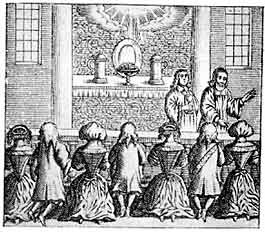
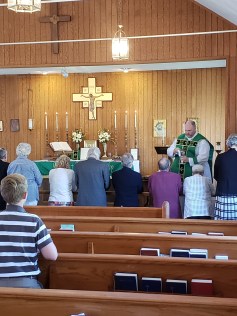
Yesterday… Today… and Tomorrow!
With familiar worship
The Book of Common Prayer and Anglican worship is familiar to you as well. Its phrases and terms have become almost as important in the English language as the King James Bible (and that version too is read from every Sunday by Anglican Catholics). “To have and to hold . . . for better for worse, for richer for poorer, in sickness and in health . . .,” “Erred and strayed,” “Ashes to ashes, Dust to dust,” “We commit his body to the deep,” “Here endeth the lesson,” all these are from the Book of Common Prayer. Anglican hymns like Amazing Grace or O Come, O Come Emmanuel mark the times and seasons in your life. They are a common cultural heritage and it is no surprise that the words are like old friends. Many denominations in the 20th century borrowed heavily from the Prayer Book in their worship services – the Presbyterian Book of Common Worship (1947), The Methodist Book of Worship (1964), The Lutheran Common Service Book (1917) – to name just a few. It is also admired by many Nazarene pastors and has been used for teaching purposes at their seminary in Kansas City over the years. Some have remarked in surprise after visiting that they grew up practically worshiping with the Book of Common Prayer and never knew it!
What is “Evangelical Catholic”? The term “Evangelical Catholic” dates back to William Augustus Muhlenberg (1796-1877). He was the great grandson of Henry Melchior Muhlenberg, the “Father of American Lutheranism”, and grandson of Frederick Muhlenberg, a minister, as well as a minor Founding Father of the United States. William Augustus’ great uncle, therefore, was Peter Muhlenberg, an Anglican priest serving a Lutheran-Anglican congregation in Woodstock, Virginia. It was Peter Muhlenberg who preached there at the outset of the American Revolution that there was a time for peace and a time for war, then taking off his clerical gown, and revealing a Continental Army Colonel’s uniform underneath. William Augustus was raised in the Episcopal Church, ordained therein, and was an important figure in the 19th century Church, ministering in Pennsylvania and New York. William Augustus wrote concerning Anglicanism, “our Church is both Catholic and Evangelic – Catholic in adhering to the ancient documents of the faith; Evangelic in requiring the faith of the heart and immediately in Christ.”
Does your congregation hold to the 39 Articles of Religion? That is a bit like asking if we hold to the Bible! We uphold the Bible as Christians and we uphold the Articles of Religion as Anglicans, definitely. Yet the minute we investigate further, things get complicated very quickly concerning both the Bible and the Articles. Why? Because the Bible (and the Articles) require a hermeneutic, a principle of interpretation. For the Bible, one sound method is the “historical-grammatical method” which looks at the author’s own intent, given the original language and original historical circumstances. This is a very conservative hermeneutic which safeguards the inerrancy of Holy Scripture. We safeguard this! The same method can be used towards the Articles of Religion, and by that method requires us to look at the specific circumstances surrounding the writing of the Articles of Religion, rather than later circumstances and concerns. (Looking at later issues to interpret an earlier document leads to a progressive or “open” reading, rather than a conservative one.) The Articles, unlike Scripture, are not self-interpreting (the less clear verses explained by more clear verses). Instead, the Articles require outside information as the key to interpreting them. Specifically, the Articles respond to particular, not general, late Medieval abuses in faith and practice. Methodical in a similar way, the Anglican Catholic Church applies a very conservative lens of interpretation through the Affirmation of St. Louis, by which first Scripture itself, then Church Fathers and early Councils of the Church, provide the foundation of our study of both Scripture and the Articles.
Indeed, many Anglicans who more explicitly endorse the Articles than we do, arguably, have some difficulty squaring their modern practices with the Articles that they profess. For example, within a “three streams” understanding of Anglicanism in which she is Catholic, Evangelical and Charismatic, the charismatic part should be asked for an explanation how some neo-Pentecostal practices therein relate to historic Anglicanism. For example, “speaking in tongues” is not, on the surface, consistent with the Article 24, “IT is a thing plainly repugnant to the Word of God, and the custom of the Primitive Church, to have publick Prayer in the Church, or to minister the Sacraments in a tongue not understanded of the people.” Speaking in tongues in the Pentecostal/Charismatic tradition, at face value, is in contradiction with this Article as much, if not more so, than the Anglican Catholic contention that there are Seven Sacraments (2 Gospel/Dominical and 5 minor) rather than Two (and only Two), according to a “face value”, uncritical, reading of Article 25.
The fact is that the Articles of Religion, while a monolithic confessional document within Anglicanism, is not the sine qua non of Anglicanism (and was only intended for subscription by ministers, officials, students and teachers, not common laity, as a teaching standard and legal contract made with the English Church and State by ministers of both Church and State). For instance, The Church of Ireland, from the time of the Reformation has been “Anglican” but had their own Irish Articles of 1615 (more Reformed). The Scottish Episcopal Church, clearly of the Anglican tradition, did not subscribe to the Articles of Religion until the early 19th century, rather treasuring the Articles of Perth of 1618 (more Catholic)! The Protestant Episcopal Church in the USA never required subscription to them by her clergy; they were always “historical documents” since the time of American Independence, and it is a recent American phenomenon, amongst groups severing themselves from the mainline Episcopal Church, that the Articles have taken on a “Confessional” status for particular Anglican jurisdictions operating in the United States. Just like the Book of Concord amongst the Lutherans, the Articles of Religion have contested value among even conservative groups calling themselves Anglican. Just like the Reformed churches, which have a variety of confessional documents (Scotch, Belgic, Heidelberg, Helvetic, Westminster) yet clearly one “Reformed” tradition, global Anglicans outside the Church of England can have a variation in binding documents. The Anglican Catholic Church upholds the Affirmation of St. Louis as the hermeneutical lens through which all other Anglican formularies are to be interpreted, and unapologetically proclaims that this document upholds the Vincentian Canon, the belief in “that which has been believed, at all time, everywhere, by all” far better than the all-too-often less careful reading of the Articles by a variety of well-meaning and pious Anglican thinkers and jurisdictions.
That being said, it can also be helpful to understand that what the Anglican Catholic Church teaches is more in keeping with earlier Anglican “Henrician” documents, namely, the Ten Articles (especially when read as a full document, not in a synopsis) and the King’s Book of 1543. In so far as the Anglican church “began” (and we proclaim vehemently that it did not “begin” with Henry VIII) she was definitely “Anglican” from 1534 onward, and indeed quite significantly reformed under Henry VIII, and thus the use of the Sarum Mass (which was in use under Henry VIII), with clarifications on Faith and Practice from the Henrician reformation documents, is just as “Anglican” as later (more continentally Calvinist) reforms.
What place do the Church Fathers hold in your church’s beliefs? It is said of the early reformer, Jan Hus, that he, following Wycliffe closely in some respects, advanced the idea that “[e]very Christian is bound to believe all the truth, direct or indirect, which the Holy Ghost has laid down in the Bible. The claims of the doctors of the Church [the Church Fathers] and the bulls of the pope are only to be attended to as far as they are based on Scriptures. The same thing is true concerning the authority of the Synods, Councils, and the teachings of the Church Fathers. Hus did not deny these, except in such cases where they did not harmonise with the Bible” (Jan Hus: Reformation in Bohemia). This is remarkably similar to statements within the Anglican tradition. For example, in the Preface of the first Book of Common Prayer published in 1549 the “ancient fathers” are referenced several times. For example, “[s]o that here you have an order of prayer (as touching the reading of holy scripture) much agreeable to the mind and purpose of the old fathers . . .” But more explicitly in the Reformatio Legum Ecclesiasticarum, “drawn up at the same time” as the Articles of Religion “and largely by the same men, contains the following commentary ‘Though we gladly give great honour to the Councils, especially those that are General, we judge that they ought to be placed far below the dignity of the canonical Scriptures: and we make a great distinction between the Councils themselves. . . . And we bear the same judgment about many others held afterwards, in which we see and confess that the most holy Fathers gave many weighty and holy decisions according to the Divine Scriptures, about the blessed and supreme Trinity, about Jesus Christ our Lord and Saviour, and the redemption of man obtained through Him. But we think that our faith ought not to be bound by them, except so far as they can be confirmed by Holy Scripture.’” (C.B. Moss, The Church of England and the Seventh Council, 1-2).
This is very much the context of the Anglican emphasis on Scripture, Tradition (including the writings of the Church Fathers helpful to the interpretation of the Scriptures), and Reason (our judgment through prayer that helps us in the interpretation of Scripture and Tradition). Thus we can quote Arthur Middleton in his Restoring the Anglican Mind (2008): “Scripture became the self-evident basis but because the Bible without the Church becomes a mere collection of ancient documents, Scriptural interpretation depends on the appeal to antiquity as mutually inclusive. Herein is maintained the Catholic notion of a perfect union between the Church and Scripture in that the Church’s authority is not distinct from that of Scripture but rather they are one. Anglican divinity has an ecclesial context in which the Church bears witness to the truth not by reminiscence or from the words of others, but from its own living, unceasing experience, from its Catholic fullness that has its roots in the Primitive Church. This appeal is not merely to history but to a charismatic principle, tradition, which together with Scripture contains the truth of divine revelation, a truth that lives in the Church. In this spirit Anglican divines looked to the Fathers as interpreters of Scripture. The 1571 Canons authorise preachers to preach nothing but what is found in Holy Scripture and what the ancient Fathers have collected from the same, ensuring that the interpretation of Scripture is consistent with what Christians have believed always, everywhere and by all” (45-46).
According to these words, one can identify carefully the right interpretation of Scripture in concert with the Church Fathers. And yet there can be outlying opinions evident in almost any individual Church Father, due no doubt to personal brilliance or a certain measure of eccentricity rather than to any malevolence. Such outlying opinions when they cannot be synthesized (found cohesive) with the Bible or with the Catholic Creeds or several other Church Fathers should probably simply be ignored as “outliers”.
Of course, this will naturally lead to some contentions as in most churches. It is not a methodology devoid of discord. But we may consider the words of Anthony Trollope’s character the Rev. Francis Arabin: “More scandal would fall on the church if there were no such contentions. We have but one way to avoid them – that of acknowledging a common head of our church, whose word on all points of doctrine shall be authoritative.” “Had it pleased God to vouchsafe to us such a church our path would have been easy. But easy paths have not been thought good for us.”
Still Curious? Scroll below or read
If you are from a Wesleyan, Methodist or Pentecostal background, your roots lie deep within Anglicanism. John and Charles Wesley, after all, were Anglicans. The Welsh Methodist revival, so influenced by the Anglican priest, George Whitfield, but led in many respects by great preachers such as Daniel Rowland, remained within the (Anglican) Church of Wales from its beginning in 1735 until 1811. Primitive Methodism in Ireland remained a steadfastly (Anglican) Church of Ireland movement for much of the 19th century. Similarities between Anglican Catholics and early Methodism can be read about here.
An important influence on both Methodism and later Anglo-Catholicism was the movement called the “Non-Juror” churches, in England and Scotland, which remains little known in America, but which existed from the late 17th century to the early 19th century before merging back into the Anglican Communion. One of the most remarkable of the Non-Jurors was the eccentric medical doctor and bishop, Thomas Deacon. His, no doubt, incorrigible and impulsive son, Thomas Theodorus, like many Non-Jurors (and the Wesley brothers own mother!), was a “Jacobite,” loyal to the Stewart line of succession to the Throne of England, Scotland and Ireland. The mere twenty-two year old, Thomas Theodorus, at his place of execution as a traitor to the Crown, made this noteworthy (if a bit idealistic) profession of Faith:
“I profess I die a member, not of the Church of Rome, nor yet of that of England, but of a pure episcopal church, which has reformed all the errors, corruptions, and defects, that have been introduced into the modern churches of Christendom: a church which is in perfect communion with the ancient and universal Church of Christ, by adhering uniformly to antiquity, universality, and consent: that glorious principle, which if once strictly and impartially pursued, would, and which alone can, remove all the distractions and unite all the divided members of the Christian Church. . . .”
When doing so, he very much summed up the goal and intention of those who profess themselves “Anglican Catholics” today.
How do you feel about other churches that are not Anglican? Charles Simeon (1759-1836), a great Anglican preacher wrote in his commentary on Galatians, “The Church of England [Anglicanism] has its rites, its forms, its ceremonies; but they are as few, and as simple, as can be imagined. Nor does she require them to be observed by any but her own members. Others, who judge them inexpedient, are left to adopt any other rites which in their minds and consciences they prefer . . . . Every society under heaven has rules established for its own government, and expects its members to conform to them ; else there would be nothing, in any society, but disorder and confusion. And the Church of England fitly requires this: and I hesitate not to say, that her members generally, and her ministers in particular, are bound in conscience to adhere to them. But, where a diversity of circumstances calls for a diversity of habits, there the rules, by which we were previously bound, are relaxed; and a difference of conduct may readily be admitted.”
Anglican and Catholic (Taken from the ACC website.)
The Anglican Catholic Church is worldwide body of Christians with churches in the United States, Canada, Great Britain, Australia, Africa, India, and South America. We are Anglican because our tradition of prayer and worship is rooted in the Church of England and its Book of Common Prayer. We are Catholic because we believe and practice the universal or catholic faith of the church.
The word “Catholic” is often understood in opposition to the word “Protestant.” However, this is both a recent and uniquely western perspective. In the ancient church, catholicism was understood to be the opposite of heresy, or false belief, and even today there are millions of Christians in Greece, Russia, and other parts of the world who consider themselves neither “Catholic” nor “Protestant,” but “Orthodox.”
During the sixteenth century, the Church of England sought to modify certain beliefs and practices that had developed over the centuries and appeared extraneous, unwise, or divergant from apostolic faith and practice. In doing so, the church did not abandon its catholicism; rather it engaged in a process of reform. As Bishop John Bramhall wrote in the seventeenth century, “our religion is the same it was, our Church the same it was…differing only from what they were formerly, as a garden weeded from a garden unweeded.”
Anglicanism, then, is best understood as a reformed catholic faith. Likewise, we believe that the church is in need of continual renewal and reformation. It must oppose the errors of every age in order to “contend earnestly for the faith which was once delivered to the saints” (Jude 1:3).
A Faithful Tradition
In recent years, a number of Anglican jurisdictions have moved away from this historic and apostolic faith. This is why in 1977 an international congress of nearly 2,000 Anglican bishops, clergy and lay people met in St. Louis, Missouri, to take the actions necessary to establish an orthodox jurisdiction in which traditional Anglicanism would be maintained.
Acting according to the principles determined by the seven great Ecumenical Councils of the ancient Church and adopting initially the name “Anglican Church of North America,” they placed themselves under the jurisdiction of the retired Episcopal bishop of Springfield, Illinois, the Right Reverend Albert Chambers. Bishop Chambers expanded that jurisdiction and devolved it upon others, by taking order for the consecration of four more bishops, and the Anglican Catholic Church was born.
 St. Peter's Anglican Catholic Church